Multiple Archaean gigantic impacts, perhaps beneficial to some early life

In March 1989 an asteroid half a kilometre across passed within 500 km of the Earth at a speed of 20 km s-1. Making some assumptions about its density, the kinetic energy of this near miss would have been around 4 x 10¹⁹ J: a million times more than Earth’s annual heat production and humanity’s annual energy use; and about half the power of detonating every thermonuclear device ever assembled. Had that small asteroid struck the Earth all this energy would have been delivered in a variety of forms to the Earth System in little more than a second – the time it would take to pass through the atmosphere. The founder of “astrogeology” and NASA’s principal geological advisor for the Apollo programme, the late Eugene Shoemaker, likened the scenario to a ‘small hill falling out of the sky’. (Read a summary of what would happen during such an asteroid strike).  But that would have been dwarfed by the 10 to 15 km impactor that resulted in the ~200 km wide Chicxulub crater and the K-Pg mass extinction 66 Ma ago. Evidence has been assembled for Earth having been struck during the Archaean around 3.6 billion years (Ga) ago by an asteroid 200 to 500 times larger: more like four Mount Everests ‘falling out of the sky’ (Drabon, N. et al. 2024. Effect of a giant meteorite impact on Paleoarchean surface environments and life. Proceedings of the National Academy of Sciences, v. 121, article e2408721121; DOI: 10.1073/pnas.2408721121

Impact debris layer in the Palaeoarchaean Barberton greenstone belt of South Africa, which contains altered glass spherules and fragments of older carbonaceous cherts. (Credit: Credit: Drabon, N. et al., Appendix Fig S2B)

In fact the Palaeoarchaean Era (3600 to 3200 Ma) was a time of multiple large impacts. Yet their recognition stems not from tangible craters but strata that contain once glassy spherules, condensed from vaporised rock, interbedded with sediments of Palaeoarchaean ‘greenstone belts’ in Australia and South Africa (see: Evidence builds for major impacts in Early Archaean; August 2002, and Impacts in the early Archaean; April 2014), some of which contain unearthly proportions of different chromium isotopes (see: Chromium isotopes and Archaean impacts; March 2003). Compared with the global few millimetres of spherules at the K-Pg boundary, the Barberton greenstone belt contains eight such beds up to 1.3 m thick in its 3.6 to 3.3 Ga stratigraphy. The thickest of these beds (S2) formed by an impact at around 3.26 Ga by an asteroid estimated to have had a mass 50 to 200 times that of the K-Pg impactor.

Above the S2 bed are carbonaceous cherts that contain carbon-isotope evidence of a boom in single-celled organisms with a metabolism that depended on iron and phosphorus rather than sunlight. The authors suggest that the tsunami triggered by impact would have stirred up soluble iron-2 from the deep ocean and washed in phosphorus from the exposed land surface, perhaps some having been delivered by the asteroid itself. No doubt such a huge impact would have veiled the Palaeoarchaean Earth with dust that reduced sunlight for years: inimical for photosynthesising bacteria but unlikely to pose a threat to chemo-autotrophs. An unusual feature of the S2 spherule bed is that it is capped by a layer of altered crystals whose shapes suggest they were originally sodium bicarbonate and calcium carbonate. They may represent flash-evaporation of up to tens of metres of ocean water as a result of the impact. Carbonates are less soluble than salt and more likely to crystallise during rapid evaporation of the ocean surface than would NaCl.   

Time line of possible events following a huge asteroid impact during the Palaeoarchaean. (Credit: Drabon, N. et al. Fig 8)

So it appears that early extraterrestrial bombardment in the early Archaean had the opposite effect to the Chicxulub impactor that devastated the highly evolved life of the late Mesozoic. Many repeats of such chaos during the Palaeoarchaean could well have given a major boost to some forms of early, chemo-autotrophic life, while destroying or setting back evolutionary attempts at photo-autotrophy.

See also: King, A. 2024. Meteorite 200 times larger than one that killed dinosaurs reset early life. Chemistry World 23 October 2024.

Newly discovered signs of Archaean giant impacts

It is barely credible that only two decades ago geoscientists who argued that extraterrestrial impacts had once had an important role in Earth history met with scorn from many of their peers; slightly mad, even bad and perhaps dangerous to know. Yet clear evidence for impacts has grown steadily, especially in the time before 2.5 billion years ago known as the Archaean (see EPN for March 2003 , April 2005, July 2012 , May 2014). Even in the 1990s, when it should have been clear from the golden years of lunar exploration that our neighbour had been battered at the outset of the Archaean, claims for terrestrial evidence of the tail-end of that cataclysmic event were eyed askance. Now, one of the pioneer researchers into the oldest terrestrial impacts, Don Lowe of Stanford University, California has, with two colleagues, reported finds of yet more impact-related spherule beds from the famous Archaean repository of the Barberton Mountains in South Africa (Lowe, D.R. et al. 2014. Recently discovered 3.42-3.23 Ga impact layers, Barberton Belt, South Africa: 3.8 Ga detrital zircons, Archaean impact history and tectonic implications. Geology, v. 42, p. 747-750).

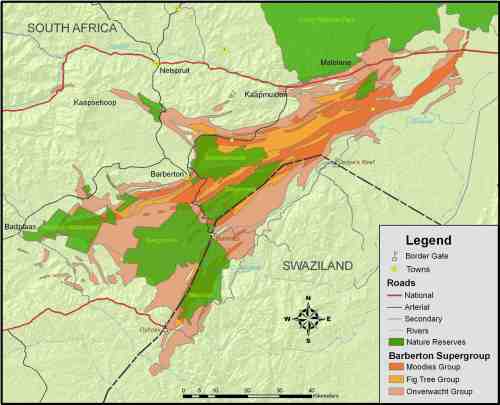
Barberton greenstone belt, South Africa (credit: Barberton World Heritage Site)

Like four other such layers at Barberton, those newly described contain several types of spherules, degraded to microcrystalline alteration products of the original glasses. Some of them contain clear evidence of originally molten droplets having welded together on deposition. Their contrasted geochemistry reveals target rocks ranging in composition from well-sorted quartz sands to intermediate, mafic and ultramafic igneous rocks. Some beds are overlain by chaotic deposits familiar from more recent times as products of tsunamis, with signs that the spherules themselves had been picked up and transported.

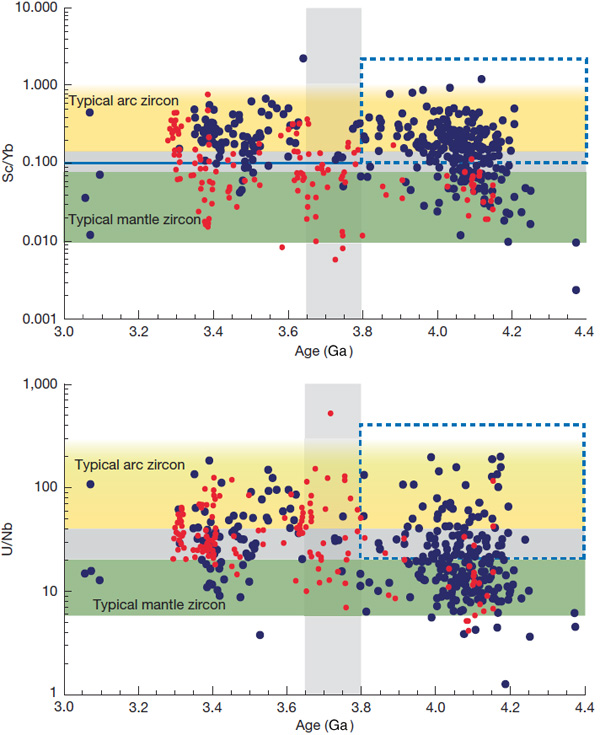
Dated by their stratigraphic relations to local felsic igneous rocks, the spherule beds arrived in pulses over a period of about 240 Ma between 3.42 to 3.23 Ga. Even more interesting, the overlying tsunami beds have yielded transported zircons that extend back to 3.8 Ga spanning the Archaean history of the Kaapvaal craton of which the Barberton greenstone belt rests and indeed that of many Eoarchaean cratons; the Earth’s oldest tangible continental crust. The zircons may reflect the depth to which the impacts penetrated, possibly the base of the continental crust. It isn’t easy to judge the size of the responsible impactors from the available evidence, but Lowe and colleagues suggest that they were much larger than that which closed the Mesozoic at the Cretaceous-Palaeogene boundary; perhaps of the order of 20-70 km across. So, although the late, heavy bombardment of the Moon seems to have closed at around 3.8 Ga, from evidence yielded by the Apollo programme, until at least half a billion years later large objects continued to hit the Earth more often than expected from the lunar record. Lowe has suggested that this tail-end of major bombardment on Earth may eventually have triggered the onset of plate tectonics as we know it now.

Impacts in the early Archaean

From the days when advocates of impacts by extraterrestrial objects as explanations of geological features were widely regarded as ‘whizz-bang artistes’ a great many hats have probably been eaten, albeit in closely guarded privacy. In 1986, when beds of glassy spherules similar to those found in lunar soil and in the K-T boundary sequence were reported from early Archaean greenstone belts in Australia and South Africa, and deduced to have formed by an impact, the authors, Donald Lowe of Stanford University, USA and colleagues, were pounced on by those who thought they could plausibly explain the very odd rocks by unremarkable, Earthly processes. Subsequent work on their geochemistry overwhelmingly supported their formation by an impact of a large carbonaceous chondrite asteroid. And at one site, the Barberton Mountain Land greenstone belt in northeastern South Africa, there was evidence for at least three such impacts formed in a 20 Ma period. In hindsight, given the lunar bombardment history that peaked between 4 and 3.8 Ga, early Archaean rocks were a great deal more likely to contain materials formed by giant impacts than less antiquated ones.

Barberton greenstone belt, South Africa (credit: Barberton World Heritage Site)

Lowe has been steadily working on his original idea since then, his enthusiasm drawing in others. The latest focus is on evidence for other likely consequences in the Archaean record of the vast power unleashed by incoming asteroids travelling at speeds around 15 km s-1 (Sleep, N.H. & Lowe, D.R. 2014. Physics of crustal fracturing and chertdike formation triggered by asteroid impact, ~3.26 Ga, Barbertongreenstone belt, South Africa. Geochemistry, Geophysics, Geosystems, v. 15, doi:10.1002/2014GC005229). The damage at Barberton not only produced spherule beds but opened fractures on the shallow sea bed into which liquefied sediments, including some spherules, were injected. These swarms of up to 10 m wide cherty dykes extend up to 100 m below what was then the sea floor strewn with impact spherules, and contain evidence of successive pulses of sediment injection.

Sleep and Lowe explain these dyke swarms as fractures caused by seismicity associated with a major impact. Their complexity suggests extreme shaking for upwards of 100 seconds; far longer than that from large, tectonic earthquakes. The fact that cracks opened to accommodate the sedimentary dykes indicates extension of the affected crust, which the authors suggest resulted from gravitational sliding of the shocked surface sediments down a gentle slope. Possibly the sediments, including the direct products of impact, the spherules, were swept into the cracks by currents associated with tsunamis induced by the impact.

Interestingly, the spherules and dykes formed upon crust largely formed of mafic to ultramafic lavas, yet volcanism following close on the heels of the impact event was of felsic composition. Did the impact trigger a shift locally from oceanic magmatism to that characteristic of island arcs; that is, did it start a new subduction zone?

Enhanced by Zemanta