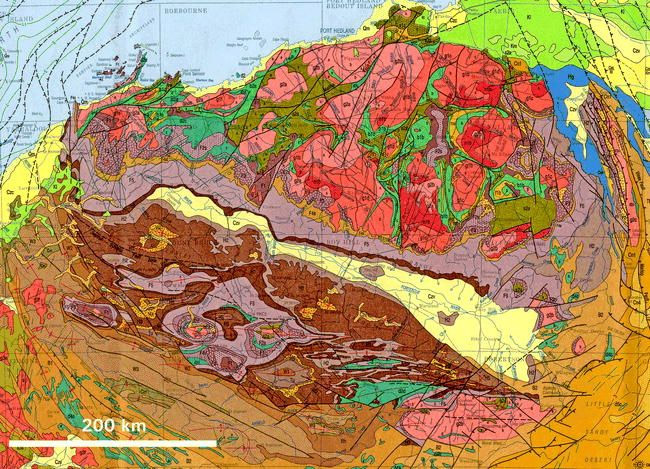
Sagduction of greenstone belts and formation of Archaean continental crust

Simplified geological map of the Archaean Yilgarn Craton in Western Australia. Credit: Geological Survey of Western Australia

Every ancient craton seen from space shows patterns that are unique to Archaean continental crust: elongated, ‘canoe-shaped’ greenstone belts enveloped by granitic gneisses, both of which are punctured by domes of younger, less deformed granites. The Yilgarn Craton of Western Australia is a typical granite-greenstone terrain. Greenstone belts contain lavas of ultramafic, basaltic and andesitic compositions, which in undeformed settings show the typical pillow structures formed by submarine volcanic extrusion. There are also layered mafic to ultramafic complexes, formed by fractional crystallisation, minor sedimentary sequences and occasionally more felsic lavas and ashes. The enveloping grey gneisses are dominantly highly deformed tonalite-trondhjemite-granodiorite (TTG) composition that suggest that they formed from large volumes of sodium-rich, silicic magmas, probably generated at depth by partial melting of hydrated basaltic rocks.

The heat producing radioactive isotopes of potassium, uranium and thorium in both the Archaean mantle and crust would have been more abundant before 2.5 Ga ago, because they decay over time. Consequently the Earth’s interior would have then generated more heat than now, gradually to escape by thermal conduction towards the cooler surface. The presence of pillow lavas and detrital sediments in greenstone belts indicate that surface temperatures during the Archaean Eon were below the boiling point of water; in fact probably much the same as in the tropics at present. Indeed there is evidence that Earth was then a water world. It may even have been so during the Hadean, as revealed by the oxygen-isotope data in 4.4 Ga zircon grains. The broad conclusion from such findings is that the Archaean geothermal gradient was much steeper; there would have been a greater temperature increase with depth than now and new crust would have cooled more slowly. Subduction of cool lithosphere would have been less likely than in later times, especially as higher mantle heat production would have generated new crust more quickly. Another likely possibility is that far more heat would have been moved by convection: there would have been more mantle-penetrating plumes and they would have been larger. Large mantle plumes of the Phanerozoic have generated vast ocean floor plateaus, such as the Kerguelen and Ontong Java Plateau.

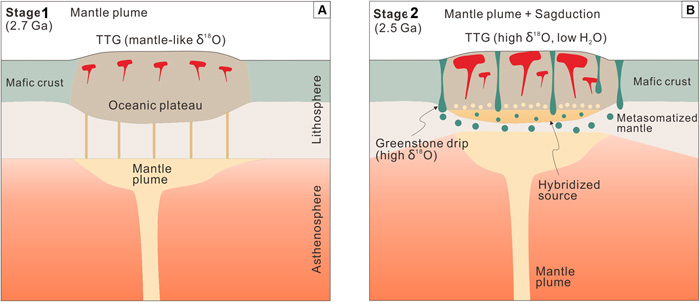
A group of geoscience researchers at The University of Hong Kong and international colleagues recently completed a geological and geochemical study of the North China Craton, analysing their data in the light of recently emerging views on Archaean processes (Dingyi Zhao et al, A two-stage mantle plume-sagduction origin of Archean continental crust revealed by water and oxygen isotopes of TTGs, Science Advances, v. 11, article eadr9513  ; DOI: 10.1126/sciadv.adr9513).They found compelling evidence that ~2.5 Ga-old Neoarchaean TTG gneisses in the North China granite-greenstone terrain formed by partial melting of an earlier mafic-ultramafic greenstone crust with high water content. They consider this to support a two-stage model for the generation of the North China Craton’s crust above a vast mantle plume. The first stage at around 2.7 Ga was the arrival of the plume at the base of the lithosphere, which partially melted as a result of the decompression of the rising ultramafic plume. The resulting mafic magma created an oceanic plateau partly by underplating the older lithosphere, intruding it and erupting onto the older ocean floor. This created the precursors of the craton’s greenstones, the upper part of which interacted directly with seawater to become hydrothermally altered. They underwent minor partial melting to produce small TTG intrusions. A second plume arriving at ~2.5 Ga resulted in sinking of the greenstones under their own weight to mix or ‘hybridise’ with the re-heated lower crust. This caused the greenstones substantially to partially melt and so generate voluminous TTG magmas that rose as the greenstones subsided. . It seems likely that this dynamic, hot environment deformed the TTGs as they rose to create the grey gneisses so typical of Archaean granite-greenstone terranes. [Note: The key evidence for Dingyi Zhao et al.’s conclusions is that the two TTG pulses yielded the 2.7 and 2.5 Ga ages, and show significantly different oxygen isotope data (δ18O)].

Two stages of TTG gneiss formation in the North China Craton and the sinking (sagduction) of greenstone belts in the second phase. Credit: Dingyi Zhao et al., Fig 4)

Such a petrogenetic scenario, termed sagduction by Dingyi Zhao and colleagues, also helps explain the unique keel-like nature of greenstone belts, and abundant evidence of vertical tectonics in many Archaean terrains (see: Vertical tectonics and formation of Archaean crust; January 2002), Their model is not entirely new, but is better supported by data than earlier, more speculative ideas. That such processes have been recognised in the Neoarchaean – the North China Craton is one of the youngest granite-greenstone terrains – may well apply to far older Archaean continental crust generation. It is perhaps the last of a series of such events that began in the Hadean, as summarised in the previous Earth-logs post.

The world’s oldest crust in the Nuvvuagittuq Greenstone Belt, Quebec

Since 1999, the rocks generally acknowledged to be the oldest on Earth were part of the Acasta gneisses in the Slave Craton in Canada’s Northwest Territories; specifically the Idiwhaa tonalitic gneisses. Zircons extracted from that unit yielded an age of 4.02 billion years (Ga) using U-Pb radimetric dating, revealing the time of their crystallisation from granitic magma. But nine years later some metabasaltic rocks from the tiny (20 km2) Nuvvuagittuq Greenstone Belt on the eastern shore of Hudson Bay were dated using the Sm-Nd method at almost 4.3 Ga (see: At last, 4.0 Ga barrier broken; November 2008). Taken at face value the metabasaltic rocks seemed to be well within the Hadean Eon (4.6 to 4.0 Ga) and could thus represent primary crust of that antiquity. However, U-Pb dating of zircons from thin sodium-rich granitic rocks (trondhjemites) that intrude them yielded ages no older than about 3.8 Ga. Similar ages emerged from zircons found in metasediments interleaved in the dominant mafic unit. Discrepancies between the two completely different dating methods resulted in the Hadean antiquity of the mafic rocks having been disputed since 2008. It was possible that the Sm-Nd results from the metabasalts may have resulted from the original mafic magmas having inherited a Hadean Sm-Nd isotopic ‘signature’ from their mantle source. That is, they may have been contaminated and could have formed in the early Archaean.

Glacially smoothed outcrops near Inukjuak, Quebec that reveals rocks of the Nuvvuagittuq Greenstone Belt. Credit: Jonathan O’Neil, University of Ottawa

Jonathan O’Neil, now at Ottawa University in Canada, led the first isotopic investigation of the Nuvvuagittuq Greenstone Belt and has engaged in research there ever since. Further field and laboratory studies revealed that the previously dated mafic rocks had been intruded by large, chemically differentiated gabbro sills. A team of geochemists from the University of Ottawa and Carleton University, including O’Neil, has now published isotopic evidence from the intrusions that suggests a Hadean age for their parent magma (C. Sole et al. 2025. Evidence for Hadean mafic intrusions in the Nuvvuagittuq Greenstone Belt, CanadaScience, v. 388, p. 1431-1435. DOI: 10.1126/science.ads8461). The authors used the decay schemes of two radioactive samarium isotopes 147Sm and 146Sm; a significant advance in radiometric dating. The first decays to 143Nd with a half-life of about 1011 years, the second to 142Nd with a much shorter half life of about 108 years. Due to its more rapid decay, in geological terms,146Sm is now much rarer than 147Sm. Consequently, using the short-lived 146Sm-142Nd decay system is technically more difficult than that of the 147Sm-143Nd system. But the team managed to get good results from both the ‘fast’ and the ‘slow’ decay schemes. They tally nicely, yielding ages of 4157 and 4196 Ma.  The gabbros provide a minimum age for the metabasalts that they cut through. The original 4.3 Ga Sm-Nd date for the metabasalts is thus plausible. Sole and colleagues consider the dominant metabasaltic rocks to have formed a primary crust in late Hadean times that was invaded by later mantle-derived mafic magma about 100 Ma later. The granitic rocks that constitute about one third of the Nuvvuagittuq terrain seem to have been generated by partial melting more than 300 Ma later still, during the Palaeoarchaean.

Perhaps similar techniques will now be deployed in granite-greenstone terrains in other cratons. Many of the older ones, generally designated as Palaeoarchaean in age, also contain abundant metamorphosed mafic and ultramafic igneous rocks. Perhaps their origin was akin to those of Nuvvuagittuq; i.e. more Hadean crust may await unmasking. Meanwhile, there seems to be more to discover from Nuvvuagittuq. For instance, some of the rocks suggested to be metasediments interleaved in the metabasalts show intricate banding that resembles products of bacterial mat accumulation in younger terrains. Signs of Hadean life?

Since the first reliable radiometric dating of Archaean rocks in 1971, there has been an element of competition to date the oldest rocks on Earth: to push history back towards the initial formation of the Earth. It is one of the most disputatious branches of Earth history. Rivalry may play a significant part in driving the science, as well as the development of novel dating techniques and the continuing discovery of clearly old relationships using ‘old-fashioned’ relative dating, such as signs of intrusion, unconformities etcetera. But in some cases there is a darker side: the potential for profit. Recently, samples from Nuvvuagittuq appeared for sale on the Internet, priced at $10,000. They may have been collected under the guise of supplying museums by a group that shipped-in mechanical excavators in 2016. Unsurprisingly this angered the local Innuit community of Inukjuak. They were also worried about bona fide collection for scientific research that had left parts of the small, once pristine area somewhat battered, including cultural features such as an inukshuk navigational monument. Their fury at commercial exploitation of their homeland resulted in the community council closing the area to collecting in 2024. I emphasise that this violation of basic geological ethics was by commercial rock collectors and dealers, not academic geologists. The local people are now considering careful issue of research permits so that important research can continue. But further rock collecting may remain banned.

See also: New Research Verifies Northern Canada Hosts Earth’s Oldest Rocks. Scienmag, 26 June 2025; Gramling, C. 2025. Earth’s oldest rocks may be at least 4.16 billion years old. ScienceNews.

PS With many thanks to ‘Piso Mojado’ for alerting me to this paper

How the earliest continental crust may have formed

Detrital zircon grains extracted from sandstones deposited ~3 billion year (Ga) ago in Western Australia yield the ages at which these grains crystallised. The oldest formed at about 4.4 Ga; only 150 Ma after the origin of the Earth (4.55 Ga). Various lines of evidence suggest that they originally crystallized from magmas with roughly andesitic compositions, which some geochemists suggest to have formed the first continental crust (see: Zircons and early continents no longer to be sneezed at; February 2006). So far, no actual rocks of that age and composition have come to light. The oldest of these zircon grains also contain anomalously high levels of 18O, a sign that water played a role in the formation of these silicic magmas. Modern andesitic magmas – ultimately the source of most continental crust – typically form above steeply-dipping subduction zones where fluids expelled from descending oceanic crust encourage partial melting of the overriding lithospheric mantle. Higher radiogenic heat production in the Hadean and the early Archaean would probably have ensured that the increased density of later oceanic lithosphere needed for steep subduction could not have been achieved. If subduction occurred at all, it would have been at a shallow angle and unable to exert the slab-pull force that perpetuated plate tectonics in later times (see: Formation of continents without subduction, March, 2017).

Landsat image mosaic of the Palaeoarchaean granite-greenstone terrain of the Pilbara Craton, Western Australia. Granite bodies show as pale blobs, the volcanic and sedimentary greenstone belts in shades of grey.

Geoscientists have been trying to resolve this paradox for quite a while. Now a group from Australia, Germany and Austria have made what seems to be an important advance (Hartnady, M. I. H and 8 others 2025. Incipient continent formation by shallow melting of an altered mafic protocrust. Nature Communications, v. 16, article 4557; DOI: 10.1038/s41467-025-59075-9). It emerged from their geochemical studies of rocks in the Pilbara Craton of Western Australia that are about a billion years younger than the aforementioned ancient zircon grains. These are high-grade Palaeoarchaean metamorphic rocks known as migmatites that lie beneath lower-grade ‘granite-greenstone’ terrains that dominate the Craton, which Proterozoic deformation has forced to the surface. Their bulk composition is that of basalt which has been converted to amphibolite by high temperature, low pressure metamorphism (680 to 730°C at a depth of about 30 km). These metabasic rocks are laced with irregular streaks and patches of pale coloured rock made up mainly of sodium-rich feldspar and quartz, some of which cut across the foliation of the amphibolites. The authors interpret these as products of partial melting during metamorphism, and they show signs of having crystallised from a water-rich magma; i.e. their parental basaltic crust had been hydrothermally altered, probably by seawater soon after it formed. The composition of the melt rocks is that of trondhjemite, one of the most common types of granite found in Archaean continental crust. Interestingly, small amounts of trondhjemite are found in modern oceanic crust and ophiolites.

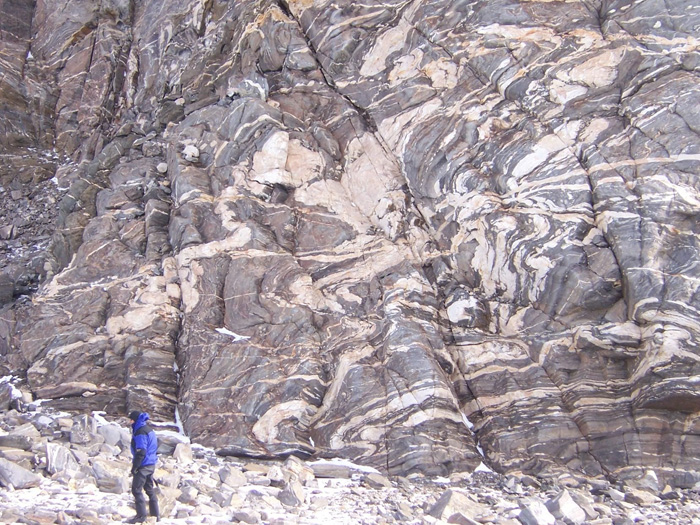
A typical migmatite from Antarctica showing dark amphibolites laced with quartzofeldspathic products of partial melting. Credit: Lunar and Planetary Laboratory, University of Arizona

The authors radiometrically dated zircon and titanite (CaTiSiO₅) – otherwise known as sphene – in the trondhjemites, to give an age of 3565 Ma. The metamorphism and partial melting took place around 30 Ma before the overlying granite-greenstone assemblages formed. They regard the amphibolites as the Palaeoarchaean equivalent of basaltic oceanic crust. Under the higher heat production of the time such primary crust would probably have approached the thickness of that at modern oceanic plateaux, such as Iceland and Ontong-Java, that formed above large mantle plumes. Michael Hartnady and colleagues surmise that this intracrustal partial melting formed a nucleus on which the Pilbara granite-greenstone terrain formed as the oldest substantial component of the Australian continent. The same nucleation may have occurred during the formation of similar early Archaean terrains that form the cores of most cratons that occur in all modern continents.

The prospect of climate chaos following major volcano eruptions

It hardly needs saying that volcanoes present a major hazard to people living in close proximity. The inhabitants of the Roman cities of Herculaneum and Pompeii in the shadow of Vesuvius were snuffed out by an incandescent pyroclastic during the 79 CE eruption of the volcano. Since December 2023 long-lasting eruptions from the Sundhnúksgígar crater row on the Reykjanes Penisula of Iceland have driven the inhabitants of nearby Grindavík from their homes, but no injuries or fatalities have been reported. Far worse was the 1815 eruption of Tambora on Sumbawa, Indonesia, when at least 71,000 people perished. But that event had much wider consequences, which lasted into 1817 at least. As well as an ash cloud the huge plume from Tambora injected 28 million tons of sulfur dioxide into the stratosphere. In the form of sulfuric acid aerosols, this reflected so much solar energy back into space that the Northern Hemisphere cooled by 1° C, making 1816 ‘the year without a summer’. Crop failures in Europe and North America doubled grain prices, leading to widespread social unrest and economic depression. That year also saw unusual weather in India culminate in a cholera outbreak, which spread to unleash the 1817 global pandemic. Tambora is implicated in a global death toll in the tens of millions. Thanks to the record of sulfur in Greenland ice cores it has proved possible to link past volcanic action to historic famines and epidemics, such as the Plague of Justinian in 541 CE. If they emit large amounts of sulfur gases volcanic eruptions can result in sudden global climatic downturns.

The ash plume towering above Pinatubo volcano in the Philippines on 12 June 1991, which rose to 40 km (Credit: Karin Jackson U.S. Air Force)

With this in mind Markus Stoffel, Christophe Corona and Scott St. George of the University of Geneva, Switzerland, CNRS, Grenoble France and global insurance brokers WTW, London, respectively, have published a Comment in Nature warning of this kind of global hazard (Stoffel, M., Corona, C. & St. George, S. 2024.  The next massive volcano eruption will cause climate chaos — we are unprepared. Nature v. 635, p. 286-289; DOI: 10.1038/d41586-024-03680-z). The crux of their argument is that there has been nothing approaching the scale of Tambora for the last two centuries. The 1991 eruption of Pinatubo fed the stratosphere with just over a quarter of Tambora’s complement of SO2, and decreased global temperatures by around 0.6°C during 1991-2. Should one so-called Decade Volcanoes – those located in densely populated areas, such as Vesuvius – erupt within the next five years actuaries at Lloyd’s of London estimate economic impacts of US$ 3 trillion in the first year and US$1.5 trillion over the following years. But that is based on just the local risk of ash falls, lava and pyroclastic flows, mud slides and lateral collapse, not global climatic effects. So, a Tambora-sized or larger event is not countenanced by the world’s most famous insurance underwriter: probably because its economic impact is incalculable. Yet the chances of such a repeat certainly are conceivable. A 60 ka record of sulfate in the Greenland ice cores allows the probability of eruptions on the scale of Tambora to be estimated. The data suggest that there is a one-in-six chance that one will occur somewhere during the 21st century, but not necessarily at a site judged by volcanologists to be precarious . Nobody expected the eruption from the Pacific Ocean floor of the Hunga Tonga-Hunga Ha’apai volcano on January 15, 2022: the largest in the last 30 years.

The authors insist that climate-changing eruptions now need to be viewed in the context of anthropogenic global warming. Superficially, it might seem that a few volcanic winters and years without a summer could be a welcome, albeit short-term, solution. However, Stoffel, Corona and St. George suggest that the interaction of a volcano-induced global cooling with climatic processes would probably be very complex. Global warming heats the lower atmosphere and cools the stratosphere. Such steady changes will affect the height to which explosive volcanic plumes may reach. Atmospheric circulation patterns are changing dramatically as the weather of 2024 seems to show. The same may be said for ocean currents that are changing as sea-surface temperatures increase. Superimposing volcano-induced cooling of the sea surface adds an element of chaos to what is already worrying. What if a volcanic winter coincided with an el Niño event? The Intergovernmental Panel on Climate Change that projects climate changes is ‘flying blind’ as regards volcanic cooling. Another issue is that our knowledge of the effects in 1815 of Tambora concerned a very different world from ours: a global population then that was eight times smaller than now; very different patterns of agriculture and habitation; a world with industrial production on a tiny proportion of the continental surface. Stoffel, Corona and St. George urge the IPCC to shed light on this major blind spot. Climate modellers need to explore the truly worst-case scenarios since a massive volcanic eruption is bound to happen one day. Unlike global warming from greenhouse-gas emission, there is absolutely nothing that can be done to avert another Tambora.

The onset of weathering in the late Archaean and stabilisation of the continents

Distribution of exposed Archaean cratons. The blue Proterozoic areas may, in part be underlain by cratons. (Credit: Groves, D.I. & Santosh, M. DOI:10.1016/j.gr.2020.06.008)

About 50% of continental crust is of Archaean age (2.5 to 4.0 Ga) in huge blocks above lithosphere more than 150 km thick. Younger continental lithosphere is significantly thinner – as low as 40 km. Since the end of the Archaean Eon these blocks have remained tectonically stable and only show signs of extensional, brittle fracture that have been exploited by basaltic dyke swarms. Such crystalline monstrosities have remained rigid for 2.5 billion years. They are termed cratons from the Greek word κράτο (kratos) for ‘might’ or ‘strength’. Numbers of cratons have been pushed together by later tectonics to form continental ‘cores’, separated from one another by highly deformed ‘mobile belts’ formed by younger collisional orogenies. Africa and South America have 4 cratons each, Eurasia 6 or 7, the other continents all have one

Considering how much cratons have been stressed by later tectonic forces, their implacable rigidity might seem surprising. This rigidity is thought to be due to cratons’ unusually low amounts of the main heat-producing elements (HPE) potassium, uranium and thorium, the decay of whose radioactive isotopes produces surface heat flow. Cratons have the lowest surface heat flow on the planet, so in bulk they must have low HPE content. This stems from the nature of cratons’ deepest parts: almost anhydrous, once igneous rocks of intermediate average composition known as granulites. They formed by metamorphism of earlier crustal rocks at depths of up to 70km, which drove out most of their original HPEs and water. The upper cratonic crust has much the same complement of HPEs as that of more recent continental crust. This bulk depletion of cratons has maintained unusually low temperatures in their deep continental crust. That has been immune from partial melting and thus ductile deformation since it formed.

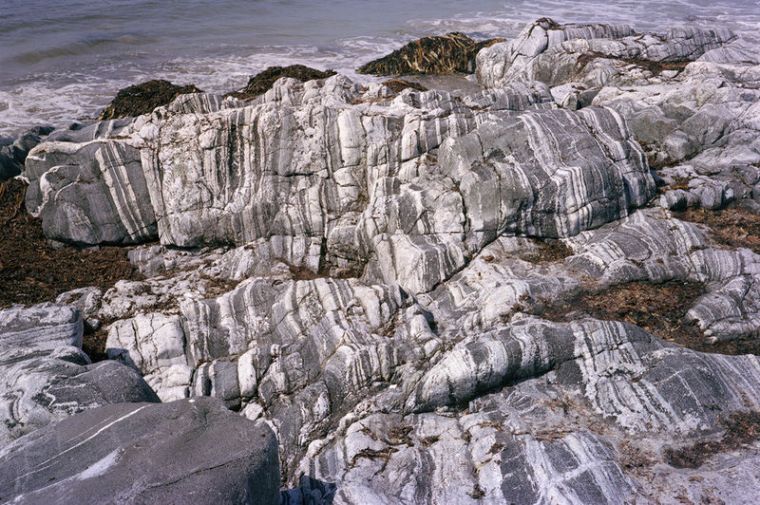
Three billion year-old TTG gneiss in the Outer Hebrides, Scotland. (Credit: British Geological Survey)

Jesse Reimink and Andrew Smye of Pennsylvania State University, USA have considered the geochemistry and history of the world’s cratons to address the long-standing issue of their stability and longevity (Reimink, J.R. & Smye, A.J. 2024. Subaerial weathering drove stabilization of continents. Nature, v. 629, online article; DOI: 10.1038/s41586-024-07307-1). Their main focus is on how the Archaean lower crust lost most of it HPEs, and where they went. During much of the Archaean continental crust formed by partial melting of hydrated basaltic rocks at shallow depths. That generated sodium-rich silicic magmas from which the dominant grey tonalite-trondhjemite-granodiorite (TTG) gneisses of Archaean crust formed by extreme ductile deformation. Though TTGs originally contained sufficient heat-producing capacity to make them ductile during the early Archaean there is little evidence that they underwent extensive partial melting themselves. But they did after 3.0 Ga to produce swarms of granite plutons in the upper Archaean crust.

Complementing the late-Archaean granite ‘swarm’ are deep-crustal granulites with low HPE contents, which mainly formed around the same time. The granulites contain highly metamorphosed sedimentary rocks, which seem to have been sliced into the Archaean crust during its ductile deformation phase. Some of them have compositions that suggest that they are derived from clay-rich shales, their proportion reaching about 30% of all granulite-facies metasediments. Clay minerals are the products of chemical weathering of silicon- and aluminium-rich igneous rocks exposed to the atmosphere. When they form, they host K, U and Th. Also, their composition and high initial water contents are conducive to partial melting under high-temperature conditions, to become a source of granitic magmas. Crustal weathering is key to Reimink and Smye’s hypothesis for the development of cratons in the late Archaean.

There is growing evidence that high Archaean heat flow through oceanic lithosphere – the mantle contained more undecayed HPE isotopes than now – reduced its density. As a result Archaean oceanic basins were considerably shallower than they became in later times. Because of the lower volume of the basins during the Archaean, seawater extended across much of the continental surface. For most of the Archaean Eon Earth was a ‘waterworld’, with little subaerial weathering of its TTG upper crust. As the volume of exposed continental crust increased so did surface weathering to form clay minerals that selectively absorbed HPEs. Over time shales became tectonically incorporated deep into the thickening Archaean continental crust to form a zone with increased heat producing capacity and a higher water content. Once deep enough and heated by their own content of HPE they began partially melting to yield voluminous granitic magmas to which they contributed their load of HPEs. Being lower in density than the bulk of TTG crust the granite melts would have risen to reach the upper crust. They also took in HPEs from the deep TTG crust itself. According to Reimink and Smye this would have concentrated continental heat production in the upper crust, leaving the deeper crust drier, less able to melt and assume ductile properties, and thus to create the cratons.

The authors believe that such a redistribution of heat production in the ancient continental crust did not need any major change in global tectonics. All it required was decreasing oceanic heat flow to create deeper and more voluminous ocean basins, allowing more continental surface to emerge above sea level and dynamic burial of sedimentary products of subaerial weathering. They conclude: “The geological record can then be cast in terms of a pre-emergence (TTG-dominated) and post-emergence (granite-dominated) planet.” That seems very neat … but it seems unlikely that samples can be drilled from the depths where the ‘action’ took place. Geologists depend on exposures of Archaean middle to deep crust brought to the surface by fortuitous later tectonics.

Repeated climate and ecological stress during the run-up to the K-Pg extinction

The Cretaceous-Palaeogene mass extinction is no longer an event that polarises geologists’ views between a slow volcanic driver (The Deccan large igneous province) and a near instantaneous asteroid impact (Chicxulub). There is now a broad consensus that both processes were involved in weakening the Late Cretaceous biosphere and snuffing out much of it around 66 Ma ago. Yet is still no closure as regards the details. From a palaeontologist’s standpoint the die-off varied dramatically between major groups of animals. For instance, the non-avian dinosaurs disappeared completely while those that evolved to modern birds did not. Crocodiles came through it largely unscathed unlike aquatic dinosaurs. In the seas those animals that lived in the water column, such as ammonites, were far more affected than were denizens of the seafloor. But much the same final devastation was visited on every continent and ocean. However, lesser and more restricted extinctions occurred before the Chicxulub impact.

Scientists from Norway, Canada, the US, Italy, the UK and Sweden have now thrown light on the possibility that climate change during the last half-million years of the Cretaceous may have been eroding biodiversity and disrupting ecosystems (Callegaro, S. et al. 2023. Recurring volcanic winters during the latest Cretaceous: Sulfur and fluorine budgets of Deccan Traps lavas. Science Advances, v. 9, article eadg8284; DOI: 10.1126/sciadv.adg8284). Almost inevitably, they turned to the record of Deccan volcanism that overlapped the K-Pg event, specifically the likely composition of the gases that the magmas may have belched into the atmosphere. Instead of choosing the usual suspect carbon dioxide and its greenhouse effect, their focus was on sulfur and fluorine dissolved in pyroxene grains from 15 basalts erupted in the 10 Formations of the Deccan flood-basalt sequence. From these analyses they were able to estimate the amounts of the two elements in the magma erupted in each of these 10 phases.

Exposed section through a small part of the Deccan Traps in the Western Ghats of Maharashtra, India. (Credit: Gerta Keller, Princeton University)

The accompanying image of a famous section through the Deccan Traps SE of Mumbai clearly shows that 15 sampled flows could reveal only a fraction of the magmas’ variability: there are 12 flows in the foreground alone. The mountain beyond shows that the pale-coloured sequence is underlain by many more flows, and the full Deccan sequence is about 3.5 km thick. Clearly, flood-basalt volcanism is in no way continuous, but builds up from repeated lava flows that can be as much as 50 m thick. Each of them is capped by a red, clay-rich soil or bole – from the Greek word bolos (βόλος) meaning ‘clod of earth’. Weathering of basalt would have taken a few centuries to form each bole. Individual Deccan flows extend over enormous areas: one can be traced for 1500 km. At the end of volcanism the pile extended over roughly 1.5 million km2 to reach a volume of half a million km3.

Fluorine is a particularly toxic gas with horrific effects on organisms that ingest it. In the form of hydrofluoric acid (HF) – routinely used to dissolve rock – it penetrates tissue very rapidly to react with calcium in the blood to form calcium fluoride. This causes very severe pain, bone damage and other symptoms of skeletal fluorosis. The 1783-4 eruption of the Laki volcanic fissure in Iceland emitted an estimated 8,000 t of HF gas that wiped out more than half the domestic animals as a result of their eating contaminated grass. The famine that followed the eruption killed 20 to 25% of Iceland’s people: exhumed human skeletons buried in the aftermath show the distinctive signs of endemic skeletal fluorosis. This small flood-basalt event had global repercussions, as the Wikipedia entry for Laki documents. Volcanic sulfur emissions in the form of SO2 gas react with water vapour to form sulphuric acid aerosols in a reflective haze. If this takes place in the stratosphere as a result of powerful eruptions, as was the case with the 1991 Pinatubo eruption in the Philippines, the high-altitude haze lingers and spreads. This results in reduced solar warming: a so-called ‘volcanic winter’. In the Pinatubo aftermath global temperatures fell by about 0.5°C during 1991-3. Unsurprisingly, volcanic sulfur emissions also result in acid rainfall. Moreover, inhaling the sulphur-rich haze at low altitudes causes victims to choke as their respiratory tissues swell: an estimated 23,000 people in Britain died in this way when the 1783-4 Laki eruption haze spread southwards Sara Calegaro and colleagues found that the fluorine and sulfur contents of Deccan magmas fluctuated significantly during the eruptive phases. They suggest that fluorine emissions were far above those from Laki, perhaps leading to regional fluorine toxicity around the site of the Deccan flood volcanism but not extinctions. Global cooling due to sulphuric acid aerosols in the stratosphere is suggested to have happened repeatedly, albeit briefly, as eruption waxed and waned during each phase. Magmas rich in volatiles would have been more likely to erupt explosively to inject SO2 to stratospheric altitudes (above 10 to 20 km). The authors do not attempt to model when such cooling episodes may have occurred: data from only 15 levels in the Deccan Traps do not have the time-resolution to achieve that. They do, however, show that this large igneous province definitely had the potential to generate ‘volcanic winters’ and toxic episodes. Time and time again ecosystems globally and regionally would have experienced severe stress, the most important perhaps being disruption of the terrestrial and marine food chains.

Direct signs of what caused the Palaeocene-Eocene thermal maximum

Until about 56 Ma ago North America and Europe were connected: one of the last relics of the Pangaea supercontinent. Oxygen isotopes and magnesium/calcium ratios in the tests of both surface- and bottom-dwelling foraminifera suggest that around that time global mean surface temperature increased by about 5 to 6°C within 10 to 20 thousand years. The rate of global warming was comparable to that currently being induced by human activities. The Palaeocene-Eocene thermal maximum (PETM) is seen by climatologists as a dreadful warning of times to come in the not so distant future. The PETM event marks the most dramatic biological changes since the mass extinction at the Cretaceous-Palaeogene boundary 10 million years earlier. They included the rapid expansions of mammals and land plants and major extinction of deep-water foraminifera. The PETM also coincided with an equally profound excursion in the δ13C of carbon-rich strata of that age, whose extreme negative value marks the release of a huge mass of previously buried organic carbon into the atmosphere. It was probably methane, much more potent at delaying heat loss to space than carbon dioxide – methane has more than 80 times the warming effect of carbon dioxide. Since CH4 is soon oxidised to CO2 and H2O estimates of atmospheric greenhouse gas levels are generally expressed in terms of CO2. The PETM release was equivalent to about 4.4 x 10¹³metrictons over 50 ka; on average 0.24 gigatons per year compared with 0.51 Gt from energy-related sources in 2022.

During the Palaeocene, areas around the present North Atlantic were subject to basaltic continental volcanism before the rifting that opened the North Atlantic from 62 to 58 Ma. Magmatism, dominated by intrusions, began again at the Palaeocene-Eocene boundary from 56 to 54 Ma, linked to the start of continental rifting. Both episodes suggest a rising mantle plume. Once the rift had truly opened volcanism became restricted to the mid Atlantic ridge and a mantle plume remains active beneath Iceland. After geoscientists became aware of the PETM and its coincidence with North Atlantic igneous activity many palaeoclimatologists suggested methane release from organic-rich sediments heated by intrusion of basaltic sills below the opening seaway (but see 2022 post on alternative hypotheses). As with so many extreme geological events, choosing a most-likely scenario depends ultimately on tangible evidence. A convincing sign has been demonstrated dramatically in a recent study by a multinational team of geophysicists, oceanographers, geochemists, palaeontologists and sedimentologists (Berndt, C. and 35 others 2023. Shallow-water hydrothermal venting linked to the Palaeocene–Eocene Thermal Maximum. Nature Geoscience, v. 16, p. 803–809; DOI: 10.1038/s41561-023-01246-8).

Three-dimensional view of seismic reflection data off western Norway. The greytone lower part is a vertical ‘slice’. The coloured part shows the depth variation of sediments that fill hydrothermal vent systems beneath a horizontal unconformity. (Credit: Berndt et al, Fig 1b)

The breakthrough by Berndt et al. stemmed from a detailed 3-D seismic survey off the coast of Norway. It revealed an unconformity at the P-E boundary beneath which were clear signs of hundreds of large pockmarks, up to 80 m deep. Seismic reflection from older sediments beneath the unconformity showed the distinctive presence of intrusive sills of igneous rocks. The consortium drilled 20 boreholes into the seabed beneath the survey area. Five of them penetrated crater-like features to yield cores through the sediments that had filled them. The fills were muds, which were interleaved beds of volcanic ash in the sequences marking the P-E boundary suggesting an igneous influence. Organic remains in the muds established the depositional timing of several distinct layers and also gave clues to their depositional conditions. Those spanning the 50 ka of the PETM were dominated by plant debris, pollen and spores, together with abundant marine diatoms that live in very shallow water. Laminations in the muds dip radially inwards towards the deeper parts of some craters to define funnel-like structures. In others the sediments have been domed upwards. The sediments and their structures closely resemble those in blow-out craters formed during petroleum drilling accidents and in onshore maar volcanoes produced by sudden explosive eruptions on land. The pockmarks formed suddenly, to be filled by mobilised mud and volcanic ash.

The evidence points to explosive vents formed by massive degassing of deeper sediments induced by igneous intrusions. Such systems are common around active ocean-floor rifts: ‘black-‘ and ‘white smokers’, but those off Norway formed in shallow water. That has an important bearing on their potency during the PETM. Deep hydrothermal systems may emit methane, but it is oxidised to CO2 in seawater. Those very close to the surface vent their gas almost directly into the atmosphere before such oxidation can consume methane. Intrusive sills also underlie the eastern continental margin of Greenland, so such explosive hydrothermal vents may have been widespread during the initial rifting of the North Atlantic’.

The Earth System in action: land plants affected composition of continental crust

The essence of the Earth System is that all processes upon, above and beneath the surface interact in a bewildering set of connections. Matter and energy in all their forms are continually being exchanged, deployed and moved through complex cycles: involving rocks and sediments; water in its various forms; gases in the atmosphere; magmas; moving tectonic plates and much else besides. The central and massively dominant role of plate tectonics connects surface processes with those of our planet’s interior: the lithosphere, mantle and, arguably, the core. Interactions between the Earth System’s components impose changes in the dynamics and chemical processes through which it operates. Living processes have been a part of this for at least 3.5 billion years ago, in part through their role in the carbon cycle and thus the Earth’s climatic evolution. During the Silurian Period life became a pervasive component of the continental surface, first in the form of plants, to be followed by animals during the Devonian Period. Those novel changes have remained in place since about 430 Ma ago, plants being the dominant base of continental ecosystems and food chains.

Schematic diagram showing changes in river systems and their alluvium before and after the development of land plants. (Credit: Based on Spencer et al. 2022, Fig 4)

Land plants exude a variety of chemicals from their roots that break down rock to yield nutrient elements. So they play a dominant role in the formation of soil and are an important means of rock weathering and the production of clay minerals from igneous and metamorphic minerals. Plant root systems bind near-surface sediments thus increasing their resistance to erosion by wind and water, and to mass movement under gravity. This binding and plant canopies efficiently reduce dust transport, slow water flow on slopes and decrease the sediment load of flowing water. Plants and their roots also stabilise channels systems. There is much evidence that before the Devonian most rivers comprised continually migrating braided channels in which mainly coarse sands and gravels were rapidly deposited while silts and muds in suspension were shifted to the sea. Thereafter flow became dominated by larger and fewer channels meandering across wide tracts on which fine sediment could accumulate as alluvium on flood plains when channels broke their banks. Land plants more efficiently extract CO2 from the atmosphere through photosynthesis and the new regime of floodplains could store dead plant debris in the muds and also in thick peat deposits. As a result, greenhouse warming had dwindled by the Carboniferous, encouraging global cooling and glaciation. 

Judging the wider influence of the ‘greening of the land’ on other parts of the Earth system, particularly those that depend on internal  magmatic processes, relies on detecting geochemical changes in minerals formed as direct outcomes of plate tectonics. Christopher Spencer of Queen’s University in Kingston, Canada and co-workers at the Universities of Southampton, Cambridge and Aberdeen in the UK, and the China University of Geosciences in Wuhan set out to find and assess such a geochemical signal (Spencer, C., Davies, N., Gernon, T. et al. 2022. Composition of continental crust altered by the emergence of land plants. Nature Geoscience, v. 15 online publication; DOI: 10.1038/s41561-022-00995-2). Achieving that required analyses of a common mineral formed when magmas crystallise: one that can be precisely dated, contains diverse trace elements and whose chemistry remains little changed by later geological events. Readers of Earth-logs might have guessed that would be zircon (ZrSiO). Being chemically unreactive and hard, small zircon grains resist weathering and the abrasion of transport to become common minor minerals in sediments. Thousands of detrital zircon grains teased out from sediments have been dated and analysed in the last few decades. They span almost the entirety of geological history. Spencer et al. compiled a database of over 5,000 zircon analyses from igneous rocks formed at subduction zones over the last 720 Ma, from 183 publications by a variety of laboratories.

The approach considered two measures: the varying percentages of mudrocks in continental sedimentary sequences since 600 Ma ago; aspects of the hafnium- (Hf) and oxygen-isotope proportions measured in the zircons using mass spectrometry and their changes over the same time. Before ~430 Ma the proportion of mudrocks in continental sedimentary sequences is consistently much lower than it is in post post-Silurian, suggesting a link with the rise of continental plant cover (see second paragraph). The deviation of the 176Hf/177Hf ratio in an igneous mineral from that of chondritic meteorites (the mineral’s εHf value) is a guide to the source of the magma, negative values indicating a crustal source, whereas positive values suggest a mantle origin. The relative proportions of two oxygen isotopes 18O and 16O  in zircons, expressed as δ18O, indicates the proportion of products of weathering, such as clay minerals, involved in magma production – 18O selectively moves from groundwater to clay minerals when they form, increasing their δ18O.

While the two geochemical parameters express very different geological processes, the authors noticed that before ~430 Ma the two showed low correlation between their values in zircons. Yet, surprisingly, the parameters showed a considerable and consistent increase in their correlation in younger zircons, directly paralleling the ‘step change’ in the proportions of mudstones after the Silurian. Complex as their arguments are, based on several statistical tests, Spencer et al. conclude that the geologically sudden change in zircon geochemistry ultimately stems from land plants’ stabilisation of river systems. As a result more clay minerals formed by protracted weathering, increasing the δ18O in soils when they were eroded and transported. When the resulting marine mudrocks were subducted they transferred their oxygen-isotope proportions to magmas when they were partially melted.

That bolsters the case for dramatic geological consequences of the ‘greening of the land’. But did its effect on arc magmatism fundamentally change the bulk composition of post-Silurian additions to the continental crust? To be convinced of that I would like to see if other geochemical parameters in subduction-related magmas changed after 430 Ma. Many other elements and isotopes in broadly granitic rocks have been monitored since the emergence of high-precision rock-analysing technologies around 50 years ago. There has been no mention, to my knowledge, that the late-Silurian involved a magmatic game-changer to match that which occurred in the Archaean, also revealed by hafnium and oxygen isotopes in much more ancient zircons.   

See also: https://www.sci.news/othersciences/geoscience/land-plants-continental-crust-composition-11151.htmlhttps://www.eurekalert.org/news-releases/963296

Did giant impacts trigger formation of the bulk of continental crust?

Earth is the only one of the rocky Inner Planets that has substantial continental crust, the rest being largely basaltic worlds. That explains a lot. For a start, it means that almost 30 percent of its surface area stands well above the average level of the basaltic ocean basins – more than 5 km – because of the difference in density between continental and oceanic lithosphere. Without continents and the inability of subduction to draw them back  into the mantle  Earth would remain a water-world as it is thought to have been during the Hadean and early Archaean Eons. The complex processes involved in geochemical differentiation and the repeated reworking of the continents through continual tectonic and sedimentary processes has further enriched parts of them in all manner of useful elements and chemical compounds. And, of course, the land has had a huge biosphere since the Devonian period that subsequently helped to draw down CO­2 well as evolving us.

It has been estimated that during the Archaean (4.0 to 2.5 Ga) around 75% of continental crust formed. Much of this Archaean crust is made up of sodium-rich granitoids: grey tonalite-trondhjemite-granodiorite (TTG) gneisses in the main. Their patterns of trace elements strongly suggest that their parent magmas formed by partial melting at shallow depths (25 to 50 km). Their source was probably basalts altered by hydrothermal fluids to amphibolites, unlike the post-Archaean dominance of melting associated with subducted slabs of lithosphere. Yet most of the discourse on early continents has centred on when plate tectonics began and when they became strong enough to avoid disruption into subductible ‘chunks’. Yet 10 years ago geochemists at the University of St Andrews in Scotland used hafnium and oxygen isotopes in Archaean zircons to suggest that the first continents grew very quickly in the Hadean and early Archaean at around 3.0 km3 yr-1, slowing to an average of 0.8 km3 yr-1 after 3.5 Ga. In 2017 Geochemists working on one of the oldest cratons in the Pilbara region of Western Australia developed a new, multistage model for early crust formation that did not have a subduction component. They proposed that high degrees of mantle melting first produced a mafic-ultramafic crust of komatiites, which became the source for a 3.5 Ga mafic magma with a geochemistry similar to those of modern island-arc basalts. If a crust of that composition attained a thickness greater than 25 km and was itself partially melted at its base, theoretically it could have generated TTG magma and Archaean continental crust. Three members of that team from Curtin University, Western Australia, and others have now contributed to formulating a new possibility for early continent formation (Johnson, T.E. et al. 2022.  Giant impacts and the origin and evolution of continents. Nature, v. 608, p. 330–335; DOI: 10.1038/s41586-022-04956-y).

The distinctive Archaean granite-greenstone terrain of the Pilbara craton of Western Australia. TTG granites are shown in reds in the form of domes, which are enveloped by metamorphosed sediments and mafic-ultramafic volcanics in khaki and emerald green. Other colours signify post Archaean rocks. (Credit: Warren B. Hamilton; Earth’s first two billion years. GSA, 2007)

Tim Johnson and colleagues base their views on oxygen isotopes in Archaean zircon grains from the Pilbara. The zircons’ O-isotopes fall into three kinds of cluster: low 18O that indicate a hydrothermally altered source; intermediate 18O suggesting a mantle source; high 18O signifying contamination by metasedimentary and volcanic rocks. The first two alternate in the 3.6 to 3.4 Ga period; 4 clusters with mantle connotations occupy the 3.4 to 3.0 Ga range; a cluster with supracrustal contamination follows 3.0 Ga. This record can be reconciled agreeably with the geological and broad geochemical history of the Pilbara craton. But there is another connection: the Late Heavy Bombardment (LHB) recognised on most rocky bodies in the Solar System.

Bodies with much more sluggish internal processes than the Earth have preserved much of their earliest surfaces and the damage they have suffered since the Hadean. The Moon is the best example. Its earliest rocks in the lunar Highlands record a vast number of impact craters. Their relative ages, deduced from older ones being affected by later ones, backed up by radiometric ages of materials produced by impacts, such as melt spherules and basaltic magmas that flooded the lunar maria, revealed the time span of the LHB. The maria formed between 4.2 and 3.2 billion years ago and the damage done then is shown starkly by the dark maria that make up the ‘face’ of the Man in the Moon. The lunar bombardment was at a maximum between 4.1 and 3.8 Ga but continued until 3.5 Ga, dropping off sharply from its maximum effects. Earth preserves no tangible sign of the LHB, but because it is larger and more massive than the Moon, and both have always been in much the same orbit around the Sun, it must have been subject to impacts on a far grander scale. Projectiles carry kinetic energy that enables them to do geological work when they impact: 1/2 x mass x speed2. The minimum speed of an impact is the same as the target’s escape velocity – 2.4 km s-1 for the Moon and 11.2 km s-1 for the Earth. So the energy of an object hitting the Earth would be 20 times more than if it struck the lunar surface. Taking into account the Earth’s larger cross sectional area, the amount of geological work done here by the LHB would have been as much as 300 times greater than that on Earth’s battered satellite.

The Earth’s early geological history was rarely seen in that context before the 21st century, but that is the framework plausibly adopted by Johnson and colleagues. Archaean  sediments in South Africa contain several beds of impact spherules older than 3.2 Ga, as do those of the Pilbara. The LHB also left a geochemical imprint on Earth in the form of anomalous isotope proportions of tungsten in 3.8 Ga gneisses from West Greenland (See: Tungsten and Archaean heavy bombardment and Evidence builds for major impacts in Early Archaean; respectively, July and August 2002). Johnson et al. suggest a 3-stage process for the evolution of the Pilbara craton: First a giant impact akin to the lunar Maria that formed a nucleus of mafic-ultramafic crust from shallow melting of the mantle; its chemical fractionation to produce low-magnesium basalts; and in turn their melting to form TTG magmas and thus a continental nucleus. They conclude:

‘The search for evidence of the Late Heavy Bombardment on Earth has been a long one. However, all along it seems that the evidence was right beneath our feet.’

I agree wholeheartedly, but would add that, until quite recently, many scientists who referred to extraterrestrial influences over Earth history were either pilloried or lampooned by their peers as purveyors of ‘whizz-bang’ science. So, many ‘kept their powder dry’. The weight of evidence and a reversal of wider opinion over the last couple of decades has made such hypotheses acceptable. But it has also opened the door to less plausible notions, such as an impact cause for sudden climate change and even for mythological catastrophes such as the destruction of Sodom and Gomorrah!

See also: Timmer, J. 2022. Did giant impacts start plate tectonics? arsTechnica 11 August 2022.

Signs of massive hydrocarbon burning at the end of the Triassic

One of the ‘Big Five’ mass extinctions occurred at the end of the Triassic Period (~201 Ma), whose magnitude matches that of the more famous end-Cretaceous (K-Pg) event. It roughly coincided with the beginning of break-up of the Pangaea supercontinent that was accompanied by a major episode of volcanism preserved in the Central Atlantic Magmatic Province (CAMP). Eastern North America, West Africa and northern South America reveal scattered patches of CAMP flood basalts, swarms of dykes and large intrusive sills. Like all mass extinctions, that at the Triassic-Jurassic boundary left a huge selection of vacant or depleted ecological niches ready for evolution to fill by later adaptive radiation of surviving organisms. Because it coincided with continental break-up and drift, unlike other such events, evolution proceeded in different ways on the various wandering land masses and in newly formed seas (see  an excellent animation of the formation and break-up of Pangaea – move the slider to 3 minutes for the start of break-up). The Jurassic was a period of explosive evolution among all groups of organisms. The most notable changes were among marine cephalopods, to give rise to a bewildering variety of ammonite species, and on land with the appearance and subsequent diversification of dinosaurs.

Pangaea at the end of the Triassic (top) and in Middle Cretaceous times (Credit: screen shots from animation by Christopher Scotese)

Many scientists have ascribed the origin of these events to the CAMP magmatic activity and the release of huge amounts of methane to trigger rapid global warming. In October 2021 one group focused on a special role for the high percentages of magma that never reached the surface and formed huge intrusions that spread laterally in thick sedimentary sequences to ‘crack’ hydrocarbons to their simplest form, CH4 or methane. A sedimentary origin of the methane, rather than its escape from the mantle, is indicated by the carbon-isotope ‘signature’ of sediments deposited shortly after the Tr-J event. The lighter isotope 12C rose significantly relative to 13C, suggesting an organic source – photosynthesis selectively takes up the lighter isotope.

By examining the element mercury (Hg) in deep ocean sediments from a Tr-J sedimentary section now exposed in Japan, scientists from China, the US and Norway have added detail to the methane-release hypothesis (Shen, J et al. 2022. Mercury evidence for combustion of organic-rich sediments during the end-Triassic crisis. Nature Communications, v. 13, article 1307; DOI:10.1038/s41467-022-28891-8). The relative proportions of Hg isotopes strongly suggest that the mercury had been released, as was the methane, from organic-rich sediments rather than from the CAMP magmas (i.e. ultimately from the mantle) through gasification and then burning at the surface.

The hypothesis is enlivened by a separate study (Fox C.P. et al. 2022. Flame out! End-Triassic mass extinction polycyclic aromatic hydrocarbons reflect more than just fire. Earth and Planetary Science Letters, v. 584, article 117418; DOI: 10.1016/j.epsl.2022.117418) that sees magmatic heating as being not so important. Calum Fox and colleagues at Curtin University, Western Australia analysed sediments from a Triassic-Jurassic sedimentary sequence near the Severn Bridge in SW England, focusing on polycyclic hydrocarbons in them. Their results show little sign of the kinds of organic chemical remnants of modern wildfires. Instead they suggest a greater contribution from soil erosion by acid rain that increased input of plant debris to a late Triassic marine basin

See also: How a major volcanic eruption paved the way for the rise of the dinosaurs Eureka Alert 23 March 2022;  Soil erosion and wildfire: another nail in coffin for Triassic era. Science Daily, 21 March 2022