Mass extinctions’ connections with volcanism: more support

Plot the times of peaks in the rates of extinction during the Mesozoic against those of flood basalt outpourings closest in time to the die-offs and a straight line can be plotted through the data. There is sufficiently low deviation between it and the points that any statistician would agree that the degree of fit is very good. Many geoscientists have used this empirical relationship to claim that all Mesozoic mass extinctions, including the three largest (end-Permian, end-Triassic and end-Cretaceous) were caused in some way by massive basaltic volcanism. The fact that the points are almost evenly spaced – roughly every 30 Ma, except for a few gaps – has suggested to some that there is some kind of rhythm connecting the two very different kinds of event.

Major extinctions and flood basalt events during the Mesozoic (credit: S Drury)
Major Mesozoic extinctions and flood basalt events (credit: S Drury)

Leaving aside that beguiling periodicity, the hypothesis of a flood-basalt – extinction link has a major weakness. The only likely intermediary is atmospheric, through its composition and/or climate; flood volcanism was probably not violent. Both probably settle down quickly in geological terms. Moreover, flood basalt volcanism is generally short-lived (a few Ma at most) and seems not to be continuous, unlike that at plate margins which is always going on at one or other place. The great basalt piles of Siberia, around the Central Atlantic margins and in Western India are made up of individual thick and extensive flows separated by fossil soils or boles. This suggests that magma blurted out only occasionally, and was separated by long periods of normality; say between 10 and 100 thousand years. Evidence for the duration of major accelerations, either from stratigraphy and palaeontology or from proxies such as peaks and troughs in the isotopic composition of carbon (e.g. EPN Ni life and mass extinction) is that they too occurred swiftly; in a matter of tens of thousand years. Most of the points on the flood-basalt – extinction plot are too imprecise in the time dimension to satisfy a definite relationship. Opinion has swung behind an instantaneous impact hypothesis for the K-P boundary event rather than one involving the Deccan Traps in India, simply because the best dating of the Deccan suggests extinction seems to have occurred when no flows were being erupted, while the thin impact-related layer in sediments the world over is exactly at the point dividing Cretaceous flora and fauna from those of the succeeding Palaeogene.

Yet no such link to an extraterrestrial factor is known to exist for any other major extinctions, so volcanism seems to be ‘the only game in town’ for the rest. Until basalt dating is universally more precise than it has been up to the present the case is ‘not proven’; but, in the manner of the Scottish criminal law, each is a ‘cold case’ which can be reopened. The previous article  hardens the evidence for a volcanic driver behind the greatest known extinction at the end of the Permian Period. And in short-order, another of the Big Five seems to have been resolved in the same way. A flood basalt province covering a large area of west and north-west Australia (known as the Kalkarindji large igneous province)has long been known to be of roughly Cambrian age but does it tie in with the earliest Phanerozoic mass extinction at the Lower to Middle Cambrian boundary? New age data suggests that it does at the level of a few hundred thousand years (Jourdan, F. et al. 2014. High-precision dating of the Kalkarindji large igneous province, Australia, and synchrony with the Early-Middle Cambrian (Stage 4-5) extinction. Geology, v. 42, p. 543-546). The Kalkarindji basalts have high sulfur contents and are also associated with widespread breccias that suggest that some of the volcanism was sufficiently explosive to have blasted sulfur-oxygen gases into the stratosphere; a known means of causing rapid and massive climatic cooling as well as increasing oceanic acidity. The magma also passed through late Precambrian sedimentary basins which contain abundant organic-rich shales that later sourced extensive petroleum fields. Their thermal metamorphism could have vented massive amounts of CO2 and methane to result in climatic warming. It may have been volcanically-driven climatic chaos that resulted in the demise of much of the earliest tangible marine fauna on Earth to create also a sudden fall in the oxygen content of the Cambrian ocean basins.

Nickel, life and the end-Permian extinction

The greatest mass extinction of the Phanerozoic closed the Palaeozoic Era at the end of the Permian, with the loss of perhaps as much as 90% of eukaryote diversity on land and at sea. It was also over very quickly by geological standards, taking a mere 20 thousand years from about 252.18 Ma ago. There is no plausible evidence for an extraterrestrial cause, unlike that for the mass extinction that closed the Mesozoic Era and the age of dinosaurs. Almost all researchers blame one of the largest-ever magmatic events that spilled out the Siberian Traps either through direct means, such as climate change related to CO2, sulfur oxides or atmospheric ash clouds produced by the flood volcanism or indirectly through combustion of coal in strata beneath the thick basalt pile. So far, no proposal has received universal acclaim. The latest proposal relies on two vital and apparently related geochemical observations in rocks around the age of the extinctions (Rothman, D.H. et al. 2014. Methanogenic burst in the end-Permian carbon cycle. Proceedings of the National Academy of the United States, v. 111, p. 5462-5467).

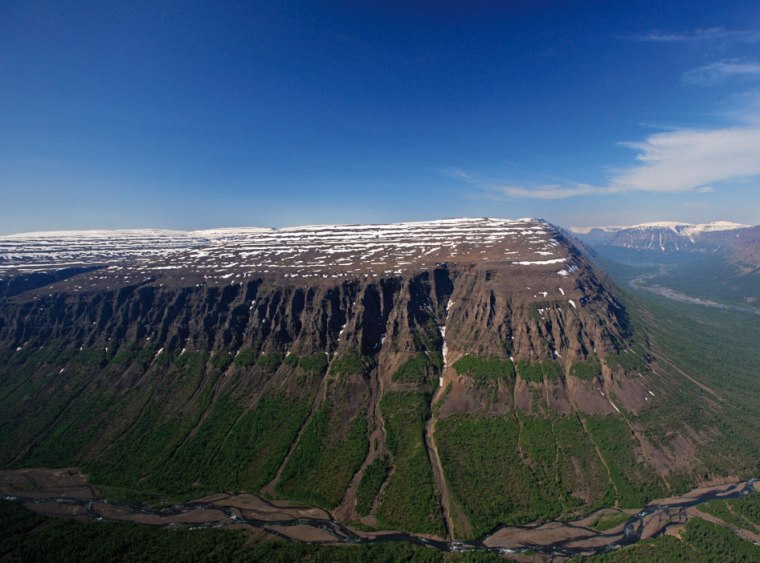
Siberian flood-basalt flows in Putorana, Taymyr Peninsula. (Credit: Paul Wignall; Nature http://www.nature.com/nature/journal/v477/n7364/fig_tab/477285a_F1.html)

In the run-up to the extinction carbon isotopes in marine Permian sediments from Meishan, China suggest a runaway growth in the amount of inorganic carbon (in carbonate) in the oceans. The C-isotope record from Meishan shows episodes of sudden major change (over ~20 ka) in both the inorganic and organic carbon parts of the oceanic carbon cycle. The timing of both ‘excursions’ from the long-term trend immediately follows a ‘spike’ in the concentration of the element nickel in the Meishan sediments. The Ni almost certainly was contributed by the massive outflow of basalt lavas in Siberia. So, what is the connection?

Some modern members of the prokaryote Archaea that decompose organic matter to produce methane have a metabolism that depends on Ni, one genus being Methanosarcina that converts acetate to methane by a process known as acetoclastic methanogenesis. Methanosarcina acquired this highly efficient metabolic pathway probably though a sideways gene transfer from Bacteria of the class Clostridia; a process now acknowledged as playing a major role in the evolution of many aspects of prokaryote biology, including resistance to drugs among pathogens. Molecular-clock studies of the Methanosarcina genome are consistent with this Archaea appearing at about the time of the Late Permian. A burst of nickel ‘fertilisation’ of the oceans may have resulted in huge production of atmospheric methane. Being a greenhouse gas much more powerful than CO2, methane in such volumes would very rapidly have led to global warming. Before the Siberian Traps began to be erupted nickel would only have been sufficiently abundant to support this kind of methanogen around ocean-floor hydrothermal springs. Spread globally by eruption plumes, nickel throughout the oceans would have allowed Methanosarcina or its like to thrive everywhere with disastrous consequences. Other geochemical processes, such as the oxidation of methane in seawater, would have spread the influence of the biosphere-lithosphere ‘conspiracy’. Methane oxidation would have removed oxygen from the oceans to create anoxia that, in turn, would have encouraged other microorganisms that reduce sulfate ions to sulfide and thereby produce toxic hydrogen sulfide. That gas once in the atmosphere would have parlayed an oceanic ‘kill mechanism’’ into one fatal for land animals.

There is one aspect that puzzles me: the Siberian Traps probably involved many huge lava outpourings every 10 to 100 ka while the magma lasted, as did all other flood basalt events. Why then is the nickel from only such eruption preserved in the Meishan sediments, and if others are known from marine sediments is there evidence for other such methanogen ‘blooms’ in the oceans?

Damp Earth: hydrous minerals in deep mantle rock

A large number of water-oriented tropes have been applied to Earth for ‘artistic effect’, ranging from Waterworld to the Blue Planet, but from a geoscientific perspective H2O in its many forms – liquid, solid, gas, supercritical fluid and chemically bound – has as much influence over the way the world works as do its internal heat production and transfer. Leaving aside surface processes, the presence of water has dramatic effects on the temperature at which rocks – felsic, mafic and ultramafic – begin to melt and deform and on the rates of important chemical reactions bound up with internal processes.

For a long while many geologists believed that the oceans were the product of water being transferred from the mantle by degassing through volcanoes so that the deep Earth has steadily been desiccated. But now it has become clear that such is the rate at which subduction can shift water back to the mantle that the entire volume of modern ocean water may have been cycled back and forth more than 3 times in Earth history (see Subduction and the water cycle). Besides, it is conceivable that accretion of cometary material up to about 3.8 Ga may have delivered the bulk of it.

An important aspect of the deep part of the water cycle concerns just how far into the mantle subduction can transport this most dominant volatile component of our planet. Ultra high-pressure experimental petrology has reached the stage when conditions at depths more than halfway to the core-mantle boundary (pressures up to 50 GPa) can be sustained using diamond anvils surrounding chemical mixtures that approximate mantle ultramafic materials. Previously, it was thought that serpentinite, the hydrous mineral most likely to be subducted, broke down into magnesium-rich, anhydrous silicates at around 1250 km down. This would prevent the deepest mantle from gaining any subducted water and retaining any that it had since the Earth formed. A team of Japanese geochemists has discovered a hint that hydrous silicates can, through a series of phase changes, achieve stability under the conditions of the deepest mantle (Nishi, M. 2014. Stability of hydrous silicate at high pressures and water transport to the deep lower mantle. Nature Geoscience, v. 7, p. 224-227). Their experiments yielded a yet unnamed mineral (phase H or MgSiH2O4) from approximate mantle composition that could remain stable in subducted slabs down to the core-mantle boundary. This development may help explain why the lowermost mantle is able to participate in plume activity through reduction in viscosity at those depths.

A parallel discovery concerns conditions at the base of the upper mantle; the 410 to 660 km mantle seismic transition zone. It comes from close study of a rare class of Brazilian diamonds that have been swiftly transported to the Earth’s surface from such depths, probably in kimberlite magma pipes, though their actual source rock has yet to be discovered. These ultra-deep diamonds prove to contain inclusions of mantle materials from the transition zone (Pearson, D.G. and 11 others 2014. Hydrous mantle transition zone indicated by ringwoodite included within diamond. Nature, v. 507, p. 221-224). Australian geochemist Ted Ringwood pioneered the idea in the 1950s and 60s that the mantle transition zone might be due to the main mantle mineral olivine ((Mg,Fe)2SiO4) being transformed to structures commensurate with extremely high pressures, including one akin to that of spinel. Such a mineral was first observed in stony meteorites that had undergone shock metamorphism, and was dubbed ringwoodite in honour of its eponymous predictor. Yet ringwoodite had never been found in terrestrial rocks, until it turned up in the Brazilian diamonds thanks to Pearson and colleagues.

Partial cross-section of the Earth showing the location of ringwoodite in the mantle. Credit: Kathy Mather
Partial cross-section of the Earth showing the location of ringwoodite in the mantle Credit: Kathy Mather

Earlier experimental work to synthesise ultra-deep minerals discovered that ringwoodite may contain up to 2% water (actually OH groups) in its molecular lattice: an astonishing thing for material formed under such extreme conditions. The ringwoodite inclusions in diamond show infrared spectra that closely resemble its hydrous form. From this it may be inferred that the 401-660 km transition zone contains a vast amount of water; roughly the same as in all the oceans combined, though the find is yet to be confirmed in a wider selection of diamonds. One of the puzzles about diamondiferous kimberlites is that the magma must have been rich in water and carbon dioxide. That can now be explained by volatile-rich materials at the depths where diamonds form, But that does not necessarily implicate the whole transition zone: there may be pockets ripe for kimberlitic magma formation in a more widely water-poor mantle.

Keppler, H. 2014.  Earth’s deep water reservoir. Nature , v. 507, p. 174-175

Enhanced by Zemanta

Could volcanism have spread organisms?

Recently there have been worrying accounts about pathogens, for instance the viruses that cause foot and mouth disease in livestock, flu in humans and other animals and the sheep disease bluetongue carried by tiny midges, being transported for thousands of kilometres in dust storms.  They raise the question of whether or not in the past organisms small enough to be carried by winds in aerosol suspension might have helped colonise regions distant from where they evolved.

The Taupo eruption's three main vents ran para...
The 600 square kilometre caldera lake of Taupo on New Zealand’s North Island. (Photo credit: Wikipedia)

Studies of volcanic ash thought to have been transported at high latitudes in the Southern Hemisphere from a 25 thousand-year old major volcanic eruption on the North Island of New Zealand add volcanic activity to violent meteorological phenomena as a possible means of transport (Van Eaton, A.R. et al. 2013. High-flying diatoms: Widespread dispersal of microorganisms in an explosive volcanic eruption. Geology, v. 41, p. 1187-1190). Ash from as far as 850 km from the volcano turns out to incorporate abundant remains of diatoms – species of algae that secrete distinctively intricate skeletons made from silica. The volcano, Taupo, erupted from beneath a lake bed, explaining the diatoms’ origin from lake muds and the water column itself. Even details of the organisms’ soft parts and pigmentation are preserved in the ash, suggesting that at least some of them might have been transported alive. Astonishingly, the New Zealand authors’ counts of organic material in the ash suggest that as much as 0.6 km3 of diatom remains were dispersed during the eruption.

English: Circle of diatoms on a slide
Assorted species of diatoms on a microscope slide (credit: Wikipedia)

Violent sub-aqueous eruptions can entrain liquid water as spray as well as water vapour and glassy magma shards, carrying the mixture into the stratosphere, far above wind belts in the lower atmosphere. At such altitudes transport can spread fine aerosols through an entire hemisphere because they remain in suspension for long periods.

Different species of diatom live in subtly different environments, so that their relative proportions and presence or absence in ash provide a ‘fingerprint’ for the volcano responsible. So the discovery by the team from the Victoria University of Wellington (a ‘first’) presents a new tool for identifying the source of ash layers in the volcanic record that came from  other volcanoes associated with caldera lakes – common for those capable of launching huge volumes of material aloft, such as Toba that erupted in Sumatra at around 74 ka and may have influenced the first modern human migrants from Africa. But could minute organisms survive both the volcanic heat and blast and a traverse through the dry stratosphere to result in colonisation? If that were possible it would have significant implications for the spread of early life forms during the far more volcanically active Hadean and Archaean Eons of Earth’s history.

Commenting on the article, Jennifer Pike of Cardiff University, UK (Pike, J. 2013. Of volcanoes and diatoms. Geology, v. 41, p. 1199-2000) surmises that diatoms might survive drying out in the stratosphere, provided they were in the form of spores encased in silica. Such spores were not found in the Taupo ash, but who is to say that they will not be discovered in other ancient volcanic ash layers? Spores are extremely durable and other micro-organisms than diatoms produce them and have done in the past.

An early oxygenated atmosphere

The Earth’s earliest atmosphere undoubtedly had a chemistry dominated by carbon dioxide and nitrogen, together with transient water vapour, outgassed from volcanoes giving pervasive reducing conditions at the surface and in the oceans. Until the last couple of decades the only clear evidence of a switch to oxidising conditions and presumably significant atmospheric oxygen was direct, mineralogical evidence. The most obvious signs are ancient, reddened soils formed when soluble Fe2+ lost electrons to molecular oxygen to form the distinct red, orange and brown oxides and hydroxides of insoluble Fe3+ that impart a deep staining in even small quantities. Others include the disappearance from river-transported sediments of clearly transported grains of metal sulfides and uranium oxide that remain stable under reducing conditions but quickly break down in the presence of oxygen.

Widespread observations in Precambrian sediments, eventually linked with reliable radiometric ages, strongly suggested a fundamental environmental change at around 2.3 billion years ago: the Great Oxidation Event. A few such signs emerge from somewhat older rocks back to 2.7 Ga, but only the 2.3 Ga event created a permanent feature of our home world; at first toxic to many of the prokaryote life forms of earlier times but eventually a prime condition for the rise of the Eukarya and eventually metazoan animals. Isotopic analysis of sulfur from Precambrian sediments also gave hints of a more complex but much debated transition because of the way S-isotopes fractionate under different environmental conditions. Now other  indirect, isotopic approaches to redox conditions have become feasible, with a surprising result: powerful evidence that about 3 billion years ago there was appreciable atmospheric oxygen (Crowe, S.A. et al. 2013. Atmospheric oxygenation three billion years ago. Nature, v. 501, p. 535-538).

The Danish-South African-German-Canadian group relied on a fractionation process among the isotopes of chromium, which can exist in several oxidation states. When minerals that contain Cr3+  are weathered under oxidising conditions to release soluble Cr6+ the loss in solution preferentially removes the 53Cr isotope from residual soil. If the isotope enters groundwater with reducing conditions to precipitate some Cr3+ -rich material yet more 53Cr remains in solution. Eventually such enriched water may enter the oceans, where along with iron and other transition-group metal ions chromium can end up in banded iron formations (BIFs) to preserve isotopic evidence for oxidising conditions along it route from land to sea.

This image shows a 2.1 billion years old rock ...
Banded iron formation (BIF) from the Precambrian of North America belonging to the National Museum of Mineralogy and Geology in Dresden, Germany. (credit: Wikipedia)

The team analysed both a palaeosol and a BIF unit from a stratigraphic sequence in the Achaean of NE South Africa that is between 2980 and 2924 Ma old. A substantial proportion of the palaeosol is depleted in 53Cr whereas the lower part of the slightly younger BIF is significantly enriched. Changes in the concentration of redox sensitive elements, such as chromium itself, uranium and iron, in the two lithologies helps confirm the isotopic evidence for a major ~3 Ga oxidation event. It is possible to use the data to estimate what the atmospheric oxygen content might have been at that time: not enough to breathe, but significant at between 6 x 10­-5 to 3 x 10⁻³ the atmospheric level at present. Oxygen can be produced abiogenically through irradiation of water vapour in the atmosphere as well as by organic photosynthesis. However, the first route seems incapable of yield more than a billionth of present atmospheric concentrations, so the spotlight inevitably falls on a ‘much deep history’ of the action of blue-green bacteria (cyanobacteria) than hitherto suspected.

Electricity from ‘black smokers’

English: Black smoker at a mid-ocean ridge hyd...
Hydrothermal vent at the mid-Atlantic Ridge (credit: Wikipedia)

Occasionally, journals not usually associated with mainstream geosciences publish something startling, but easily missed. Nature of 12 September 2013 alerted me to just such an oddity. It seems that the chemistry of sea-floor hydrothermal vents potentially can generate electrical power (Yamamoto, M. et al. 2013. Generation of electricity and illumination by an environmental fuel cell in deep-sea hydrothermal vents. Angewandte Chemie, online DOI: 10.1002/ange.201302704).

The team from the Japan Agency for Marine-Earth Science and Technology, the Riken Centre for Sustainable Resource Science and the University of Tokyo used a submersible ROV to suspend a fuel cell based on a platinum cathode and iridium anode in hydrothermal vents that emerge from the Okinawa Trough off southern Japan at a depth of over 1 km. It recorded a tiny, but significant power generation of a few milliwatts.

The fluids issuing from the vents are at over 300°C while seawater is around 4°C, creating a very high thermal gradient. More importantly, the fluid-seawater interface is also a boundary between geochemically very different conditions. The fluids are highly acidic (pH 4.8) compared with the slight alkalinity of seawater, and contain high concentrations of hydrogen and hydrogen sulfide but undetectable oxygen (sea water is slightly oxygenated).

The fuel cell was designed so that iridium in the anode speeds up the oxidation of H2S at the geochemical interface which yields the electrons necessary in electrical currents. The experiment neatly signified its success by lighting up three light-emitting diodes.

Does this herald entirely new means of renewable power generation? Perhaps, if the fuel cell is scaled-up enormously. Yet, the very basis of oxidation and reduction is expressed by the mnemonic OILRIG (Oxidation Is Loss Reduction Is Gain – of electrons) and any potential redox reaction in nature has potential, even plants can be electricity producers. In fact all fuel cells exploit oxidation reactions of one kind or another.

Not-so-light, but essential reading

In its 125th year the Geological Society of America is publishing invited reviews of central geoscience topics in its Bulletin. They seem potentially useful for both undergraduate students and researchers as accounts of the ‘state-of-the-art’ and compendia of references. The latest focuses on major controls on past sea-level changes by processes that operate in the solid Earth (Conrad, C.P. 2013. The solid Earth’s influence on sea level. Geological Society of America Bulletin, v. 125, p. 1027-1052), a retrospective look at how geoscientists have understood large igneous provinces (Bryan, S. E. & Ferrari, L. 2013. Large igneous provinces and silicic large igneous provinces: Progress in our understanding over the last 25 years. Geological Society of America Bulletin, v. 125, p. 1053-1078) and the perennial topic of how granites form and end up in intrusions (Brown, M. 2013. Granite: From genesis to emplacement Geological Society of America Bulletin, v. 125, p. 1079-1113).

Sea level change

Conrad covers sea-level changes on the short- (1 to 100 years), medium- (1 to 100 ka) and long term (1 to 100 Ma). The first two mainly result from local deformation of different kinds associated with glacial loading and unloading. These result in changes in the land surface, the sea surface nearby and on thousand year to 100 ka timescales to ups and downs of the sea-bed. Global sea-level changes due to melting of continental glaciers at the present day amount to about half the estimated 2 to 3 mm of rise each year. But increasingly sensitive measures show it is more complex as the rapid shifts of mass involved in melting ice also result in effects on the solid Earth. At present solid mass is being transferred polewards, but at rates that differ in Northern and Southern hemispheres and which are changing with anthropogenic influences on glacial melting. Viscous movement of the solid Earth is so slow that effects from previous glacial-interglacial episodes continue today. As a result rapid elastic movements are tending to produce relative sea-level falls in polar regions of up to 20 mm per year with rising sea level focusing on areas between 30°N and 30°S. The influence of the slower viscous mass transfer has an opposite sense: sea-level rise at high latitudes. Understanding the short- and medium-term controls is vital in predicting issues arising in the near future from natural and anthropogenic change.

Comparison of two sea level reconstructions du...
Comparison of two sea level reconstructions during the last 500 Ma. (credit: Wikipedia)

 Most geologists are concerned in practice with explanations for major sea-level changes in the distant past, which have a great deal to do with changes in the volumes of the ocean basins. If the global sea-floor rises on average water is displaced onto former land to produce transgressions, and subsidence of the sea floor draws water down from the land. Conrad gives a detailed account of what has been going on since the start of the Cretaceous Period, based on the rate of sea-floor spreading, marine volcanism and sedimentation, changes in the area of the ocean basins and the effects of thermally-induced uplift and subsidence of the continents, showing how each contribution acted cumulatively to give the vast transgressions and regressions that affected the late Phanerozoic. On the even longer timescale of opening and closing of oceans and the building and disintegration of supercontinents the entire mantle becomes involved in controls on sea level and a significant amount of water is chemically exchanged with the mantle.

Large igneous provinces

Cathedral Peak, 3004m above sea level in the K...

The Web of Science database marks the first appearance in print of “large igneous province” in 1993, so here is a topic that is indeed new, although the single-most important attribute of LIPs, ‘flood basalt’ pops up three decades earlier and the term ‘trap’ that describes their stepped topography is more than a century old. Bryan and Ferrari are therefore charting progress in an exciting new field, yet one that no human – or hominin for that matter – has ever witnessed in action. One develops, on average, every 20 Ma and since they are of geologically short duration long periods pass with little sign of one of the worst things that our planet can do to the biosphere. In the last quarter century it has emerged that they blurt out the products of energy and matter transported as rising plumes from the depths of the mantle; they, but not all, have played roles in mass extinctions; unsuspected reserves of precious metals occur in them; they play some role in the formation of sedimentary basins and maturation of petroleum and it seems other planets have them – a recipe for attention in the early 21st century. Whatever, Bryan and Ferrari provide a mine of geological entertainment.


Granites

In comparison, granites have always been part of the geologist’s canon, a perennial source of controversy and celebrated by major works every decade, or so it seems, with twenty thousand ‘hits’ on Web of Science since 1900 (WoS only goes back that far). Since the resolution of the plutonist-neptunist wrangling over granite’s origin one topic that has been returned to again and again is how and where did the melting to form granitic magma take place? If indeed granites did form by melting and not as a result of ‘granitisation. Lions of the science worried at these issues up to the mid  20th century: Bowen, Tuttle, Read, Buddington, Barth and many others are largely forgotten actors, except for the credit in such works as that of Michael Brown. Experimental melting under changing pressure and temperature, partial pressures of water, CO2 and oxygen still go on, using different parent rocks. One long-considered possibility has more or less disappeared: fractional crystallisation from more mafic magma might apply to other silicic plutonic rocks helpfully described as ‘granitic’ or called ‘granitoids’, but granite  (sensu stricto) has a specific geochemical and mineralogical niche to which Brown largely adheres. For a while in the last 40 years classification got somewhat out of hand, moving from a mineralogical base to one oriented geochemically: what Brown refers to as the period of ‘Alphabet Granites’ with I-, S- A- and other-type granites. Evidence for the dominance of partial melting of pre-existing continental crust has won-out, and branched into the style, conditions and heat-source of melting.

English: Kit-Mikayi, a rock formation near Kis...
Typical granite tor near Kisumu, Kenya (credit: Wikipedia)

All agree that magmas of granitic composition are extremely sticky. The chemical underpinnings for that and basalt magma’s relatively high fluidity were established by physical chemist Bernhardt Patrick John O’Mara Bockris (1923-2013) but barely referred to, even by Michael Brown. Yet that high viscosity has always posed a problem for the coalescence of small percentages of melt into the vast blobs of low density liquid able to rise from the deep crust to the upper crust. Here are four revealing pages and ten more on how substantial granite bodies are able to ascend, signs that the puzzle is steadily being resolved. Partial melting implies changes in the ability of the continental crust to deform when stressed, and this is one of the topics on which Brown closes his discussion, ending, of course, on a ‘work in progress’ note that has been there since the days of Hutton and Playfair.

Afar: the field lab for continental break-up

The Afar Depression of Ethiopia and Eritrea is a feature of tectonic serendipity. It is unique in showing on land the extensional processes and related volcanism that presage sea-floor spreading. Indeed it hosts three rift systems and a triple junction between the existing Red Sea and Gulf of Aden spreading centres and the East African Rift System that shows signs of future spalling of Somalia from Africa. Afar has been a focus of geoscientific attention since the earliest days of plate theory but practical interest has grown rapidly over the last decade or so when the area has become significantly more secure and safe to visit. Two recent studies seem to have overturned one of the most enduring assumptions about what drives this epitome of continental break-up.

Perspective view of the Afar depression and en...
Simulated perspective view of the Afar depression from the south (credit: Wikipedia)

From the obvious thermal activity deep below Afar, linked with volcanism and high heat flow, a mantle host spot and rising plume of deep mantle has been central to ideas on the tectonics of the area. A means of testing this hypothesis is the use of seismic data to assess the ductility and temperature structure of deep mantle through a form of tomography. The closer the spacing of seismic recording stations and the more sensitive the seismometers are the better the resolution of mantle structure. Afar now boasts one of the densest seismometer networks, rivalling the Earthscope USArray. http://earth-pages.co.uk/2009/11/01/the-march-of-the-seismometers/ and it is paying dividends (Hammond, J.O.S. and 10 others 2013. Mantle upwelling and initiation of rift segmentation beneath the Afar Depression. Geology, v. 41, p. 635-638). The study  brought together geoscientists from Britain, the US, Ethiopia, Eritrea and Botswana, who used data from 244 seismic stations in the Horn of Africa to probe depths down to 400 km with a resolution of about 50 km.

The tomographic images show no clear sign of the kind of narrow plume generally aasociated with the notion of a ‘hot spot’. Instead they pick out shallow (~75 km depth) P- and S-wave  low-velocity features that follow the axes of the three active rift systems. The features coalesce at depth; in some respects the opposite of a classic plume that has a narrow ‘stem’ that swells upwards to form a broad ‘head’. If there ever was an Afar Plume it no longer functions. Instead, the rifts and associated lithospheric thinning are associated with a mantle upwelling that is being emplaced passively in the space made available by extensional tectonics. This is closely similar to what goes on beneath active and well-established mid-ocean spreading centres where de-pressuring of the rising mantle results in partial melting and basaltic magmatism along the rift system. Perhaps this is a sign that full sea-floor spreading in Afar is imminent, at least on geological timescales.

Simplified geologic map of the Afar Depression.
Simplified geologic map of the Afar Depression. (credit: Wikipedia after Beyene and Abdelsalam (2005))

For once, mantle geochemists and geophysicists have data that support a common hypothesis (Ferguson, D.J. and 8 others 2013. Melting during late-stage rifting in Afar is hot and deep. Nature, v. 499, p. 70-73). This US-British-Ethiopian team compares the trace element geochemistry of Recent basaltic lavas erupted along the axis of the Afar rift that links with the Red Sea spreading centre with equally young lavas from volcanoes some 20 km from the axis. Both sets of lavas are a great deal more enriched in incompatible trace elements that are generally enriched in melt compare with source than are ocean-floor basalts sampled from the mid-Red Sea rift.  Modelling rare-earth element patterns in particular suggests that partial melting is going on at depths where garnet is stable in the mantle instead of spinel. This suggests that a strong layer, about 85 km down in the upper mantle is beginning to melt – magmas formed by small degrees of partial melting generally contain higher amounts of incompatible trace elements than do the products of more extensive melting. Estimates of the temperature of melting from lavas extruded at the rift axis than off-axis are significantly higher than expected at this depth suggesting that deeper mantle is rising faster than it can lose heat.

The depth of melting tallies with the thermal feature picked out by seismic tomography. The two teams converge on passively induced upwelling of hot asthenosphere while the Afar lithosphere is slowly being extended. The degree of melting beneath Afar is low at present, so that to become like mid-ocean ridge basalts a surge in the fraction of melting is needed. That would happen if the strong mantle layer fails plastically so that more asthenosphere can rise higher by passive means. The geochemists persist in an appeal to an Afar Plume for the 30 Ma old flood basalts that plaster much of the continental crust outside Afar. Those plateau-forming lavas, however, are little different in their trace element geochemistry from off-axis Afar basalts. Yet they are not obviously associated with an earlier episode of lithospheric extension and passive mantle upwelling.  Most geologists who have studied the flood basalts would agree that they preceded the onset of rifting but have little idea of the actual processes that went on during that mid-Oligocene volcanic cataclysm.

Bling from space

People have a keen eye for unusual objects and an even keener one for the aesthetic. Fossil echinoderms with their five-fold starry shape have been enduringly popular as trinkets since the Palaeolithic. Astonishingly, the gravel terrace at Swanscombe that yielded skull fragments of 400 ka Homo erectus plus many Acheulean tools also contained a flint bi-face ‘hand axe’ with a near perfect echinoid in its blunt grip. It cannot be proven, but the object seems to refute the idea that an artistic sense only arose with anatomically modern humans in the last 100 ka. Our immediate ancestors of the Neolithic sometimes took collecting to extremes in graves half full of fossil sea urchins (McNamara, K.J. 2007. Shepherds’ crowns, fairy loaves and thunderstones: the mythology of fossil echinoids in England. In: Piccardi, L. & Masse, W.B. Myth and Geology. Geological Society, London, Special Publication 273, 279–294).

Before the invention of metal smelting native gold, iron and copper appear in the archaeological record, undoubtedly because they look and indeed feel so different from the usual pebbles on the beach or just lying around. It is just that element of the odd that continues to draw people, including scientists, into a perpetually stooped posture when the walk across surfaces scattered with pebbles and boulders. The habit is especially hard to shake off for the meteoriticist whose hunting grounds are desert plains and ice caps where oddities are easy to spot, even when rare. So it is interesting when such dogged searchers encounter evidence of long-dead people having done much the same.

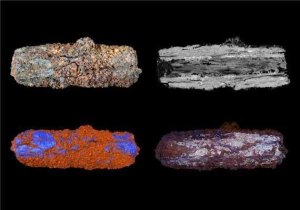
By 5300 years ago people had settled in small farming communities in the Nile Valley eventually to develop on the shores of lake – now represented by several smaller water bodies – what is regarded as the world’s first city near modern Faiyum. These Predynastic people buried their dead nearer to the Nile at Gerzeh, often sending them off with grave goods. The site has been continually excavated by professional archaeologists for more than a century, beginning with Sir Flinders Petrie. Two of the graves contained metallic iron beads, which presented a puzzle as iron smelting is only known from the 6th century BCE onwards. Unsurprisingly, the beads came to be regarded as artefacts wrought from an iron meteorite, though their highly altered nature and intrinsic value thwarted attempts at full analysis. Geochemists from the Open and Manchester Universities, and the Natural History Museum have now resolved the issue (Johnson, D. et al. 2013. Analysis of a prehistoric Egyptian iron bead with implications for the use and perception of meteorite iron in ancient Egypt. Meteoritics and Planetary Science, on-line, DOI: 10.1111/maps.12120). Non-destructive electron microscopy and X-ray tomography reveal, respectively, clear signs of the banded Widmanstätten structures and traces of nickel-rich iron alloy (taenite) that typify iron meteorites but are absent from smelted iron. The beads were clearly beaten and rolled into shape, but this working did not destroy the tell-tale evidence of their origin.

Optical, microprobe and CT-scan images of Predynastic iron bead from the Nile Valley (credit: Open University)

This provenance tallies with the appearance in early New Kingdom hieroglyphs of the term biA-n-pt – literally iron-from-the-sky – which was adopted for smelted iron when first made in the 26 to 27th Dynasties. But pharaonic iron was not a poor relation of gold, regarded as flesh of the gods and hence featuring in the masks of Pharaohs such as Tutankhamen, but supposedly what their bones were made from.

Continental comfort blanket

Way back in the mists of time, say around 1970-71, an idea was doing the rounds that because the thermal conductivity of continental crust is lower than that of the ocean floor it should allow thermal energy to build up in the mantle beneath. In turn that might somehow encourage the formation of hot spots and a shallower depth to the asthenosphere: the outcome might be to encourage rifting of weakened lithosphere and ultimately a new round of sea-floor spreading. The case often cited was the Atlantic – North and South – since there are eight hotspots currently on the mid-Atlantic ridge. Africa was another popularised case with a great many broad domes associated with Cenozoic volcanism, and the link between formation of the East African Rift System, hot spots and doming had already been suggested. Africa has barely drifted for around 100 Ma and the domes were supposed to have formed by the build up of heat in the mantle beneath. Geoscience moved on to clearly demonstrate the coincidence of large igneous provinces and flood basalt volcanism with the initiation of Atlantic spreading in the form of the Central Atlantic and Brito-Arctic LIPs during initial opening of the South and North Atlantic at the end of the Triassic and during the Palaeocene respectively. But the role of continental insulation became a bit of backwater compared with notions of mantle plumes emanating at the core-mantle boundary. Well, it’s back.

Divergent plate boundary: Mid-Atlantic Ridge
The Mid-Atlantic Ridge (credit: Wikipedia)

There is now a vast repository of ocean-floor lavas that formed at mid-ocean ridges in the past, thanks to the international Deep Sea and Ocean Drilling Programmes begun in 1968 about when the heyday of plate tectonics really got underway. In the last 45 years there have also been great advances in igneous geochemistry and its interpretation, including relations with mantle melting temperatures. Geochemists at the Friedrich-Alexander-Universiteit in Erlangen, Germany have re-examined the major-element geochemistry of 184 glassy ocean-floor basalts from drill sites of different ages on the floor of the Atlantic Ocean and compared them with 157 from the Pacific. To avoid the possible influence of plume-related heating, the sites were chosen well away from the tracks of existing hot spots. Mantle temperature can be assessed from the sodium and iron content of basalts, Na decreasing with higher temperatures and Fe doing the reverse (Brandl, P.A. et al. 2013. High mantle temperatures following rifting cause by continental insulation. Nature Geoscience, v. 6, p. 391-394). Atlantic samples show increasing Na and decreasing Fe contents in progressively younger basalts, i.e. a trend with time of decreasing mantle temperature such that the oldest (~166 Ma) record 150°C higher mantle temperature than the youngest, with a similar result for the Indian Ocean floor. No such trend is present in samples from the same age range of the Pacific Ocean floor. At around 170 Ma the mid-Atlantic Ridge was close to the continental lithosphere of the Americas and Africa, whereas the East Pacific Rise was at least 2000 km from any continental margin. Younger Atlantic samples formed progressively further from its shores record cooling of the mantle source.
A prediction of the model is that the converse, continental accretion to form supercontinents such as Pangaea, should rapidly have caused considerable warming in the mantle beneath them. This suggests that the formation of supercontinents, or even less substantial continents, should carry the seeds of their re-fragmentation, as Africa is currently demonstrating by the separation of Arabia since the Red Sea began to open some 15 Ma ago, which Somalia and much of eastern Kenya and Tanzania seem destined to follow once the East African Rift System ‘gets steam up’.

  • Langmuir, C. 2013. Older and hotter. Nature Geoscience, v. 6, p. 332-333