Artist’s depiction of the asteroid impact 65 million years ago that caused the K-T mass extinction. (Photo credit: Wikipedia)
Just in time for the festive season I have been sent the URL for an on-line impact simulator written by a team from Imperial College London and the University of Arizona (Collins, G.S. et al. 2005. Earth Impact Effects Program: A Web-based computer program for calculating the regional environmental consequences of a meteoroid impact on Earth. Meteoritics and Planetary Science, v. 40, p. 817–840), with a web presence designed at Purdue University, Indiana. ImpactEarth (http://www.purdue.edu/impactearth/) has been around for two years and has a scientifically pleasing level of precision, thanks to the authors, Gareth Collins, Jay Melosh and Robert Marcus.
The fact that the target shown by the accompanying animation and other graphics seems to be the Washington-New York megalopolis may be a cause for some concern for US readers, especially the Department of Homeland Security, National Security Agency and CIA. They can rest easy, however, as this seems to be a matter of artistic license: the choice of parameters allows for ocean strikes and targets of sedimentary or crystalline rocks. Others are impactor diameter and density, impact angle and speed, plus distance from ground zero. An element of whimsy allows the casual user to choose inbound humpback whales, school buses and the Empire State Building as well as more astronomically likely scenarios.
There are a number of missing parameters such as direction relative to Earth’s rotation, latitude and the likely affect of an ice-cap strike, and no mention in the results of the electromagnetic burst from atmospheric compression on entry – the Diesel effect. However, the thermal effects on bystanders, buildings and vegetation at the ‘viewpoint’ personalise the experience to some extent. It is the detail about crater dimensions and evolution, lithospheric melting and what might happen to the Earth’s axial tilt and day length that the wealth of computations produce surprises. It is not easy to destroy our planet: using a body with a density of 3000 kg m-3 and the diameter of Asia causes no significant melting or changes in axial tilt at speeds less than 12 km s-1, but does change the length of the day by up to 113 hours. This is because the power of impacts and therefore the work done by them is proportional to the square of the speed. Mind you, nothing is left standing as the seismic effect has a Richter Magnitude of more than 15! Yet, curiously, no atmospheric or thermal radiation effects are noted.
Gas hydrate (methane clathrate) block embedded in seabed sediment (Photo credit: Wikipedia)
The biggest tsunami to affect inhabitants of Britain, mentioned in the earlier post Landslides and multiple dangers, emanated from the Storegga Slide in the northern North Sea west of Norway. That submarine debris flow was probably launched by gas hydrates beneath the sea bed breaking down to release methane thereby destabilising soft sediments on the continental slope. Similar slides were implicated in breaking Europe-America communications in the 20th century, such as the Grand Banks Slide of 1929 that severed submarine cables up to 600 km from the source of the slide. Even now, much Internet traffic is carried across oceans along optic-fibre cables, breakages disrupting and slowing services. A more mysterious facet of clathrate breakdown is its possible implication in unexplained and sudden losses of ships. When gas escapes to the surface, the net density of seawater decreases, the more so as the proportion of bubbles increases. Ship design and cargo loading rests on an assumed water density range from fresh to salt water and for different temperatures at high and low latitudes.
Gulf stream map (credit: Wikipedia)
The Atlantic seaboard of the USA hosts some of the best-studied accumulations of clathrates in the top 100-300 m of seabed sediments. Since their discovery these ‘cage complexes’ of mainly methane and carbon dioxide trapped within molecules of water ice have been studied in detail. Importantly, the temperatures at which they form and the range over which they remain stable depend on pressure and therefore depth below the sea surface. At atmospheric pressure solid methane hydrate is unstable at any likely temperature and requires -20°C to form at a pressure equivalent to 200 m water depth. Yet is stable at temperatures up to 10°C 500 m down and 20°C at a depth of 2 km. Modern sea water cools to around 0°C at depths greater than 1.5 km, so gas hydrates can form virtually anywhere that there is a source of methane or CO2 in seafloor sediment. In the sediments temperature increases sharply with depth beneath the seabed due to geothermal heat flow thereby limiting the clathrate stability zone to the top few hundred metres.
Two factors may lead to clathrate instability: falling sea level and sea-floor pressure or rising sea-floor temperature. Many gas-hydrate deposits, especially on the continental shelf and continental edge are likely to be close to their stability limits, hence the worries about destabilisation should global warming penetrate through the water column. The western North Atlantic is an area of especial concern because the Gulf Stream flows northward from the Caribbean to pass close to the US seaboard off the Carolinas: that massive flow of tropical warm water has been increasing during the last 5 thousand years so that its thermal effects are shifting westwards.
Geophysicists Benjamin Phrampus and Matthew Hornbach of the Southern Methodist University in Dallas, Texas have used thermal modelling to predict that gas-hydrate instability is imminent across 10 thousand square kilometres of the Caroline Rise (Phrampus, B.J. & Hornbach, M.J. 2012. Recent changes to the Gulf Stream causing widespread gas hydrate destabilization. Nature, v. 490, p. 527-530). As a test they analysed two seismic reflection profiles across the Carolina Rise, seeking anomalies known as bottom-simulating reflectors that signify free gas in the sediments. These are expected at the base of the gas-hydrate zone and their presence helps assess sediment temperature. At depths less than 1 km the base of the gas-hydrates modelled from the present temperature profile through the overlying seawater lies significantly above the base’s signature on seismic lines. The deeper levels probably formed under cooler conditions than now – probably eight degrees cooler – and may be unstable. If that is correct, the Caroline Rise area seems set to release around 2.5 Gt of methane to add to atmospheric greenhouse warming. The Storegga Slide also lies close to the northern track of the Gulf-Stream – North Atlantic Drift…
A landslide in Guerrero, Mexico in August, 1989. (credit: Wikipedia)
Just as modern humans were establishing a permanent foothold in Britain and engaging in the transition to settled farming and livestock husbandry disaster struck some of the most attractive Mesolithic real estate. Around 8 000 years ago the east coast of Scotland, from the Shetland Isles to the Firth of Forth, was struck by a tsunami as big as that affecting the north eastern island of Honshu in the Japan archipelago in 2011. It washed over low lying islands of Shetland and Orkney and roiled up the great inlets or firths of eastern mainland Scotland to leave thick sand deposits containing carcases of whales and other large sea mammals. At that time, Britain was joined to the rest of Europe by marshy lowlands linking East Anglia and the Netherlands dubbed ‘Doggerland’ at the southern end of a huge gulf that became the North Sea. Final sea level rise removed that initial gateway to Britain, so we cannot judge what damage the tsunami wrought, but tools and animal bones dredged from the area show that it was full of game and people. A disaster, but not one linked to seismicity. The driving force has been recognised in a series of submarine scars off the west coast of Norway that witness massive slides of sediment on the sea bed area known as Storegga. Similar scars around the Hawaiian Islands and those making up the Azores and Canaries in the mid Atlantic bear witness to many large slippage events, on the sea bed and from the islands themselves. Recognising signs of past tsunami damage in coastal areas worldwide reveals plenty of cases triggered by landslides rather than earthquakes.
The March 2011 Sendai tsunami and those which ravaged lands around the Indian Ocean in late 2004 formed because of vertical movements on major faults that dropped or shoved up the oceanic crust itself. Yet any sudden change in the shape of the sea floor will displace all the ocean water above, the difference from seismic tsunamis lies in the energy source: instead of tectonic plate forces, gravitational potential energy is released by slumps and slides. That may happen because of erosion producing unstable steep slopes, build up of sedimentary piles, large outpourings of lavas or slopes being destabilised by minor earthquakes or release of gases from the sediments themselves. The Mesolithic submarine slide at Storegga may have been set in motion by massive release of methane from gas-hydrate deposits, and such is the extent of scarring of the sea floor there that it must have happened before and may do so again.
Copper engraving showing the 1755 Lisbon tsunami overwhelming ships in the harbor. (credit: Wikipedia)
Realisation of the potential for tsunamis to be triggered by submarine and coastal and slides has spurred bathymetric studies in a number of likely areas, including the Gorringe Bank that lies on the Atlantic floor just west of the Iberian Peninsula. It is tectonic in origin but has a thick veneer of sediment brought by Iberian river systems. On its northern flank is a 35 km long scar of a slip that moved 80 km3 of sediment (Lo Iacono, C. And 11 others 2012. Large, deepwater slope failures: implications for landslide generated tsunamis. Geology, v. 40, p. 931-934). The Spanish-British-Italian group estimate that the slip would have generated a 15 m tsunami most likely to have affected the Iberian coast south of Lisbon. Conditions for slides of si,ilar magnitude still exist on the Gorringe Bank. One unstable system ripe for collapse is present far out in the Atlantic on the south-east coast of the island of Picos in the Azores (Hildenbrand, A. et al. 2012. Large-sale active slump on the southeast flan of Picos Island, Azores. Geology, v. 40, p. 939-942). This is in a coastal area where repeated volcanism has piled up lavas on the flanks of the island’s main volcanic edifice. Failure has already started, with a number of prominent arcuate scars having developed. The Picos slide moves very slowly sideways but vertical displacements ar estimated at up to a centimetre a year. The volume of the slowly moving mass is an order of magnitude less that the fossil slide on the Gorringe Bank. Yet should it fail entirely, the slopes involved, the absence of water’s slowing effect and the height of the mass might ensure comparable energy is delivered to the Atlantic Ocean, though the likely trajectory of tsunamis would be parallel to the coast of Africa rather than directly towards it.
Landslides of all kinds, though hazardous, have long been thought to be less of a risk to life globally than the more spectacular seismic and volcanic hazards, but there are few data to support that view. In an attempt to assess the annual risk properly, David Petley of Durham University, UK ‘mined’ world-wide landslide records for the seven years since 2004 (Petley, D. 2012. Global patterns of loss of life from landslides. Geology, v. 40, p. 927-930). There were more than 2600 recorded slope-failures that killed people and caused a total of more than 32 thousand fatalities: ten time more than previous vague estimates. This is a minimum because many landslides occur in very remote areas, especially in the mountainous regions of China and the Himalaya. The number of fatalities accompanying each event shows distinct signs, on a country-by-country basis, of a relationship with population density. Several international agencies are emerging that aim at means of measuring disaster risk, one being the Integrated Global Observing Strategy for Geohazards (IGOS).
A Canadian carbon capture and storage project in Saskatchewan (credit: US Mission to Canada via Flickr)
Tucking away vast amounts of atmospheric carbon dioxide (carbon capture and storage or CCS), or at least that emitted by fossil-fuel power stations, is a widely suggested and well supported approach to slowing down global warming. It has two main downsides: if successful it helps maintain the dominance of fossil fuels and vast amounts of buried greenhouse gas might simply leak out some time. Ideally, the storage part of CCS would involve CO2 being taken up by an inert solid. Carbonates may be stable enough but arranging the chemical reactions to make them seem difficult, the most widely considered being by encouraging weathering of ultramafic rocks to form magnesium carbonates as a by-product: huge areas would have be coated with finely-ground peridotite. A less satisfactory approach would to dissolve the gas in water held at great depths in sedimentary aquifers, but if that water doesn’t move and doesn’t get warmed it might do the trick.
Unsurprisingly, a lot of funds are available to research CCS and ideas are pouring forth, a recent, sober assessment focussing on the solubility option (Steele-MacInnis, M. et al. 2012. Volumetrics of CO2 storage in deep saline formations. Environmental Science and Technology (August 2012 online) DOI: 10.1021/es301598t). The team from Virginia Tech and the US Department of Energy conclude that solution in brines trapped in deep aquifers may help, although solution is an equilibrium between gas and dissolved CO2, so that a gas layer in the aquifer is always likely to be present, even at high pressures. The only way of avoiding that is if the dissolved gas reacted with carbonate in the aquifer so that calcium and hydrogen-carbonate (HCO3–) ions entered solution. That ‘enhanced’ solution is not so easy since, although it mimics the calcite-weathering effect by acid rain that naturally takes CO2 from the atmosphere, calcite dissolves very sluggishly. But solution adds to the density of already dense brine so that it is less likely to leak upwards into more shallow aquifers. Their preferred technology is to liquefy the gas under pressure and pump that to deep aquifers where eventually the supercritical CO2 liquid will dissolve. The problem is this: while experiment and theory suggest the approach will work, nobody knows how long CO2 solution in brine will take. There needs to be a sizeable pilot study…
geological sequestration of carbon dioxide emissions from a coal-fired power plant. (Photo credit: LeJean Hardin and Jamie Payne Wikipedia)
Of all the ‘geoengineering’ approaches that may offer some relief from global warming pumping CO2 into deep sedimentary rocks, through carbon capture and storage (CCS) is one that most directly intervenes in the natural carbon cycle. In fact it adds an almost wholly anthropogenic route to the movement of carbon. It is difficult if not impossible for natural processes to ‘pump’ gases downwards except when they are dissolved in water and most often through the conversion of CO2 to solid carbonates or carbohydrates that are simply buried on the ocean floor. Artificially producing carbonate or organic matter on a sufficient scale to send meaningful amounts of anthropogenic carbon dioxide to long-term rock storage is pretty much beyond current technology, but gas sequestration seems feasible, if costly. The main issues concern making sure geological traps are ‘tight’ enough to prevent sufficient leakage to render the exercise of little use and to understand the geochemical effects of large amounts of buried gas that would inevitably move around to some extent.
The geochemistry is interesting as reactions of CO2 with rock and subsurface water are inevitable. The most obvious is that solution in water releases hydrogen ions to create weakly acidic fluids: on the one hand that might be a route for precipitation of carbonate and more secure carbon storage, through reaction with minerals (see http://earth-pages.co.uk/2012/04/10/possible-snags-and-boons-for-co2-disposal/), but another possibility is increasing solution of minerals that might eventually cause a trap to leak. A counterpart of pH change is the release of electrons, whose acceptance in chemical reactions creates reducing conditions. The most common minerals to be affected by reducing reactions are the iron oxides, hydroxides and sulfates that often coat sand-sized grains in sedimentary rocks, or occur as accessory minerals in igneous and metamorphic rocks. Iron in such minerals is in the Fe-3 valence state (ferric iron from which an electron has been lost through oxidation) which makes them among the least soluble common materials, provided conditions remain oxidising. Flooding sedimentary rocks with CO2 inevitably produces a commensurate flow of electrons that readily interact with Fe-3. The oxidised product Fe-2 (ferrousiron) is soluble in water, and so reduction breaks down iron-rich grain coatings. Much the same happens with less abundant manganese oxides and hydroxides. One important concern is that iron hydroxide (FeO.OH or goethite) has a molecular structure so open that it becomes a kind of geochemical sponge. Goethite may lock up a large range of otherwise soluble ions, including those of arsenic and some toxic metals. Should goethite be dissolved by reduction that toxic load moves into solution and can migrate.
Bleached zone with carbonate-oxide core in Jurassic Entrada Sandstone, Green River, Utah. (Image: Max Wigley, University of Cambridge)
Except where deep, carbonated groundwater leaks to the surface in springs – the famous Perrier brand of mineral water is an example – it is difficult to judge what is happing to gases and fluids at depth. But their long-past activity can leave signatures in sedimentary rocks exhumed to the surface. Most continental sandstones, formed either through river or wind action, are strongly coloured by iron minerals simply because of strongly oxidising conditions at the Earth’s surface for the past two billion years or more. Should reducing fluids move through the, the iron is dissolved and leached away to leave streaks and patches of bleached sandstone in otherwise red rocks. In a few cases an altogether more pervasive bleaching of hundreds of metres of rock marks the site of massive fluid-leakage zones. Terrestrial Mesozoic sedimentary sequences in the Green River area of Utah, USA exhibit spectacular examples, easily amenable to field and lab study (Wigley, M. et al. 2012. Fluid-mineral reactions and trace metal mobilization in an exhumed natural CO2 reservoir, Green River, Utah. Geology, v. 40, p. 555-558). There the bleaching rises up through the otherwise brown and yellow sandstones, cutting across the bedding. In the bleached zone, secondary calcite fills pore spaces. At the contact with unbleached sandstone there are layers of carbonate and metal oxides, enriched in cobalt, copper, zinc, nickel, lead, tin, molybdenum and chromium: not ores but clear signs confirming the general model of reductive dissolution of iron minerals and movement of metal-rich fluid. Carbon isotopes from the junction are richer in 13C than could be explained by the gas phase having been methane, and confirm naturally CO2 – rich fluids.
So, Green River provides a natural analogue for a carbon capture and storage system, albeit one that leaked so profusely it would be a latter day disaster zone. In that sense the site will help in deciding where not to construct CCS facilities.
Asbestos mine tailingsat Thetford in Quebec, Canada.(Photo credit: Wikipedia)
Not many people would like to visit a waste heap at an asbestos mine. That is not because waste heaps are generally boring but all forms of asbestos are carcinogens when inhaled. Encountering pits in the tailings that emits puffs of warm air would cause health and safety alarm bells to ring. Yet that is exactly what has attracted researchers to the huge asbestos mining complex at Thetford in Quebec, Canada: the air leaving the vents can be extremely depleted in carbon dioxide (Pronost, J. and 10 others 2012. CO3-depleted warm air venting from chrysotile milling waste (Thetford Mines, Canada): Evidence for in-situ carbon capture and storage. Geology, v. 40, p. 275-278). More precisely, the depletion – down to less than 10 parts per million (ppm) compared with normal atmospheric levels of 385 ppm – occurs in winter, when the puffing pits emit warm air far above the frigid air temperatures encountered in winter Quebec. The chrysotile must be reacting with groundwater and CO2, and is therefore a potential means of using near-surface natural materials for carbon capture and storage (CCS). The end product is an innocuous carbonate – Mg5(OH)2(CO3)4·4H2O – and dissolved silica. Quite a find, it might seem, as the reaction is exothermic too: CCS plus geothermal energy plus safe decomposition of a major environmental hazard. In fact any magnesium-rich silicates are likely to undergo the same carbonation reaction, especially if ground-up to increase the net surface area exposed to moist air.
The parent asbestos rock at Thetford is a metamorphic derivative from mantle ultramafic rocks in an ophiolite, and the asbestos insulation business, both for extremely hazardous blue (crocidolite) and less dangerous white (chrysotile) asbestos has been hugely profitable since the 19th century. Consequently, wherever there are altered ophiolites, generally in collision-zone orogenic belts, asbestos has been exposed either naturally or through mining and processing. There are many related cancer ‘hot spots’ in populous mining areas of Canada, India, the Alps and southern Africa, and in dry climates even natural exposures pose considerable risk. Could these blighted areas take on a new role in lessening the chance of global warming? About 30 billion tonnes of CO2 are emitted by burning fossil fuels each year. To keep pace, at the current atmospheric concentration of CO2, some 75 trillion tonnes of air would have to react annually with about 100 billion tonnes of magnesian silicate, making this form of CCS the largest industry on the planet (http://www.newscientist.com/article/mg21428593.800-stripping-co2-from-air-requires-largest-industry-ever.html).
Another factor tempering somewhat forced optimism for CCS as a way of having our fossil fuel cake and eating it is that direct injection of greenhouse gases into deep storage may have an unforeseen down-side. Deep drilling and injection of fluids may trigger earthquakes. The alarm raised by small yet disturbing seismicity accompanying sites for shale-gas development by ‘fracking’ (http://earth-pages.co.uk/2011/11/04/fracking-check-list/ and http://earth-pages.co.uk/2011/10/14/britain-to-be-comprehensively-fracked/) has died down to some extent following detailed analysis of small earthquakes around drilling sites. It turns out that they are triggered not by the drilling itself but the subsurface disposal of the large amounts of fluids that have to be passed through the oil shales to make the tight rock permeable to gas (Kerr, R.A. 2012 Learning how to NOT make earthquakes. Science, v. 23 p. 1436-1437). Safe subsurface disposal requires injection wells penetrating 1 to 3 km below the surface, often below the cover of sedimentary strata and into crystalline basement. Such hard rocks store elastic strain induced by burial and tectonics, and release it when lubricated by fluids, especially if they contain dormant faults. Once impermeable rock can thus be hydrofractured in the same manner as ‘fracked’ gas-prone shales and old, often unsuspected faults reactivate: a catastrophic prospect for injected CO2. In sedimentary sequences, drilling CCS wells into porous rocks capped by impermeable ones – the scenario for ‘safe’ gas storage – could also induce ‘fracking’ of the sealing rocks and thereby causing leakage (see also http://www.newscientist.com/article/dn21633-fracking-could-foil-carbon-capture-plans.html).
Recent earthquakes in the US mid-west around New Madrid Missouri. Image via Wikipedia
Almost all devastating earthquakes within living memory and the tsunamis that ensued from some of them have occurred where tectonic plates meet and move past one another either horizontally through strike-slip motion or vertically as a result of subduction. This link between real events and the central theory of global dynamics gives an impression of inherent predictability about where damaging and deadly earthquakes might happen, if not the more useful matter of when the lithosphere might rupture. Such confidence is potentially highly dangerous: the most deadly earthquake in recorded history killed at least 800 thousand people in China’s Shanxi Province in 1556 when according to a description written shortly afterwards, ‘… various misfortunes took place… In some places, the ground suddenly rose up and formed new hills, or it sank abruptly and became new valleys. In other areas, a stream burst out in an instant, or the ground broke and new gullies appeared…’. Shanxi is far from any plate boundary. A study of Chinese historic records covering the last two millennia (Liu, M. et al. 2011. 2000 years of migrating earthquakes in North China: How earthquakes in midcontinents differ from those at plate boundaries. Lithosphere, v. 3, p. 128-132) shows a pattern to the position of large intraplate events. Rather than occurring along lines as do those at plate boundaries, earthquakes ‘hopped’ from place to place without affecting the same areas twice. Liu and colleagues consider this almost random pattern to result from reactivation of interlinked faults through broad-scale and gradual tectonic loading of the crust by far off plate movements. After a short period of reactivation one fault locks so that energy build-up is eventually released by another in the plexus of crustal weaknesses.
The best studied site of such intraplate seismicity lies midway along the Mississippi valley in the mid-US, between St Louis and Memphis. In 1811 and 1812 four Magnitude 7 to 8 earthquakes struck, the most affected place being the small township of New Madrid on the banks of the great river where mud and sand spouted from numerous sediment volcanoes. No-one died there but tremors were felt over a million square kilometers, bells ringing spontaneously as far away as Boston and Toronto. It is now known that this section of the Mississippi basin lies above a graben that affects the ancient basement beneath the alluvial sediments, one of whose faults was reactivated, perhaps in an analogous way to the hypothesis about Chinese seismicity. A coauthor in Liu et al. (2011), Seth Stein of Northwestern University, Illinois, believes stress redistribution through a Mid-western fault network was responsible and other events are likely at some uncertain time in the future on this and other areas underpinned by ancient fault complexes. Indeed sporadic ‘quakes up to Magnitude 7 have affected the eastern US and Canada and the Atlantic seaboard since European settlement. But since the largest of the New Madrid quartet of earthquakes, populations have grown across the likely areas of tenuous risk and future ones could have extremely serious consequences for which it is difficult to plan by virtue of unpredictability of both place and timing: in some respects a more worrying prospect than is the case where major events are inevitable – sometime – as along the San Andreas Fault. There are few, if any, major conurbations worldwide that could be considered seismically safe if the theory of networked stress redistribution through otherwise inert parts of continental crust is borne out.
In some respects the theory is a small-scale version of the suggested mechanical linkage through all major plate boundaries that has been suggested by some to account for the clustering in time of great earthquakes – around and above Magnitude 8 – around the globe. Since 2000 great earthquakes have occurred on subduction zones beneath Sumatra, the Himalaya, the Andes, Central America, Alaska, New Guinea, the mid-Pacific, Japan and the Kurile islands, on the strike-slip system that cuts New Zealand and in the intraplate setting of the 2008 Sichuan earthquake in China. Almost all plate boundaries link up globally, but although it seems likely that stress is redistributed along boundaries, especially between adjacent segments, as documented for the great Anatolian fault system of Turkey and the Indonesian subduction zone, a mechanism that transmits stress beyond individual plates seems unlikely.
The first signs of chronic arsenic poisoning: skin keratoses. Image by waterdotorg via Flickr
That groundwater in West Bengal, India was polluted with arsenic to such levels that symptoms of poisoning had become endemic was reported by Depankar Chakraborti in 1983, leading to his being branded a ‘panic monger’ by the Indian authorities. The news broke internationally in 1993 as the now infamous tragedy in neighbouring Bangladesh emerged. Means of mitigating the effects – lesions or keratoses and skin discoloration, and later increases in incidence of several forms of cancer – and ideas of how the pollution had occurred had to await proper geochemical analyses of well waters and logging of the mainly alluvial sediments from which water was being withdrawn; another 8 years went by. Reports of arsenicosis began to emerge from other areas of alluvial sediments in SE Asia, revealing by far the worst mass poisoning in history and the likelihood that the lives of millions would be blighted by what Bangladeshis dubbed ‘the Black Rain’ from the resemblance of the characteristic skin lesions to drops of black water.
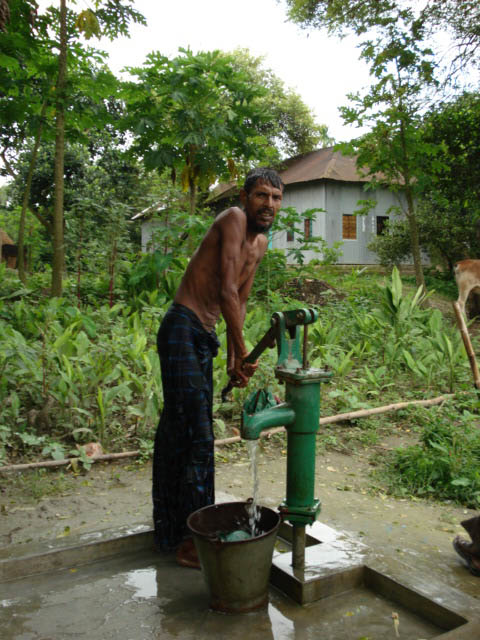
Thanks principally to the work of water engineer Peter Ravenscroft with other geochemists, the source of arsenic in groundwater was narrowed down to the effect of reducing conditions in grey, carbonaceous sandstones and peats on the mineral goethite, an iron oxy-hydroxide that forms the main colorant in oxidised sediments and whose loose structure normally encourages the mopping-up by surface adsorption of a wide spectrum of dissolved ions, including those of arsenic. Goethite readily breaks down under reducing conditions, and when that happens all the adsorbed material is released into solution. The upper parts of the alluvial and deltaic sediments in the lower reaches of the Ganges and Brahmaputra rivers contain abundant organic remains picked up when vegetation burgeoned during the Holocene, which mixed with goethite-coated sand grains derived from erosion in the Himalayan stretches of the rivers. Purely natural sedimentary and hydrogeological processes created the dreadful plight of villagers. The terrible irony was that before the 1980s there were no signs of arsenicosis, yet mortality, especially of under-fives, was very high due to water-borne pathogens in surface water supplies. Indian and Bangladeshi authorities and UN agencies waged a campaign to sink shallow wells for drinking water rather than relying on river and pond supplies. At first rural people resisted the change since they regarded water from wells as the ‘Devil’s water’, but as infant mortality began to fall, the resistance turned to rapid construction nationwide of wells, both public and private. A few years later came the ‘Black Rain’.
In the attempts to mitigate the arsenicosis plague, filters containing adsorptive materials, including goethite, were installed on pumps. However, the geochemists showed that in the deeper wells there were consistently low concentrations of arsenic in sediments that were brown-coloured due to prevailing oxidising conditions and the presence of goethite. Although arsenic was present in the sediments it was safely locked in the goethite coatings of sand grains. Steadily major public supplies were transferred to deep, high-yield wells. Alluvial and deltaic deposits are generally highly permeable, so it was feared that as the deeper wells were pumped arsenic-rich water from the reduced shallow sediments would replace the safe groundwater. Thankfully, it seems that is not likely to be a problem (Radloff, K.A. and 12 others 2011. Arsenic migration to deep groundwater in Bangladesh influenced by adsorption and water demand. Nature Geoscience, v. 4, p. 793-798). The study injected As-bearing groundwater into a deep aquifer and monitored its arsenic concentration over time, once in place. Within a day, the concentration of dissolved arsenic fell by 70% and by 5 days had fallen below recommended maximum levels for drinking water; a dramatic demonstration of the clean-up power of even minute films of goethite in sediments, for that seems the only explanation for the fall. The US-Bangladeshi team verified this by testing samples of the deeper sediments from drill cuttings. They mixed highly contaminated groundwater with the cuttings, to find that arsenic sorption over about a week was extremely high (~40mg kg-1).
Rather than just publishing their reassuring findings, the team input them to hydrogeological models of the Bengal Basin, varying hypothetical pumping rates to assess the changes in deep-groundwater chemistry over time due to downward migration of the highly polluted near-surface waters. Sure enough, the As-rich waters would end up in the deep aquifer eventually to overwhelm the sorptive capacity of its goethite content; arsenic would once again enter well supplies. However, if deep extraction was limited to drinking water by limiting pumping for irrigation to intermediate depths, safe limits could be sustained theoretically for a thousand years or more, except in some areas especially prone downward intrusion of polluted shallow groundwater. (Use of highly contaminated shallow groundwater for irrigation would simply transfer the problem to crops.) Clearly, monitoring is obligatory, but one hopes this important study does resolve the horrifying plight faced by so many people in catchments fed by Himalayan waters.
Aftermath of the 1906 mine explosion at Courrières, northern France; the largest mining disaster in Europe with 1099 fatalities. Image via Wikipedia
Britain is on the cusp of a shale-gas boom (see Britain to be comprehensively fracked? : EPN 14 October 2011) and it is as well to be prepared for some potential consequences. In extensively fracked parts of the US – the states of New York, Pennsylvania, Texas and Colorado – there are reports of water taps emitting roaring flames after dissolved methane in groundwater ignites. This is largely due to common-place household water supplies from unprocessed groundwater, which are rare in Britain. But there are other hazards (Mooney, C. 2011. The truth about fracking. Scientific American, v. 305 (Nov 2011), p. 62-67) that have enraged Americans in affected areas, which are just as likely to occur in Britain. In fact the nature of shale-gas exploitation by horizontal drilling beneath large areas poses larger threats in densely populated area, as the people of Blackpool have witnessed in the form of small earthquakes that the local shale-gas entrepreneur Cuadrilla admit as side effects of their exploratory operations .
Chris Mooney succinctly explains the processes involved in fracking shale reservoirs; basically huge volumes of water laced with a cocktail of hazardous chemicals and sand being blasted into shales at high pressure to fracture the rock hydraulically and create pathways for natural gas to leak to the wells. One risk is that this water has to be recovered and stored in surface ponds for re-use. About 75% returns to the surface and also carries whatever has been dissolved from the shales, which can be extremely hazardous. By definition a shale containing hydrocarbons creates strongly reducing conditions, which in turn can induce several elements to enter solution as well as easily dissolved salts; for instance divalent iron (Fe2+) is highly soluble, whereas more oxidised Fe3+ is not, so waters having passed through gas-rich shales will be iron-rich. But that is by no means the worst possibility; one of the most common iron minerals in sedimentary rocks is goethite (FeOOH), which adsorbs many otherwise soluble elements and compounds. In reducing conditions goethite can break down to release its adsorbed elements, among which is commonly arsenic. The blazing faucet hazard results from hydrocarbon gases leaking through imperfectly sealed well casings to enter shallow groundwater, where the gases can also create reducing conditions and release toxic elements and compounds into otherwise pure groundwater by dissolution of ubiquitous goethite, as in the infamous arsenic crisis of Bangladesh and adjoining West Bengal in India where natural reducing conditions do the damage.
What is not mentioned in the Scientific American article is the common association of hydrogen sulfide gas with petroleum, produced from abundant sulfate ions in formation water by bacteria that reduce sulfate to sulfide in the metabolism. This ‘sour gas’, as it is known in the oil industry, is a stealthy killer: at high concentrations it loses its rotten-eggs smell and in the early days of the petroleum industry killed more oil workers than did any other occupational hazard. Visit the spa towns of Harrogate in Yorkshire and Strathpeffer in northern Scotland and sample their waters for examples of what Carboniferous and Devonian gas-rich shales produce quite naturally: noxious stuff of questionable efficacy. The environmental effects of such natural seepage from gas-rich rocks tell a cautionary tale as regards fracking. The highly reducing cocktail of hydrocarbon and sulfide gases in rising, mineral-rich formation water kills the microbiotic symbionts that are essential to plant root systems for nutrient uptake die and so too do trees. The onshore Solway Basin of Carboniferous age in NW England illustrates both points, having many chalybeate springs as the sulfide- and iron-rich waters are euphemistically known and also a strange phenomenon in many of the deep valleys cut by glacial melt waters as land rose following the last glacial maximum. Once trees reach a certain height – and correspondingly deep root systems – they die, to litter the valley woodland with large dead-heads. Also leaves on smaller trees turn to their autumnal colours earlier than on higher ground. Both seem to be due to minor gas seepages from thick sale sequences in the depths of the sedimentary basin. Indeed, both are botanical indicators to the hydrocarbon explorationist.
To recap, a common size of a fracking operation using several horizontal wells driven from a single wellhead is 4km in diameter entering gas-rich shales at up to 2 km depth. Each well can generate fractures of a hundred metres or more in the shales and surrounding rocks, as they have to for commercial production. In Britain, most of the sites underlain by shales with gas potential are low-lying agricultural- or urban land. The producing rock in the Blackpool area is the Middle Carboniferous Bowland Shale that lies beneath the Coal Measures of what was formerly the Lancashire coalfield, now a patchwork of expanding urban centres. On 23 May 1984 an explosion occurred in Abbystead, Lancashire at an installation designed to pump winter flood water between the rivers Lune and Wyre through a tunnel beneath the Lower to Middle Carboniferous Bowland Fells. The Abbystead Disaster coincided with an inaugural demonstration of the pumping station to visitors, of whom 16 were killed and 22 injured. Methane had escaped from Carboniferous shales to build up in the flood-balancing tunnel soon after its construction. Methane build-ups were by far the worst hazard throughout the history of British coal mining, thousands dying and being maimed as a result of explosions. One of the largest death tolls in British coal-mining history was 344 miners at Hulton Colliery in Westhoughton, Lancashire in 1910 after a methane explosion; the methane may well have escaped from the underlying Bowland Shales.
Japan's deep-sea Drilling Vessel "CHIKYU" Image via Wikipedia
The most important factors in attempting to assess risk from earthquakes are their frequency and the time-dependence of seismic magnitude. Historical records, although they go back more than a millennium, do not offer sufficient statistical rigor for which tens or hundreds of thousand years are needed. So the geological record is the only source of information and for most environments it is incomplete, because of erosion episodes, ambiguity of possible signs of earthquakes and difficulty in precise dating; indeed some sequences are extremely difficult to date at all with the resolution and consistency that analysis requires. One set of records that offer precise, continuous timing is that from ocean-floor sediment cores in which oxygen isotope variations related to the intricacies of climate change can be widely correlated with one another and with the records preserved in polar ice cores. For the past 50 ka they can be dated using radiocarbon methods on foraminifera shells The main difficulty lies in finding earthquake signatures in quite monotonous muds, but one kind of feature may prove crucial; evidence of sudden fracturing of otherwise gloopy ooze (Sakagusch, A. et al. 2011. Episodic seafloor mud brecciation due to great subduction zone earthquakes. Geology, v.39, p. 919-922).
The Japanese-US team scrutinised cores from the Integrated Ocean Drilling Program (IODP) that were drilled 5 years ago through the shallow sea floor above the subduction zone associated with the Nankai Trough to the SE of southern Japan. Young, upper sediments were targeted close to one of the long-lived faults associated with the formation of an accretionary wedge by the scraping action of subduction. Rather than examining the cores visually the team used X-ray tomography similar to that involved in CT scans, which produce precise 3-D images of internal structure. This showed up repeated examples of sediment disturbance in the form of angular pieces of clay set in a homogeneous mud matrix separated by undisturbed sections containing laminations. The repetitions are on a scale of centimetres to tens of centimetres and were dated using a combination of 14C and 210Pb dating (210Pb forms as a stage in the decay sequence of 238U and decays with a half-life of about 22 years, so is useful for recent events). The youngest mud breccia gave a 210Pb age of AD 1950±20, and probably formed during the 1944 Tonankai event, a great earthquake with Magnitude 8.2. Two other near-surface breccias gave 14C ages of 3512±34 and 10626±45 years before present. These too probably represent earlier great earthquakes as it can be shown that mud fracturing and brecciation by ground shaking needs accelerations of around 1G, induced by earthquakes with magnitudes greater than about 7.0. So, not all earthquakes in a particular segment of crust would show up in seafloor cores, most inducing turbidity flow of surface sediment, but knowing the frequency of the most damaging events, both by onshore seismicity and tsunamis, could be useful in risk analysis. In its favour, the method requires cores that penetrate only about 10 m, so hundreds could be systematically collected using simple piston coring rigs where a weighted tube is dropped onto the sea floor from a small craft.




 Earth-logs