Tungsten isotopes provide a ‘vestige of a beginning’

Apart from ancient detrital zircons no dated materials from the Earth’s crust come anywhere near the age when our home world formed, which incidentally was derived by indirect means. Hutton’s famous saying towards the close of the 18th century, ‘The result, therefore, of our present enquiry is, that we find no vestige of a beginning, – no prospect of an end’ seems irrefutable. Hardly surprising, you might think, considering the frantic pace of events that have reworked the geological record for four billion years and convincing evidence that not long after accretion the Moon-forming collision may have melted most of the early mantle. But there is a way of peering beyond even that definitive catastrophe. The metal tungsten, as anyone from the steel town of Rotherham will tell you, alloys very nicely with iron and makes it harder, stronger and more temperature resistant. Most of the Earth’s original complement of tungsten probably ended up in the core; it is a siderophile element. But traces can be detected in virtually any rock and, of course, in W-rich ore bodies. Its interest to modern-day geochemists lies in its naturally occurring isotopes, particularly 182W, a proportion of which forms by decay of a radioactive isotope of hafnium (182Hf). Or rather it did, for 182Hf has a half-life of about 9 million years. Only a vanishingly small amount from a nearby supernova that may have triggered  formation of the solar system remains undecayed.

Artistic impression of the early Earth before Moon formation. (Source: Creative Commons)

A sign of the former presence of 182Hf in the early Earth comes from higher amounts of its daughter isotope 182W in some Archaean rocks (3.96 Ga) than in younger rocks. That excess is probably from undecayed  182Hf  in asteroidal masses that bombarded the Earth between 4.1 and 3.8 Ga. Now it turns out that some much younger flood basalts from the Ontong Java Plateau on the floor of the West Pacific Ocean (~120 Ma) and Baffin Island in northern Canada (~60 Ma) also contain anomalously high 182W/184W ratios (Rizo, H. et al. 2016. Preservation of Earth-forming events in the tungsten isotopic composition of modern flood basalts. Science, v. 352, p. 809-812; see also: Dahl, T.W. 2016. Identifying remnants of early Earth. Science, v. 352, p. 768-769). A different explanation is required for these occurrences. The flood basalts must have melted from chemically anomalous mantle, which originally contained undecayed 182Hf. The researchers have worked out that this heterogeneity stems from a silicate-rich planetesimal that had formed in the first 50 Ma of the solar system’s history, and was accreted to the Earth before the Moon-forming event – lunar rocks formed after 182Hf became extinct. That catastrophe and the succeeding 4.51 Ga of mantle convection failed to mix the ancient anomaly with the rest of the Earth.

Hunting down the Tully Monster

The word ‘monster’ has its origin in the Latin monere ‘to warn’ but has broadened out in its usage.  It has even reverted to its origins as a verb: a highly critical, verbal attack. But I prefer ‘something about which one needs to be warned’, and the Tully Monster encapsulates that meaning. It once lived in Illinois, specifically at just a single location, Mazon Creek, where thousands of them have been seen. But should you be especially fearful of Tullimonstrum gregarium? Well, at first sight, no; it’s only about 10 cm long and apparently has no proper bones and it’s dead. The first was spotted in a coal-mine waste heap by Francis Tully in 1958, a pipefitter with an interest in Carboniferous fossils. Two years after his death in 1987, he and his monster were honoured by a bill that the Illinois State Legislature passed to make it the official State Fossil.

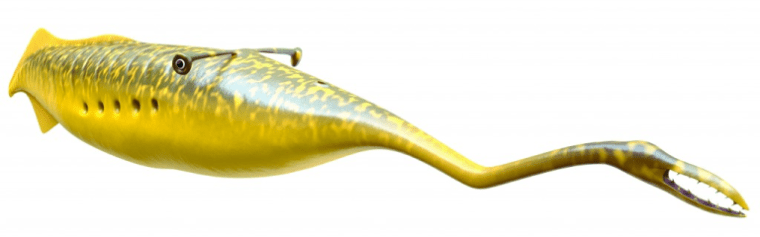
Artist's impression of the Carboniferous Tully Monster (
Artist’s impression of the Carboniferous Tully Monster (Tullimonstrum gregarium) (credit: Sean McMahon, Yale University)

It seems to have become a ‘monster’ by stumping all previous attempts to categorise it; so much so that it long served as a warning to eager palaeontologists not to tangle with its taxonomy. That’s not surprising, because as well as bearing a passing resemblance to Captain Nemo’s submarine in Jules Verne’s 20 000 leagues Under the Sea, it has some truly astonishing features.  Portholes down its sides are not the weirdest – actually they are gill openings. It has a biting apparatus at the end of an absurdly lengthy forward protuberance, that would not be unexpected if it were one of those fish from the Amazon that, you know, men really ought to be warned about. Most of us would not share a bath with it if we had been. And then, there are the eyes on the ends of a dorsal bar which would give Tullimonstrum gregarium superb stereoscopic vision to guide it unerringly to its target, lashing its efficient-looking caudal fin. The fact that it has only a single nostril is merely puzzling by comparison.

Six decades on, Victoria McCoy of Yale University (now at Leicester University, UK) and 15 undeterred colleagues have pored over more than 1200 Tully Monster fossils and seem to have cracked its affinities (McCoy, V.E. et al. 2016. The ‘Tully monster’ is a vertebrate. Nature, v. 532, p. 496-499). In fact, it’s surprising that it has remained an enigma for so long, because McCoy and colleagues have documented almost every aspect of its anatomy, available from a huge number of superbly preserved specimens – teeth, fin, muscle traces, gills, nostril, notochord, gut and so on. As well as being a vertebrate, its dreadful proboscis is very like that of the Cambrian oddity Opabinia from the Burgess Shale. A  separate study by four British palaeontologists and a Texan concentrated on the eyes using electron microscopy and found ‘ultrastructural details’, including pigment cells (Clements, T. et al. 2016. The eyes of Tullimonstrum reveal a vertebrate affinity. Nature, v. 532, p. 500-503) which unequivocally confirm that it is a vertebrate. It has all the hallmarks of being related to lampreys and hagfishs. They devour rotting, drowned corpses.

Homo floresiensis, aka the ‘Hobbit’, is somewhat older

In 2004 a newly discovered hominin fossil from the Indonesian island of Flores made headlines worldwide. Although an adult, it was tiny – about a metre tall, had a commensurately small brain (the size of a grapefruit), had made tools and hunted small elephants and giant rats. Dates from the cave floor sediments that had entombed it gave ages as young as 13 to 11 thousand years and as far back as 850 ka. So H. floresiensis was regarded as being the last human to share the Earth with us; that is, if it was a different species rather than a product of evolutionary shrinkage of anatomically modern humans stranded and isolated on the island for a very long time. Then there was talk among locals of the legendary Ebo Go-Go, with whom their ancestors had shared the island – they had arrived between 35 to 55 thousand years ago.

Homo floresiensis (the "Hobbit")
Homo floresiensis (the “Hobbit”) ( credit: Wikipedia)

Unsurprisingly, a major controversy raged in palaeoanthropology circles, between those who demanded either island dwarfism or congenital deformity of modern humans, and the other camp focused on many anatomical differences that pointed to a bona fide companion to later immigrants who perhaps survived into modern times. The ‘Hobbit’ became a cause celebre, but many of the original protagonists are now left with the proverbial egg on their faces. The cave sediments turn out to have a much more complex stratigraphy than previously thought, following further excavations led by the original discoverer Thomas Sutikna of the Pusat Penelitian Arkeologi Nasional in Jakarta Indonesia (Sutikna, T. and 19 others 2016. Revised stratigraphy and chronology for Homo floresiensis at Liang Bua in Indonesia. Nature, v. 532, p. 366-369.

English: Cave where the remainings of ' where ...
Liang Bua cave on Flores island, Indonesia, where the remains of Homo floresiensis were discovered in 2003. (credit: Wikipedia)

The delayed appearance of the revision is hardly surprising, given the lengthy political squabbles surrounding access to the site. And neither are the outcomes, for cave sediments are notoriously tricky because of their episodic reworking by cave floods and roof falls, together with the difficulty in finding materials suited to dating in tropical settings. The original charcoal used in radiocarbon dating and sand grains subject to the thermoluminescence method were in fact from a  unit that lies unconformably against the stratum that hosted the fossils. More sophisticated luminescence dating of the actual fossil-hosting sediments yield ages between 100 to 60 ka, tool-bearing units range from 190 to 50 ka. The origins of H. floresiensis are thus pushed back beyond the date of supposed colonisation by H. sapiens, and remain an open question.

New ideas on evolution of the Solar System

The Kepler Space Telescope launched in 2009 was designed to detect and measure planetary bodies orbiting other stars. It was hoped that it would help slake the growing thirst for signs of alien but Earth-like worlds, extraterrestrial life and communications from other sentient beings. Results from the Kepler mission have, however, fostered a growing awareness that all is not well with the simple, Laplacian formation of planetary systems. For a start not one of the thousands of exoplanets revealed by Kepler is in a planetary system resembling the Solar System, let along sharing crucial attributes with the Earth. Giant planets occur around only a tenth of the stars observed, and even fewer in stable, near-circular orbits. Although it is early days in the quest for Earth- and Solar System look-alikes, some unexpected contrasts with the Solar System are emerging. For instance, many of the systems have far more mass in close orbit around their star, including gas giants with orbital periods of only a few days and giant rocky planets. Such configurations defy the accepted model for the Solar System where an outward increase in the proportion of volatiles and ices was thought to be the universal rule. Could these ‘hot Jupiters’ have formed further out and then somehow been dragged into scorching proximity to their star? Answers to this and other questions have been sought from computer simulations of the evolution of nebulas. Inevitably, the software has been applied to that of the Solar System, and the results are, quite literally, turning ideas about its early development inside out (Batygin, K., Laughlin, G. & Morbidelli, A., 2016. Born of chaos. Scientific American, v. 314(May 2016),  p. 20-29).

An artist's impression of a protoplanetary disk
An artist’s impression of a protoplanetary disk (credit: Wikipedia)

It seems that at some stage in its growth from the protoplanetary disk the gravitational influence of a planet creates mass perturbations in the remainder of the disk. These feed back to the planet itself, to others and different parts of the disk to create complex and continuously evolving motions; individual planets may migrate inwards, outwards or escape their star’s influence altogether in a chaotic, unpredictable dance. Ultimately, some balance emerges, although that may involve the star engulfing entire worlds and other bodies ending up in interstellar space. It may also end up with worlds dominated by ‘refractory’ materials – i.e. rocky planets like Earth – orbiting further from their star than those composed of ‘volatiles’. In the case of the early Solar System the modelling revealed  Jupiter and Saturn drifting inwards and dragging planetesimals, dust, ice and gas with them to create a gap in the protoplanetary disk. Within about half a million years the two giant planets became locked in their present orbital resonance, which changed the distribution of angular momentum between them and reversed their motion to outward. The clearing of mass neatly explains the asteroid belt and Mars’s otherwise inexplicably small size.

One of the characteristics emerging from Kepler’s discoveries is that ‘super Earths’ orbit close to their star in other systems. Had they existed in the early Solar System the inward drive of Jupiter and Saturn and their ‘bow wave’ of smaller bodies would have had consequences. Swarms of matter from the ‘bow wave’ captured and dissipated angular momentum from the super Earths and dissipated it within a few hundred thousand years, thereby pushing them into death spirals to be consumed by the Sun. This explains what by comparison with Kepler data is a mass deficit in the inner Solar System. The rocky planets – Mercury, Venus, Earth and Mars – accreted from the leftovers, perhaps over far longer periods than previously thought.

Intense bombardment of the Moon and the Earth took place during the first half billion years after they had formed, rising to a crescendo in its later stages. Formation of the mare basins brought it to a sudden close at 3.8 Ga, which coincides with the earliest evidence for life on Earth. Lunar evidence indicates that this Late Heavy Bombardment spanned 4.1 to 3.8 Ga. Previously explained by a variety of unsatisfying hypotheses it forms part of the new grand modelling of jostling among the giant planets. Once Jupiter and Saturn together with Uranus and Neptune had stabilised, temporarily, they accumulated lesser orbital perturbations from an outlying disk of evolving dust and planetesimals throughout the Hadean Eon. Ultimately, around 4.1 Ga, the giant planets shifted out of resonance, pushing Jupiter slightly inwards to its current orbit and thrusting the other 3 further outwards. Incidentally, this may have flung another giant planet out of solar orbit to the void. Over about 300 million years they restabilised their orbits through gravitational interaction with the Kuiper belt but at the expense of destabilising the icy bodies within it. Some fled inwards as a barrage of impactors, possibly to deliver much of the water in Earth’s oceans. By 3.8 Ga the giants had settled into their modern orbital set-up; hopefully for the last time.

Most exotic geology on far-off Pluto

About 9 months ago NASA’s New Horizons spacecraft flew past the binary dwarf planets Pluto and Charon more than 9 years after launch. Everyone knew they would be frigid little worlds but the great risk was that they might turn out to be geologically boring. The relief when the first images finally arrived – New Horizons’ telecoms are pretty slow – was obvious on the faces at mission control. Even non-Trekkies, such as me, will be thrilled by the first in-depth, illustrated account (Moore, J.M. and 41 others 2016. The geology of Pluto and Charon through the eyes of New Horizons. Science, v. 351, p. 1284-1293), part of a five-article summary of early findings; the other 4 are on-line and scheduled for full publication later (summaries in Science, 18 March 2016, v. 351, p. 1280-1284). A gallery of images can be seen here and an abbreviated summary of the series here.

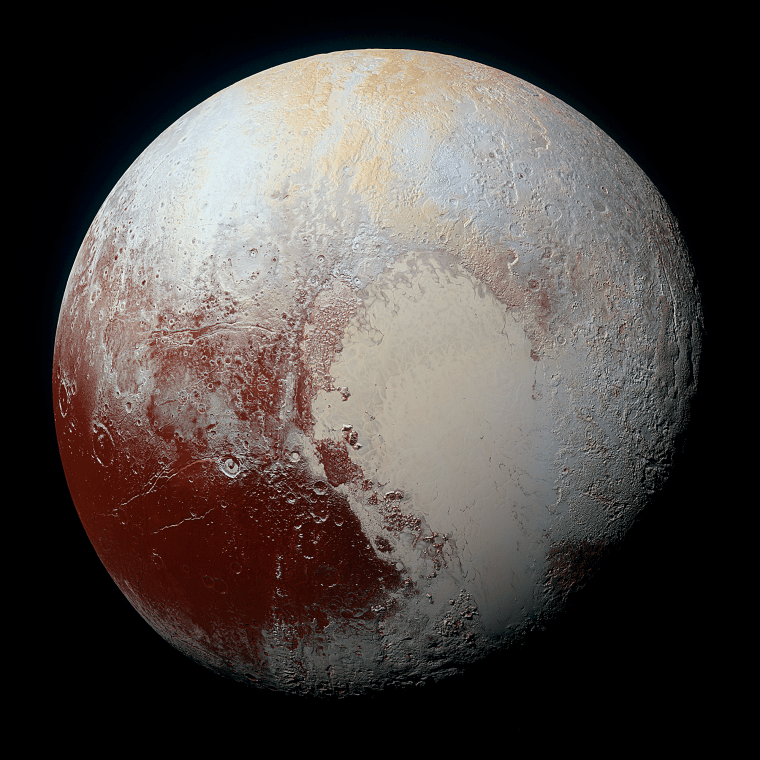
Pluto imaged in approximately natural colour by New Horizons. (credit: NASA)

They are astonishing places, even at a resolution of only about 1 km (270 m for some parts), and only one fully illuminated hemisphere was imaged for each because of the short duration of the fly-by. Pluto is by no means locked in stasis, for one of its largest features, Sputnik Planum, is so lightly cratered that is must be barely 10 Ma old at most. It is a pale, heart-shaped terrane dominated by smooth plains, which have a tiled or cellular appearance, with flanking mountains up to 9 km high that appear to be a broken-up chaos. Much of it is made of frozen nitrogen, carbon monoxide and methane. The dominant nitrogen ice has low strength which accounts for the large area of very low relief. The highly angular mountains are water ice that is buoyant and stronger relative to the others making up Sputnik Planum. Across the plain are areas of pitting and blades that seem to have formed by ice sublimation (solid to gas phase transitions) much like terrestrial snow or ice fields that have begun to degrade, and there are even signs of glacier-like flow.

4 Ga old cratered, upland terranes surrounding Sputnik Planum display grooved, ‘washboard’ and a variety of other surface textures reminiscent of dissection. The may have formed by long-term lateral flow (advection) of nitrogen ice and perhaps some melting. It is in this rugged part of Pluto that colour variation is spectacular, with yellows, blues and reds, probably due to deposition of hydrocarbon ‘frosts’ condensed from the atmosphere. That Pluto is still thermally active is shown by a few broad domes with central depressions that suggest volcanism, albeit with a magma made of ices. Areas of aligned ridges and troughs provide signs of tectonics, possibly extensional in nature.

Charon imaged in approximately natural colour by New Horizons. (credit: NASA)

Charon  shows little sign of remaining active and capable of remoulding its surface. The hemisphere that has been imaged is spectacularly bisected by a 200 km wide belt of roughly parallel escarpments, ridges and troughs with a relief of about 10 km. Superimposed by large craters the extensional system probably dates back to the early history of the outer Solar System. Dominated by water ice it seems that Charon’s surface may have lost any more volatile ices by sublimation and loss to space. This suggests that superficial differences between two small worlds of similar density may be explained by Charon’s lower mass and gravitational field, resulting in the loss of its most volatile components that partly veneer the surface of Pluto.

Being hugely distant from any other sizeable body it is likely that the energy used to form cryovolcanic eruptions and deform the surface of both dwarf planets is due to internal radioactivity. Their similar mean density around 1.9 implies rocky cores that could host the required unstable isotopes. Being the only Kuiper Belt objects that have been closely examined naturally suggests that the rest of the myriad bodies that clutter it are similar. There are currently as many as 9 other sizable bodies suspected of eccentrically orbiting the Sun in the Kuiper Belt, including one that may be ten times more massive than Earth – a candidate for a ninth planet to replace Pluto, which was removed from that status following redefinition in 2006 of what constitutes a bona fide planet.

Neanderthals and Denisovans at it more often

Palaeogeneticists certainly have the bit between their teeth as DNA sequencing methods become faster and more productive and statistical methods of sequence analysis and comparison are made more powerful. Only last month I reported on the two-way breeding unearthed from the data on single-chromosome DNA extracted from Croatian and Spanish Neanderthals, as well as some of the tangible inheritance from Neanderthals found in living non-African people. Now a team of statisticians, anthropologists and genetic sequencers have applied the new approaches to the genomes of over 1500 non-Africans, including 35 living Melanesian people from Papua-New Guinea (Vernot, B. and 16 others 2016.  Excavating Neandertal and Denisovan DNA from the genomes of Melanesian individuals. Science, v. 351 doi:10.1126/science.aad9416).  Melanesians had previously shown evidence of hybridization with both Neanderthals and Denisovans. The most interesting outcome is that the analyses pointed towards yet more instances of interbreeding between ancestors of modern non-Africans and Neanderthals. Many East Asians have 3 Neanderthals in their family trees, for Europeans and South Asians the score is 2, while Melanesians show descent from one Neanderthal and one Denisovan. Moreover, it emerges that interbreeding episodes were at different times among different populations since anatomically modern humans migrated from Africa, beginning perhaps as long ago as 130 ka and recurring later, after different regional groups of AMH had proceeded on their separate ways.

English: Melanesia, a cultural and geographica...
Melanesia, a cultural and geographical area in the Pacific. (credit: Wikipedia)

A second study (Sankararaman, S. et al. 2016. The combined landscape of Denisovan and Neanderthal ancestry in modern humans. Current Biology, v. 26, p. 1-7) has teased out evidence for Denisovan ancestry among South Asians, their admixture with Melanesians after that group acquired Neanderthal forebears, and significant signs  of dwindling fertility among hybrid males.

Early 2016 has been very fertile as regards palaeoanthropology. Katherine Zink and Daniel Lieberman of Harvard University focus on the small teeth of Homo erectus and later humans, wondering if they arose following a major shift in culinary practices (Zink, K.D. & Lieberman, D.E. 2016. Impact of meat and lower Palaeolithic food processing techniques on chewing in humans. Nature, v. 531, p. 500-503). Their work is based  on experiments to discover how much chewing is needed to make it possible to swallow different uncooked foodstuffs (assuming that cooking did not arise until after 500 ka). It seems that simply introducing meat to the diet would have reduced mastication by around 13% (2 million chews) per year, with a 15% reduction in applied chewing force. Simply slicing and pounding takes out another 750 thousand annual chews and gives a 12% fall in average biting force. So, here’s a link between tools and human gnashers as well as with development of the hand. Fascinating, perhaps, but every hominin species since 7 Ma old Sahelanthropus tchadensis had far smaller canine teeth than are the norm among non-hominin living and fossil apes. Something else was going on with dentition during our evolution, which may have been a loss of the need for threatening teeth. From ‘Do that again and I’ll bite you’, to ‘Let’s chew this over’…

More on Neanderthals, Denisovans and anatomically modern humans

A ‘proper’ stratigraphic view of the ‘Anthropocene’

Readers may recall my occasional rants over the years against the growing bandwagoning for an  ‘Anthropocene‘ epoch at the top of the stratigraphic column. I , for one, was delighted to find in the latest issue of GSA Today a more sober assessment of the campaign by two stratigraphers who are well placed to have a real say in whether or not the ‘Anthropocene’ is acceptable, one serving on the International Commission on Stratigraphy, the other on the North American Commission on Stratigraphic Nomenclature (Finney, S.C. & Edwards, L.E. 2016. The “Anthropocene” epoch: Scientific decision or political statement? GSA Today, v. 26 (3–4).

Fracking unlikely in Europe

These days, leading British politicians burdened with power have a tendency to show outwardly that they are, if little else, earnest. When busy with economic and industrial policy they wear tailored day-glo hi-viz suits and shiny new hard hats. During the great 2015 floods of Northern England, their garb was off the peg North Face gear and green wellington boots. And, of course, for social policy a hoodie is de rigueur. Rosy-cheeked Prime Minister David Cameron has been extremely earnest about fracking for shale gas for several years, and in the petroleum industry the appropriate signal of a leading politician’s enthusiasm is to wear a rigger’s blue jumpsuit; ‘We’re going all out for shale’ Cameron has said. Given the explosive success of shale-gas exploitation in North America over the last decade that’s not very surprising, but do not expect to see him looking earnestly at an exploration rig again any time soon.

Cameron’s excitement began when in 2011 the Advanced Resources Institute (ARI) in Washington DC released the results of its consultancy for the US Department of Energy on global shale-gas prospects. The star prospect in Europe was Poland, well endowed with subsurface shales, which according to ARI, had more than 5 trillion cubic metres of technically recoverable reserves, enough to satisfy Polish consumption for more than 300 years. In 2013, ARI suggested 17 trillion m3 beneath Britain, albeit only 0.7 trillion that was amenable to fracking (about a decade’s worth of British gas consumption). But still the hype was maintained. An article in the 3 March 2016 issue of Nature (Inman, M. 2016. Can fracking power Europe. Nature, v. 531, p. 22-24) tempers enthusiasm a great deal more.

The Polish Geological Institute revised the country’s reserves down to a tenth of ARI’s estimate. After an initial frenzy of interest following the ARI report, when exploration licences covered a third of Poland, during 2013 and 2014 major companies relinquished licences for fracking en masse. Their exploratory activities had been disappointing because of the depth of burial (2-5 km compared with 1-2 km in the US) and unfavourably high clay content and strength of the target shales. The less thrilling ARI prospects for Britain did not excite major petroleum players at all, what interest there is being from ‘juniors’ such as Cuadrilla. The British Geological Survey, which has huge archives of geological information, both surface and subsurface, has assessed the three main British shale-gas ‘plays’ and comes up with a reserve figure of between 24 and 68 trillion m3. But that high figure is based on the situation in mid-west North American shale-gas fields, where the geology is a great deal simpler than here. In Britain, orogenies at the end of the Carboniferous and the outermost ripples of that which formed the Alps in late Mesozoic and Palaeogene times created far more deformation than beneath the central plains of North America. Widespread faults, even though few in Britain have large displacements, pose two sets of problems. As the minor earthquakes set off by fracking in the tectonically simple Fylde area of western Lancashire indicate, pumping fluids into faulted rock can release pent-up elastic strain. But such leakage into faults and smaller fractures may also cause the injection pressure to fall, making the fracking process less efficient.

https://i0.wp.com/www.agentsofchangefoundation.org/wp-content/uploads/2014/06/4596344953.jpg
Fracking information sheet from the British Geological Survey

Inman reports that fracking is now moribund throughout Europe, partly because of the disappointing results and also because environmental concerns for densely populated regions have spurred widespread moratoria, including those in three of Britain’s four nations; Scotland, Wales and Northern Ireland. The only current European fracking activity is in England, conducted by a handful of junior companies. A stumbling block in England actually lies with the quality of subsurface data for what has been described at the most close examined geology in the world. Since the early 1980s there has been a succession of onshore licensing rounds for oil and conventional gas, the 14th of which is still active. The early ones were accompanied by a great deal of seismic reflection surveying, mainly using the truck mounted ‘Vibroseis’ method where the ground is mechanically thumped rather than subject to explosive shot firing that is favoured in sparsely populated areas. According to BGS, the guardians of the onshore seismic exploration repository, compared with the onshore seismic data available in North America that for Britain is ‘sparse, and fairly poor’.

Neanderthal news

Note: Earth-Pages will be closing as of early July, but will continue in another form at Earth-logs

Increasingly sophisticated analysis of existing genomes from Neanderthal and Denisovan fossil bone, together with new data on single-chromosome DNA extracted from Croatian and Spanish Neanderthals continues to break new ground.

Artistic reconstruction of Neanderthal woman (credit: Natural History Museum, http://www.nhm.ac.uk/natureplus/blogs/tags/human_evolution)

According to genome comparison between a Siberian specimen and modern humans, a population from which Neanderthals emerged separated from that which led to anatomically modern humans (AMH) sometime between 550 and 765 ka, although the fossil record can only confirm that divergence was before 430 ka. The comparison famously showed that Neanderthals contributed to modern, non-African humans between 47 and 75 ka, that is after the exodus of AMH from Africa that spread our species throughout all continents except Antarctica. This genetic exchange is thought to have taken place somewhere in the Middle East, which seems to have been a major staging post for our spread further east and also westward to Europe. A similar indication of liaison between Denisovans and AMH migrants is restricted to modern Melanesians, and probably took place in eastern Asia before 45 ka, when modern people began crossing from Eurasia to New Guinea and Australia. Neanderthal-Denisovan comparison suggests that those distinct groups separated between 380 and 470 ka ago (recently revised from an earlier estimate).

In both cases the gene flow was from the older groups to humans. Further examination of Siberian Neanderthal genomes now indicates that a reverse exchange occurred more than 100 ka ago (Kuhlwilm, M. and 21 others 2016. Ancient gene flow from early modern humans into Eastern Neanderthals. Nature, v. 530, p. 429-433). But the single-chromosome DNA from Croatian and Spanish Neanderthals shows no such sign This instance of two-way exchange is significant in another way: it took place before direct evidence of the generally accepted departure of African migrants to populate the rest of the world. At about 100 ka there is fossil evidence of possible AMH-Neanderthal cohabitation of the Levant, followed by a period with fossil evidence for Neanderthal presence there but not modern humans. Because stone tools from northern Arabia are dated as far back as 125 ka and closely resemble those associated with archaic modern humans, there is a possibility that AMH migration was far earlier than previously thought and passed through the Levant en route to points east.

Another tantalizing aspect of Neanderthal-modern human genetics is the tangible legacy of interbreeding with non-African humans. The first sign was that the gene (mc1r) that confers red hair on those of us blessed, or otherwise, with it may have Neanderthal origins, thus making us extremely proud of that heritage. The same gene is implicated in northern modern humans having developed pale skin, which might embarrass ‘white supremacists’! Similar studies in Svante Paabo’s lab at the Max Planck Institute for Evolutionary Anthropology in Leipzig also suggested 15 genome regions that include those involved in energy metabolism, possibly associated with type 2 diabetes; cranial shape and cognitive abilities, perhaps linked to Down’s syndrome, autism and schizophrenia; wound healing; skin, sweat glands, hair follicles and skin pigmentation; and barrel chests. There is more…

Joshua Akey of the University of Washington, Seattle, and evolutionary genomicist Tony Capra of Vanderbilt University in Nashville hit on the idea of ‘mining’ archived genetic information from more than 28 thousand living people for traces of 6000 Neanderthal DNA variants and comparing the results with physical traits and diseases logged in the human database (reported by Gibbons, A. 2016. Neanderthal genes linked to modern diseases. Science, v. 351, p. 648-9). On the plus side, Neanderthal ancestry may help boost immune responses to fungi, parasites and bacteria. Inheritance of enhanced blood coagulation, although greatly assisting recovery from wounds and hemorrhage when giving birth, confers a proclivity to heart attacks and strokes. Neanderthals also passed on ‘weak bladders’, solar keratoses that confer skin cancer risk, a tendency to malnutrition from modern diets low on meat and nuts, depression triggered by jet lag(!) and even a tendency to nicotine addiction. But a ‘pure’ line of modern human descent, shared by most Africans, also has its positive and negative heritable traits.

More on Neanderthals, Denisovans and anatomically modern humans

Focus on glaciation…and avoid physics envy

About 1.3 billion years ago two small black holes, each weighing in at about 30 solar masses, ran into one another and fused. At that time Earthly life forms had neither mouths nor anuses, nor even a nervous system, and they were not much bigger than a sand grain. The distant collision involved  rapid acceleration of considerable masses. A century ago Albert Einstein predicted that the movement of any matter in the universe should perturb space-time in a wave-like form that travels at the same speed as light. Well, he was right for, at 9:50:45 universal time on 14 September 2015, four exquisitely engineered mirrors deployed in the two set-ups of a Laser Interferometer Gravitational-Wave Observatory (LIGO) in Louisiana and Washington states in the US minutely shuddered, first in the Deep South and 0.007 seconds later in the Pacific Northwest. The signal lasted 0.25 seconds and, when rendered as sound, comprised a sort of chirrup starting at 35 Hz and rising to 250 Hz before an abrupt end. Five months later, and silent internationally shared theoretical verification, the story was released to the back slapping, stamping and pawing the air that we have come to expect from clever, ambitious and persuasive people who have spent a great deal of our money and have something to show for it. So now we know that the universe is probably throbbing – albeit very, very, very quietly – with gravitational waves generated by every single motion that has taken place in the whole of ‘recorded’ history since the Big Bang. Indeed, it is claimed, LIGO-like machines may one day detect the big wave itself if, that is, it hasn’t already passed through the solar system. Recall, 13.7 billion years ago the Big Bang didn’t take much longer than this comparatively mundane collision at 1.3 Ga . Physicists are going to have a lot to ponder on now they have a lever to get yet greater funds. To put all this in perspective, the detected chirrup had been traveling for 1.3 Ga, and so too must the actual place in the universe where it took place: I guess we will never know where it is now or what damage or otherwise may have been visited upon planetary systems in its vicinity, if indeed it had even the slightest recognisable geological or ecological consequence.

So, onto the mundane world of glaciology and climate change.

Tibet is the third greatest repository of glacial ice on the surface of the Earth’s continents. It is the focus of one of the planet’s greatest climatic system, the South Asian. While much of the Plateau hasn’t borne glaciers continuously throughout even the last glacial cycle, it is becoming clear that its western margin has remained cold enough to retain ice throughout an even longer period. In the Kunlun mountains is a 200 km2 ice cap known as the Guliya. At the start of detailed glacial stratigraphic ventures in 1990s, focused mainly on Greenland and Antarctica, analysis of a core from the Guliya ice cap yielded dates extending back to 130 ka, before the start if the last interglacial. This section lies above ice that at the time could not be dated reliably other than to show that it may be older than about 750 ka. This stemmed from its lack of the radioactive 36Cl formed, similarly to 14C, by cosmic-ray interactions with stable 35Cl in atmospheric salt aerosols: such cosmogenic chlorine can be used for radiometric dating of ice younger than 750 ka.

A News Feature in the 29 January issue of Science (Qiu, J. 2016. Tibet’s primeval ice. Science, v. 351, p. 436-439) focused on the preliminary results of an expedition, led by Yao Tandong of the Institute of Tibetan Plateau Research, Beijing and Lonnie Thompson of Ohio State University, Columbus, to drill a further five ice cores at Guliya in September 2015, one of which penetrated ove 300 m of glacial ice. It is now possible to date ice layers back to a million years using argon isotopes. Combined with stable isotope and other measurements through the cores, the dating should provide a huge amount of new information on the evolution of the monsoon, which is currently understood only vaguely. Such information would sharpen models of how the monsoon system works and even hint at how it might change during a period of anthropogenic warming. An estimated 1.4 billion people – a fifth of humanity – who live in the Indian subcontinent, China and SE Asia depend for their food-production on the monsoon.

With less humanitarian urgency but equally fascinating is the discovery that, as well as sea-ice, the central Arctic Ocean once hosted vast ice shelves during the last-but-one glacial episode (Jakobsson, M. and 24 others 2016. Evidence for an ice shelf covering the central Arctic Ocean during the penultimate glaciations. Nature Communications, v. 7, doi:10.1038/ncomms10365. Clues emerged from multibeam sonar bathymetry that created detailed images of topography on the floor of the Arctic Ocean. These revealed sets of parallel ridges on the shallowest parts of the polar basin, thought to have formed when moving ice shelves grounded. The depths of the grooved areas indicate ice thicknesses up to and exceeding 1 km. The grooves look very similar to the large-scale lineaments that formed on the surface of the Canadian Shield when the Laurentide ice sheet ground its way from zones of glacial accumulation. Grounding of an ice shelf would have resulted in its thickening in the upflow direction as a result of plastic deformation of the ice, tending to lock the flow and direct ice escape over the deeper parts of the Arctic basin.

Antarctic Ice Shelf
Antarctic Ice Shelf (credit: Wikipedia)

Back-tracking the grooves defines the ice shelf’s source regions in the northern Canadian islands, north Scandinavia and the lowlands of eastern Siberia as well as regional flow patterns and the extent of floating continental ice. The last is a major surprise: at over 4 million km2 it was four times larger than all modern Antarctic ice shelves. The ice moved to ‘escape’ to the North Atlantic Ocean through the Fram Strait between East Greenland and Svalbard (Spitzbergen). Dating sediment stratigraphy in the grooved areas using magnetic and fossil data shows that the ice shelves existed between 160 and 140 ka during the penultimate glacial maximum. For such a mass of glacial ice to be expelled into the Arctic Ocean implies that a great deal more snow fell on its fringes then than during the last glacial maximum. Another possibility is that the huge mass of floating ice regulated the salinity and density of the upper Atlantic in a different way from the periodic iceberg ‘armadas’ that characterized the last glacial epoch and help account for a whole number of sudden warming and cooling events.

Domack, E. 2016. A great Arctic ice shelf. Nature, v. 530, p. 163-164.