Former Senior Lecturer at British Open University, research in remote sensing of arid lands, groundwater exploration, Precambrian tectonics and geochemistry
For many years anthropologists were certain that the Americas remained outside the human realm until the great icecap of North America had begun to melt decisively. This view stemmed partly from the only conceived route being across the exposed floor of the Bering Sea when sea-level had fallen to leave it as a landmass known as Beringia. The other literal stumbling block had been the glacial blockage of the only lowland corridor from Alaska to the Great Plains which roughly follows the Alberta – British Columbia border in Canada. There is abundant evidence that the corridor did not become ice-free until about 13 ka, an important fact that for a long while bolstered the Clovis-First hypothesis, from the eponymous and highly distinctive stone tools that date back to just after that time. After a long, sturdy rearguard action by its devotees that view was transcended by finds of earlier tools with dates as old as 15.5 ka that extend close to the southernmost tip of South America. Studies of Y-chromosome DNA from living First Nations men that suggested that all early Americans stemmed from 4 separate colonising populations who may have entered via Beringia by different routes, including along the Pacific coast. A possible common ancestor of all native Americans has turned up from the mitochondrial and Y-chromosome DNA of a fossil skeleton from near Lake Baikal in Siberia who lived about 24 ka ago. But yet another twist has emerged from the Yukon Territory of Northern Canada.
Beringia Land Bridge. Animation of its development from 21.000 BC to modern times.(Photo credit: Wikipedia)
Since 1987 it has been known that animal bones with clear signs of butchery occurred in the Bluefish Cave on the Yukon – Alaska border. Dating of the bones by the 14C method seemed to support human occupation there during the Last Glacial Maximum; highly controversial at the time, in the absence of any other sites of that age in the whole Americas. The material has now been re-examined and dated by a more advanced radiocarbon method (Bourgeon, L. et al. 2017. Earliest human presence in North America dated to the Last Glacial Maximum: new radiocarbon dates from Bluefish Caves, Canada. PLoS ONE, v. 12; doi:10.1371/journal.pone.0169486). This work has confirmed the earlier view since the ages of bones range from 24 to 12 ka. But the discovery of what seems long-term occupation under the most arduous glacial conditions is not the only outcome of the research. One hypothesis for the genetic diversity among living indigenous people of the Americas is that their forebears, the first people of the Americas, may have been from genetically isolated populations stranded on Beringia, yet surviving eventually to migrate southward once climate warmed. The ‘Beringian standstill hypothesis’ suggest that the small population underwent genetic drift for about eight thousand years, their descendants inheriting the genetic diversity produced by this process. Bluefish Cave is probably where some of those pioneers waited-out the Ice Age
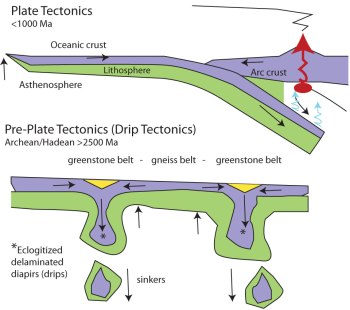
The formulation of the theory of plate tectonics provided plausible explanations for the growth of continental crust over time, among many other fundamental Earth processes. Briefly expressed, once basalt capped oceanic lithosphere is forced downwards at plate boundaries where plates move towards one another, beyond a certain penetration cool, moist basalt undergoes a pressure-controlled change of state. Its chemical constituents reassemble into minerals more stable under elevated pressure. In doing so, one outcome involves dehydration reactions the other being that the bulk composition is recast mainly in the form of high-pressure pyroxene and the mineral garnet: the rock eclogite. The density of the basaltic cap increases above that of the mantle. Gravity acts to pull the subducting slab downwards, this slab-pull force being the main driver of plate motions globally. Water vapour and other fluids shed by dehydration reactions rise from the subducted slab into the wedge of overlying mantle to change its conditions of partial melting and the composition of the magma so produced. This is the source of arc magmatism that persists at the destructive plate margin to increase the volcanic pile’s thickness over time. When magma is able to pond at the base of the new crust its fractional crystallisation produces dense cumulates of high-temperature mafic silicates and residual melt that is both lighter and more enriched in silica. Residual magma rises to add to the middle and upper crust while the cumulate-rich lower crust becomes less gravitationally stable, eventually to spall downwards by delamination. Such a process helps to explain the bulk low density of continental crust built up over time together with the freeboard of continents relative to the ocean floor: a unique feature of the Earth compared with all other bodies in the Solar System. It also accounts for the vast bulk of continental crust having remained at the surface since it formed: it rarely gets subducted, if at all.
Tangible signs that such subduction was taking place in the past – eclogites and other high-pressure, low-temperature metamorphosed basalts or blueschists – are only found after 800 Ma ago. Before that time evidence for plate tectonics is circumstantial. Some geologists have argued for a different style of subduction in earlier times, plates under riding others at low angles. Others have argued for a totally different style of tectonics in Earth early history, marked by changes in bulk chemical composition of the continental crust at the Archaean-Proterozoic boundary. A new twist comes from evidence in the Archaean Pilbara Craton of Western Australia (Johnson, T.E. et al. 2017. Earth’s first stable continents did not form by subduction. Nature, v. 543, p. 239-242; doi:10.1038/nature21383). The authors found that basalts dated at about 3.5 Ga have trace-element geochemistry with affinities to the primitive basalts of island arcs. That makes them a plausible source for slightly younger felsic plutonic rocks with a tonalite-trondhjemite-granodiorite (TTG) compositional range (characteristic of Archaean continental crust). If the basalts were partially melted to yield 30% of their mass as new magma the melt composition would match that of the TTG crust. This would be feasible at only 30 km depth given a temperature increase with depth of at least 25° C per kilometre; more than the average continent geothermal gradient today but quite plausible with the then higher heat production by less decayed radioactive isotopes of uranium, thorium and potassium 3.5 Ga ago. This would have required the basalts to have formed a 30 km thick crust. However, the basalts’ geochemistry requires their generation by partial melting of earlier more mafic basalts rather than directly from the mantle. That early Archaean mantle melting probably did generate vast amounts such primary magma is generally acknowledged and confirmed by the common occurrence of komatiitic lavas with much higher magnesium content than common basalts of modern constructive margins. In essence, Johnson et al. favour thermal reworking of primitive Archaean crust, rather than reworking in a plate tectonic cycle.
Teeth are the most likely parts of skeletons to survive for long periods because of their armour by a layer of enamel made of hydroxyapatite (Ca5(PO4)3(OH)). Dental enamel is the hardest material in the bodies of vertebrate animals and lies midway between fluorite and feldspar on Moh’s scale of hardness (value 5). Like the mineral apatite, teeth survive abrasion, comminution and dissolution for long periods in the surface environment. Subdivision of fossil hominin species and even among different groups of living humans relies to a marked extent on the morphology of their teeth’s biting and chewing surface. Although there are intriguing examples in Neolithic jawbones of dental cavities having been filled it is rather lack of attention to teeth that characterises hominin fossils. As well as horrifying signs of mandibular erosion due to massive root abscesses, a great many hominin remains carry large accumulations of dental plaque or calculus made of mineralised biofilm laid down by oral bacteria. Even assiduous brushing only delays the build up. Grisly as this inevitability might seem, plaque is an excellent means of preserving not only the bacteria but traces of what an individual ate. As fossil DNA is a guide to ancestry and relatedness among fossil hominins, so far going back to about 430 ka in the case of a Spanish Homo heidelburgensis, plaque potentially may reveal details of diet and to some extent social behaviour elaborating beyond the possibilities presented by carbon isotopes and dental wear patterns.
Plaque deposits have already shown that Neanderthals had a very varied vegetable diet and that they cooked their food, the sugars thereby released encouraging bacterial biofilms. There have even been hints that they used medicinal herbs, such as yarrow and chamomile. Now a large multinational team of scientists has taken this fascinating line of study a step further using short DNA fragments to identify the actual oral microbes and even plant and animal species that dominated the diets of 8 cave-dwelling Neanderthals found in Spain, Belgium and Italy (Weyrich, L.S. and 30 others 2017. Neanderthal behaviour, diet, and disease inferred from ancient DNA in dental calculus. Nature, v. 543; online doi:10.1038/nature21674). The Spanish individuals found in El Sidrón cave seem to have been mainly vegetarian (mushrooms, pine nuts and edible moss) whereas two from the Spy cave in Belgium feasted on wooly rhinoceros and mouflon sheep. One of the El Sidrón Neanderthals had a dental abscess, and was probably in great pain, and whose calculus contained evidence of ingestion of tissue from poplar trees, known to contain salicylic acid (the active ingredient in aspirin): an example of self-medication. The unfortunate individual was also suffering from acute diarrhoea brought on by a eukaryote parasite (microsporidium). Astonishingly, DNA from several plant fungi, including Penicillium rubens (penicillin) also occurred in this individual’s calculus, from eating mouldy plant material: predating modern antibiotics by more than forty-five thousand years!
More predictable findings from the unfortunate El Sidrón individual was a spectrum of common plaque colonising bacteria. But another surprise was Methanobrevibacter oralis, an archaea common in the human mouth ecosystem, for which a complete genome was reconstructed. It is different from that in the Methanobrevibacter oralis found in living humans and the team were able to use a molecular clock approach to date the divergence between the two sub-species. This seems to have occurred between 112-143 ka ago, long after the divergence of Neanerthals and anatomically modern humans, judged to be around 450 to 750 ka ago. The authors suggest that ‘commensal microbial species were transferred between the two hosts during subsequent interactions, potentially in the Near East’. Two alternative ‘interactions’ occurred to one commentator: kissing or exchange of chewed food (Callaway, E, 2017. Plaque DNA hints at Neanderthal lifestyle. Nature, v. 543, p. 163). Intriguingly the date, albeit imprecise, overlaps with estimates for the timing of Neanderthal – modern human interbreeding as the latter began to leave Africa: not only do living non-Africans share genes with Neanderthals, the may also share saliva and oral bacteria.
For more information on recent human evolution see here.
On the edge of the small town of Lingjing near Xuchang City in Henan Province, China, local people have long practiced intensive vegetable gardening because the local soil is naturally irrigated by the water table beneath the flood plain deposits of the Yinghe River. In the mid 1960s, around a small spring, they began to find dozens of small stone tools together with animal bones. Only in 2005, after the spring had stopped flowing, did systematic excavation begin (Li, Z.-Y. et al. 2017. Late Pleistocene archaic human crania from Xuchang, China. Science, v. 355, p. 969-972; doi: 10.1126/science.aal2482) About 3.5 m below the surface tools and bone fragments, including one with a carved representation of a bird, occurred just above the base of the modern soil profile. Radiocarbon dating of charcoal from the layer clustered around 13 500 years ago, just before the start of the Younger Dryas cooling episode; probably products of modern humans, although no human remains were found in the layer. Continued excavation penetrated sediments free of fossils and tools down to a depth of 8 m, when stone tools and bone fragments began to turn up again through the lowest 2 m of sediment. Optically stimulated luminescence (OSL) dating of mineral grains, which shows the last time that sediments were exposed to sunlight, produced much older dates between 78 to 123 ka. The thousands of stone flakes and cores, and cut marks on the animal bones found through the fossil-rich layer suggests that this was a site long used for tool making and food preparation, that had begun in the last interglacial period. Among the bones were fragments of the crania of as many as five individual humans.
Who were they? Their age range is tens of thousands of years before anatomically modern humans began to migrate into east Asia, so they are likely to have been an earlier human group. Homo erectus is known to have inhabited China since as early as 1.6 Ma ago and may be a possibility. The other possible group are the Denisovans, known only from their DNA in a small finger bone from a cave in eastern Siberia. Fragments of Denisovan DNA are famously present in that of many living indigenous people from eastern Asia, Melanesia and the Americas, but hardly at all in west Asians and Europeans. They also interbred with Neanderthals and may share a common ancestor with us and them, who lived about 700 ka ago.
Map showing the proportion of the genome inferred to be Denisovan in ancestry in non-Africans. The color scale ranges from black – 0, through greens – present to red – highest . (Credit: Sankararaman et al./Current Biology 2016; http://dx.doi.org/10.1016/j.cub.2016.03.037)
Unfortunately the human bones are completely fragmented and lack any teeth, jaw bones or elements of the face. However, the Chinese-US team used sophisticated computer refitting of CT-scanned fragments to reconstruct two of the crania, revealing one individual with prominent brow ridges and a flat-topped skull extended towards the back, similar to that of Neanderthals but with a much larger brain than H. erectus. The semi-circular canals associated with the ears, but used in balancing, are well preserved and also resemble those of Neanderthals. Yet east Asia has yielded not a single Neanderthal fossil. Could these be the elusive Denisovans? Even if more diagnostic bones turn up, especially teeth, such is the state of late hominin taxonomy that only DNA will provide definitive results: the Denisovans are defined entirely by DNA. The authors, perhaps wisely, do not speculate, but others may not be able to resist the temptation.
For more information on recent human evolution see here.
Related articles
Gibbons, A. 2017. Close relative of Neandertals unearthed in China. Science, v. 355, p. 899; doi: 10.1126/science.355.6328.899
That seawater circulates through the axial regions of rifts associated with sea-floor spreading has been known since well before the acceptance of plate tectonics. The idea stems from the discovery in 1949 of brines with a temperature of 60°C on the central floor of the Red Sea, which in the early 60s turned out to be anomalously metal-rich as well. Advanced submersibles that can withstand the high pressures at great depth a decade later produced images of swirling clouds of sediment from large sea-floor springs, first on the Galapagos rift and subsequently on many others. The first shots were of dark, turbulent clouds, prompting the term ‘black smoker’ for such hydrothermal vents and it turns out that others produce light-coloured clouds – ‘white smokers’. Sampling revealed that the sediments in black smokers were in fact fine-grained precipitates of metallic sulfides, whereas those forming white smokers were sulfates, carbonates and oxides of barium calcium and silicon also precipitated from solute-rich brines produced by partial dissolution of ocean floor through which they had passes.
A black smoker with associated organism. (credit: Wikipedia)
Excitement grew when hydrothermal vents were shown to have complex animal ecosystems completely new to science. A variety of chemical evidence, most importantly the common presence of proteins and other cell chemicals built around metal sulfide groups in most living organisms, prompted the idea that hydrothermal vents may have hosted the origins of life on Earth. Many fossil vent systems also contain fossils; macrofossils in the Phanerozoic and microbial ones from the Precambrian. But tangible signs of life, in the form of mats ascribed to bacteria or archaea holding together fine-grained sediments, go back no further than 3830 Ma in the Isua area of SW Greenland. Purely geochemical evidence that carbonaceous compounds may have formed in living systems are ambiguous since quite complex hydrocarbons can be synthesised abiogenically by Fischer-Tropsch reactions between carbon monoxide and hydrogen. Signs of deep sea hydrothermal activity are common in any geological terrain containing basalt lavas with the characteristic pillows indicating extrusion beneath water. So to trace life’s origins all that is needed to trigger the interest of palaeobiologists are the oldest known pillow lavas. Until quite recently, that meant the Isua volcano-sedimentary association, but heating, high pressures and very strong deformation affected those rocks when they were metamorphosed half a billion years after they were formed; a cause for skepticism by some geoscientists.
The primacy of Isua metavolcanic rocks has been challenged by more extensive metamorphosed basalts in the Nuvvuagittuk area in Quebec on the east side of Hudson Bay, Canada. They contain hydrothermal ironstones associated with pillowed basalts that are cut by more silica-rich intrusive igneous rocks dated between 3750 and 3775 Ma. That might place the age of basalt volcanism and the hydrothermal systems in the same ball park as those of Isua, but intriguingly the basalts’ 146Sm-142Nd systematics suggest a possible age of magma separation from the mantle of 4280 Ma (this age is currently disputed as it clashes with U-Pb dates for zircon grains extracted from the metabasalts around the same as the age at Isua). Nonetheless, some parts of the Nuvvuagittuk sequence are barely deformed and show only low-grade metamorphism, and they contain iron- and silicon-rich hot spring deposits (Dodd, M.S. et al. 2017. Evidence for early life in Earth’s oldest hydrothermal vent precipitates. Nature, v. 543, p. 60-64; doi:10.1038/nature21377). As at Isua, the ironstones contain graphite whose carbon isotope proportions have an ambiguous sign of having formed by living or abiotic processes. It is the light deformation and low metamorphism of the rocks that gives them an edge as regards being hosts to tangible signs of life. Extremely delicate rosettes and blades of calcium carbonate and phosphate, likely formed during deposition, remain intact. These signs of stasis are in direct contact with features that are almost identical to minute tubes and filaments formed in modern vents by iron-oxidising bacteria. All that is missing are clear signs of bacterial cells. Ambiguities in the dating of the basalt host rocks do not allow the authors claims that their signs of life are significantly older than those at Isua, but their biotic origins are less open to question. Neither offer definitive proof of life, despite widespread claims by media science correspondents, some of whom tend metaphorically to ‘run amok ‘ when the phrase ‘ancient life’ appears; in this case attempting to link the paper with life on Mars …
It is some 40 years since the last explosive development in understanding the way the world works. In 1976 verification of Milutin Milanković’s astronomical theory to explain cyclical climate change as expressed by surface processes has had a similar impact as the underpinning of internal processes by the emergence of plate tectonics in the preceding decade. Signals that match the regularity of changes in the Earth’s orbital eccentricity and the tilt and precession of its axis of rotation, with periods of roughly 96 and 413 ka, 41 ka, 21 and 26 ka respectively, were found in climate change proxies in deep-sea sediment cores (oxygen isotope sequences from benthonic foraminifera) spanning the last 2.6 Ma. The findings seemed as close to proof as one might wish, albeit with anomalies. The most notable of these was that although Milanković’s prediction of a dominant 41 ka effect of changing axial tilt, the strongest astronomical forcing, had characterised cooling and warming cycles in the early Pleistocene, since about a million years ago a ~100 ka periodicity took over – that of the weakest forcing from changing orbital obliquity. Analysis of sedimentary cycles from different episodes in earlier geological history, as during Carboniferous to Permian global frigidity, seemed to confirm that gravitational fluctuations stemming from the orbits of other planets, Jupiter and Saturn especially, had been a continual background to climate change.
All manner of explanations have been offered to explain why tiny, regular and predictable changes in Earth’s astronomical behaviour produce profound changes in the highly energetic and chaotic climate system. Much attention has centred on the mathematically based concept of stochastic resonance. That is a phenomenon where weak signals may be induced to show themselves if they are mixed with a random signal – ‘white noise’ spanning a great range of frequencies. The two resonate at the hidden frequencies thereby strengthening the weak, non-random signal. Noise is already present in the climate system because of the random and highly complex nature of the components of climate itself and the surface processes that it induces.
The latest development along these lines suggests that something quite simple may be at the root of inner complexities in the climatic history of the Pleistocene Epoch: the larger an ice sheet becomes and the longer it lasts the easier it is to cause it to melt away (Tzedakis, P.C. et al. 2017. A simple rule to determine which insolation cycles lead to interglacials. Nature, v. 542, p. 427-432; doi:10.1038/nature21364). The gist of the approach taken in the investigation lies in analysing the degree to which the onsets of major ice-cap melting match astronomically predicted peaks in summer insolation north of 65° N. It also subdivides O-isotope signals of periods of sea level rise into full interglacials, interstadials during periods of climate decline and a few cases of extended interglacials. Through time it is clear that there has been an increase in the number of interstadials that interrupt cooling between interglacials. Plotting the time of peaks in predicted summer warming closest to major glacial melting events against their insolation energy is revealing.
Before 1.5 Ma the peak energy of summer insolation in the Northern Hemisphere exceeded a threshold leading to full interglacials rather than interstadials more often than it did during the period following 1 Ma. Although Milanković’s 41 ka periodicity remained recognisable throughout, from about 1.5 Ma ago more and more of the energy peaks resulted in only the partial ice melting of interstadial events. The energy threshold for the full deglaciation of interglacials seems to have increased between 1.5 to 1.0 Ma and then settled to a ‘steady state’. The balance between glacial growth and melting increasingly ‘skipped’ 41 ka peaks in insolation so that ice caps grew bigger with time. Deglaciation then required additional forcing. But considering the far larger extent of ice sheets, the tiny additional insolation due to shifts in orbital eccentricity every ~100 ka surprisingly tipped truly savage ice ages into warm interglacials.
Resolving this paradox may lie with three simple, purely terrestrial factors associated with great ice caps: thicker and more extensive ice becomes warmer at its base and more prone to flow; climate above and around large ice caps becomes progressively colder and drier, so reducing their growth rate; the more sea level falls as land ice builds up, the more the vertical structure and flow of ocean water change. The first of these factors leads to periodic destabilisation when ice sheets surge outwards and increase the rate of iceberg calving into the surrounding oceans. Such ‘iceberg armadas’ characterised the last Ice Age to result in sudden irregularly spaced changes in ocean dynamics and global climate to return to metastable ice coverage, as did earlier ones of similar magnitude. The second factor results in dust lingering at the surface of ice caps that reduced the ability of ice to reflect solar radiation back to space, which enhances summer melting. The third and perhaps most profound factor reduces the formation of ocean bottom water into which dissolved carbon dioxide has accumulated from thermohaline sinking of surface water. This leads to more CO2 in the atmosphere and a growing greenhouse effect. Comforting as finding simplicity within huge complexity might seem, that orbital eccentricity’s weak effect on climatic warming – an order of magnitude less than any other astronomical forcing – can tip climate from one extreme to the other should be a grave warning: climate is chaotic and responds unpredictably to small changes …
Until only a few decades ago artistic portrayals of dinosaurs had them as leathery and scaled like lizards or crocodiles, as indeed rare examples of their fossilized skin seemed to suggest. The animatronic and CGI dinosaurs of the first Jurassic Park film were scary, but brownish grey. Later films in the franchise had them mottled and sometimes in colour, but still as mainly scaled leathery monsters. Reality soon overtook imagination as more and more exquisitely preserved fossils of small species were turned up, mainly in China, that were distinctly furry, fuzzy or feathered as shown below in a Microraptor gui fossil. It is now well-established that birds arose in the Jurassic from saurischian dinosaurs, the order that also included all of the large carnivorous dinosaurs as well as the many more nimble and diminutive ones whose feathers sometimes conferred an ability to glide or fly. Even the other main order, the ornithischia noted for hugeness and herbivory, has yielded fossil skin that suggest furry or feathered pelts. Once fur and feathers had been found, the next big issue became whether or not dinosaurs may have been as gaudy as many modern birds.
Fossil of a feathered dinosaur Microraptor gui from the early Cretaceous Jiufotang Formation in China (source: Wikipedia)
One of the first palaeobiologists to become immersed in the search for colourful dinosaurs was Jakob Vinther, now of Britain’s Bristol University. In The March 2017 issue of Scientific American he summarises the progress that he and his colleagues have made (Vinther, J. 2017. The true colors of dinosaurs. Scientific American, v. 316(3), p. 42-49). On his account, the major breakthrough was Vinther’s discovery of tiny spherules in fossilised octopus ink that were identical to the granules of the pigment melanin that give the famous cephalopod ‘smoke screen’ its brownie-black colour. Melanin, or more precisely the melanosomes in which it is enclosed, is a key to coloration throughout much of the animal kingdom, especially in fur and feathers. There are two basic kinds, one conferring blackness and the other that imparts a rusty red hue, which combined with paleness due to lack of melanin together produce a gamut of greys, reds, browns oranges and yellows. Elongated melanosomes when lined up produce the phenomenon of interference fringes that yield iridescence, responsible for the bright colours of starlings, hummingbirds and some ducks when in bright light. There are other pigments, such as carotenoids (bright reds and yellows) and porphyrins (green, red and blue) that add to the gamut possible in animals, but it was melanosomes that captured Vinther’s attention because of their importance in living feather colours.
Melanosomes occur in distinctively grouped assemblages, according to actual colour, and very similar microscopic structures turned up in the first fossil bird feathers that he studied. Others had assumed that they were bacterial colonies, which had grown during decay. The breakthrough was finding a fossil bird feather in which different structures were arranged in stripes; clear signs of patterning. Vinther’s concept bears fruit in a range of furry and feathered dinosaurs. One (Anchiornis) with a black and white body and limb speckles had a bright red crest and another (Sinosauropterix) was ginger over its back with a tiger striped tail and a white underside; an example of countershaded camouflage. His team has even been able to assign different kinds of patterning to a variety of possible habitats. Given superbly preserved specimens it seems likely that dinosaur and bird coloration may be traceable back more than 200 Ma.
Artist’s impression of the small theropod dinosaur Microraptor showing colours predicted by analysis of melanosomes on its feathers.(credit: Wikipedia)
Another aspect of the filmic licence of Jurassic Park was its hinging on preservation of genetic material from the Mesozoic, specifically in a parasite preserved in amber, so that the creatures could be resurrected by bio-engineering. The only relevant find is a 46 Ma old mosquito whose abdomen was blood-engorged when it was fossilised. But all that remains are high iron concentrations the organic molecule porphyrin; break-down products of haemoglobin. Given that fossil DNA can only be reassembled from millions of fragmentary strands found in fossils in digital form that corresponds to the order of AGCT nucleobases that is barely likely to be possible – the oldest full genome yet analysed is that of a 700 ka horse. However, another biological material that varies hugely among living animals, protein, has proved to be tractable, albeit in a very limited way. Frozen mammoth meat, somewhat bloody, is sometimes unearthed from Siberian permafrost, but according to one Russian mammoth expert even the best preserved is inedible.
Beyond the Pleistocene the search for fossilised proteins has been hesitant and deeply controversial, particularly in the case of that from dinosaurs, for the obvious reason of publicity suspicions. But again, it is a story of persistence and patience. Mary Schweitzer of North Carolina State University claimed in 2007 that she had found some, but was howled down by other palaeontologists on the issues of its unlikely survivability and contamination. But other researchers had pushed back the age limits. By repeating their earlier analyses with the greatest possible care Schweitzer’s team confirmed their earlier results with several strands of the protein collagen about 15 amino acids in length from an 80 Ma old duck-billed dinosaur. Moreover they were able to show a closer affinity of the partial proteins to those of modern birds than to other reptiles, tallying with tangible fossil evidence (Schroeter, E.R and 8 others 2017. Expansion for the Brachylophosaurus canadensis Collagen I Sequence and Additional Evidence of the Preservation of Cretaceous Protein. Journal of Proteome Research, v. 16, p. 920-932). The work continues for other dinosaurs and early fossil birds, with better reason for confidence and a chance of tying-down genetic relatedness. Another approach shows that collagen may still be preserved in a Jurassic (195 Ma) sauropod dinosaur’s rib (Lee, Y-C. and 9 others 2017. Evidence of preserved collagen in an Early Jurassic sauropodomorph dinosaur revealed by synchrotron FTIR microspectroscopy. Nature Communications, v. 8 doi:10.1038/ncomms14220).
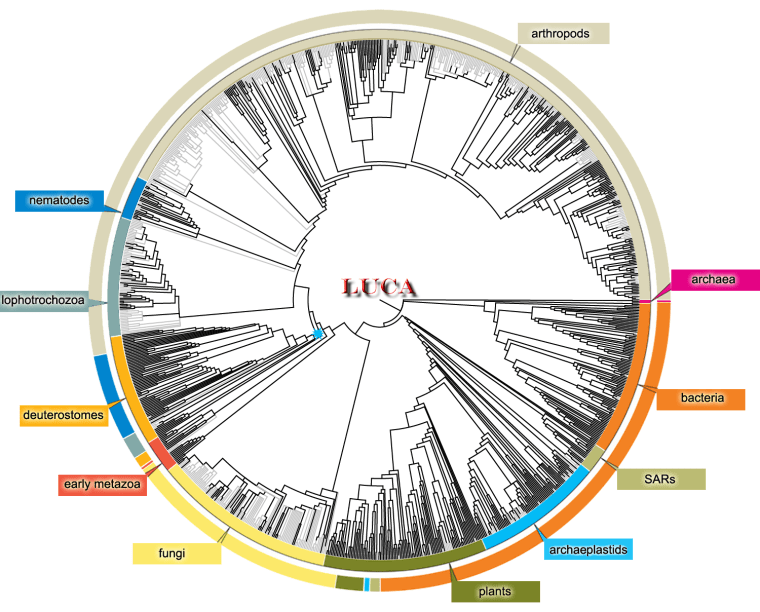
Studies of DNA among living animals suggest that our own group, the vertebrates of the phylum Chordata, originated from a common ancestor that we share with echinoderms (sea urchins, star fish, sea cucumbers etc) and one of many worm-like phyla. This superphylum comprises the deuterostomes, but it is just one of several that encompass all animals and happens to be one of the smallest in terms of the number of living species that belong to it. We deuterostomes are vastly outnumbered by arthropods, nematodes, other worm-like creatures, molluscs, the rest of the animal kingdom and, of course, single-celled organisms, plants and fungi. Yet the DNA-based Circle of Life reveals that the deuterostome ancestral spoke originated early on in animal evolution.
The ‘Circle of Life’ as compiled by Cody Hinchliffe of the University of Michigan and 21 collaborators from the USA, and partly based on Fischetti, M. 2016. The circle of life. Scientific American, v. 314 (March 2016).
The majority of animals of all kinds are blessed with a mouth separate from means of expelling waste products and can be divided into two similar halves, hence their name bilaterians. The earliest fossils judged to be of this kind date to about 580 to 600 Ma ago, in the Doushantuo Formation of southern China, all of them visible only using microscopes. A DNA-based molecular clock hints at around 900-1000 Ma for the emergence of all animal body plans known today. Now another important time marker has turned up, again in sediments showing exquisite fossil preservation from China (Han, J. et al. 2017. Meiofaunal deuterostomes from the basal Cambrian of Shaanxi (China). Nature, v. 542, (online); doi: 10.1038/nature21072). The Chinese-British team of palaeontologists has found tiny, bag-like fossils preserved in phosphate, which have a mouth surrounded by folds and conical openings on either side of the body. They lived in limy muds on the sea bed now preserved as limestones at the base of the Cambrian System (541 Ma) and probably had a habit akin to worms in the most general sense. The authors sifted through 3 tonnes of rock to recover the fossils, rather than relying on a lucky hammer stroke.
Reconstruction of Saccorhytus coronarius (diameter about 1 mm) from the lowest Cambrian of Shaanxi, China. (credit: Han et al 1917)
Not especially prepossessing, the fossils are said to show more affinity to deuterostomes than anything else and to be the earliest known fossil examples. Yet the world’s media pounced on them as the ‘earliest known human ancestors’, which is a bit rich as they could equally be the earliest sea urchins or may have led to several odd-looking fossils known only from the later Cambrian. It isn’t possible to say with any certainty that they lie on the path that led to chordates and thus ourselves. Of course, that would not raise headlines in newspapers of record, such as Britain’ Daily Telegraph, on the BBC News website or Fox News. The authors are much more honest, claiming only that the Saccorhytus coronarius fossils are probably deuterostomes whose affinities and later descendants are obscure. Their most important conclusion is that the cradle of our branch of animals lay in deep water muds laid down around the Precambrian-Cambrian boundary, ideal for subtly varied small, flabby creatures behaving like worms. Many more varieties are likely remain to be found in similar rocks of the late Precambrian and slightly younger Cambrian when they are studied painstakingly in microscopic detail. A start has been made, that’s all.
The Earth continues to collect meteorites, the vast majority of which are about as old as our planet; indeed many are slightly older. So it has long been thought that Earth originally formed by gravitational accretion when the parental bodies of meteorites were much more abundant and evenly distributed. Meteorites fall in several classes, metallic (irons) and several kinds that contain silicate minerals, some with a metallic component (stony irons) others without, some with blebs or chondrules of once molten material (chondrites) and others that do not (achondrites), and more subtle divisions among these general groups. In the latter half of the 20th century geochemists and cosmochemists became able to compare the chemical characteristics of different meteorite classes with that of the Sun –from its radiation spectrum – and those of different terrestrial rocks – from direct analysis. The relative proportions of elements in chondrites turned out to match those in the Sun – inherited from the gas nebula from which it formed – better than did other classes. The best match with this primitive composition turned out to be the chemistry of carbonaceous chondrites that contain volatile organic molecules and water as well as silicates and sulfides. The average chemistry of one sub-class of carbonaceous chondrites (C1) has been chosen as a ‘standard of standards’ against which the composition of terrestrial rocks are compared in order that they can be assessed in terms of their formative processes relative to one another. For a while carbonaceous chondrites were reckoned to have formed the bulk of the Earth through homogeneous accretion: that is until analyses became more precise at increasingly lower concentrations. This view has shifted …
Geochemistry is a complex business(!), bearing in mind that rocks that can be analysed today predominantly come from the tiny proportion of Earth that constitutes the crust. The igneous rocks at the centre of wrangling how the whole Earth has evolved formed through a host of processes in the mantle and deep crust, which have operated since the Earth formed as a chemical system. To work out the composition of the primary source of crustal igneous rocks, the mantle, involves complex back calculations and modelling. It turns out that there may be several different kinds of mantle. To make matters worse, those mantle processes have probably changed considerably from time to time. To work back to the original formative processes for the planet itself faces the more recent discovery that different meteorite classes formed in different ways, different distances from the Sun and at different times in the early evolution of the pre-Solar nebula. Thankfully, some generalities about chemical evolution and the origin of the Earth can be traced using different isotopes of a growing suite of elements. For instance, lead isotopes have revealed when the Moon formed from Earth by a giant impact, and tungsten isotopes narrow-down the period when the Earth first accreted. Incidentally, the latest ideas on accretion involve a series of ‘embryo’ planets between the Moon and Mars in size.
An example of an enstatite chondrite (from the Abee fall) in the Gallery of Minerals at the Royal Ontario Museum. (Photo credit: Wikipedia)
Calculating from a compendium of isotopic data from various types of meteorite and terrestrial materials, Nicolas Dauphas of the University of Chicago has convincingly returned attention to a model of heterogeneous accretion of protoplanetary materials from different regions of the pre-Solar nebula (Dauphas, N. 2017. The isotopic nature of the Earth’s accreting material through time. Nature, v. 541, p. 521-524; doi:10.1038/nature20830). His work suggests that the first 60% of Earth’s accretion involved materials that were a mixture of meteorite types, half being a type known as enstatite chondrites. These meteorites are dry and contain grains of metallic iron-nickel alloy and iron sulfides set in predominant MgSiO3 the pyroxene enstatite. The Earth’s remaining bulk accumulated almost purely from enstatite-chondrite material. A second paper in the same issue of Nature (Fischer-Gödde, M. & Kleine, T. 2017. Ruthenium isotopic evidence for an inner Solar System origin of the late veneer. Nature, v. 541, p. 525-527; doi:10.1038/nature21045) reinforces the notion that the final addition was purely enstatite chondrite.
This is likely to cause quite a stir: surface rocks are nothing like enstatite chondrite and nor are rocks brought up from the upper mantle by volcanic activity or whose composition has been back-calculated from that of surface lavas; and where did the Earth’s water at the surface and in the mantle come from? It is difficult to escape the implication of a mantle dominated by enstatite chondrite From Dauphas’s analysis, for lots of other evidence from Earth materials seem to rule it out. One ‘escape route’ is that the enstatite chondrites that survived planetary accretion, which only make up 2% of museum collections, have somehow been changed during later times. The dryness of enstatite chondrites and the lack of evidence for a late veneer of ‘moist’ carbonaceous chondrite in these analyses cuts down the options for delivery of water, the most vital component of the bulk Earth and its surface. Could moister meteorites have contributed to the first 60% of accretion, or was post-accretion cometary delivery to the surface able to be mixed in to the deep mantle? Nature’s News & Views reviewer, Richard Carlson of the Carnegie Institution for Science in Washington DC, offers what may be a grim outlook for professional meteoriticists: that perhaps “the meteorites in our collection are not particularly good examples of Earth’s building blocks” (Carlson, R.W. 2017. Earth’s building blocks. Nature, v. 541, p. 468-470; doi:10.1038/541468a).
Concerns about impending, indeed actual, anthropogenic climate change brought on by rapidly rising levels of the greenhouse gas carbon dioxide have spurred efforts to quantify climates of the distant past. Beyond the CO2 record of the last 800 ka established from air bubbles trapped in glacial ice palaeoclimate researchers have had to depend on a range of proxies for the greenhouse effect. Those based on models linking plate tectonic and volcanic CO2 emissions with geological records of the burial of organic matter, weathering and limestone accumulation are imprecise in the extreme, although they hint at considerable variation during the Phanerozoic. Other proxies give a better idea of the past abundance of the main greenhouse gas, one using the curious openings or stomata in leaves that allow gases to pass to and fro between plant cells and the atmosphere. Well preserved fossil leaves show stomata nicely back to about 400 Ma ago when plants first colonised the land.
Stomata draw in CO2 so that it can be combined with water during photosynthesis to form carbohydrate. So the number of stomata per unit area of a leaf surface is expected to increase with lowering of atmospheric CO2 and vice versa. This has been observed in plants grown in different air compositions. By comparing stomatal density in fossilised leaves of modern plants back to 800 ka allows the change to be calibrated against the ice-core record. Extending this method through the Cenozoic, the Mesozoic and into the Upper Palaeozoic faces the problems of using fossils of long-extinct plant leaves. This is compounded by plants’ exhalation of gases to the atmosphere – some CO2 together with other products of photosynthesis, oxygen and water vapour. Increasing stomatal density when carbon dioxide is at low concentration risks dehydration. How extinct plant groups coped with this problem is, unsurprisingly, unknown. So past estimates of the composition of the air become increasingly reliant on informed guesswork rather than proper calibration. The outcome is that results from the distant past tend to show very large ranges of CO2 values at any particular time.
An improvement was suggested some years back by Peter Franks of the University of Sydney with Australian, US and British co-workers (Franks, P.J. et al. 2014. New constraints on atmospheric CO2 concentration for the Phanerozoic. Geophysical Research Letters, v. 41, p. 4685-4694; doi:10.1002/2014GL060457). Their method included a means of assessing the back and forth exchange of leaf gases with the atmosphere from measurements of the carbon isotopes in preserved organic carbon in the fossil leaves, and combined this with stomatal density and the actual shape of stomata. Not only did this narrow the range of variation in atmospheric CO2 results for times past, but the mean values were dramatically lessened. Rather than values ranging up to 2000 to 3000 parts per million (~ 10 times the pre-industrial value) in the Devonian and the late-Triassic and early-Jurassic, the gas-exchange method does not rise above 1000 ppm in the Phanerozoic.
The upshot of these findings strongly suggests that the Earth’s climate sensitivity to atmospheric CO2 (the amount of global climatic warming for a doubling of pre-industrial CO2 concentration) may be greater than previously thought; around 4° rather than the currently accepted 3°C. If this proves to be correct it forebodes a much higher global temperature than present estimates by the Intergovernmental Panel on Climate Change (IPCC) for various emission scenarios through the 21st century.
See also: Hand, E. 2017. Fossil leaves bear witness to ancient carbon dioxide levels. Science, v. 355, p. 14-15; DOI: 10.1126/science.355.6320.14.