Earliest Americans and Denisovan art

It was Mary Leakey’s jaw-dropping discovery in the 1970s of the footprints of two adult Australopithecus afarensis and an accompanying juvenile in 3.6 Ma-old volcanic ash at Laetoli, Tanzania that provided the oldest palpable evidence of a bipedal hominin species. Just seeing a high-resolution image of this now legendary trackway made me determined to call my book on Earth and human evolution Stepping Stones: the Making of our Homeworld. Human footprints have figured several times in Earth-logs articles. A jumble of footprints in 1.0 to 0.78 Ma old Pleistocene interglacial sediments at Happisbugh on England’s Norfolk coast marks the presence there of Homo antecessor: the earliest known, northern Europeans. In The first volcanologists (March 2003) I noted the discovery of evidence that Neanderthal children played in 350 ka volcanic ash on the Roccamonfina volcano in Italy. The emotion generated by seeing such relics has never left me. Two similarly important proofs of human presence emerged in September 2021.

Footprints thought to have been made by children and teenagers between 23 and 21 thousand years ago in lake shore muds at White Sands, New Mexico. (Credit Bennett et al. 2021)

Since 2011 a variety of evidence has accumulated that the Americas began to be populated by anatomically modern humans before what had long been assumed to be the ‘first arrivals’: the Clovis people who made finely-worked stone spear points first found in 13 ka-old sediments in New Mexico. To the pre-Clovis artefacts that suggested earlier immigrations have been added indisputable signs of human presence even earlier than anticipated. They were uncovered in lake sediments beneath the gypsum sand dunes of White Sands National Park in New Mexico. The site is not far from where Robert Oppenheimer exclaimed to himself ‘Now I am become Death, the destroyer of worlds’ after he witnessed his creation, the first detonation of a nuclear weapon on 9 July 1945. These lake sediments have yielded thousands of human and animal footprints over the years, but the latest have been dated at between 23 to 21 ka (Bennett, M.R. and 13 others 2021. Evidence of humans in North America during the Last Glacial Maximum. Science, v. 373, p. 1528-1531; DOI: 10.1126/science.abg7586). As with the Happisburgh and Roccamonfina human trackways, size analysis suggests that they were made mainly by children and teenagers! Other animal trackways show that the lake edge was teeming with game at the height of the last Ice Age: abundant food for hunter-gatherers generally results in lots of free time. So maybe these early American people were having fun too. When ice sheets were at their maximum extent sea level had fallen, leaving the Bering Strait dry. The broad Beringia land-bridge made the Americas accessible from Eurasia. Whatever objections have previously been raised as regards human penetration south from Alaska during the Last Glacial Maximum, the White Sands find sweeps them away; people overcame whatever obstacles there were.

Travertine outcrop covered with hand- and footprints at Quesang on the Tibetan Plateau (Credit: Zhang et al., Fig. 1c)

Much older footprints and handprints, preserved in a biogenic carbonate (travertine) deposit from the Tibetan Plateau – more than 4,000 metres above sea level – are reported in an article soon to be published by Elsevier (Zhang, D.D. and 17 others 2021. Earliest parietal art: hominin hand and foot traces from the middle Pleistocene of Tibet, Science Bulletin v 66 online; DOI: 10.1016/j.scib.2021.09.001). Travertine forms when calcium carbonate is precipitated from lime-rich spring water onto films of algae or bacteria. At first it is soft and spongy, hardening as more carbonate is precipitated and solidifying when dried out to form a porous rock. People made a jumble of prints when they pressed their hands and feet into the originally spongy biofilm. Three-dimensional images of the slab provide the basis for interpreting how the prints were made. There are 5 handprints and 5 footprints. From comparing their sizes with modern humans’ feet and hands, it seems that the handprints were made by a single 12-year-old, and the footprints by a child of about 7. Although the travertine layer would have been steep and slippery none of the prints show signs of falling or sliding. They seem to have been deliberately placed close to one another, with suggestions that at least one thumb was wiggled. The authors argue that the prints are a form of art similar to the hand stencils commonly seen on Palaeolithic cave walls. It could be that a couple of kids took delight in leaving signs that they had been there, ‘messing around’: but still an art form. What is especially exciting is their age, between 169 and 226 ka. The children are unlikely to have been anatomically modern humans, who first reached Tibet only a little before 21 ka. One alternative is that they were Denisovans (see: Denisovan on top of the world, May 2019.

See also: Bennett, M.R. 2021.  Fossil footprints prove humans populated the Americas thousands of years earlier than we thought. The Conversation, 23 September 2021. 2021Metcalf, T. 2021. Art or not? Ancient handprints spark debate. NBC News, 16 September 2021.

Influence of massive igneous intrusions on end-Triassic mass extinction

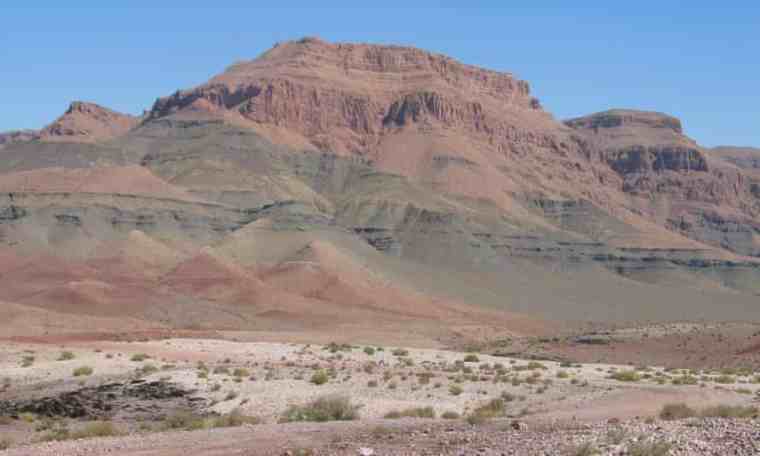
About 200 Ma ago, the break-up of the Pangaea supercontinent was imminent. The signs of impending events are spread through the eastern seaboard of North America, West Africa and central and northern South America. Today, they take the form of isolated patches of continental flood basalts, dyke swarms – probably the feeders for much more extensive flood volcanism – and large intrusive sills. Break-up began with the separation of North America from Africa and the start of sea-floor spreading that began to form the Central Atlantic Ocean: hence the name Central Atlantic Magmatic Province (CAMP) for the igneous activity. It all kicked off at the time of the Triassic-Jurassic stratigraphic boundary, and a mass extinction with a similar magnitude to that at the end of the Cretaceous. Disappearances of animals in the oceans and on continents were selective rather than general, as were extinctions of land plants. The mass extinction is estimated to have taken about ten thousand years. It left a great variety of ecological niches ready for re-occupation. On land a small group of reptiles with a substantial destiny entered some of these vacant niches. They evolved explosively to the plethora of later dinosaurs as their descendants became separated as a result of continental drift and adaptive radiation.

Flood basalts of the Central Atlantic Magmatic Province in Morocco (Credit: Andrea Marzoli)

The end-Triassic mass extinction, like three others of the Big Five, was thus closely associated in time with massive continental flood volcanism: indeed one of the largest such events. Within at most 10 ka large theropod dinosaurs entered the early Jurassic scene of eastern North America. The Jurassic was a greenhouse world whose atmosphere had about five times more CO2, a mean global surface temperature between 5 and 10°C higher and deep ocean temperatures 8°C above those at present. Was mantle carbon transported by CAMP magmas the main source (widely assumed until recently) or, as during the end-Permian mass extinction, was buried organic carbon responsible? A multinational group of geoscientists have closely examined samples from a one million cubic kilometre stack of intrusive basaltic sills, dated at 201 Ma, in the Amazon basin of Brazil that amount to about a third of all CAMP magmatism (Capriolo, M. and 11 others 2021. Massive methane fluxing from magma–sediment interaction in the end-Triassic Central Atlantic Magmatic ProvinceNature Communications, v. 12, article 5534; DOI: 10.1038/s41467-021-25510-w).

The team focussed on fluid inclusions in quartz within the basaltic sills that formed during the late stages of their crystallisation. The tiny inclusions contain methane gas and tiny crystals of halite (NaCl) as well as liquid water. Such was the bulk composition of the intrusive magma that the presence of around 5% of quartz in the basalts would be impossible without their magma having assimilated large volumes of silica-rich sedimentary rocks such as shales. The host rocks for the huge slab of igneous sills are sediments of Palaeozoic age: a ready source for contamination by both organic carbon and salt. The presence of methane in the inclusions suggests that more complex hydrocarbons had been ‘cracked’ by thermal metamorphism. Moreover, it is highly unlikely to have been derived from the mantle, partly because methane has been experimentally shown not to be soluble in basaltic magmas whereas CO2 is. The authors conclude that both quartz and methane entered the sills in hydrothermal fluids generated in adjacent sediments. Thermal metamorphism of the sediments would also have driven such fluids to the surface to inject methane directly to the atmosphere. Methane is 25 times as potent as carbon dioxide at trapping heat in the atmosphere, yet it combines with the hydroxyl (OH) radical to form CO2 and water vapour within about 12 years. Nevertheless during continuous emission methane traps 84 times more heat in the atmosphere than would an equivalent mass of carbon dioxide.

Calculations suggest about seven trillion tonnes of methane were generated by the CAMP intrusions in Brazil. Had the magmas mainly been extruded as flood basalts then perhaps global warming at the close of the Triassic would have been far less. Extinctions and subsequent biological evolution would have taken very different paths; dinosaurs may not have exploded onto the terrestrial scene so dramatically during the remaining 185 Ma of the Mesozoic. So it seems important to attempt an explanation of why CAMP magmas in Brazil did not rise to the surface but stayed buried as such stupendous igneous intrusions. Work on smaller intrusive sills suggests that magmas that are denser than the rocks that they pass through – as in a large, thick sedimentary basin – are forced by gravity to take a lateral ‘line of least resistance’ to intrude along sedimentary bedding. That would be aided by the enormous pressure of steam boiled from wet sedimentary rocks forcing beds apart. In areas where only thin sedimentary cover rests on crystalline, more dense igneous and metamorphic rocks, basaltic magma has a greater likelihood of rising through vertical dyke swarms to reach the surface and form lava floods.

Anthropocene more an Event than an Epoch.

The Vattenfall lignite mine in Germany; the Anthropocene personified

The issue of whether or not to assign the time span during which human activities have been significantly affecting the planet and its interwoven Earth Systems has been dragging on since the term ‘Anthropocene’ was first proposed more than two decades ago. A suggestion that may resolve matters, both amicably and with a degree of scientific sense, has emerged in a short letter to the major scientific journal Nature, written by six eminent scientists (Bauer, A.M. et al. 2021. Anthropocene: event or epoch? Nature, v. 597, p. 332; DOI: 10.1038/d41586-021-02448-z). The full text is below

The concept of the Anthropocene has inspired more than two decades of constructive scholarship and public discussion. Yet much of this work seems to us incompatible with the proposal to define the Anthropocene as an epoch or series in the geological timescale, with a precise start date and stratigraphic boundary in the mid-twentieth century. As geologists, archaeologists, environmental scientists and geographers, we have another approach to suggest: recognize the Anthropocene as an ongoing geological event.

The problems with demarcating the Anthropocene as a globally synchronous change in human–environment relations, occurring in 1950 or otherwise, have long been evident (P. J. Crutzen and E. F. Stoermer IGBP Newsletter 41, 17–18; 2000). As an ongoing geological event, it would be analogous to other major transformative events, such as the Great Oxidation Event (starting around 2.4 billion years ago) or the Great Ordovician Biodiversification Event (around 500 million years ago).

Unlike formally defined epochs or series, geological events can encompass spatial and temporal heterogeneity and the diverse processes — environmental and now social — that interact to produce global environmental changes. Defining the Anthropocene in this way would, in our view, better engage with how the term has been used and criticized across the scholarly world.”

AUTHORS: Andrew M. Bauer, Stanford University, Stanford, California, USA; Matthew Edgeworth, University of Leicester, Leicester, UK;  Lucy E. Edwards, Florence Bascom Geoscience Center, Reston, Virginia, USAErle C. Ellis, University of Maryland, Baltimore County, Maryland, USA ; Philip Gibbard, Scott Polar Research Institute, University of Cambridge, Cambridge, UK;  Dorothy J. Merritts, Franklin and Marshall College, Lancaster, Pennsylvania, USA.

I have been grousing about the attempt to assign Epoch/Series status to the Anthropocene for quite a while (you can follow the development of my personal opinions by entering ‘Anthropocene’ in the Search Earth-logs box). In general I believe that the proposal being debated is scientifically absurd, and a mere justification for getting a political banner to wave. What the six authors of this letter propose seems eminently sensible. I hope it is accepted by International Commission on Stratigraphy as a solution to the increasingly sterile discussions that continue to wash to and fro in our community. Then perhaps the focus can be on action rather than propaganda.

As things have stood since 21 May 2019, a proposal to accept the Anthropocene as a formal chrono-stratigraphic unit defined by a GSSP at its base around the middle of the 20th century is before the ICS and the International Union of Geological Sciences (IUGS) for ratification. It was accepted by 88% of the 34-strong Anthropocene Working Group of the ICS Subcommission on Quaternary Stratigraphy. But that proposal has yet to be ratified by either the ICS or IUGS. Interestingly, one of the main Anthropocene proponents was recently replaced as chair of the Working Group.