Soluble iron and global climate

The environment that humans inhabit is better described as the Earth System, for a good reason. Every part of our planet, the living and the seemingly inert, from the core to the outermost atmosphere, is and always has been interacting with all the others in one way or another. Earth-logs aims to express that, as does my recently revised and now free book Stepping Stones. The vagaries of the Earth’s climate present good examples, the most obvious being the role of chemistry in the form of atmospheric greenhouse gases, especially carbon dioxide, and their interaction with other parts of the Earth System.

Carbon and oxygen atoms that make up CO2 are also present in dissolved form in rain, freshwater and the oceans as the dissolved gas itself, carbonic acid (H2CO­3­) and the soluble bicarbonate ion HCO3, in proportions that depend on water temperature and acidity (pH). Those forms make the oceans an extremely large ‘sink’ for carbon; i.e. CO2 in dissolved form is removed from the atmospheric greenhouse effect. In the short term, there is a rough balance because water bodies also emit CO2, particularly when they heat up.
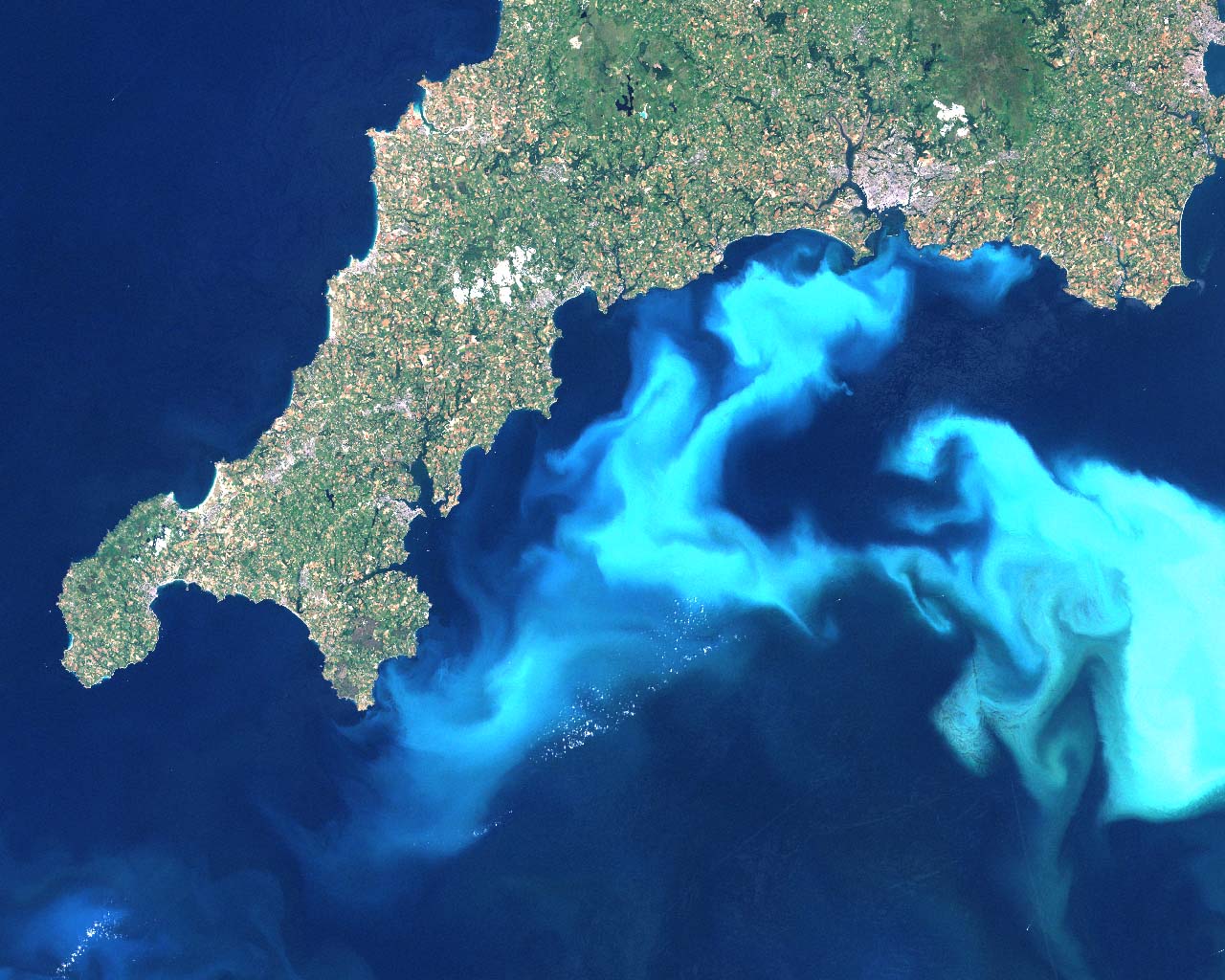
Phytoplankton bloom in the Channel off SW England (Landsat image)

Carbon dioxide enters more resilient forms through the marine part of the biosphere, at the base of which is photosynthesising phytoplankton. Photosynthesisers ‘sequester’ CO2 from the oceans as various carbohydrates in their soft tissue. Some of them use bicarbonate ions to form calcium carbonate in shells or tests. Once the organisms die both their soft and hard parts may end up buried in ocean-floor sediments: a longer-term sink. How much carbon is buried in these two forms depends on whether bacteria break down the soft tissues by oxidation and on the acidity of water that tends to dissolve the carbonate. Both processes ultimately yield dissolved CO2 that returns to the atmosphere.

Even the simplest phytoplankton cannot live on carbon dioxide and water alone: they need nutrients. The most familiar to any gardener are nitrogen, phosphorus and potassium. These are mainly supplied in runoff from the continents; although marine upwellings supply large amounts where deep ocean water is forced to the surface. Large tracts in the central parts of the oceans are, in effect, marine deserts whose biological productivity is very low. Surprisingly this is not because of severe shortages of N, P and K. This is because a key nutrient, albeit a minor one, is missing; dissolved iron that phytoplankton and ocean fertility in general depend on. This was discovered in the 1970s by US oceanographer John Martin. Just how important iron is to fertility of the oceans and to global climate emerged from studies of ice cores from the Antarctic ice sheet. Air bubbles in the myriad annual layers reveal that their CO2 content falls with each change in oxygen isotopes related to the periodic build up of polar ice caps during cold periods. The greenhouse effect diminished as a result during each stadial, for the simple reason that up to a third of all atmospheric carbon dioxide – about 200 billion tonnes – was withdrawn. The clearest of these are at the last glacial maximum and during the rapid build up glacial ice between 70 and 60 thousand years ago; a time of low sea level when a major ‘out-of-Africa’ human migration took place. A possible candidate for achieving this could have been massively increased ocean fertility and the burial of dead phytoplankton and their shells.

Analyses of Antarctic ice cores record fluctuations in atmospheric CO2 trapped in bubbles during the last ice age (top) and how iron-rich dust deposition onto the ice increased hugely during two major cold periods (bottom) – the last glacial maximum (35 to 18 ka) and between 70 and 60 ka. (Credit, Stoll; Fig. 1)

During stadials the ice cores also reveal that a great deal more dust found its way from the continents to the polar ice sheets. Analysing the dusty layers showed that to have included lots of iron. Falling into the cold ocean-surface waters around the polar regions would have added this crucial nutrient to a medium already rich in CO2 – the colder water is the more gas it will dissolve. These distant oceans bloomed with phytoplankton, speeding up the sequestration of carbon into ocean-floor sediments. Iron may have triggered a biological pump of gargantuan proportions that amplified ice-age cooling. Today the remotest parts of the world’s oceans are starved of iron so the pump only functions in a few places where iron is supplied by rivers or upwellings of deep ocean water

The marine biosphere is clearly a very important active component in the Earth’s climate subsystem. Climate’s continually changing interactions with the rest of the Earth System make climate change hugely complex. It is difficult to predict but growing understanding of its past behaviour is helpful. The late John Martin’s hypothesis of the effects on climate of changing iron concentrations in surface ocean water has a corollary: the stronger the biological pump the more oxygen in deep water must be used up in bacterial decay of descending organic matter. Indeed it was as recent estimates of the degree of oxygenation in ocean-sediment layers correlate with changes in climate that they also reveal.

So, would deliberate iron-fertilisation of polar oceans help draw down greenhouse warming? When several small patches of the Southern Ocean were injected with a few tonnes of dissolved iron they did indeed respond with phytoplankton blooms. However, it is impossible to tell if that had any effect on the atmosphere. ‘Going for broke’ with a massive fertilisation of this kind has been proposed, but this ventures dp into the political swamp that currently surrounds global warming and the wider environment. It is becoming possible to model such a strategy by using the data from the experiments and from ice cores, and early results seem to confirm the role of iron and the biological pump in CO2 sequestration by suggesting that half the known draw-down during ice ages can be explained in this way.

Based on a review by: Heather Stoll in February 2020. (30 years of the iron hypothesis of ice ages. Nature, v. 578, p. 370-371; DOI: 10.1038/d41586-020-00393-x}

How did the planets form?

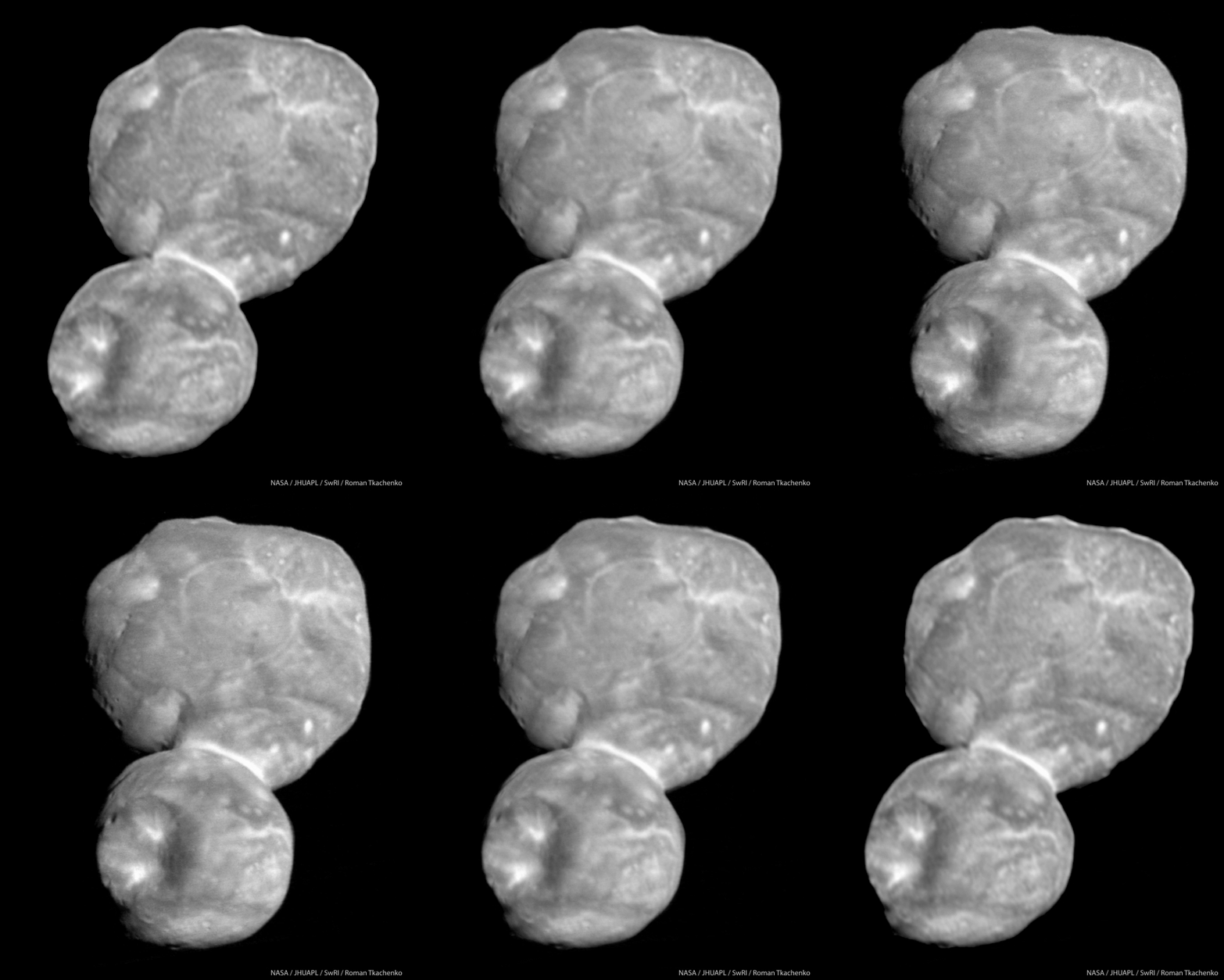
Animation of the 3-D shape of planetesimal Arrokoth. (Credit: Roman Tkachenko, NASA)

The latest addition to knowledge of the Solar System looks a bit like a couple of potatoes that have lain together and dried over several years. It also has a name – Arrokoth – that might have been found in a novel by H.P. Lovecraft. In fact Arrokoth meant ‘sky’ in the extinct Powhatan language once spoken by the native people of Chesapeake Bay. The planetesimal was visited by the New Horizons spacecraft two years after it had flown by Pluto (see; Most exotic geology on far-off Pluto, Earth-logs 6 April 2016). It is a small member of the Kuiper Belt of icy bodies. Data collected by a battery of imaging instruments on the spacecraft has now revealed that it has a reddish brown coloration that results from a mixture of frozen methanol mixed with a variety of organic compounds including a class known as tholins – the surface contains no water ice. Arrokoth is made of two flattened elliptical bodies (one 20.6 × 19.9 × 9.4 km the smaller 15.4 × 13.8 × 9.8 km) joined at a ‘waist’. Each of them comprises a mixture of discrete ‘terrains’ with subtly different surface textures and colours, which are likely to be earlier bodies that accreted together. On 13 February 2020 a flurry of three papers about the odd-looking planetesimal appeared in Science.

The smooth surface implies a lack of high-energy collisions when a local cluster of initially pebble sized icy bodies in the sparsely populated Kuiper Belt gradually coalesced under extremely low gravity. The lack of any fractures suggests that the accretions involved relative speeds of, at most, 2 m s-1; slow-walking speed or spacecraft docking (McKinnon, W.B. and a great many more 2020. The solar nebula origin of (486958) Arrokoth, a primordial contact binary in the Kuiper Belt. Science, article eaay6620; DOI: 10.1126/science.aay6620). The authors regard this quiet, protracted, cool accretion to have characterised at least the early stages of planet formation in the Outer Solar System. The extent to which this can be extrapolated to the formation of the giant gas- and ice worlds, and to the rocky planets and asteroids of the Inner Solar System is less certain, to me at least. It implies cold accretion over a long period that would leave large worlds to heat up only through the decay of radioactive isotopes. Once large planetesimals had accreted, however that had happened, the greater their gravitational pull the faster other objects of any size would encounter them. That scenario implies a succession of increasingly high-energy collisions during planet formation.

This hot-accretion model, to which most planetary scientists adhere, was supported by a paper published by Science a day before those about Arrokoth hit the internet (Schiller, M. et al. 2020. Iron isotope evidence for very rapid accretion and differentiation of the proto-Earth. Science Advances, v. 6, article eaay7604; DOI: 10.1126/sciadv.aay7604). This work hinged on the variation in the proportions of iron isotopes among meteorites, imparted to the local gas and dust cloud after their original nucleosynthesis in several supernovas in the Milky Way galaxy during pre-solar times. Iron found in different parts of the Earth consistently shows isotopic proportions that match just one class of meteorites: the CI carbonaceous chondrites. Yet there are many other silicate-rich meteorite classes with =different iron-isotope proportions. Had the Earth accreted from this mixed bag by random ‘collection’ of material over a protracted period prior to 4.54 billion years ago, its overall iron-isotope composition would have been more like the average of all meteorites than that of just one class. The authors conclude that Earth’s accretion, and probably that of the smaller body that crashed with it to form the Moon at about 4.4 Ga, must have taken place quickly (<5 million years) when CI carbonaceous chondrites dominated the inner part of the protoplanetary disc.

See also: Barbuzano, J. 2020. New Horizons Reveals Full Picture of Arrokoth . . . and How Planets Form. Sky & Telescope

Finding Archaean atmospheric composition using micrometeorites

Modern micrometeorites (about 20 μm in diameter) from deep-sea sediments, with shiny magnetite-rich veneers (Credit: D. E. Brownlee)

The gases making up the Earth’s atmosphere and their relative proportions before 2.5 billion years (Ga) ago are known with very little certainty. Carbonate rocks are rare, indicating that the oceans were more acidic, which implies that they had dissolved more CO2 from the atmosphere, which, in turn implies that there was much more of that gas than in present air. There are few signs of widespread glaciogenic sediments of Archaean age, at a time when the Sun’s energy output is estimated to have been at 70 to 75% of its present level. Without an enhanced greenhouse effect oceans would have been frozen over; so that supports high CO2 concentrations too. The fact that water worn grains of minerals such as uraninite (UO2) and pyrite (FeS2), which are stable only in reducing conditions, occur in Archaean conglomerates is a good indicator that there were only vanishingly small amounts of oxygen in the air. That was not to change until marine photosynthesisers produced enough to overcome the general reducing conditions at the Earth’s surface, marked by the Great Oxidation Event at around 2.4 Ga (see: Massive event in the Precambrian carbon cycle; Earth-logs, January 2012. Search for more articles in sidebar at Earth-logs home page). It was then that ancient soils (palaeosols) became the now familiar red colour because of their content of ferric iron oxides and hydroxides The problem is that reliable numbers cannot be attached to these kinds of observation. A common means of estimating CO2 levels comes from the way in which the gas reacts with silicates as soils form at the land surface, estimated from carbon isotopes in soil carbonate nodules. Since the rise of land plants around 400 Ma ago the distribution of pores (stomata) in fossil leaves provides a more precise estimate: the more CO2 in air the less densely packed are leaf stomata. For the Precambrian we are stuck with estimates based on chemical reactions of minerals with the atmosphere. Until recently, one reaction that must always have been extremely common was overlooked.

When meteorite pass through the atmosphere at very high speed friction heats them to incandescence. Their surfaces not only melt but the minerals from which they are composed react very strongly with air. The reaction products should therefore provide chemical clues to the relative proportions of atmospheric gases. Both oxygen and carbon dioxide are reactive at such temperatures, although nitrogen is virtually inert, yet it tends to buffer oxidation reactions. The rest of the atmosphere comprises noble gases – mainly argon – and by definition they are completely unreactive. Pure-iron micrometeorites collected from 2.7 Ga old sediments in the Pilbara Province of Western Australia are veneered with magnetite (Fe3O4) and wüstite (FeO), thus preserving a record of their passage through the Neoarchaean atmosphere. If the oxidant had been oxygen, for these minerals to form from elemental iron suggests oxygen levels around those prevailing today: clearly defying the abundant evidence for its near-absence during the Archaean. Carbon dioxide is the only candidate. Two studies have produced similar results (Lehmer, O. R. et al. 2020. Atmospheric CO2 levels from 2.7 billion years ago inferred from micrometeorite oxidationScience Advances, v. 6, article aay4644;  DOI: 10.1126/sciadv.aay4644 and Payne, R.C. et al. 2020. Oxidized micrometeorites suggest either high pCO2 or low pN2 during the Neoarchean. Proceedings of the National Academy of Sciences, v. 117 1360 DOI:10.1073/pnas.1910698117). Both use complex modelling of the chemical effects of meteorite entry. Lehmer and colleagues estimated that the Neoarchaean atmosphere contained about 64% CO2, with a surface atmospheric pressure about half that at present. This would be sufficient for a surface temperature of about 30°C achieved by the greenhouse effect, taking into account lower solar heating. The team led by Payne concluded a lower concentration (25 to 50%) and a somewhat cooler planet at that time. Both results suggest ocean water considerably more acid than are today’s. The combined warmth and acidity would have had a fundamental bearing on both the origin, survival and evolution of early life.

See also: Carroll, M. 2020. Meteorites reveal high carbon dioxide levels on early Earth; Yirka, R. Computer model shows ancient Earth with an atmosphere 70 percent carbon dioxide. (both from Phys.org)

Everyone now has their Inner Neanderthal

For 20 years, we have known the full human genome. For 10 years the full content of Neanderthal DNA has been available, courtesy of Svante Paabo’s team at the Max Planck Institute for Evolutionary Anthropology in Leipzig, Germany. The two were compared and suddenly every living person with a Eurasian ancestry learned that they had significant and functional bits of Neanderthal in their make-up: some beneficial, some not so good (see: Yes, it seems that they did… in Human evolution and migrations, May 2010). Then the Denisovan connection emerged for East Asians and original populations of Australasia. Africans seemed not to share such a privilege. But now it seems that they do, but as a result of a somewhat tortuous route (Lu Chen et al. 2020. Identifying and interpreting apparent Neanderthal ancestry in African individuals. Cell v. 180, p. 1–11; DOI: 10.1016/j.cell.2020.01.012).

Reconstruction of Neanderthal male

Lu and colleagues used a new approach to discover that 2500 people from five widespread subpopulations living in Africa carry in their DNA several million base-pairs of Neanderthal origin (about 0.3% of their genomes). This happened in two steps. The most recent resulted when ancient anatomically modern humans (AMH), who carried Neanderthal DNA as a result of repeated interbreeding, migrated back to Africa from Europe about 20 thousand years ago. But the modern Africans’ DNA also suggests that their ancestral Neanderthals had also interbred with a much earlier group of Africans who had left their home continent between 150 to 100 thousand years ago. The Neanderthals already carried sections of that earlier AMH genome. The relationship between modern humans and Neanderthals seems to have been a great deal more complex that previously thought.

The authors conclude, …  our data show that out-of-Africa and in-to-Africa dispersals must be accounted for when interpreting archaic hominin ancestry in contemporary human populations. It is notable that Neanderthal sequences have been identified in every contemporary modern human genome analyzed to date. Thus, the legacy of gene flow with Neanderthals likely exists in all modern humans, highlighting our shared history’. Palaeo-geneticists have also shown that a similarly complex social relationship may have characterised Neanderthals and Denisovans, where their ranges overlapped (see Neanderthal Mum meets Denisovan Dad in Human evolution and migrations, August 2018). It would come as no surprise to learn, eventually, that wherever different human groups crossed paths in the more distant past they engaged in similar practices, that is, they behaved humanly. Things have changed a bit in recorded history, when only a single human group has existed; perhaps a consequence of the emergence of what today passes for ‘economy’.

Watch Chris Stringer discussing his views on Neanderthal-AMH interactions

See also: Price, M. 2020. Africans, too, carry Neanderthal genetic legacy. Science, v. 367, p. 497; DOI: 10.1126/science.367.6477.497

Note added 14 February 2020

Several studies of DNA from living Africans have suggested introgression (interbreeding) of an even earlier archaic population into ancient AMH in Africa. Because this cannot be related to any known fossils, such as Homo erectus, such a population is known in palaeogenetic circles as a ‘ghost’. A new paper (Durvasula, A. & Sankararaman, S. 2020. Recovering signals of ghost archaic introgression in
African populationsScience Advances, v. 6, article eaax5097; DOI: 10.1126/sciadv.aax5097) suggests that two living groups from West Africa (Yoruba and Mende) derive 2 to 19% of their genetic ancestry from such a ‘ghost’ population. It seems that this archaic group diverged from the descent path of AMH before the split of Neanderthals and AMH. But when the Neanderthal-AMH event took place is uncertain, estimates ranging from 185 to 800 ka. This time uncertainty further obscures the genetic ‘trail’. Curiously, as far as I know non-Africans whose AMH ancestors were of African origin, show no sign of this particular ‘ghost’ among their forebears. That perhaps suggests that few if any West Africans engaged in ‘out-of-Africa’ migrations …