Ordovician ice age: an extraterrestrial trigger

The Ordovician Period is notable for three global events; an explosion in biological diversity; an ice age, and a mass extinction. The first, colloquially known as the Great Ordovician Biodiversification Event, occurred in the Middle Ordovician around 470 Ma ago (see The Great Ordovician Diversification, September 2008) when the number of recorded fossil families tripled. In the case of brachiopods, this seems to have happened in no more than a few hundred thousand years. The glacial episode spanned the period from 460 to 440 Ma and left tillites in South America, Arabia and, most extensively, in Africa. Palaeogeographic reconstructions centre a Gondwanan ice cap in the Western Sahara, close to the Ordovician South Pole. It was not a Snowball Earth event, but covered a far larger area than did the maximum extent the Pleistocene ice sheets in the Northern Hemisphere. It is the only case of severe global cooling bracketing one or the ‘Big Five’ mass extinctions of the Phanerozoic Eon. In fact two mass extinctions during the Late Ordovician rudely interrupted the evolutionary promise of the earlier threefold diversification, by each snuffing-out almost 30% of known genera.

ord met
L-chondrite meteorite in iron-stained Ordovician limestone together with a nautiloid (credit: Birger Schmitz)

A lesser-known feature of the Ordovician Period is a curious superabundance of extraterrestrial debris, including high helium-3, chromium and iridium concentrations, preserved in sedimentary rocks, particularly those exposed around the Baltic Sea (Schmitz, B. and 19 others 2019. An extraterrestrial trigger for the mid-Ordovician ice age: Dust from the breakup of the L-chondrite parent body. Science Advances, v. 5(9), eaax4184; DOI: 10.1126/sciadv.aax4184). Yet there is not a sign of any major impact of that general age, and the meteoritic anomaly occupies a 5 m thick sequence at the best studied site in Sweden, representing about 2 Ma of deposition, rather than the few centimetres at near-instantaneous impact horizons such as the K-Pg boundary. Intact meteorites are almost exclusively L-chondrites dated at around 466 Ma. Schmitz and colleagues reckon that the debris represents the smashing of a 150 km-wide asteroid in orbit between Mars and Jupiter. Interestingly, L-chondrites are more abundant today and in post-Ordovician sediments than they were in pre-Ordovician records, amounting to about a third of all finds. This suggests that the debris is still settling out in the Inner Solar System hundreds of million years later. Not long after the asteroid was smashed a dense debris cloud would have entered the Inner Solar System, much of it in the form of dust.

The nub of Schmitz et al’s hypothesis is that considerably less solar radiation fell on Earth after the event, resulting in a sort of protracted ‘nuclear winter’ that drove the Earth into much colder conditions. Meteoritic iron falling the ocean would also have caused massive phytoplankton blooms that sequestered CO2 from the Ordovician atmosphere to reduce the greenhouse effect. Yet the cooling seems not to have immediately decimated the ‘booming’ faunas of the Middle Ordovician. Perhaps the disruption cleared out some ecological niches, for new species to occupy, which may explain sudden boosts in diversity among groups such as brachiopods. Two sharp jumps in brachiopod species numbers are preceded and accompanied by ‘spikes’ in the number of extraterrestrial chromite grains in one Middle Ordovician sequence. One possibility, suggested in an earlier paper (Schmitz, B. and 8 others 2008. Asteroid breakup linked to the Great Ordovician Biodiversification Event. Nature Geoscience, v. 1, p. 49-53; DOI: 10.1038/ngeo.2007.37)  is that the undoubted disturbance may have killed off species of one group, maybe trilobites, so that the resources used by them became available to more sturdy groups, whose speciation filled the newly available niches. Such a scenario would make sense, as mobile predators/scavengers (e.g. trilobites) may have been less able to survive disruption, thereby favouring the rise of less metabolically energetic filter feeders (e.g. brachiopods).

See also: Sokol, J. 2019. Dust from asteroid breakup veiled and cooled Earth. Science, v. 365, pp. 1230: DOI: 10.1126/science.365.6459.1230, How the first metazoan mass extinction happened (Earth-logs, May 2014)

Last day of the dinosaurs

As they say, ‘everyone knows’ that the dinosaurs were snuffed out, except, of course, for those that had evolved to become birds and somehow survived. When it happened is known quite precisely – at the end of the Cretaceous (66.043 ± 0.011 Ma) – and there were two possible causal mechanisms: emissions from the Deccan Trap flood basalts and/or the Chicxulub impact crater. But what was the Cretaceous-Palaeogene (K-Pg) boundary event actually like? Many have speculated, but now there is evidence.

In 2016 a deep-sea drilling rig extracted rock core to a depth of 1.35 km beneath the sea floor off Mexico’s Yucatan Peninsula, slightly off the centre of the circular Chicxulub structure (see K-T (K-Pg) boundary impact probed, November 2016). This venture was organised and administered jointly by the International Ocean Discovery Program IODP) and the International Continental Scientific Drilling Program (ICDP) as Mission Specific Platform Expedition no. 364. Results from the analysis of the cored rock sequence have been generating pulses of excitement among palaeontologists, petrologists and planetary scientist on a regular basis. The science has been relatively slow to emerge in peer-reviewed print. Appetites have been whetted and the first substantial paper is about the bottom 130 metres of the core (Gulick, S.P.S. and 29 others 2019. The first day of the Cenozoic. Proceedings of the National Academy of Sciences. 9 September 2019; DOI: 10.1073/pnas.1909479116). It might seem as though the publication schedule has been stage managed to begin with, literally, the ‘bang’ itself.

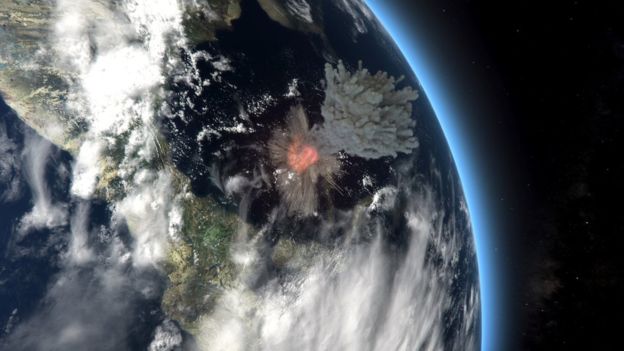
The deepest 20 m thick layer is mainly silicate glass. It was formed in the seconds after the 12 km-wide impactor arrived to smash through the water and sea-floor sediments of the early Caribbean Sea, at speed of around 20 Km s-1. It vaporised water and rock as well as shoving aside the surrounding sea and blasting debris skyward and outward. In an instant a new hole in the crust was filled with molten rock. The overlying rock is a veritable apple-crumble of shattered debris mixed with and held together by glass, and probably formed as water flowed into the crater to result in explosive reaction with the molten crystalline crust beneath. The fragments lessen in size up the core, probably reflecting ejected material mixed in the displaced seawater. Impact specialists have estimated that this impactite layer formed in little more than ten minutes after collision. The glass-laden breccia is abruptly capped by bedded sediments, considered to have been delivered by the backwash of a huge, initial tsunami. In them are soils and masses of charcoal, from the surrounding land areas, scorched and burnt by the projectile’s entry flash, inundated by the tsunami and then dragged out to sea as it receded. These are the products of the hours following the impact as successive tsunamis swashed to and fro across the proto-Caribbean Basin; hence ‘The first day of the Cenozoic’, of Gulick et al.’s title.

IMGP6086
Artist’s impression of the Chicxulub impact (Credit: Barcroft Productions for the BBC)

Other cores drilled beyond the scope of the Chicxulub crater during offshore oil exploration show a sequence of limestones with thick beds of gypsum (CaSO4.2H2O). Yet the crater debris itself contains no trace of this mineral. Around 325 Gt of sulfur, almost certainly in the form of SO2, entered the atmosphere on that first day, adding to the dust. Ending up in the stratosphere as aerosols it would have diffused solar radiation away from the surface, resulting in an estimated 25°C global cooling that lasted 25 years. The sulfur oxides in the lower atmosphere ended up in acid rain that eventually acidified the upper ocean to devastate shallow-marine life.

See also: Amos, J. 2019. The day the dinosaurs’ world fell apart. (BBC News 10 September 2019); Rocks at asteroid impact site record first day of dinosaur extinction (Phys.org); Wei-Haas, M. 2019. Last day of the dinosaurs’ reign captured in stunning detail.  National Geographic, 9 September 2019.

Life with the Neanderthals

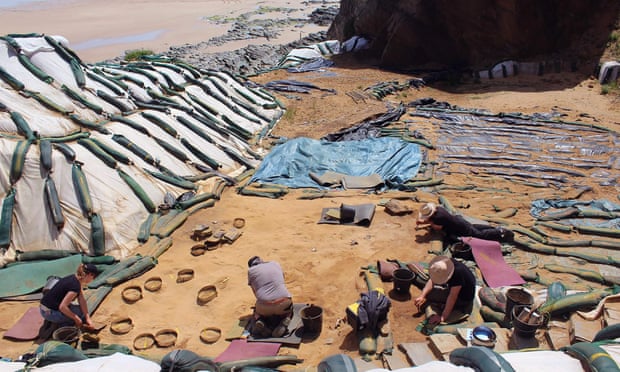
From Robinson Crusoe’s discovery of Friday’s footprint on his desert island to Mary Leakey’s unearthing of a 3.6 Ma old trackway left by two adults and a juvenile of the hominin species Australopithecus afarensis at Laetoli in Tanzania, such tangible signs of another related creature have fostered an eerie thrill in whoever witnesses them. Other ancient examples have turned up, such as the signs of mud trampled by 800 ka humans (H. antecessor?) at Happisburgh, Norfolk, UK (see Traces of the most ancient Britons, February 2014). From a purely scientific standpoint, footprints provide key evidence of foot anatomy, gait, travel speed, height, weight, and the number of individuals who contributed to a trackway. At Le Rozel on the Cherbourg Peninsula in Normandy, France – about 30 km west of the D-Day landing site at Utah beach – Yves Roupin, an amateur archaeologist, discovered a footprint on the foreshore in the 1960s close to the base of a thick sequence of late-Pleistocene dune sediments exposed below a rocky cliff. Fifty years later, rapid onset of wind and tidal erosion threatened to destroy the site, so excavations and scientific analysis began. This involved excavation of thick overburden on an annual basis to expose as much of five footprint-bearing horizons as possible (about 90 m2).

Le Rozel
The Le Rozel excavation, with weighted plastic sheets to protect the site from erosion between visits (credit: Dominique Cliquet)

More and more prints emerged, each photographed and modelled in 3-D, with the best being preserved as casts using a flexible material, similar to that used by dentists (Duveau, J. eyt al. 2019. The composition of a Neandertal social group revealed by the hominin footprints at Le Rozel (Normandy, France). Proceedings of the National Academy of Sciences. 9 September 2019; DOI: 10.1073/pnas.1901789116). At the end of the excavation hundreds of prints had been found and recorded. They had been preserved in wet sand, probably deposited in an interdune pond. Luminescence dating of sand grains revealed that the footprints were produced around 80 ka ago, 35 ka before Europe was occupied by anatomically modern humans. Scattered around the site are numerous fossils of butchered prey animals, together with stone tools typical of Neanderthal technology.

Such a large number of footprints presented a unique opportunity to analyse the social structure of the Neanderthal group that produced them, for they came in many different sizes. During the very short period in which they were produced and buried by wind-blown sand, an estimated 10 to 13 individuals had crossed and re-crossed the site – there may have been more individuals who didn’t happen to cross the wet patch But the evidence suggests that children and adolescents, one of whom may have been as young as 2 years, predominated. Two or three with the biggest feet were probably adults as tall as 1.9 metres – about 20 cm taller that the average for modern human males. That is surprising for Neanderthals who are widely believed to have been more stocky. The fact that footprints occur in 5 horizons suggests that the band, or perhaps family, found the site to be good for occupation. Wider hypotheses are a little shaky. Did Neanderthals have large families? Does the predominance of children and adolescents indicate that they died young? But perhaps children stayed close to habitations with just a few ‘minders’, while other adults went off hunting and foraging. Were the kids playing?