A new kind of seismology

The detection and analysis of earthquake waves has played a major role in the study of how the Earth works for more than a century. Seismology has laid bare the deep structure of our planet. Using records from seismographs that showed the arrival times at different sites of body waves propagated by a 1909 earthquake near Zagreb Croatian scientist Andrija Mohorovičić deduced that the upper Earth was layered. His name is given to the boundary between the crust and underlying mantle; the Mohorovičić Discontinuity (Moho for short). Applying the principles of wave reflection and refraction to wave-arrival times from major seismic events at seismographic stations across the Earth’s surface resulted in the discovery of deeper discontinuities in the mantle and the structure of the core. As the number of stations increased, largely as a result of the need to detect and pin-point tests of nuclear weapons, reversing the principles enabled the 3-D positions of lesser events to be plotted. The resulting swathes of seismicity defined the boundaries of tectonic plates, and from the varying depths at which earthquakes occurred came ideas about their nature; especially important for the mapping of subduction zones. Expansion and standardisation of the global seismographic network and the millions of records that it has produced, together with advances in their digital analysis, has created the current method of charting deep-Earth properties using seismic tomography. A remarkable outcome of such studies is the strikingly named ‘The Atlas of the Underworld’.

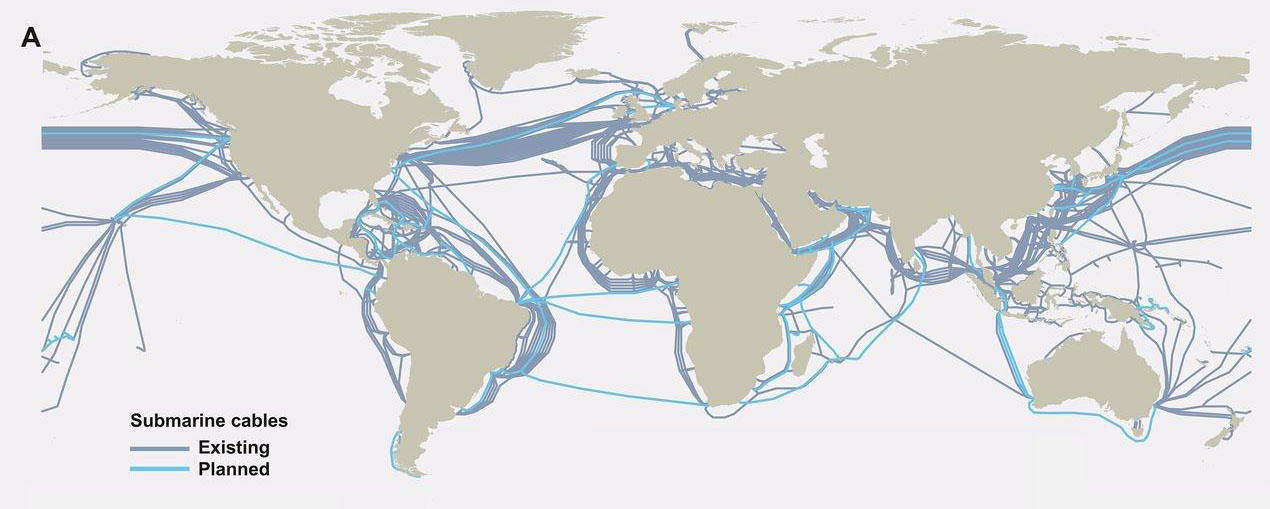
Up to now there has been a limit to the scope of such studies, particularly their resolution of features in the Earth’s mantle. Almost all the recording stations are on land, leaving the 70% of the surface covered by oceans devoid of data. Yet that might be set to change. The building of the Internet’s World Wide Web has largely depended on a growing network of telecommunications optic-fibre cables that criss-cross the oceans as well as the continents, stretching about a million kilometres. Using lasers at each end of a cable and interferometric analysis of two light signal that takes up a tiny proportion of the cable’s bandwidth it is possible to detect noise due to disturbances of the cable that result from earthquakes. On land this is compromised by local effects, such as traffic noise, but the ocean floors are remarkable quiet. Giuseppe Marra of Britain’s National Physical Laboratory discovered the potential of using optic fibre while testing a 79 km length cable linking atomic clocks at NPL and Reading (Marra, G. And 11 others 2018. Ultrastable laser interferometry for earthquake detection with terrestrial and submarine cables. Science online publication; doi:10.1126/science.aat4458). Purely by chance he observed unusually high spikes in noise during 2016. By no stretch of the imagination could they have been caused by events along the course of the cable. Curious, he eventually tracked the signals down to a series of earthquakes beneath Norcia in central Italy that cause death and destruction between 24 August and 30 October 2016. With a magnitude of 6.5, the last was the largest seismic event in Italy for 36 years. Subsequently, he and colleagues picked up the signal of a far less energetic event beneath the Mediterranean Sea (magnitude 3.4) from a cable linking Malta and Sicily.
F1.large
Map of submarine optic-fibre cables (credit: TeleGeography’s Telecom Resources)

With records from three suitably equipped cables an earthquake focus could be located precisely using triangulation. Together with the recorded signals, it would also be possible to use high magnitude earthquakes detected by optic-fibre cables to add to conventional seismic tomography, thereby sharpening the 3-D images of the deep Earth, which at present are plagued by blurring of much useful detail. Since both submarine and terrestrial cables might be used, such a method may become a bonanza for geophysicists

See also: Hand, E, 2018. Seafloor fibre optic cables can listen for earthquakes. Science, v. 360, p. 1160.

A fully revised edition of Steve Drury’s book Stepping Stones: The Making of Our Home World can now be downloaded as a free eBook

A hint of life on Mars

We can be certain that life was around on Planet Earth around 3.5 billion years ago, if not before, because unmetamorphosed sedimentary rocks of that age from Western Australia in which stromatolites occur contain a black to brownish, structureless material known as kerogen. The material is a hodgepodge of organic compounds that form during the breakdown of proteins and carbohydrates in living matter. It is the source material for petroleum compounds when kerogen-rich rocks are heated during burial. The vast bulk of organic compounds preserved on Earth are in the form of ancient kerogen, whose mass exceeds that of the living biosphere by about 10 thousand times. A good sign that it does represent ancient life lies in sedimentary kerogen’s depletion in ‘heavy’ 13C compared with 12C (negative values of δ13C), because in metabolising carbon dioxide living cells preferentially use the lighter of these two isotopes. Conceivably, 13C can be removed from inorganic carbon by metamorphic processes, so low values of δ13C in metasediments from West Greenland might be organically derived or, equally, they might not.

At the time of writing, geoscientists specialising in Martian matters had become excited by some results from the geochemical system aboard the surviving functional NASA rover. Curiosity has slowly been making its way up Mount Sharp at the centre of Gale Crater near to Mars’s equator. Analysis of high-resolution images taken from orbit suggest that the rocks forming the mountain are sediments. the lowest and oldest strata are suspected to have been deposited in a crater lake when conditions were warmer and wetter on Mars, about 3 billion years ago. Curiosity was equipped with a drill to penetrate and sample sediment unaffected by ultraviolet radiation that long ago would have destroyed any hydrocarbons exposed at the surface. In late 2016, before the rover had reached the lake sediments, the drill’s controller broke down. Since then, Curiosity had moved on to younger, less promising sediments. More than a year later mission engineers fixed the problem and the rover backtracked to try again. Heating the resulting samples to almost 900°C yields any volatile components as a gas to a mass spectrometer, results from which give clues to the molecules released.

‘Selfie’ of Curiosity rover en route to Mount Sharp. (Credit: NASA)

The Sample Analysis at Mars (SAM) team report a range of thiophenic, aromatic and aliphatic molecules of compounds of carbon, hydrogen and sulfur (Eigenbrode, J.L and 21 others 2018. Organic matter preserved in 3-billion-year-old mudtsones at Gale crater, Mars. Science, v. 360, p. 1096-1101; doi:10.1126/science.aas9185). The blend of pyrolysis products closely resembles those which form from heated terrestrial kerogens and coals, but also from pyrolysis of carbonaceous chondrite meteorites. So, the presence of Martian kerogen is not proven. But the results are so promisingly rich in hydrocarbons that another weapon in SAM’s armoury will be deployed, dissolving organic compounds directly from the drill cuttings. This may provide more convincing evidence of collagen. Yet only when samples are returned to labs on Earth will there be a chance to say one way or the other that there was once life on Mars. The results reported in Science’s 8 June issue will surely add weight to the clamour for the Mars 2020 sample-return mission to be funded. Whether or not there is life on Mars demands a great deal more investment still…

A fully revised edition of Steve Drury’s book Stepping Stones: The Making of Our Home World can now be downloaded as a free eBook

The great Cambrian unconformity

My first field trip from the Geology Department at the University of Birmingham in autumn 1964 was located within hooter distance of the giant British Leyland car plant at Longbridge. It involved a rubbish-filled linear quarry behind a row of shops on the main road through south Birmingham. Not very prepossessing but it clearly exposed a white quartzite, which we were told was a beach deposit laid down by a massive marine transgression at the start of the Cambrian. An hour later we were shown an equally grim exposure of weathered volcanic rocks in the Lickey Hills; they were a sort of purple brown, and said to be Precambrian in age. Not an excellent beginning to a career, but from time to time other Cambrian quartzites sitting unconformably on Precambrian rocks entered our field curriculum: in the West Midlands, Welsh Borders and much further afield in NW Scotland, as it transpired on what had been two separate continental masses of Avalonia and Laurentia. This had possibly been a global marine transgression.

In North America, then the Laurentian continent, what John Wesley Powell dubbed the Great Unconformity in the Grand Canyon has as its counterpart to the Lickey Quartzite the thrillingly named Tonto Group of the Lower Cambrian resting on the Vishnu Schists that are more than a billion years older. Part of the Sauk Sequence, the Tonto Group is, sadly, not accompanied by the Lone Ranger Group, but the Cambrian marine transgression crops out across the continent. In fact it was a phenomenon common to all the modern continents. Global sea level rose relative to the freeboard of the continents then existing. A recent study has established the timing for the Great Unconformity in the Grand Canyon by dating detrital zircons above and below the unconformity (Karlstrom, K, et al. 2018. Cambrian Sauk transgression in the Grand Canyon region redefined by detrital zircons. Nature Geoscience, v. 11, p. 438-443; doi:10.1038/s41561-018-0131-7). Rather than starting at the outset of the Cambria at 542 Ma, the marine transgression was a protracted affair that began around 527 Ma with flooding reaching a maximum at the end of the Cambrian.

Extensive flooding of the continents at the end of the Cambrian (credit: Ron Blakey , Colorado Plateau Geosystems)

It seems most likely that the associated global rise in sea level relative to the continents was a response to the break-up of the Rodinia supercontinent by considerable sea-floor spreading. The young ocean floor, having yet to cool to an equilibrium temperature, would have had reduced density so that the average depth of the ocean basins decreased, thereby flooding the continents. The creation of vast shallow seas across the continents has been suggested to have been a major factor in the explosive evolution of Cambrian shelly faunas, partly by expanding the range of ecological niches and partly due to increased release of calcium ions to to seawater as a result of chemical weathering.

A fully revised edition of Steve Drury’s book Stepping Stones: The Making of Our Home World can now be downloaded as a free eBook

Humans and mass extinction

It is often said that the biosphere is currently undergoing species losses that may rival those of the ‘Big Five’ mass extinction, with the rate of new extinctions being estimated at about 100 times the background rate during geological time. Scientifically, this is probably a dodgy assumption for palaeobiologists simply do not have the evidence to suggest what such a ‘normal’ rate might be. The fossil record is notoriously incomplete for a whole variety of reasons largely to do with both preservation and fossil collection strategies. For instance, as today, some genera may have been very common and widespread in past times, whereas others rare and restricted to small ecological niches. The record of life is prone to huge errors so that only huge, global shifts in diversity, such as mass extinctions, can be viewed with statistical rigour; and then only with caveats. For sure, the rapid demise of species today is cause for alarm and dismay, and more taxa – mainly of smaller and more restricted groups – probably have escaped identification, and will continue to do so. In the context of growing human impacts on ecosystems across the globe extinction is an increasingly emotive topic, as witness the clamour among some geoscientists for adding a new Anthropocene Epoch to the to the Stratigraphic Column. Does that require renaming the Holocene, beginning 11,700 years ago at the end of the last Ice Age, during which agriculture began? Should its start be assigned to some event during recorded history, such as the European invasion of the Americas after 1493, the beginning of the Industrial Revolution or the explosion of the first thermonuclear weapons in the 1940s and 50s? Or did humans begin significantly to affect the biosphere once their spread from Africa started after about 130 ka ago, i.e. in the late Pleistocene? That argument may well run and run: it is foremost a scientific issue, to which rules apply. A cogent example is that of the fate of megafaunas on the major continents except Antarctica as humans migrated far and wide.

The demise of the large flightless birds of Madagascar and New Zealand form a well known case as they almost certainly followed first colonisation by humans around 200 BC and 1300 CE respectively. The megafaunas of the much larger continents of Australia and the Americas have been deemed to have been more than decimated in the same way after about 65 ka and 15 ka respectively. There are no longer giant armadillos and ground sloths in South America, mammoths ceased to roam North America, and giant wombats, marsupial predators and kangaroos only remain as bones, to name but a few. It has been argued that their extinctions stemmed from the first human migrants literally eating their way through vast terrains. Yet the vast herds of Africa seem not to have been affected in the same way, until much more recently as population grew and modern projectile weapons became widely available. That has been suggested to have resulted from co-evolution of humans and megafauna over two million years, together with instinctive caution among large African beasts, whereas the ‘naivety’ of their counterparts in the Americas and Australia doomed them to extinction. Of course, it is likely that things were a great deal more complicated in every case, as argued in a review of Late Pleistocene megafaunal extinctions by Gilbert Price of the University of Queensland, and colleagues from Australia, the US and Denmark (Price, G.J. et al. 2018. Big data little help in megafauna mysteries. Nature, v. 558, p. 23-25;  doi:10.1038/d41586-018-05330-7).

The gist of Price and colleagues’ critique of meta-analyses of data – 32 since 1997 – concerning allegedly human-induced extinctions is that much of the pertinent data is either low quality or poorly understood. For starters, much of the dating is questionable, either using inaccurate and outdated methods or based on inference. For instance, fossils of some alleged victim, e.g.  Australian land crocodiles (Quinkana) and giant wombats (Ramsayia), have never been dated. Moreover, dates of the last known fossils are used when they may have remained extant until more recently: wooly Eurasian mammoths were long supposed not to have survived the last glacial maximum, yet recently mammoth bones from Wrangel island were found to be as young as the second millennium BCE. In 2010 spores of the fungus Sporormiella, in sediment cores, which grows only on digested plant matter in herbivore dung, was used as a proxy for the former presence or absence of large herbivore herds. Its decline in sediments after 13 ka in North America happened to coincide roughly with the start of the North American Clovis hunter culture, which was used to show that extinctions of large herbivores were linked to human predation. Yet such fungi also live on excrement of many animals both large and small, and its preservation is affected by changes in climate and water flow. To properly link declines and extinctions in human prey animals requires concrete evidence of predation, such as cut marks on identifiable bones within middens associated with human habitation, such as hearths.

When emotion, ambition and bandwagon tendencies become associated with science, objectivity sometimes gets compromised.

A fully revised edition of Steve Drury’s book Stepping Stones: The Making of Our Home World can now be downloaded as a free eBook