Review of fracking issues

The release and exploitation of natural gas from shales using the unconventional means of in situ hydraulic fracturing – ‘fracking’ – has had plenty of bad press, including some hammering in Earth Pages. Now, what seems to be a balanced academic review has appeared on-line in Science magazine (Vidic, R.D. et al. 2013. Impact of shale gas development on regional water quality. Science, v. 340, DOI: 10.1126/science.1235009). The review focuses on hazards to groundwater resources from a variety of environmental effects, primarily gas migration, contaminant transport through induced and natural fractures, wastewater discharge, and accidental spills.

English: Protests against shale gas drilling i...
Protests against shale gas drilling in Bulgaria (credit: Wikipedia)

Much attention has centred on faulty seals put in place to stop gas escaping from drill targets. Yet fewer than 3% of seals are said to have proved problematic, with some finger-pointing at natural gas leakage from the hydrocarbon-rich shales. After all, there are plenty of natural fractures and completely ‘tight’ stratigraphic sequences are rare. in fact toxic effects of natural gas leakage on surface vegetation have been widely used as exploration indicators for conventional petroleum. The review does point out that there are so few pre-drilling studies of natural leakage that this controversy – including widely publicised blazing household water supplies – can not yet be resolved. Obviously more independent monitoring of areas above prospective shales are essential; but who will fund them? The one well-documented before-and-after study, from 48 water wells in Pennsylvania, USA, showed no change, though it seems that monitoring after fracking was short-lived.

The chemically-charged water used to induce the hydrofracturing obviously leaves an unmistakable mark when leaks occur, and there have been cases of considerable environmental release. The fluids are indeed a wicked brew of acids, organic thickeners, biocides, alkalis and inorganic surfactants, to name but a few infredients. To some extent re-use of such fluids, which are costly, ought to mitigate risks. However, once a shale-gas field is fully developed, large volumes of the fracking fluids remain in the subsurface and may leak into shallow groundwater sources. But what pathways do these fluids follow when they are pumped into shales under very high pressure? The review warns of the lesson of toxic fluid leakage from underground coal mines.

The University of Pittsburgh team who compiled the review usefully outline why shale gas is both profitable and feasible. They deal with what methane does in an environmental chemistry sense. It isn’t a solvent, so carries no other materials such as toxic ions, but its interaction with bacteria creates reducing conditions. A now well-known hazard of subsurface reduction is dissolution of iron hydroxide, naturally an important component of many rocks, that can adsorb a great range of dangerous ions at potentially high concentrations, including those involving arsenic. Reductive dissolution lets such ions loose into natural waters, even at shallow depths. Yet methane is emitted by a host of sources other than hydrocarbon-rich shale: landfill; swamps; other bacterial action; conventional petroleum fields both active and abandoned; and even deep water boreholes themselves. A recent study of groundwater geochemistry in relation to fracking in Arkansas, USA (Warner, N.R. et al. 2013. Geochemical and isotopic variations in shallow groundwater in areas of the Fayetteville shale development, north-central Arkansas. Applied Geochemistry, v. 33, doi/10.1016/j.apgeochem.2013.04.013) does address changes in groundwater chemistry, but not for all the ions cited by the WHO as potential hazards.

Whereas the mechanisms involved in vertical and lateral migration of subsurface fluids are well understood there is little knowledge of natural structural features such as deep jointing, fractures and fault fragmentation that control actual migration from area to area. The use of natural seepage as an exploration guide was largely abandoned when many studies showing apparently high-priority targets proved to be far removed from the actual source of the moving fluids. The most easily investigated route for leakage is the actual ‘plumbing’ that fracking uses. This is held together by cement that high pressures can disrupt before it sets, resulting in leaks. A lot depends on ‘due diligence’ deployed by the contractors, whose regulation can leave a lot to be desired. Vidic and colleagues devote most space to the matter of wastewater and deep formation water, yet make little if any case for routine geochemical monitoring of domestic groundwater supplies in shale-gas fields. Much is directed at the industry itself rather than independent surveys.

Bling from space

People have a keen eye for unusual objects and an even keener one for the aesthetic. Fossil echinoderms with their five-fold starry shape have been enduringly popular as trinkets since the Palaeolithic. Astonishingly, the gravel terrace at Swanscombe that yielded skull fragments of 400 ka Homo erectus plus many Acheulean tools also contained a flint bi-face ‘hand axe’ with a near perfect echinoid in its blunt grip. It cannot be proven, but the object seems to refute the idea that an artistic sense only arose with anatomically modern humans in the last 100 ka. Our immediate ancestors of the Neolithic sometimes took collecting to extremes in graves half full of fossil sea urchins (McNamara, K.J. 2007. Shepherds’ crowns, fairy loaves and thunderstones: the mythology of fossil echinoids in England. In: Piccardi, L. & Masse, W.B. Myth and Geology. Geological Society, London, Special Publication 273, 279–294).

Before the invention of metal smelting native gold, iron and copper appear in the archaeological record, undoubtedly because they look and indeed feel so different from the usual pebbles on the beach or just lying around. It is just that element of the odd that continues to draw people, including scientists, into a perpetually stooped posture when the walk across surfaces scattered with pebbles and boulders. The habit is especially hard to shake off for the meteoriticist whose hunting grounds are desert plains and ice caps where oddities are easy to spot, even when rare. So it is interesting when such dogged searchers encounter evidence of long-dead people having done much the same.

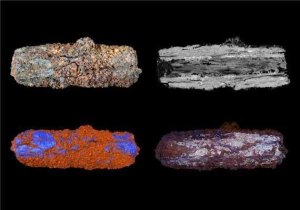
By 5300 years ago people had settled in small farming communities in the Nile Valley eventually to develop on the shores of lake – now represented by several smaller water bodies – what is regarded as the world’s first city near modern Faiyum. These Predynastic people buried their dead nearer to the Nile at Gerzeh, often sending them off with grave goods. The site has been continually excavated by professional archaeologists for more than a century, beginning with Sir Flinders Petrie. Two of the graves contained metallic iron beads, which presented a puzzle as iron smelting is only known from the 6th century BCE onwards. Unsurprisingly, the beads came to be regarded as artefacts wrought from an iron meteorite, though their highly altered nature and intrinsic value thwarted attempts at full analysis. Geochemists from the Open and Manchester Universities, and the Natural History Museum have now resolved the issue (Johnson, D. et al. 2013. Analysis of a prehistoric Egyptian iron bead with implications for the use and perception of meteorite iron in ancient Egypt. Meteoritics and Planetary Science, on-line, DOI: 10.1111/maps.12120). Non-destructive electron microscopy and X-ray tomography reveal, respectively, clear signs of the banded Widmanstätten structures and traces of nickel-rich iron alloy (taenite) that typify iron meteorites but are absent from smelted iron. The beads were clearly beaten and rolled into shape, but this working did not destroy the tell-tale evidence of their origin.

Optical, microprobe and CT-scan images of Predynastic iron bead from the Nile Valley (credit: Open University)

This provenance tallies with the appearance in early New Kingdom hieroglyphs of the term biA-n-pt – literally iron-from-the-sky – which was adopted for smelted iron when first made in the 26 to 27th Dynasties. But pharaonic iron was not a poor relation of gold, regarded as flesh of the gods and hence featuring in the masks of Pharaohs such as Tutankhamen, but supposedly what their bones were made from.

Continental comfort blanket

Way back in the mists of time, say around 1970-71, an idea was doing the rounds that because the thermal conductivity of continental crust is lower than that of the ocean floor it should allow thermal energy to build up in the mantle beneath. In turn that might somehow encourage the formation of hot spots and a shallower depth to the asthenosphere: the outcome might be to encourage rifting of weakened lithosphere and ultimately a new round of sea-floor spreading. The case often cited was the Atlantic – North and South – since there are eight hotspots currently on the mid-Atlantic ridge. Africa was another popularised case with a great many broad domes associated with Cenozoic volcanism, and the link between formation of the East African Rift System, hot spots and doming had already been suggested. Africa has barely drifted for around 100 Ma and the domes were supposed to have formed by the build up of heat in the mantle beneath. Geoscience moved on to clearly demonstrate the coincidence of large igneous provinces and flood basalt volcanism with the initiation of Atlantic spreading in the form of the Central Atlantic and Brito-Arctic LIPs during initial opening of the South and North Atlantic at the end of the Triassic and during the Palaeocene respectively. But the role of continental insulation became a bit of backwater compared with notions of mantle plumes emanating at the core-mantle boundary. Well, it’s back.

Divergent plate boundary: Mid-Atlantic Ridge
The Mid-Atlantic Ridge (credit: Wikipedia)

There is now a vast repository of ocean-floor lavas that formed at mid-ocean ridges in the past, thanks to the international Deep Sea and Ocean Drilling Programmes begun in 1968 about when the heyday of plate tectonics really got underway. In the last 45 years there have also been great advances in igneous geochemistry and its interpretation, including relations with mantle melting temperatures. Geochemists at the Friedrich-Alexander-Universiteit in Erlangen, Germany have re-examined the major-element geochemistry of 184 glassy ocean-floor basalts from drill sites of different ages on the floor of the Atlantic Ocean and compared them with 157 from the Pacific. To avoid the possible influence of plume-related heating, the sites were chosen well away from the tracks of existing hot spots. Mantle temperature can be assessed from the sodium and iron content of basalts, Na decreasing with higher temperatures and Fe doing the reverse (Brandl, P.A. et al. 2013. High mantle temperatures following rifting cause by continental insulation. Nature Geoscience, v. 6, p. 391-394). Atlantic samples show increasing Na and decreasing Fe contents in progressively younger basalts, i.e. a trend with time of decreasing mantle temperature such that the oldest (~166 Ma) record 150°C higher mantle temperature than the youngest, with a similar result for the Indian Ocean floor. No such trend is present in samples from the same age range of the Pacific Ocean floor. At around 170 Ma the mid-Atlantic Ridge was close to the continental lithosphere of the Americas and Africa, whereas the East Pacific Rise was at least 2000 km from any continental margin. Younger Atlantic samples formed progressively further from its shores record cooling of the mantle source.
A prediction of the model is that the converse, continental accretion to form supercontinents such as Pangaea, should rapidly have caused considerable warming in the mantle beneath them. This suggests that the formation of supercontinents, or even less substantial continents, should carry the seeds of their re-fragmentation, as Africa is currently demonstrating by the separation of Arabia since the Red Sea began to open some 15 Ma ago, which Somalia and much of eastern Kenya and Tanzania seem destined to follow once the East African Rift System ‘gets steam up’.

  • Langmuir, C. 2013. Older and hotter. Nature Geoscience, v. 6, p. 332-333

Could the Toba eruption have affected migrating humans?

Around 73 thousand years ago a supervolcano in Sumatra erupted on a scale unprecedented in the last 2 million years. It left a 100 by 30 km elliptical caldera now occupied by Lake Toba, and explosively ejected 2800 of magma, about 800  km3 falling as ash as far afield as the Greenland ice cap. Although ice-core records show little if any sign of associated climate change in polar regions, the vast amount of ash and sulfate aerosols blasted into the stratosphere must have had some ‘global winter’ effect. Large areas of South Asia were blanketed by thick beds of ash. Human migration from Africa into Eurasia was probably underway at the time, indeed stone tools are found directly beneath and above the Toba ash in southern India and Malaysia. Some palaeoanthropologists have seen the stresses imposed by the Toba eruption as possible means of reducing the entire human population to a mere few thousand: a genetic ‘bottleneck’ that could have led to rapid evolution among surviving generations that may have shaped changes in human behaviour and culture.

Landsat image of Lake Toba, the largest volcan...
Landsat image of Lake Toba, the largest volcanic crater lake in the world. (credit: Wikipedia)

There is a widening range of views on the climate changes that may have followed Toba. It has even been suggested that global mean surface temperature fell by as much as 10°C (Robock, A. et al. 2009. Did the Toba volcanic eruption of ∼74 ka B.P. produce widespread glaciation? Journal of Geophysical Research: Atmospheres, v. 114, DOI: 10.1029/2008JD011652), although not so far as to produce a worldwide glacial surge but sufficient to devastate vegetation. This bleak look back to a critical point in human affairs resulted from modeling of the effects of a global reflective cloud of ash and sulfate. A later modeling study factored in particle and aerosol sizes (Timmreck, C. et al. 2010. Aerosol size confines climate response to volcanic super-eruptions. Geophysical Research Letters, v. 37, doi:10.1029/2010GL045464) to give a less dramatic, but still severe maximum global cooling due to Toba of ~3.5°C.

The focus has now shifted from modelling to a more direct look at the environmental effects of the Toba super-eruption, preserved in sediments beneath Lake Malawi in southern Africa (Lane, C.S. et al. 2013. Ash from the Toba supereruption in Lake Malawi shows no volcanic winter in East Africa at 75 ka. Proceedings of the National Academy of Science, v. 110, doi/10.1073/pnas.1301474110). The sediments contain a thin ash layer that is very different from those produced by East African Rift volcanism but chemically and texturally similar to the Toba ash from the Indian Ocean and India. The sediments, diatom fossils and chemical biomarkers immediately above the ash show little sign of a significant temperature fall. At most it records a 1.5°C fall, and the authors conclude little chance of a human genetic bottleneck among Africans living at the time.

There is clearly a conflict between results of modeling and real-world climatic data, which is interesting in its own right. But the Malawi findings do not rule out ‘bottlenecks’ resulting from severe stress in South Asia where the ash itself would have severely affected game and vegetation for long enough to face migrating human bands with the prospect of starvation. Obviously, some survived to move on and to leave their tools behind on top of the Toba Ash.