More dinosaur trackways from the Jurassic of the Isle of Skye, Scotland

The Isle of Skye off the northwestern coast of Scotland is one of several areas in Britain that are world-class geological gems. Except for the Cuillin Hills that require advanced mountaineering skills it is easy to explore and has become a major destination for both beginners and expert geoscientists of all kinds. Together with the adjacent Isle of Raasay the area is covered by a superb, free geological guidebook (Bell, B. 2024. The Geology of the Isles of Skye and Raasay. Geological Society of Glasgow) together with 60 standalone excursion guides, and even an introduction to Gaelic place names and pronunciation. It is freely available from https://www.skyegeology.com/
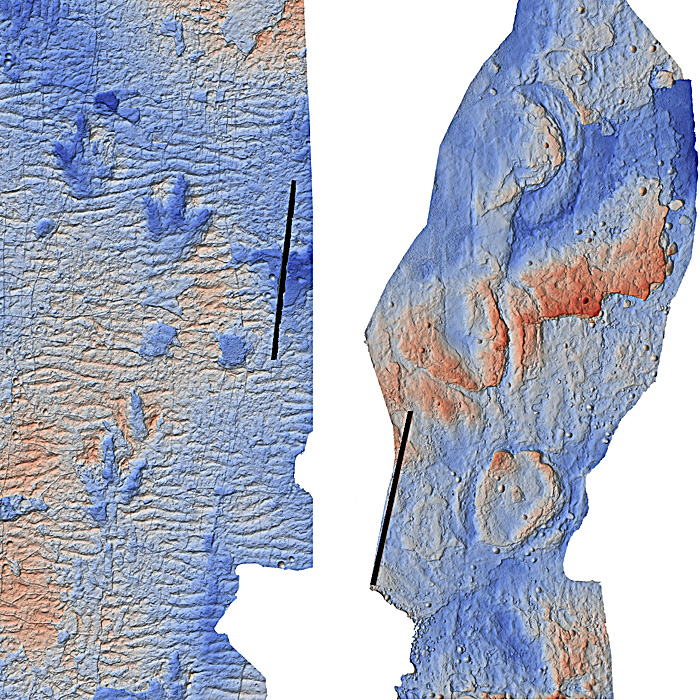
Fig Dinosaur trackways at Prince Charles’s Point on the Isle of Skye: Left carnivorous theropods; Right herbivorous sauropods. The black scales are 1 m long. The images are enhanced fine-scale elevation models of the exposed surfaces that were derived from vertical photographs. Credit: Blakesley et al., Figs 9 and 27.

Since 2018 Skye has also become a must-visit area for vertebrate palaeontologists. Beneath Palaeocene flood basalts is a sequence of Jurassic strata, both shallow marine and terrestrial. One formation, the Great Estuarine Group of Middle Jurassic (Bathonian, 174–164 Ma) age covers the time when meat-eating theropod- and herbivorous sauropod dinosaurs began to grow to colossal sizes from diminutive forebears. While other Jurassic sequences on Skye have notable marine faunas, its Bathonian strata have yielded a major surprise: some exposed bedding surfaces are liberally  dotted with trackways of the two best known groups of dinosaur. The first to be discovered were at Rubha Nam Brathairean (Brothers’ Point) suggesting a rich diversity of species that had wandered across a wide coastal plain, also including the somewhat bizarre Stegosaurus. The latest finds are from a rocky beach at Prince Charles’s Point where the Young Pretender to the British throne, Charles Edward Stuart, landed and hid during his flight from the disastrous Battle of Culloden (16 April 1746). It was only in the last year or so that palaeontologists from the universities of Edinburgh and Liverpool, and the Staffin Museum came across yet more footprints (131 tracks) left there by numerous dinosaurs in the rippled sands of a Bathonian lagoon (Blakesley, T. et al. 2025. A new Middle Jurassic lagoon margin assemblage of theropod and sauropod dinosaur trackways from the Isle of Skye, Scotland. PLOS One, v. 20, article e0319862; DOI: 10.1371/journal.pone.0319862.

The Prince Charles’s Point site is partly covered by large basalt boulders, which perhaps account for the excellent preservation of the bedding surfaces from wave action. Two kinds of footprint are preserved (see image): those made by three-toed feet and by elephant-like feet that ‘squidged-up’ sediment surrounding than. Respectively these are suggested to represent the hind limbs of bipedal carnivorous theropods and quadrupedal herbivorous sauropods. They show that individual dinosaurs moved in multiple directions, but there is no evidence for gregarious behaviour, such as parallel trackways of several animals. They occur on two adjacent bedding surfaces so represent a very short period of time, perhaps a few days. The authors suggest that several individual animals were milling around, with more sauropods than theropods. What such behaviour represents is unclear. The water in an estuarine lagoon would likely have been fresh or brackish. They may have been drinking or perhaps there was some plants or carcases worth eating ? That might explain both kinds of dinosaurs’ milling around. The sizes of both sauropod and theropod prints average about 0.5 m. The stride lengths of the theropods suggest that they were between 5 to 7 metres long with a hip height of around 1.85 m. Their footprints resemble those reconstructed from skeletal remains of Middle Jurassic Megalosaurus, the first dinosaur to be named (by William Buckland in 1827). The sauropods had estimated hip heights of around 2 m so they may have been similar in size (around 16 m) to the Middle Jurassic Cetiosaurus, the first sauropod to be named (by Richard Owen in 1842).

A fully revised edition of Steve Drury’s book Stepping Stones: The Making of Our Home World can now be downloaded as a free eBook

When dinosaurs roamed the Western Isles

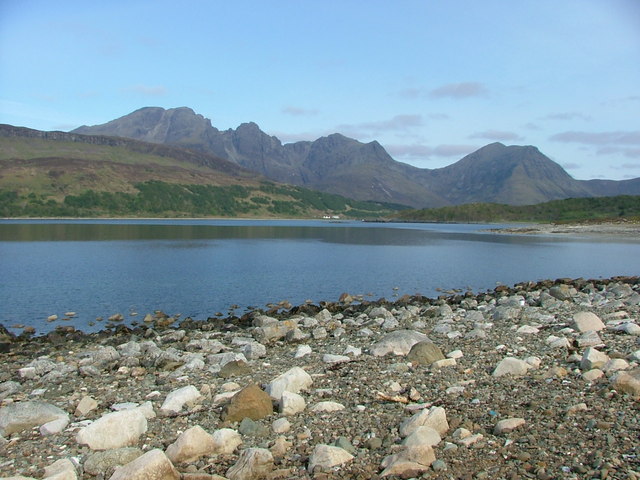
Cuillin Hills, Isle of Skye, Scotland, UK
Cuillin Hills, Isle of Skye, Scotland, UK (credit: Wikipedia)

The Isle of Skye off the northwest coast of Scotland  is known largely as a prime tourist destination, such as Dunvegan Castle with a real clan chief (The MacLeod of MacLeod) and its Faerie Flag; Britain’s only truly challenging mountains of the Black Cuillin; and, of course, the romantic connection with the Young Pretender, Charles Edward Stuart and his escape, in drag, from the clutches of the Duke ‘Butcher’ Cumberland, hence the Skye Boat Song. Geologists know it best for its flood basalts with classic stepped topography and the exhumed guts of a massive central volcano (the Cuillin), relics of the Palaeocene-Eocene (62 to 54 Ma) North Atlantic Large Igneous Province. The spectacular Loch Coruisk, a glacial corrie drowned by the sea, exposes the deepest part of the main magma chamber. It is also the lair of Scotland’s lesser known Monster, the dread Each Uisge (Water Horse). Yet evidence is emerging for the former presence in the Hebrides of other, more tangible monsters.

Skye’s great volcanic edifice rests on Mesozoic sedimentary rocks including shallow-water muddy limestones of the Great Estuarine Group of Middle Jurassic (Bathonian, 174–164 Ma) age. For dinosaur specialists this is of the time when meat-eating theropods and herbivorous sauropods began growing to colossal sizes. Yet the Bathonian is notable for its global paucity in well exposed terrestrial and near-shore sedimentary sequences. Easily accessible, the Skye Bathonian sequence is much visited and has yielded a rich, though generally fragmentary fauna. A group of recent visiting palaeontologists from the University of Edinburgh, the Chinese Academy of Sciences and Skye’s Staffin Museum have discovered an extensive tract of wave-cut platform on the east shore of the Trotternish Peninsula where lagoonal carbonate muds were trampled by several dinosaurs that left around 50 tracks (dePolo, P.E. et al. 2018. A sauropod-dominated tracksite from Rubha nam Brathairean (Brothers’ Point), Isle of Skye, Scotland. Scottish Journal of Geology, online; doi:10.1144/sjg2017-016).

Dinosaur foot prints from Skye. Left example of a sauropod rear-foot print; right theropod. (credit dePolo, P.E. et al. 2018, modified from Figs 8 and 9a)

Some are of medium-sized sauropods (either Parabrontopodus or Breviparopus – both names for footprints rather than any genus of dinosaur) whose crudely elephant-like footprints are up to 0.5 m across (the largest, from Western Australia, are about 1.7 m across). Although there are fragmentary dinosaur bones from the same strata, assigning the footprint to a known species is not possible. However, foot size can be used to estimate how high the creatures’ hips stood (2 to 2.5 m): hefty beasts but not the true giants of later times A variety of three-toed, clawed, somewhat bird-like, footprints also occur. They are assigned to probably bipedal carnivores or theropods. Variation in foot size suggests a range of hip-height from about 0.9 to 2 metres, so these carnivores would have been pretty formidable.

A fully revised edition of Steve Drury’s book Stepping Stones: The Making of Our Home World can now be downloaded as a free eBook

Impact debris in Britain

These days reports of geological evidence for asteroid impacts are not regarded with a mixture of disbelief, wonder and foreboding: well, not by geologists anyway. But for such a small area as Britain now to have three of widely different ages and in easily accessible places is pretty good for its brand as the place to visit for practically every aspect of Earth history. The first to be discovered lies at the base of Triassic mudstones near Bristol (see Britain’s own impact) and would need some serious grubbing around at a former construction site. The next to emerge was located in one of the best geological districts in the country at several easily accessed coastal exposures in Northwest Scotland. A glass-rich ejecta layer occurs in the basal Torridonian Stoer Group on Stac Fada, Stoer, Sutherland (UK National Grid Reference 203300, 928400). The most recently found (Drake, S.N. and 8 others 2018. Discovery of a meteoritic ejecta layer containing unmelted impactor fragments at the base of Paleocene lavas, Isle of Skye, Scotland. Geology, v. 46, p. 171-174; doi:10.1130/G39452.1) is on the Inner Hebridean island of Skye at the base of its famous Palaeocene flood basalt sequence (UK National Grid Reference 155371,821112).

View to the northwest across Loch Slapin to the Cuillin Hills of Skye (Central Igneous Complex). The flood basalts beneath which the ejecta layer occurs are just above the trees. (Credit: Wikipedia)

The last is perhaps the most spectacular of the three, as it contains the full gamut of provenance, matched only by material from the drill core into the 66 million year-old Chicxulub crater. The 0.9 m thick debris layer rests directly on mid-Jurassic sandstones beneath Palaeocene basalts of the North Atlantic Igneous Province (NAIP). The layer contains a basalt clast dated at 61.54 Ma, but is dominantly reminiscent of a pyroclastic ignimbrite flow as it contains glass shards. But there the resemblance ends for the bulk of small clasts are of quartz and K-feldspar, sandstone and gneiss. Zircons extracted from the debris show shock lamellae and give Archaean and Proterozoic ages commensurate with the local basement, but also with the bulk of the Scandinavian and Canadian Shields. So the impact could have been anywhere in such widespread terrains, although the enclosed basalt narrows this down to areas where basement is overlain by lavas of the NAIP. The Skye impactite contains unmelted meteorite fragments in the form of titanium nitrides alloyed with vanadium and niobium, metallic iron-silicon alloy containing exsolved carbon, and manganese sulfide.

Although it may be coincidental, the situation of the ejecta layer immediately beneath the Skye lavas, its containing a clast of basalt whose age corresponds to the oldest flows anywhere in the NAIP is fascinating. But the actual impact site is, as yet, unknown. Even so, the layer provokes thoughts about whether an impact may have been more than spatially related to the large NAIP flood basalt pile, preserved on either side of the North Atlantic. If the event was large, then surely the ejecta should be preserved near the base of the flood basalts elsewhere in NW Britain and further afield