The origin of life on Earth: new developments

Debates around the origin of Earth’s life and what the first organism was like resemble the mythical search for the Holy Grail. Chivalric romanticists of the late 12th and early 13th centuries were pretty clear about the Grail – some kind of receptacle connected either with the Last Supper or Christ’s crucifixion – but never found it. Two big quests that engage modern science centre on how the chemical building blocks of the earliest cells arose and the last universal common ancestor (LUCA) of all living things. Like the Grail’s location, neither is likely to be fully resolved because they can only be sought in a very roundabout way: both verge on the imaginary. The fossil record is limited to organisms that left skeletal remains, traces of their former presence, and a few degraded organic molecules. The further back in geological time the more sedimentary rock has either been removed by erosion or fundamentally changed at high temperatures and pressures. Both great conundrums can only be addressed by trying to reconstruct processes and organisms that occurred or existed more than 4 billion years ago.

Artistic impression of the early Earth dominated by oceans (Credit: Sci-news.com)

In the 1950s Harold Urey of the University of Chicago and his student Stanley Miller mixed water, methane, ammonia and hydrogen sulfide in lab glassware, heated it up and passed electrical discharges through it. They believed the simple set-up crudely mimicked Hadean conditions at the Earth surface. They were successful in generating more complex organic chemicals than their starting materials, though the early atmosphere and oceans are now considered to have been chemically quite different. Such a ‘Frankenstein’ approach has been repeated since with more success (see Earth-logs April 2024), creating 10 of the 20 amino acids plus the peptide bonds that link them up to make all known proteins, and even amphiphiles, the likely founders of cell walls. The latest attempt has been made by Spanish scientists at the Andalusian Earth Sciences Institute, the Universities of Valladolid and Cadiz, and the International Physics Centre in San Sebastian (Jenewein, C. et al 2024. Concomitant formation of protocells and prebiotic compounds under a plausible early Earth atmosphere. Proceedings of the National Academy of Sciences, v. 122, article 413816122; DOI: 10.1073/pnas.241381612).
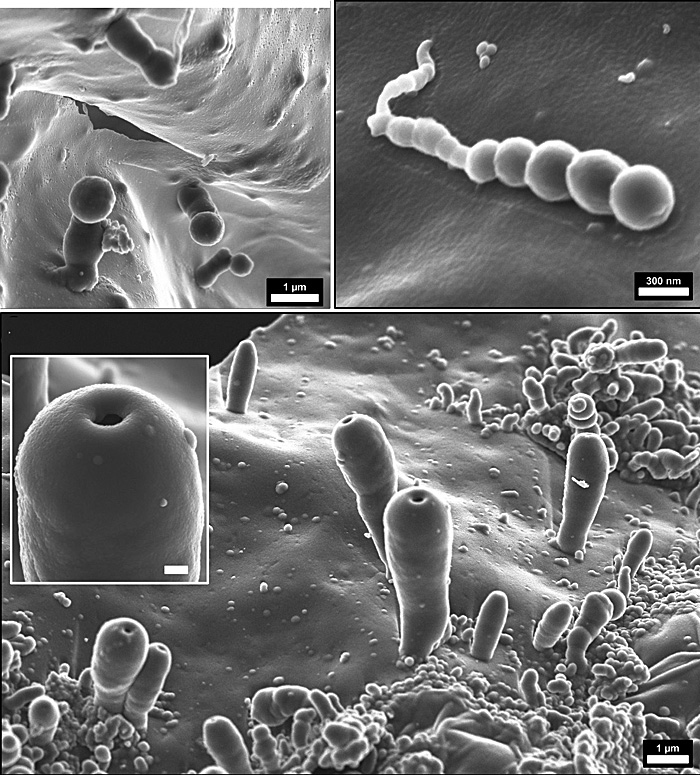
Biomorphs formed by polymerisation of HCN (Credit: Jenewein, C. et al 2024, Figure 2)

Jenewein and colleagues claim to have created cell-like structures, or ‘biomorphs’ at nanometre- and micrometre scale – spheres and polyp-like bodies – from a more plausible atmosphere of CO2 , H2O, and N2. These ‘protocells’ seem to have formed from minutely thin (150 to 3000 nanometres) polymer films built from hydrogen cyanide that grew  on the surface of the reaction chamber as electric discharges and UV light generated HCN and more complex ‘prebiotic’ chemicals. Apparently, these films were catalysed by SiO2 (silica) molecules from the glass reactor. Note:  In the Hadean breakdown of olivine to serpentinite as sea water reacted with ultramafic lavas would have released abundant silica. Serpentinisation also generates hydrogen. Intimate release of gas formed bubbles to create the spherical and polyp-like ‘protocells’. The authors imagine the Hadean global ocean permanently teeming with such microscopic receptacles. Such a veritable ‘primordial soup’ would be able to isolate other small molecules, such as amino acids, oligopeptides, nucleobases, and fatty acids, to generate more complex organic molecules in micro-reactors en route  to the kind of complex, self-sustaining systems we know as life.

So, is it possible to make a reasonable stab at what that first kind of life may have been? It was without doubt single celled. To reproduce it must have carried a genetic code enshrined in DNA, which is unique not only to all species, but to individuals. The key to tracking down LUCA is that it represents the point at which the evolutionary trees of the fundamental domains of modern life life – eukarya (including animals, plants and fungi), bacteria, and archaea – converge to a single evolutionary stem. There is little point in using fossils to resolve this issue because only multicelled life leaves tangible traces, and the first of those was found in 2,100 Ma old sediments in Gabon (see: The earliest multicelled life; July 2010). The key is using AI to compare the genetic sequences of the hugely diverse modern biosphere. Modern molecular phylogenetics and computing power can discern from their similarities and differences the relative order in which various species and broader groups split from others. It can also trace the origins of specific genes that provides clues about earlier genetic associations. Given a rate of mutation the modern differences provide estimates of when each branching occurred. The most recent genetic delving has been achieved by a consortium based at various institutions in Britain, the Netherlands, Hungary and Japan  (Moody, E.R.R. and 18 others 2024. The nature of the last universal common ancestor and its impact on the early Earth system. Nature Ecology & Evolution, v.8, pages 1654–1666; DOI: 10.1038/s41559-024-02461-1).

Moody et al have pushed back the estimated age of LUCA to halfway through the Hadean, between 4.09 to 4.33 billion years (Ga), well beyond the geologically known age of the earliest traces of life (3.5 Ga). That age for LUCA in itself is quite astonishing: it could have been only a couple of hundred million years after the Moon-forming interplanetary collision. Moreover, they have estimated that Darwin’s Ur-organism had a genome of around 2 million base pairs that encoded about 2600 proteins: roughly comparable to living species of bacteria and archaea, and thus probably quite advanced in evolutionary terms. The gene types probably carried by LUCA suggest that it may have been an anaerobic acetogen; i.e. an organism whose metabolism generated acetate (CH3COO) ions. Acetogens may produce their own food as autotrophs, or metabolise other organisms (heterotrophs). If LUCA was a heterotroph, then it must have subsisted in an ecosystem together with autotrophs which it consumed, possibly by fermentation. To function it also required hydrogen that can be supplied by the breakdown of ultramafic rocks to serpentinites, which tallies with the likely ocean-world with ultramafic igneous crust of the Hadean (see the earlier paragraphs about protocells). If an autotroph, LUCA would have had an abundance of CO2 and H2 to sustain it, and may have provided food for heterotrophs in the early ecosystem. The most remarkable possibility discerned by Moody et al is that LUCA may have had a kind of immune system to stave off viral infection.
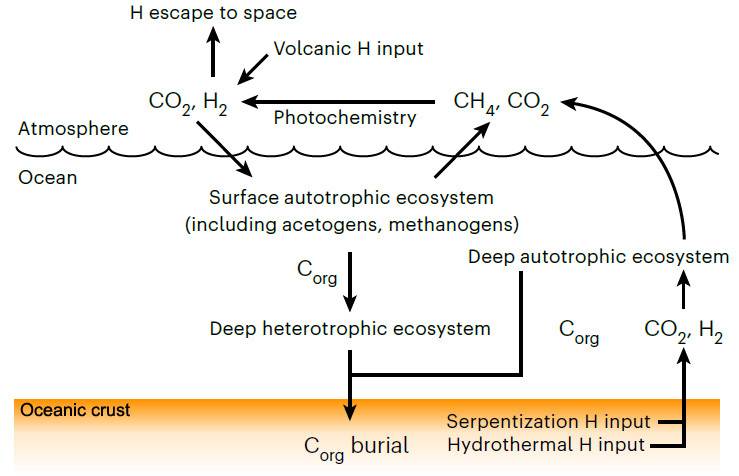
The carbon cycle on the Hadean Earth (Credit: Moody et al. 2024; Figure 3e)

The Hadean environment was vastly different to that of modern times: a waterworld seething with volcanism; no continents; a target for errant asteroids and comets; more rapidly spinning with a 12 hour day; a much closer Moon and thus far bigger tides. The genetic template for the biosphere of the following four billion years was laid down then. LUCA and its companions may well have been unique to the Earth, as are their descendants. It is hard to believe that other worlds with the potential for life, even those in the solar system, could have followed a similar biogeochemical course. They may have life, but probably not as we know it  . . .

See also: Ball, P. 2025. Luca is the progenitor of all life on Earth. But its genesis has implications far beyond our planet. The Observer, 19 January 2025.

A fully revised edition of Steve Drury’s book Stepping Stones: The Making of Our Home World can now be downloaded as a free eBook

Darwin’s ‘warm little pond’: a new discovery

There may still be a few people around today who, like Aristotle did, reckon that frogs form from May dew and that maggots and rats spring into life spontaneously from refuse. But the idea that life emerged somehow from the non-living is, to most of us, the only viable theory. Yet the question, ‘How?’, is still being pondered on. Readers may find Chapter 13 of Stepping Stones useful. There I tried to summarise in some detail most of the modern lines of research. But the issue boils down to means of inorganically creating the basic chemical building blocks from which life’s vast and complex array of molecules might have been assembled. Living materials are dominated by five cosmically common elements: carbon, hydrogen, oxygen, nitrogen and phosphorus – CHONP for short. Organic chemists can readily synthesise countless organic compounds from CHONP. And astronomers have discovered that life is not needed to assemble the basic ingredients: amino acids, carbon-ring compounds and all kinds of simpler CHONP molecules occur in meteorites, comets and even interstellar molecular clouds. So an easy way out is to assume that such ingredients ended up on the early Earth simply because it grew through accretion of older materials from the surrounding galaxy. Somehow, perhaps, their mixing in air, water and sediments together with a kind of chaotic shuffling did the job, in the way that an infinity of caged monkeys with access to typewriters might eventually create the entire works of William Shakespeare.  But, aside from the statistical and behavioural idiocy of that notion, there is a real snag: the vaporisation of the proto-Earth’s outer parts by a Moon-forming planetary collision shortly after initial accretion.

In 1871 Charles Darwin suggested to his friend Joseph Hooker that:

          ‘… if (and Oh, what a big if) we could conceive in some warm little pond, with all sorts of ammonia and phosphoric salts, light, heat, electricity, etc., present that a protein compound was chemically formed, ready to undergo still more complex changes, at the present day such matter would be instantly devoured or absorbed, which would never have been the case before living creatures were formed’.

Followed up in the 1920s by theorists Alexander Oparin and J.B.S. Haldane, a similar hypothesis was tested practically by Harold Urey and Stanley Miller at the University of Chicago. They devised a Heath-Robinson simulation of an early atmosphere and ocean seeded with simple CHONP (plus a little sulfur) chemicals, simmered it and passed electrical discharges through it for a week. The resulting dark red ‘soup’ contained 10 of the 20 amino acids from which a vast array of proteins can be built. A repeat in 1995 also yielded two of the four nucleobases at the heart of DNA – adenine and guanine.  But simply having such chemicals around is unlikely to result in life, unless they are continually in close contact: a vessel or bag in which such chemicals can interact. The best candidates for such a containing membrane are fatty acids of a form known as amphiphiles. One end of an amphiphile chain has an affinity for water molecules, whereas the other repels them. This duality enables layers of them, when assembled in water, spontaneously to curl up to make three dimensional membranes looking like bubbles. In the last year they too have been created in vitro (Purvis, G. et al. 2024. Generation of long-chain fatty acids by hydrogen-driven bicarbonate reduction in ancient alkaline hydrothermal vents. Nature Communications (Earth & Environment), v. 5, article 30; DOI: 10.1038/s43247-023-01196-4).

Cell-like membranes formed by fatty acid amphiphiles

Graham Purvis and colleagues from Newcastle University, UK allowed three very simple ingredients – hydrogen and bicarbonate ions dissolved in water and the iron oxide magnetite (Fe3O4) – to interact. Such a simple, inorganic mixture commonly occurs in hydrothermal vents and hot springs. Bicarbonate ions (HCO3) form when CO2 dissolves in water, the hydrogen and magnetite being generated during the breakdown of iron silicates (olivines) when  ultramafic igneous rocks react with water:

3Fe2SiO4 + 2H2O → 2 Fe3O4 + 3SiO­2 +3H2

Various simulations of hydrothermal fluids had previously been tried without yielding amphiphile molecules. Purvis et al. simplified their setup to a bicarbonate solution in water that contained dissolved hydrogen – a simplification of the fluids emitted by hydrothermal vents – at 16 times atmospheric pressure and a temperature of 90°C. This was passed over magnetite. Under alkaline conditions their reaction cell yielded a range of chain-like hydrocarbon molecules. Among them was a mixture of fatty acids up to 18 carbon atoms in length. The experiment did not incorporate P, but its generation of amphiphiles that can create cell-like structures are but a step away from forming the main structural components of cell membranes, phospholipids.

When emergence of bag-forming membranes took place is, of course, hard to tell. But in the oldest geological formations ultramafic lava flows are far more common than they are today. In the Hadean and Eoarchaean, even if actual mantle rocks had not been obducted as at modern plate boundaries, at the surface there would have been abundant source materials for the vital amphiphiles to be generated through interaction with water and gases: perhaps in ‘hot little ponds’. To form living, self-replicating cells requires such frothy membranes to have captured and held amino acids and nucleobases. Such proto-cells could become organic reaction chambers where chemical building blocks continually interacted, eventually to evolve the complex forms upon which living cells depend.

Naturally occurring hydrogen: an abundant green fuel?

Burning hydrogen produces only water vapour, so it is not surprising that it has been touted as the ultimate ‘green’ energy source, and increasingly attracts the view that the ‘Hydrogen Economy’ may replace that based on fossil fuels. It is currently produced from natural gas by ‘steam reforming’ of methane that transforms water vapour and CH4 to hydrogen and carbon monoxide. That clearly doesn’t make use of the hydrogen ‘green’ as the CO becomes carbon dioxide because it reacts with atmospheric oxygen; it is termed ‘grey hydrogen’. But should it prove possible to capture CO and store it permanently underground in some way then that can be touted as ‘blue hydrogen’ thereby covering up the carbon footprint of all the rigmarole in getting the waste CO into a safe reservoir. However, if carbon-free electricity from renewables is used to electrolyse water into H and O the hydrogen aficionados can safely call it ‘green hydrogen’.   It seem there is a bewildering colour coding for hydrogen that depends on the various options for its production: ‘yellow’ if produced using solar energy; ‘red’ if made chemically from biowaste; ‘black’ by coking coal using steam; ‘pink’ is electrolysis using nuclear power; and even ‘turquoise’ hydrogen if methane is somehow turned into hydrogen and solid carbon using renewables – a yet-to-be-developed technology! Very jolly but confusing: almost suspiciously so!

But not to be forgotten is the ‘white’ variety, applied to hydrogen that is emitted by natural processes within the Earth. Eric Hand, the European news editor for the major journal Science has written an excellent Feature article about ‘white’ hydrogen in a recent issue (Hand, E. 2023. Hidden hydrogen. Science, v. 379, article adh1460; DOI: 10.1126/science.adh1460). Hand’s feature is quirky, but well-worth a read. It is based on the proceedings of a Geological Society of America mini-conference about non-petroleum, geological energy resources  held in October 2022. He opens with a bizarre anecdote related by a farmer who lives in rural Mali. The only drilling that ever went on in his village was for water, and many holes were dry. But one attempt resulted in ‘wind coming out of the hole’. When a driller looked in the hole, the ‘wind’ burst into flame – he had a cigarette in his mouth. The fire burned for months. Some 20 years later the story reached a Malian company executive who began prospecting the area’s petroleum potential, believing the drilling had hit natural gas. Analysis of the gas revealed that it was 98% hydrogen – now the village has electricity generated by ‘white’ hydrogen.

Mantle rock in the Oman ophiolite, showing cores of fresh peridotite, surrounded by brownish serpentinite and white magnesium carbonate veins (credit: Juerg Matter, Oman Drilling Project, Southampton University, UK)

So how is hydrogen produced by geological processes? Some springs in the mountains of Oman also release copious amounts of the gas. The springs emerge from ultramafic rocks of the vast ophiolite that was emplaced onto the Arabian continental crust towards the end of the Cretaceous. The lower part of this obducted mass of oceanic lithosphere is mantle rock dominated by iron- and magnesium-rich silicates, mainly olivine [(Mg,Fe)2SiO4 – a solid solution of magnesium and iron end members]. When saturated with groundwater in which CO2 is dissolved olivine breaks down slowly but relentlessly. The hydration reaction is exothermic and generates heat, so is self-sustaining. Olivine’s magnesium end member is hydrated to form the soft ornamental mineral serpentine (Mg3Si2O5(OH)4) and magnesium carbonate. Under reducing conditions the iron end member reacts with water to produce an iron oxide, silica and hydrogen:

3Fe2SiO4 + 2H2O → 2 Fe3O4 + 3SiO­2 +3H2

Gases emanating from mid-ocean ridges contain high amounts of hydrogen produced in this way, for example from Icelandic geothermal wells. But Mali is part of an ancient craton, so similar reactions involving iron-rich ultramafic rocks deep in the continental crust are probably sourcing hydrogen in this way too. Hydrogen production on the scale of that discovered in Mali seems to be widespread, with discoveries in Australia, the US, Brazil and the Spanish Pyrenees that have pilot-scale production plants. The US Geological Survey has estimated that around 1 trillion tonnes of ‘white’ hydrogen may be available for extraction and use

Hydrogen, like other natural gases, may be trapped below the surface in the same ways as in commercial petroleum fields. But petroleum-gas wells emit little if any hydrogen mixed in with methane. That absence is probably because petroleum fields occur in deep sedimentary basins well above any crystalline basement. The geophysical exploration that discovers and defines the traps in petroleum fields has never been deployed over areas of crystalline continental crust because as far as the oil companies are concerned they are barren. That may be about to change. There is another exploration approach: known hydrogen seepage seems to deter vegetation so that the sites are in areas of bare ground, which have been called ‘fairy circles’. These could be detected easily using remote sensing techniques.

Artificially increasing serpentine formation by pumping water into the mantle part of ophiolites, such as that in Oman, and other near-surface ultramafic rocks is also a means of carbon sequestration, which should produce hydrogen as a by-product (see: Global warming: Can mantle rocks reduce the greenhouse effect?, July 2021). A ‘two-for-the-price-of-one’ opportunity?