New drill core penetrates the Mohorovičić Discontinuity (the ‘Moho’)

In 1909 Croatian geophysicist Andrija Mohorovičić examined seismograms of a shallow earthquake that shook the area around Zagreb. To his surprise the by-then familiar time sequence of P-waves followed by the slower S-waves appeared twice on seismic records up to 800 km away. The only explanation that he could come up with was that the first arrivals had travelled directly through the crust to the detector whereas the second set must have followed a longer path: it had travelled downwards to be refracted to reach the surface when it met rocks denser than those at the surface. His analysis revealed a sharp boundary between the Earth’s crust and its mantle at a depth of about 54 km below what was then Yugoslavia. Later workers confirmed this discovery and honoured its discoverer by naming it the Mohorovičić Discontinuity. Difficulty with pronouncing his name resulted in a geological nickname: ‘the Moho’. It can be detected everywhere: at 20 to 90 km beneath the continental surface and 5 to 10 km beneath the ocean floor, thus distinguishing between continental and oceanic crust.

In the late 1950s accelerating geological and oceanographic research that would culminate in the theory of plate tectonics turned its focus on drilling down to the Moho in much the same way as a lust for space travel spawned getting to the Moon. The difference was that the proposers of what became known as the Mohole Project were members of what amounted to a geoscientific glee club (The American Miscellaneous Society), which included a member of the well-financed US National Science Foundation’s Earth Science Panel. The idea emerged shortly after the Soviet Union had launched the Sputnik satellite and rumours emerged that it was proposing deep drilling into the continental crust beneath the Kola Peninsula.  The Mohole’s initial target was the 3.9 km deep floor of the Caribbean off Guadalupe in Mexico and required advanced methods of stabilisation for a new oceanographic ship that was to host the drilling rig.
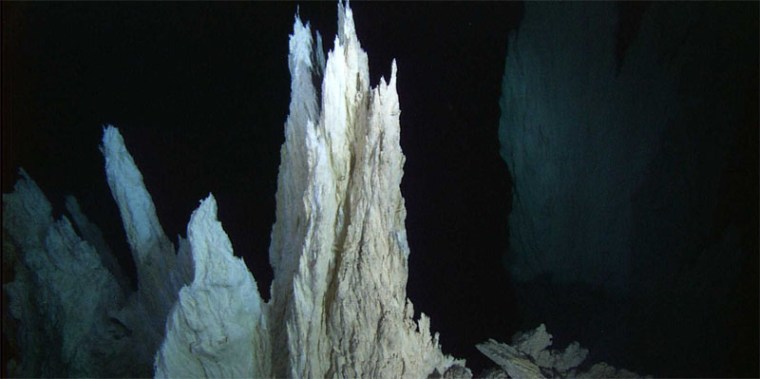
Huge (tens of metres high) pillars or ‘chimneys’ of carbonates formed by the Lost City hydrothermal vent near the mid-Atlantic ridge (Credit: ETH Zurich)

The Mohole was spudded in 1961, but the deepest of five holes reached only 200 m beneath the sea floor. It recovered Miocene sediments and a few metres of basalt. Deep water drilling was somewhat more complicated than expected and about US$ 57 million was spent fruitlessly. The project was disbanded in 1966 with considerable acrimony and schadenfreude. Nonetheless, the Mohole fiasco made technical advances and did demonstrate the feasibility of offshore drilling. The petroleum industry benefitted and so did oceanography with the globe-spanning deep-sea drilling of ocean floor sediments. The sediment cores produced the 200 million-year exquisitely detailed record of climate change and vast amounts of geochemical data from the basaltic oceanic crust. In 2005 JOIDES (the Joint Oceanographic Institutions for Deep Earth Sampling) had another crack at the Moho. That venture centred on the intersection of the Mid-Atlantic Ridge and the Atlantis Fracture Zone close to the ‘Lost City’ hydrothermal vent. The area around the vent is the site of a huge low-angled extensional fault that has partly dragged the basaltic ocean crust off the mantle beneath causing it to bulge. This provided an excellent opportunity to drill through the Moho. All went well, but 54 days of drilling yielded 1.4 km of basalt but nothing resembling mantle rock. So, again, the Moho had thwarted Science (and research economics). But finally it is beginning to reveal it secrets (see: Voosen, P. 2023. Ocean drillers exhume a bounty of mantle rocks. Science, v. 380 (News) p. 876-877; DOI: 10.1126/science.adi9899

The area around the ‘Lost City’ vent was originally chosen for drilling to examine the chemical processes going on there. Hydrogen emitted by serpentinisation of mantle rocks can combine with carbon monoxide in hydrothermal fluids to create a wide variety of organic compounds, which could be the initial building blocks for the origin of life. As part of the International Ocean Drilling Programme JOIDES decided to launch IODP Expedition 399 to re-examine the area around ‘Lost City’ in more detail. The expedition first tried to continue drilling the 2005 hole, but failed yet again. Finally a new drill site aimed at penetrating the extensional detachment. Within a few days the drill bit punched into mantle rocks and over a 6-week period the expedition had recovered a kilometre of core. The technical accounts for each week of drilling give a flavour of what it must be like to be a part of such a ship-borne expedition as well as describing what emerged in the drill core. It seems like a bit of a jumble, dominated by the mineral olivine– the principal characteristic of the ultramafic mantle – almost pure in the rock dunite and mixed with pyroxenes in various kinds of peridotite. There are also coarse-grained rocks that contain plagioclase feldspar, which cut through the ultramafic materials – gabbros, troctolites and norites.  They are relics of intrusive basaltic magmas that did not make it to the seabed. The samples are variably altered by interaction with watery hydrothermal fluids, with lots of serpentine, talc and even asbestos: the drilling presented a health hazard for a few days. The rocks have been metamorphosed under pressure-temperature conditions of greenschist to amphibolite facies and subject to ductile deformation, probably because of the effect of extensional deformation. Whatever, there is plenty of material to be analysed, including for signs of microbial activity. So, the dreams of a 1950s academic drinking fraternity (they were all men!) have finally been realised. But since those pre-plate-tectonic times many geologists have seen and collected much the same, even putting their index fingers on the Moho itself in the time-honoured fashion. Intricate 3-D geology in ophiolite complexes such as that in Oman, provide such opportunities at the much lower cost of air travel, Land Cruiser hire and camping. Indeed what we know of the structure of the oceanic lithosphere – pillow lavas, sheeted dyke complexes, gabbro cumulates and serpentinised ultramafic mantle – has come from such bodies thrust onto continental crust at ancient plate margins. So, why the celebration in this case? They are the first samples of mantle from young oceanic lithosphere; the rocks of ophiolites may not have formed at mid-ocean ridges. These should give clues to the long-term magmatism that has created the vast abyssal basins that the mantle eventually reabsorbs by subduction. Then, of course, there is the link to biogenic processes at constructive margins that underpinned the return to the active hydrothermal venting at ‘Lost City’.

Naturally occurring hydrogen: an abundant green fuel?

Burning hydrogen produces only water vapour, so it is not surprising that it has been touted as the ultimate ‘green’ energy source, and increasingly attracts the view that the ‘Hydrogen Economy’ may replace that based on fossil fuels. It is currently produced from natural gas by ‘steam reforming’ of methane that transforms water vapour and CH4 to hydrogen and carbon monoxide. That clearly doesn’t make use of the hydrogen ‘green’ as the CO becomes carbon dioxide because it reacts with atmospheric oxygen; it is termed ‘grey hydrogen’. But should it prove possible to capture CO and store it permanently underground in some way then that can be touted as ‘blue hydrogen’ thereby covering up the carbon footprint of all the rigmarole in getting the waste CO into a safe reservoir. However, if carbon-free electricity from renewables is used to electrolyse water into H and O the hydrogen aficionados can safely call it ‘green hydrogen’.   It seem there is a bewildering colour coding for hydrogen that depends on the various options for its production: ‘yellow’ if produced using solar energy; ‘red’ if made chemically from biowaste; ‘black’ by coking coal using steam; ‘pink’ is electrolysis using nuclear power; and even ‘turquoise’ hydrogen if methane is somehow turned into hydrogen and solid carbon using renewables – a yet-to-be-developed technology! Very jolly but confusing: almost suspiciously so!

But not to be forgotten is the ‘white’ variety, applied to hydrogen that is emitted by natural processes within the Earth. Eric Hand, the European news editor for the major journal Science has written an excellent Feature article about ‘white’ hydrogen in a recent issue (Hand, E. 2023. Hidden hydrogen. Science, v. 379, article adh1460; DOI: 10.1126/science.adh1460). Hand’s feature is quirky, but well-worth a read. It is based on the proceedings of a Geological Society of America mini-conference about non-petroleum, geological energy resources  held in October 2022. He opens with a bizarre anecdote related by a farmer who lives in rural Mali. The only drilling that ever went on in his village was for water, and many holes were dry. But one attempt resulted in ‘wind coming out of the hole’. When a driller looked in the hole, the ‘wind’ burst into flame – he had a cigarette in his mouth. The fire burned for months. Some 20 years later the story reached a Malian company executive who began prospecting the area’s petroleum potential, believing the drilling had hit natural gas. Analysis of the gas revealed that it was 98% hydrogen – now the village has electricity generated by ‘white’ hydrogen.

Mantle rock in the Oman ophiolite, showing cores of fresh peridotite, surrounded by brownish serpentinite and white magnesium carbonate veins (credit: Juerg Matter, Oman Drilling Project, Southampton University, UK)

So how is hydrogen produced by geological processes? Some springs in the mountains of Oman also release copious amounts of the gas. The springs emerge from ultramafic rocks of the vast ophiolite that was emplaced onto the Arabian continental crust towards the end of the Cretaceous. The lower part of this obducted mass of oceanic lithosphere is mantle rock dominated by iron- and magnesium-rich silicates, mainly olivine [(Mg,Fe)2SiO4 – a solid solution of magnesium and iron end members]. When saturated with groundwater in which CO2 is dissolved olivine breaks down slowly but relentlessly. The hydration reaction is exothermic and generates heat, so is self-sustaining. Olivine’s magnesium end member is hydrated to form the soft ornamental mineral serpentine (Mg3Si2O5(OH)4) and magnesium carbonate. Under reducing conditions the iron end member reacts with water to produce an iron oxide, silica and hydrogen:

3Fe2SiO4 + 2H2O → 2 Fe3O4 + 3SiO­2 +3H2

Gases emanating from mid-ocean ridges contain high amounts of hydrogen produced in this way, for example from Icelandic geothermal wells. But Mali is part of an ancient craton, so similar reactions involving iron-rich ultramafic rocks deep in the continental crust are probably sourcing hydrogen in this way too. Hydrogen production on the scale of that discovered in Mali seems to be widespread, with discoveries in Australia, the US, Brazil and the Spanish Pyrenees that have pilot-scale production plants. The US Geological Survey has estimated that around 1 trillion tonnes of ‘white’ hydrogen may be available for extraction and use

Hydrogen, like other natural gases, may be trapped below the surface in the same ways as in commercial petroleum fields. But petroleum-gas wells emit little if any hydrogen mixed in with methane. That absence is probably because petroleum fields occur in deep sedimentary basins well above any crystalline basement. The geophysical exploration that discovers and defines the traps in petroleum fields has never been deployed over areas of crystalline continental crust because as far as the oil companies are concerned they are barren. That may be about to change. There is another exploration approach: known hydrogen seepage seems to deter vegetation so that the sites are in areas of bare ground, which have been called ‘fairy circles’. These could be detected easily using remote sensing techniques.

Artificially increasing serpentine formation by pumping water into the mantle part of ophiolites, such as that in Oman, and other near-surface ultramafic rocks is also a means of carbon sequestration, which should produce hydrogen as a by-product (see: Global warming: Can mantle rocks reduce the greenhouse effect?, July 2021). A ‘two-for-the-price-of-one’ opportunity?

Global warming: Can mantle rocks reduce the greenhouse effect?

Three weeks ago I commented on a novel and progressive use for coal seams as stores for large quantities of hydrogen gas. That would be analogous to batteries for solar- and wind power plants by using electricity generated outside times of peak demand to electrolyse water to hydrogen and oxygen. There are other abundant rocks that naturally react with the atmosphere to permanently sequester carbon dioxide in alteration products, and form possible solutions to global warming. The most promising of these contain minerals that are inherently unstable under surface conditions; i.e. when they come into contact with rainwater that contains dissolved CO2. The most common are anhydrous minerals containing calcium and magnesium that occur in igneous rocks. Basalts contain the minerals plagioclase feldspar (CaAl2Si2O8), olivine ([Fe,Mg]2SiO4)] and pyroxene ([Fe,Mg]CaSi2O6)] that weather to yield the minerals calcium and magnesium carbonate. My piece Bury the beast in basalt, written in June 2016, mentions experiments in the basalts of Iceland and Washington State, USA to check their potential for drawing down atmospheric CO2. News of an even more promising prospect for CO2 sequestration in igneous rock emerged in the latest issue of Scientific American (Fox, D. 2021. Rare Mantle Rocks in Oman Could Sequester Massive Amounts of CO2. Scientific American, July 2021 issue).

Distribution of ophiolites around the Eastern Mediterranean and Black Seas. Most orogenic belts carry comparable volumes of ophiolites. (Credit: Gültekin Topuz, Istanbul Technical University)

The most abundant magnesium-rich material in our planet is the peridotite of the mantle, which consists of more than 60% olivine with lesser amounts of pyroxene and almost no feldspar. Being so rich in Mg and Fe, it is said to have an ultramafic composition and is extremely prone to weathering. The rock dunite is the ultimate ultramafic rock being made of more than 90% olivine. All ultramafic rocks are denser than 3,000 kg m-3, so might be expected to be rare in lower density continental crust (2,600 kg m-3). But they are present at the base of sections of oceanic lithosphere that plate tectonics has thrust up and onto the continents, known as ophiolite bodies. They often occur in orogenic belts at former destructive plate margins and are more common than one might expect. One of the largest and certainly the best-exposed occurs in the Semail Mountains of Oman, where scientists from the Lamont-Doherty Earth Observatory, New York State, USA, and other collaborators have been investigating its potential for absorbing CO2, since 2008.

Olivine-rich rocks react with naturally carbonated groundwater or hydrothermal fluids to form soft, often highly coloured material known as serpentine, well-known for the ease with which it can be carved and polished. As well as the mineral serpentinite [Mg3Si2O5(OH)4], the hydration reactions yield magnetite (Fe3O4), magnesium carbonate (magnesite) and silica (SiO2). If reaction takes place in the absence of oxygen gaseous hydrogen also forms. All these have been noted in the Oman ophiolite: fractures in serpentinites are filled with carbonates, and springs associated with them emit copious amounts of hydrogen and, in some cases, methane. Interestingly, the reactions – like those that involve anhydrous calcium-aluminium silicates when cement is wetted and then cures – release large amounts of heat. This makes the reactions self-sustaining once they begin in peridotite or dunite. However, at the Earth’s surface they are somewhat sluggish as the heat of reaction is lost to the air.  

Mantle rock in the Oman ophiolite, showing cores of fresh peridotite, brownish serpentinite and white carbonate veins (credit: Juerg Matter, Oman Drilling Project, Southampton University, UK)

The capacity for CO2 sequestration by ultramafic igneous rocks is high: a ton of olivine when completely hydrated takes in 0.62 tons of CO2. The Lamont-Doherty team has estimated that they speed up in crushed peridotite, for instance after milling during industrial-scale mining – peridotites are host rocks for platinum-group metals, nickel and chromium. (Kelemen, P.B. et al. 2020. Engineered carbon mineralization in ultramafic rocks for CO2 removal from air. Chemical Geology, v. 550, article 119628; DOI: 10.1016/j.chemgeo.2020.119628). Spreading mine waste over large areas of desert surfaces  would be one way of capturing CO2. However, using the age of emplacement of the Oman ophiolite (96-70 Ma) and the amount of carbonate found in fractured serpentinite there, the team estimates that each ton of the 15 m deep zone of active weathering has naturally absorbed CO2 at a rate of about 1 g m-3 year-1 equivalent to 1000 tons per cubic km per year. But parts of the ophiolite have been fully altered to serpentinite plus carbonates since the Cretaceous, probably at depth. Dating some of the near-surface carbonate veins revealed that they had formed in only a few thousand years rather than the tens of million years expected. Natural sequestration could therefore be happening at depth about 10,000 times faster than theory predicts. Also natural springs emerging from the peridotite are highly alkaline and by combining with atmospheric carbon dioxide precipitate carbonate to form travertine deposits at the surface. This is so rapid that if the carbonate is scraped off the exposed rock, within a year it has recoated the surface.

This year, deep drilling into the Oman ophiolite has begun. To the surprise of members of the team, carbonate minerals are not present in the bedrock below 100 m depth: CO2 is not penetrating naturally beyond that depth. If it becomes possible to inject CO2 deep beneath the surface the exothermic reactions could be kick-started. This would involve sinking pairs of boreholes to set up a flow of carbon-charged water from the ‘injection’ hole to the other that would return decarbonised water to the surface for re-use. The carbon-capture experiment in Iceland (Carbfix) has been running since 2012. Carbon dioxideseparated from hot water passing through a geothermal power plant is re-injected into basalt at a depth of half a kilometre. This small pilot runs at a cost of US$25 per ton of sequestered gas. But it uses already concentrated CO2, whereas global-scale sequestration would require capturing, compressing and dissolving it directly from the atmosphere, probably costing about $120 to $220 per ton injected into mantle rock. The engineering required – about 5,000 boreholes – to capture a billion tons of CO2 deep in the Oman ophiolites is achievable with current technology. Since 2005 almost 140 thousand fracking wells have been sunk in the US alone; they are analogous to the paired holes needed for sequestration. Worldwide, the petroleum industry has driven tens of million wells for conventional oil and gas extraction.

The energy needed to run carbon capture in mantle rocks in an arid country like Oman could be solar derived. Moreover, there are possible by-products such as hydrogen released by the chemical reactions. The alternative, more conventional approach of pumping CO2 into deep, permeable sedimentary reservoirs also carries substantial costs but has the disadvantage of possible leakage. Ophiolites are not rare, occurring as they do in areas of ancient destructive plate margins. So permanently locking away excess atmospheric greenhouse gases currently driving global warming would require only a tiny proportion of the volume of peridotite that is easily accessible by drilling. It would clearly cost an eye-watering sum, but bear in mind that the four biggest petroleum companies – BP, Shell, Chevron and Exxon – have harvested profits of around US$ 2 trillion since 1990. Along with the global coal industries, they are the source of the present climate emergency.