
You can follow my ‘reportage’ on the long running story of the Snowball Earth events during the Neoproterozoic Cryogenian Period (850 to 635 Ma) since 2000 through the index to annual Palaeoclimatology logs (15 posts). Once these dramatic events were over sedimentary rocks deposited around the world during the Ediacaran Period (635 to 541 Ma) record the sudden appearance of large-bodied fossils: the first multicellular animals. This explosion from slimy biofilms and colonies of single-celled prokaryotes and eukaryotes laid the basis for the myriad ecological niches that have characterised Planet Earth ever since. The change saw specialised eukaryote cells (see: The rise of the eukaryotes; December 2017), whose precursors had originated in single-celled forms, begin to cooperate inthe development of complex tissues, organs, and organ systems to form bodies rather than just cell walls. The pulsating evolution, diversification and repeated extinction that followed during the last one tenth of geological time shaped a planet that is unique in the Solar System and possibly in the galaxy, if not the entire universe. The simple biosphere that preceded it, on the other hand, may have emerged on innumerable rocky planets blessed with liquid water to survive little changed for billions of years, as have Earths’ prokaryotes, the Archaea and Bacteria.
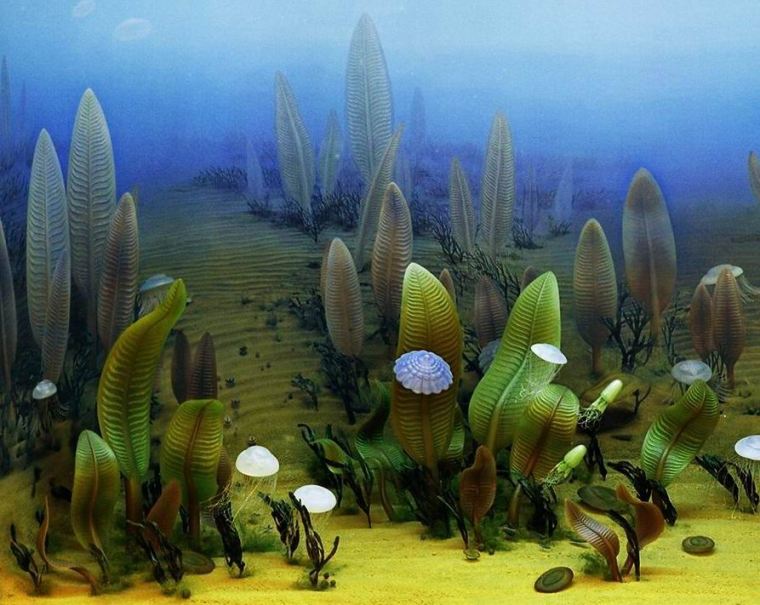
The Ediacaran biological revolution followed repeated changes in the geochemistry of the oceans, which carbon isotope data from the Cryogenian and Ediacaran suggest to have ‘gone haywire’. This turmoil involved dramatic changes in the cycling of sulfur and phosphorus that help ‘fertilise’ the marine food chain and in the production of oxygen by photosynthesis that is essential for metazoan animals. The episodes when the Earth was iced over reduced the availability of nutrients through decreased rates of ocean-floor burial of dead organisms. Such Snowball events would also have reduced penetration of sunlight in the oceans. Less photosynthesis would not only have reduced oxygen production but also the amounts of autotrophic organisms. Furthermore, decreased water temperature would have increased its viscosity thereby slowing the spread of nutrients. The food chain for heterotrophs was decimated. Each Snowball event ended with warming, ice-free conditions so that the marine biosphere could burgeon
A great deal of data and numerous theories have accumulated since the Snowball concept was first mooted, but there has been little progress in understanding the rise of multi-celled life. Four geoscientists from the Massachusetts Institute of Technology, the Santa Fe Institute and the University of Colorado (Boulder), USA have developed an interesting hypothesis for how this enormous evolutionary step may have developed (Crockett, W.W. et al. 2024. Physical constraints during Snowball Earth drive the evolution of multicellularity. Proceedings of the Royal Society B: Biological Sciences, v. 291; DOI: 10.1098/rspb.2023.2767). The concatenation of huge events during the Cryogenian and Ediacaran presented continually changing patterns of selective pressures on simple organisms that preceded that time period. Crockett et al. review them in the light of fundamental biology to suggest how multicellular animals emerged as the Ediacara Fauna. Intuitively, such harsh conditions suggest at worst mass, even complete, extinction, at best a general reduction in size of all organism to cope with scarce resources. That the size of eukaryotes should have grown hugely goes against the grain of most biologists’ outlook.
The authors consider the crucial factor to be fundamental differences between prokaryotes and early eukaryotes. Prokaryote cells are very small, and whether autotrophs of heterotrophs they absorb nutrients through their walls by diffusion. Single-celled eukaryotes are far larger than prokaryotes and typically have a flagellum or ‘tail’ so that they can move independently and more easily gather resources. Crockett et al. used computer modelling to simulate the type of life form that could grow and thrive under Snowball conditions. They found that prokaryotes could only grow smaller, being ‘stunted’ by scarce resources. On the other hand eukaryotes would be better equipped to gather resources, the more so if they adopted a simple multicellular form – a hollow, self-propelled sphere about the size of a pea, which the authors dub a choanoblastula. Although no such form is known today, it does resemble the green Volvox algae, and plausibly could have evolved further to the simple forms of the Ediacaran fauna. The next task is either to find a fossil of such an organism, or to grow one.

 Earth-logs