Was Venus once habitable?

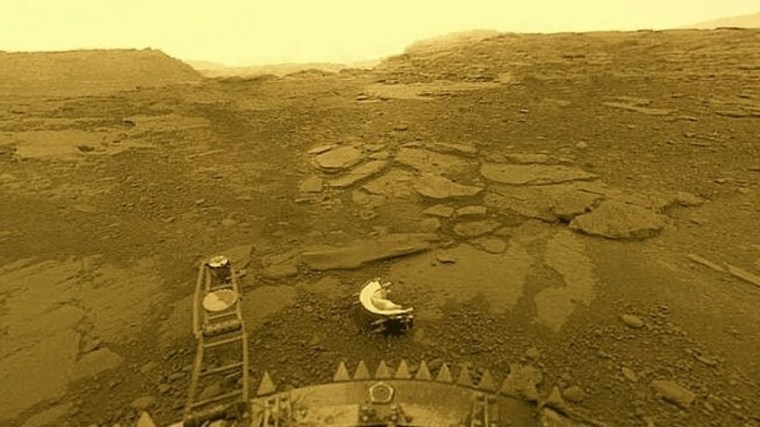
The surface of Venus from the USSR Venera 14 lander

It is often said that Earth has a twin: Venus, the second planet from the Sun. That isn’t true, despite the fact that both have similar size and density. Venus, in fact, is even more inhospitable that either Mars or the Moon, having surface temperatures (~465°C) that are high enough to melt lead or, more graphically, those in a pizza oven. The only vehicles successfully to have landed on Venus (the Russian Venera series) survived for a mere 2 hours, but some did did send back data and images. That near incandescence is masked by the Venusian atmosphere that comprises 96.5% carbon dioxide, 3.5% nitrogen and 0.05 % sulfur dioxide, with mere traces of other gases including extremely low amounts of water vapour (0.002%) and virtually no oxygen. The dense atmosphere imposes a pressure at Venus’s surface tht is 92 times that on Earth: so dense that CO2 and N2 are, strictly speaking, not gases but supercritical fluids at the surface. At present Venus is definitely inimical to any known type of life. It is the victim of an extreme, runaway greenhouse effect.

As it stands, Venus’s geology is also very different from that of the Earth. Because its upper atmosphere contains clouds of highly reflective sulfuric acid aerosols only radar is capable of penetrating to the surface and returning to have been monitored by a couple of orbital vehicles: Magellan (NASA 1990 to 1994) and Venus Express (European Space Agency 2006 to 2014). The latter also carried means of mapping Venus’s surface gravitational field. The radar imagery shows that 80% of the Venusian surface comprises somewhat wrinkled plains that suggests a purely volcanic origin. Indeed more that 85,000 volcanoes have been mapped, 167 of which are over 100 km across. Much of the surface appears to have been broken into polygonal blocks or ‘campuses’ (campus is Latin for field) that give the impression of ‘crazy paving’. A peculiar kind of local-scale tectonics has operated there, but nothing like the plate tectonics on Earth in either shape or scale.

Polygonal blocks or ‘campuses’ on the lowland surface of Venus. Note the zones of ridges that roughly parallel ‘campus’ margins. Credit: Paul K. Byrne, North Carolina State University and Sean C. Solomon, Lamont-Doherty Earth Observatory

Many of the rocky bodies of the solar system are pocked by impact craters – the Earth has few, simply because erosion and sedimentary burial on the continents, and subduction of ocean floors have removed them from view. The Venusian surface has so few that it can, in its entirety, be surmised to have formed by magmatic ‘repaving’ since about 500 Ma ago at least. Earlier geological process can only be guessed at, or modelled in some way. A recent paper postulates that ‘there are several lines of evidence that suggest that Venus once did have a mobile lithosphere perhaps not dissimilar to Earth …’ (Weller, M.B. & Kiefer, W.S. 2025. The punctuated evolution of the Venusian atmosphere from a transition in mantle convective style and volcanic outgassing. Science Advances, v. 11, article eadn986; DOI: 10.1126/sciadv.adn986). One large, but subtle feature may have formed by convergence similar to that of collision tectonics. There are also gravitational features that hint at active subduction at depth, although the surface no longer shows connected features such as trenches and island arcs. Local extension has been inferred from other data.

Weller and Kiefer suspect that Venus in the past may have shifted between a form of mobile plate tectonics and stagnant ‘lid’ tectonics, the vast volcanic plains having formed by processes akin to flood volcanism on a planetary scale. Venus’s similar density to that of Earth suggests that it is made of similar rocky material surrounding a metallic core. However, that planet has a far weaker magnetic field suggesting that the core is unable to convect and behave like a dynamo to generate a magnetic field. That may explain why the atmosphere of Venus is almost completely dry. With no magnetic field to deflect it the solar wind of charged particles directly impacts the upper atmosphere, in contrast to the Earth where only a very small proportion descends at the poles. Together with the action of UV solar radiation that splits water vapour into its constituent hydrogen and oxygen ions, the solar wind adds energy to them so that they escape to space. This atmospheric ‘erosion’ has steadily stripped the atmosphere of Venus – and thus its solid surface – of all but a minute trace of water, leaving behind higher mass molecules, particularly carbon dioxide, emitted by its volcanism. Of course, this process has vastly amplified the greenhouse effect that makes Venus so hot. Early on the planet may have had oceans and even primitive life, which on Earth extract CO2 by precipitating carbonates and by photosynthesis, respectively. But they no longer exist.

The high surface temperature on Venus has made its internal geothermal gradient very different from Earth’s; i.e. increasing from 465°C with depth, instead of from about 15°C on Earth. As a result, everywhere beneath the surface of Venus its mantle has been more able to melt and generate magma. Earlier in its history it may have behaved more like Earth, but eventually flipped to continual magmatic ‘repaving’. To investigate how this evolution may have occurred Weller and Kiefer created 3-D spherical models of geological activity, beginning with Earth-like tectonics – a reasonable starting point because of the probable Earth-like geochemistry of Venus. My simplified impression of what they found is that the periodic blurting of magma well-known from Earth history to have created flood-basalt events without disturbing plate tectonics proceeded on Venus with progressively greater violence. Such events here emitted massive amounts of CO2 into the atmosphere over short (~1 Ma) time scales and resulted in climate change, but Earth’s surface processes have always returned to ‘normal’. Flood-basalt episodes here have had a rough periodicity of around 35 Ma. Weller and Kiefer’s modelling seems to suggest that such events on Venus may have been larger. Repetition of such events, which emitted CO­2 that surface processes could not erase before the next event, would progressively ramp up surface temperatures and the geothermal gradient.  Eventually climatic heating would drive water from the surface into the atmosphere, to be lost forever through interaction with the solar wind. Without rainfall made acid by dissolved CO2, rock weathering that tempers the greenhouse effect on Earth would cease on Venus. The increased geothermal gradient would change any earlier rigid, Earth-like lithosphere to more ductile material, thereby shutting down the formation of plates, the essence of tectonics on Earth. It may have been something along those lines that made Venus inimical to life, and some may fear that anthropogenic global warming here might similarly doom the Earth to become an incandescent and sterile crucible orbiting the Sun. But as Mark Twain observed in 1897 after reading The New York Herald’s account that he was ill and possibly dying in London, ‘The report of my death was an exaggeration’. It would suit my narrative better had he said ‘… was premature’!

The Earth has a very large Moon because of a stupendous collision with a Mars-sized planet shortly after it accreted. That fundamentally reset Earth’s bulk geochemistry: a sort of Year Zero event. It endowed both bodies with magma oceans from which several tectonic scenarios developed on Earth from Eon to Eon. There is no evidence that Venus had such a catastrophic beginning. By at least 3.7 billion years ago Earth had a strong magnetic field. Protected by that thereafter from the solar wind, it has never lost its huge endowment of water; solid, liquid or gaseous. It seems that it did go through a stagnant lid style of tectonics early on, that transitioned to plate tectonics around the end of the Hadean Eon (~4.0 Ga), with a few hiccups during the Archaean Eon. And it did develop life as an integral part of the rock cycle. Venus, fascinating as it is, shows no sign of either, and that’s hardly surprising. Those factors and its being much closer to the Sun may have condemned it from the outset.

A fully revised edition of Steve Drury’s book Stepping Stones: The Making of Our Home World can now be downloaded as a free eBook

The chaotic early Solar System: when giant planets went berserk

Readers of Earth-logs will be familiar with the way gravitational interactions between the planets that orbit the Sun control cyclical shifts in each other’s rotational and orbital behaviours. The best known are the three Milankovich cycles. The eccentricity of Earth’s orbit (deviation from a circular path) changes according to the varying gravitational pulls exerted by Jupiter and Saturn as they orbit the Sun, and is dominated by 100 ka cyclicity. The tilt (obliquity) of Earth’s rotational axis changes in 41 ka cycles.  The direction in which the axis points relative to the Sun varies with its precession which has a period of about 25.7 ka. Together they control the amount of solar heating that our planet receives, best shown by the current variation in glacial-interglacial cycles. But the phenomena predicted by Milutin Milankovich show up in palaeoclimatic changes back to at least the late Precambrian. Climate changes resulting from the gravitational effect of Mars have recently been detected with a 2.4 Ma period. But that steady carousel of planetary motions hasn’t always characterised the Solar System.

Cartoon showing planet formation in the early, unstable Solar System (Credit: Mark Garlick, Science Source)

Observations of other stars that reveal the presence of their own planetary systems show that some have giant planets in much closer orbits than those that circuit the Sun. Others occur at distances that extend as far as the orbital diameters as those in the Solar System: so perhaps giant planets can migrate. A possibility began to be discussed in the late 1990s that Jupiter, Saturn, Uranus and Neptune – and a fifth now-vanished giant planet – were at the outset in neat, evenly-spaced and much closer orbits. But they were forced outwards later into more eccentric and generally askew orbits. In 2005, planetary astronomers gathered in Nice, France to ponder the possibilities. The outcome was the ‘Nice’ Model that suggested that a gravitational instability had once emerged, which set the Solar System in chaotic motion. It may even have flung gigantic masses, such as postulated fifth giant planets, into interstellar space. This upheaval may have been due to a rapid change in the overall distribution of mass in the Solar System, possibly involving gas and dust that had not yet accreted into other planets or their planetesimal precursors. Chaotic antics of monstrous bodies and shifts in their combined gravitational fields can barely be imagined: it was nothing like the staid and ever present Milankovich Effect. Geologists have reconstructed one gargantuan event that reset the chemistry of the early Earth when it collided with another body about the size of Mars. That  also flung off matter that became the Moon. Evidence from lunar and terrestrial zircon grains (see: Moon-forming impact dated; March 2009) suggests the collision occurred before 4.46 billion years ago (when parts of both eventually crystallised from magma oceans), Solar System having begun to form at around 4.57 Ga. Could formation of the Moon record the early planetary chaos? Others have suggested instead that the great upheaval was the Late Heavy Bombardment, between 4.1 and 3.8 Ga, which heavily cratered much of the lunar surface and those of moons orbiting the giant planets.

Another approach has been followed by Chrysa Avdellidou of the University of Leicester, UK and colleagues from France and the US (Avdellidoli, C. et al. 2024. Dating the Solar System’s giant planet orbital instability using enstatite meteorites. Science, v. 384, p. 348-352; DOI: 10.1126/science.adg8092) after discovery of a new family of asteroids: named after its largest member Athor. The composition of their surfaces, from telescopic spectra, closely matches that of EL enstatite chondrite meteorites. Dating these meteorites should show when their parent asteroids – presumably the Athors – formed.  Using argon and xenon isotopes Mario Trieloff  and colleagues from the University of Heidelberg, Germany in showed that the materials in EL enstatite chondrite meteorites were assembled a mere 2 Ma after the Solar System formed (Trieloff, M. et al. 2022. Evolution of the parent body of enstatite (EL) chondrites. Icarus, v. 373, article 114762; DOI: 10.1016/j.icarus.2021.114762). Be that as it may, that the evidence came from small meteorites shows that the parent body, estimated as having had a 240 to 420 km diameter, was shattered at some later time. Moreover, at that very early date such bodies would have contained a ready heat source in the form of a short-lived isotope of aluminium (26Al) which decays to stable 26Mg, with a half-life of 0.717 Ma. 26Al is thought to have been produced by a supernova that has been suggested to have triggered the formation of the Solar System. Excessive 26Mg is found in many meteorites, evidence for metamorphism formed by such radiogenic heat. They also record the history of their cooling.

Avdellidoli et al. estimate that the 240 to 420 km Athor parental planetesimal had slowly cooled for at least 60 Ma after it formed. When it was shattered, the small fragments would have cooled instantaneously to the temperature of interplanetary space – a few degrees above absolute zero (-273.2 °C). From this they deduce the age of the chaotic restructuring of the early Solar System to be at least 60 Ma after its formation. Other authors use similar reasoning from other chondritic meteorite classes to suggest it may have happened even earlier at 11 Ma. But there are other views for a considerably later migration of the giant planets and the havoc that they wrought. The only widely agreed date, in what seems to be an outbreak of wrangling among astronomers, is for the Moon-forming collision: 110 Ma after formation of the Solar System. For me, at least, that’s good-enough evidence for when system-wide chaos prevailed. The Late Heavy Bombardment between 4.1 and 3.8 Ga seems to require a different mechanism as it affected large bodies that still exist. It may have resulted from whatever formed the asteroid belt, for it was bodies within the range of sizes of the asteroids that did the damage, in both the Inner and Outer Solar System.

See also: The instability at the beginning of the solar system. MSUToday, 27 April 2022: Voosen, P. 2024. Giant planets ran amok soon after the Solar System’s birth. Science, v. 384 news article eadp8889; DOI: 10.1126/science.adp8889

Relics of the Moon-forming impact?

Close to the core-mantle boundary (CMB) there are two extensive zones up to 10 km thick in the lower mantle. They have seismic-wave speeds that are much lower than expected at such depths: hence their being termed large low-velocity provinces (LLVPs). Seismic velocities being inversely proportional to the density of the material through which such waves travel, these zones have anomalously high density. The LLVPs have remained enigmatic since they were first discovered. Some have suggested that they are relics of dense subducted banded iron formations (see also: Curiously low-velocity material at the core-mantle boundary; March 2005) or simply piles of subducted slabs with an eclogite component that have gradually accumulated through Earth’s long history of  plate tectonics. An alternative is that LLVPs may be connected to geochemical evidence for a heterogeneous lower mantle and perhaps are relics of Earth’s earliest history.

An artist’s impression of the collision between Theia and the proto-Earth. (Credit: Hernán Cañellas, Nature)

The Moon-forming event about 4,500 Ma ago (for more information search the Planetary Science annual logs index) that probably involved a collision between the proto-Earth and another, Mars-sized planet – dubbed ‘Theia’ – is an alternative explanation for LLVPs. Maybe they are chunks of that planet that became embedded in the early Earth’s mantle. Many geochemical approaches to such an obvious origin are inconclusive, however. The latest attempt to model the processes involved in such a planetary truck crash using computer simulation does suggest that LLVPs may indeed be relics of Theia material that sank through the molten mass that became Earth’s mantle after the collision (Yuan, Q. et al. 2023. Moon-forming impactor as a source of Earth’s basal mantle anomalies. Nature v. 623, p. 95–99; DOI: 10.1038/s41586-023-06589-1).

Qian Yuan of the California Institute of Technology, and colleagues from China, USA and the UK based their approach on geochemical anomalies in plume related ocean-island basalts. These included distinctly non-terrestrial isotopic proportions of the noble gases neon and xenon, similar to those in lunar basalts., which in turn are more iron-rich than most basalts and thus 2-3% denser. The initial assumption in their modelling was that during the collision fragments of Theia peppered the magma ocean that became Earth upper mantle. These were thoroughly mixed in this molten zone as it convected before solidifying. But melts derived from some of the fragments could have penetrated the solid mantle below 1400 km depth as blobs, to retain their chemically anomalous integrity. Being dense, the blobs could slowly sink to accumulate at the CMB to form the two LLVPs. An animation of the processes revealed by Yuan et al.’s modelling can be viewed here.

See also: Oza, A. 2023. Strange blobs in Earth’s mantle are relics of a massive collision. Nature v. 623; DOI: 10.1038/s41586-023-06589-1

Lower-mantle blobs may reveal relics of event going back to the Hadean

The World-Wide Standardised Seismograph Network (WWSSN) records the arrivals of waves generated by earthquakes that have passed through the Earth’s interior. There are two types of these body waves: S- or shear waves that move matter at right angles to their direction of movement; compressional or P-waves that are a little like sound waves as materials are compressed and expanded along the direction of movement. Like sound, P-waves can travel through solids, liquids and gases. Since liquids and gases are non-rigid they cannot sustain shearing, so S-waves only travel through the solid Earth’s mantle but not its liquid outer core. However, their speed is partly controlled by rock rigidity, which depends on the temperature of the mantle; the hotter the lower the mantle’s rigidity.

Analysis of the S-wave arrival times throughout the WWSSN from many individual earthquakes enables seismologists to make 3-D maps of how S-wave speeds vary throughout the mantle and, by proxy, the variation of mantle rigidity with depth. This is known as seismic tomography, which since the late 1990s has revolutionised our understanding of mantle plumes and subduction zones, and also the overall structure of the deep mantle. In particular, seismic tomography has revealed two huge, blob-like masses above the core-mantle boundary that show anomalously low S-wave speeds, one beneath the Pacific Ocean and another at about the antipode beneath Africa: by far the largest structures in the deep mantle. They are known as ‘large low-shear-wave-velocity provinces’ (LLSVPs) and until recently they have remained the enigmatic focus of much speculation around two broad hypotheses: ‘graveyards’ for plates subducted throughout Earth history; or remnants of the magma ocean thought to have formed when another protoplanet impacted with the early Earth to create the Moon about 4.4 billion years ago.

Three-dimensional rendition of seismic tomography results beneath Africa. Mantle with anomalously low S-wave speeds is show in red, orange and yellow. The faint grey overlay represents the extent of surface continental crust today – Horn of Africa at right and Cape Town at the lower margin – the blue areas near the top are oceanic crust on the floor od the Mediterranean Sea. (Image credit: Mingming Li/ASU)

Qian Yuan and Mingming Li of Arizone State University, USA have tried to improve understanding of the shapes of the two massive blobs (Yuan, Q. & Li, M. 2022. Instability of the African large low-shear-wave-velocity province due to its low intrinsic density. Nature Geoscience, v. 15  DOI: 10.1038/s41561-022-00908-3) using advanced geodynamic modelling of the seismic tomography. Their work reveasl that the Pacific LLSVP extends between 500 to 800 km above the core-mantle boundary. Yet that beneath Africa reaches almost 1000 km higher, at 1300 to 1500 km. Both of them are less rigid and therefore hotter than the surrounding mantle. In order to be stable they must be considerably denser than the rest of the mantle surrounding them. But, because it reaches much higher above the core, the African LLSVP is probably less dense than the Pacific one. A lower density suggests two things: the African blob may be less stable; the two blobs may have different compositions and origins.

Both the Pacific Ocean floor and the African continent are littered with volcanic rocks that formed above mantle plumes. The volcanic geochemistry above the two LLSVPs differs. African samples show signs of a source enriched by material from upper continental crust, whereas those from the Pacific do not. Yuan and Li suggest that the enrichment supports the ‘plate graveyard’ hypothesis for the African blob and a different history beneath the Pacific. The 3-D tomography beneath Africa (see above) shows great complexity, perhaps reflecting the less stable nature of the LLSVP. Interestingly, 80 % of the pipe-like African kimberlite intrusions that have brought diamonds up from mantle depths over that last 320 Ma formed above the blob.

But why are there just two such huge blobs of anomalous material that lie on opposite sides of the Earth rather than a continuous anomaly or lots of smaller ones? The subduction graveyard hypothesis is compatible with the last two distributions. In a 2021 conference presentation the authors suggest from computer simulations that the two blobs may have originated at the time of the Moon’s formation after a planetary collision (Yuan, Q. et al. 2021. Giant impact origin for the large low shear velocity provinces. Abstracts for the 52nd Lunar and Planetary Science Conference: Lunar and Planetary Institute, Houston). Specifically, they suggest that the LLSVPs originated from the mantle of the other planet (Theia) after its near complete destruction and melting, which sank without mixing through the magma ocean formed by the stupendous collision. Yet, so far, no geochemists have been bold enough to suggest that there are volcanic rocks of any age that reveal truly exotic compositions inherited from deep mantle material with such an origin. If Theia’s mantle was dense enough to settle through that of the Earth when both were molten, it would be sufficiently anomalous in its chemistry for signs to show up in any melts derived from it. There again, because of a high density it may never have risen in plumes to source any magma that reached the Earth’s surface …

Note added later: Simon Hamner’s Comment about alternative views on seismic tomography has prompted me to draw attention to something I wrote 19 years ago

Earth’s water and the Moon

Where did all our water come from? The Earth’s large complement of H2O, at the surface, in its crust and even in the mantle, is what sets it apart in many ways from the rest of the rocky Inner Planets. They are largely dry, tectonically torpid and devoid of signs of life. For a long while the standard answer has been that it was delivered by wave after wave of comet impacts during the Hadean, based on the fact that most volatiles were driven to the outermost Solar System, eventually to accrete as the giant planets and the icy worlds and comets of the Kuiper Belt and Oort Cloud, once the Sun sparked its fusion reactions That left its immediate surroundings depleted in them and enriched in more refractory elements and compounds from which the Inner Planets accreted. But that begs another question: how come an early comet ‘storm’ failed to ‘irrigate’ Mercury, Venus and Mars? New geochemical data offer a different scenario, albeit with a link to the early comet-storms paradigm.

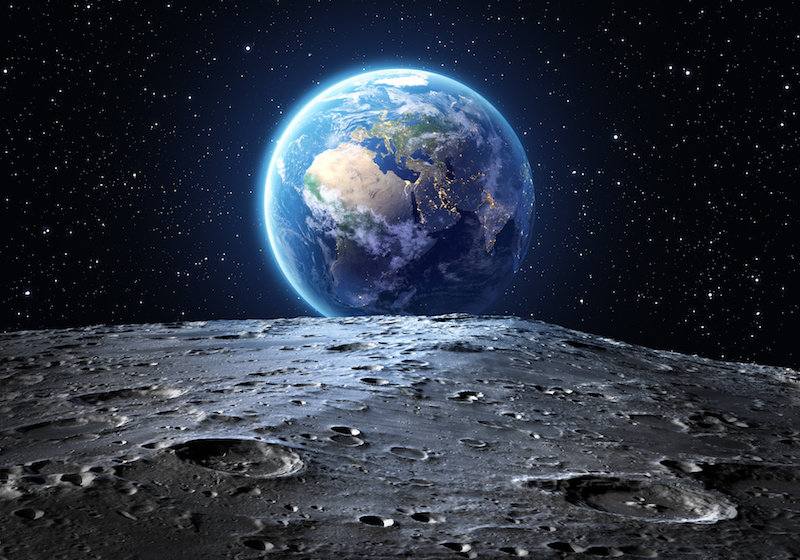
Simulated view of the Earth from lunar orbit: the ‘wet’ and the ‘dry’. (credit: Adobe Stock)

Three geochemists from the Institut für Planetologie, University of Münster, Germany, led by Gerrit Budde have been studying the isotopes of the element molybdenum (Mo) in terrestrial rocks and meteorite collections. Molybdenum is a strongly siderophile (‘iron loving’) metal that, along with other transition-group metals, easily dissolves in molten iron. Consequently, when the Earth’s core began to form very early in Earth’s history, available molybdenum was mostly incorporated into it. Yet Mo is not that uncommon in younger rocks that formed by partial melting of the mantle, which implies that there is still plenty of it mantle peridotites. That surprising abundance may be explained by its addition along with other interplanetary material after the core had formed. Using Mo isotopes to investigate pre- and post-core formation events is similar to the use of isotopes of other transition metals, such as tungsten (see Planetary science, May 2016). Continue reading “Earth’s water and the Moon”

Year Zero: the giant-impact hypothesis

On close examination, the light-coloured Highlands of the Moon look remarkably like an old sign by a North American road through hunting country: they are pocked by impact craters of every size. More than that, a lengthy period of bombardment is signified by signs that the craters themselves are cratered to form a chaotic landscape dominated by interlocking and overlapping circular feature. In contrast the dark basaltic plains, called maria (seas), are pretty smooth albeit with some craters. They are clearly much younger than the Highlands. The discovery by Apollo astronauts that the older lunar Highlands are made almost exclusively of calcic plagioclase feldspar was a major surprise, requiring an astonishing event to explain them. Such anorthosites may form by flotation of low-density feldspar from a cooling and crystallising basaltic magma. Yet to form the bulk of the Moon’s early crust from such materials requires not simply a deep magma chamber, but literally an ocean of molten material at least 200 km deep. The anorthosites also turned out to be far older than the oldest rocks on Earth, close to 4.5 billion years. The most likely explanation seemed to be that the melting resulted from a gargantuan collision between two protoplanets, the Earth’s forebear and another now vanished. This would have melted and partially vaporised both bodies. After this discovery the Moon was widely believed to have formed from liquid and vaporised rock flung into orbit around what became the Earth.

Artist’s depiction of a collision between two planetary bodies likely to have formed the Moon (Credit: Wikipedia)

Such a catastrophic model for joint formation of the Earth and Moon shortly after planets of the Solar System had formed is hard to escape, but it carries two major puzzles. First, Earth and Moon seem to have very similar, indeed almost the same chemistry: So what happened to the colliding planet? If it had been identical in composition to the proto Earth there is no problem, but a different composition would surely have left some detectable trace in a Moon-Earth geochemical comparison. Initial models of the collision suggested that the other planet (dubbed Theia) was about the size of Mars and should have contributed 70 to 90% of the lunar mass: the Moon-Earth geochemical difference should have been substantial The second issue raised in the early days of the hypothesis was that since the Moon seemed to be almost totally dry (at least, the first rock analyses suggested that), then how come the Earth had retained so much water?

For decades, after an initial flurry of analyses, the Apollo samples remained in storage. Only in the last 10 years or so, when the need to gee-up space exploration required some prospect of astronauts one more to be sent beyond Earth orbit, have the samples been re-examined. With better analytical tools, the first puzzle was resolved: lunar rocks do contain measurable amounts of water, so the impact had not entirely driven off volatiles from the Moon. The bulk geochemical similarity was especially puzzling for the isotopes of oxygen. Meteorites of different types are significantly ear-marked by their relative proportions of different oxygen isotopes, signifying to planetary scientists that each type formed in different parts of the early Solar System; a suggestion confirmed by the difference between those in meteorites supposedly flung from Mars and terrestrial oxygen isotope proportions. A clear target for more precise re-examination of the lunar samples, plus meteorites reckoned to have come from the Moon, is therefore using vastly improved mass spectrometry to seek significant isotopic differences (Harwartz, D. et al. 2014. Identification of the giant impactor Theia in lunar rocks. Science, v. 344, p. 1146-1150). It turns out that there is a 12 ppm difference in the proportion of 17Oin lunar oxygen, sufficient to liken Theia’s geochemistry to that of enstatite chondrites. However, that difference may have arisen by the Earth, once the Moon had formed, having attracted a greater proportion of carbonaceous-chrondrite material during the later stages of planetary accretion by virtue of its much greater gravitational attraction. That would also account for the much higher volatile content of the Earth.

The new data do help to support the giant-impact hypothesis, but still leave a great deal of slack in the big questions: Did Theia form in a similar orbit around the Sun to that of Earth; was the impact head-on or glancing; how fast was the closure speed; how big was Theia and more besides? If Theia had roughly the same mass as the proto-Earth then modelling suggests that about half the mass of both Moon and Earth would be made of Theia stuff, giving the Moon and post-impact Earth much the same chemistry, irrespective of where Theia came from. Were William of Ockham’s ideas still major arbiters in science, then his Razor would suggest that we stop fretting about such details. But continuing the intellectual quest would constitute powerful support for a return to the Moon and more samples…