The earliest known impact structure

Earth has been through a great many catastrophes, but the vast majority of those of which we know were slow-burning in a geological sense. They resulted in unusually high numbers of extinctions at the species- to family levels over a few million years and the true mass extinctions seem to have been dominated by build ups of greenhouse gases emitted by large igneous provinces. Even the most famous at the end of the Cretaceous Period, which did for the dinosaurs and considerably more organisms that the media hasn’t puffed, was partly connected to the eruption of the Deccan flood basalts of western India. Yet the event that did the real damage was a catastrophe that appeared in a matter of seconds: the time taken for the asteroid that gouged the Chicxulub crater to pass through the atmosphere. Its energy was huge and because it was delivered in such a short time its sheer power was unimaginable. Gradually geologists have recognised signs of an increasing number of tangible structures produced by Earth’s colliding with extraterrestrial objects, which now stands at 190 that have been confirmed.
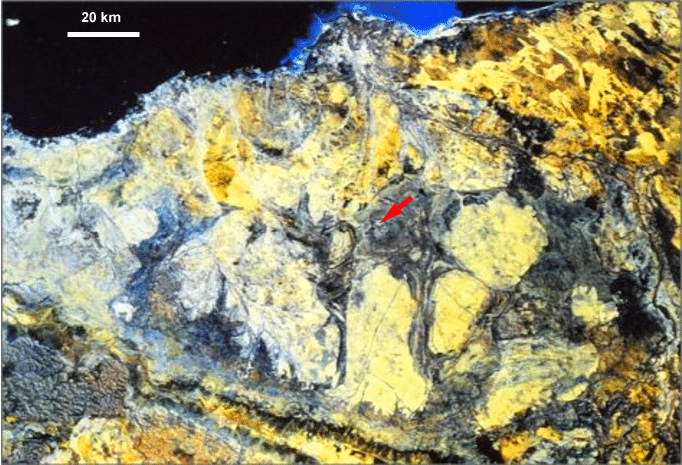
Landsat image mosaic of the Palaeoarchaean granite-greenstone terrain of the Pilbara Craton, Western Australia. Granite bodies show as pale blobs, the volcanic and sedimentary greenstone belts in shades of grey. The site of Kirkland et al.’s study site is at the tip of the red arrow

The frequency of impact craters falls off with age, most having formed in the last ~550 million years (Ma) during the Phanerozoic Eon, only 25 being known from the Precambrian, which spanned around 88 percent of geological time. That is largely a consequence of the dynamic processes of tectonics, erosion and sedimentation that may have obliterated or hidden a larger number. Earth is unique in that respect, the surfaces of other rocky bodies in the Solar System showing vastly more. The Moon is a fine example, especially as it has been Earth’s companion since it formed 4.5 billion years ago (Ga) after the proto-Earth collided with a now vanished planet about the size of Mars. The relative ages of lunar impact structures combined with radiometric ages of the surfaces that they hit has allowed the frequency of collisions to be assessed through time. Applied to the sizes of the craters such data can show how the amount of kinetic energy inflicted on the lunar surface has changed with time. During what geologists refer to as the Hadean Eon (before 4 Ga), the moon underwent continuous bombardment that reached a crescendo between 4.1 and about 3.8 Ga. Thereafter impacts tailed off. Always having been close to the Moon, the Earth cannot have escaped the flux of objects experienced by the lunar surface. Because of Earth’s much greater gravitation pull it was probably hit by more objects per unit area. Apart from some geochemical evidence from Archaean rocks (see: Tungsten and Archaean heavy bombardment; July 2002) and several beds of 3.3 Ga old sediment in South Africa that contain what may have been glassy spherules there are no signs of actual impact structures earlier than a small crater dated at around 2.4 Ga in NE Russia.

Shatter cones in siltstone near Marble Bar in the Pilbara Province: finger for scale. Credit: Kirkland et al.; Fig 2a

Now a group of geologists from Curtin University, Perth Western Australia, and the Geological Survey of Western Australia have published their findings of indisputable signs of an impact site in the northern part of Western Australia (Kirkland, C.L. et al. 2025. A Paleoarchaean impact crater in the Pilbara Craton, Western Australia. Nature Communications, v. 16, article 2224; DOI: 10.1038/s41467-025-57558-3). In fact there is no discernible crater at the locality, but sedimentary strata show abundant evidence of a powerful impact in the form of impact-melt droplets in the form of spherules together with shatter cones. These structures form as a result of sudden increase in pressure to 2 to 30 GPa: an extreme that can only be generated in underground nuclear explosions, and thus likely to bear witness to large asteroid impacts. The shocked rocks are immediately overlain by pillow lavas dated at 3.47 Ga, making the impact the earliest known. It has been speculated that impacts during the Archaean and Hadean Eons helped create conditions for the complex organic chemistry that eventually to the first living cells. Considering that entry of hypervelocity asteroids into the early Earth’s atmosphere probably caused such compression that temperatures were raised by adiabatic heating to about ten times that of the Sun’s surface, their ‘entry flashes’ would have sterilised the surface below; the opposite of such notions. Impacts may, however, have delivered both water and simple, inorganic hydrocarbons. Together with pulverisation of rock to make ‘fertiliser’ elements (e.g. K and P) more easily dissolved, they may have had some influence. Their input of thermal energy seems to me to be of little consequence, for decay of unstable isotopes of U, Th and K in the mantle would have heated the planet quite nicely and continuously from Year Zero onwards.

A fully revised edition of Steve Drury’s book Stepping Stones: The Making of Our Home World can now be downloaded as a free eBook

The chaotic early Solar System: when giant planets went berserk

Readers of Earth-logs will be familiar with the way gravitational interactions between the planets that orbit the Sun control cyclical shifts in each other’s rotational and orbital behaviours. The best known are the three Milankovich cycles. The eccentricity of Earth’s orbit (deviation from a circular path) changes according to the varying gravitational pulls exerted by Jupiter and Saturn as they orbit the Sun, and is dominated by 100 ka cyclicity. The tilt (obliquity) of Earth’s rotational axis changes in 41 ka cycles.  The direction in which the axis points relative to the Sun varies with its precession which has a period of about 25.7 ka. Together they control the amount of solar heating that our planet receives, best shown by the current variation in glacial-interglacial cycles. But the phenomena predicted by Milutin Milankovich show up in palaeoclimatic changes back to at least the late Precambrian. Climate changes resulting from the gravitational effect of Mars have recently been detected with a 2.4 Ma period. But that steady carousel of planetary motions hasn’t always characterised the Solar System.

Cartoon showing planet formation in the early, unstable Solar System (Credit: Mark Garlick, Science Source)

Observations of other stars that reveal the presence of their own planetary systems show that some have giant planets in much closer orbits than those that circuit the Sun. Others occur at distances that extend as far as the orbital diameters as those in the Solar System: so perhaps giant planets can migrate. A possibility began to be discussed in the late 1990s that Jupiter, Saturn, Uranus and Neptune – and a fifth now-vanished giant planet – were at the outset in neat, evenly-spaced and much closer orbits. But they were forced outwards later into more eccentric and generally askew orbits. In 2005, planetary astronomers gathered in Nice, France to ponder the possibilities. The outcome was the ‘Nice’ Model that suggested that a gravitational instability had once emerged, which set the Solar System in chaotic motion. It may even have flung gigantic masses, such as postulated fifth giant planets, into interstellar space. This upheaval may have been due to a rapid change in the overall distribution of mass in the Solar System, possibly involving gas and dust that had not yet accreted into other planets or their planetesimal precursors. Chaotic antics of monstrous bodies and shifts in their combined gravitational fields can barely be imagined: it was nothing like the staid and ever present Milankovich Effect. Geologists have reconstructed one gargantuan event that reset the chemistry of the early Earth when it collided with another body about the size of Mars. That  also flung off matter that became the Moon. Evidence from lunar and terrestrial zircon grains (see: Moon-forming impact dated; March 2009) suggests the collision occurred before 4.46 billion years ago (when parts of both eventually crystallised from magma oceans), Solar System having begun to form at around 4.57 Ga. Could formation of the Moon record the early planetary chaos? Others have suggested instead that the great upheaval was the Late Heavy Bombardment, between 4.1 and 3.8 Ga, which heavily cratered much of the lunar surface and those of moons orbiting the giant planets.

Another approach has been followed by Chrysa Avdellidou of the University of Leicester, UK and colleagues from France and the US (Avdellidoli, C. et al. 2024. Dating the Solar System’s giant planet orbital instability using enstatite meteorites. Science, v. 384, p. 348-352; DOI: 10.1126/science.adg8092) after discovery of a new family of asteroids: named after its largest member Athor. The composition of their surfaces, from telescopic spectra, closely matches that of EL enstatite chondrite meteorites. Dating these meteorites should show when their parent asteroids – presumably the Athors – formed.  Using argon and xenon isotopes Mario Trieloff  and colleagues from the University of Heidelberg, Germany in showed that the materials in EL enstatite chondrite meteorites were assembled a mere 2 Ma after the Solar System formed (Trieloff, M. et al. 2022. Evolution of the parent body of enstatite (EL) chondrites. Icarus, v. 373, article 114762; DOI: 10.1016/j.icarus.2021.114762). Be that as it may, that the evidence came from small meteorites shows that the parent body, estimated as having had a 240 to 420 km diameter, was shattered at some later time. Moreover, at that very early date such bodies would have contained a ready heat source in the form of a short-lived isotope of aluminium (26Al) which decays to stable 26Mg, with a half-life of 0.717 Ma. 26Al is thought to have been produced by a supernova that has been suggested to have triggered the formation of the Solar System. Excessive 26Mg is found in many meteorites, evidence for metamorphism formed by such radiogenic heat. They also record the history of their cooling.

Avdellidoli et al. estimate that the 240 to 420 km Athor parental planetesimal had slowly cooled for at least 60 Ma after it formed. When it was shattered, the small fragments would have cooled instantaneously to the temperature of interplanetary space – a few degrees above absolute zero (-273.2 °C). From this they deduce the age of the chaotic restructuring of the early Solar System to be at least 60 Ma after its formation. Other authors use similar reasoning from other chondritic meteorite classes to suggest it may have happened even earlier at 11 Ma. But there are other views for a considerably later migration of the giant planets and the havoc that they wrought. The only widely agreed date, in what seems to be an outbreak of wrangling among astronomers, is for the Moon-forming collision: 110 Ma after formation of the Solar System. For me, at least, that’s good-enough evidence for when system-wide chaos prevailed. The Late Heavy Bombardment between 4.1 and 3.8 Ga seems to require a different mechanism as it affected large bodies that still exist. It may have resulted from whatever formed the asteroid belt, for it was bodies within the range of sizes of the asteroids that did the damage, in both the Inner and Outer Solar System.

See also: The instability at the beginning of the solar system. MSUToday, 27 April 2022: Voosen, P. 2024. Giant planets ran amok soon after the Solar System’s birth. Science, v. 384 news article eadp8889; DOI: 10.1126/science.adp8889

Pinpointing the source of Martian meteorites and a stab at magmatism on Mars

Most meteorites found on the Earth’s surface are fragments of small bodies left over from the accretion of the planets around 4.5 billion years ago, thanks largely to collisions among larger, asteroid-sized bodies. A minority have other origins: some as debris from otherwise icy comets and a few that have been flung off other rocky planets or large moons by crater-forming impacts. Meteorites suspected to have originated through impact are ‘rocky’ – i.e.  made of silicates – and have textures and mineral contents suggesting they formed late in planetary evolution. Most are igneous with basaltic or ultramafic composition: respectively lavas and cumulates formed in magma chambers. Some are breccias, hinting at a pyroclastic origin. The radiometric ages of such planetary fragments are generally far younger than the times when the solar system and planets formed.  Almost 300 have been classified as coming from Mars, only two of which are older than 1400 Ma. The most numerous group of Martian meteorites, known as shergottites, crystallised between 575 and 150 Ma ago to form crust of igneous origin. During the journey from their source to Earth meteorites are exposed to high-energy cosmic rays that generate a variety of new isotopes, from whose relative proportions their travel time can be estimated. The shergottites all seem to have been blasted from Mars a mere 1.1 Ma ago, suggesting that a single impact launched them. So, identifying their source crater on Mars would enable the shergottites to be treated in the same way as samples collected by geologists from a small locality on Earth. Their geochemistry should give important clues to processes within Mars over a time period that spans the late-Precambrian to early Cretaceous on Earth.

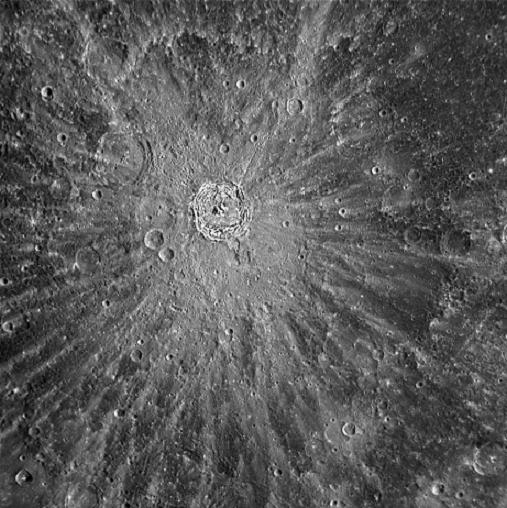
Kuiper crater on the Moon, with rays and secondary craters. (Credit: NASA/Johns Hopkins University, USA)

There are many craters on Mars, so homing-in on a single source for shergottite meteorites might seem a tall order. A strategy for doing that depends on recognising craters formed by impacts with sufficient energy to eject debris at the escape velocity from Martian gravity: about 5 km s-1 compared with 11 km s-1 for Earth. Calculations suggest that such impacts would produce craters larger than 3 km across. Large ejecta travelling at slower speeds from them would fall back to produce smaller craters arranged radially from the main crater, forming distinctive rays. Anthony Lagain and colleagues from Curtin University, Western Australia and other institutions in Australia, USA, France and Côte d’ Ivoire adapted a detection algorithm to locate craters less than 1 km across that formed in rays around larger craters (Lagain, A. and 10 others 2021. The Tharsis mantle source of depleted shergottites revealed by 90 million impact craters. Nature Communications, v. 12, article6352; DOI: 10.1038/s41467-021-26648-3). They used 100 m resolution images of thermal emission from the Martian surface that most clearly distinguish large craters that have ejecta deposits around them. Then they turned to images with 0.25 m resolution covering the visible spectrum that can spot very small craters. The authors’ analysis compiled around 90 million impact craters smaller than 300 metres across (a quarter the size of the celebrated Meteor Crater in Arizona).

Laser-altimetry data that show two large impact craters and their ejecta aprons on the Tharsis Plateau of Mars and two of its huge volcanoes: grey-brown-red-orange-yellow-green = high-to-low elevations. (Credit: NASA / JPL-Caltech / Arizona State University)

Dust storms on Mars gradually fill and obscure small craters and ejecta rays, so the younger the impact event, the more visible are rays and secondary small craters. Luckily, just two large craters on Mars have well-preserved rays that contain high densities of small secondary craters. Both of them lie on the Tharsis Plateau near the Martian Equator. This is a vast bulge on the planet’s surface – 5000 km across and rising to 7 km – characterised by three enormous shield volcanoes that rise to 18 km above the average elevation of Mars. The authors judge that one or the other crater is the source for shergottite meteorites, and that this meteorite class collectively samples the most recent igneous rocks that form the Tharsis Plateau. So vast is its mass, that the plateau has probably built-up over most of Mars’s history. One hypothesis is that the bulging has progressively developed over a huge thermal anomaly that has supported a mantle superplume for billions of years from which basaltic magma has steadily moved to the surface.

This model of a perpetual hot spot beneath Tharsis implies that the magmas that it has generated in the past have progressively depleted the underlying mantle in the incompatible trace elements that preferentially enter magma rather than remaining in solid minerals during partial melting. Having been able to suggest that the 575 to 150 Ma-old shergottites represent the upper crust of Tharsis that formed at that late stage in its history, Lagain et al. use those meteorites’ well-established trace-element geochemistry to test that hypothesis. They do indeed suggest their derivation by partial melting of mantle rocks that had in earlier times been strongly depleted in incompatible elements. One of the greatest mysteries about Mars’ evolution may have been resolved without the need for a crewed mission.

Newly discovered signs of Archaean giant impacts

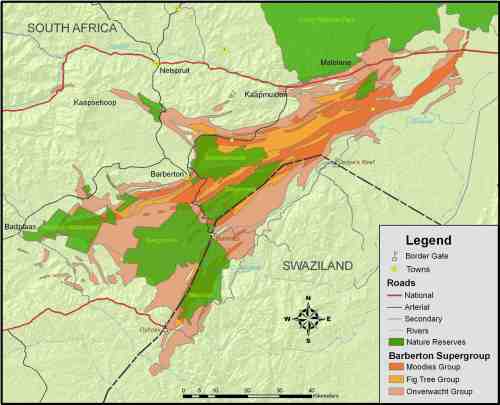
It is barely credible that only two decades ago geoscientists who argued that extraterrestrial impacts had once had an important role in Earth history met with scorn from many of their peers; slightly mad, even bad and perhaps dangerous to know. Yet clear evidence for impacts has grown steadily, especially in the time before 2.5 billion years ago known as the Archaean (see EPN for March 2003 , April 2005, July 2012 , May 2014). Even in the 1990s, when it should have been clear from the golden years of lunar exploration that our neighbour had been battered at the outset of the Archaean, claims for terrestrial evidence of the tail-end of that cataclysmic event were eyed askance. Now, one of the pioneer researchers into the oldest terrestrial impacts, Don Lowe of Stanford University, California has, with two colleagues, reported finds of yet more impact-related spherule beds from the famous Archaean repository of the Barberton Mountains in South Africa (Lowe, D.R. et al. 2014. Recently discovered 3.42-3.23 Ga impact layers, Barberton Belt, South Africa: 3.8 Ga detrital zircons, Archaean impact history and tectonic implications. Geology, v. 42, p. 747-750).

Barberton greenstone belt, South Africa (credit: Barberton World Heritage Site)

Like four other such layers at Barberton, those newly described contain several types of spherules, degraded to microcrystalline alteration products of the original glasses. Some of them contain clear evidence of originally molten droplets having welded together on deposition. Their contrasted geochemistry reveals target rocks ranging in composition from well-sorted quartz sands to intermediate, mafic and ultramafic igneous rocks. Some beds are overlain by chaotic deposits familiar from more recent times as products of tsunamis, with signs that the spherules themselves had been picked up and transported.

Dated by their stratigraphic relations to local felsic igneous rocks, the spherule beds arrived in pulses over a period of about 240 Ma between 3.42 to 3.23 Ga. Even more interesting, the overlying tsunami beds have yielded transported zircons that extend back to 3.8 Ga spanning the Archaean history of the Kaapvaal craton of which the Barberton greenstone belt rests and indeed that of many Eoarchaean cratons; the Earth’s oldest tangible continental crust. The zircons may reflect the depth to which the impacts penetrated, possibly the base of the continental crust. It isn’t easy to judge the size of the responsible impactors from the available evidence, but Lowe and colleagues suggest that they were much larger than that which closed the Mesozoic at the Cretaceous-Palaeogene boundary; perhaps of the order of 20-70 km across. So, although the late, heavy bombardment of the Moon seems to have closed at around 3.8 Ga, from evidence yielded by the Apollo programme, until at least half a billion years later large objects continued to hit the Earth more often than expected from the lunar record. Lowe has suggested that this tail-end of major bombardment on Earth may eventually have triggered the onset of plate tectonics as we know it now.

Any excuse to return to the Moon

Humans first set foot on the Moon 45 years ago, yet by 42 years ago the last lunar astronaut left: by human standards staffed lunar exploration has been ephemeral. Yet for several reasons – romantic and political – once again getting living beings onto other worlds has become an obsession to some, in much the same manner that increasing numbers of countries seem hell-bent in increasing the redundancy of equipment in orbit; redundant because many of the satellites being launched all do much the same thing, especially in the remote sensing field. It’s all a bit like the choice between buying a Ferrari or hiring a perfectly serviceable vehicle when needed – prestige is high on the list of motivators. A new obsession is extraterrestrial mining and some very rich kids on the block are dabbling in that possibility: James Cameron of Aliens and Avatar fame (both films with space mining in the plot); a bunch of Google top dogs; billionaire entrepreneurs and oligarchs with cash to burn. Resource exploitation has also motivated Indian, Russian and Chinese interest in a return to the Moon, at least at an exploratory level.

NASA's proposed Moon colony concept from early...
NASA’s proposed Moon colony concept from early 2001 (image: NASA)

The main prospective targets have been water, as a source of hydrogen and oxygen through electrolysis to make portable rocket fuel, and helium, especially its rare isotope He-3, for use in fusion reactors. Helium is more abundant on the Moon than it is on Earth: only 300 grams of He-3 per year leaks out of the Earth’s depths. On the Moon there may be as much as 50 parts per billion in its dusty regolith cover where it remains supercooled in areas of permanent shadow. But to get a ton of it would require shifting 150 million tons of regolith. A decade ago geologists suggesting that metals might be mined on the Moon – noble metals and rare-earth elements have been mooted (the latter’s export being embargoed by Earth’s main producer China) – would have been laughing stocks, but now they get air time. Yet none of these materials occur on the Moon in the type of ore deposit found on Earth; if they did the anomalous nature of such enrichments on a body devoid of vegetation would have ensured their detection already. Even if there were lunar ore bodies, anyone with a passing familiarity with resource extraction knows just how much waste has to be shifted to make even a super-rich deposit economic on Earth, and that vast amounts of water are deployed in enriching the ‘paying’ metal to levels fit for smelting. For instance, while the rise in gold price since it was detached from a fixed link with paper money in 1971 has enabled very low concentrations to be mined, the methods involve grinding ore in water and then dissolving the gold in sodium cyanide solution, re-precipitating it on carbon made from coconut husks, redissolving and then precipitating the gold again by mixing the ‘liquor’ with zinc dust. Dry ore processing methods – based on density, magnetic and electrical properties – are hardly used in major mining operations nowadays.

The other, and perhaps most important issue with lunar or asteroid mining is that the undoubtedly high costs of whatever beneficiation process is deemed possible must be offset against income from the product; i.e. determined by market price on the home world which would have to be far higher than now. Such a rise in price would work to make currently uneconomic resources here worth mining, and anyone who believes that mining on the Moon would ever be competitive in that capitalist scenario risks being en route to the chuckle farm. Unless, of course, their motive is an exclusivist hobby par excellence and the bragging rights that accompany it – a bit like big game hunting, but the buzz coming from risking their billions rather than their lives.

But it turns out that a refocus on bringing stuff back from the Moon is not confined to floating stock on the financial markets. There are academic efforts to rationalise the Dan Dare spirit. There aren’t many scientific journals with a level of kudos to match the Philosophical Transactions of the Royal Society, the first journal in the world exclusively devoted to science and probably the longest running since it was established in 1665 at the same time as the Royal Society itself. Recently one of its thematic issues dubbed ‘‘Shock and blast: celebrating the centenary of Bertram Hopkinson’s seminal paper of 1914’  (Hopkinson, B. 1914. A method of measuring the pressure produced in the detonation of high explosives or by the impact of bullets. Philosophical Transactions of the Royal Society A v. 213, p. 437-456) a paper appeared that examines the likelihood of fossils surviving the shocks of a major impact (Burchell, M.J. et al. 2014. Survival of fossils under extreme shocks induced by hypervelocity impacts. Philosophical Transactions of the Royal Society A v. 372, 20130190 Open Access).

The authors, based at the University of Kent, UK, used a high-velocity air gun to fire quite fragile fossils of diatoms frozen in ice into water at speeds up to 5.34 km s-1. They then looked at solids left in the target to see if any recognisable sign of the fossils remained. Even at the highest energies of impact some diatomaceous material did indeed remain. Their conclusion was that meteorites derived by large impacts into planetary bodies, such as those supposedly from Mars or the Moon, could reasonably be expected to carry remnants of fossils from the bodies, had the impact been into sedimentary rock and that the bodies had supported living organisms that secreted hard parts. My first thought was that the paper was going to resurrect the aged notion of panspermia and a re-examination of the ALH84001 meteorite found in Antarctica claimed in 1996 to contain a Martian fossil (and believed by then US President Bill Clinton). Likewise it might be cited in support of the similar claim, made by panspermia buff Chandra Wickramasinghe, regarding fossils reputedly in a meteorite that fell in Sri Lanka on 29 December 2012: widely regarded as being mistaken. Yet Wickramasinghe’s team reported diatoms in the meteorite!

The Martian meteorite ALH84001 shows microscop...
The Martian meteorite ALH84001 shows microscopic features once suggested to have been created by life. (credit: Wikipedia)

However, Burchell has suggested that their results open up the possibility of meteorites on the Moon that had been blasted there from Earth might preserve terrestrial fossils. Moreover, such meteorites might preserve fossils from early stages in the evolution of life on Earth, since when both rocks and whatever they once contained have been removed by erosion or obliterated by deformation and metamorphism on our active planet. ‘Another reason we should hurry back to the Moon’ says Kieren Torres Howard of New York’s City University…