Arsenic: an agent of evolutionary change?

The molecules that make up all living matter are almost entirely (~98 %) made from the elements Carbon, Hydrogen, Oxygen, Nitrogen and Phosphorus (CHONP) in order of their biological importance. All have low atomic numbers, respectively 6th, 1st, 8th, 7th and 15th in the Periodic Table. Of the 98 elements found in nature, about 7 occur only because they form in the decay schemes of radioactive isotopes. Only the first 83 (up to Bismuth) are likely to be around ‘for ever’; the fifteen heavier than that are made up exclusively of unstable isotopes that will eventually disappear, albeit billions of years from now. There are other oddities that mean that the 92 widely accepted  to be naturally occurring is not strictly correct. That CHONP are so biologically important stems partly from their abundances in the inorganic world and also because of the ease with which they chemically combine together. But they are not the only ones that are essential.

About 20 to 25% of the other elements are also literally vital, even though many are rare. Most of the rest are inessential except in vanishingly small amounts that do no damage, and may or may not be beneficial. However some are highly toxic. Any element can produce negative biological outcomes if above certain levels. Likewise, deficiencies can result in ill thrift and event death. For the majority of elements, biologists have established concentrations that define deficiency and toxic excess. The World Health Organisation has charted the maximum safe levels of elements in drinking water in milligrams per litre. In this regard, the lowest safe level is for thallium (Tl) and mercury (Hg) at 0.002 mg l-1.Other highly toxic elements are cadmium (Cd) (0.003 mg l-1), then arsenic (As) and lead (Pb) (0.01 mg l-1) that ‘everyone knows’ are elements to avoid like the plague. In nature lead is very rarely at levels that are unsafe because it is insoluble, but arsenic is soluble under reducing conditions and is currently responsible for a pandemic of related ailments, especially in the Gangetic plains of India and Bangladesh and similar environments worldwide.

Biological evolution has been influenced since life appeared by the availability, generally in water, of both essential and toxic elements. In 2020 Earth-logs summarised a paper about modern oxygen-free springs in Chile in which photosynthetic purple sulfur bacteria form thick microbial mats. The springs contain levels of arsenic that vary from high in winter to low in summer. This phenomenon can only be explained by some process that removes arsenic from solution in summer but not in winter. The purple-bacteria’s photosynthesis uses electrons donated by sulfur, iron-2 and hydrogen – the spring water is highly reducing so they thrive in it. In such a simple environment this suggested a reasonable explanation: the bacteria use arsenic too. In fact they contain a gene (aio) that encodes for such an eventuality. The authors suggested that purple sulfur bacteria may well have evolved before the Great Oxygenation Event (GOE). They reasoned that in an oxygen-free world arsenic, as well as Fe2+ would be readily available in water that was in a reducing state, whereas oxidising conditions after the GOE would suppress both: iron-2 would be precipitated as insoluble iron-3 oxides that in turn efficiently absorb arsenic (see: Arsenic hazard on a global scale, May 2020).

Colour photograph and CT scans of Palaeoproterozoic discoidal fossils from the Francevillian Series in Gabon. (Credit: El Albani et al. 2010; Fig. 4).

A group of geoscientists from France, the UK, Switzerland and Austria have investigated the paradox of probably high arsenic levels before the GOE and the origin and evolution of life during the Archaean  (El Khoury et al. 2025. A battle against arsenic toxicity by Earth’s earliest complex life forms. Nature Communications, v. 16, article 4388; DOI: 10.1038/s41467-025-59760-9). Note that the main, direct evidence for Archaean life are fossilized microbial mats known as stromatolites, some palaeobiologists reckoning they were formed by oxygenic photosynthesising cyanobacteria others favouring the purple sulfur bacteria (above). The purple sulfur bacteria in Chile and other living prokaryotes that tolerate and even use arsenic in their metabolism clearly evolved that potential plus necessary chemical defence mechanisms, probably when arsenic was more available in the anoxic period before the GOE. Anna El Khoury and her colleagues sought to establish whether or not eukaryotes evolved similar defences by investigating the earliest-known examples; the 2.1 Ma old Francevillian biota of Gabon that post-dates the GOE. They are found in black shales, look like tiny fried eggs and are associated with clear signs of burrowing. The shales contain steranes that are breakdown products of steroids, which are unique to eukaryotes.

The fossils have been preserved by precipitation of pyrite (Fe2S) granules under highly reducing conditions. Curiously, the cores of the pyrite granules in the fossils are rich in arsenic, yet pyrite grains in the host sediments have much lower As concentrations. The latter suggest that seawater 2.1 Ma ago held little dissolved arsenic as a result of its containing oxygen. The authors interpret the apparently biogenic pyrite’s arsenic cores as evidence of the organism having sequestered As into specialized compartments in their bodies: their ancestors must have evolved this efficient means of coping with significant arsenic stress before the GOE. It served them well in the highly reducing conditions of black shale sedimentation. Seemingly, some modern eukaryotes retain an analogue of a prokaryote As detoxification gene.

The origin of life on Earth: new developments

Debates around the origin of Earth’s life and what the first organism was like resemble the mythical search for the Holy Grail. Chivalric romanticists of the late 12th and early 13th centuries were pretty clear about the Grail – some kind of receptacle connected either with the Last Supper or Christ’s crucifixion – but never found it. Two big quests that engage modern science centre on how the chemical building blocks of the earliest cells arose and the last universal common ancestor (LUCA) of all living things. Like the Grail’s location, neither is likely to be fully resolved because they can only be sought in a very roundabout way: both verge on the imaginary. The fossil record is limited to organisms that left skeletal remains, traces of their former presence, and a few degraded organic molecules. The further back in geological time the more sedimentary rock has either been removed by erosion or fundamentally changed at high temperatures and pressures. Both great conundrums can only be addressed by trying to reconstruct processes and organisms that occurred or existed more than 4 billion years ago.

Artistic impression of the early Earth dominated by oceans (Credit: Sci-news.com)

In the 1950s Harold Urey of the University of Chicago and his student Stanley Miller mixed water, methane, ammonia and hydrogen sulfide in lab glassware, heated it up and passed electrical discharges through it. They believed the simple set-up crudely mimicked Hadean conditions at the Earth surface. They were successful in generating more complex organic chemicals than their starting materials, though the early atmosphere and oceans are now considered to have been chemically quite different. Such a ‘Frankenstein’ approach has been repeated since with more success (see Earth-logs April 2024), creating 10 of the 20 amino acids plus the peptide bonds that link them up to make all known proteins, and even amphiphiles, the likely founders of cell walls. The latest attempt has been made by Spanish scientists at the Andalusian Earth Sciences Institute, the Universities of Valladolid and Cadiz, and the International Physics Centre in San Sebastian (Jenewein, C. et al 2024. Concomitant formation of protocells and prebiotic compounds under a plausible early Earth atmosphere. Proceedings of the National Academy of Sciences, v. 122, article 413816122; DOI: 10.1073/pnas.241381612).

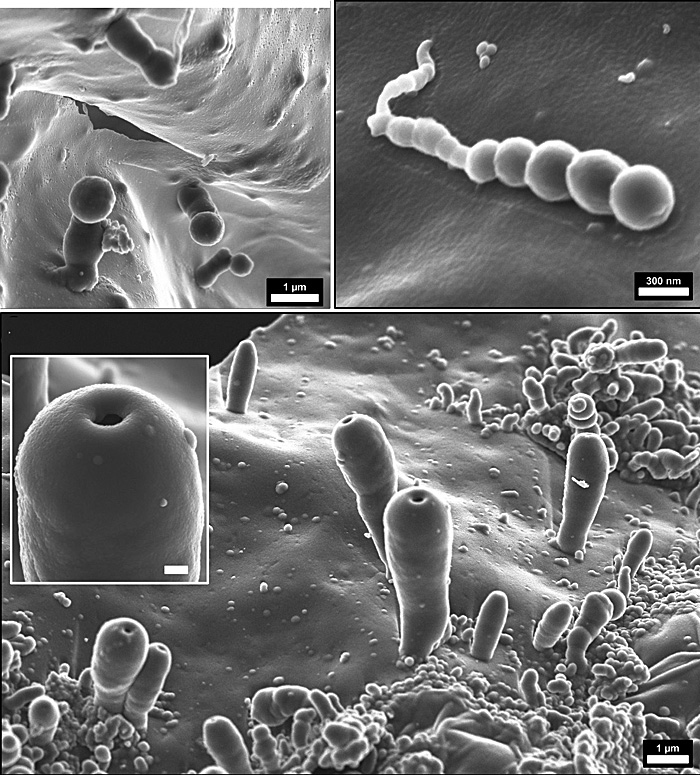
Biomorphs formed by polymerisation of HCN (Credit: Jenewein, C. et al 2024, Figure 2)

Jenewein and colleagues claim to have created cell-like structures, or ‘biomorphs’ at nanometre- and micrometre scale – spheres and polyp-like bodies – from a more plausible atmosphere of CO2 , H2O, and N2. These ‘protocells’ seem to have formed from minutely thin (150 to 3000 nanometres) polymer films built from hydrogen cyanide that grew  on the surface of the reaction chamber as electric discharges and UV light generated HCN and more complex ‘prebiotic’ chemicals. Apparently, these films were catalysed by SiO2 (silica) molecules from the glass reactor. Note:  In the Hadean breakdown of olivine to serpentinite as sea water reacted with ultramafic lavas would have released abundant silica. Serpentinisation also generates hydrogen. Intimate release of gas formed bubbles to create the spherical and polyp-like ‘protocells’. The authors imagine the Hadean global ocean permanently teeming with such microscopic receptacles. Such a veritable ‘primordial soup’ would be able to isolate other small molecules, such as amino acids, oligopeptides, nucleobases, and fatty acids, to generate more complex organic molecules in micro-reactors en route  to the kind of complex, self-sustaining systems we know as life.

So, is it possible to make a reasonable stab at what that first kind of life may have been? It was without doubt single celled. To reproduce it must have carried a genetic code enshrined in DNA, which is unique not only to all species, but to individuals. The key to tracking down LUCA is that it represents the point at which the evolutionary trees of the fundamental domains of modern life life – eukarya (including animals, plants and fungi), bacteria, and archaea – converge to a single evolutionary stem. There is little point in using fossils to resolve this issue because only multicelled life leaves tangible traces, and the first of those was found in 2,100 Ma old sediments in Gabon (see: The earliest multicelled life; July 2010). The key is using AI to compare the genetic sequences of the hugely diverse modern biosphere. Modern molecular phylogenetics and computing power can discern from their similarities and differences the relative order in which various species and broader groups split from others. It can also trace the origins of specific genes that provides clues about earlier genetic associations. Given a rate of mutation the modern differences provide estimates of when each branching occurred. The most recent genetic delving has been achieved by a consortium based at various institutions in Britain, the Netherlands, Hungary and Japan  (Moody, E.R.R. and 18 others 2024. The nature of the last universal common ancestor and its impact on the early Earth system. Nature Ecology & Evolution, v.8, pages 1654–1666; DOI: 10.1038/s41559-024-02461-1).

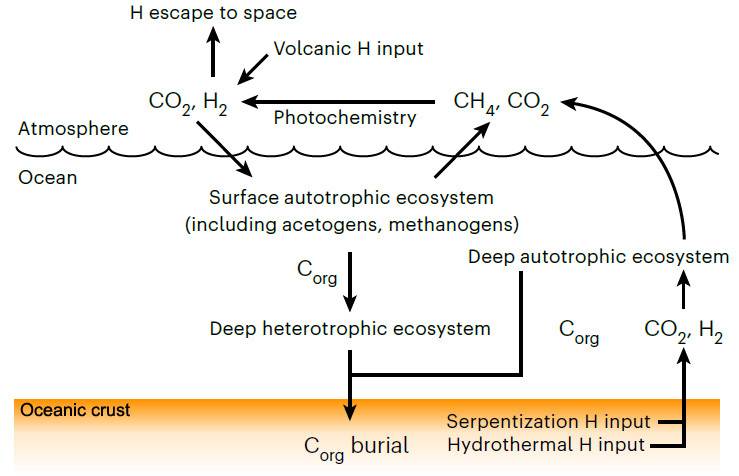
Moody et al have pushed back the estimated age of LUCA to halfway through the Hadean, between 4.09 to 4.33 billion years (Ga), well beyond the geologically known age of the earliest traces of life (3.5 Ga). That age for LUCA in itself is quite astonishing: it could have been only a couple of hundred million years after the Moon-forming interplanetary collision. Moreover, they have estimated that Darwin’s Ur-organism had a genome of around 2 million base pairs that encoded about 2600 proteins: roughly comparable to living species of bacteria and archaea, and thus probably quite advanced in evolutionary terms. The gene types probably carried by LUCA suggest that it may have been an anaerobic acetogen; i.e. an organism whose metabolism generated acetate (CH3COO) ions. Acetogens may produce their own food as autotrophs, or metabolise other organisms (heterotrophs). If LUCA was a heterotroph, then it must have subsisted in an ecosystem together with autotrophs which it consumed, possibly by fermentation. To function it also required hydrogen that can be supplied by the breakdown of ultramafic rocks to serpentinites, which tallies with the likely ocean-world with ultramafic igneous crust of the Hadean (see the earlier paragraphs about protocells). If an autotroph, LUCA would have had an abundance of CO2 and H2 to sustain it, and may have provided food for heterotrophs in the early ecosystem. The most remarkable possibility discerned by Moody et al is that LUCA may have had a kind of immune system to stave off viral infection.

The carbon cycle on the Hadean Earth (Credit: Moody et al. 2024; Figure 3e)

The Hadean environment was vastly different to that of modern times: a waterworld seething with volcanism; no continents; a target for errant asteroids and comets; more rapidly spinning with a 12 hour day; a much closer Moon and thus far bigger tides. The genetic template for the biosphere of the following four billion years was laid down then. LUCA and its companions may well have been unique to the Earth, as are their descendants. It is hard to believe that other worlds with the potential for life, even those in the solar system, could have followed a similar biogeochemical course. They may have life, but probably not as we know it  . . .

See also: Ball, P. 2025. Luca is the progenitor of all life on Earth. But its genesis has implications far beyond our planet. The Observer, 19 January 2025.

A fully revised edition of Steve Drury’s book Stepping Stones: The Making of Our Home World can now be downloaded as a free eBook

Snowball Earth and the rise of multi-celled life

You can follow my ‘reportage’ on the long running story of the Snowball Earth events during the Neoproterozoic Cryogenian Period (850 to 635 Ma) since 2000 through the index to annual Palaeoclimatology logs (15 posts). Once these dramatic events were over sedimentary rocks deposited around the world during the Ediacaran Period (635 to 541 Ma) record the sudden appearance of large-bodied fossils: the first multicellular animals. This explosion from slimy biofilms and colonies of single-celled prokaryotes and eukaryotes laid the basis for the myriad ecological niches that have characterised Planet Earth ever since. The change saw specialised eukaryote cells (see: The rise of the eukaryotes; December 2017), whose precursors had originated in single-celled forms, begin to cooperate inthe development of complex tissues, organs, and organ systems to form bodies rather than just cell walls. The pulsating evolution, diversification and repeated extinction that followed during the last one tenth of geological time shaped a planet that is unique in the Solar System and possibly in the galaxy, if not the entire universe. The simple biosphere that preceded it, on the other hand, may have emerged on innumerable rocky planets blessed with liquid water to survive little changed for billions of years, as have Earths’ prokaryotes, the Archaea and Bacteria.  

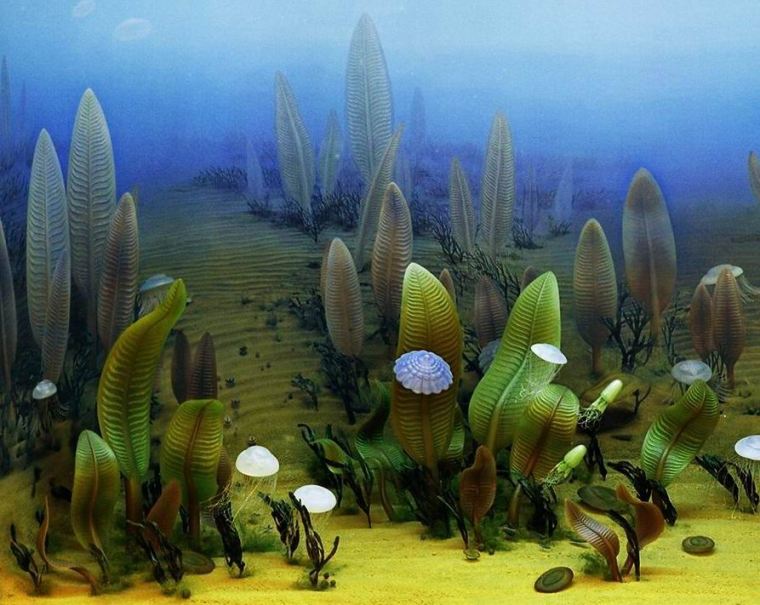
Artist’s impression of the Ediacaran Fauna (credit: Science)

The Ediacaran biological revolution followed repeated changes in the geochemistry of the oceans, which carbon isotope data from the Cryogenian and Ediacaran suggest to have ‘gone haywire’. This turmoil involved dramatic changes in the cycling of sulfur and phosphorus that help ‘fertilise’ the marine food chain and in the production of oxygen by photosynthesis that is essential for metazoan animals.  The episodes when the Earth was iced over reduced the availability of nutrients through decreased rates of ocean-floor burial of dead organisms. Such Snowball events would also have reduced penetration of sunlight in the oceans. Less photosynthesis would not only have reduced oxygen production but also the amounts of autotrophic organisms. Furthermore, decreased water temperature would have increased its viscosity thereby slowing the spread of nutrients. The food chain for heterotrophs was decimated. Each Snowball event ended with warming, ice-free conditions so that the marine biosphere could burgeon

A great deal of data and numerous theories have accumulated since the Snowball concept was first mooted, but there has been little progress in understanding the rise of multi-celled life. Four geoscientists from the Massachusetts Institute of Technology, the Santa Fe Institute and the University of Colorado (Boulder), USA have developed an interesting hypothesis for how this enormous evolutionary step may have developed (Crockett, W.W. et al. 2024. Physical constraints during Snowball Earth drive the evolution of multicellularity. Proceedings of the Royal Society B: Biological Sciences, v. 291; DOI: 10.1098/rspb.2023.2767). The concatenation of huge events during the Cryogenian and Ediacaran presented continually changing patterns of selective pressures on simple organisms that preceded that time period. Crockett et al. review them in the light of fundamental biology to suggest how multicellular animals emerged as the Ediacara Fauna. Intuitively, such harsh conditions suggest at worst mass, even complete, extinction, at best a general reduction in size of all organism to cope with scarce resources. That the size of eukaryotes should have grown hugely goes against the grain of most biologists’ outlook.

The authors consider the crucial factor to be fundamental differences between prokaryotes and early eukaryotes. Prokaryote cells are very small, and whether autotrophs of heterotrophs they absorb nutrients through their walls by diffusion. Single-celled eukaryotes are far larger than prokaryotes and typically have a flagellum or ‘tail’ so that they can move independently and more easily gather resources. Crockett et al. used computer modelling to simulate the type of life form that could grow and thrive under Snowball conditions. They found that prokaryotes could only grow smaller, being ‘stunted’ by scarce resources. On the other hand eukaryotes would be better equipped to gather resources, the more so if they adopted a simple multicellular form – a hollow, self-propelled sphere about the size of a pea, which the authors dub a choanoblastula. Although no such form is known today, it does resemble the green Volvox algae, and plausibly could have evolved further to the simple forms of the Ediacaran fauna. The next task is either to find a fossil of such an organism, or to grow one.

Multicelled fossils from the 1 Ga old Torridonian of Scotland

Beinn Alligin and Loch Torridon, Northwest Highlands of Scotland. The hills are formed by Torridonian terrestrial sediments (credit: Stefan Krause, Wikimedia Commons)

Palaeobiologists interested in the origin of animals have generally focussed on sedimentary rocks from southern China: specifically those of the 635 to 550 Ma Doushantuo Formation. Phosphorus-rich nodules in those marine sediments have yielded tiny spheroids whose structure suggests that they are fossil embryos of some unspecified eukaryote. The Doushantuo Formation lies on top of rocks associated with the Marinoan episode of global glaciation during the Neoproterozoic; a feature which suggested that the evolutionary leap from single- to multi-celled eukaryotes was associated with environmental changes associated with Snowball Earth events. In a forthcoming issue of Current Biology that view will be challenged and the origin of multicellular life pushed back to around 1 billion years ago (Strother, P.K. et al. 2021. A possible billion-year-old holozoan with differentiated multicellularity. Current Biology, v. 31, p. 1-8; DOI: 10.1016/j.cub.2021.03.051). Spherical fossils of that age have been teased out of phosphatic nodules deposited in lacustrine sediments from the lower part of the Mesoproterozoic Torridonian Group of the Northwest Highlands of Scotland.

The internal structure of the fossils has been preserved in exquisite detail. Not only are cells packed together in their interiors, but some reveal an outer layer of larger sausage-shaped cells. So, cell differentiation had taken place in the original organisms, whereas such features are not visible in the Doushantuo ‘embryos’. A few of the central cells show dark, organic spots that may be remains of theirnucleii. Whatever these multicellular spheres may have developed into, the morphology of the Torridonian fossils is consistent with a transition from single-celled holozoans to the dominant metazoans of the Phanerozoic; i.e. the stem of later animals. The younger, Chinese fossils that are reputed to be embryos cannot be distinguished from multicellular algae (see: Excitement over early animals dampened, January 2012)

Photomicrograph of Bicellum brazieiri: scale bar = 10μm; arrows point to dark spots that may be cell nuclei (credit: Charles Wellman, Sheffield University)

Interestingly, the Torridonian Group is exclusively terrestrial in origin, being dominated by sediments deposited in the alluvial plains of huge braided streams that eventually buried a rugged landscape eroded from Archaean high-grade metamorphic rocks. Thus the environment would have been continually in contact with the atmosphere and thus oxygen that is vital for eukaryote life forms. The age of the fossils also rings a bell: a molecular clock based on the genomics of all groups of animals alive today hints at around 900-1000 Ma for the emergence of the basic body plan. Because its host rocks are about that age, could Bicellum brazier be the Common Ancestor of all modern animals? That would be a nice tribute to the second author, Martin Brazier (deceased) of Oxford University, who sought signs of the most ancient life for much of his career.

See also:Billion-year-old fossil reveals missing link in the evolution of animals (Press release, Sheffield University; 29 April 2021)