Chinese skull confirmed as Denisovan

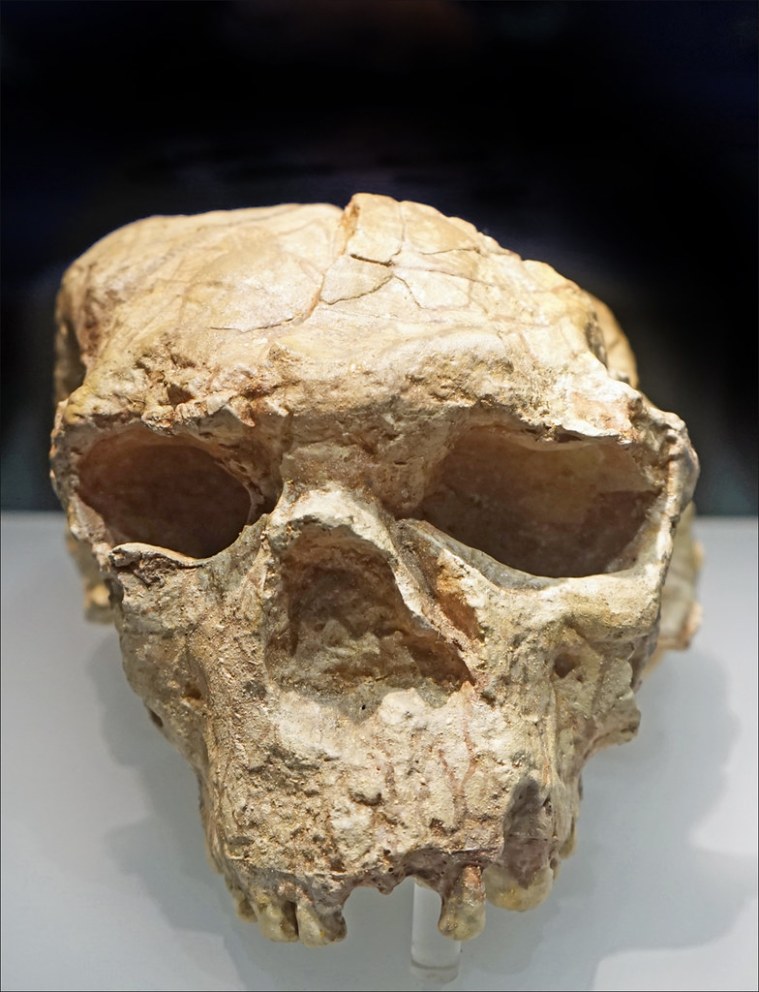
For over a century Chinese scientists have been puzzling over ancient human skulls that show pronounced brow ridges. Some assigned them to Homo, others to species that they believe were unique to China. A widely held view in China was that people now living there evolved directly from them, adhering to the ‘Multiregional Evolution’ hypothesis as opposed to that of ‘Out of Africa’. However, the issue might now have been resolved. In the last few years palaeoanthropologists have begun to suspect that these fossilised crania may have been Denisovans, but none had been subject to genetic and proteomic analysis. The few from Siberia and Tibet that initially proved the existence of Denisovans were very small: just a finger bone and teeth.  Out of the blue, teeth in a robust hominin mandible dredged from the Penghu Channel between Taiwan and China yielded protein sequences that matched proteomic data from Denisovan fossils in Denisova Cave and Baishiya Cave in Tibet, suggesting that Denisovans were big and roamed  widely in East Asia. In 2021 a near-complete robust cranium came to light that had been found in the 1930s near Harbin in China and hidden – at the time the area was under Japanese military occupation. It emerged only when its finder revealed its location in 2018, shortly before his death. It was provisionally called Homo longi or ‘Dragon Man’. Qiaomei Fu of the Institute of Vertebrate Paleontology and Paleoanthropology in Beijing and her colleagues have made a comprehensive study of the fossil.

The cranium found near Harbin, China belonged to a Denisovan. Credit: Hebei Geo University

It is at least 146 ka old, probably too young to have been H. erectus, but predates the earliest anatomically modern humans to have reached East Asia from Africa (~60 ka ago). The Chinese scientists have developed protein- and DNA extraction techniques akin to those pioneered at the Max Planck Institute for Evolutionary Anthropology in Leipzig. It proved impossible to extract sufficient ancient nuclear DNA from the cranium bone for definitive genomic data to be extracted, but dental plaque (calculus) adhering around the only surviving molar in the upper jaw did yield mitochondrial DNA. The mtDNA matched that found in Siberian Denisovan remains (Qiaomei Fu et al. 2025. Denisovan mitochondrial DNA from dental calculus of the >146,000-year-old Harbin cranium. Cell, v. 188, p. 1–8; DOI: 10.1016/j.cell.2025.05.040). The bone did yield 92 proteins and 122 single amino acid polymorphisms, as well as more than 20 thousand peptides (Qiaomei Fu and 8 others 2025. The proteome of the late Middle Pleistocene Harbin individual. Science, v. 388: DOI: 10.1126/science.adu9677). Again, these established a molecular link with the already known Denisovans, specifically with one of the Denisova Cave specimens. Without the painstaking research of the Chinese team, Denisovans would have been merely a genome and a proteome without much sign of a body! From the massive skull it is clear that they were indeed big people with brains much the same size as those of living people. Estimates based on the Harbin cranium suggest an individual weighing around 100 kg (220 lb or ~15 stone): a real heavyweight or rugby prop!

The work of Qiaomei Fu and her colleagues, plus the earlier, more limited studies by Tsutaya et al., opens a new phase in palaeoanthropology. Denisovans now have a genome and well-preserved parts of an entire head, which may allow the plethora of ancient skulls from China to be anatomically assigned to the species. Moreover, by extracting DNA from dental plaque for the first time they have opened a new route to obtaining genomic material: dental calculus is very much tougher and less porous than bone.

See also: Curry, A. ‘Dragon Man’ skull belongs to mysterious human relative. 2025. Science, v. 388; DOI: 10.1126/science.z8sb68w. Smith K. 2025. We’ve had a Denisovan skull since the 1930s – only nobody knew. Ars Technica, 18 June 2025. Marshall, M. 2025. We finally know what the face of a Denisovan looked like. New Scientist 18 June 2025.

Consider Homo erectus …

Championed as the earliest commonly found human species and, apart from anatomically modern humans (AMH), the most widespread through Africa and Eurasia. It also endured longer (~1.75 Ma) than any other hominin species, appearing first in East Africa around 2 Ma ago, the youngest widely accepted fossil – found in China – being around 250 ka old. The ‘erects’ arguably cooked their food and discovered the use of fire 1.7 to 2 Ma ago. The first fossils discovered in Java by Eugene Dubois are now known to be associated with the oldest-known art (430 to 540 ka) The biggest issue surrounding H. erectus has been its great diversity, succinctly indicated by a braincase capacity ranging from 550 to 1250 cm3: from slightly greater than the best endowed living apes to within the range of AMH. Even the shape of their skulls defies the constraints placed on those of other hominin species. For instance, some have sagittal crests to anchor powerful jaw muscles, whereas others do not. What they all have in common are jutting brow ridges and the absence of chins along with all more recently evolved human species, except for AMH.

This diversity is summed up in 9 subspecies having been attributed to H. erectus, the majority by Chinese palaeoanthropologists. Chinese fossils from over a dozen sites account for most of the anatomical variability, which perhaps even includes Denisovans, though their existence stems only through the DNA extracted from a few tiny bone fragments. So far none of the many ‘erect’ bones from China have been submitted to genetic analysis, so that connection remains to be tested. Several finds of diminutive humans from the Indonesian and Philippine archipelagos have been suggested to have evolved from H. erectus in isolation. All in all, the differences among the remains of H. erectus are greater than those used to separate later human species, i.e. archaic AMH, Neanderthals, Denisovans, H. antecessor etc. So it seems strange that H. erectus has not been split into several species instead of being lumped together, in the manner of the recently proposed Homo bodoensis. Another fossil cranium has turned up in central China’s Hubei province, to great excitement even though it has not yet been fully excavated (Lewis, D. 2022. Ancient skull uncovered in China could be million-year-old Homo erectus. Nature News 29 November 2022; DOI: 10.1038/d41586-022-04142-00; see also a video). Chances are that it too will be different from other examples. It also presents a good excuse to consider H. erectus.

Cranium of a Chinese Homo erectus, somewhat distorted by burial, from a site close to the latest find. (Credit: Hubei Museum, Wuhan, China)

The complications began in Africa with H. ergaster, the originator of the bifacial or Acheulean multi-purpose stone tool at around 1.6 Ma (see: Flirting with hand axes; May 2009), the inventor of cooking and discoverer of the controlled use of fire. ‘Action Men’ were obviously smarter than any preceding hominin, possibly because of an increase of cooked protein and plant resources that are more easily digested than in the raw state and so more available for brain growth. The dispute over nomenclature arose from a close cranial similarity of H. ergaster to the H. erectus discovered in Java in the 19th century: H. erectus ergaster is now its widely accepted name. In 1991-5 the earliest recorded hominins outside Africa were found at Dmanisi, Georgia, in sediments dated at around 1.8 Ma (see: First out of Africa; November 2003) Among a large number of bones were five well-preserved skulls, with brain volumes less than 800 cm3 (see: An iconic early human skull; October 2013). These earliest known migrants from Africa were first thought to resemble the oldest humans (H.habilis) because of their short stature, but now are classified as H. erectus georgicus. They encapsulate the issue of anatomical variability among supposed H. erectus fossils, each being very different in appearance, one even showing ape-like features. Another had lost all teeth from the left side of the face, yet had survived long after their loss, presumably because others had cared for the individual.

The great variety of cranial forms of the Asian specimens of H. erectus may reflect a number of factors. The simplest is that continuous presence of a population there for as long as 1.5 Ma inevitably would have resulted in at least as much evolution as stemmed from the erects left behind in Africa, up to and including the emergence of AMH in North Africa about 300 ka ago. If contact with the African human population was lost after 1.8 Ma, the course of human evolution in Africa and Asia would clearly have been different. But that leaves out the possibility of several waves of migrants into Asia that carried novel physiological traits evolved in Africa to mix with those of earlier Asian populations. From about 1 Ma ago a succession of migrations from Africa populated Europe – H. antecessor, H. heidelbergensis, and Neanderthals and then AMH. So a similar succession of migrants could just as well have gone east instead of west on leaving Africa. Asia is so vast that migration may have led different groups to widely separated locations, partially cut-off by mountain ranges and deserts so that it became very difficult for them to maintain genetic contact. Geographic isolation of small groups could lead to accelerated evolution, similar to that which may have led to the tiny H. floresiensis and H. luzonensisdiscovered on Indonesian and Philippine islands.

 Another aspect of the Asian continent is its unsurpassed range of altitude, latitude and climate zones. Its ecologically diversity offers a multitude of food resources, and both climate and elevation differences pose a range of potential stresses to which humans would have had to adapt. The major climate cycles of the Pleistocene would have driven migration across latitudes within the continent, thereby mixing groups with different physical tolerances and diets to which they had adapted. Equally, westward migration was possible using the Indo-Gangetic plains and the shore of the Arabian Sea: yet more opportunities for mixing between established Asians and newly arrived African emigrants.