The ‘boring billion’ years of the Mesoproterozoic: plate tectonics and the eukaryotes

The emergence of the eukaryotes – of which we are a late-entry member – has been debated for quite a while. In 2023 Earth-logs reportedthat a study of ‘biomarker’ organic chemicals in Proterozoic sediments suggests that eukaryotes cannot be traced back further than about 900 Ma ago using such an approach. At about the same time another biomarker study showed signs of a eukaryote presence at around 1050 Ma. Both outcomes seriously contradicted a ‘molecular-clock’ approach based on the DNA of modern members of the Eukarya and estimates of the rate of genetic mutation. That method sought to deduce the time in the past when the last eukaryotic common ancestor (LECA) appeared. It pointed to about 2 Ga ago, i.e. a few hundred million years after the Great Oxygenation Event got underway. Since eukaryote metabolism depends on oxygen, the molecular-clock result seems reasonable. The biomarker evidence does not. But were the Palaeo- and Mesoproterozoic Eras truly ‘boring’? A recent paper by Dietmar Müller and colleagues from the Universities of Sydney and Adelaide, Australia definitely shows that geologically they were far from that (Müller, R.D. et al. 2025. Mid-Proterozoic expansion of passive margins and reduction in volcanic outgassing supported marine oxygenation and eukaryogenesis. Earth and Planetary Science Letters, v. 672; DOI: 10.1016/j.epsl.2025.119683).
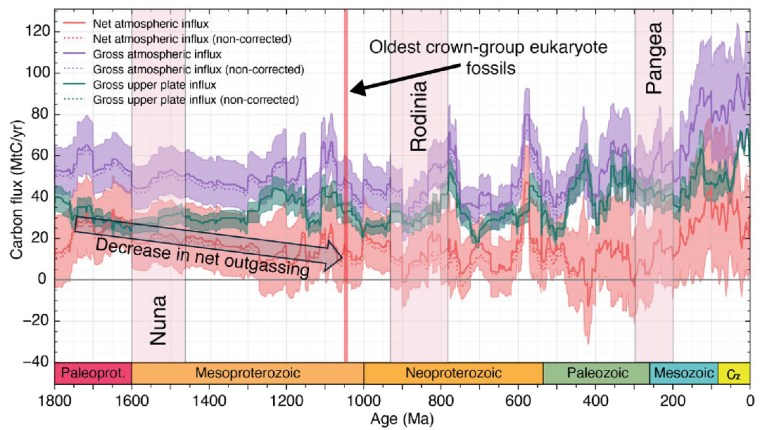
Carbon influx (million tons per year) into tectonic plates and into the ocean-atmosphere system from 1800 Ma to present. The colour bands represent: total carbon influx into the atmosphere (mauve); sequestered in tectonic plates (green); net atmospheric influx i.e. total minus carbon sequestered into plates (orange). The widths of the bands show the uncertainties of the calculated masses shown as darker coloured lines.

From 1800 to 800 Ma two supercontinents– Nuna-Columbia and Rodinia – aggregated nearly all existing continental masses, and then broke apart. Continents had collided and then split asunder to drift. So plate tectonics was very active and encompassed the entire planet, as Müller et al’s palaeogeographic animation reveals dramatically. Tectonics behaved in much the same fashion through the succeeding Neoproterozoic and Phanerozoic to build-up then fragment the more familiar supercontinent of Pangaea. Such dynamic events emit magma to form new oceanic lithosphere at oceanic rift systems and arc volcanoes above subduction zones, interspersed with plume-related large igneous provinces and they wax and wane. Inevitably, such partial melting delivered carbon dioxide to the atmosphere. Reaction on land and in the rubbly flanks of spreading ridges between new lithosphere and dissolved CO2 drew down and sequestered some of that gas in the form of solid carbonate minerals. Continental collisions raised the land surface and the pace of weathering, which also acted as a carbon sink. But they also involved metamorphism that released carbon dioxide from limestones involved in the crustal transformation. This protracted and changing tectonic evolution is completely bound up through the rock cycle with geochemical change in the carbon cycle.

From the latest knowledge of the tectonic and other factors behind the accretion and break-up of Nuna and Rodinia, Müller et al. were able to model the changes in the carbon cycle during the ‘boring billion’ and their effects on climate and the chemistry of the oceans. For instance, about 1.46 Ga ago, the total length of continental margins doubled while Nuna broke apart. That would have hugely increased the area of shallow shelf seas where living processes would have been concentrated, including the photosynthetic emission of oxygen. In an evolutionary sense this increased, diversified and separated the ecological niches in which evolution could prosper. It also increased the sequestration of greenhouse gas through reactions on the flanks of a multiplicity of oceanic rift systems, thereby cooling the planet. Translating this into a geochemical model of the changing carbon cycle (see figure) suggests that the rate of carbon addition to the atmosphere (outgassing) halved during the Mesoproterozoic. The carbon cycle and probable global cooling bound up with Nuna’s breakup ended with the start of Rodinia’s aggregation about 1000 Ma ago and the time that biomarkers first indicate the presence of eukaryotes.
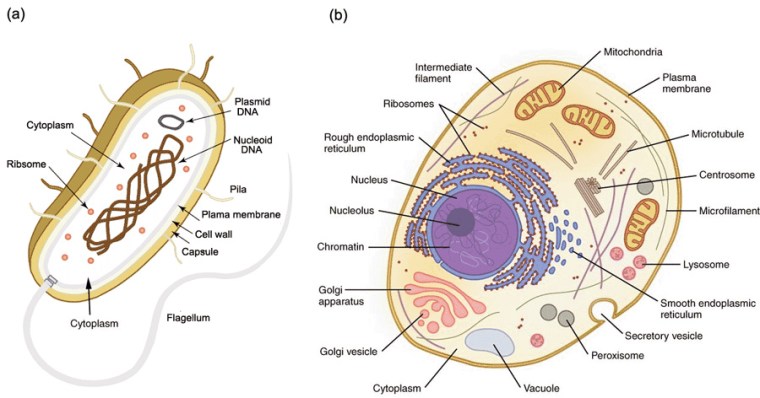
Simplified structures of (a) a prokaryote cell; (b) a simple eukaryote animal cell. Plants also contain organelles called chloroplasts

So, did tectonics play a major role in the rise of the Eukarya? Well, of course it did, as much as it was subsequently the changing background to the appearance of the Ediacaran animals and the evolutionary carnival of the Phanerozoic. But did it affect the billion-year delay of ‘eukaryogenesis’ during prolonged availability of the oxygen that such a biological revolution demanded? Possibly not. Lyn Margulis’s hypothesis of the origin of the basic eukaryote cell by a process of ‘endosymbiosis’ is still the best candidate 50 years on. She suggested that such cells were built from various forms of bacteria and archaea successively being engulfed within a cell wall to function together through symbiosis. Compared with prokaryote cells those of the eukaryotes are enormously complex. At each stage the symbionts had to be or become compatible to survive. It is highly unlikely that all components entered the relationship together. Each possible kind of cell assembly was also subject to evolutionary pressures. This clearly was a slow evolutionary process, probably only surviving from stage to stage because of the global presence of a little oxygen. But the eukaryote cell may also have been forced to restart again and again until a stable form emerged.

See also: New Clues Show Earth’s “Boring Billion” Sparked the Rise of Life. SciTechDaily, 3  November 2025

How India accelerated towards Eurasia at the end of the Cretaceous

About 70 Ma ago the magnetic striping of the Indian Ocean floor suggests that the Indian subcontinent was then moving towards the huge, almost stationary Eurasian continent at about 8 cm per year. Over the next 5 Ma this convergence rate underwent a tectonically startling acceleration to reach 18 cm yr-1 by around the time of the Cretaceous-Palaeogene boundary (65 Ma): more than doubling the approach rate. Thereafter it slowed, eventually to a few centimetres per year once collision and building of the Himalayan mountain belt were more or less complete about 30 Ma ago. This cannot easily be explained by a speeding up of the sea-floor spreading rate at an Indian Ocean ridge to the south, 18 cm yr-1 being as fast as tectonic forces can manage at present. At that time ocean floor to the north of India was being subducted beneath Eurasia, and basaltic volcanism was flooding what is now the Deccan Plateau on western India. A couple of suggestions have been made: two northward subduction zones may have developed or the mantle plume feeding the Deccan flood basalts may have driven the tectonic acceleration. A third possibility is that the subduction was somehow lubricated. That approach has recently been considered by geoscientists from China and Singapore  (Zhou, H. et al. 2024. India–Eurasia convergence speed-up by passive-margin sediment subduction. Nature, v. 635, p. 114-120; DOI: 10.1038/s41586-024-08069-6).

Hao Zhou and colleagues studied the isotopic and trace-element geochemistry of volcanic and plutonic igneous complexes to the north of the Himalaya. They were emplaced in arc environments in three stages: from 98 to 89; 65 to 60; and 57 to 50 Ma. In this tectonic setting fluids rise from the subducted slab to induce the mantle part of the overriding lithosphere to partially melt. That yields magmas which penetrate the crust above. The first and last magmatic events produced similar isotopic and trace-element ‘signatures’, which suggest fluids rose from subducted ocean lithosphere.  But those in the latest Cretaceous to earliest Palaeocene are markedly different. Instead of showing signs of their magmas being entirely mantle derived like the earlier and later groups, the 65 to 60 Ma rocks exhibit clear evidence of partial melting having incorporated materials that had originated in older continental crust. The authors suggest that this crustal contamination stemmed from sediments that had been deposited at the northern margin of the Indian subcontinent during the Mesozoic. These sediments had formed by weathering of the ancient rocks that underpin India, transport of the debris by rivers and deposition on the seafloor as water-saturated sands, silts and clays. Once those sediments were subducted beneath what is now Tibet they would yield fluids with a geochemical ‘fingerprint’ inherited from old continental crust. Moreover, far more fluids than subducted oceanic crust could ever release would rise into the overriding lithosphere than.

The fluids rising from a subducted wedge of sediments may have reduced friction between the overriding Eurasian lithosphere and the subducted slab derived from the Indian tectonic plate. That scenario would not only have lubricated subduction, but allowed compressive forces in the overriding lithosphere to relax. Both would have allowed convergence of the two plates to move significantly faster as the sediments were progressively consumed. Once completed, convergence would have slowed without such ‘lubrication’.Earlier continent-continent collision zones, such as those that united Pangaea and older supercontinents may well have involved such tectonic surges. And the same kind of process may eventually speed up the reassembly of the latest distribution of continents.

Watch an animation of the India-Eurasia convergence (just over 3 minutes long)compiled by Christopher Scotese of Northwestern University in Evanston, Illinois, USA, which is a component of his Paleomap Project. It starts by following India from its current position to its origin in the break-up of Gondwanaland ~100 Ma ago. The last half reverses the motions to show India’s slow collision with Eurasia.

Subduction and continental collision in the Himalaya

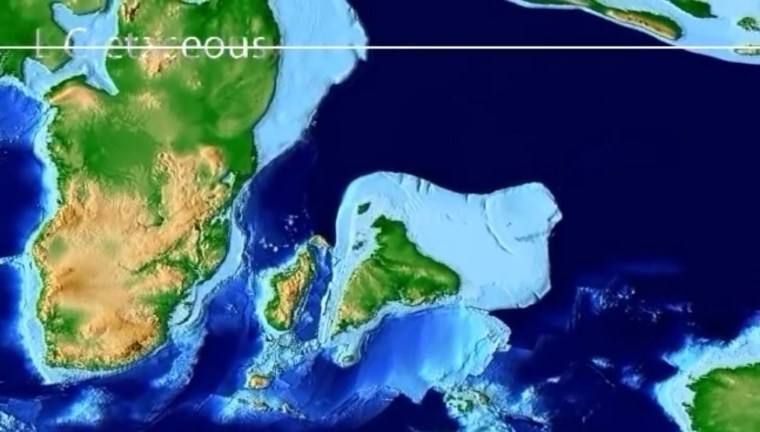
The Indian subcontinent after it separated from Madagascar in the Late Cretaceous to move northwards to its destined collision with Eurasia and the formation of the Himalaya. (Credit: Frame from an animation ©Christopher Scotese)

During the Early Cretaceous (~140 Ma ago) India, Madagascar, Antarctica and Australia parted company with Africa after 400 Ma of unity as components of the Gondwana supercontinent. By 120 Ma Antarctica and Australia split from India and Madagascar, and the Indian Ocean began to form. India moved northwards , leaving Madagascar in its wake after about 70 Ma ago. By 50 Ma the subcontinent began to collide with Eurasia, its northward motion driving before it crustal materials that eventually formed the Himalaya. This highly complex process is wonderfully documented in an animation made in 2015 by Christopher Scotese, Emeritus Professor in the Department of Earth and Environmental Sciences, Northwestern University, USA. At the start of its journey India moved northwards at a slow rate of about 5 cm per year. After 80 Ma it speeded up dramatically to 15 cm per year, about twice as fast as any modern continental drift and a pace that lasted for over 30 Ma until collision began. How could that, in a geological sense, sudden and sustained acceleration have been induced? It would have required a change in the slab-pull force that is the primary driver of plate tectonics, suggesting an increase in the amount of subduction in the Tethys Ocean that formerly lay between India and Eurasia, probably at two, now hidden destructive plate margins.

A group of geoscientists from Canada, the US and Pakistan has documented that collision in terms of the record of metamorphism experienced beneath the Himalaya as slab after slab of once near-surface rocks were driven beneath the rising orogen (Soret, M. et al. 2021. How Himalayan collision stems from subduction. Geology, v. 49, p. 894-898; DOI: 10.1130/G48803.1). The Western Himalaya has trapped a deformed and tilted magmatic rock sequence of an island arc – the Kohistan Arc – between  the Eurasian plate and a zone of crustal thickening and shortening that was thrust southward over the ancient metamorphic basement of India itself. That crust was mantled by a variety of younger sediments deposited on the Tethyan continental shelf of the northern Indian plate which became involved in the process of crustal thickening. The Kohistan Arc probably formed above one of the destructive margins that consumed the oceanic lithosphere of the now vanished Tethys Ocean. Two distinct types of rock make up the slabs stacked-up by thrusting.

The uppermost, which also forms the highest part of the Western Himalaya in the form of Nanga Parbat (at 8,126 metres the world’s ninth highest mountain) comprises rocks thought to represent Tethyan oceanic lithosphere subducted perhaps at the second destructive margin. Their mineral assemblages, especially those of eclogites, indicate that they have been metamorphosed under pressures corresponding to depths of up to 100 km, but at low temperatures along a geothermal gradient of about 7°C km-1, i.e. in a low heat-flow environment. These ultra-high pressure (UHP) metamorphic rocks formed at the start of the India-Eurasia collision. The sequence of sedimentary slabs now overridden by the UHP slab were metamorphosed at around the same time, but under very different conditions. Their burial reached only about 35 km – the normal thickness of the continental crust – and a temperature of about 600°C on a 30°C km-1 geothermal gradient. Detailed mineralogy of the UHP slab reveals that as it was driven over the metasediments it evolved to the same geothermal conditions.

Matthew Soret and his colleagues explain how this marked metamorphic duality may have arisen in rocks that are now part of the same huge thrust complex. Their results are consistent with slicing together of oceanic lithosphere in a subduction zone to form a tectonic wedge of UHP mineral assemblages at the same time as continental shelf sediments were metamorphosed under more normal geothermal conditions. This was happening just as India came into contact with Eurasia. When crustal thickening began in earnest through the inter-slicing of the two assemblages, pressure on the UHP rocks fell rapidly as a result of their being thrust over the dominantly metasedimentary shelf sequence. It also moved into a zone of normal heat flow, first heating up equally quickly and then following a path of decreasing pressure and temperature as erosion pared away the newly thickened crust. Both assemblages now became part of the same metamorphic regime. In this way a subduction system evolved to become incorporated in an orogenic zone as two continents collided; a complex process that finds parallels in other orogens such as the Alps.

Plate tectonics and the Cambrian Explosion

A rough-and-ready way of assessing the rate at which silicic magmatic activity has varied through time is to separate out grains of zircon that have accumulated in sedimentary rocks of different ages. Zircon is readily datable using the U-Pb method, if you have access to mass spectrometry. While some of the zircons will date from much older continental crust that was exposed while the sediments originated, sometimes there are grains that formed only a few million years before the sediments accumulated. Those are likely to have crystallized from silica-rich volcanic rocks above subduction zones where ocean-floor has been driven beneath continental crust; i.e. at continental volcanic arcs. Such young zircons therefore help assess the tectonic conditions close to sedimentary basins. The potential of detrital zircon geochronology was first suggested to me by Dr M.V.N. Murthy of the Geological Survey of India in 1978, long before anyone could aspire to mass zircon dating. M.V.N. had by then amassed kilograms of zircon grains from every imaginable source in India, and may have been the first geologist to realise their potential. It has become a lot quicker and cheaper in the last two decades, thanks to methods of dating single zircon grains both precisely and accurately and M.V.N.’s prescient suggestion has been borne out globally.

Optical microscope photograph; the length of t...
A detrital zircon grain about 0.25 mm long. (Photo credit: Wikipedia)

Results for the late Precambrian to early Palaeozoic have recently been compiled (McKenzie, N.R. et al. 2014. Plate tectonic influences on Neoproterozoic-early Paleozoic climate and animal evolution. Geology, online publication doi:10.1130/G34962.1). One of the striking correlations is between the abundance of ‘young’ zircons relative to Cambrian sedimentary deposition and the pace of diversification of animal faunas during the Cambrian.  During the Cambrian Period there may have been far more continental-margin arc volcanism than in the preceding late Neoproterozoic or later in the early Palaeozoic. That would match with evidence for the Cambrian atmosphere having reached the greatest CO2 concentration of Phanerozoic times and the fact that the Gondwana supercontinent (comprising the present southern continents plus India) was assembled at that time by collision of several Precambrian continental masses. Global temperatures must have been rising.

Reconstruction of Earth 550 Ma ago showing the...
Earth at abround the start of the Cambrian showing the cratons that collided to form Gondwana (Photo credit: Wikipedia)

The rapid emergence of all the major animal groups by the middle Cambrian – the Cambrian Explosion – took place during and despite climatic warming. Environmental stress, perhaps increased calcium and bicarbonate ions in sea water as a result of acid conditions, may have forced animals to develop means of getting both ions out of their cells to form carbonate skeletons: the Cambrian Explosion really marks the first appearance of shelly faunas and a good chance of fossilisation. Yet at the peak of volcanically-induced warming faunal diversity, especially of reef-building animals, fell-off dramatically to create what some palaeobiologsts have termed the Cambrian ‘dead interval’. Marine life really took-off in a big way during the Ordovician while temperatures were falling globally; so much so that the close of the Ordovician was marked by the first major glaciation focused on Gondwana. The zircon record indicates that continental-arc volcanism also declined during the Ordovician, and maybe the Cambrian silicic volcanics were chemically weathered during that Period to remove carbon-dioxide from the atmosphere, along with renewed reef building to bury carbonate fossils.

Enhanced by Zemanta