Ancient mining pollutants in river sediments reveal details of early British economic history

People have been mining in Britain since Neolithic farmers opened the famous Grimes Graves in Norfolk – a large area dotted with over 400 pits up to to 13 metres deep. The target was a layer of high quality black flint in a Cretaceous limestone known as The Chalk. Later Bronze Age people in Wales and Cornwall drove mine shafts deeper underground to extract copper and tin ores to make the alloy bronze. The Iron Age added iron ore to the avid search for sources of metals. The production and even export of metals and ores eventually attracted the interest of Rome. Roman invasion in 43 CE during the reign of Claudius annexed most of England and Wales to create the province of Britannia. This lasted until the complete withdrawal of Roman forces around 410 CE. Roman imperialism and civilisation depended partly on lead for plumbing and silver coinage to pay its legionaries. Consequently, an important aspect in Rome’s four-century hegemony was mining, especially for lead ore, as far north as the North Pennines. This littered the surface in mining areas with toxic waste. Silver occurs in lead ore in varying proportions. In the Bronze Age early metallurgists extracted silver from smelted, liquid lead by a process known as cupellation. The molten Pb-Ag alloy is heated in air to a much higher temperature than its melting point, when lead reacts with oxygen to form a solid oxide (PbO) and silver remains molten.
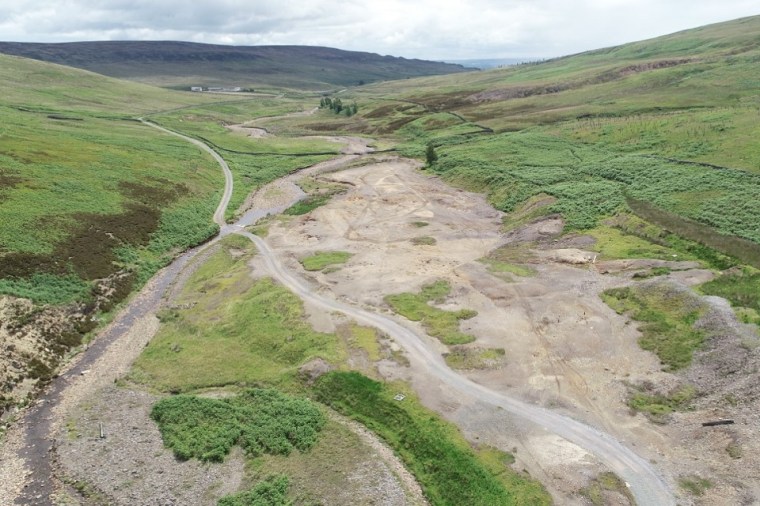
Mine waste in the North Pennine orefield of England. Credit: North Pennines National Landscape

Until recently, historians believed that the fall of the Western Empire brought economic collapse to Britain. Yet archaeologists have revealed that what was originally called the “Dark Ages” (now Early Medieval Period) had a thriving culture among both the remaining Britons and Anglo Saxon immigrants. A means of tracking economic activity is to measure the amount of pollutants from mining waste at successive levels in the alluvium of rivers that flow through orefields. Among the best known in Britain is the North Pennine Orefield of North Yorkshire and County Durham through which substantial rivers flow eastwards, such as the River Ure that flows through the heavily mined valley of Wensleydale. A first attempt at such geochemical archaeology has been made by a British team led by Christopher Loveluck of Nottingham University (Loveluck, C.P. and 10 others 2025. Aldborough and the metals economy of northern England, c. AD 345–1700: a new post-Roman narrative. Antiquity: FirstView, online article; DOI: 10.15184/aqy.2025.10175). Aldborough in North Yorkshire – sited on the Romano-British town of Isurium Brigantum – lies in the Vale of York, a large alluvial plain. The River Ure has deposited sands, silts and muds in the area since the end of the last Ice Age, 11 thousand years ago.

Loveluck et al. extracted a 6 m core from the alluvium on the outskirts of Aldborough, using radiocarbon and optically-stimulated luminescence of quartz grains to calibrate depth to age in the sediments.  The base of the core is Mesolithic in age (~6400 years ago) and extends upwards to modern times, apparently in an unbroken sequence. Samples were taken for geochemical analysis every 2 cm through the upper 1.12 m of the core, which spans the Roman occupation (43 to 410 CE), the early medieval (420 to 1066 CE), medieval (1066 to 1540 CE), post-medieval (1540 to 1750 CE) and modern times (1750 CE to present). Each sample was analysed for 56 elements using mass spectrometry; lead, silver, copper, zinc, iron and arsenic being the elements of most interest in this context. Other data gleaned from the sediment are those of pollen, useful in establishing climate and ecological changes. Unfortunately, the metal data begin in 345 CE, three centuries after the Roman invasion, by which time occupation and acculturation were well established. The authors assume that Romans began the mining in the North Pennines. They say nothing about the pre-mining levels of pollution from the upstream orefield nor mining conducted by the Iron Age Brigantes. For this kind of survey, it is absolutely essential that a baseline is established for the pollution levels under purely natural conditions. The team could have analysed sediment from the Mesolithic when purely natural weathering, erosion and transport could safely be assumed, but they seem not to have done that.

The team has emphasised that their data suggest that mining for lead continued and even increased through the ‘Dark Ages’ rather than declining, in an economic ‘slump’ once the Romans left, as previous historians have suggested. Lead pollution continued at roughly the same levels as during the Roman occupation through the Early Medieval Period and then rose to up to three times higher after the late 14th century. The data for silver are different. The Ag data from Aldborough show a large ‘spike’ in 427 to 427 CE. Interestingly this is after the Roman withdrawal. Its level in alluvium then ‘flatlines’ at low abundances until the beginning of the 14th century when again there is a series of ‘booms’. This seems to me to mark sudden spells of coining, after the Romans left perhaps first to ensure a money economy remained possible, and then as a means of funding wars with the French in the 14th century. The authors also found changing iron abundances, which roughly double from low Roman levels to an Early Medieval peak and then fall in the 11th century: a result perhaps of local iron smelting. The overall patterns for zinc and copper differ substantially from those of lead, as does that for arsenic which roughly follows the trend for iron. That might indicate that local iron production was based on pyrite (FeS2) which can contain arsenic at moderate concentrations: pyrite is a common mineral in the ore bodies of the North Pennines’ The paper by Loveluck et al. is worth reading as a first attempt to correlate stratigraphic geochemistry data with episodes in British and, indeed, wider European history. But I think it has several serious flaws, beyond the absence of any pre-Roman geochemical baseline, as noted above. No data are presented for barium (Ba) and fluorine (F) derived from the gangue minerals baryte (BaSO4) and fluorite (CaF2), which outweigh lead and zinc sulfides in North Pennine ore bodies, yet had no use value until the Industrial Revolution. They would have made up a substantial proportion of mine spoil heaps – useful ores would have been picked out before disposal of gangue – whose erosion, comminution and transport would make contributions to downstream deposition of alluvium consistent with the pace of mining. That is: Ba and F data would be far better guides to industrial activity. There is a further difficulty with such surveys in northern Britain. The whole of the upland areas were subjected to repeated glaciation, which would have gathered exposed ore and gangue and dumped it in till, especially in the numerous moraines exposed in valleys such as Wensleydale. Such sources may yield sediment in periods of naturally high erosion during floods. Finally, the movement of sediment downstream is obviously not immediate, especially when waste is disposed in large dumps near mines Therefore phases of active mining may not contribute increased toxic waste far downstream until decades or even centuries later. These factors could easily have been clarified by a baseline study from earlier archaeological periods when mining was unlikely, into which the Aldborough alluvium core penetrates

Holocene migrations of people into Britain

People assigned to a variety of human species: Homo sapiens H. neanderthalensis (Swanscombe, 400 ka and several later times ) H heidelbergensis (Boxgrove, ca 500 ka, )H. antecessor (Happisburgh, ca 950 ka) – have left signs of their presence in Britain. Human occupancy has largely depended on climate. Around 9 times since the first known human presence here, much of Britain was repeatedly buried by glacial ice to become a frigid desert for tens of thousands of years. Between 180 and 60 ka only a couple of flint artefacts found in road excavations in Kent hint at Neanderthal visitors. For most of the Late Pleistocene the archipelago seems to have been devoid of humans. Arguably, Europe’s first known anatomically modern humans occupied several caves in Devon, Derbyshire and South Wales as early as around 43 ka, while climate was cooling, only to abandon Britain during the Last Glacial Maximum (24 to 18 ka ago). As climate warmed again thereafter, sporadic occupation by Late Palaeolithic hunter-gatherers occurred up to the sudden onset of the frigid Younger Dryas (12.9 ka). Once warming returned quickly 11,700 years ago, sea level was low enough for game and hunter gatherers to migrate to Britain; this time for permanent occupancy. Bones of the earliest known of these Mesolithic people have yielded DNA and a surprise: they were dark skinned and so far as we can tell remained so until the beginning of Neolithic farming in Britain around 6100 years ago. The DNA of most living Britons with pale skins retains up to 10% of inheritance from these original hunter gatherers.  Much the same is known from elsewhere in NW Europe. In the early Holocene it was possible to walk across what is now the southern North Sea thanks to Doggerland. Following a tsunami at around 8.2 ka this rich area of wetland vanished, so that all later migration demanded sea journeys.  

Mesolithic people remained in occupation of the British Isles for another two millennia. A wealth of evidence, summarised nicely in Ray, K. & Thomas, J. 2018, Neolithic Britain, Oxford University Press, suggests that there was a lengthy period of overlap between Mesolithic and Neolithic occupation around 4100 BCE. The main difference between the two groups was that Neolithic communities subsisted on domesticated grains and animals, while those of the Mesolithic consumed wild resources. Cultural clues in archaeological finds, however, suggest a lot in common, such as the erection of various kinds of monuments. Posts of tree trunks, sometimes arranged in lines, were raised in the Mesolithic and lines of probably ritual pits were dug. Both ‘traditions’ continued into the Neolithic and evolved to stone monuments, to which were added burials of different kinds. It is worth noting that Stonehenge was developed on a site that held much earlier, large totem-pole like posts, with a nearby spring that had hosted regular gatherings of Mesolithic people. Signs of Mesolithic occupation in Britain extend just as widely as do those of Neolithic practices. A study of DNA from 7 Mesolithic skeletons and 67 of early Neolithic age (Brace, S. and 20 others 2019. Population Replacement in Early Neolithic Britain. Nature Ecology & Evolution, v. 3, p. 765-771; DOI: 10.1038/s41559-019-0871-9) revealed that early Neolithic people did not wipe out the genetic make-up (either by complete displacement or annihilation) of their predecessors. About 20 to 30% of Neolithic DNA was inherited from them; as would be expected from assimilation of a probably much smaller number of hunter-gatherers into a larger population  of  immigrants who brought farming and herding from Asian Turkey (Anatolia). Such ‘hybrid’ genetics was widespread in Europe and they are referred to as the Early European Farmers (EEF). As Ray and Thomas suggest, aspects of Mesolithic culture may have been adopted by the newcomers across the British Isles from Orkney to Wiltshire.

Around 2400 BCE the earliest Neolithic ceremonial site at Brodgar on Orkney was destroyed to the accompaniment of an enormous feast that consumed several hundred cattle. At about the same time several men, whose tooth geochemistry indicated an origin in the European Alps, were buried on Salisbury Plain together with the earliest metal artefacts known from Britain (copper knives), the accoutrements of archery and distinctive, bell-shaped pottery beakers. Stonehenge was ‘remodelled’ shortly afterwards, with the addition of its giant trilithons, four of which were later adorned with carvings of metal axes and daggers. The Early Bronze (or Chalcolithic) Age had arrived! A 2018 study of ancient DNA from Bronze Age burials in Europe suggested a far more drastic swamping of Neolithic genetic heritage by the ‘Beaker people’ (Olalde, I. and a great many others 2018. The Beaker phenomenon and the genomic transformation of northwest Europe. Nature, v. 555, p. 190-196; DOI: 10.1038/nature25738). The skeletons from Britain analysed by Olalde et al. apparently suggested that, within a few hundred years, up to 90% of the Neolithic gene pool had been removed from the British population. Who were these people who used metals and the distinctive Bell Beakers, where did they come from and what did they do?

The closest match to the British and western European Bronze Age DNA was that associated with the Yamnaya people from the steppes of SE Ukraine and Southern Russia who had developed a culture centred on herding. They had also adopted the wheel from people of the Mesopotamian plains and had domesticated the horse for riding and pulling carts: ideal for their semi-nomadic lifestyle and for moving en masse. After 3000 BCE they spread into Europe, as widely recorded by their distinctive beakers and the presence of their DNA in the genomes of later Europeans. Their burials – in ‘kurgans’ – resembled the round barrows that appeared on Salisbury Plain and elsewhere during the Bronze Age. The DNA replacement data from 2018 were limited and held few clues to how it happened. One possibility for such a dramatic change could be a violent takeover that drove down the population of British Neolithic people. To address the broader influence of migration in more detail and over a loner time span, a team led by the Universities of York and Vienna, and Harvard Medical School (Patterson, N. and a great many others 2021. Large-scale migration into Britain during the Middle to Late Bronze Age. Nature, early online release; DOI: 10.1038/s41586-021-04287-4) used ancient DNA from 793 individuals excavated in Britain (416 individuals) and continental Europe (377) from Bronze- to Iron Age sites (2300 to ~100 BCE).

The proportion of Early European Farmers DNA in British individuals from the Bronze Age (2400 BCE) to the Iron Age (750 BCE to 43 CE). Note the ‘fuzzy’ nature of the data, and that the decline in EEF in British individuals was not as great as earlier analyses had shown. Remarkably, the ‘Amesbury Archer’, who brought the first metals to Britain, had a higher proportion of EEF ancestry than the Early Bronze-Age average. (Credit: Patterson et al. Fig. 3)

The new data from Britain suggest that the migrants, who crossed the Channel later in the Bronze Age, were of mixed ethnicity, but most carried EEF genes. The influence of earlier migrants from the Yamnaya heartlands is present, but so too are relics of Mesolithic ancestry. Interestingly, the British data show a much larger increase in the genes associated with lactase persistence, which marks the ability of adults to digest milk, than was apparent in the wider European population (50% compared with about 7% in Eastern Europeans of the time). Whatever the impact of the first influx of metal-using people – it may have been culturally decisive in Britain – by the end of the Bronze Age the EEF ‘signature’ had increased in peoples’ genomes. Rather than some kind of invasion, the influx was more likely to have been a sustained movement of people to Britain over several hundred years By the Iron Age, almost half the ancestry of Britain, particularly in England and Wales, was once again predominantly of EEF origin (around 40% of the mixture), but culture had become completely different. There are even suggestions that the influx brought with it the beginnings of Celtic languages. Yet the data leave a great deal of further analysis to be undertaken.

See also: Drury, S.A. 2019. Genetics and the peopling of Britain: We are all hybrids, People and Nature; Ancient DNA Analysis Reveals Large Scale Migrations Into Bronze Age Britain, SciTechDaily, 28 December 2021.

UK shale gas: fracking potential dramatically revised downwards

In 2013, much to the joy of the British government and the fracking industry, the British Geological Survey (BGS) declared that there was likely to be between 24 and 68 trillion m3 (TCM) of gas available to fracking ventures in the Carboniferous Bowland Shale, the most promising target in Britain. That is equivalent to up to about 90 years’ supply at the current UK demand for natural gas.  The BGS estimate was based on its huge archives of subsurface geology, including that of the Bowland Shale; they know where the rock is present and how much there is. But their calculations of potential gas reserves used data on the gas content of shales in the US where fracking has been booming for quite a while. Fracking depends on creating myriad cracks in a shale so that gas can escape what is an otherwise impermeable material.

Bowland Shale 1
Areas in Britain underlain by the Bowland Shale formation (credit: British Geological Survey)

How much gas might be available from a shale depends on its content of solid hydrocarbons (kerogen) and whether it has thermally matured and produced gas that remains locked within the rock. So a shale may be very rich in kerogen, but if it has not been heated to ‘maturity’ during burial it may contain no gas at all, and is therefore worthless for fracking. Likewise, a shale from which the gas has leaked away over millions of years. A reliable means of checking has only recently emerged. High-pressure water pyrolysis (HPWP) mimics the way in which oil and gas are generated during deep burial and then expelled as once deep rock is slowly uplifted (Whitelaw, P. et al. 2019. Shale gas reserve evaluation by laboratory pyrolysis and gas holding capacity consistent with field data. Nature Communications, v. 10, article 3659; DOI: 10.1038/s41467-019-11653-4). The authors from the University of Nottingham, BGS and a geochemical consulting company show that two samples of the Bowland Shale are much less promising than originally thought. Based on the HPWP results, it seems that the Bowland Shale as a whole may have gas reserves of only around 0.6 TCM of gas that may be recoverable from the estimated 4 TCM of gas that may reside in the shale formation as a whole. This is ‘considerably below 10 years supply at the current [UK] consumption’.

Unsurprisingly, the most prominent of the fracking companies, Cuadrilla, have dismissed the findings brusquely, despite having published analyses of other samples that consistent with results in this paper. Opinion in broader petroleum circles is that the only way of truly putting a number to potential reserves is to drill and frack many wells … The British government may well have a collective red face only a week after indicating that they were prepared to review regulation of fracking, which currently forces operations to stop if it causes seismic events above magnitude 0.5 on the Richter scale. A spokesperson for Greenpeace UK said that, ‘Fracking is our first post-truth industry, where there is no product, no profit and no prospect of either.’

See also: McGrath, M. 2019. Fracking: UK shale reserves may be smaller than previously estimated. (BBC News 20 August); Ambrose, J. 2019. Government’s shift to relax shale gas fracking safeguards condemned (Guardian 15 August); Fracking in the UK; will it happen? (Earth-logs June 2014)

Fracking in the UK; will it happen?

Whether or not one has read the Tractatus Logico-Philosophicus of Ludwig Wittgenstein, there can be little doubt that one of his most famous quotations can be applied to much of the furore over hydraulic fracturing (fracking) of hydrocarbon-rich shale in south-eastern Britain: ‘Whereof one cannot speak, one must remain silent’ (more pithily expressed by Mark Twain as ‘Better to remain silent and be thought a fool than to speak and remove all doubt’). A press release by the British Geological Survey  in late May 2014 caused egg to appear on the shirts of both erstwhile ‘frackmeister’ David Cameron (British Prime Minister) and anti-fracking protestors in Sussex. While there are oil shales beneath the Weald, these Jurassic rocks have never reached temperatures sufficient to generate any significant gas reserves (see: Upfront, New Scientist, 31 May 2014 issue, p. 6). Yet BGS estimate the oil shales to contain a total of 4.4 billion barrels of oil. That might sound a lot, but the experience of shale fracking companies in the US is that, at best, only about 5% can be recovered and, in cases that are geologically similar to the Weald, as little as 1% might be expected. Between 44 and 220 million barrels is between two and six months’ worth of British oil consumption; and that is only if the entire Wealden shales are fracked.

Areas where petroleum-rich shales occur at the surface in Britain. (credit: British Geological Survey)

Why would any commercial exploration company, such as Cuadrilla, go to the trouble of drilling wells, even of an ‘exploratory nature’, for such meager potential returns? Well, when there is sufficient hype, and the British Government has gushed in this context for a few years, bigger fish tend to bite and cash flows improve. For instance, Centrica the owner of British Gas forked out $160 million to Cuadrilla in June 2013 for a quarter share in the well-publicised licence area near Blackpool in Lancashire; the grub stake to allow Cuadrilla to continue exploration in exchange for 25% of any profit should commercial quantities of shale-gas be produced.

Sedimentary rock sequences further north in Britain whose geological evolution buried oil shales more deeply are potential gas producers through fracking; an example is the Carboniferous Bowland Shale beneath the Elswick gasfield in west Lancashire, targeted by Cuadrilla. Far greater potential may be present in a large tract of the Pennine hills and lowlands that flank them where the Bowland Shale occurs at depth.

Few people realize just how much detail is known about what lies beneath their homes apart from maps of surface geology. That is partly thanks to BGS being the world’s oldest geological survey (founded in 1835) and partly the sheer number of non-survey geologists who have prowled over Britain for 200 years or more and published their findings. Legally, any excavation, be it an underground mine, a borehole or even the footings for a building, must be reported to BGS along with whatever geological information came to light as a result. The sheer rarity of outcropping rock in Britain is obvious to everyone: a legacy of repeated glaciation that left a veneer of jumbled debris over much of the land below 500m that lies north of the northern outskirts of the London megalopolis. Only highland areas where glacial erosion shifted mullock to lower terrains have more than about 5% of the surface occupied by bare rock. Of all the data lodged with BGS by far the most important for rock type and structure at depth are surveys that used seismic waves generated by vibrating plates deployed on specialized trucks. These and the cables that connected hundreds of detectors were seen along major and minor roads in many parts of Britain during the 1980s during several rounds of licenced onshore exploration for conventional petroleum resources. That the strange vehicles carried signs saying Highway Maintenance lulled most people apart from professional geologists as regards their actual purpose. Over 75 thousand kilometers of seismic sections that penetrated thousands of metres into the Earth now reside in the UK Onshore Geophysical Library (an Interactive Map at UKOGL allows you to see details of these surveys, current areas licenced for exploration and the locations of various petroleum wells).

Seismic survey lines in northern England (green lines) from the interactive map at the UK Onshore Geophysical Library

Such is the detail of geological knowledge that estimates of any oil and gas, conventional or otherwise, residing beneath many areas of Britain are a lot more reliable than in other parts of the world which do not already have or once had a vibrant petroleum industry. So you can take it that when the BGS says there is such and such a potential for oil or gas beneath this or that stretch of rural Britain they are pretty close to the truth. Yet it is their raw estimates that are most often publicized; that is, the total possible volumes. Any caveats are often ignored in the publicity and hype that follows such an announcement. BGS recently announced that as much as 38 trillion cubic metres of gas may reside in British shales, much in the north of England. There followed a frenzy of optimism from Government sources that this 40 years’ worth of shale gas would remove at a stroke Britain’s exposure to the world market of natural gas, currently dominated by Russia, and herald a rosy economic future to follow the present austerity similar to the successes of shale-gas in North America. Equally, there has been fear of all kinds of catastrophe from fracking on our ‘tight little island’ especially amongst those lucky enough not to live in urban wastelands. What was ignored by both tendencies was reality. In the US, fracking experience shows that only 10% at most of the gas in a fractured shale can be got out; even the mighty Marcellus Shale of the NE US underlying an area as big as Britain can only supply 6 years of total US gas demand. Britain’s entire shale-gas endowment would serve only 4 years of British gas demand.

To tap just the gas in the upper part of the Bowland basin would require 33 thousand fracking wells in northern Britain. Between 1902 and 2013 only 19 onshore petroleum wells were drilled here in an average year. To make any significant contribution to British energy markets would require 100 per annum at a minimum. Yet, in the US, the flow rate from fracked wells drops to a mere zephyr within 3 years. Fracking on a large scale may well never happen in Britain, such are the largely unstated caveats. But the current hype is fruitful for speculation that it will, and that can make a lot of cash sucked in by the prospect – without any production whatsoever.

Enhanced by Zemanta