Hominin footprints in Kenya confirm two species occupied the same ecosystem the same time

For the last forty thousand years anatomically modern humans have been the only primates living on Planet Earth with a sophisticated culture; i.e. using tools, fire, language, art etcetera. Since Homo sapiens emerged some 300 ka ago, they joined at least two other groups of humans – Neanderthals and Denisovans – and not only shared Eurasia with them, but interbred as well. In fact no hominin group has been truly alone since Pliocene times, which began 5.3 Ma ago. Sometimes up to half a dozen species occupied the habitable areas of Africa. Yet we can never be sure whether or not they bumped into one another. Dates for fossils are generally imprecise; give or take a few thousand years. The evidence is merely that sedimentary strata of roughly the same age in various places have yielded fossils of several hominins, but that co-occupation has never been proved in a single stratum in the same place: until now.
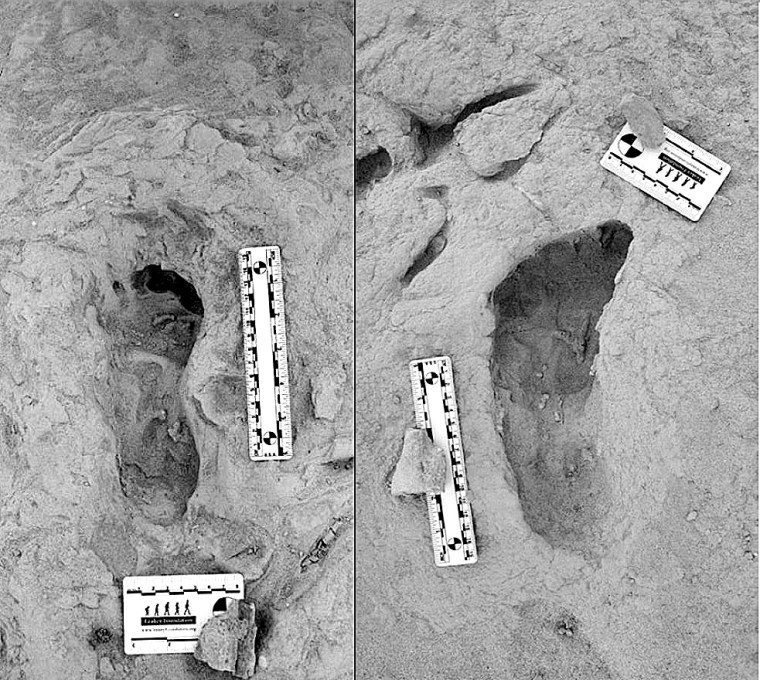
Footprints from Koobi Fora: left – right foot of H. erectus; right – left foot of Paranthropus boisei. Credit: Kevin Hatala. Chatham University

The Koobi Fora area near modern Lake Turkana has been an important, go-to site, courtesy of the Leakey palaeoanthropology dynasty (Louis and Mary, their son and daughter-in-law Richard and Meave, and granddaughter Louise). They discovered five hominin species there dating from 4.2 to 1.4 Ma. So there was a chance that this rich area might prove that two of the species were close neighbours in both space and time. In 2021 Kenyan members of the Turkana Basin Institute based in Nairobi spotted a trackway of human footprints on a bedding surface of sediments that had been deposited about 1.5 Ma ago. Reminiscent of the famous, 2 million years older Laetoli trackway of Australopithecus afarensis in Tanzania, that at Koobi Fora is scientifically just as exciting  for it shows footprints of two hominin species Homo erectus and Paranthropus boisei who had walked through wet mud a few centimetres below the surface of Lake Turkana’s ancient predecessor (Hatala, K.G. and 13 others, 2024. Footprint evidence for locomotive diversity and shared habitats among early Pleistocene hominins. Science, v. 386, p. 1004-1010; DOI: 10.1126/science.ado5275). The trackway is littered with the footprints of large birds and contains evidence of zebra.

One set of prints attributed to H. erectus suggest the heels struck the surface first, then the feet rolled forwards before pushing off with the soles: little different from our own, unshod footprints in mud. They are attributed to H. erectus. The others also show a bipedal gait, but different locomotion. The feet that made them were significantly flatter than ours and had a big toe angled away from the smaller toes. They are so different that no close human relative could have made them. The local fossil record includes paranthropoids (Paranthropus boisei), whose fossil foot bones suggest an individual of that speciesmade those prints. It also turns out that a similar, dual walkers’ pattern was found 40 km away in lake sediments of roughly the same age. The two species cohabited the same terrain for a substantial period of time. As regards the Koobi Fora trackway, it seems the two hominins plodded through the mud only a few hours apart at most: they were neighbours.
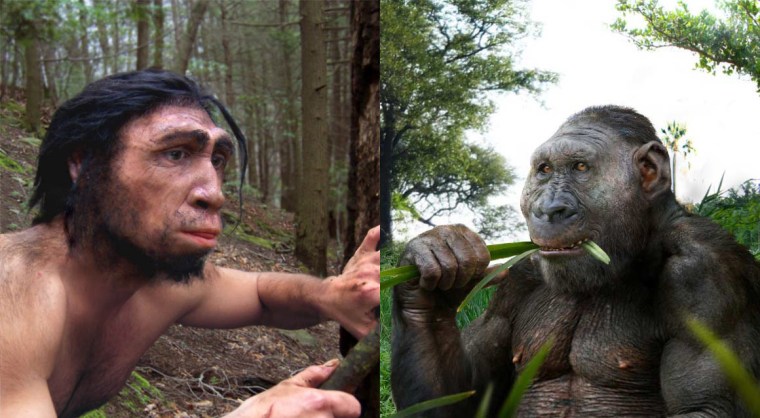
Artists’ reconstructions of: left – H. erectus; right – Paranthropus boisei. Credits: Yale University, Roman Yevseyev respectively

From their respective anatomies they were very different. Homo erectus was, apart from having massive brow ridges, similar to us. Paranthropus boisei had huge jaws and facial muscles attached to a bony skull crest. So how did they get along? The first was probably omnivorous and actively hunted or scavenged meaty prey: a bifacial axe-wielding hunter-gatherer. Paranthropoids seem to have sought and eaten only vegetable victuals, and some sites preserve bone digging sticks. They were not in competition for foodstuffs and there was no reason for mutual intolerance. Yet they were physically so different that intimate social relations were pretty unlikely. Also their brain sizes were very different, that of P. Boisei’s being far smaller than that of H. erectus , which may not have encouraged intellectual discourse. Both persist in the fossil record for a million years or more. Modern humans, Neanderthals and Denisovans, as we know, sometimes got along swimmingly, possibly because they were cognitively very similar and not so different physically.

Since many hominin fossils are associated with riverine and lake-side environments, it is surprising that more trackways than those of Laetoli and Koobi Fora have been found. Perhaps that is because palaeoanthropologists are generally bent on finding bones and tools! Yet trackways show in a very graphic way how animals behave and interrelate with their environment, for example dinosaurs. Now anthropologists have learned how to spot footprint trace fossils that will change, and enrich the human story.

See also: Ashworth, J. Fossil footprints of different ancient humans found together for the first time. Natural History Museum News 28 November 2024; Marshall, M. Ancient footprints show how early human species lived side by side. New Scientist, 28 November 2024

Was the earliest human ancestor a European?

Charles Darwin famously suggested that humans evolved from apes, and since great apes (chimpanzees, bonobos and gorillas) live in Africa he reckoned it was probably there that the human ‘line’ began. Indeed, the mitochondrial DNA of chimpanzees (Pan troglodytes) is the closest to that of living humans. Palaeoanthropology in Africa has established evolutionary steps during the Pleistocene (2.0 to 0.3 Ma) by early members of the genus Homo: H. habilis, H. ergaster, H. erectus; H. heidelbergensis and the earliest H. sapiens. Members of the last three migrated to Eurasia, beginning around 1.8 Ma with the individuals found at Dmanisi in Georgia. The earliest African hominins emerged through the Late Miocene (7.0 to 5.3 Ma): Sahelanthropus tchadensi, Orrorin tugenensis and Ardipthecus kadabba. Through the Pliocene (5.3 to 2.9 Ma) and earliest Pleistocene two very distinct hominin groups appeared: the ‘gracile’ australopithecines (Ardipithecus ramidus; Australopithecus anamensis; Au. afarensis; Au. africanus; Au. sediba) and the ‘robust’ paranthropoids (Paranthropus aethiopicus; P. robustus and P. boisei). The last of the paranthropoids cohabited East Africa with early homo species until around 1.4 Ma. Most of these species have been covered in Earth-logs and an excellent time line of most hominin and early human fossils is hosted by Wikipedia.

All apes, including ourselves, and fossil examples are members of the Family Hominidae (hominids) which refers to the entire world. A Subfamily (Homininae) refers to African apes, with two Tribes. One, the Gorillini, refers to the two living species of gorilla. The other is the Hominini (hominins) that includes chimpanzees, living humans and all fossils believed to be on the evolutionary line to Homo. The Tribe Hominini is defined to have descended from the common ancestor of modern humans and chimps, and evolved only in Africa. As the definition of hominins stands, it excludes other possibilities! The Miocene of Africa before 7.2 Ma ‘goes cold’ as regards the evolution of hominins.  There are, however fossils of other African apes in earlier Miocene strata (8 to 18 Ma) that have been assigned to the Family Hominidae, i.e. hominids, of which more later.

Much has been made of using a ‘molecular clock’ to hint at the length of time since the mtDNA of living humans and chimps began to diverge from their last common ancestor. That is a crude measure at it depends entirely on assuming a fixed rate at which genetic mutation in primates take place. Many factors render it highly uncertain, until ancient DNA is recovered from times before about 400 ka, if ever. The approach suggests a range from 7 to 10 Ma, yet the evolutionary history of chimps based on fossils is practically invisible: the earliest fossil of a member of genus Pan is from the Middle Pleistocene (1.2 to 0.8 Ma) of Kenya. Indeed, we have little if any clue about what such a common ancestor looked like or did. So the course of human evolution relies entirely on the fossil sequence of earlier African hominins and comparing their physical appearances. Each species in the African time line displays two distinctive features. All were bipedal and had small canine teeth.  Modern chimps habitually use knuckle walking except when having to cross waterways. As with virtually all other primates, fossil or living, male chimps have large, threatening canines. In the absence of ancient DNA from fossils older than 0.4 Ma these two features present a practical if crude way of assessing to when and where the hominin time line leads.

In 2002 a Polish geologist on holiday at the beach at Trachilos on Crete discovered a trackway on a bedding plane in shallow-marine Miocene sediments. It had been left by what seems to have been a bipedal hominin. Subsequent research was able to date the footprints to about 6.05 Ma. Though younger than Sahelanthropus, the discovery potentially challenges the exclusivity of hominins to Africa. Unsurprisingly, publication of this tentative interpretation drew negative responses from some quarters. But the discovery helped resurrect the notion that Africa may have been colonised in the Miocene by hominins that had evolved in Europe. That had been hinted at by the 1872 excavation of Oreopithecus bambolii from an Upper Miocene (~7.6 Ma) lignite mine in Tuscany, Italy – a year after publication of Darwin’s The Descent of Man.

Lignites in Tuscany and Sardinia have since yielded many more specimens, so the species is well documented. Oreopithecus could walk on two legs, its hands were capable of a precision grip and it had relatively small canines. Its Wikipedia entry cautiously refers to it as ‘hominid’ – i.e. lumped with all apes to comply with current taxonomic theory (above). In 2019 another fascinating find was made in a clay pit in Bavaria, Germany. Danuvius guggenmosi lived 11.6 Ma ago and fossilised remains of its leg- and arm bones suggested that it could walk on two legs: it too may have been on the hominin line. But no remains of Danuvius’s skull or teeth have been found. There is now an embarrassment of riches as regards Miocene fossil apes from Europe and the Eastern Mediterranean (Sevim-Erol, A. and 8 others 2023. A new ape from Türkiye and the radiation of late Miocene hominines. Nature Communications Biology, v. 6, article  842.; DOI: 10.1038/s42003-023-05210-5). A number of them closely resemble the earliest fossil hominins of Africa, but most predate the hominin record there by several million years.

Phylogenetic links between fossils assigned to Hominidae found in Africa and north of the Mediterranean Sea. (Credit: Sevim-Erol et al. 2023, Fig 5)

Ayla Sevim-Erol of Ankara University, Turkiye and colleagues from Turkiye, Canada and the Netherlands describe a newly identified Miocene genus, Anadoluvius, which they place in the Subfamily Homininae dated to around 8.7 Ma. Fragments of crania and partial male and female mandibles from Anatolia show that its canines were small and comparable with those of younger African hominins, such as Ardipithecus and Australopithecus. But limb bones are yet to be found. Around the size of a large male chimpanzee, Anadoluvius lived in an ecosystem remarkably like the grasslands and dry forests of modern East Africa, with early species of giraffes, wart hogs, rhinos, diverse antelopes, zebras, elephants, porcupines, hyenas and lion-like carnivores. Sevim-Erol et al. have attempted to trace back hominin evolution further than is possible with African fossils. They compare various skeletal features of different fossils and living genera to assess varying degrees of similarity between each genus, applied to 23 genera. These comprised 7 hominids from the African Miocene, 2 early African hominins (Ardipithecus and Orrorin) and 10 Miocene hominids from Europe and the Eastern Mediterranean. They also assessed similarities with 4 living genera, Homo, orang utan (Pongo), gorilla and chimp (Pan).

The resulting phylogeny shows close morphological links within a cluster (green ‘pools’ on diagram) of non-African hominids with the African hominins, gorillas, humans and chimps. There are less-close relations between that cluster and the earlier Miocene hominids of Africa (blue ‘pool’) and the possible phylogeny of orang utans (orange ‘pool’). Sevim-Erol et al. note that African hominins are clearly more similar and perhaps more closely related to the fossils of Europe and the Eastern Mediterranean than they are to Miocene African hominids. This suggests that evolution among the non-African hominids ceased around the end of the Miocene Epoch north of the Mediterranean Sea. But it may have continued in Africa. Somehow, therefore, it became possible late in Miocene times for hominids to migrate from Europe to Africa. Yet the earlier, phylogenetically isolated African hominids seem to have ‘crashed’ at roughly the same time. Such a complex scenario cannot be supported by phylogenetic studies alone: it needs some kind of ecological impetus.

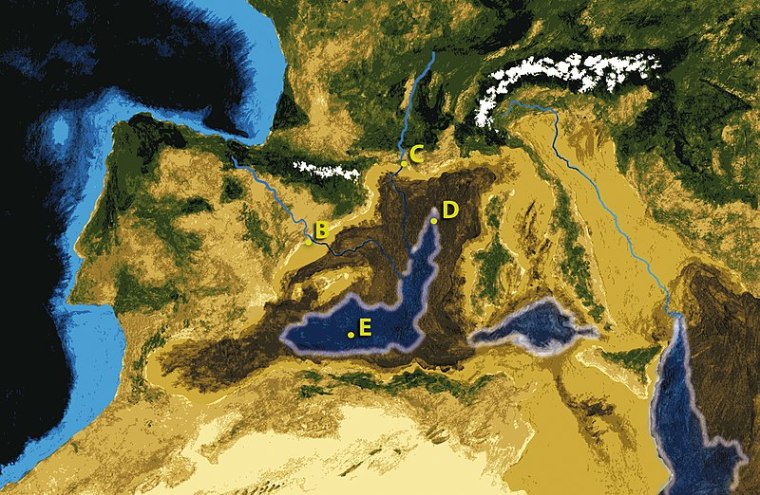
The Mediterranean Basin at the end of the Miocene Epoch when the only water was in the deepest parts of the basin. (Credit: Wikipedia, Creative Commons)

Following a ‘mild’ tectonic collision between the African continent and the Iberian Peninsula during the late Miocene connection between the Atlantic Ocean and the Mediterranean Sea was blocked from 6.0 to 5.3 Ma. Except for its deepest parts, seawater in the Mediterranean evaporated away to leave thick salt deposits. Rivers, such as the Rhône, Danube, Dneiper and Nile, shed sediments into the exposed basin. For 700 ka the basin was a fertile, sub-sea level plain, connecting Europe and North Africa over and E-W distance of 3860 km. There was little to stop the faunas of Eurasia and Africa migrating and intermingling, at a critical period in the evolution of the Family Hominidae. One genus presented with the opportunity was quite possibly the last common ancestor of all the hominins and chimps. The migratory window vanished at the end of the Miocene when what became the Strait of Gibraltar opened at 5.3 to allow Atlantic water. This resulted in the stupendous Zanclean flood with a flow rate about 1,000 times that of the present-day Amazon River. An animation of these events is worth watching

The earliest upright ape

Two decades ago the world of palaeoanthropologists was in turmoil with the publication of an account of a new find in Chad (see: Bonanza time for Bonzo; July 2002). A fossil cranium, dubbed Sahelanthropus tchadensis (nicknamed Toumaï­ or ‘hope of life’ in the Goran language), appeared like a cross between a chimpanzee and an australopithecine. The turmoil erupted partly because of its age: Upper Miocene, around 7 Ma old. Such an antiquity was difficult to reconcile with the then accepted ~5 Ma estimate for the evolutionary split between humans and chimpanzees, based on applying a ‘molecular clock’ approach to the difference between their mtDNA. The other point of contention was the size of Sahelanthropus’s canine teeth: far too large for australopithecines and humans, but more appropriate for a gorilla or chimp.

Cast of the reconstructed skull of Sahelanthropus tchadensis. (Credit: Didier Descouens, University of Toulouse)

In the absence of pelvic- and foot bones, or signs of the foramen magnum where the spinal cord enters the skull – crucial in distinguishing habitual bipedalism or being an obligate quadruped – encouraged the finders of a 6.1 to 5.7 Ma-old Kenyan hominin Orrorin tugenensis to insist that its skeletal remains – several teeth, fragments of a lower jaw, a thigh bone, an upper arm and of a finger and thumb but no cranial bones – were of ‘the earliest human ancestor’. In Orrorin’s favour were smaller canine teeth than those of later australopithecines. At the time of the dispute, centred mainly on absence of crucial evidence, doyen of hominin fossils Bernard Wood of George Washington University and an advocate of ‘untidy’ evolution, suggested that both early species may well have been evolutionary ‘dead ends’ (see: A considered view; October 2002). And there the ‘muddle’ has rested for 20 years.

In 2002 not only a cranium of Sahelanthropus had been unearthed. Three lower jaw bones and a collection of teeth suggested that as many as 5 individuals had been fossilised. A partial leg bone (femur) and three from forearms (ulna) cannot definitely be ascribed to Sahelanthropus but, in the absence of evidence of any other putative hominin species, they may well be. It has taken two decades for these remains to be analysed to a standard acceptable to peer review (Daver, G. et al. 2022. Postcranial evidence of late Miocene hominin bipedalism in Chad. Nature v. 608, published online; DOI: 10.1038/s41586-022-04901-z). The authors present convoluted anatomical evidence that Toumaï­’s femur, which had been gnawed by a porcupine and lacks joints at both ends, suggesting that it was indeed suited to upright walking. Yet the arm bones hint that it may have been equally comfortable in tree canopies. Yet it does look very like an ape rather than a hominin.

Much the same conclusion has been applied to Australopithecus afarensis, indeed its celebrated representative ‘Lucy’ met her end through falling out of a large tree ~3.2 Ma ago (see: Lucy: the australopithecine who fell to Earth?; September 2016). So, dual habitats may have been adopted by hominins long after they emerged. Yet Au afarensis was capable of trudging through mud as witnessed by the famous footprints at Laetoli in Tanzania. Only around 3 Ma has reasonably convincing evidence for upright walking similar to ours been discovered in Au africanus. The full package of signs from pelvis and foot for habitual bipedalism dates to 2 Ma ago in Au sediba. Even this latest known australopithecine seems to have had a gait oddly different from that of members of the genus Homo.

So, in many respects the benefits of full freeing of the hands to develop manipulation of objects, as first suggested by Freidrich Engels, may have had to await the appearance of early humans. Earlier hominins almost certainly did make tools of a kind, but the revolutionary breakthrough associated with humanity was more than 5 million years in the making.

See also: Callaway, E. 2022. Seven-million-year-old femur suggests ancient human relative walked upright. Nature (News)24 August 2022;

Handwerk, B. 2022. Seven Million Years Ago, the Oldest Known Early Human Was Already Walking. Smithsonion Magazine, 24 August 2022 (click the link ‘published today in Nature’ in 2nd paragraph to access complimentary PDF of Daver et al)

Tracing hominin evolution further back

The earliest hominin known from Africa is Sahelanthropus tchadensis, announced in 2002 by Michel Brunet and his team working in 7 Ma old Miocene sediments deposited by the predecessor to Lake Chad in the central Sahara Desert. Only cranial bones were present. From the rear the skull and cranial capacity resembled what might have been regarded as an early relative of chimpanzees. But its face and teeth look very like those of an australopithecine. Sadly, the foramen magnum – where the cranium is attached to the spine – was not well preserved, and leg bones were missing. The position of the first is a clue to posture; forward of the base of the skull would suggest an habitual upright posture, towards the rear being characteristic of knuckle walkers. Some authorities, including Brunet, believe Sahelanthropus may have been upright, but others strongly contest that. The angle of the neck-and-head ball joint of the femur (thigh bone), where the leg is attached to a socket on the pelvis to form the hip joint is a clue to both posture and gait. The earliest clear sign of an upright, bipedal gait is the femur of a fossil primate from Africa – about a million years younger than Sahelanthropus, found in the Tugen Hills of Kenya. Orrorin tugenensis was described from 20 bone fragments, making up: a bit of the other femur, three hand bones; a fragment of the upper arm (humerus); seven teeth; part of the left and right side of a lower jawbone (mandible). Apart from the femur that retains a neck and head and signifies an upright gait, only the teeth offer substantial clues. Orrorin has  a dentition similar to humans apart from ape-like canines but significantly smaller in size – all known hominins lack the large canines, relative to other teeth. Despite being almost 2 Ma older than Ardipithecus ramidus, the first clearly bipedal hominin, Orrorin is more similar to humans than both it and Australopithecus afarensis, Lucy’s species.

Oreopithecus_bambolii_1
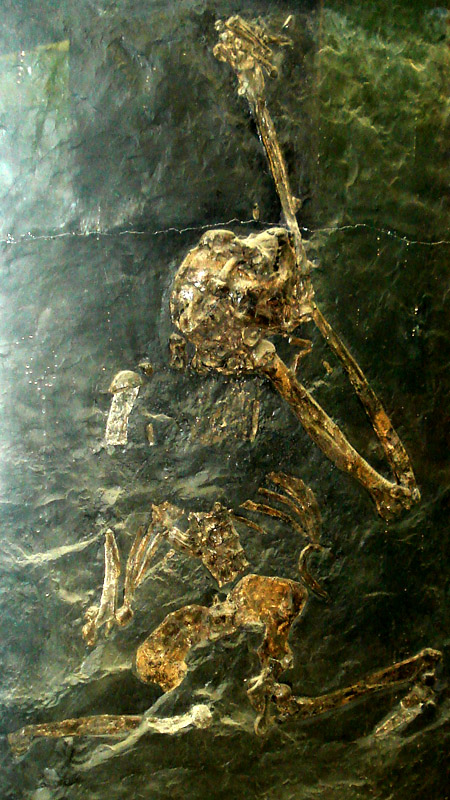
Near-complete skeleton of Oreopithecus bambolii from Italy (credit: Wikipedia Commons)

DNA differences suggest that human evolution split from that of chimpanzees about 12 Ma ago. Yet the earlier Miocene stratigraphy of Africa has yet to provide a shred of evidence for earlier members of either lineage or a plausible last common ancestor of both. In 1872, a year after publication of Charles Darwin’s The Descent of Man parts of an extinct primate were found in Miocene sediments in Tuscany and Sardinia, Italy. In 1950 an almost complete skeleton was unearthed and named Oreopithecus bambolii (see Hominin evolution becoming a thicket, January 2013). Despite dozens of specimens having been found in different localities, the creature was largely ignored in subsequent debate about human origins, until 1990 when it was discovered that not only could Oreopithecus walk on two legs, albeit differently from humans, it had relatively small canine teeth and its hands were like those of hominins, capable of a precision grip. Dated at 7 to 9 Ma, it may lie further back on the descent path of hominins; but it lived in Europe not Africa. Now the plot has thickened, for another primate has emerged from a clay pit in Bavaria, Germany (Böhme, M. and 8 others 2019. A new Miocene ape and locomotion in the ancestor of great apes and humans. Nature, online publication; DOI: 10.1038/s41586-019-1731-0).

Danuvius
Bones from 4 Danuvius guggenmosi individuals. Note the diminutive sizes compared with living apes (Credit: Christoph Jäckle)

Danuvius guggenmosi lived 11.6 Ma ago and its fossilised remains represent four individuals. Both femurs and a tibea (lower leg), together with the upper arm bones are preserved. The femurs and vertebrae strongly suggest that Danuvius could walk on two legs, indeed the vertebral shapes indicate that it had a flexible spine; essential for balance by supporting the weight of the torso over the pelvis. It also had long arms, pointing to its likely hanging in and brachiating through tree canopies. Maybe it had the benefit of two possible lifestyles; arboreal and terrestrial. Its discoverers do not go that far, suggesting that it probably lived entirely in trees using both forms of locomotion in ‘extended limb clambering’. It may not have been alone, another younger European primate found in the Miocene of Hungary, Rudapithecus hungaricus, may also have had similar clambering abilities, as might have Oreopithecus.

There is sure to be a great deal of head scratching among palaeoanthropologists, now that three species of Miocene primate seem – for the moment – to possess  ‘prototype specifications’ for early entrants on the evolutionary path to definite hominins. Questions to be asked are ‘If so, how did any of them cross the geographic barrier to Africa; i.e. the Mediterranean Sea?’, ‘Did the knuckle-walking chimps evolve from a bipedal common ancestor shared with hominins?, ‘Did bipedalism arise several times?’. The first may not have been as difficult as it might seem (see Africa_Europe exchange of faunas in the Late Miocene, July 2013). The Betic Seaway that once separated Iberia from NW Africa, in a similar manner to the modern Straits of Gibraltar, closed during the Miocene after a ‘mild’ tectonic collision that threw up the Betic Cordillera of Southern Spain. Between 5.6 and 5.3 Ma there was a brief ‘window of opportunity’ for the crossing, that ended with one of the most dramtic events in the Cenozoic Era; the Zanclean Flood, when the Atlantic burst through what is now the Straits of Gibraltar cataclysmically to refill the Mediterranean .

See also: Barras, C. 2019. Ancient ape offers clues to evolution of two-legged walking. Nature, v. 575, online; Kivell, T.L. 2019. Fossil ape hints at how walking on two feet evolved. Nature, v. 575, online; DOI: 10.1038/d41586-019-03347-0

Feet of the ancients

Cast of Footprints, Laetoli Museum
Cast of footprints, probably of Au. afrensis, from the famous trackway of Laetoli in Tanzania (Photo credit: GIRLintheCAFE)

Much of what palaeoanthropologists have surmised about the evolution of humans and their hominin forebears has come from fossils of their heads. Crania, jaws and teeth can reveal a lot about human ancestors and related species, and inevitably smart modern humans would dearly like to know how brainy and clever they were and when possible intellectual changes, such as the acquisition of language, might have taken place. But only the rest of the body gives us clues about what they did and potentially might have done. If, like Darwin, and following his lead Frederick Engels (http://www.marxists.org/archive/marx/works/1876/part-played-labour/index.htm), we believe that the single most important development was adopting an upright gait and thereby freeing the hands to manipulate the world, then fossil hands and feet are of very high importance. Yet they are among the most fragile appendages consisting of a great many separate bones, each being small enough to be transported by flowing water once soft tissues decay and a corpse falls apart. And they are easily bitten off by scavengers.  Heads are a lot bigger, heavier and robust, and being round and smooth, quite difficult for, say, a hyena or porcupine to gnaw. Moreover, disaggregated hominin foot and hand bones are not easy to recognise in fossiliferous sediments, especially if they have been scattered far and wide: the big prize being heads jaws and teeth, professional hominin hunters become expert at spotting them, but not necessarily the other 80% of skeletons.

Ardi (Ardipithecus ramidus)
Artists reconstruction of female Ardipithecus ramidus (Photo credit: Mike Licht, NotionsCapital.com)

So, the discovery of hominin hands or feet is a rare cause for celebration. A new partial foot has turned up in the hominin ‘bran-tub’ that is the Afar depression of NE Ethiopia (Haile-Selassie, Y. et al. 2012. A new hominin foot from Ethiopia shows multiple Pliocene bipedal adaptations. Nature, v. 483, p. 565-569) and has caused quite a stir. It is significantly different from the few other feet known from the hominin record. Moreover, it adds a sixth design to those already know, leaving out those of chimps, taken as likely to be similar to those of our shared common ancestor, Homo sapien, Neanderthals and H. erectus whose feet are much the same. While being easily distinguished from the feet of Homo species, those of australopithecines are sufficiently like them in basic morphology to suggest that Au. africanus and sediba both walked the savannas as upright as we do. But one of the earlier hominins, Ardipithecus ramidus, also from Afar but dated at more than 4 Ma, has provided an almost complete foot whose geometry , including a spayed-out, short big toe capable of grasping, almost certainly indicates that the creature was equally at home in trees as it was on the ground. Ardipithecus walked upright, but probably could not run as its gait placed the side of the foot on the ground, much like a chimpanzee, instead of proceeding heel-to-toe as we do (Lieberman, D.E. 2012. Those feet in ancient times. Nature, v. 483, p. 550-551). The new find seems similar, although better adapted for upright walking. Yet no other body parts have been found so it has not been assigned to a species, though it almost certainly represents a new one. The excitement concerns its age, which at 3.4 Ma is within the time range of Australopithecus afarensis, a family of which left the famous trackway at Laetoli in Tanzania whose foot prints strongly suggest full adaptation to human-like gait: walking, running and abandonment of partially habitual life in the trees.

It seems therefore that the multiplicity of co-existing hominins from 2 million years ago to very recently existed much further back in their evolutionary history. That raises several possibilities, among which is the possibility of repeated evolution of bipedality, hinted at by some similarities to the feet of modern gorillas in that of the newly found foot. Another implication is that simply being able to walk upright did not lead quickly to a tool-making ability because the earliest stone tools capable of cutting through meat, skin and sinew did not arise until 2.6 Ma. Like fossils of feet, those of hominin hands are extremely rare. The first crucial evidence of a hand with potential to manipulate objects delicately and with purpose is around 2 Ma, with the astonishingly well preserved hand of a young Au. sediba unearthed in South Africa (http://earth-pages.co.uk/2011/10/12/another-candidate-for-earliest-direct-human-ancestor/). Frustratingly, the 2.6 Ma tools are not associated with fossil hominins, and the Au. sediba skeletons had no tools.