Bibliometrics: the numbers game

In mid-December, British universities, their constituent units and departments, and most academics experienced the same kind of traumatic day familiar to 18-year olds awaiting the examination results on which their advancement to higher education, or not, depended. December 18th, 2014, was REF-Day. Since its predecessor (RAE-Day), 8 years before, a vast – by university standards – effort went into preparing bids on a department-by-department basis to rank them nationally and conflate individual assessments to build a sort of institutional league table for research excellence; hence REF stands for Research Excellence Framework (the RAE was the less meritorious-sounding Research Assessment Exercise). It resembled the Guide Michelin or Automobile Association star system for restaurants and hotels or guest houses. The reason for the 8-year frenzy of activity was that the outcomes aimed to inform the selective allocation of governmental research funding. Unsurprisingly, this kind of competition stemmed from the Tory government of Margaret Thatcher, which in 1986 set the scene for ‘performance-related’ funding rather than that based on peer review of each individual bid for major grants, which preceded it.

To itemise each aspect of the way the REF worked could take the majority of Earth Pages readers to an early and ignoble grave. It centred on departmental selection from its full-time researchers of those who were deemed to be ‘research active’ and those who were not, the former having to select four recently published works or ‘outputs’. They had to self-assess each according to its ‘impact’, defined as ‘an effect on, change or benefit to the economy, society, culture, public policy or services, health, the environment or quality of life, beyond academia’. Institutions vetted and bundled individual submissions, collated them in the subject areas designated by the REF, then sent them off to ‘REF Central’, where they were to be reviewed by subject-specialist panels that gave out the stars for each submitted item of work: **** = world-leading (30% were deemed to be); *** = internationally excellent (46%); ** = recognized internationally (20%); * = recognized nationally (3%); unclassified = below the standard of national recognition (1% – presumably those obviously lacking star quality were weeded out at institution level). There were more than 190 thousand ‘outputs’, which begs the questions; Were all of them read by at least one specialist panel member? Against what standards were they judged?

On average, each of the roughly 1000 panelists would have had to consider about 190 outputs in greater depth than a casual skim, or more if some were read by several panelists. Outputs were rated ‘in terms of their “originality, significance and rigour”, with reference to international research quality standards’, ‘the “reach and significance” of impacts on the economy, society and/or culture’ and the part they played in their department’s contribution to ‘the vitality and sustainability… of the wider discipline or research base’. On paper – and believe me, REF Central produced plenty of wordy PDFs of guidance – this level of scrutiny makes the adjective ‘daunting’ seem a bit of an understatement. Entering into this spirit of things in the gleeful manner of a Michelin or AA assessor does seem to me a bit hard to grasp. I wonder if the panels in reality just checked each submission for signs of an overly hubristic vision of self-worth.

To some extent, the issue of each output’s citation count or other bibliometric measure must at some stage have come into REF reckoning, and here is what spurred me to defy normal cautions about boredom as a contributor to general organ failure. Physicist Reinhard Werner of Leibniz University in Hanover, Germany believes that deciding on funding and hiring, or firing, needs to steer well-clear of impact factors, citations and other kinds of bibliometrics (Werner, R. 2015 The focus on bibliometrics makes papers less useful. Nature, v. 517, p. 245). Scientists cite other works for many reasons, some worthy and some less so. But it is rare that in doing so we express any opinion on the overall significance of the work that we choose to cite. Yet, conversely, a researcher can choose a field, phrase some findings and submit to such and such journal that will boost their citation frequency and impact. Just by writing about some mundane topic in a publicly accessible way, reviewing the work of lots of other people, or simply writing about this or that topic as observed or measured in an especially highly populous country where science is really booming does much the same thing. Werner makes a telling point, ‘When we believe that we will be judged by silly criteria, we will adapt and behave in silly ways’. Although he does not touch on the absurdities of the REF – why on Earth would he? – Werner comments on distortion of the job market, and peer-reviewed journals. He also pleas for a return to proper scrutiny of scientific merit and, I suspect, for cutting hubris off at the roots.

Judging earthquake risk

The early 21st century seems to have been plagued by very powerful earthquakes: 217 greater than Magnitude 7.0; 19 > Magnitude 8.0 and 2 >Magnitude 9.0. Although some lesser seismic events kill, those above M 7.0 have a far greater potential for fatal consequences. Over 700 thousand people have died from their effects: ~20 000 in the 2001 Gujarat earthquake (M 7.7); ~29 000 in 2003 Bam earthquake (M 6.6); ~250 000 in the 2004 Indian Ocean tsunami that stemmed from a M 9.1 earthquake off western Sumatra; ~95 000 in the 2005 Kashmir earthquake (M7.6); ~87 000 in the 2008 Sichuan earthquake (M 7.9); up to 316 000 in the 2010 Haiti earthquake (M 7.0); ~20 000 in the 2011 tsunami that hit NE Japan from the M 9.0 Tohoku earthquake. The 26 December 2004 Indian Ocean tsunamis spelled out the far-reaching risk to populated coastal areas that face oceans prone to seismicity or large coastal landslips, but also the need for warning systems: tsunamis travel far more slowly than seismic waves and , except for directly adjacent areas, there is good chance of escape given a timely alert. Yet, historically http://earthquake.usgs.gov/earthquakes/world/most_destructive.php, deadly risk is most often posed by earthquakes that occur beneath densely populated continental crust. Note that the most publicised earthquake that hit San Francisco in 1906 (at M 7.8) that lies on the world’s best-known fault, the San Andreas, caused between 700 and 3000 fatalities, a sizable proportion of which resulted from the subsequent fire. For continental earthquakes the biggest factor in deadly risk, outside of population density, is that of building standards.

English: A poor neighbourhood shows the damage...
A poor neighbourhood in Port au Prince, Haiti following the 2010 earthquake measuring >7 on the Richter scale. (credit: Wikipedia)

It barely needs stating that earthquakes are due to movement on faults, and these can leave distinct signs at or near to the surface, such as scarps, offsets of linear features such as roads, and broad rises or falls in the land surface. However, if they are due to faulting that does not break the surface – so-called ‘blind’ faults – very little record is left for geologists to analyse. But if it is possible to see actual breaks and shifts exposed by shallow excavations through geologically young materials, as in road cuts or trenches, then it is possible to work out an actual history of movements and their dimensions. It has also become increasingly possible to date the movements precisely using radiometric or luminescence means: a key element in establishing seismic risk is the historic frequency of events on active faults. Some of the most dangerous active faults are those at mountain fronts, such as the Himalaya and the American cordilleras, which often take the form of surface-breaking thrusts that are relative easy to analyse, although little work has been done to date. A notable study is on the West Andean Thrust that breaks cover east of Chile’s capital Santiago with a population of around 6 million (Vargas, G. Et al. 2014. Probing large intraplate earthquakes at the west flank of the Andes. Geology, v. 42, p. 1083-1086). This fault forms a prominent series of scarps in Santiago’s eastern suburbs, but for most of its length along the Andean Front it is ‘blind’. The last highly destructive on-shore earthquake in western South America was due to thrust movement that devastated the western Argentinean city of Mendoza in 1861. But the potential for large intraplate earthquakes is high along the entire west flank of the Andes.

Vargas and colleagues from France and the US excavated a 5 m deep trench through alluvium and colluvium over a distance of 25 m across one of the scarps associated with the San Ramon Thrust. They found excellent evidence of metre-sized displacement of some prominent units within the young sediments, sufficient to detect the effects of two distinct, major earthquakes, each producing horizontal shifts of up to 5 m. Individual sediment strata were dateable using radiocarbon and optically stimulated luminescence techniques. The earlier displacement occurred at around 17-19 ka and the second at about 8 ka. Various methods of estimation of the likely earthquake magnitudes of the displacements yielded values of about M 7.2 to 7.5 for both. That is quite sufficient for devastation of now nearby Santiago and, worryingly, another movement may be likely in the foreseeable future.

Basin and Range: From mountains to basin

The "marching caterpillars" of the Basin and Range province, showing the San Andreas Fault in  (credit: University of Maryland, USA)
The “marching caterpillars” of the Basin and Range province, showing the San Andreas Fault in green (credit: University of Maryland, USA)

The Basin and Range province of the western US is one of the world’s largest products of continental extension. Being semi-arid, sedimentation has been unable to keep pace with crustal thinning thereby giving form to its name: linear mountain ridges separated by sediment-filled basins. Despite the extreme extension the Basin and Range has an average elevation of about 1400 m, although it is well below that of the Sierra Nevada range (2000+ m) that flanks it to the west. Throughout the Mesozoic, subduction towards the east beneath the North American plate produced voluminous magmas and fold-thrust belts adding to the continental crust in a manner similar to that still occurring in the South American Andes. Extension began in earnest during the Eocene (~45 Ma) and continues today. Much of the theory regarding continental extension – listric normal faults and detachments, fault-tilt blocks, core complexes etc. – stems from studies in this huge terrain. As regards the evolution of the Basin and Range, it has been widely thought that by the Late Oligocene (~25 Ma) the thickened Cordilleran crust had been reduced to a plateau no higher than the present Sierra Nevada, which subsequent extension reduced to the present Basin and Range.

The Eocene to Miocene extensional history was punctuated by huge episodes of explosive volcanism from which hot ash flowed laterally for hundreds of kilometres, relics of which are still widespread. Such ignimbrites are often very porous and were aquifers while still exposed, until buried by sediment and subsequent nuée ardent flows. Groundwater at the time of first exposure altered the volcanic glass shards from which ignimbrites are formed, so that the oxygen and hydrogen making up what was originally rainwater is now locked in the altered ash flows. The hydrogen isotopic composition of such meteoric water is known to vary with the altitude of the clouds shedding it. Water containing the heavier hydrogen isotope deuterium (D) is preferentially precipitated at low altitudes, so that high altitude rainfall is significantly depleted in it. Because of this the alteration can give clues to the former topographic elevation of the ignimbrites when they first rushed across the land surface. Applying this method to the repeated ignimbrite events in what is now the Basin and Range has given a good idea of the actual evolution of the land surface in the western US during the Palaeogene (Cassel, E.J. et al. 2014. Profile of a paleo-orogen: high topography across the present-day Basin and Range from 40-23 Ma. Geology, v. 42, p. 1007-1010).

The results present a major surprise. In the Eocene, elevation across the area was, as anticipated, a little more than the present Sierra Nevada (2000-2500 m). This fell back to roughly 2000 m, again as theory would suggest. But by the Late Oligocene (23-27 Ma) elevation expected to have declined further over the Basin and Range actually leapt to between 2500-3500 m, up to 2.1 km higher than it is today: the opposite of prediction. Effectively, despite evidence for Palaeogene extension the crust was buoyed-up probably by an upwelling of the asthenosphere and increased heat flow. The unexpected uplift occurred towards the end of subduction of oceanic lithosphere beneath western North America, the dynamics of which prevented the westward collapse of an earlier orogen. When subduction ended and the plate-margin tectonics became strike slip, as witnessed by the San Andreas Fault, the continental crust slid apart in the manner of books on a library shelf if a bookend is removed.

Johnson, S.K. 2015. From rain to ranges. Scientific American, v. 312 (January 2015), p. 12-13.

Art from half a million years ago

original fossils of Pithecanthropus erectus (n...
Original fossils of Pithecanthropus erectus (now Homo erectus) found By Eugene Dubois in Java in 1891 (credit: Wikipedia)

Eugene Dubois, an anatomist at the University of Amsterdam in the late 19th century, became enthralled by an idea that humans had evolved in what is now Indonesia, contrary to Charles Darwin’s suggestion of an African origin. So much so that Dubois took the extraordinary step of joining the Dutch army and scrounging a posting to the Dutch East Indies to facilitate his search for a ‘missing link’, accompanied by his wife and newborn daughter. After a four-year quest, in 1891 he discovered the upper cranium and brow of a being that was obviously related to us, but also quite distinct as regards its beetling brow ridges. Pithecanthropus erectus (now Homo erectus) raised a storm of controversy, sadly only resolved in Dubois’s favour after his death in 1940. Yet, as well as mounting the first deliberate search for human ancestors, Dubois collected everything possible in the sediments at Trinil, Java, so in a sense he was also an early palaeoecologist. The collection gathered dust in Leiden for the best part of a century, until archaeologist Josephine Joordens of the University of Leiden took on the task of reviewing its contents in 2007 (Joordens, J.C.A. and 20 others 2014. Homo erectus at Trinil on Java used shells for tool production and engraving. Nature (on-line): doi:10.1038/nature13962).

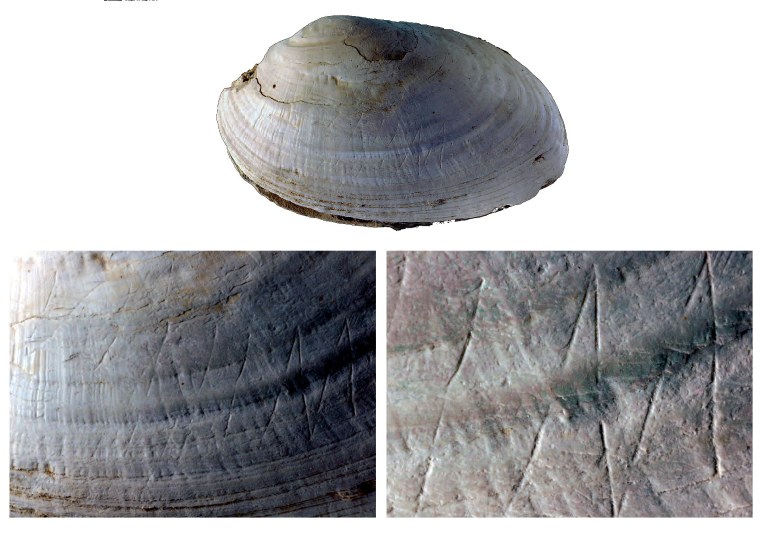
Progressively enlarged views of freshwater clam from Eugene Dubois's collecti9on from Trimil, showing clear evidence of deliberate engraving. (credit: Joordens et al., 2014 in Nature; photos by Wim Lustenhouwer, VU University Amsterdam
Progressively enlarged views of freshwater clam from Eugene Dubois’s collection from Trinil, showing clear evidence of deliberate engraving. (credit: Joordens et al., 2014 in Nature; photos by Wim Lustenhouwer, VU University Amsterdam)

Homo erectus clearly had a taste for freshwater clams and lots of their shells figure in the Trinil collection: all are of similar large size rather than showing a wide variation according to age, suggesting a shell midden rather than a natural assemblage. A piece of serendipity revealed what may prove to be the anthropological find of the year. High-quality photos of the shells taken by a visiting mollusc specialist showed up evidence that one of them had been meticulously engraved. Its surface had a near-perfectly geometric, zig-zag pattern deeply gouged by someone with a steady hand, who probably used an associated shark’s tooth as a scribing tool. Since the molluscs in life bear a dark, chitinous veneer the etching would have been more striking when freshly made. Another of these sturdy shells also show signs of having had its edge sharpened, suggesting that they were used for tools such as scrapers or graters.

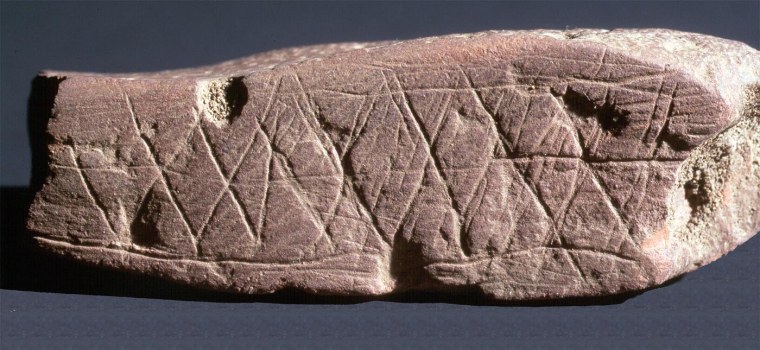
The stratigraphy at Trinil suggested that the engraved shell and tools were coeval with Homo erectus, but that needed proof. Using sediment grains trapped in the shells and a combination of 40Ar/39Ar and thermoluminescence dating, the team have shown that they and the human fossils from Trinil date to between 430 and 540 thousand years ago: at least 350 ka older than the very similar engravings made by an anatomically modern human on ochre that was found at Blombos Cave in South Africa. The next-oldest putative artwork is the controversial ‘Venus’ found at Berekhat Ram on the Israel-Syria border, dated between 250 and 280 ka.

Engraved ochre from Blombos Cave, South Africa. (credit Chris Henshilwood)
Engraved ochre from Blombos Cave, South Africa. (credit: Chris Henshilwood)

Probably the majority of palaeoanthropologists have dismissed humans other than ­H. sapiens as being cognitively incapable of either abstract or figurative art. The general view is that the mental capacity to create art or design began with the creation of the Blombos engraving, was restricted to anatomically modern humans and only exploded in Europe after they had migrated there by about 40 ka. A few argue that portable art, such as the Trinil and Blombos engravings, is bound by its very nature to be rare and easily overlooked. Whether having some use – counting? – merely being the making of an idle ‘doodle’ or expressing some unknowable ritual significance, the Trinil etching is a result of creativity and controlled skill that could only be the product of the H. erectus mind. Moreover, the very close comparison with the 0.35 Ma younger Blombos engraving suggests the product of a consciousness little different from that of our direct ancestors of 75 ka ago.

Are modern humans ‘domesticated’?

While animals, especially dogs, underwent domestication the deliberate or unconscious human choice of favoured physiological and behavioural traits produced distinct differences between the ancestral species and the ‘breeds’ with which we are now familiar. In general domestication has resulted in dogs with reduced jaws and flatter faces, lower aggression, especially in the case of males, and reduced stressfulness in the company of humans and other tame dogs compared with their wolf ancestors. It is widely accepted that cats have ‘tamed themselves’ through the adoption of lifestyles associated with the benefits of close association with human communities, which have resulted in similar adaptations to those in more deliberately domesticated dogs. It is beginning to dawn on anthropologists that human social evolution may unwittingly have affected the course of our own evolution. Tighter social bonding among growing sizes of communities as brain capacity increased and the behavioural and cognitive attributes needed for that have been summarised recently by a group associated with the Social Brain hypothesis of Robin Dunbar of Oxford University, UK (Gamble, C., Gowlett, J. & Dunbar, R.I.M. 2014. Thinking Big: How the Evolution of Social Life Shaped the Human Mind. ISBN-13: 978-0500051801;Thames and Hudson: London).

It was Charles Darwin who first speculated that ‘Man in many respects may be compared with those animals which have long been domesticated’. But to what extent does the hominin fossil record support such a view? Collaborators from Duke University and the University of Iowa, USA, have set out to analyse physiological changes over the last 200 ka that may be explained in this way (Cieri, R.L. et al. 2014. Craniofacial feminization,social tolerance and the origins of behavioural modernity. Current Anthropology, v. 55, p. 419-443. Includes discussion and responses). They used the degree of projection of brow ridges, facial shape and cranial volume from 3 groups of Homo sapiens remains: skulls older than 80 ka (13 specimens); spanning 38 to 80 ka (41) and from recent humans (1367). They found that brow ridges shrank significantly over the last 80 thousand years, faces shortened and cranial capacity decreased, especially among males. This resulted in a convergence in appearance between males and females, which the authors attributed to general lowering of testosterone and stress hormone levels through selection for greater social tolerance: akin to similar physiognomic changes in domesticated dogs which DNA analyses have shown to be been linked with modification of genes associated with aggression regulation. The finding among dogs suggests that their domestication is accomplished by slower development; i.e. young animals are naturally less fearful and have a greater tendency to taming. This delayed development from foetus to adulthood, with retention in mature individuals of juvenile characteristics, is known as neoteny, and affects all manner of adult characteristics, including coloration, snout length and the adrenal glands: as adult dogs now more resemble wolf pups, so human adults are more like young chimps than elders. At a conference where Cieri et al.’s results were presented, it was observed that hunter gatherer bands are intolerant, to the point of capital punishment, of wife stealers, murderers and seriously dishonest men, whereas such reactions fall off significantly among members of larger social groups involved in agriculture and urban life. Such modern behavioural patterns tally with brow ridge, face length and cranial capacity, perhaps linked with selection for personalities more attuned to cooperation.

English: comparison of Neanderthal and Modern ...
Comparison of Neanderthal and Modern human skulls from the Cleveland Museum of Natural History (credit: Wikipedia)

Although earlier human species, such as H. neanderthalensis, heidelbergensis and erectus had significantly different skull anatomy, each had prominent brow ridges that, on this account, may signify both greater exposure to testosterone and less social tolerance, and smaller group sizes. But, so far, analysis of the Neanderthal genome has not led to publication of any comments about testosterone or stress-hormone related genes. However, a clear strand of discussion is developing around evidence rather than mere speculation about psychological/cognitive aspects of human evolution that challenges the old-style ‘what-you-see-is-what-there-was’ (WYSWTW) archaeological dogma: a dialectic of social and biological relationships.

November Picture of the Month

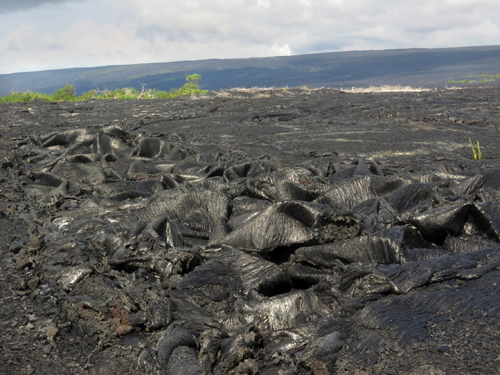
If any technical terms are likely to be remembered by anyone exposed to a bit of geological education, amongst them will be two that are Hawaiian Polynesian words: pahoehoe (‘pa hoy hoy’) and aa (‘a ah’). The first slides around the palate wonderfully while the latter give a sort of worrisome feel as if a large weight is about to land on one’s toes. Aa is lava with a blocky, broken and jagged surface, whereas pahoehoe refers to lava with the appearance of a freshly set torrent of toffee. November’s Picture of the Month is of basaltic lava that looks like it is chewable.

Pahoehoe lava from the Big Island of Hawaii. (Credit: Mila Zinkova)


Place your bets for a chance of posterity on Lunar Mission One

When I learned about the unveiling of Lunar Mission One (LM1) , a few days after the global excitement about ESA’a Rosetta mission following Philae’s 12 November 2014 landing on a far-distant comet and success with its core experiments, it did cross my mind that here was a bit of a let-down in PR terms. There’s an old saying – ‘What can follow the Lord Mayor’s Show?’ – and the thrill of Philae’s landing rivalled any of the events at the 2012 London Olympics, plus the science it and Rosetta promise is likely to be about as leading-edge as it will get for quite some time. So what does LM1 offer that might achieve a similar scoop, and indeed your prospect of virtual immortality?

Unlike NASA or ESA missions, LM1 is to be a crowd-funded private enterprise by Lunar Missions Ltd, and for that the subscribers will want something in exchange. Through Kickstarter anyone can have a punt to help raise the initial £600 thousand goal by midnight on 17 December. Apparently that sum is to fund 3 years full-time work by a professional management team to raise further mission funds from commercial partners to take the project further: it will cost at least £0.5 billion. At this stage you can pledge any sum you wish, but what you get in return depends on your generosity. Highlights are: for £3 to 15 the reward is ‘Our eternal thanks and a place in space history’; >£15 gets you a certificate and a place in an online ‘wall of thanks’; >£30 escalates to your name being included in a digital ‘time capsule’ taken to the Moon and buried, plus membership of the Lunar Missions Club; >£60 entitles you to a voucher to invest in your own digital ‘memory box’ to go in the capsule – one of ‘millions and millions’ – and a vote on key decisions; for >£300 you can ‘Meet the Team’; >£600 gets you annual meetings and a chance to ballot for the landing module’s name; for higher contributions there are invitations to the launch (>£1200), sealing of the digital archive capsule and your name engraved on the lander (>£3000); and – wait for it – you get a place in the viewing gallery at Mission Control if you can stump up more than £5000.

For those contributing £60 or more, what goes in the much vaunted digital ‘Memory Box’ is on a sliding scale, from the equivalent of a text message to a strand of your hair and the DNA in it. One catch, if you are thinking of resurrection, is that it will be at the bottom of a 5 cm diameter hole at least 20 m deep. The buried digital archive will also contain a record of all living species on Earth and the entire history of humankind to date, but a continually updated copy will also be freely available online. Wikipedia seems not to be associated for some reason, but every item in this public archive will be peer-reviewed through an editorial board to whose deliberations schools, colleges and universities can contribute. The buried, multi-Terabyte, digital capsule is said to have a life of perhaps a billion years. Currently the longest lived data storage (~1500 years) is still ink on vellum, whereas the most advanced static and optical digital media are estimated to have a maximum 100 year lifetime, subject to technical obsolescence. On the plus side, privacy is guaranteed, partly by the nature of the storage. So, for £10000 Joe and Josie Soap will figure on a kind of cenotaph but who- or whatever digs up the module will learn absolutely nothing about them and but conceivably could clone them from their anonymous strands of hair.

What are the science goals for an LM1 landing scheduled for 2024 that cannot be achieved by lunar-lander and sample-return missions currently under state-funded development by China, Russia, NASA, Japan and India before LM1 reaches the ‘Go/No Go’ stage? The landing is planned for the Moon’s South Pole, on the rim of a major crater. There, LM1 will drill a hole to between 20-100 m deep, using a maximum of 1 kW of solar power – this ‘will also be a major leap forward for safer and more efficient remote drilling on Earth’: make of that claim what you will. Such a hole is said to enable sampling of pristine lunar rock in 15 cm lengths of 2.5 cm diameter core through the debris of the impact that caused the crater. The core samples are to be chemically analysed in the lander to test the hypothesis that Earth and Moon shared their origins. Future missions may pick up the cores and return them for more detailed analysis on Earth. But consider this: the oldest rocks known from the Apollo programme are approximately 4.4 billion year-old, feldspar-rich anorthosites that are thought to have formed the lunar highlands through fractional crystallisation of an early magma ocean that immediately followed Moon formation. Any unfractionated lunar material is only likely, if at all, at far greater depths than 20 m, and none was found or even suggested among the 0.4 tonnes of samples returned by the Apollo missions, which have been repeatedly analysed using advanced instruments. Indeed, near-surface debris from a crater rim is unlikely to be any more diverse lithologically than the various kinds of lunar surface from which the Apollo samples were collected, and may be contaminated by whatever caused the cratering and by the immense, long-lived heating at the impact site itself.

filedesc Lunar Ferroan Anorthosite #60025 (Pla...
Lunar Ferroan Anorthosite #60025 (Plagioclase Feldspar). Collected by Apollo 16 from the Lunar Highlands near Descartes Crater. (credit: National Museum of Natural History in Washington, D.C.)

Compared with the prospect of advancing understanding of the origins of life and the Earth’s oceans, and the early stages of Solar System evolution from data provided by Rosetta and Philae, LM1 might seem less exciting, though the buzz being hyped is that it would be a People’s Mission. Yet those who place their punt on it and the commercial concerns that ultimately earn from it are two different sets of people. The ambitious global education wing will, of course, face competition from the growth of MOOCs in the science, technology, engineering and maths area that have a considerable head start, but it does have a noble ring to it. Whatever, if you make a pledge before midnight on 17 December this year and the ‘pump-priming’ target is not met by then, you pay nothing. If £600 thousand is raised there is no going back and only 10 years to wait. But what a challenge, you may well think… LM1 definitely has the edge over Virgin Galactica, but here on Earth there are probably a great many more vital challenges than either.

A supervolcano’s plumbing system

What was the most devastating natural disaster ever to face humans? It would be tempting to suggest the Indian Ocean tsunami of 26 December 2004, but that is because most people remember it with horror. In fact the worst the Earth ever flung at us was much further back in our history and left a huge spike of sulfates in the Greenland icecap at around 73 thousand years ago. This relic of volcanic aerosols that had blasted into the stratosphere was tracked back to a 100 by 30 km caldera in Sumatra now occupied by a lake (Lake Toba) that is 500 m deep in places and almost filled by a slightly off-centre island. The eruption explosively ejected 2800 cubic kilometres of magma, of which an estimated 800 km3 fell as ash across a wide swath of the tropics westwards of Sumatra at least as far as Arabia and East Africa; the line of march taken by anatomically modern humans migrating from Africa. In India and Malaysia the Toba ash layer reaches 5-10 m thickness and probably occurs undetected as a thin layer across the entire tropics. Around 1010 tonnes of sulfuric acid belched out, some to enter and linger in the stratosphere, which is estimated to have caused an average decrease in average global temperatures of 3.0 to 3.5 °C for several years. Studies of human mtDNA hint at a genetic bottleneck around the time of Toba’s eruption and a large decrease, perhaps as much as 60%, in the global population of Homo sapiens. But humans survived or quickly filled devastated land in India, where stone tools are found both below and just above the Toba ash layer.

Landsat image of Lake Toba, the largest volcan...
Landsat image (120 km across) of Lake Toba, the largest volcanic crater lake in the world. (credit: Wikipedia)

The largest volcanic eruption in the last 26 Ma, there can be little doubt that no other natural catastrophe had as large an influence on humanity as did Toba. Of course, slower processes such as climate change and ups and downs of sea level lay behind the repeated spread of humans out of Africa and probably their evolution as a whole. The drama of the Toba event has drawn attention to the massive risk posed by supervolcanoes in general, such as that centred on Yellowstone in the NW US, which show signs of activity 640 ka after its last major explosive event. Toba certainly is not dead, for its peculiar island of Samosir has been uplifted steadily since the eruption by about 450 m, probably due to influx of magma deep beneath the surface, and experiences shallow earthquakes. What lies in the guts of supervolcanoes is literally a hot topic and a new 3-D imaging method has been applied to Toba.

English: Batak village on Samosir island, Lake...
Traditional village on Samosir island, Lake Toba. (credit: Wikipedia)

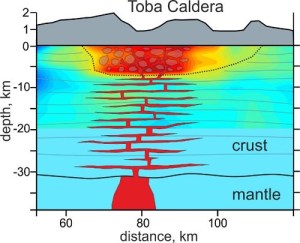
Seismic tomography that uses background or ambient seismic noise has become a powerful technique for studying the crust and lithosphere when small-amplitude short-wavelength Rayleigh and Love surface waves are monitored to pick up subsurface reflecting bodies and measure variation in wave speed with depth. The greater the density of seismometers deployed, the finer the resolution of deep crustal features and 40 such detectors are in place around Lake Toba. A team of Russian, French and German geophysicists have reported new results bearing on how magma may be accumulating beneath the vast caldera (Jaxibulatov, K. et al. 2014. A large magmatic sill complex beneath the Toba caldera. Science, v. 346, p. 617-619). Down to about 7 km the tomography has picked up a structurally homogeneous low-speed zone directly beneath Samosir Island that the authors attribute to the 73 ka explosive eruption. Beneath that several magma sills appear to dominate the sub-caldera crust, possibly responsible for the post eruption uplift within the caldera: the precursor to a layered intrusive body and each an increment towards a further huge eruption.

Interpretation of seismic tomography cross section of Toba. Greens to reds increasingly negative shear speed anomaly. Showing magma sills in lower crust and 74 ka damage zone above 7 km. (credit: Jaxibulatov et al. 2014

October 2014 picture

The 1200 m Montserrat mountains in Catalonia, NE Spain (credit: Xavier Varela)

The Montserrat mountains are part of the Pre-Coastal Range of Catalonia in Spain and rise close to the capital Barcelona to form a spectacular backdrop.

https://i0.wp.com/upload.wikimedia.org/wikipedia/commons/c/cd/Montserrat_des_de_Manresa.JPG

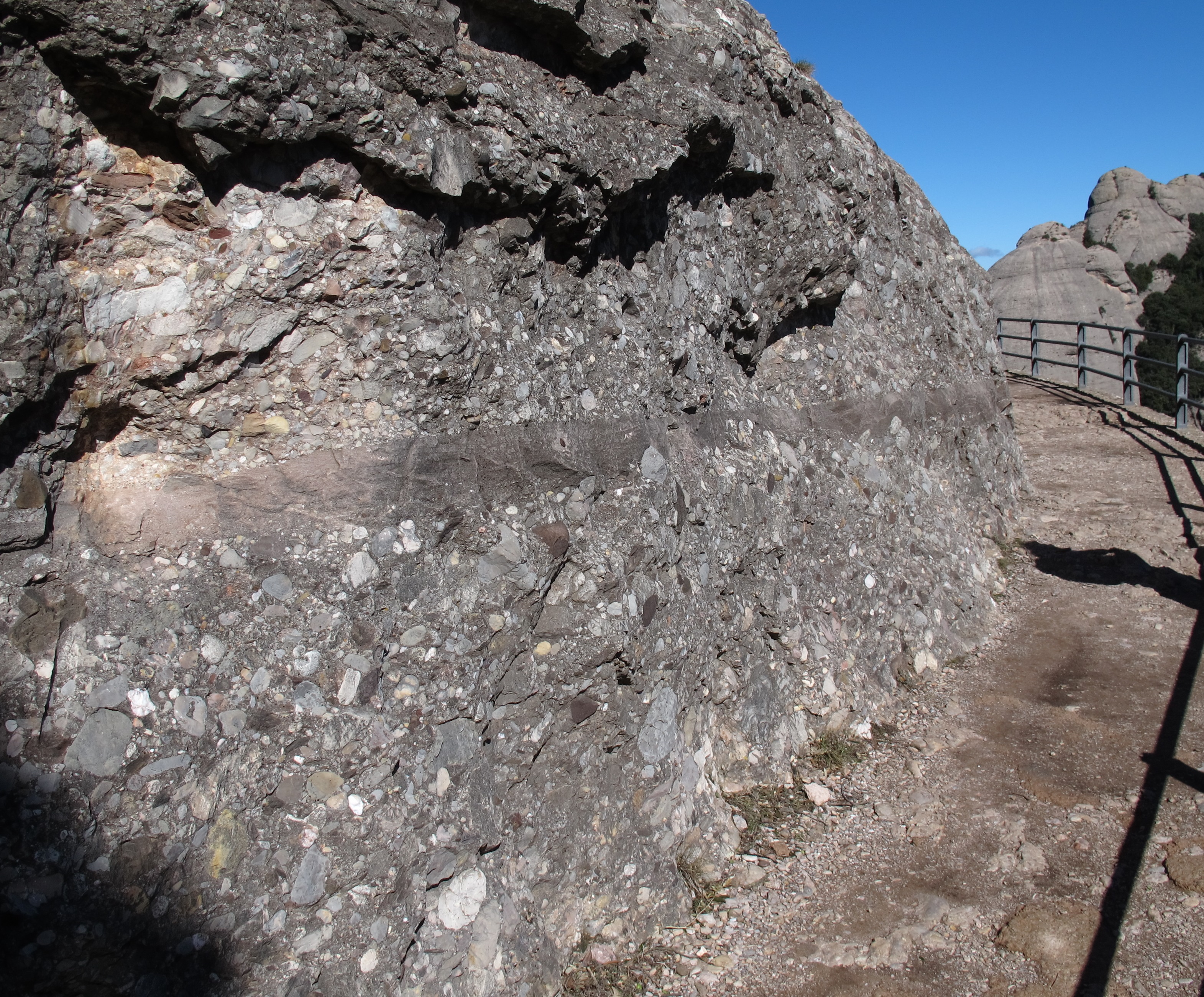
Their peculiar pinnacled form results from their comprising tough, well-cemented thick conglomerates, pink in colour and having formed in an early Cenozoic delta. The conglomerates are in very thick, homogeneous beds riven by vertical joints. These two features control the serrated and pinnacled topography, from which is derived the ranges’ Catalan name.

https://i0.wp.com/upload.wikimedia.org/wikipedia/commons/4/4c/Montserrat_cgl_with_sst_layer.jpg
Cenozoic conglomerates of the Monserrat mountains, Catalonia (credit: Wikipedia)

Human evolution news

Since discovery of its fossilised remains in Liang Bua cave on the Indonesian island of Flores was discovered in 2004 the diminutive Homo floresienesis, dubbed the ‘hobbit’ by the media, has remained a popular news item each time controversies surrounding it have flared. To mark the tenth anniversary  of its publication of a paper describing the remains Nature has summarised the recollections of many of those involved in trying to understand the significance of H. floresiensis (Callaway, E. 2014. Tales of the hobbit. Nature, v. 514, p. 422-426). Two main schools of thought continue in dispute, one holding that it is anatomically so different from anatomically modern humans and earlier members of the genus Homo that it constitutes a new species, despite its youngest member dating back only 18 ka, the other that it is H. sapiens, its tiny size having resulted from some kind of genetic disorder, such as microcephaly or Down’s syndrome. There have been so many attempts to expunge the idea of such an odd fossil cohabiting an island with fully modern humans yet being a different and perhaps extremely archaic species that such an outlook itself seems somewhat pathological.

English: Homo floresiensis, replica Deutsch: H...
Replica of the Homo floresiensis skull from Liang Bua cave, Flores, Indonesia (credit: Wikipedia)

The evidence presented to force H. floresiensis into a deformed human mould has never been convincing, and the best way of combating that view is to document from a ‘non-combatant ‘standpoint the many ways in which its anatomy differs from ours and how it might have arisen; a job to which Chris Stringer of the Museum of Natural History in London is amply qualified (Stringer, S. 2014. Small remains still pose big problems. Nature, v. 514, p. 427-429). He, like the original discoverers, feels this is a case of evolution of small stature due to a limited population being isolated for a long time on a relatively small island, which is just what happened to elephants that colonised Flores to become the pigmy Stegodon that H. floresiensis seemingly hunted. These tiny Flores dwellers (adults were about 1 m tall) used fire and made tools, similar ones dating as far back as ~1 Ma. Stringer mentions the possibility of first human colonisation about that time by Asian H. erectus but also the view that if it happened once there may have been several waves of immigration to Flores. The unusual ‘hobbit’ anatomy is not restricted to tiny size and a small skull and brain cavity (400 cm3), but includes odd hips, wrist bones, shoulder joint and collar bone. In fact the remains bear as much or more resemblance to australopithecines like ‘Lucy’ (3.2 Ma) than to other members of our genus, even H. erectus that has been proposed as its possible ancestor. Could they be far-travelled descendants of the 1.8 Ma old H. georgicus from Dmanisi in Georgia? More fossils clearly need to be found, and Stringer raises the possibility of the search being widened to other islands east of Java, such as Sulawesi, the Philippines and Timor. He hints that in such a tectonically active region tsunamis may have led to animals and humans saving themselves and then being current dispersed on rafts of broken vegetation, rather like some survivors of the 2004 Indian Ocean tsunami who ended up 150 miles from their homes by such a means.

Another story that is set to ‘run and run’ is that of ‘alien’ DNA in the human genome and productive relations between early out-of-Africa migrants with Neanderthals, Denisovans and perhaps yet a mysterious, earlier human species. The oldest (45 ka) anatomically modern human genome sequence so far charted is from a leg bone found by a mammoth-ivory prospector in Siberian permafrost (Fu, Q. and 27 others 2014. Genome sequence of a 45,000-year-old modern human from western Siberia. Nature, v. 514, p. 445-449). Like a great many living non-Africans this individual carried about 2 % Neanderthal DNA, but unlike living people the 45 ka genome has it in significantly longer segments. That allowed the authors to re-estimate the timing of the genetic flow from Neanderthals into the individual’s ancestors. Previous estimates from living DNA geve the possibility of that being between 37-86 ka, but this closer data suggests that it happened between 7 to 13 ka before the date of the fossil femur, i.e. narrowing it down to between 52 and 58 ka closer to the widely suggested time of African exodus around 60 ka (but see an Earth Pages item from September 2014)

More on human evolution here and here