Continental comfort blanket

Way back in the mists of time, say around 1970-71, an idea was doing the rounds that because the thermal conductivity of continental crust is lower than that of the ocean floor it should allow thermal energy to build up in the mantle beneath. In turn that might somehow encourage the formation of hot spots and a shallower depth to the asthenosphere: the outcome might be to encourage rifting of weakened lithosphere and ultimately a new round of sea-floor spreading. The case often cited was the Atlantic – North and South – since there are eight hotspots currently on the mid-Atlantic ridge. Africa was another popularised case with a great many broad domes associated with Cenozoic volcanism, and the link between formation of the East African Rift System, hot spots and doming had already been suggested. Africa has barely drifted for around 100 Ma and the domes were supposed to have formed by the build up of heat in the mantle beneath. Geoscience moved on to clearly demonstrate the coincidence of large igneous provinces and flood basalt volcanism with the initiation of Atlantic spreading in the form of the Central Atlantic and Brito-Arctic LIPs during initial opening of the South and North Atlantic at the end of the Triassic and during the Palaeocene respectively. But the role of continental insulation became a bit of backwater compared with notions of mantle plumes emanating at the core-mantle boundary. Well, it’s back.

Divergent plate boundary: Mid-Atlantic Ridge
The Mid-Atlantic Ridge (credit: Wikipedia)

There is now a vast repository of ocean-floor lavas that formed at mid-ocean ridges in the past, thanks to the international Deep Sea and Ocean Drilling Programmes begun in 1968 about when the heyday of plate tectonics really got underway. In the last 45 years there have also been great advances in igneous geochemistry and its interpretation, including relations with mantle melting temperatures. Geochemists at the Friedrich-Alexander-Universiteit in Erlangen, Germany have re-examined the major-element geochemistry of 184 glassy ocean-floor basalts from drill sites of different ages on the floor of the Atlantic Ocean and compared them with 157 from the Pacific. To avoid the possible influence of plume-related heating, the sites were chosen well away from the tracks of existing hot spots. Mantle temperature can be assessed from the sodium and iron content of basalts, Na decreasing with higher temperatures and Fe doing the reverse (Brandl, P.A. et al. 2013. High mantle temperatures following rifting cause by continental insulation. Nature Geoscience, v. 6, p. 391-394). Atlantic samples show increasing Na and decreasing Fe contents in progressively younger basalts, i.e. a trend with time of decreasing mantle temperature such that the oldest (~166 Ma) record 150°C higher mantle temperature than the youngest, with a similar result for the Indian Ocean floor. No such trend is present in samples from the same age range of the Pacific Ocean floor. At around 170 Ma the mid-Atlantic Ridge was close to the continental lithosphere of the Americas and Africa, whereas the East Pacific Rise was at least 2000 km from any continental margin. Younger Atlantic samples formed progressively further from its shores record cooling of the mantle source.
A prediction of the model is that the converse, continental accretion to form supercontinents such as Pangaea, should rapidly have caused considerable warming in the mantle beneath them. This suggests that the formation of supercontinents, or even less substantial continents, should carry the seeds of their re-fragmentation, as Africa is currently demonstrating by the separation of Arabia since the Red Sea began to open some 15 Ma ago, which Somalia and much of eastern Kenya and Tanzania seem destined to follow once the East African Rift System ‘gets steam up’.

  • Langmuir, C. 2013. Older and hotter. Nature Geoscience, v. 6, p. 332-333

Cordilleran terrane accretion in western North America

One of the key areas for unravelling the range of tectonic processes involved in the assembly of continents lies in the Western Cordillera of North America, made up of dozens of slivers of mutually exotic terranes. Their exposed upper parts remain largely intact and are dateable using fossils or radiometric dating. Through assiduous palaeomagnetic research it is sometimes possible to chart their motions over time to see the manner in which they approached and collided with one another. Geoscientists are now able to link such a complex process with underlying tectonics, not by inference but through direct seismological observation of the remains of subducted slabs in the mantle deep beneath.

sigloch
The crumpled Farallon Plate beneath North America, colours showing different depths in the mantle (credit: Karin Sigloch)

This item can be read in full at Earth-logs in the Tectonics archive for 2013

Birth of a plate boundary rocks the planet

English: Historical seismicity across the Sund...
Historical seismicity across the Sunda trench(credit: Wikipedia)

Few people will fail to remember the Indian Ocean tsunamis of 26 December 2004 because of their quarter-million death toll. The earthquake responsible for them resulted from thrusting movements on the subduction zone where part of the India-Australia plate descends beneath Sumatra. There have been some equally large but far less devastating events and many lesser earthquakes in the same region since. Some have been on the massive Wadati-Benioff zone but many, including two with magnitudes >8 in April 2012, have occurred well off the known plate boundary. Oddly, those two had strike-slip motions and were the largest such events since seismic records have been kept. Such motions where masses of lithosphere move past one another laterally can be devastating on land, yet offshore ones rarely cause tsunamis, for a simple reason: they neither lift nor drop parts of the ocean floor. So, to the world at large, both events went unreported.

To geophysicists, however, they were revealing oddities, for there is no bathymetric sign of an active sea-floor strike-slip fault. But there is a series of linear gravity anomalies running roughly N-S thought to represent transform faults that were thought to have shut down about 45 Ma ago (Delescluse, M. et al. 2012. April 2012 intra-oceanic seismicity off Sumatra boosted by the Banda-Aceh megathrust. Nature (on-line 27 September issue) doi:10.1038/nature11520). Examining the post-December 2004 seismic record of the area the authors noted a flurry of lesser events, mostly in the vicinity of the long dead fracture zones. Their analysis leads them to suggest not only that the Banda-Aceh earthquake and others along the Sumatran subduction zone reactivated the old strike-slip faults but that differences in the motion of the India-Australia plate continually stress the lithosphere. Indian continental crust is resisting subduction beneath the Himalaya thereby slowing plate movement in its wake. Ocean lithosphere north of Australia slides more easily down the subduction zone, so its northward motion is substantially faster, creating a torque in the region affected by the strike-slip motions. Ultimately, it is thought, this will split the plate into separate Indian and Australian plates.

Another surprising outcome of this complex seismic linkage in the far-east of the Indian Ocean is that the April strike-slip earthquake set the Earth ringing. For six days afterwards there was a five-fold increase in events of magnitudes greater than 5.5 more than 1500 km away, including some of around magnitude 7.0 (Polliitz, F.F. et al. 2012. The 11 April 2012 east Indian Ocean earthquake triggered large aftershocks worldwide. Nature (on-line 27 September issue) doi:10.1038/nature11504). Although distant minor shocks often follow large earthquakes, this is the first time that a swarm of magnitude 5.5 and greater has been noticed.

When Iapetus opened

English: Global paleogeographic reconstruction...
The Iapetus Ocean separating the paleocontinents of Baltica, Laurentia and Avalonia about 460 million years ago. (Rob Blakey http://jan.ucc.nau.edu/~rcb7/, Wikipedia)

The first sign that there was something odd about the Lower Palaeozoic in NW Europe and North America stemmed from gross mismatches between fossil assemblages only a few tens of kilometers apart across the regional strike of sedimentary rocks older than the Upper Silurian. It didn’t show up in the Devonian and Carboniferous, and nothing like it reappeared until well into the Jurassic. Until the 1960s the separation of these faunal provinces was ascribed to something akin to the Wallace Line that currently separates the flora and fauna of Oceania, Australia and the eastern islands of Indonesia from those of western Indonesia and Asia: a barrier to migration presented by the deep-water but narrow channel between Bali and Lombok in the Indonesian archipelago. The ancient biological boundary roughly coincides with the long-described Caledonian and Acadian Orogens of NW Europe and eastern North America respectively. With the discovery of plate tectonics another explanation arose: that formerly the opposite sides of the once contiguous orogens had been separated by thousands of kilometers across a former ocean. This was named in 1966 by John Tuzo Wilson after Iapetus , one of the mythical Greek titans who fathered Atlas – the eponym of the Atlantic Ocean. So, in the tectonic canon, the Caledonian-Acadian mountain belt marks the closure through subduction of its former oceanic lithosphere which brought the distinct faunal provinces together across a line known as the Iapetus Suture. Many lines of evidence time-stamp this continental collision to the end of the Silurian Period.

The Iapetus Suture, also known as the Niarbyl ...
The Iapetus Suture, marked by the Niarbyl Fault on the Isle of Man. One of few places one can believably straddle two ancient continents. (G.J Kingsley at  Wikipedia)

When the Iapetus Ocean began to open is not so easy to pin-point, save that it predated the Cambrian Period. The most likely possibility is that it marked the line of separation between fragments of the 1 billion-year old Rodinia supercontinent, which started to break up in the early Neoproterozoic. That was a protracted event, palaeomagnetic, radiometric and stratigraphic data loosely constraining extension between the former two sides of Iapetus to between 620 and 570 Ma. Around Quebec City, Canada are a number of large faults in the St Lawrence rift system that bound a zone of deep water sediments and volcanic rocks that yielded this broad age range. Yet the faults are associated with glassy rocks formed by frictional melting during brittle fracturing. These pseudotachylites can be dated, and have now helped resolve the ‘fuzziness’ of Iapetus’s formation (O’Brien, T.M. & van der Pluijm, B.A. 2012. Timing of Iapetus Ocean rifting from Ar geochronology of pseudotachylites in the St Lawrence rift system of southern Quebec. Geology, v. 40, p. 443-446). The two co-workers from the University of Michigan show that the rifting occurred between 613 and 614 Ma, coinciding with a brief period of mafic dyke emplacement in Newfoundland and Labrador. Since the Iapetus Suture occurs not far away from the St Lawrence rift system in eastern Canada the area has now become the best constrained example of what soon became known in the early days of plate tectonics as a Wilson Cycle, representing rift, drift and collision. John Tuzo Wilson (1908-1993), a Canadian descended from French and Scottish settlers, and a pioneer of the modern phase of geology, would be pleased it had finally homed in on terrain he knew well.

Charting the growth of continental crust

Česky: Budynáž nedaleko obce Kangerlussuaq, zá...
Archaean gneisses from West Greenland (Photo credit: Wikipedia)

When continents first appeared; the pace at which they grew; the tectonic and magmatic processes responsible for continental crust, and whether or not crustal material is consumed by the mantle to any great extent have been tough issues for geologists and geochemists to ponder on for the last four decades. Clearly, continental material was rare if not absent in the earliest days of the solid Earth, otherwise Hadean crust should have been found by now. Despite the hints at some differentiated, high silica rocks that may have hosted >4 billion-year old zircon crystals from much younger sediments, the oldest tangible crust – the Acasta Gneiss of northern Canada – just breaks the 4 Ga barrier: half a billion years short of the known age of the Earth (http://earth-pages.co.uk/2008/11/01/at-last-4-0-ga-barrier-broken/). Radiometric ages for crustal rocks steadily accumulated following what was in the early 1970s the astonishing discovery by Stephen Moorbath and colleagues at Oxford University and the Geological Survey of Greenland of a 3.8 billion year age for gneisses from West Greenland.  For a while it seemed as if there had been great pulses that formed new crust, such as one between 2.8 and 2.5 Ga (the Neoarchaean) separated by quieter episodes. Yet dividing genuinely new material coming from the mantle from older crust that later thermal and tectonic events had reworked and remelted required – and still does – lengthy and expensive radiometric analysis of rock samples with different original complements of radioactive isotopes.

One approach to dating has been to separate tiny grains of zircon from igneous and metamorphic rocks and date them using the U-Pb method as a route to the age at which the rock formed, but that too was slow and costly. Yet zircons, being among the most intransigent of Earth materials, end up in younger sedimentary rocks after their parents have been weathered and eroded. It was an investigation of what earlier history a sediment’s zircons might yield that lead to the discovery of grains almost as old as the Earth itself (http://earth-pages.co.uk/2011/12/21/mistaken-conclusions-from-earths-oldest-materials/ http://earth-pages.co.uk/2005/05/01/zircon-and-the-quest-for-life%E2%80%99s-origin/). That approach is beginning to pay dividends as regards resolving crustal history as a whole. Almost 7000 detrital zircon grains separated from sediments have been precisely dated using lead and hafnium isotopes. Using the age distribution alone suggests that the bulk of continental crust formed in the Precambrian, between 3 and 1 Ga ago, at a faster rate than it formed during the Phanerozoic. However, that assumes that a zircon’s radiometric age signifies the time of separation from the mantle of the magmas from which the grain crystallised. Yet other dating methods have shown that zircon-bearing magmas also form when old crust is remelted, and so it is important to find a means of distinguishing zircons from entirely new blocks of crust and those which result from crustal reworking. It turns out that zircons from mantle-derived crust have different oxygen isotope compositions from those which crystallised from remelted crust.

U-Pb ages of detrital zircons from sediments o...
An example of ages of detrital zircons from sediments, in this case from five Russian rivers (credit: Wikipedia)

Bruno Dhuime and colleagues from St.Andrew’s and Bristol universities in the UK measures hafnium model ages and δ18O  values in a sample of almost 1400 detrital zircons collected across the world from sediments of different ages (Dhuime, B. et al. 2012. A change in the geodynamics of continental growth 3 billion years ago. Science, v. 335, p. 1334-1336). Plotting δ18O  against Hf model age reveals two things: there are more zircons from reworked crust than from mantle-derived materials; plotting the proportion of new crust ages to those of reworked crust form 100 Ma intervals through geological time reveals dramatic changes in the relative amounts of ‘mantle-new’ crust being produced. Before 3 Ga about three quarters of all continental crust emerged directly from the mantle. Instead of the period from 3 to 1 Ga being one of massive growth in the volume of the crust, apparently the production rate of new crust fell to about a fifth of all crust in each 100 Ma time span by around 2 Ga and then rose to reach almost 100% in the Mesozoic and Cenozoic. This suggests that the late Archaean and most of the Proterozoic were characterised by repeated reworking of earlier crust, perhaps associated with the repeated formation and break-up of supercontinents by collision orogeny and then tectonic break up and continental drift.

Dhuine and colleagues then use the record of varying new crust proportions to ‘correct’ the much larger database of detrital zircon ages. What emerges is a well-defined pattern in the rate of crustal growth through time. In the Hadean and early Archaean the net growth of the continents was 3.0 km3 yr-1, whereas throughout later time this suddenly fell to and remained at 0.8 km3 yr-1. Their explanation is that the Earth only came to be dominated by plate tectonic processes mainly driven by slab-pull at subduction zones after 3 Ga. Subduction not only produces mantle-derived magmas but inevitably allows continents to drift and collide, thereby leading to massive deformation and thermal reworking of older crust in orogenic belts and an apparent peak in zircon ages. The greater rate of new crust generation before 3 Ga may therefore have been due to other tectonic processes than the familiar dominance of subduction. Yet, since there is convincing evidence for subduction in a few ancient crustal blocks, such as west Greenland and around Hudson’s Bay in NE Canada, plate tectonics must have existed but was overwhelmed perhaps by processes more directly linked to mantle plumes.

More on continental growth can be found here

Pan African Review

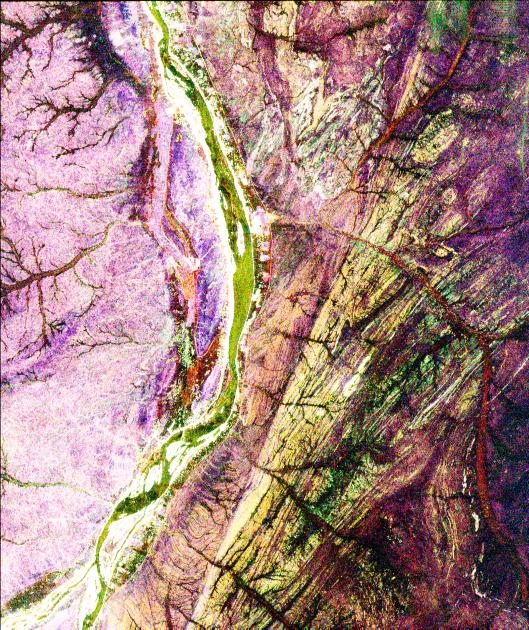
A terrane boundary close to the Nile in the Sudan, detected by radar from the Space Shuttle: the Keraf Suture. From NASA

Undoubtedly the best exposed and one of the biggest examples, the accretionary orogen of the Arabian-Nubian Shield (ANS) is a witness to the creation of a supercontinent from the remnants of an earlier one. At about 1 Ga, most of the Earth’s continental material was clumped together in the Rodinia supercontinent that existed for a quarter of a billion years. At a time of massive mantle upheaval that left most crust of that age affected by basaltic magmatism, in the form of lava flows and dyke swarms, Rodinia began to break up at 800 Ma to scatter continental fragments. Subduction zone accommodated this continental drift to form many ocean and continental-margin volcanic arcs. The ANS is a repository for many of these arcs which episodically accreted between earlier cratons to the west in Africa and those comprising Somalia and the present Indian subcontinent. Primarily the terranes are oceanic in origin and formed in the aftermath of the dismemberment of Rodinia, although a few slivers of older, reworked crust occur in Saudi Arabia and Yemen. Among the various components are ophiolites marking sutures and other major tectonic features of the orogen. The shape of the Shield is unlike that of any other major orogen of later times, for it shrinks from a width estimated at ~2000 km in Arabia to the north to vanish just south of the Equator in southern Kenya. This ‘pinched’ structure has suggested to some that the bulk of the new crust was forced laterally northwards when the African and Indian cratons collided, in the manner of toothpaste from a trodden-on tube.

Today the ANS is a harsh place, some off-limits to geologists either for political reasons or the sheer hostility and remoteness of the environment. Yet a picture has emerged, bit by bit, over the last 30 years. So a detailed review of the most extensive and varied part from 7° to 32°N and 26° to 50°E – in Egypt, Saudia Arabia, eastern Sudan, Eritrea, Yemen and northern Ethiopia is especially welcome (Johnson, P.R. et al. 2011. Late Cryogenian–Ediacaran history of the Arabian–Nubian Shield: A review of depositional, plutonic, structural, and tectonic events in the closing stages of the northern East African Orogen. Journal of African Earth Sciences, v. 61, p. 167-232). Peter Johnson himself compiled a vast amount of information during his career with the US Geological Survey Mission in Saudi Arabia and has blended the inevitably diverse ideas of his 7 co-workers – but by no means all the ideas that are in the literature. The result is a readable and well illustrated account of how the ANS assembled tectonically during times when a near-global glaciation took place, and the first macroscopic animals appear in the fossil record. Tillites and other glaciogenic rocks from the Marinoan ‘SnowBall’ occur from place to place in the ANS, as do banded iron formations that made a surprise return after a billion-year or longer absence in the Cryogenian Period . Coincidentally, glacial conditions returned to the region twice in Ordovician and Carboniferous to Permian times, forming distinctive, tectonically undisturbed sediments in the Phanerozoic cover that unconformably overlies the Neoproterozoic orogen.

Except in a few areas only recently explored, geologists have assiduously dated events in the ANS, showing nicely that all the basement rock formed after 800 Ma, and that orogenic events culminated before the start of the Cambrian period, although one or two unusual granites intruded as late as the Ordovician. The deformation is immense in places, with huge nappes, often strike-slip shear zones and exposure ranging from the lowest metamorphic grade to that in which water and granitic magma was driven from the lower Pan African crust. The range of exposed crustal levels stems partly from the tectonics, but owes a lot to the 2-3 km of modern topographic relief, unique to NE Africa and Arabia. Yet it is not uncommon to come upon delicate features such as pillowed lavas, conglomerates and finely laminated volcanoclastic tuffs. Following tectonic welding, more brittle deformation opened subsiding basins that contain exclusively sedimentary rocks derived from the newly uplifted crust, both marine and terrestrial in formation (basins of this type, in Eritrea and Ethiopia, unfortunately do not figure in the regional maps). Much of the ANS is currently the object of a gold rush, encouraged by a rising world price for the ‘inflation-proof’ comfort blanket provided by the yellow metal. Consequently, newcomers to the stampede will be well advised to mug-up on the regional picture of occurrences and gold-favourable geology provided in the review, and may be interested by other exploration possibilities for rare-earth metals and other rising stars on the London Metal Exchange, such as tin, which are often hosted in evolved granites, that stud the whole region.

Low-lying Tibet before India-Asia collision

The Tibetan plateau lies between the Himalayan...
The semi-arid Tibetan Plateau from spaceImage via Wikipedia

The vast Tibetan Plateau at an average elevation of 4500 m is a major influence on the climate of Asia, being central to the annual monsoons, as well as one the world’s largest continental tectonic features. When it formed is crucial in palaeoclimatic modelling as well as to geomorphologists and structural geologists. Whether or not it was present before the Indian subcontinent collided with Asia at 50 Ma has been the subject of perennial debate; it could have formed during the more or less continual accretion of terranes to southern Eurasia since the Jurassic Period. A novel approach to timing uplift of Tibet is obviously needed to resolve the controversies, and that may have been achieved (Hetzel, R. et al. 2011. Peneplain formation in southern Tibet predates the India-Asia collision and plateau uplift.  Geology, v.39, p.983-986). North of Lhasa is an area of coincident small plateaus at around 5200-5400 m into which are cut valleys a few hundred metres. It has the hallmarks of a peneplain stripped to the base level of erosion, and developed on Cretaceous granites. The German-Chinese-South African team applied a range of geochronological techniques to date the emplacement of the granites and their cooling history. U/Pb dating shows the granites to have crystallised between 120 to 110 Ma; U-Th/He dating of zircons in them indicate their cooling from 180° to 60°C between 90 and 70 Ma; apatite  U-Th/He and fission-track dating show that the granites experienced surface temperatures by around 55 Ma during a period of erosion at a rate of 200-400 m Ma-1. The clear inference is that an area >10 000 km2 became a peneplain by the end of the Palaeocene, to be unconformably overlain by Eocene continental redbeds.

By the Eocene the northern Lhasa Block had become a low-elevation plain from which a vast amount of sediment had been removed to be deposited elsewhere – Palaeocene and Eocene sediments are not common throughout the whole Tibetan Plateau. This is strong evidence that uplift of the Plateau only began after the India-Asia collision during the Eocene. Despite that and the erosion that would have taken place, much of the peneplain remains; given resistant bedrock peneplains can be very long-lived.

Plate tectonics monitored by diamonds

eclogite
Norwegian Eclogite. Image by kevinzim via Flickr

For more than 30 years a debate has raged about the antiquity of plate tectonics: some claim it has always operated since the Earth first acquired a rigid carapace not long after a molten state following formation of the Moon; others look to the earliest occurrences of island-arc volcanism, oceanic crust thrust onto continents as ophiolite complexes, and to high-pressure, low-temperature metamorphic rocks. The earliest evidence of this kind has been cited from as far apart in time as the oldest Archaean rocks of Greenland (3.9 Ga) and the Neoproterozoic (1 Ga to 542 Ma). A key feature produced by plate interactions that can be preserved are high-P, low-T rocks formed where old, cool oceanic lithosphere is pulled by its own increasing density into the mantle at subduction zones to form eclogites and blueschists. In the accessible crust, both rock types are unstable as well as rare and can be retrogressed to different metamorphic mineral assemblages by high-temperature events at lower pressures than those at which they formed. Relics dating back to the earliest subduction may be in the mantle, but that seems inaccessible. Yet, from time to time explosive magmatism from very deep sources brings mantle-depth materials to the surface in kimberlite pipes that are most commonly found in stabilised blocks of ancient continental crust or cratons. Again there is the problem of mineral stability when solids enter different physical conditions, but there is one mineral that preserves characteristics of its deep origins – diamond. Steven Shirer and Stephen Richardson of the Carnegie Institution of Washington and the University of Cape Town have shed light on early subduction by exploiting the relative ease of dating diamonds and their capacity for preserving other minerals captured within them (Shirey, S.B. & Richardson, S.H. 2011. Start of the Wilson cycle at 3 Ga shown by diamonds from the subcontinental mantle. Science, v. 333, p. 434-436). Their study used data from over four thousand silicate inclusions in previously dated large diamonds, made almost worthless as gemstones by their contaminants. It is these inclusions that are amenable to dating, principally by the Sm-Nd method. Adrift in the mantle high temperature would result in daughter isotopes diffusing from the minerals. Once locked within diamond that isotopic loss would be stopped by the strength of the diamond structure, so building up with time to yield an age of entrapment when sampled.  The collection spans five cratons in Australia, Africa, Asia and North America, and has an age spectrum from 1.0 to 3.5 Ga. Note that diamonds are not formed by subduction but grow as a result of reduction of carbonates or oxidation of methane in the mantle at depths between 125 to 175 km. In growing they may envelop fragments of their surroundings that formed by other processes.

A notable feature of the inclusions is that before 3.2 Ga only mantle peridotites (olivine and pyroxene) are trapped, whereas in diamonds younger than 3.0 Ga the inclusions are dominated by eclogite minerals (garnet and Na-, Al-rich omphacite pyroxenes). This dichotomy is paralleled by the rhenium and osmium isotope composition of sulfide mineral inclusions. To the authors these consistent features point to an absence of steep-angled subduction, characteristic of modern plate tectonics, from the Earth system before 3 Ga. But does that rule out plate tectonics in earlier times and cast doubt on structural and other evidence for it? Not entirely, because consumption of spreading oceanic lithosphere by the mantle can take place if basaltic rock is not converted to eclogite by high-P, low-T metamorphism when the consumed lithosphere is warmer than it generally is nowadays – this happens beneath a large stretch of the Central Andes where subduction is at a shallow angle. What Shirey and Richardson have conveyed is a sense that the dominant force of modern plate tectonics – slab-pull that is driven by increased density of eclogitised basalt – did not operate in the first 1.5 Ga of Earth history. Eclogite can also form, under the right physical conditions, when chunks of basaltic material (perhaps underplated magmatically to the base of continents) founder and fall into the mantle. The absence of eclogite inclusions seems also to rule out such delamination from the early Earth system. So whatever tectonic activity and mantle convection did take place upon and within the pre-3 Ga Earth it was probably simpler than modern geodynamics. The other matter is that the shift to dominant eclogite inclusions appears quite abrupt from the data, perhaps suggesting major upheavals around 3 Ga. The Archaean cratons do provide some evidence for a major transformation in the rate of growth of continental crust around 3 Ga; about 30-40 percent of modern continental material was generated in the following 500 Ma to reach a total of 60% of the current amount, the remaining 40% taking 2.5 Ga to form through modern plate tectonics

A plume drive for tectonics?

Himalaya Formation Source www.usgs.org US Gove...
India's tectonic travels. Image via Wikipedia

The theory of plate tectonics resolved Alfred Wegener’s search for a driving force for continental drift around half a century after his discovery faced near-universal rejection for not having one that was large enough or plausible. Plate theory recognises many forces, both driving and in opposition to tectonic movement. By far the largest is the gravitational pull exerted by subducting slabs of dense oceanic lithosphere, followed in distant second place by ridge-push, another gravity-driven force that arises from the slope on the ocean floors away from sea-floor spreading centres as the oceanic lithosphere cools and shrinks as it ages. Until very recently, no place was assigned in the theory to forces associated with the apparently non-tectonic plumes that rise through the mantle from well beneath the lithosphere from which plates are made, quite possibly because it seems logical to expect a vertically upwards force, if any, from hot plumes whereas plate tectonics is mainly concerned with horizontal movements. Looking around the present state of sea-floor spreading, the maximum pace at which plates move is just over 100 mm a-1 (100 km Ma-1) in the case of the Pacific Plate. Yet, during the Late Cretaceous and Early Palaeogene Periods after India had been wrenched away from the Gondwana supercontinent to move towards eventual collision with Eurasia the subcontinent experienced an extraordinary episode beginning around 68 Ma when its pace increased to as high as 180 km Ma-1. This accelerated motion continued over some 15 Ma and then equally abruptly slowed to less than 40 km Ma-1 around the start of the Eocene (Cande, S.C. & Stegman, D.R. 2011. Indian and African plate motions driven by the push force of the Réunion plume head. Nature, v. 475, p. 47-52; see also: Müller, R.D. 2011. Plate motion and mantle plumes. . Nature, v. 475, p. 40-41). The acceleration coincided with the start of continental flood-basalt volcanism that blanketed much of western India with the Deccan Traps across the K-P boundary when the subcontinent lay over the site of the Réunion hot spot. Coincidentally, the Réunion plume head formed at that time; i.e. the Indian continental lithosphere did not drift over an active plume, but was hit from below by one that happened to be rising to the surface. Curiously, while the Indian plate was accelerated, nearby Africa was slowed, explained by a push in the same direction of India’s travel towards a subduction zone beneath Asia and one applied to Africa that opposed its motion. Africa too resumed its usual tectonic progress at the start of the Eocene. But how did a mantle plume exert such a force: was it because it caused a local bulge from which the plates slid, or did mantle motion associated with the mushroom-like structure of the horizontally growing plume head exert viscous drag on the overlying plates? Such shifts in motion of major plates inevitably have an effect on the whole plate tectonic carapace, and the authors list a number of contemporary, distant consequences, speculating that the famous bend in the Hawaii-Emperor island and sea-mount chain in the Early Eocene resulted from the final waning of the Réunion plume head’s influence and major readjustment of tectonics.

Himalayan Horizon From Space
The result of India's final collision with Eurasia - the Himalaya. Image via Wikipedia

Coast-to-coast seismic section of Canada

Geological Map of Canada
Geological map of Canada. Image via Wikipedia

In the last few decades there have been several massive programmes aimed at imaging the lithospheric structure beneath continents, often linked with a re-assessment of the various tectonic provinces thought to be present. One of the first was a joint Indian-Soviet project managed by the National Geophysical research Institute in Hyderabad to investigate the crust of South India in the 1970s, which still graces my office wall as a memento of my own contribution to unravelling the underpinnings of this ravishing area. This was followed-up by one from the Himalaya southwards, and others have focused on Britain, the Baltic Shield and the USA by the Consortium for Continental Reflection Profiling (COCORP); the last revealing in detail large-scale, low-angle thrust faulting in the Appalachians and crustal-scale detachment faults in the eastern Basin and Range. These experiments must have been great fun, as they involved detonating large amounts of high explosive to produce sufficient energy to get returns from 100 r more km below, with all the planning needed to avoid fear and loathing among the populace, let alone frightening the horses. Nowadays, most seismic profiling onshore is done using Vibroseis, best imagined as large trucks jacked up on pads on which they bounce up and down, in manner of an LA ‘lowrider’. By comparison, marine surveys are far easier, although marine mammals have seemingly had major setbacks as a result of endless closely spaced seismic lines needed for 3-D subsurface analysis. Onshore, you only get one chance and need to pick your route with great care. Now a Canadian consortium has gone one better by using state-of-the-art seismic refraction and reflection techniques (Hammer, P.T.C. et al. 2011. The big picture: A lithospheric cross section of the North American continent. GSA Today, v. 21 (June 2011 issue), p. 4-9). Uniquely, the Canadian Lithoprobe project  coordinated a full spectrum of geological, geochemical, and geophysical research,  covering 20 years of deep-crustal research by hundreds of contributors.

A large-format profile in a supplement to the paper shows the deep relationships in the Mesozoic Cordilleran Orogen in the west, through the plexus of Precambrian Provinces of the Canadian Shield to the Palaeozoic Orogen in the east: a tract some 6000 km from west to east. The general picture is repeated stacking of orogens, with a remarkable repetition of very similar gross tectonic styles. Clearly, large-scale compressional processes have remained largely unchanged since the middle of the Archaean, and several upper parts of long-dead subduction zones and accretionary duplexes spring from the profile. The surface picture of much of the crust crossed by the stitched-together traverses gives the impression of both complex tectonics and many plutons of different ages, yet on the grand scale of the crust and lithosphere it is the tectonics that dominates: the passage of voluminous melts towards the surface has left the plethora of gently dipping deep shear zones and faults largely unmodified. Indeed, the seismic data reveal astonishingly well-preserved subducted or delaminated crust associated with collisions that occurred 2-3 billion years ago. Despite repeated accretionary tectonics spanning 3 Ga, and the Phanerozoic erosion of the Shield to reveal its innermost and deepest secrets, the crust-mantle boundary, the Moho, is astonishingly flat, ranging from 33-43 km deep. Nor is there much sign of ‘roots’ beneath orogens in the underlying lithospheric mantle; a long standing concept that appears not to be generally supportable over this stretch of the North American continent. The synthesis raises questions as to whether the Moho has always been that shallow or whether it can, in some situations, be a dynamic ‘boundary’. For that to be the case requires that the geologic crust-mantle boundary may not always correspond to the seismic discontinuity with which the Moho has previously been correlated.

PDFs of the profile can be downloaded from ftp://rock.geosociety.org/pub/GSAToday/1106insert-hammer/