Pushing back the origin of photosynthesis

English: Rock sample from a banded iron format...
Sample from a banded iron formation (BIF) from the Barberton Greenstone Belt, South Africa. (credit:K. Lehmann and J.D. Kramers via Wikipedia)

More than a decade ago the oldest sedimentary rocks in the world at Isua in West Greenland hit the headlines, and not for the first time. Inclusions of graphite in crystals of the mineral apatite from the Isua supracrustals  had yielded carbon isotopes unusually deficient in 13C relative to 12C, which is often regarded as a sign that life was involved in the carbon cycle at the time. The Isua rocks have been reliably dated at around 3.8 billion years (Ga) so that added over 400 Ma to the time at which life was present on Earth. Sedimentary rocks formed at 3.4 Ga contain the first tangible signs in the form of stromatolites thought to have been secreted by biofilms of blue-green bacteria which are oxygen-generating photosynthesisers. Sadly, limestones at Isua, indeed all the putative sedimentary rocks there were metamorphosed and deformed plastically so that such features, if they were ever present, had been obliterated. Apatite was thought to be so strong and resistant to heating that carbon within its crystals would have preserved original isotopic ‘signatures’. Detailed studies to test this hypothesis refuted the early age for life, which reverted back to around 3.4 Ga. But Isua presents too good an opportunity for its geochemical secrets to be left uninvestigated.

The latest targets are its iron isotopes. Isua includes metamorphosed banded ironstones composed largely of magnetite and quartz. Magnetite is iron oxide (Fe3O4) and begs the question of how such an oxygen-rich mineral formed in such volumes in sediment if photosynthesizing life had not made elemental oxygen available. That would oxidize soluble ferrous ions (Fe2+) to the insoluble ferric form (Fe3+) in order for iron oxide to precipitate from sea water in large amounts. There is no other means known for oxygen to be produced in a planet’s surface environment. A team at the University of Wisconsin’s NASA Astrobiology Institute, led by Andrew Czaja and joined by Stephen Moorbath of the University of Oxford, who set the entire West Greenland story rolling by leading its geochronological investigation since the early 1970s, have made a breakthrough (Czaja, A.D. et al. 2013. Biological Fe oxidation controlled deposition of banded iron formation in the ca. 3770 Ma Isua Supracrustal Belt (West Greenland). Earth and Planetary Science Letters, v. 363, p. 192-203).

Any element that has more than one naturally occurring isotope offers the possibility of studying various kinds of chemical process by looking for changes to the relative proportions of the different isotopes. Having different relative atomic masses isotopes of an element have slightly different chemical properties so that one is likely to be more favoured in a reaction than another. In the case of iron, the most important reactions in surface processes are those that depend on reducing and oxidising conditions, i.e. producing soluble Fe2+ and insoluble Fe3+ respectively. Oxidation and precipitation of iron oxides and hydroxides tend to favour the heavier isotope 56Fe over the more common 54Fe resulting in an increase in the 56Fe/54Fe ratio (δ56Fe). This is found throughout the Isua ironstones, but may again reflect metamorphism. However, such was the detail of this study that δ56Fe values were measured for many individual bands. Instead of showing roughly the same values throughout the rock, each band had a different value. That strongly suggests that values produced during sedimentation had been preserved. It seems that a bacterial mechanism of oxidation was involved. Moreover, by comparing the 3.8 Ga Isua ironstones with examples dated at 2.5 Ga from Australia the team found different isotopic values that implicates different kinds of bacteria involved in producing apparently similar rock types. The twist is that the most likely bacterial type involved at Isua may have been a photosynthesiser, but not of the kind that releases elemental oxygen instead transferring it from water to combine directly with the ions of iron that its photosynthesis  had oxidised. The younger ironstones seem more likely to have involved cyanobacteria that do excrete oxygen; shortly after their formation the Earth’s surface increasingly became oxygen-bearing.

Throughout the Precambrian, BIFs appear and then vanish from the record only to reappear when geologist least expect them, for instance around the time of the Snowball Earth events in the Neoproterozoic Era. Iron isotopes could well become handy tools to probe the processes that formed them.

K-T (K-Pg) event: can the havering stop now, please?

Chicxulub impact - artist impression
Artist’s impression of the Chicxulub impact – (credit: Wikipedia)

Since 1980, when Alvarez père et fils discovered signs of a globe-affecting impact event in rocks marking the stratigraphic boundary at the end of the Mesozoic Era –between the Cretaceous and Palaeogene Periods – there has been continual bickering over the cause of the mass extinction at that time. Unlike other mass extinctions that one marked the end of an Era dominated in the popular mind by the iconic dinosaurs. Besides that focus, many geologists have been averse to external, ‘wham-bam-thank-you-ma’am’ explanations for shifts in the fossil record: a sort of Lyellian view that geological change had to be at the pace of the humble tortoise and must be due to something in the Earth system itself. Then a majority, this conservative faction looked instead to the effects of the voluminous basalt flood that had affected western India at around the same time. Incidentally, that apparent match to the end-Mesozoic extinction sparked an interest in volcanic associations with other mass extinctions.

Discovery by geophysicists of evidence for a large almost completely buried impact basin, about 180 km across, centred in the Caribbean off Mexico’s Yucatan Peninsula swayed opinion towards an extraterrestrial cause when it became clear that the impact had occurred around the time of the K-Pg boundary, then placed at 65 Ma. Soon there were claims that the Deccan Traps had erupted in less than a million years at that time, together with doubts cast on the actual age of the Chicxulub crater. The time-spread of the Deccan volcanism enlarged with more dating to between 68 and 60 Ma; and so the to-ing and fro-ing continued, gleaning sizeable grants for entrepreneurial geoscientists keen on one or other of what were becoming bandwagon topics. Then the ‘golden spike’ marking the time of the mass extinction became the subject of controversy. A means of precise dating is to examine signs in sediments of cyclical climate change using the Milankovich approach, although before 50 Ma only the 405 ka cyclicity predicted from astronomy is readily detected. Using well-dated volcanic horizons to calibrate such a stratigraphic dating method might be the key, but it became apparent that 65.3, 65.7 or 66.1 Ma all seemed to have the same likelihood.

The two kill mechanisms that had been proposed are in fact very different, not merely in terms of what might have happened to atmospheric chemistry, climate, photosynthesis and so on, but concerning their timing. Repeated episodes of major basalt eruption every 100 ka or so would have had a chronic and perhaps cumulative effect on the Earth’s biota; i.e.  even a 10 Ma spread for Deccan basalt floods bracketing the actual die-off would be acceptable as a cause. An impact however takes no more than a second to occur, because of the hypersonic speed induced by Earth’s gravity as well as that of the asteroid through the Solar System. All its immediate effects – entry flash; crater excavation; debris fall-out; atmospheric dust and toxic gas accumulation; climate change; acid rain and tsunamis – would have been done and dusted over a matter of a few thousand years. The Chicxulub impact would have been a catastrophe that was instantaneous in geological terms. Its occurrence would need to bear the same date as the mass extinction itself to be seen as incontrovertible; well, at least to the majority of geoscientists. That point seems to have been reached.

As well as the crater, Chicxulub scattered molten rock far and wide to appear in the ‘boundary layer’ as glass spherules, which are dateable using radiometric means. So too is the timing of the mass extinction itself, provided suitable materials can be found above and below the strata across which fossil abundances change so dramatically. Paul Renne of the University of California, Riverside, and colleagues from the US, the Netherlands and Britain dated impact glasses from Haiti and volcanic ash from the late Cretaceous to early Palaeogene terrestrial sediments of Montana, USA that bracket the extinction event using multiple argon-isotope studies and the 40Ar-39Ar method (Renne, p.r. and 8 others 2013. Time scales of critical events around the Cretaceous-Paleogene boundary. Science, v. 339, p.684-687. The glasses come out at 66.038+0.049 Ma, while the Ar-Ar age of volcanic ash just above the carbon-isotope anomaly that marks the world-wide disappearance of a large proportion of living biomass is 66.019+0.021 Ma. As they say, the ages are ‘within error’ and the error is very small indeed.

So, does this work mark the end of the K-Pg controversy? Probably not, as very large sums of grant money are still tied up with on-going studies. Perhaps to assuage the fears of all those still financially addicted to answering ‘what killed the dinosaurs?’, The abstract of the paper reads thus’ ‘The Chicxulub impact likely triggered a state shift of ecosystems already under near-critical stress’.

Artist's impression of the common ancestor of placental mammals (Credit: Science magazine)
Artist’s impression of the common ancestor of placental mammals (Credit: Science magazine)

Interestingly, in the very same issue of Science came a research article that reexamines taxonomy of 86 key living and fossil placental mammals in the light of genetic sequencing, to locate startigraphically their earliest common ancestor (O’Leary, M.A. and 22 others 2013. The placental mammal ancestor and the post-K-Pg radiation of placentals. Science, v. 339, p. 662-667). That seems to wrap up, for now, another controversy; did diminutive placental mammals arise unnoticed beneath the gaze of mighty dinosaurs, or what? It seems that some precursor mammals were able to diversify and produce a line whose fetuses grow and are nourished in the mothers uterus attached to a placenta, before live birth at an advanced stage of development, once opportunities for diversification emerged after the K-Pg event. Morphologically, the ancestor of everything from a naked mole rat to a blue whale and, of course, ourselves, seems to have been a sneaky-looking little beast with a long nose and pointy teeth. It does look like it, or its predecessor, could have scuttled unscathed amongst the leaf litter as dinosaurs engaged in their death prance…

The Ediacaran fossils: a big surprise

English: Photograph showing the 'golden spike'...
Edicara sandstones in the Flinders Ranges of  South Australia (credit: Wikipedia).

The first macroscopic life forms were the enigmatic bag-like and quilted fossils in sedimentary rocks dating back to 635 Ma in Australia, eastern Canada and NW Europe. They are grouped as the Ediacaran Fauna named after the Ediacara Hills in South Australia where they are most common and diverse. Generally they are not body fossils but impressions of soft-bodied organisms, often in sandstones rather than muds. Some are believed to be animals that absorbed nutrients through their skin, whereas others are subjects of speculation. One thing seems clear; these first metazoans arose because of some kind of trigger provided by the global glacial conditions that preceded their appearance. It has always been assumed that, whatever they were, Ediacaran organisms lived on the sea floor, probably in shallow water. New sedimentological evidence found in the type locality by Gregory Retallack of the University of Oregon seems set to force a complete rethink about these hugely important life forms (Retallack, G.J 2012. Ediacaran life on land. Nature (online), doi:10.1038/nature11777). So momentous are his conclusions that they form the subject of a Nature editorial in the 13 December 2012 issue.

Retallack, a specialist on ancient soils of the Precambrian, examined reddish facies of the Ediacara Member of the Rawnsley Quartzite of South Australia, whose previous interpretation have a somewhat odd background. Originally regarded as non-marine, before their fossils were discovered, when traces of jellyfish-like organisms turned up this view was reversed to marine, the red coloration being ascribed to deep Cretaceous weathering. A range of features, such as clasts of red facies in grey Ediacaran rocks, the presence of feldspar in the red facies – unlikely to have survived deep weathering – bedding surfaces with textures very like those formed by subaerial biofilms, and desiccation cracks, suggest to Retallack that the red facies represents palaeosols in the sedimentary sequence. Moreover, some features indicate a land surface prone to freezing from time to time. The key observation is that this facies contains Ediacaran trace fossils representing many of the forms previously regarded as marine animals of some kind, including Spriggina, Dickinsonia and Charnia  on which most palaeontologists would bet good money that they were animals, albeit enigmatic ones.

English: Cropped and digitally remastered vers...
Specimen of Edicaran Dickinsonia (credit: Wikipedia)

If Retallack’s sedimentological observations are confirmed then organisms found in the palaeosols cannot have been animals but perhaps akin to lichens or colonial microbes, and survived freezing conditions. As they occur in other facies more likely to be subaqueous, then they were ‘at home’ in a variety of ecosystems. As the Nature editorial reminds us, from the near-certainty that early macroscopic life was marine there is a chance that views will have to revert to a terrestrial emergence first suggested in the 1950s by Jane Grey. Uncomfortable times lie ahead for the palaeontological world.

Early animals and Snowball Earth

"SNOWBALL EARTH" - 640 million years ago
The Earth 640 million years ago during the Marinoan ‘Snowball’ event (credit: Cornell University via Flickr)

Palaeobiologists generally believe that without a significant boost to oxygen levels in the oceans macroscopic eukaryotes, animals in particular, could not have evolved. Although the first signs of a rise in atmospheric oxygen enter the stratigraphic record some 2.4 billion years ago and eukaryote microfossils appeared at around 2 Ga, traces of bulky creatures suddenly show up much later at ~610 Ma with possible fossil bilaterian embryos preserved in 630 Ma old sediments. An intriguing feature of this Ediacaran fauna is that it appeared shortly after one of the Neoproterozoic global glaciations, the Marinoan ‘Snowball’ event: a coincidence or was there some connection? It has looked very like happenstance because few if any signs of a tangible post-Marinoan rise in environmental oxygen have been detected. Perhaps the sluggish two billion-year accumulation of free oxygen simply passed the threshold needed for metazoan metabolism. But there are other, proxy means of assessing the oxidation-reduction balance, one of which depends on trace metals whose chemistry hinges on their variable valency. The balance between soluble iron-2 and iron-3 that readily forms insoluble compounds is a model, although iron itself is so common in sediments that its concentration is not much of a guide. Molybdenum, vanadium and uranium, being quite rare, are more likely to chart subtle changes in the redox conditions under which marine sediments were deposited.

English: Cropped and digitally remastered vers...
Dickinsonia; a typical Ediacaran animal. Scale in cm (credit: Wikipedia)

Swapan Sahoo of the University of Nevada and colleagues from the USA, China and Canada detected a marked increase in the variability of Mo, V and U content of the basal black shales of the Doushantuo Formation of southern China, which contain the possible eukaryote embryos (Sahoo, S.K and 8 others 2012. Ocean oxygenation in the wake of the Marinoan glaciation. Nature, v. 489, p. 546-549). These rocks occur just above the last member of the Marinoan glacial to post-glacial sedimentary package and are around 632 Ma old. Since the black shales accumulated at depths well below those affected by surface waves that might have permitted local changes in the oxygen content of sea water the geochemistry of their formative environment ought not to have changed if global chemical conditions had been stable: the observed fluctuations may represent secular changes in global redox conditions. The earlier variability settles down to low levels towards the top of the analysed sequence, suggesting stabilised global chemistry.

What this might indicate is quite simple to work out. When the overall chemistry of the oceans is reducing Mo, V and U are more likely to enter sulfides in sediments, thereby forcing down their dissolved concentration in sea water. With a steady supply of those elements, probably by solution from basalt lavas at ocean ridges, sedimentary concentrations should stabilise at high levels in balance with low concentrations in solution. If seawater becomes more oxidising it holds more Mo, V and U in solution and sediment levels decline. So the high concentrations in sediments mark periods of global reducing conditions, whereas low values signal a more oxidising marine environment. Sahoo et al.’s observations suggest that marine geochemistry became unstable immediately after the Marinoan glaciation but settled to a fundamentally more oxidising state than it had been in earlier times, perhaps by tenfold increase in atmospheric oxygen content. So what might have caused this and the attendant potential for animals to get larger in the aftermath of the Snowball Earth event? One possibility is that the long period of glaciers’ grinding down continental crust added nutrients to the oceans. Once warmed and lit by the sun they hosted huge blooms of single-celled phytoplankton whose photosynthesis became an oxygen factory and whose burial in pervasive reducing conditions on the sea bed formed a permanent repository of organic carbon. The outcome an at-first hesitant oxygenation of the planet and then a permanent fixture opening a window of opportunity for the Ediacarans and ultimately life as we know it.

Burrowers: knowing front from back

In sedimentary rocks below the base of the Cambrian there is not only a dearth of body fossils, but signs of creatures burrowing and stirring up the sediment are most uncommon. A burrower needs several criteria to be fulfilled: a supply of oxygen; sufficient food; a body able to penetrate and an ability to move back and forth, but forth would probably do fine, provided the animal could turn corners. The amount of oxygen in bottom waters would have influenced its availability beneath the seabed. Whatever the conditions, dead organic matter falls and is buried by sediment before it is oxidised away, even nowadays.  There is little sign that there was any marked change between the oxygenation of the planet just before and after the start of the Cambrian Period, so the main control over burrowing is that of animal morphology.

Many modern burrowing animals are pretty flaccid but moving sediment aside and upwards demands some muscle power. Most important, the creature needs a means of navigation, albeit of a rudimentary kind, and since what goes in beneath the surface – food – must go out – excreta – there must be a front- and a back end. That ‘fore-and-aft’ symmetry is the essential feature of bilaterian animals. Only a limited range of animal taxa don’t have that built-in. Sponges are the most obvious example, having no discernible symmetry of any kind. Radially symmetrical animals such as jellyfish and coral polyps only have a top and a bottom. An absence of inbuilt horizontal directionality stops non-bilaterians from burrowing in any shape or form. But, so what?

The vast majority of animals have some kind of bilateral symmetry; even echinoderms have it from their 5-fold symmetry that is also the simplest kind of radiality. By the start of the Cambrian, not only had bilaterians split off from the less symmetrical but almost all the phyla living today, and several that became extinct in the last 542 Ma, have representatives in the Cambrian fossil record. The only logical conclusion is that emergence of bilaterians and their fundamental diversification took place in the Precambrian: they are absent  from earlier strata only because they had no hard parts. Comparing the DNA of living representatives of the main bilaterian phyla and with that of non-bilaterians can help date the times of genetic and morphological separation, but only crudely. This ‘molecular clock’ approach points to some time between 900 and 650 Ma ago for the last common ancestor of bilaterians.

Uruguayan fossil burrows from late Neoproterozoic (Credit: Pecoits, E. et al. 2012)

Getting a handle on the minimum time for the split depends either on finding fossils or unequivocal signs of bilaterian activity. The oldest unequivocally bilaterian fossils occur in rocks about 550 Ma old, which doesn’t take us much further back than the base of the Cambrian. But there are trace fossils that are significantly more ancient (Pecoits, E. et al. 2012. Bilaterian burrows and grazing behaviour at >585 million years ago. Science, v. 336, p. 1693-1696). They are tiny burrows in fine-grained sediments from Uruguay, so tiny that there is a chance that they may be traces of grazing bacterial films on the seabed rather than beneath it. The decider is the mechanics of trace fossil formation. Surface tracks only a millimetre or so across would only penetrate the biofilm, so on lithification they would simply disappear. Burrows on the other hand penetrate the sediment itself to get at food items. Even if this was a biofilm, the track would be in sediment above the film, so compaction would preserve it. The Uruguayan exam-[les are exquisite horizontal burrows, and they push back the minimum age for the origin of the bilaterians to at least 40 Ma older than the start of the Cambrian. In fact 585 Ma is a minimum age for the sediments as it is the U-Pb age of zircons in a granite that intrudes and metamorphoses them.

An equally significant observation is that the burrows only appear towards the end of a glacial episode – probably the last of the Neoproterozoic ‘Snowball Earth’ events – as marked by tillites below the burrowed shales and occasional ‘dropstones’ in them. Could it be that the climatic and other stresses of a global glaciation triggered the fundamental division among the Animalia?

Origin of the arms race

Global paleogeographic reconstruction of the E...
Global paleogeographic reconstruction of the Earth in the early Cambrian period 540 million years ago. (credit:Ron Blakey, Northern Arizona University)

Palaeontologists generally agree on one broad aspect of animal evolution: the central role of predation versus defence in animal diversification to occupy different ecological niches. Indeed that co-relation has to an extent been responsible for the diversification of potentially habitable niches themselves. Armour and arms form a dialectic within the animal world, but one that only rose to dominate when hard materials became an integral part of animal morphology, allowing some to bite, gnaw or rasp and others to develop shelly or horny skeletons. The Kingdom Animalia within the domain of the eukaryotes – organisms based on cells that bear a nucleus – is united by one life style, that of feeding directly or indirectly on other living things. They are heterotrophs unable to generate energy and tissue through the fundamental harnessing of chemistry and physics to use the inorganic world directly, as do autotrophs.  One of the earliest discoveries about the history of animals was that fossils in the widely accepted meaning of the word appeared suddenly in the geological record, earlier rocks containing virtually no tangible signs of life: fossils explode in numbers from the start of the Cambrian Period at 542 Ma. Subsequently, geologists did discover imprints of clearly quite complicated organisms in rocks a few tens of million years older than the start of the Cambrian. But these were flaccid, bag like creatures that recent research has shown to rely on filtering microorganisms from water or directly absorbing organic matter through their skin.

Cropped and digitally remastered version of an...
An animal from the late Precambrian(Photo credit: Wikipedia)

Another feature of sediments of the oldest Cambrian is that in many parts of the world they rest with or=profound unconformity on deformed older rocks of Precambrian age. Throughout Britain the lowest Cambrian rocks are almost pure quartz sandstones that rest upon older more complex rocks ranging from only a few tens of million years older than 542 Ma to some of the oldest rocks in Europe, the Lewisian complex dating back 3 billion years. Many of the hills of North West Scotland have a gleaming white cap of Lower Cambrian quartzite above what has been termed the Great Unconformity where it occurs in Arizona’s Grand Canyon. Sedimentary sequences that continuously record the Precambrian to Cambrian transition and the biological explosion at the juncture are rare. But they show two curious features in sediments that immediately predate those bearing recognisable fossils: a complete lack of evidence for burrowing and millimetre-scale shell-like bodies made of calcium phosphate and carbonate, which are thought to have adorned the skins of otherwise unprotected animals.

Português: Classe Radiodonta
Creatures from the Cambrian Period (credit: Wikipedia)

Calcium, while a very common element is one of the most dangerous to life. Traces are essential for the signalling that goes on in cell metabolism, and too little snuffs out those vital processes.  Yet too much – still a very low concentration in cell cytoplasm – results in the growth of minute mineral crystals within cells, also spelling cell death. This results from the limited solubility of calcium in water, compared with those of other common metals.  At an early stage in evolution cells developed means of restricting the admission of calcium ions and efficient means of expelling excess amounts of calcium. The ubiquitous occurrence of Ca-rich marine limestones throughout the geological record bears witness to two things: the abundance of calcium ions in seawater; a closer look reveals that a great many limestones, going back some 3.5 billion years show traces of biomineralisation that helped form the limey sediments. In the second case, the calcium carbonate in most Precambrian limestones was secreted by photosynthetic blue-green bacteria in minutely thing layers, probably in the form of a slimy film excreted to avoid calcium toxicity. Palaeontologists have long suspected that the earliest skeletal materials formed by animals evolved from the need to excrete biomineralised films by turning a metabolic necessity into functional and integral parts of their body plans: arms and armour. Yet limestones are not rare signs of the presence of a dissolved calcium threat, so why the sudden adoption of waste products in this way?

A fairly old hypothesis is that calcium in seawater must have risen above a threshold that posed toxic threat to all living things and excretion had to increase to maintain the balance, perhaps matched with increasing sizes of animals in the late Precambrian. Only recently has support been found for this suggested evolutionary trigger, initially from analysis of brines trapped in crystalline materials within sediments, such as salt (NaCl). But the very presence of such halite in a sediment is a universally accepted sign of evaporation increasing ionic concentrations in isolated seawater lagoons, whereas a general increase in marine calcium would be needed to present sufficient chemical stress that the whole of animal evolution would require a step-change for survival.  It turns out that support for the hypothesis stems from two isotopic systems most usually associated with dating the formation and weathering of continental  crust: those of strontium and neodymium. The global record of ratios of 87Sr/86Sr and 143Nd/144Nd show unusually large changes in the run-up to the Cambrian Period, the first rising to the highest level recorded in geological history and the second reaching a historic nadir during the Cambrian. This anti-correlation signifies the greatest chemical weathering of older continental crust in the history of the Earth (Peters, S. & Gaines, R.R. 2012. Formation of the ‘Great Unconformity’ as a trigger for the Cambrian explosion. Nature, v. 484, p. 363-366). Not only would this have poured dissolved ions, including those of calcium, into the oceans and raised their concentrations in seawater, but vast areas of the continents would have been eroded to form huge coastal plains, ripe for marine inundation. The last is exactly what the near-universal unconformity at the base of the Cambrian signifies. Presaging this long drawn-out grinding of continents to their gums had been a protracted bout of continental assembly to form the Rodinia supercontinent around 1000 Ma though collision and mountain building. Then Rodinia broke apart, its fragments being driven by plate tectonics to reassemble, along with vast chains of new crust formed in volcanic island arcs, by yet more orogenesis: tectonically high-energy times matched by the processes of denudation on land.

A nice example of planetary interconnectedness on the largest scale with the greatest conceivable consequences, for we vertebrates anyhow. This comes as a great comfort to me in the twilight of my career, since in 1999 I stuck out my neck with a similar concept in Stepping Stones only to meet a suitably stony silence.

A cuddly tyrannosaur

Feathered Dinosaurs 1
Feathered dinosaur Deinonychus (Photo credit: Aaron Gustafson)

Feathered and fluffy dinosaurs in the families that may have led to birds have become almost commonplace, thanks to wonderful preservation in some Chinese Mesozoic sedimentary rocks (see http://earth-pages.co.uk/2003/03/01/flying-feathers/)  and what has become a cottage industry for local people, under professional direction. Most have been small theropods in the Coelurosauria taxonomic branch that span the Jurassic and Cretaceous Periods. The famous Lower Cretaceous Liaoning lagerstätte in NE China recently yielded something truly awesome: three well-preserved specimens of a feathered dinosaur almost as large as the giant tyrannosaurs of the Late Cretaceous (i.e. > 1 tonne in life) (Xu, X. et al.2012. A gigantic feathered dinosaur from the Lower Cretaceous of China. Nature, v. 484. P. 92-95). In fact Yutyrannus huali (‘beautiful feathered tyrant)is a member of the same subgroup as the Upper Cretaceous T. rex and was clearly a top predator in its day. Equally fortuitous is that the three specimens  comprise one with a living body weight of about 1.4 t, the other two being between 500 and 600 kg. Various differences between the largest and the two smaller individuals suggest that thee find represents two generations, the largest perhaps 8 years older than the two smaller ones. All three preserve densely packed filaments suggesting that they were fluffy rather than truly feathered. So why the difference from its probably scaly relative tyrannosaurs from about 50 Ma later?

Around 125 Ma global climate was considerably cooler than the Late Cretaceous greenhouse world, Liaoning probably having mean annual air temperatures around 10°C compared with 18°C late in the Period. Yutyrannus huali and some of its contemporary theropods probably evolved high TOG insulation to ensure all-season sprightliness. It is also possible that a display function was also involved, as seems to have been the case for other dinosaurs.

Mesozoic fleas

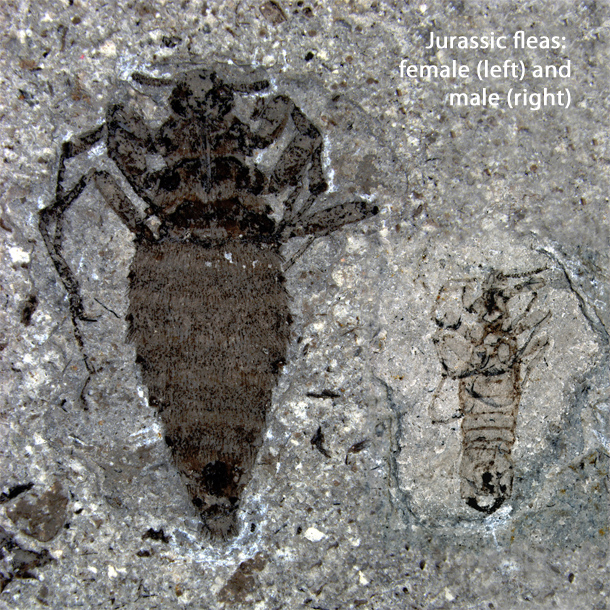
Giant Mesozoic fleas from China, 1.4 and 0.8 cm long. From Huang et al. (2012)

Strange as it might seem, rather than bringing to mind the opening pages of Michael Crichton’s Jurassic Park ancient fleas suggest to me Frederick Engels’s Dialectics of Nature (1883). In his lampoon of determinism, which might today be directed at a famous evolutionary biologist, Engels wrote:

‘…last night I was bitten by a flea at four o’clock in the morning, and not at three or five o’clock, and on the right shoulder and not on the left calf – these are all facts which have been produced by an irrevocable concatenation of cause and effect, by an unshatterable necessity of such a nature indeed that the gaseous sphere, from which the solar system was derived, was already so constituted that these events had to happen thus and not otherwise.’

But a paper about fossil fleas from the time of the dinosaurs was always going to catch the eye (Huang, D. et al. 2012. Diverse transitional giant fleas from the Mesozoic era of China. Nature, v. 483, p. 201-204), and that they come from China does have an element of inevitability that arises from that country’s rich endowment with sites of exceptional preservation. The fleas are not at all like the shiny creatures that are so difficult to trap in the fur of a cat’s ear, and they are big: up to 2 cm long. Two species come from Middle Jurassic and one from the Lower Cretaceous. The fascinating thing about fleas, however, is that they evolved to live and thrive in fur and feathers.  This niche is signified by their claws, whose form and articulation avoid entanglement with fibres: which is why cat fleas are so nimble. While cat fleas are flattened laterally to help them slip though fur and have powerful legs that allows them to leap from host to host, the Mesozoic fleas are flat from back to front and are not so leggy.

English: This photo was taken by Andy Brookes ...
Cat flea ~1.5 mm long. Image via Wikipedia

Being so large, it seems unlikely that these Mesozoic fleas would have parasitized mammals that were probably far smaller on average than now. But by the Jurassic fossil evidence, largely from China, shows that dinosaurs had developed feather-like cover. Their evolution itself created a niche occupied thereafter by fleas and other bloodsuckers. They are wingless relatives of flies (Order: Diptera) that first appear in the Triassic fossil record, both thought to have stemmed from more primitive scorpionflies (Order: Mecoptera)

Late Devonian: mass extinction or mass invasion?

A hand made lookalike for User:Dragons flight'...
Image via Wikipedia

The later part of the Devonian (the Frasnian and Famennian Stages) once marked the second largest marine mass extinction (~375 Ma) of the Phanerozoic Eon: it was one of the ‘Big Five’. For the last decade the drop in marine biodiversity in that interval has come under scrutiny: partly because it may have involved several  events;  no well-supported extinction mechanism has emerged; and extinctions seem have been concentrated on three animal groups – trilobites, brachiopods and reef corals. Something large did happen, as reef-building corals almost disappeared and coral reefs only returned with the rise of modern (scleractinian) corals in the Mesozoic. While the end of the Devonian still figures widely as having experienced a mass extinction event, more detailed palaeontological work at the genus and species level suggests another possibility.

‘Officially’ a mass extinction event must exceed the background extinction rate throughout the Phanerozoic and be above that in immediately preceding and following stages: statistically significant, that is. They always give rise to a marked reduction in biodiversity, but another mechanism can do that without extinctions suddenly increasing. The rate at which new species emerge can fall below that of species extinctions, when the overall number of living species falls. As far as ecosystems are concerned both processes are equally severe, but the causes may be very different.

Hederelloids encrusting a Spiriferida brachiop...
Brachiopod from the Devonian of Ohio, USA. Image via Wikipedia

Reviewing detailed records of Devonian species of two genera of brachiopods and one bivalve genus (50 species in all) in five North American stratigraphic sequences, Alycia Stigall of Ohio University, USA noted apparently significant variations in the local assemblages (Stigall, A. L. 2012. Speciation collapse and invasive species dynamics during the Late Devonian ‘Mass Extinction’. GSA Today, v. 22(1), p. 4-9). Speciation overall fell in the Frasnian and the preceding Givetian, while rate of extinction barely changed. For the three studied genera ,speciation reached low values in the Frasnian and Famennian, but that was accompanied by an equally large fall in extinctions. In this narrow sample we seem to be seeing not an extinction crisis but one of biodiversity. Why?

The Late Devonian saw repeated ups and downs in sea level, which repeatedly connected and disconnected shallow- to moderate-depth marine basins. The fossil record shows repeated cases of species from one basin colonising another, each invasion accompanying rapid marine transgression.. One means whereby species arise is through prolonged isolation of separate populations of the ancestral species through independent genetic drift and mutation. The episodic connection of basins may have prevented such allopatric speciation. Interestingly, the invading species  were dominantly animals with a broad tolerance for environmental conditions.

Whether this mechanism applied to all three main animal groups whose diversity plummeted in Late Devonian times remains to be seen, and it begs the question ‘why didn’t it happen among other animal groups that were less affected by whatever the events were?’ One of the problems associated with decreasing biodiversity in modern marine (and terrestrial) settings is growth in the numbers of invasive species, so the work on 375 Ma fossils might help understand and mitigate current ecological issues. The only difference is that for many of the hyper-successful invader species the means of invasion has been provided by human activities. brachiopod brachioopod

Excitement over early animals dampened

Alga (Volvox sp.)
Volvox cyst. Image via Wikipedia

The Neoproterozoic lagerstätte in the Doushantuo Formation in the south of China was until recently thought to be a source of astonishing information about Earth’s earliest animals (See Ancestral animal? in EPN August 2004) that preceded the appearance of those with hard parts at the start of the Phanerozoic.  It contains well-preserved fossils that resemble embryos, algae, acritarchs, and small bilaterians. Dated at between 580 to 600 Ma(See Age range of early fossil treasure trove  in EPN February 2005), the Doushantuo directly overlies cap carbonates representing the emergence of Earth’s climate from a Snowball epoch represented by a tillite beneath the carbonate sequence. A detailed examination using synchrotron X-ray tomography of the putative animal embryos does show clear signs of cell doubling or palintomy (Huldtgren, T. et al. 2011. Fossilized nucluei and germination structures identify Ediacaran ‘animal embryos’ as encysting protists. Science. V. 334, p. 1696-1699) but also internal cell features most likely to be nuclei, but which have no counterparts in animal embryos. The organisms which the fossils most resemble are indeed eukaryotes, but of a kind separate from animals known as Holozoa. Yet there are striking resemblances with eukaryotes more distant from animals, such as the modern Volvox, a type of alga (Butterfield, N.J. 2011. Terminal developments in Ediacaran embryology. Science. V. 334, p. 1655-1656), that developed from an ancestor further back in time than the separation of metazoan animals from holozoans.