Our ancestors parted from other humans earlier than expected

Despite the excitement raised by the discovery of remnants of 15 individuals of Homo naledi in a South African Cave the richest trove of hominin fossils remains that of Sima de los Huesos (‘pit of bones’) in northern Spain. In 2013 bone found in that cave from one of 28 or more individuals of what previous had been regarded as H. heidelbergensis, dated at around 400 ka, yielded mitochondrial DNA. It turned out to have affinities with mtDNA of both Neanderthals and Denisovans, especially the second. The data served to further complicate the issue of our origins, but were insufficient to do more than throw some doubt on the significance of H. heidelbergensis as a distinct species: nuclear DNA would do better, it was hoped by the palaeo-geneticists of the Max Planck Institute for Evolutionary Anthropology in Leipzig. Now a small fragment of those data (about 1 tro 2 million base pairs) have been presented to a London meeting of the European Society for the Study of Human Evolution – though not yet in a peer-reviewed journal. Anne Gibbons summarised the formal presentation in the 18 September 2015 issue of Science (Gibbons, Ann 2015. Humanity’s long, lonely road. Science, v. 349, p. 1270).

English: Cranium 5 is one of the most importan...
One of the best preserved discoveries in the Sima de los Huesos, Atapuerca (Spain). (credit: Wikipedia)

The partial nuclear DNA is a great deal more like that of Neanderthals from much more recent times than it is of either Denisovans and modern humans. It seems most likely that the Sima de los Huesos individuals are early Neanderthals, which implies that the Neanderthal-Denisovan split was earlier than 400 ka. That might seem to be just fine, except for one thing: Neanderthal and Denisovan DNA are much more closely related to each other than to that of ourselves. That implies that the last common ancestor of the two archaic human species must have split from the ancestral line leading to modern humans even further back in time: maybe 550 to 765 ka ago and 100 to 400 ka earlier than previously surmised. This opens up several interesting possibilities for our long and separate development. Since Neanderthals and perhaps Denisovans emigrated from Africa to Eurasia several glacial cycles ago, maybe people genetically en route to anatomically modern humans did so too. The Neanderthal and Denisovan genomes suggest that they interbred with each other and that could have been at any time after the genetic split between them. Famously, they also interbred with direct ancestors of living Eurasians, but there is no genetic sign of that among living Africans. The evidence suggests that the insertion of archaic genetic material was into new migrants from Africa around 100 to 60 ka ago at different points along their routes to Europe and East Asia. But, obviously, it is by no means clear cut what passed between all three long-lived groups nor when. It is now just as possible that surviving, earlier Eurasians on the road to modern humans passed on their own inheritance from relationships with Neanderthal and Denisovan to newcomers from Africa. But none of these three genetic groups ever made their way back to Africa, until historic times.

More on Neanderthals, Denisovans and anatomically modern humans

The ‘star’ hominin of South Africa

The week of 7 to 11 September 2015 was one of the most news-rich of the year. To name but two issues: the plight of tens of thousands of refugees fleeing Africa and the Middle East to Europe was made worse by total confusion, little action and downright obstruction by some of the most privileged governments on Earth ; in Britain one of the most exciting political dramas in decades – the leadership elections of the Labour Party – were reaching a climax of press and political skulduggery because of the unexpected direction both had taken. Something else burst onto the media scene that was, if anything, even more out-of-the-blue to the majority of people on Thursday 10 September: the remains of at least 15 individuals of a new hominin species found in a near-inaccessible cave were announced by a multinational team of geologists and anthropologists. The feature that ensured its wide publicity in competition with some pretty serious political and humanitarian developments was the suggestion that the corpses had been ritually laid to rest by beings that lived maybe 2 million years ago. This major scientific stir arose from the publication of two lengthy papers by the open-access, electronic journal eLife (Berger, L. R. and 46 others 2015. Homo naledi, a new species of the genus Homo from the Dinaledi Chamber, South Africa. eLife DOI: 10.7554/eLife.09560. Dirks, P.H.G.M. and 23 others 2015. Geological and taphonomic context for the new hominin species Homo naledi from the Dinaledi Chamber, South Africa. eLife, DOI: 10.7554/eLife.09560).

Artist’s reconstruction of the face of Homo naledi (credit: John Gurche artist, Mark Thiessen photographer, National Geographic)

Homo naledi (naledi means ‘star’ in the Sotho language: the find was in the Rising Star cave system near Johannesburg) is known in more anatomical detail than any early hominin, and most closely resembles H. habilis and H. rudolphensis discovered 3 to 4 thousand miles away in Tanzania and Kenya. The Dinaledi deposit remains undated but likely to come out at around 2 Ma or older. The sheer wealth of anatomical detail, including complete foot- and hand-bone remains from individuals, evidence for a range of ages at death, and plenty of dental and cranial information, actually poses a taxonomic problem of comparison with remains of other early hominins. Most of them are fragmentary, and it seems likely that once a precise date is obtained H. naledi will assume greater importance in comparative anatomy. Comparison with australopithecines is easier because of their abundant remains, and H. naledi is clearly distinct from that clade as regards gait, chewing, overall physiognomy (see reconstruction video) and cranial dimensions, but does have some australopithecine affinities. They were certainly different from their near geographic neighbour Au. sediba, also found in a cave deposit within the great swath of Palaeoproterozoic limestones near Johannesburg, where the Cradle of Humankind UNESCO World Heritage Site is situated. The brain of Homo naledi was on a par with those of australopithecines as regards volume, yet larger than that of H. floresiensis: it does seem that brain size is not necessarily related to the uses to which it is put.

The route into the Dinaledi Chamber where bones of at least 15 individual members of Homo naledi were found (credit: National Geographic magazine http://news.nationalgeographic.com/2015/09/150910-human-evolution-change/)

Interestingly, it is reported that only the most diminutive members of the research team were able to enter the chamber where the remains were found because of the narrowness of the connecting passage. Also, access from the main cave system involved an upward ‘U-bend’, so that although water could – and did from time to time – enter the chamber in the past, it is unlikely that coarse material such as large bones could simply have been washed in, the more so as the chamber is on a minor spur from the main system and its outlet is through small floor drains that could not sustain torrential flow. Nor is there any direct access from the ground surface to this part of the system. Some of the more fragile body parts, such as a hand, are still articulated, which suggests a non-violent movement to the chamber. There are no signs of physical trauma to any of the bones, ruling out action by carnivores or transport by violent floods, nor any indicative of de-fleshing as by cannibalism. However, before fossilisation, many of the bones had been gnawed by beetles and snails. This combination of features leads to the possibility that corpses may have been deliberately placed in the chamber. If they had been, then to get to deepest recess of the cave system and find the Denalidi Chamber required illumination: fire brands.  That the chamber was actually a living space is highly unlikely because of its remoteness from the surface. One big question that cannot be answered is whether or not such possible disposal was by ritual or simply for sanitary arrangements. Another possibility, not considered by the authors is seeking refuge from predators and becoming trapped in the desperately constricted space.

The possibility of ritual burial is clearly what has seized headlines. Yet few palaeoanthropologists will accept that: only Neanderthals and anatomically modern humans are definitely considered to have adopted such a practice, in the last hundred thousand years. The association of a bifacial stone tool with 350 ka old H. heidelbergensis remains at Atapuerca in northern Spain has been suggested to be the earliest evidence for ritual burial, but is not widely accepted. There are no reports of artefacts in the Dinaledi Chamber.

Stone tools go even further back

Shortly after it seemed that the maker of the earliest stone tools (2.6 Ma) may have been Australopithecus africanus, thanks to a novel means of analyzing what hominin hands may have been capable of, some actual tools have turned up from even earlier times (Harmand, S. and 20 others 2015. 3.3-million-year-old stone tools from Lomekwi 3, West Turkana, Kenya. Nature, v. 521, p. 310-315). Their age is comparable with that (3.4 Ma) of animal bones from Dikika, Ethiopia showing cut marks and signs of deliberate breaking, which had previously been controversial as they suggested that local Australopithecus afarensis of a similar age had made them. What the authors claim to be ‘a new beginning to the known archaeological record’ almost a million years earlier than the first appearance of Homo fossils in the Lake Turkana area seems to point in that direction. But A. afarensis has not been found in that area, although a hominin known as Kenyanthropus platyops with roughly the same age as the tools has.

Australopithecus afarensis reconstruction
Reconstruction of Australopithecus afarensis (Photo credit: Wikipedia)

Almost 150 fine-grained basaltic artefacts turned up at the Lomekwi site, which may have been where knappers habitually worked as many of them were fragments or debitage. The cores from which flakes had been struck are large, weighing on average 3.1 kg. It seems that the tool makers may have been forcefully pounding out edged tools for a variety of uses, unlike the single-use hammer stones used by chimpanzees today. Compared with the well known Oldowan tools, however, these are cruder and made by a different knapping technique that seems not to have focused on exploiting the conchoidal fracturing that produces the sharpest tools and is a feature of the later Oldowan tools.

English: Chopper: one of the earliest examples...
Oldowan ‘chopper’ from Melka Kunture, Ethiopia. (credit: Wikipedia)

Frederick Engels, whose 1876 essay The Part played by Labour in the Transition from Ape to Man was among the first works to take Darwin’s ideas on human origins forward, would have had a field day with the new evidence. For him the vital step was freeing of the hands by a habitual bipedal gait and their manipulation of objects – together with changes to the hands that would arise by such a habit. What the first tool maker looked like, doesn’t really matter: the potential that act conferred was paramount. Nevertheless, there is a big step between early hominins and humans, from relatively small brains to those of H. erectus that were on the way to modern human capacity. The Lomekwi tools and the improved Oldwan artefacts spanned 1.7 Ma at least before H. erectus revolutionised manufacture to produce the bi-facial Acheulian hand ‘axe’, and going beyond that took almost a million years of little change in both tools and anatomy until the emergence of archaic modern humans.

Note added 28 May 2015: Within a week palaeoanthropologists’ focus shifted to the Afar Depression in Ethiopia where a new species of hominin has emerged from Pliocene sediments dated to between 3.3 and 3.5 Ma (Haile-Selassie, Y et al. 2015. New species from Ethiopia expands Middle Pliocene hominin diversity. Nature, v. 521, p. 483-488. doi:1038/nature14448). Australopithecus deyiremeda is represented by fragments of two lower- and one upper jaw plus several other lower facial specimens. So the species is differentiated from other hominins by dentition alone, but that is unmistakably distinct from extensive data on Au. afarensis which lived within a few kilometres over the same period. Until the last 15 to 20 years it was thought that Au. afarensis was the sole hominin around in the Middle Pliocene of East and Central Africa, but now it seems there may have been as many as five, the three mentioned above, plus Au. bahrelghazali from Chad and an as yet undesignated fossilised foot from Afar. For possibly three closely related species to coexist in Afar is difficult to understand: possibly they occupied different niches in the local food web or employed different strategies (Spoor, F. 2015. The middle Pliocene gets crowded. Nature, v. 521, p. 432-433). Another question is: did they all make and use tools? For the Lomekwi tools K. platyops is a candidate, but for the cut marks on bones at Dikika in Afar there are at least two: Au. afarensis and Au. deyiremeda. So multiple tool makers living at the same time suggests some earlier originator of the ‘tradition’.

Note added 4 June 2015: Add southern Africa into the equation and there is yet more breaking news about coeval hominin diversity. US, Canadian, South African and French collaborators have finally started to resolve the achingly complex stratigraphy of the fossil-rich Sterkfontein cave deposits in South Africa by using a novel approach to estimating ages of materials’ last exposure to cosmic rays (Granger, D.E. et al. 2015. New Cosmogenic burial ages for Sterkfontein member 2 Australopithecus and Member 5 Oldowan. Nature, v. 522, p. 85-88). Specifically, they managed to date the tumbling into a deep sinkhole of a recently found, almost complete skeleton of an australopithecine. It still resembles no other some 70 years after a less complete specimen was found by Raymond Dart in the mid 1940s. It was first informally dubbed ‘Little Foot’ and then Au. prometheus and up to now has been regarded as an odd contemporary of 2.2 Ma old Au. africanus. The new dating gives an age of about 3.7 Ma: so at least 6 hominids occupied Africa in the Middle Pliocene. It is beginning to look like a previously unsuspected time of sudden diversification.

Genus Homo pushed back nearly half a million years

Bill Deller, a friend whose Sunday is partly spent reading the Observer and Sunday Times from cover to cover, alerted me to a lengthy article by Britain’s doyen of paleoanthropologists Chris Stringer of the Natural History Museum. (Stringer, C. 2015. First human? The jawbone that makes us question where we’re from. Observer, 8 March 2015, p. 36). His piece sprang from two Reports published online in Science that describe about 1/3 of a hominin lower jaw unearthed – where else? – in the Afar Depression of Ethiopia. The discovery site of Ledi-Geraru is a mere 30 km from the most hominin-productive ground in Africa: Hadar and Dikika for Australopithecus afarensis (‘Lucy’ at 3.2 Ma and ‘Selam’ at 3.3 Ma, respectively); Gona for the earliest-known stone tools (2.6 Ma); and the previously earliest member of the genus Homo, also close to Hadar.

On some small objects mighty tales are hung, and the Ledi-Geraru jawbone and 6 teeth is one of them. It has features intermediate between Australopithecus and Homo, but more important is its age: Pliocene, around 2.8 to 2.75 Ma (Villmoare, B. And 8 others. Early Homo at 2.8 Ma from Ledi Geraru, Afar, Ethiopia. Science Express doi: 10.1126/science.aaa1343). The sediments from which Ethiopian geologist Chalachew Seyoum, studying at Arizona State University, extracted the jawbone formed in a river floodplain. Other fossils suggest open grassland rich with game, similar to that of the Serengeti in Tanzania, with tree-lined river courses. These were laid down at a time of climatic transition from humid to more arid conditions, that several authors have suggested to have provided the environmental stresses that drove evolutionary change, including that of hominins (DiMaggio, E.N. and 10 others 2015. Late Pliocene fossiliferous sedimentary record and the environmental context of early Homo from Afar, Ethiopia. Science Express doi: 10.1126/science.aaa1415).

Designating the jawbone as evidence for the earliest known member of our genus rests almost entirely on the teeth, and so is at best tentative awaiting further fossil material. The greatest complicating factor is that the earliest supposed fossils of Homo (i.e. H. habilis, H rudolfensis and others yet to be assigned a species identity) are a morphologically more mixed bunch than those younger than 2 Ma, such as H. ergaster and H. erectus. Indeed, every one of them has some significant peculiarity. That diversity even extends to the earliest humans to have left Africa, found in 1.8 Ma old sediments at Dmanisi in Georgia (Homo georgicus), where each of the 5 well-preserved skulls is unique.  The Dmanisi hominins have been likened to the type specimen of H. habilis, but such is the diversity of both that is probably a shot in the dark.

English: Cast replica of OH 7, the type specim...
Replica of OH 7, the deformed type specimen of Homo habilis. (credit: Wikipedia)

Coinciding with the new Ethiopian hominin papers a study was published in Nature the same week that describes how the type specimen of H. habilis (found, in close association with crude stone tools and cut bones, by Mary and Lewis Leakey at Olduvai Gorge, Tanzania in 1960) has been digitally restored from its somewhat deformed state when found (Spoor, F. et al. 2015. Reconstructed Homo habilis type OH 7 suggests deep-rooted species diversity in early Homo. Nature, v. 519, p. 83-86, doi:10.1038/nature14224). The restored lower jaw and teeth, and part of its cranium, deepened the mysterious diversity of the group of fossils for which it is the type specimen, but boosts its standing as regards probable brain size from one within the range of australopithecines to significantly larger –~750 ml compared with <600 ml – about half that of modern humans. The habilis diversity is largely to do with jaws and teeth: it is the estimated brain size as well as the type specimen’s association with tools and their use that elevates them all to human status. Yet, the reconstruction is said by some to raise the issue of a mosaic of early human species. The alternative is an unusual degree of shape diversity (polymorphism) among a single emerging species, which is not much favoured these days. An issue to consider is: what constitutes a species? For living organisms morphological similarity has to be set against the ability for fertile interbreeding. Small, geographically isolated populations of a single species often diverge markedly in terms of what they look like yet continue to be interfertile, the opposite being convergence in form by organisms that are completely unrelated.

Palaeontologists tend to go largely with division on grounds of form, so that when a specimen falls outside some agreed morphological statistics, it crosses a species boundary. Set against that the incontrovertible evidence that at least 3 recent human species interbred successfully to leave the mark in all non-African living humans. What if the first humans emerging from, probably, a well-defined population of australopithecines continued to interbreed with them, right up to the point when they became extinct about 2 Ma ago?

On a more concrete note, the Ledi Geraru hominin is a good candidate for the maker of the first stone tools found ‘just down the road’ at Gona!

Wet spells in Arabia and human migration

In September 2014, Earth Pages  reported how remote sensing had revealed clear signs of extensive fossil drainage systems and lakes at the heart of the Arabian Peninsula, now the hyper-arid Empty Quarter (Rub al Khali). Their association with human stone artifacts dated as far back as 211 ka, those with affinities to collections from East Africa clustering between 74-90 ka, supported the sub-continent possibly having been an early staging post for fully modern human migrants from Africa. Member of the same archaeological team based at Oxford University have now published late Pleistocene palaeoclimatic records from alluvial-fan sediments in the eastern United Arab Emirates that add detail to this hypothesis (Parton, A. ­et al. 2015. Alluvial fan records from southeast Arabia reveal multiple windows for human dispersal. Geology, advance online publication doi:10.1130/G36401.1).

The eastern part of the Empty Quarter is a vast bajada formed from coalesced alluvial fans deposited by floods rising in the Oman Mountains and flowing westwards to disappear in the great sand sea of dunes. Nowadays floods during the Arabian Sea monsoons are few and far between, and restricted to the west-facing mountain front. Yet, older alluvial fans extend far out into the Empty Quarter, some being worked for aggregate used in the frantic building boom in the UAE. In one of the quarries, about 100 km south of the Jebel Faya Upper Palaeolithic tool site , the alluvial deposit contains clear signs of cyclical deposition in the form of 13 repeated gradations from coarse to fine waterlain sediment, each capped by fossil soils and dune sands. The soils contain plant remains that suggest they formed when the area was colonized by extensive grasslands formed under humid conditions.

Dating the sequence reveals that 6 of the cycles formed over a 10 thousand-year period between 158 to 147 ka, which coincides with a peak in monsoon intensity roughly between 160 and 150 ka during the glacial period that preceded the last one. Three later cycles formed at times of monsoon maxima during the last interglacial and in the climatic decline leading to the last glacial maximum, at ~128 to 115 ka, 105 to 95 ka, 85 to 74 ka. So, contrary to the long-held notion that the Arabian Peninsula formed a hostile barrier to migration, from time to time it was a well watered area that probably had abundant game. Between times, though, it was a vast, inhospitably dry place.

English: SeaWiFS collected this view of the Ar...
Satellite view of the Arabian Peninsula. The Oman mountains sweep in a dark arc south eastwards from the Staits of Hormuz at the mouth of the Persian Gulf. The brownish grey area to the south of the arc is the bajada that borders the bright orange Empty Quarter (credit: NOAA)

The authors suggest that the climatic cyclicity was dominated by a 23 ka period. As regards the southern potential migration route out of Africa, via the Straits of Bab el Mandab, which has been highly favoured by palaeoanthropologists lately, opportunities for migration in the absence of boats would have depended on sea-level lows. They do not necessarily coincide with wet windows of opportunity for crossing the cyclically arid Arabian peninsula that would allow both survival and proceeding onwards to south and east Asia. So far as I can judge, the newly published work seems to favour a northward then eastward means of migration, independent of fluctuations in land-ice volume and sea level, whenever the driest areas received sufficient water to support vegetation and game. In fact most of NE Africa is subject to the Arabian Sea monsoons, and when they were at their least productive crossing much of Ethiopia’s Afar depression and the coastal areas of Eritrea, Sudan and Egypt would have been almost as difficult as the challenge of the Empty Quarter.

Human-Neanderthal cohabitation of the Levant

The earliest known remains of anatomically modern humans outside of Africa were found unearthed from the Skhul and Qafzeh caves in what is now northern Israel. Their context was that of deliberate burial at a time when climate was cooling from the last interglacial, between 90 to 120 ka. The Levant was also the repository for a number of well-preserved Neanderthal skeletons, most dating to between 35-65 ka, including ten individuals at Shanidar in today’s northern Iraq, some of whom were also deliberately buried including one whose grave reputedly contained evidence for a floral tribute. The 25 ka gap between the two populations has previous been regarded as evidence for lack of contact between them. However, the Tabun Cave in modern Israel has yielded tools attributed to Neanderthal Mousterian culture that may indicate their intermittent presence from 200 to 45 ka, and fossils of two individuals dated at ~122 and ~90 ka. The remains at Skhul and Qafzeh are significantly more rugged or robust than African contemporaries and have been considered possible candidates for Neanderthal-modern human hybrids. But whatever their parentage, it seems they became extinct as the climate of the Levant dried to desert conditions around 80 ka.

View of the exterior of Shanidar Cave, taken d...
Entrance to the Shanidar Cave, northern Iraq, occupied by Neanderthals between 35-65 ka (credit: Wikipedia)

A more promising overlap between modern human and Neanderthal occupation comes with the discovery by a group of Israeli, US, Canadian, German and Austrian scientists of a much younger anatomically modern human cranium from the Manot Cave, also in northern Israel (Herschkovitz, I. and 23 others 2015. Levantine cranium from Manot Cave (Israel) foreshadows the first European modern humans. Nature (online) doi:10.1038/nature14134). The cranium has a U-Th radiometric age of ~55 ka, well within the time span of Neanderthal occupation. Moreover, Manot Cave is one of a cluster of occupied sites in northern Israel, with separations of only a few tens of kilometres: undoubtedly, this individual and companions more than likely met Neanderthals. The big question, of course, is did the neighbours interbreed? If so the Levant would be the confirmed as the probable source of hybridisation to which the DNA of non-African living humans points. There may be a insuperable difficulty in taking this further: it is thought that the high temperatures of the region, despite its dryness, may have destroyed any chance of reconstructing ancient genomes. Yet one of the first Neanderthal bones to yield useful genetic material was from Croatia, which is not a great deal cooler in summer.

Convincing, indirect evidence for early toolmakers

A surprising number of animals pick up items from their surroundings and use them, mainly to get at otherwise inaccessible foodstuffs. What sets humans apart from such tool users is that we make them and for a long time part of our repertoire has been tools used to make other tools; so-called ‘machine tools’. An example is a piece of antler used to pressure-flake flint to give a stone blade a better edge, a more recent one is the increasing use of robots on assembly lines. Making a tool is impossible for a bird with only its beak and ill-adapted feet, while even a chimpanzee lacks various forms of grip needed for precisely directed force and manipulation. It was Frederick Engels who first focussed on the importance of the hand being freed to evolve the capacity for manual labour by the permanent adoption of an upright posture and gait, in his essay The Part Played by Labour in the Transition from Ape to Man written in 1876.

The earliest tools known turned up in 2.6 Ma old sediments at Gona in NE Ethiopia, while evidence for tool use is well accepted from cracked and sliced bones found in sediments dated at 2.5 Ma from Bouri in the same region. In neither case can the finds be tied to fossil remains of the makers and users, the earliest direct link emerging from famous Olduvai Gorge in western Tanzania, where crude Oldowan tools and worked bones occur with incomplete remains of a hominin, dubbed Homo habilis (‘handy man’) because of this association. Somewhat more controversial are bones that show cuts and scrape marks plus signs of having been cracked open that were found in a 3.4 Ma context at Dikika, also in Ethiopia, within the same sedimentary horizon as the young Australopithecus afarensis known as Selam (‘Hello’). The Dikika material is little different from 0.9 to 1.2 Ma younger bones at Bouri and Olduvai: the controversy seems to stem more from its much greater age and association with hominins deemed by some to have been incapable of creating tools.

English: Main division on the (right) human hand.
Bone structure of the (right) human hand. (credit: Wikipedia)

An entirely novel approach to the issue of the first tools and their makers, which with little doubt would have tickled Engels no end, is a careful anatomical and physiological examination of fossil hominin hand bones in comparison with those of chimps and living humans (Skinner, M.M. et al. Human-like hand use in Australopithecus africanus. Science, v. 347, p. 395-399). The bones being scrutinized are the five metacarpals that form the links in the palms from muscles of the forearm to finger and thumb movements and thus to various kinds of grip. In humans there are a host of ways of gripping objects from the precision of opposed thumb and finger pinching, especially that using the forefinger, to the squeezing power grip that wraps thumb and all fingers around an object and makes a fist. The best a chimp can do is grabbing a branch, to which its knuckle-walking hands are well adapted. The tips of the metacarpals are mechanically loaded according to the types of grip used repeatedly in life and that works to modify the physical density of the tips’ spongy bone tissue in patterns that vary according to habitual usage of the hand and its digits. This new approach is reputedly far more diagnostic than the actual shape of metacarpal bones, and requires high-resolution CT scanning.

Known early human and Neanderthal tool-makers show very similar patterns: in fact they suggest far more heavy loading through various kinds of grip than the metacarpals of humans from the modern period. In 1.8 to 3.0 Ma old A. africanus and Paranthropus robustus (a gorilla-like but bipedal australopithecine) from South Africa metacarpals suggest that both were habitually using a tree-climbing grip, much as chimpanzees do, but more closely resembled modern human and Neanderthal committed tool users. Both were certainly capable of using forceful precision grips to make and use tools up to 0.5 Ma earlier than the date of the earliest known tools. So far the technique has not been applied to the palm bones of earlier hominins such as A. afarensis (2.9-3.9 Ma) and Orrorin tugenensis (~6 Ma). Despite the suggestion of tool-making capability­, agreeing that it did take place in non-Homo hominins must await finds of tools, as well as signs of their use, in close association with fossil remains of their makers. The Dikika association is simply not enough. Yet, some bipedal being must have made tools before the date of the earliest ones (~2.6 Ma) discovered at Gona. Look at it this way: it is a lucky archaeologist who discovers every piece of evidence for a fundamental social change at one site. The fact that, by definition, the vast bulk of Pliocene and Pleistocene sediments that may contain the key evidence is either buried by younger material or was a victim of erosion, means that the chance of resolving the origin of the fundamental feature of human behaviour is tiny. The chance that scientists will continue looking is astronomically higher.

Art from half a million years ago

original fossils of Pithecanthropus erectus (n...
Original fossils of Pithecanthropus erectus (now Homo erectus) found By Eugene Dubois in Java in 1891 (credit: Wikipedia)

Eugene Dubois, an anatomist at the University of Amsterdam in the late 19th century, became enthralled by an idea that humans had evolved in what is now Indonesia, contrary to Charles Darwin’s suggestion of an African origin. So much so that Dubois took the extraordinary step of joining the Dutch army and scrounging a posting to the Dutch East Indies to facilitate his search for a ‘missing link’, accompanied by his wife and newborn daughter. After a four-year quest, in 1891 he discovered the upper cranium and brow of a being that was obviously related to us, but also quite distinct as regards its beetling brow ridges. Pithecanthropus erectus (now Homo erectus) raised a storm of controversy, sadly only resolved in Dubois’s favour after his death in 1940. Yet, as well as mounting the first deliberate search for human ancestors, Dubois collected everything possible in the sediments at Trinil, Java, so in a sense he was also an early palaeoecologist. The collection gathered dust in Leiden for the best part of a century, until archaeologist Josephine Joordens of the University of Leiden took on the task of reviewing its contents in 2007 (Joordens, J.C.A. and 20 others 2014. Homo erectus at Trinil on Java used shells for tool production and engraving. Nature (on-line): doi:10.1038/nature13962).

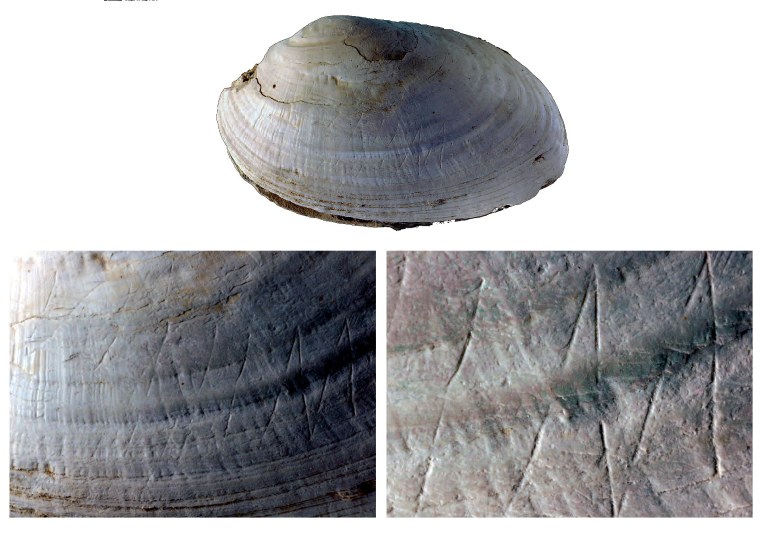
Progressively enlarged views of freshwater clam from Eugene Dubois's collecti9on from Trimil, showing clear evidence of deliberate engraving. (credit: Joordens et al., 2014 in Nature; photos by Wim Lustenhouwer, VU University Amsterdam
Progressively enlarged views of freshwater clam from Eugene Dubois’s collection from Trinil, showing clear evidence of deliberate engraving. (credit: Joordens et al., 2014 in Nature; photos by Wim Lustenhouwer, VU University Amsterdam)

Homo erectus clearly had a taste for freshwater clams and lots of their shells figure in the Trinil collection: all are of similar large size rather than showing a wide variation according to age, suggesting a shell midden rather than a natural assemblage. A piece of serendipity revealed what may prove to be the anthropological find of the year. High-quality photos of the shells taken by a visiting mollusc specialist showed up evidence that one of them had been meticulously engraved. Its surface had a near-perfectly geometric, zig-zag pattern deeply gouged by someone with a steady hand, who probably used an associated shark’s tooth as a scribing tool. Since the molluscs in life bear a dark, chitinous veneer the etching would have been more striking when freshly made. Another of these sturdy shells also show signs of having had its edge sharpened, suggesting that they were used for tools such as scrapers or graters.

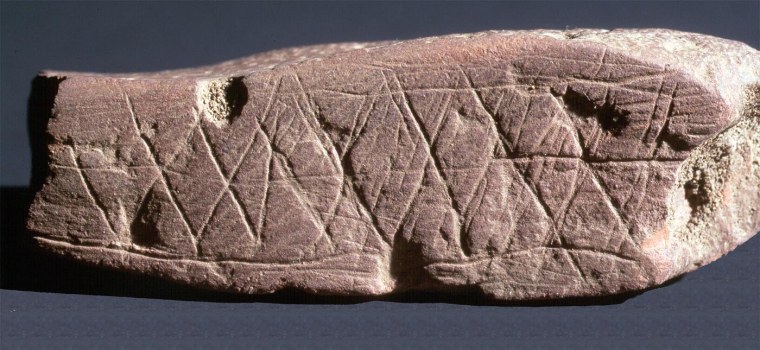
The stratigraphy at Trinil suggested that the engraved shell and tools were coeval with Homo erectus, but that needed proof. Using sediment grains trapped in the shells and a combination of 40Ar/39Ar and thermoluminescence dating, the team have shown that they and the human fossils from Trinil date to between 430 and 540 thousand years ago: at least 350 ka older than the very similar engravings made by an anatomically modern human on ochre that was found at Blombos Cave in South Africa. The next-oldest putative artwork is the controversial ‘Venus’ found at Berekhat Ram on the Israel-Syria border, dated between 250 and 280 ka.

Engraved ochre from Blombos Cave, South Africa. (credit Chris Henshilwood)
Engraved ochre from Blombos Cave, South Africa. (credit: Chris Henshilwood)

Probably the majority of palaeoanthropologists have dismissed humans other than ­H. sapiens as being cognitively incapable of either abstract or figurative art. The general view is that the mental capacity to create art or design began with the creation of the Blombos engraving, was restricted to anatomically modern humans and only exploded in Europe after they had migrated there by about 40 ka. A few argue that portable art, such as the Trinil and Blombos engravings, is bound by its very nature to be rare and easily overlooked. Whether having some use – counting? – merely being the making of an idle ‘doodle’ or expressing some unknowable ritual significance, the Trinil etching is a result of creativity and controlled skill that could only be the product of the H. erectus mind. Moreover, the very close comparison with the 0.35 Ma younger Blombos engraving suggests the product of a consciousness little different from that of our direct ancestors of 75 ka ago.

Are modern humans ‘domesticated’?

While animals, especially dogs, underwent domestication the deliberate or unconscious human choice of favoured physiological and behavioural traits produced distinct differences between the ancestral species and the ‘breeds’ with which we are now familiar. In general domestication has resulted in dogs with reduced jaws and flatter faces, lower aggression, especially in the case of males, and reduced stressfulness in the company of humans and other tame dogs compared with their wolf ancestors. It is widely accepted that cats have ‘tamed themselves’ through the adoption of lifestyles associated with the benefits of close association with human communities, which have resulted in similar adaptations to those in more deliberately domesticated dogs. It is beginning to dawn on anthropologists that human social evolution may unwittingly have affected the course of our own evolution. Tighter social bonding among growing sizes of communities as brain capacity increased and the behavioural and cognitive attributes needed for that have been summarised recently by a group associated with the Social Brain hypothesis of Robin Dunbar of Oxford University, UK (Gamble, C., Gowlett, J. & Dunbar, R.I.M. 2014. Thinking Big: How the Evolution of Social Life Shaped the Human Mind. ISBN-13: 978-0500051801;Thames and Hudson: London).

It was Charles Darwin who first speculated that ‘Man in many respects may be compared with those animals which have long been domesticated’. But to what extent does the hominin fossil record support such a view? Collaborators from Duke University and the University of Iowa, USA, have set out to analyse physiological changes over the last 200 ka that may be explained in this way (Cieri, R.L. et al. 2014. Craniofacial feminization,social tolerance and the origins of behavioural modernity. Current Anthropology, v. 55, p. 419-443. Includes discussion and responses). They used the degree of projection of brow ridges, facial shape and cranial volume from 3 groups of Homo sapiens remains: skulls older than 80 ka (13 specimens); spanning 38 to 80 ka (41) and from recent humans (1367). They found that brow ridges shrank significantly over the last 80 thousand years, faces shortened and cranial capacity decreased, especially among males. This resulted in a convergence in appearance between males and females, which the authors attributed to general lowering of testosterone and stress hormone levels through selection for greater social tolerance: akin to similar physiognomic changes in domesticated dogs which DNA analyses have shown to be been linked with modification of genes associated with aggression regulation. The finding among dogs suggests that their domestication is accomplished by slower development; i.e. young animals are naturally less fearful and have a greater tendency to taming. This delayed development from foetus to adulthood, with retention in mature individuals of juvenile characteristics, is known as neoteny, and affects all manner of adult characteristics, including coloration, snout length and the adrenal glands: as adult dogs now more resemble wolf pups, so human adults are more like young chimps than elders. At a conference where Cieri et al.’s results were presented, it was observed that hunter gatherer bands are intolerant, to the point of capital punishment, of wife stealers, murderers and seriously dishonest men, whereas such reactions fall off significantly among members of larger social groups involved in agriculture and urban life. Such modern behavioural patterns tally with brow ridge, face length and cranial capacity, perhaps linked with selection for personalities more attuned to cooperation.

English: comparison of Neanderthal and Modern ...
Comparison of Neanderthal and Modern human skulls from the Cleveland Museum of Natural History (credit: Wikipedia)

Although earlier human species, such as H. neanderthalensis, heidelbergensis and erectus had significantly different skull anatomy, each had prominent brow ridges that, on this account, may signify both greater exposure to testosterone and less social tolerance, and smaller group sizes. But, so far, analysis of the Neanderthal genome has not led to publication of any comments about testosterone or stress-hormone related genes. However, a clear strand of discussion is developing around evidence rather than mere speculation about psychological/cognitive aspects of human evolution that challenges the old-style ‘what-you-see-is-what-there-was’ (WYSWTW) archaeological dogma: a dialectic of social and biological relationships.

Human evolution news

Since discovery of its fossilised remains in Liang Bua cave on the Indonesian island of Flores was discovered in 2004 the diminutive Homo floresienesis, dubbed the ‘hobbit’ by the media, has remained a popular news item each time controversies surrounding it have flared. To mark the tenth anniversary  of its publication of a paper describing the remains Nature has summarised the recollections of many of those involved in trying to understand the significance of H. floresiensis (Callaway, E. 2014. Tales of the hobbit. Nature, v. 514, p. 422-426). Two main schools of thought continue in dispute, one holding that it is anatomically so different from anatomically modern humans and earlier members of the genus Homo that it constitutes a new species, despite its youngest member dating back only 18 ka, the other that it is H. sapiens, its tiny size having resulted from some kind of genetic disorder, such as microcephaly or Down’s syndrome. There have been so many attempts to expunge the idea of such an odd fossil cohabiting an island with fully modern humans yet being a different and perhaps extremely archaic species that such an outlook itself seems somewhat pathological.

English: Homo floresiensis, replica Deutsch: H...
Replica of the Homo floresiensis skull from Liang Bua cave, Flores, Indonesia (credit: Wikipedia)

The evidence presented to force H. floresiensis into a deformed human mould has never been convincing, and the best way of combating that view is to document from a ‘non-combatant ‘standpoint the many ways in which its anatomy differs from ours and how it might have arisen; a job to which Chris Stringer of the Museum of Natural History in London is amply qualified (Stringer, S. 2014. Small remains still pose big problems. Nature, v. 514, p. 427-429). He, like the original discoverers, feels this is a case of evolution of small stature due to a limited population being isolated for a long time on a relatively small island, which is just what happened to elephants that colonised Flores to become the pigmy Stegodon that H. floresiensis seemingly hunted. These tiny Flores dwellers (adults were about 1 m tall) used fire and made tools, similar ones dating as far back as ~1 Ma. Stringer mentions the possibility of first human colonisation about that time by Asian H. erectus but also the view that if it happened once there may have been several waves of immigration to Flores. The unusual ‘hobbit’ anatomy is not restricted to tiny size and a small skull and brain cavity (400 cm3), but includes odd hips, wrist bones, shoulder joint and collar bone. In fact the remains bear as much or more resemblance to australopithecines like ‘Lucy’ (3.2 Ma) than to other members of our genus, even H. erectus that has been proposed as its possible ancestor. Could they be far-travelled descendants of the 1.8 Ma old H. georgicus from Dmanisi in Georgia? More fossils clearly need to be found, and Stringer raises the possibility of the search being widened to other islands east of Java, such as Sulawesi, the Philippines and Timor. He hints that in such a tectonically active region tsunamis may have led to animals and humans saving themselves and then being current dispersed on rafts of broken vegetation, rather like some survivors of the 2004 Indian Ocean tsunami who ended up 150 miles from their homes by such a means.
Another story that is set to ‘run and run’ is that of ‘alien’ DNA in the human genome and productive relations between early out-of-Africa migrants with Neanderthals, Denisovans and perhaps yet a mysterious, earlier human species. The oldest (45 ka) anatomically modern human genome sequence so far charted is from a leg bone found by a mammoth-ivory prospector in Siberian permafrost (Fu, Q. and 27 others 2014. Genome sequence of a 45,000-year-old modern human from western Siberia. Nature, v. 514, p. 445-449). Like a great many living non-Africans this individual carried about 2 % Neanderthal DNA, but unlike living people the 45 ka genome has it in significantly longer segments. That allowed the authors to re-estimate the timing of the genetic flow from Neanderthals into the individual’s ancestors. Previous estimates from living DNA geve the possibility of that being between 37-86 ka, but this closer data suggests that it happened between 7 to 13 ka before the date of the fossil femur, i.e. narrowing it down to between 52 and 58 ka closer to the widely suggested time of African exodus around 60 ka (but see an Earth Pages item from September 2014)

More on human evolution here and here