Hominin updates

A new approach to 14C dating at the Oxford Radiocarbon Accelerator Unit at the University of Oxford UK, combined with detailed analysis of human teeth to distinguish fully modern human remains from those of Neanderthals has pushed back the date and pace of migration into Europe by people whose tools define the Aurignacian and Italian Uluzzian technologies. These are the earliest modern-human cultures found in Europe, but some of the tools are similar to those produced by Neanderthals (Châtelperronian culture), raising the possibility of transfer of technologies between the two groups. So, without confirmation from human remains of the anatomical affinities the would be doubts about using tools of these kinds to signify the presence at a site of full modern humans. Teeth found decades ago at caves in SW England and southern Italy prove, on detailed comparative study, to be from ‘moderns’ (Higham, T. And 12 others 2011. The earliest evidence for anatomically modern humans in northwestern Europe. Nature, v. 479, p. 521-524; Benazzi, S. And 13others 2011. Early dispersal of modern humans in Europe and implications for Neanderthal behaviour. Nature, v. 479, p. 525-528).The new carbon-isotope method  efficiently eliminates chemical contamination of material by post-fossilisation processes and so tend to increase the measured age of samples. The two studies produced exciting results: dates of occupation between 42-43 and 43-45 ka from SW England and southern Italy respectively. Together with results from other sites throughout central and southern Europe, the discovery shows that widespread colonisation was accomplished in three to five thousand years by migrants probably from the Levant, who may have travelled along three routes fanning out from the Bosporus in modern Turkey: along the Danube; along the Adriatic coast; from southern Greece to the ‘heel’ of Italy.

In early 2011 a group of archaeologists led by Simon Armitage of the University of Birmingham, UK reported stone tools from a cave in the United Arab Emirates for which they derived possible ages of 125, 95 and 40 ka (see Human migration in EPN for January 2011). The older dates were coeval with anatomically modern humans in the Levant, but the tools themselves showed features that could not be matched decisively with those from any other sites, including those in the Leant, though they most resembled collections from East and NE Africa. Armitage and colleagues suggested that the people who occupied the UAE cave had crossed the Red Sea at the time of the glacial maximum around 130 ka, at a time of unprecedented low sea level. A recent paper adds considerable weight to this idea (Rose, J.I. and 9 others 2011. The Nubian Complex of Dhofar, Oman: An African Middle Stone Age Industry in Southern Arabia at http://www.plosone.org/article/info%3Adoi%2F10.1371%2Fjournal.pone.0028239). Jeffrey Rose, also of the University of Birmingham, and colleagues from Ukraine, US, UK, Germany, the Czech Republic and Australia excavated site in Dhofar southern Oman, much closer to the Straits of Bab el Mandab than the UAE. Chert tools found in the area are of the Levallois type, specifically resembling closely those found widely in the Nile Valley of southern Egypt and northern Sudan, and in the Afar Depression of Ethiopia, in deposits dated between 128 to 74 ka. The Omani tools yielded an optically stimulated luminescence age of about 106 ka. This nicely confirms that Africans had moved far beyond the confines of their home continent by the last interglacial episode, with the route to South Asia open to them along the shores of the Persian Gulf and Indian Ocean. However, the route that they had taken could equally have been around the head of the Red Sea as across the Bab el Mandab.

Desert varnish: an outdoor canvas

Petroglyphs carved in desert varnish at the Va...
Petroglyphs in desert varnish near Las Vegas, Nevada, USA. Image via Wikipedia

Early occupants of semi-arid areas found a cultural use for what is one of geology’s greatest annoyances: desert varnish. Annoying because once developed it leaves an extremely durable brownish to black, shiny coating over rock surfaces: be they dunite, marble or quartzite, sandstone or granite, desert outcrops all look very much the same. You have to bash them unmercifully to see the true texture and mineralogy, and, except on images of thermally emitted infrared, remote sensing doesn’t help as the varnish has the same reflectance whatever the wavelength of radiation. Yet to the former inhabitants of dry lands – and latter day ‘taggers’ – desert varnish has been irresistible for millennia. Lightly peck away with a sharp pebble – and some ability to depict your thoughts – and you can leave an almost indelible sign that you and your ideas were at that very rock face: a petroglyph, picked out for all time in the manner of chalk on a blackboard. Even more spectacular, given an oversight of a varnished cobbly plain and it is possible to magnify your tag, or whatever petroglyphs once signified, a hundredfold or more. That happened on the famous Nazca Plain of Peru  and continues to do so in especially dry places in the south-western US, as around Lake Havasu City in Arizona. Varnish forms only on the exposed face of cobbles, the downward side remaining more or less the original rock’s colour; generally lighter. Turn over the cobbles in an organised way, with a degree of persistence as well as talent and you too can make your mark on Google Earth! (Do not pass this on to Banksy – it doesn’t hurt the ecosystem, but will annoy the authorities immensely).

Français : Lignes de Nazca au Pérou. Le contra...
Ancient art depicting a hummingbird on the Nazca Plain, Peru. Image via Wikipedia

For all this period of artistic endeavour, stretching back in some places to the Palaeolithic, it now seems that desert varnish also records how environments have changed as well as the religiosity, humour or downright egotism of its inhabitants (Dickerson, R. 2011. Desert varnish – nature’s smallest sedimentary formation. Geology Today, v. 27 (November-December issue), p. 216-219). As well as reviewing how the varnish forms (see also Desert varnish in EPN May 2008, in Subjects: GIS and Remote Sensing)., Dickerson flags-up the little-known fact that the minute layers produced as varnish imperceptibly develops record changes in environmental conditions – wet, dry and middling – and, moreover they can be dated precisely despite being extremely thin (e.g. Liu, T. & Broeker, W.S. 2008. Rock varnish microlamination dating of late Quaternary geomorphic features in the dry lands of wester USA. Geomorphology, v. 93, p. 501-523). Liu and Broeker were able to match variations in the colour of varnish layers with important climatic episodes of the Northern Hemisphere, such as the Younger Dryas and other warming-cooling, dry-wet shifts as far back as the Last Glacial Maximum. Their approach offers a chance of dating petroglyphs and thereby cultural changes during critical stages in the history of modern human migrations, occupations and abandonments, even when no artefacts or bones remain. That is because once made, petroglyphs gradually become varnished themselves.

Water sources and early migration from Africa

SeaWiFS collected this view of the Arabian Pen...
The Arabian Peninsula today. Image via Wikipedia

In March 2011 EPN reported in Human migration a puzzle relating to evidence for modern human occupation of Arabia on the southern shore of the Persian Gulf during the last Eemian interglacial at 125 and 95 ka. At that time sea level would have been as it is now, discouraging any attempt to cross the Red Sea via the Straits of Bab el Mandab; a widely suggested short-cut from East Africa to the rest of the world. Around 125 ka modern humans were making a living from coastal resources in Eritrea, leaving abundant stone tools in shoreline deposits at the head of the Gulf of Zula, and in the Sodmein Cave on Egypt’s Red Sea coast. They had also reached the famous Qafzeh and Skhul caves of Mount Carmel in today’s Israel around 100 thousand years ago. A route out of Africa through the Levant has not been widely favoured and the humans of Qafzeh and Skhul have been suggested to have reached a geographic cul-de-sac with no eastward exit because of the aridity of the Arabian Peninsula. Yet once in the Levant they could have skirted the desert interior by following the east coast of the Red Sea, and ‘strandloped’, as Jonathan Kingdon has dubbed following the coastline. But continuous access to fresh water would still have been essential.

The shores of the Red Sea preserve many examples of uplifted coral reefs, indeed signs of human presence in Eritrea occur in such a terrace. Being extremely porous, reef terraces are potential aquifers and a sign that they may have sourced freshwater springs is the conversion of the intricate coral skeletons from one form of calcium carbonate to another; original aragonite changes to calcite in the presence of fresh water, a complete replacement being estimated to take a thousand years of continual contact with fresh water. This change allowed Boaz Lazar and Mordechai Stein of the Hebrew University of Jerusalem and the Geological Survey of Israel to check for the presence of freshwater coastal springs in the past (Lazar, B. & Stein, M. 2011. Freshwater on the route of hominins out of Africa revealed by U-Th in Red Sea corals. Geology, v. 39, p. 1067-1070). Their test site was a series of uplifted reefs near Aqaba on the Red Sea coast of Jordan. The authors determined variations in the 230Th/238U ratio in the reefs relative to that of 234U/238U and showed open-system addition of 230Th and 234U during the aragonite to calcite recrystallization, that results in an isotopic compositional trend charting the timing of any alteration. Thus, the original age of reef terraces can be backtracked, revealing at Aqaba successively higher terraces formed recently and at 120, 142 and  190 ka. The oldest of the terraces seems to have been flooded with fresh water at the start of the Eemian interglacial (~140 ka), and may have been a source of springs that would have served the earliest human travellers well. It remains to use Lazar and Stein’s approach at other reef terraces along the postulated northern exit route for the earliest modern human emigrants from Africa and, more important, to find traces of their passage.

Added 21 December 2011. The likely route for leaving Africa got a push towards the Bab el Mandab with publication of evidence for a greener south Arabia at several times in the late Pleistocene (Rosenberg, T.M. and 8 others 2011. Humid periods in southern Arabia: Windows of opportunity for modern human dispersal. Geology, v. 39, p. 1115-1118). On the eastern edge of the now hyper-arid Rub al Khali are a series of former lakes with thin sediments. When first discovered they yielded radiocarbon ages of fossil molluscs of around 40 to 20 and 10.5 to 6 ka. However recent dating using optically stimulated luminescence (OSL) of the dune sands between which occur lacustrine muds and silts suggest that the lakes were water-filled  for lengthy periods  before those ages – radiocarbon dating can be reset to younger ages by precipitation of carbonates on older  fossils.  The OSL results show wet periods around 80, 100 and 125 ka, suggesting that around these times the Intertropical Convergence Zone was pulled northwards so taking seasonal monsoon rains well into the Arabian Peninsula. They tie in nicely with a variety of other parameters, including the timing of lowstands of the Red Sea. This created episodes a few thousand years long that would have been conducive to humans living there and passing through en route to Asia around eastern Arabia and perhaps to the Levant up the west side of the sub-continent. Potential occupancy was shut off by long arid periods, which might have allowed only pulses of migration. Had such episodic diffusion occurred it might have left a record in human DNA that ongoing and planned population genetic research may reveal.

Snippets on human evolution

Image copyright held by author, Chris Henshilw...
Artifacts from the Blombos Cave, South Africa, including deliberately etched block of hematite Image by Chris Henshilwood via Wikipedia

The news that most humans outside of Africa carry fragments of DNA that match with those of Neanderthals and the mysterious Denisovan archaic humans ( see Yes, it seems that they did… and Other rich hominin pickings in the May 2010 issue of EPN) has entered into popular culture; or soon will have! Similar dalliances with the ‘older folk’ seem also to have occurred among those humans who remained in Africa (Hammer, M.F. et al. 2011. Genetic evidence for archaic admixture in Africa. Proceedings of the National Academy of Sciences, v. 108, p. 15123-15128). The DNA of three groups in West Africa who maintain a hunter-gatherer lifestyles show regions that are not involved in coding for proteins that differ from the African norm. This suggests mating with an entirely separate and unknown group of hominins – probably archaic forms of humans – that produced fertile offspring, probably around 35 thousand years ago. The find spurred re-evaluation of bones with a mix of archaic and modern features that were discovered in a Nigerian cave in the 1960s (Harvati, K. et al. 2011. The Later Stone Age Calvaria from Iwo Eleru, Nigeria: Morphology and Chronology. PLoS ONE, v.  6: e24024. doi:10.1371/journal.pone.0024024). The study confirms that the skulls are outside the fully modern human range, but display a close similarity with Neanderthal and H. erectus. The big surprise is that U-Th dating suggests they are quite recent, around 16 ka. The stage seems set for nor only a burst of exploration for human remains of less antiquity than early hominins but a ‘paradigm shift’ in our view of what constitutes a human species.

See also: Gibbons, A. 2011, African data bolster new view of modern human origins. Science, v. 334, p. 167.

Another interesting link with archaic humans who had the closest of relationships with some of our ancestors is that their union may have bolstered the resistance of migrants from Africa to Eurasian pathogens (Abi-Rached, L. and 22 others 2011. The shaping of modern human immune systems by multiregional admixture with archaic humans. Science, v. 334, p. 89-94). The focus was on the human leucocyte antigen (HLA) group that is a vital part of our immune system in the form of ‘killer cells’. Part of modern Eurasian DNA that codes for the group (HLA-B*73 allele) appears in the Neanderthal and Denisovan genomes; indeed more than half the HLA alleles of modern Eurasians may have originated in this way, and have also been introduced into Africans subsequently.

Also at the front line of genomic research into human origins, DNA sequenced from a lock of hair given to an Edwardian anthropologist by a native Australian turns out to have an extreme antiquity compared with that of other Eurasian people descended from African migrants (Rasmussen, M. and 57 others. An aboriginal Australian genome reveals separate human dispersals into Asia. Science, v. 334, p. 94-98). The unique aspects of the Australian genome signify separation of a group of individuals from the main African population around 62-75 thousand years ago; significantly earlier than and different from ‘run of the mill’ migrants from whom modern Asians arose at between 25 to 38 ka. There is little doubt that native Australians are descended from the pioneers who first diffused from Africa either by crossing the Straits of Bab el Mandab or taking another route and they moved more speedily across southern Asia than other waves made possible by climate change and sea-level falls following the Eemian interglacial of 133-115 ka.

Despite the lingering Eurocentrist view that somehow fully modern human consciousness sprang into being at the time the famous French and Spanish cave art was painted, around 30 ka, increasing evidence points to an African origin for a sense of aesthetics and the ability to express it. The latest is the discovery of a 100 ka ‘paint box’ in a South African coastal cave (Henshilwood, C.S. et al. 2011. A 100,000-year-old ochre-processing workshop at Blombos Cave, South Africa. Science, v. 334, p. 219-223). The material consists of two large abalone shells containing traces of red and orange ochre, together with a hammer stone and grinder with adhering ochre, and fat-rich bones which ground-up would have produced a binder for the ochre. No art occurs in the cave and it might be supposed that the pigments were intended for face- or body adornment.

Another candidate for earliest, direct human ancestor

The cranium of Malapa Hominid 1, Holotype of A...
The head of Australopithecus sediba. Image via Wikipedia

In May 2010 EPN commented on a new find from the famous fossil-rich caves of north-eastern South Africa; a new hominin species called Australopithecus sediba. At least one of them fell into a deathtrap shaft, died and remained unchewed without bones being spread far and wide. Inevitably, near-complete skeletons of individual hominins are soon pored over by dozens of specialists in human evolution, as they were for the much older Ardepithecus ramidus found in sediments of Ethiopia’s Afar Depression (see Early hominin takes over Science magazine in the November 2009 issue of EPN). Now there are two near-complete, well-preserved skeletons of Au. sediba and the palaeoanthropological world is agog. Dating to about 1.98 Ma the specimens represent the same time as do far less impressive remains of H habilis from Tanzania that were found with associated rudimentary stone tools. The first hint (just a fragment of upper jaw) of any remains that might be tagged ‘Homo’ dates to 2.3 Ma and is from Ethiopia, as are the first undoubted stone tools going back as far as 2.5 Ma, though lacking association with a maker.

Five consecutive papers on Au. Sediba occupy 22 pages in the 9 September 2011 issue of Science and make for startling reading. The first concerns the shape of its brain case, and therefore crudely its brain, discerned by tomographic X-ray scanning (Carlson, K.J. et al. 2011. The endocast of MH1, Australopithecus sediba. Science, v. 333, p. 1402-1407). It isn’t any bigger than that of other members of the genus but shows ‘some foreshadowing of the human frontal lobes’ and other shifts from the basic ape model that the authors imply are en route to human features. The next considers the two pelvis regions (Kibii, J.M. et al. 2011. A partial pelvis of Australopithecus sediba. Science, v. 333, p. 1407-1411); again australopithecine-like in the small size of the birth canal but with a hint of the S-shape of humans. Most astonishingly well-preserved are the fragile bones of a complete hand (Kivell, T.L.  et al. 2011. Australopithecus sediba hand demonstrates mosaic evolution of locomotor and manipulative abilities. Science, v. 333, p. 1411-1417), which convincingly shows the long thumb and short fingers (for a primate) that characterise Homo and are essential for a precision grip and making things. Actually, the thumb is longer relative to fingers (60%) than in humans (54%), but Lucy’s (Au. afarensis) was a closer match. No tools that such a hand might have created and wielded were found with the fossils. Then there is the foot (Zipfel, B. et al. 2011. The foot and ankle of Australopithecus sediba. Science, v. 333, p. 1417-1420), which, again, mixes human and australopithecine features, giving ‘a unique form of bipedality and some degree of arboreality’. The fifth paper (Pickering, R. et al. 2011. Australopithecus sediba at 1.977 Ma and implications for the origins of the genus Homo. Science, v. 333, p. 1417-1420) is as remarkable for the precision of U-Pb dating of speleothem (cave carbonates), which at 1.977+0.002 Ma far exceeds the workhorse Ar-Ar method used for most other hominins, as it is for the absolute age that precedes that of undisputed remains of humans.

In short, for Australopithecus sediba there is an embarrassment of riches unmatched until those of the 1.5 Ma old H. erectus (‘Turkana Boy’) found at Nariokotome in NW Kenya. To some extent this throws a flock of peregrines in among the palaeoanthropology pigeons, as an account of a meeting earlier in 2011, at which the bones were grandstanded, shows (Gibbons, A. 2011. Skeletons present an exquisite paleo-puzzle. Science, v. 333, p. 1370). Naturally, the authors are making the most of their material especially, it seems, its finder Lee Berger of the University of Witwatersrand, South Africa, the last author in all the papers. Comparisons with more australopithecine remains were said to be needed. The soon-to-be-famous hand has been said to be essentially like others from the same genus. While the remains of the creature’s pelvis could imply that its evolution was more driven by a need for efficient upright walking than to birth big-headed babies, the ankle shows a primitive trait that would have forced Australopithecus sediba to walk strangely as the heel bone is small and angled unlike that in human feet, which is broad and flat. But all the species’s features are combined in two near-complete individuals, whereas for the rest of its contemporaries, predecessors and near successors in time speculation is based on fragments of several individuals, none more so than in the case of the earliest agreed human, near contemporaneous H. habilis, which barely stands up to taxonomic scrutiny (Gibbons, A. 2011. Who was Homo habilis – and was it really Homo?  Science, v. 332, p. 1370-1371). Some would say that it was only the associated stone tools that assigned ‘Handy Man’ to more elevated status than slightly large-headed australopithecine. The fact is; stone tools were around since 2.5 Ma, at least in Ethiopia, and this newly found being could have handled them and even made them with its palpable dexterity. Finding tools and skeletons together is almost as rare as hens with teeth…

First bi-face tools and Homo erectus

ארקטוס
Reconstruction of H. erectus face. Image via Wikipedia

The elegant pear-shaped, double edged tool, known as the Acheulean ‘hand-axe’ is an icon for the distant past of humans. It appears in the record as a sharp contrast to the earlier crude cutting tools made of broken and sharpened pebbles, known generally as Oldowan, that around 2.5 Ma marked the appearance of some hominin species with the wit to exploit the inorganic world and begin manufacture. There can be little doubt that the visualisation of a useful shape within a formless block of stone and the dexterity to realise it as a tool marked a major change in human cognitive ability.

This article can be read in full at Earth-logs in the Human evolution and migrations archive for 2011

Homes for hominin evolution

African savannah exhibit at the National Zoolo...
Typical African savannah. Image via Wikipedia

Friedrich Engels’s notion in The Part Played by Labour in the Transition from Ape to Man (1876), encouraged by Darwin’s The Descent of Man (1871), that the road to modern humans began with walking on two legs, thereby freeing the hands for work and tool making has been central to discussion of human evolution for more than a century. The ‘descent from the trees’ that bipedalism signifies has long been supposed to stem from the replacement of tropical forests in East Africa by open woodland or savannah, but evidence to support that environmental change has been difficult to glean from the fossil record  since the Late Miocene. Even in terrestrial sediments plant remains are rare, so that much has rested on animal fossils in relation to the habitats of their living descendants: opinion is divided.

There is a round-about means of resolving this central issue: using the carbon-isotope record in fossil soils that depends on the fractionation effects of broadly different kinds of plants that once grew in the soils and the signature of that fractionation in carbonate nodules that formed in the soils. The d13C value (crudely the difference between the 13C/12C ratio of a sample and that of a carbon-rich standard) found in C4 plants (many grasses) is -16 to -10 ‰ whereas that in C3 plants (including almost all trees) it is much more depleted in the heavier 13C isotope (-33 to -24‰). Exchange of carbon between living and dead organic matter, and carbonates that are precipitated from soil waters through the intermediary of gases in the soil should leave a d13C signature in the carbonates that reflects the overall proportions of different photosynthetic plant groups living at the time the soil formed. The approach was developed in the early 1990s by Thure Cerling and Jay Quade of the US universities of Utah and Arizona respectively.

After a long gestation period, involving calibration using soils from different modern ecosystems, the soil C-isotope method has been applied painstakingly to palaeosols in which African hominin remains have turned-up (Cerling, T.E. and 9 others 2011. Woody cover and hominin environments in the past 6 million years. Nature, v. 476, p. 51-56). All the famous hominin sites from the Awash and Omo Valleys of Ethiopia and around Lake Turkana in Kenya, figure in this important study, in which the authors devise a proxy for ‘palaeo-shade’ based on their carbonate d13C data from 76 modern tropical soils: a good ‘straight-line’ plot of d13C against the fraction of woody cover at the different calibration sites. Applying the proxy to their 1300 samples of palaeosols they show convincingly that since about 6 Ma tree cover rarely rose above 40% in the homelands of all the East African hominins. From the times of Ardepithecus ramidus (~4 Ma) at Aramis in Ethiopia, through those of ‘Selam’ and ‘Lucy’, the 2.5 Ma first stone tools at Gona, the times when Africa was dominated by Homo erectus(1.8 to 1 Ma) to perhaps the first signs of modern human cranial remains (those with chins!) around 1 Ma, all hominins strode through open, grassy environments. One can imagine pleasured nods from the shades of Darwin and Engels now their prescience has finally been confirmed.

Hominin round-up

The skull of Australopithecus africanus so-cal...
Australopithecus africanus from Sterkfontein cave, South Africa. Image via Wikipedia

Strontium isotopes and australopithecine habits

Viewers of Channel 4’s Time Team will be used to seeing eating habits and places of habitation being derived from strontium isotopic analyses of the teeth of modern humans found by archaeologists. The methods enabled scientists to work out where ‘Ötzi the Iceman’, whose mummified remains were found on the alpine border of Austria and Italy, hailed from: it was most likely to have been the South Tyrol province of Italy. Other isotopes (nitrogen and carbon) shows that he was predominantly vegetarian; i.e. he was neither a hunter, nor an especially privileged member of Tyrolean Chalcolithic society.

The same methods offer insights into the life styles of far earlier hominins and has recently been used on teeth of australopithecines (Australopithecus africanus and Paranthropus robustus) found in the famous Sterkfontein and Swartkrans caves South Africa (Copeland, S.R. et al. 2011. Strontium isotope evidence for landscape use by early hominins. Nature, v. 474, p. 76-78). The caves formed in Precambrian dolomites and it was expected that all the teeth would show signs that the individuals from whose jaws they were collected lived their entire lives in a small tract of dolomites (~30 km2) surrounding the caves. For large individuals that was indeed the case, but teeth from smaller fossils show 87Sr/86Sr ratios that are significantly different from those characteristic of local rocks and soils. That suggests the smaller individuals came from further afield than the restricted tract of carbonate strata. Although pelvic remains are normally the best guide to the sex of primate fossils, they are less frequently found than those of crania and dentition. Size variations of adults in a primate species, however, may indicate sexual dimorphism – larger males than females – and this is well-accepted for australopithecines. The implication is that for both species males had small home ranges on the dolomites, or that they preferred that tract. Yet females had dispersed from their parental groups and moved into the area.

Most living primates do not show this kind of sexual dispersion pattern, termed male philopatry,  it being common among modern humans, chimpanzees and bonobos. In the case of the australopithecines that were being studied, both were diminutive creatures living in open savannah with risks of predation from a range of large carnivores. Perhaps the bands living in the dolomite area had better refuges in caves than those elsewhere, and therefore able to attract females.

Arctic Neanderthals

Mousterian Point
A Mousterian stone point, possibly for a spear. Image via Wikipedia

The last Neanderthals known to have been alive were close to the southernmost limit of Europe, in caves on the Rock of Gibraltar at about 24 ka, shortly before the last glacial maximum. Their remains have been found in a >6000 km west-east zone at temperate latitudes, south of 50°N, which extended from western Europe to the Denisova cave in the Altai republic of Russia (50°N, 87°E). This suggests that they subsisted in deciduous woodland and temperate steppe, diffusing southwards as conditions cooled during 2 or 3 past glacial periods. Consequently, sites at higher northern latitudes that preserve only cultural remains – Palaeolithic tools – have hitherto been regarded as signs of fully modern human occupation; it takes considerable skill to distinguish Neanderthal from early modern human artefacts, which are very similar during the time of overlapping occupation (~40-30 ka). A site in northern Siberia at Byzovaya  in the Polar Urals, close to the Arctic circle, is a case in point. A French, Norwegian and Russian team of archaeologists re-examined the site (Slimak, L. et al. 2011. Late Mousterian persistence near the Arctic Circle. Science, v. 332, p. 841-845) and dated it to between 31-34 ka. They also analysed a suite of stone tools, finding that they are directly comparable with Mousterian (Middle Palaeolithic) implements from western Europe rather than products of modern human’s industry of similar antiquity. At that time high-latitude climate was well on its way to frigid, dry conditions (there were no substantial continental ice sheets in northern Russia). The animal remains found at the site were dominated by those of mammoth, with minor proportions of other cold-steppe large mammals, such as woolly rhino, musk ox, horse and bear.

A notable feature of the results is that they suggest that Neanderthals, or others people with a Mousterian culture, were occupying this bleak terrain at roughly the same time as modern humans, who left considerably richer suites of artefacts, including tools, ornaments and figurines carved from bone and ivory, but were after more or less the same prey species. Both groups clearly were able to cope with and thrive on the harsh conditions, until recently only within the scope of highly specialised cultures such as the Innuit and original Siberian peoples. The dating shows that whoever produced and used the Mousterian tools not only shared the terrane with modern humans, but lingered until well after the previously accepted time (~37 ka) of the Neanderthals’ demise except for a few refuges in the Iberian Peninsula and Balkans. Despite the occupation of northern Siberia by different cultural groups, until their bones are found who they were is not certain. Denisova Cave showed that Neanderthals and the genetically different Denisovans co-occupied temperate central Siberia (see Other rich hominin pickings in the May 2010 issue of EPN) so there are currently two options.

Clovis first hypothesis refuted

Examples of Clovis points
Clovis blades. Image via Wikipedia

For decades palaeoanthropologists studying the Americas were dominated by a single idea; that nobody entered the continents before those people who used the elegant fluted spear blades first found near Clovis, New Mexico in the 1930s. These were eventually dated at a maximum age of around 13 ka before the present. One reason for accepting the Clovis people as the first Americans, apart from the lack of conclusive evidence for any earlier occupation, was the fact that glaciers blocked the route from the Bering land bridge of the last Ice age until about 13 ka. But migration may have been possible as far back as 30 ka along the Pacific coast after people crossed the Beringia flatlands exposed by fallen sea-level . There have been suggestions of pre-Clovis sites, but none have carried the weight of evidence to shift the majority from their position. This now has to change because of very high-quality evidence from a site in Texas (Waters, M.R.and 12 others 2011. The Buttermilk Creek complex and the origins of Clovis at the Debra L. Friedkin site, Texas. Science, v. 331, p. 1599-1603). The site in question is in sediments that lie beneath those containing Clovis style tools. In fact it has yielded more than 15 thousand items that are well made, but bear little comparison with  the iconic Clovis tools. Almost 50 optically stimulated luminescence (OSL, based on time of burial after exposure to sunlight) dates show a clear increase in age with depth in the excavations, some reaching back as far as 33 ka. The authors favour a conservative approach and restrict their estimated ages to those artefacts found in a well defined stratigraphic horizon, which span the range 13.2 to 15.5 ka. The Clovis-first case seems to be closed, but a new phase in North America aimed at pushing back the time of first human colonising will undoubtedly begin now.

Early bi-face tools from South India

Assorted tools, including biface ‘hand axes, from Attirampakkam. Figure 2 Pappu et al 2011, with kind permission of the authors.

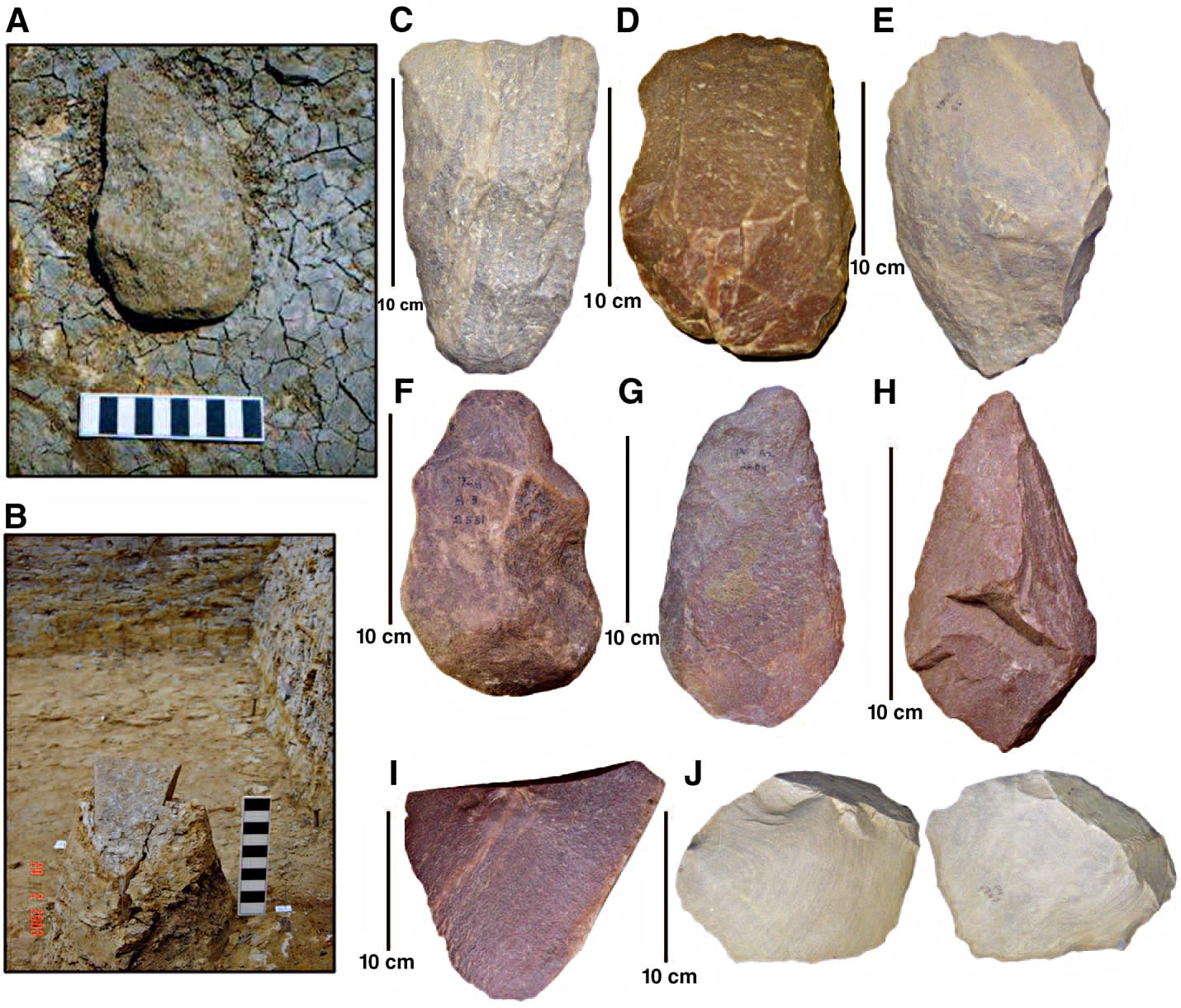
One of the most familiar icons of archaeology, the biface or Acheulean ‘hand axe’ was invented in Africa, presumably by H. ergaster, about 1.6 Ma ago and apart from in the Middle East, where it first occurs around 1.4 Ma, elsewhere it seemed to have been a late arrival in the artefact record. Human colonisation of Asia began as early as 1.8 Ma ago, so in its absence those early arrivals have been assumed not to have brought the Acheulean technology but used less elegant tools similar to the earliest Oldowan edged pebbles. Although parts of Asia were occupied by H. erectus until as recently as ~20 ka, they are believed not to have managed the biface breakthrough.  It has been widely accepted that abundant biface tools in India date from about 500 ka ago, presumed to have been brought by H. heidelbergensis migrants. An object lesson in the way that new techniques rather than new archaeological sites can dramatically change such long-held notions has emerged from excavations at Attirampakkam about 30 km NW of Chennai (Madras) in South India (Pappu, S. et al. 2011. Early Pleistocene presence of Acheulian hominins in South India. Science, v. 331, p. 1596-1599). This was the site where Palaeolithic tools were first unearthed  in the sub-continent by Robert Bruce Foote in 1863. The Indo-French research team used the cosmogenic isotope- and magnetostratigraphic dating methods to estimate when the tools were buried and discovered a much earlier age than expected, between 1.0 to 1.5 Ma. That throws into question the assumption of younger ages in general for the Acheulean technology in India, but more important, suggests that there was an eastward wave of migration from Africa shortly after the invention of biface tools. A wave of re-evaluation of the somewhat confusing Asian record of early humans seems on the cards.

See also: Dennell, R. 2011. Earlier Acheulian arrival in South Asia. Science, v. 331, p. 1532-1533

Human migration: latest news

SeaWiFS collected this view of the Arabian Pen...
The Arabian Peninsula. Image via Wikipedia

A widely accepted view of the departure from Africa of anatomically modern humans to colonise the rest of the habitable world is that it involved them crossing the Straits of Bab el Mandab in the southern Red Sea and following coastlines around Arabia and thence to the rest of Eurasia. That crossing would have become possible when sea level had fallen by more than 80m to expose much of the shelf between southern Eritrea and Yemen; a level that was reached during a glacial stadial from 60 to 70 ka as climate cooled erratically to reach the last glacial maximum. That hypothesis focused archaeologists on the narrow coastal fringe of Arabia in the search for remnants of human occupation. Indeed there have been discoveries of Palaeolithic stone tools in caves and rock shelters in southern and central Oman, and lately in the United Arab Emirates close to the Straits of Hormuz at the outlet of the Persian Gulf (Armitage, S.J. et al. 2011. The southern route ‘out of Africa’: evidence for an early expansion of modern humans into Arabia. Science, v. 331, p. 453-456). The trouble is that optically stimulated luminescence (OSL) dating of the UAE site (Jebel Faya) yielded ages of around 125, 95 and 40 ka for the tool-bearing layers; during the last (Eemian) interglacial, the early cooling in the succeeding glacial epoch and just before the last glacial maximum, respectively. For the two oldest ages sea level would have been high and the Bab el Mandab as wide as it is nowadays.

Armitage et al. focus on the stone tool kits at the site, finding them substantially different from any known Palaeolithic artifacts. The oldest tools are about the same age as those found at sites in the Levant (occupations at ~120 and 80 ka), but unlike them. The best match is with coeval tools from E and NE Africa. Accepting that view could point to a much earlier migration from Africa than currently accepted: probably during the previous glacial maximum (130-140 ka) as proposed by Armitage et al. when crossing the Red Sea would have been even easier because sea level had by then fallen 120 m. Alternatively, the anatomically modern human sites of the Levant may represent ‘waypoints’ along a northerly exodus. That has some geographic support as the narrow Nile flood plain would have provided continuous subsistence for gatherer hunters moving along it throughout even the most arid times. Yet before the  hyperarid, and probably impassable desert would have separated the Levant from the Tigris Euphrates plains en route eastwards. Yet there is no evidence, other than their morphology, that the Jebel Faya tools were made by modern humans; skeletal remains are yet to be found and the tools could have been made by more archaic humans from a much earlier diaspora. Until tangible evidence of their association with anatomically modern humans emerges from Jebel Faya or other old Arabian sites, Neanderthals or, quite conceivably, H. erectus remain candidates. Perhaps, however, Jebel Faya presents a sign of a soon-to-come shift in ideas about human migration.

Morocco at the opposite side of the African continent also hosts a potentially revolutionizing discovery at the Grotte des Contrabandiers on the Atlantic coast (Balter, M. 2011. Was North Africa the launch pad for modern human migrations? Science, v. 331, p. 20-23). The cave revealed 108 ka remains of an 8 year-old child. Like other human fossils in Morocco and across North Africa, the child has much larger teeth than other contemporary Africans; a trait shared with some of the earliest anatomically modern human fossils outside the continent, including those found in the Levant. Merely following the Mediterranean coast would have brought migrants of this group into the Levant. Indeed there are old sites all along the Maghreb shore and in the Saharan interior that yield tool kits similar to those of the Grotte des Contrabandiers, which interestingly include triangular blades that may have been arrowheads or spear points. This surprisingly advanced culture, which also contains shell ornaments, has yielded ages up to 145ka. More archaic human remains on the Atlantic coast date to 160 ka suggest that modern-human occupation of North Africa may have been almost as prolonged as that of Ethiopia.

So, there are now two candidate groups of modern humans for populating the rest of the world: those of NE Africa (Nile to Levant and/or via Bab el Mandab to Yemen) and those of North Africa. Using records of past sea level and climate there is scope for hypothesizing multiple migrations. Since early migrants entered unknown territories they did not set out purposively to colonise them. But provided there were navigable and survivable routes simple diffusion could take people far and wide in radiometrically brief periods (order of 1-5 ka) as they followed similarly migrating prey species. As regards sea-level, it was low enough for the Bab el Mandab crossing (and that of the Straits of Hormuz) to be feasible during several stadials of the 240-130 ka glacial, and seashore resources would have sustained migrants hugging the coast during the aridity that accompanies low global mean surface temperatures. The desert stretching from northern Syria to Aqaba on the Red Sea, is passable now during periods of high rainfall, as it would have been during the Eemian interglacial. Yet there is every reason to believe it would have become far more arid in colder global climates; a major barrier to migration.

That humans reached India before crossing the Bab el Mandab was probably not feasible because of high sea level has been suggested from stone tools that occur below a 74 ka volcanic ash layer in Andhra Pradesh, India. The tools lie above sediments with a 77 ka date, and have Middle Palaeolithic characteristics, although that alone does not necessarily signify that they were made by modern humans. If they were then that suggests a route from the Levant eastwards. The search is on for anatomically human remains in Arabia and also in India, although whether they have been preserved in the acid tropical soils of southern India is less likely than in more arid regions.

See also: Petraglia, M.D. 2011. Trailblazers across Arabia. Nature, v. 470, p. 50-51

Neanderthals: diet, gait and ornamentation

map of main sites where classical Neandertal f...
Image via Wikipedia

Anyone who has followed British TV series featuring the survival specialist Ray Mears will be well aware of the wealth of wild foods available from plants even in cold climes: Mears is famous for persuading his camera crews to try what he eats when ‘out bush’. Surviving gatherer-hunters, such as the native people of Australia, have encyclopaedic knowledge of what is edible and how to find plant victuals, and we can surmise that such skills date back to the earliest hominins. Neanderthals have been widely regarded as being exclusive meat eaters – the Innuit of Greenland can subsist on a meat- and fish-only diet, showing that it is a perfectly wholesome strategy – but new evidence reveals that they also ate a wide variety of vegetables, and cooked them. Neanderthals suffered from plaque (calculus) and that dental biofilm preserves traces of their diet (Henry, A. G. et al. 2010. Microfossils in calculus demonstrate consumption of plants and cooked foods in Neanderthal diets (Shanidar III, Iraq; Spy I and II, Belgium), Proceedings of the National Academy of Sciences, doi/10.1073/pnas.1016868108). Teeth from the famous Neanderthal sites of Shanidar in Iraq and Spy in Belgium had substantial plaque deposits. The authors found a wide variety of starch grains and silica-bearing hard parts that are characteristic of a wide range of plants (phytoliths) embedded in the plaques. Food plants included grasses, such as wild barley and sorghum; starchy roots, such as water lily; date palm, and a wide variety of starch grains and phytoliths that proved difficult to link to specific plants. Clearly, Neanderthals were not exclusively hunters of large and small game. The exclusively hunting hypothesis arose from analysis of fossilized fecal matter preserved with Neanderthal remains in occupation sites dating to the onset of frigid conditions in Europe, and in any case only shows what their producer’s last few meals contained. We can expect a closer look at teeth of other hominins from now on, as mineralized plaque is almost as indestructible as teeth themselves.

Neanderthals definitely did hunt, and evidence is that they were able regularly to bring down enormous beasts such as elephants and rhinoceroses. The question is, did they have to chase their prey animals so that they weakened through heat exhaustion before the kill, as in the case of the San hunters of SW Africa? To do that they would have had to be endurance runners. Comparing their ankle bones with those of modern humans suggests they were not very athletic in this way. (Raichlen, S.A. et al. 2011. Calcaneus length determines running economy: Implications for endurance running performance in modern humans and Neandertals. Journal of Human Evolution, v. 60, p. 299-308). Running well and keeping it up over long distances depends to a large extent on the efficiency of the Achilles tendon, the largest in the whole body: it literally puts a ‘spring in the step’ and couples muscle power to the role of feet in running. The calcaneus bone in the ankle provides leverage from the elastic storage of power in the Achilles, so its length is a guide to running efficiency. Neanderthals had a longer calcaneus than modern humans and probably had to spend considerably more muscular energy in keeping up with prey; they would have tired more quickly. The authors put this down to an evolutionary adaptation in cold climes to the lesser chance of prey animals succumbing to heat exhaustion. That would also perhaps explain evidence from other parts of Neanderthal skeletons for severe injuries, probably caused during hunting. They probably used ambush techniques and close-quarters stabbing with spears; a very risky strategy with unexhausted  big game.

Interestingly, close on the heels of the Neanderthal Achilles tendon work a newly discovered foot bone of Australopithecus afarensis (Ward, C.V. et al. 2011. Complete fourth metatarsal and arches in the foot of Australopithecus afarensis. Science, v. 331, p. 750-753)  shows that, like us, it had arches whereas modern apes do not. This seems to settle a lengthy debate about how australopithecines walked – they are long acknowledged to have been at least part bipedal. The 4th metatarsal is crucial: in apes its shape gives the flexibility needed to negotiate and grip branches, whilst in Homo sp. it endows the foot with the rigidity and stability to balance, absorb shock and use the toes efficiently in walking.  This is pretty fundamental stuff en route to ‘proper’ humans, yet skull morphology dominates discussion of hominin anatomical relationships: the earliest tools (~3.4 Ma; see Another big surprise in EPN of September 2010) are a million years older than the earliest human, H. habilis. But they overlap in age with and occur in the same area as Australopithecus afarensis. So, should these beings actually be renamed H. afarensis?

Tantalising glimpses suggesting that Neanderthals were not brutes, such as possible shell jewellery, use of pigments and scattering of flowers at burials, has been accumulating for years. The latest has been unearthed from a cave in the north of Italy, in association with Levallois tools that are distinctive of Neanderthals (Peresani, M. et al. 2011. Late Neandertals and the intentional removal of feathers as evidenced from bird bone taphonomy at Fumane Cave 44 ky B.P., Italy. Proceedings of the National Academy of Sciences, doi:10.1073/pnas.1016212108). Wing bones of vultures, eagles, owls, crows and various other birds show grooves and scratches suggesting that the long flight feathers had been carefully removed: there isn’t much meat on a wing. Since fletched arrows are believed not to have been invented until much later times, it seems pretty certain that the feathers were aimed at personal adornment, or even clothing. The evidence is very convincing and so helps confirm earlier suspicions of feather-use from wing bones found at a variety of Neanderthal sites. Some hollow bird bones are also suspected of having been used as whistles. Given the recent genetic evidence of their sexual interaction with anatomically modern humans, gradual build-up of signs of a rich cultural life make the Neanderthals significantly more attractive than the famous view of geneticist Steve Jones in 1994 that ‘If you met an unwashed Cro Magnon dressed in a business suit on the Underground, you would probably change seats.  If you met a similarly garbed Neanderthal, you would undoubtedly change trains’.

Assorted developments in palaeoanthropology

The notion that Neanderthals were dim and brutish compared with us continues to be undermined, but although their brain capacity was as large and in some cases distinctly larger than that of fully modern humans, its shape was significantly different; longer towards the rear than our more rounded brain. Studies of a Neanderthal baby and three children reveal that just after birth the Neanderthal brain was virtually identical to that of fully modern babies, i.e. elongate, but remains so in childhood through to maturity, whereas modern children’s brains develop towards the roundness of adults. Consequently, there must have been differences in the parts of the brain from which aspects of behaviour stem: Neanderthals almost certainly behaved differently from us both in childhood and as adults (Harvati, K. et al. 2010. Evolution of middle-late Pleistocene human cranio-facial form: a 3-D approach. Journal of Human Evolution, v. 59, p. 445-464. See also: Gibbons, A. 2010. Neandertal brain growth shows a head start for moderns. Science, v. 330, p. 900-901).

The now widely accepted hypothesis that modern humans did not begin to leave Africa to colonise Eurasia until about 60 ka may be under threat from reports of what seem to be fully modern human remains in China dated to ~105 ka (Liu, W. et al. 2010. Human remains from Zhirendong, South China, and modern human emergence in East Asia. Proceedings of the National Academy of the US, v. 107, p. 19201-19206). The dating appears to be sound, being based on the uranium-series (230Th) method applied to flowstone that rests on top of the sedimentary layer containing the remains in Zhirendong cave. The precipitated calcite layer completely sealed in the fossils as soon as it began to form about 105 ka ago, indicating that they are older still. Whether or not the remains are of fully modern humans is uncertain. Had they been found in Europe there would be little doubt about their affinities, the only other contemporary hominins being the Neanderthals. The problem in South China is that it was inhabited by H. erectus and the finds may be from ‘late’ members of that archaic species which arrived more than a million years earlier than fully modern humans. Judging by the DNA evidence for three interfertile hominin genetic groups cohabiting Eurasia, there is a host of possibilities for the Zhirendong fossils. One line of evidence that does not rule out that they are fully modern is the occurrence of stone tools more advanced than used by Asian H. erectus beneath the 74 ka Toba volcanic ash in India. It seems inevitable that these remains will be tried for DNA sequencing

See also: Dennell, R. 2010. Early Homo sapiens in China. Nature, v. 468, 512-513

It is well accepted that as with all forms of life the twists and turns in hominin evolution was surely tuned by changes in their environments. But that is not just linked to the immediate milieu of individuals: environments change on all scales up to that of the entire planet and reflect physical as well as biological processes. The largest scales are generally assumed to be the province of climate change, yet animals also occupy a landscape subject to geophysical forces such as tectonics and erosion. Geoffrey Bailey and Geoffrey King of the University of York, UK and the Institute de Physique du Globe in Paris, France have championed the view that water supplies and topography, for example, are just as influential over hominin evolution as interspecies competition and changing vegetation patterns for almost two decades. They have now put their ideas to rigorous tests (Bailey, G.N.& King, G.C., 2010 (in press) Dynamic landscapes and human dispersal patterns: Tectonics, coastlines, and the reconstruction of human habitats. Quaternary Science Reviews doi:10.1016/j.quascirev.2010.06.019). This fascinating and well illustrated paper correlates known hominin sites in Africa with variations in topography and its roughness, derived from global elevation data from the Shuttle Radar Topography Mission (SRTM), active seismicity, Neogene uplift and volcanicity.

Perspective view of the Afar depression and en...
Afar Depression: a cradle of human evolution

They concentrate on the rich palaeoanthropological pickings of the Afar Depression and the Sterkfontein area of South Africa, applying their ideas and findings to the eastern coast of the Red Sea at the recently discovered Palaeolithic site of Harat Al Birk south of Jeddah, and the Red Sea islands that would have been connected to either side of the Red Sea during the last glacial maximum because of a 130 m lower sea level. This application is vital for directing searches for new site that relate to the pathways out of Africa for early modern humans. Though a largely empirical study, it forms a link between human evolution and geological and landscape change that is not yet widely grasped and linked to climate studies.

See also: Marshall, M. 2010. Evolution by shake, rattle and roll. New Scientist, v. 208 (13 November 2010), p. 8-9.

Earlier colonisers of northern Europe

The Pleistocene of East Anglia in England is a rich source of the high-latitude flora and fauna from early interglacials of the 1 Ma long series of 100 ka climate cycles. Eyed by archaeologists for decades as a potential source of human remains, a coastal site at Pakefield in Suffolk finally yielded stone tools in 2005 (see Earliest tourism in northern Europe in EPN January 2006). The enclosing sediments, to widespread excitement, turned out to be around 700 ka old, establishing the earliest known human colonisation at that latitude (52ºN). At that time East Anglia was connected to Europe during both glacial and interglacial periods, and was crossed by a now-vanished river system draining the Midlands and Wales into the proto-North Sea. Stone artifacts have now emerged from similar interglacial terrestrial sediments on the shore below the village of Happisburgh (pronounced ‘Haze-burra’) further north still, in Norfolk (Parfitt, S.A and 115 others 2010. Early Pleistocene human occupation at the edge of the boreal zone in northwest Europe. Nature, v. 466, p. 229-233). Magnetostratigraphy pushes back the human influence here to more than 800 ka, maybe as far back as 950 ka. As yet no human remains have been turned up, and the site is below high-tide level and liable to be destroyed by winter storms so work proceeds as fast as possible. Yet cliff erosion will inevitably reveal new material each spring.

Fauna and flora from Happisburgh indicate a slow flowing river flanked by coniferous forest with grassed clearings. Beetle fossils suggest summer temperatures slightly warmer than those in modern southern Britain, but with winters some 3ºC colder than now. The climate was analogous to that in southern Norway today, at the transition from temperate to boreal vegetation zones; certainly tough in winter for people without shelter. Yet the permanent connection with continental Europe would have permitted easy seasonal migration across great plains that extended to warmer southern climes. The tool-using people were not the earliest Europeans, for several archaeological sites in Spain, southern France and Italy extend back to 1.3 Ma. Who or rather what hominin species they were needs bones, preferably those of the head. The discovery that there were at least 4 hominin species cohabiting Eurasia during the last glacial epoch encourages caution in any speculation.

See also: Roberts, A.P. & Grűn, R. 2010. Early human northerners. Nature, v. 466, p. 189-190.

Survival by the seaside

Increasingly, hominins have survived swings of climate by their wits and by chance. Neither underpin the instinct to migrate when times are hard, but where one ends up depended, until the Holocene, more on chance than design. Early migrations must have been more by diffusion than purposeful, especially in the vastness of the African continent. Yet groups of hominins found their way into Eurasia several times and thrived there. Far more of them would have met the coast far from a continental exit route, such as the Levant or the Straits of Bab el Mandab. However, in stressful glacial episodes reaching the coast was a key to survival as its food resources are almost limitless (see Human migration and sea food May 2000 issue of EPN). Our own species found refuge by the sea not long after we originated (Marean, C.W. 2010. When the sea saved humanity. Scientific American, v. 303 (August 2010), p. 40-47). Around 195 ka climate began to cool and dry to reach a glacial maximum at roughly 123 ka. Curtis Marean (Arizona State University, USA) was one of the first scientists to look for signs of coastal refuges in Africa during the early 1990s, particularly at its southern tip. With co-workers he found several caves on the coast of South Africa that yielded the evidence on which he has based a review of littoral survival opportunities and the skills that we developed. This particular coastal stretch has a huge diversity of plant life, most unique to it, and many of which store carbohydrate in tubers, bulbs and corms. They are adapted to dry conditions and need only the simplest technology – digging sticks and fires for cooking – to exploit starchy, easily digested energy resources, along with the more obvious animal protein sources present on all shorelines. Marean’s review puts in plain language all the discoveries made by his group over the last 20 years, including evidence of the use of fire treatment to improve flaked stone tools and the development of art based on iron-oxide pigments, plus his own take on their anthropological significance.

Another big surprise

The discovery from the Neanderthal genome that people outside Africa have such a muscular bloke in their distant ancestry (see Yes, it seems that they did…in May 2010 issue of EPN) ought to be quite enough of a shock for one year, but hard on its heels comes another. Animal bones from Ethiopia in sediments dated at more than 3.4 Ma show clear signs of having flesh cut from them with a sharp blade (McPherron, S.P. et al. 2010. Evidence for stone-tool assisted consumption of animal tissues before 3.39 million years ago at Dikika, Ethiopia. Nature, v. 466, p. 857-860). The oldest known stone tools date back only 2.4 Ma (none were found at Dikika), and those associated with a known hominin (H. habilis) to half a million years later than that. No species of the genus Homo is known to have been living 3.4 Ma ago, so a likely candidate for making and wielding stone tools then would be Australopithecus afarensis: Lucy’s genus. In fact the infant A. afarensis named Selam (see ‘Peace’ (Selam) disturbed in October 2006 issue of EPN) was found a mere 300 m away from the cut-marked bones.

There are several problems that arise from these butchered bones, as regards their implications. Do hominin specialists reserve the genus Homo exclusively for tool makers? If so, do Lucy and Selam become H. afarensis? But without actual tools associated with the bones, it is impossible to decide whether they were specifically made to deflesh prey or carrion, or were just sharp, naturally occurring bits of stone that some creature with insubstantial teeth happened to use to snaffle a quick snack from competing carnivores. Even more intriguing, in the light of the immense rarity of hominin remains, was there some creature more advanced than A. afarensis roaming the stifling plains of Ethiopia’s Awash valley 1.4 Ma before the first known tool maker? The various Awash projects will run and run after this new and startling discovery.

Another big surprise

The discovery from the Neanderthal genome that people outside Africa have such a muscular bloke in their distant ancestry (see Yes, it seems that they did…in May 2010 issue of EPN) ought to be quite enough of a shock for one year, but hard on its heels comes another. Animal bones from Ethiopia in sediments dated at more than 3.4 Ma show clear signs of having flesh cut from them with a sharp blade (McPherron, S.P. et al. 2010. Evidence for stone-tool assisted consumption of animal tissues before 3.39 million years ago at Dikika, Ethiopia. Nature, v. 466, p. 857-860). The oldest known stone tools date back only 2.4 Ma (none were found at Dikika), and those associated with a known hominin (H. habilis) to half a million years later than that. No species of the genus Homo is known to have been living 3.4 Ma ago, so a likely candidate for making and wielding stone tools then would be Australopithecus afarensis: Lucy’s genus. In fact the infant A. afarensis named Selam (see ‘Peace’ (Selam) disturbed in October 2006 issue of EPN) was found a mere 300 m away from the cut-marked bones.

There are several problems that arise from these butchered bones, as regards their implications. Do hominin specialists reserve the genus Homo exclusively for tool makers? If so, do Lucy and Selam become H. afarensis? But without actual tools associated with the bones, it is impossible to decide whether they were specifically made to deflesh prey or carrion, or were just sharp, naturally occurring bits of stone that some creature with insubstantial teeth happened to use to snaffle a quick snack from competing carnivores. Even more intriguing, in the light of the immense rarity of hominin remains, was there some creature more advanced than A. afarensis roaming the stifling plains of Ethiopia’s Awash valley 1.4 Ma before the first known tool maker? The various Awash projects will run and run after this new and startling discovery.

Survival by the seaside

Increasingly, hominins have survived swings of climate by their wits and by chance. Neither underpin the instinct to migrate when times are hard, but where one ends up depended, until the Holocene, more on chance than design. Early migrations must have been more by diffusion than purposeful, especially in the vastness of the African continent. Yet groups of hominins found their way into Eurasia several times and thrived there. Far more of them would have met the coast far from a continental exit route, such as the Levant or the Straits of Bab el Mandab. However, in stressful glacial episodes reaching the coast was a key to survival as its food resources are almost limitless (see Human migration and sea food May 2000 issue of EPN). Our own species found refuge by the sea not long after we originated (Marean, C.W. 2010. When the sea saved humanity. Scientific American, v. 303 (August 2010), p. 40-47). Around 195 ka climate began to cool and dry to reach a glacial maximum at roughly 123 ka. Curtis Marean (Arizona State University, USA) was one of the first scientists to look for signs of coastal refuges in Africa during the early 1990s, particularly at its southern tip. With co-workers he found several caves on the coast of South Africa that yielded the evidence on which he has based a review of littoral survival opportunities and the skills that we developed. This particular coastal stretch has a huge diversity of plant life, most unique to it, and many of which store carbohydrate in tubers, bulbs and corms. They are adapted to dry conditions and need only the simplest technology – digging sticks and fires for cooking – to exploit starchy, easily digested energy resources, along with the more obvious animal protein sources present on all shorelines. Marean’s review puts in plain language all the discoveries made by his group over the last 20 years, including evidence of the use of fire treatment to improve flaked stone tools and the development of art based on iron-oxide pigments, plus his own take on their anthropological significance.

Earlier colonisers of northern Europe

The Pleistocene of East Anglia in England is a rich source of the high-latitude flora and fauna from early interglacials of the 1 Ma long series of 100 ka climate cycles. Eyed by archaeologists for decades as a potential source of human remains, a coastal site at Pakefield in Suffolk finally yielded stone tools in 2005 (see Earliest tourism in northern Europe in EPN January 2006). The enclosing sediments, to widespread excitement, turned out to be around 700 ka old, establishing the earliest known human colonisation at that latitude (52ºN). At that time East Anglia was connected to Europe during both glacial and interglacial periods, and was crossed by a now-vanished river system draining the Midlands and Wales into the proto-North Sea. Stone artifacts have now emerged from similar interglacial terrestrial sediments on the shore below the village of Happisburgh (pronounced ‘Haze-burra’) further north still, in Norfolk (Parfitt, S.A and 115 others 2010. Early Pleistocene human occupation at the edge of the boreal zone in northwest Europe. Nature, v. 466, p. 229-233). Magnetostratigraphy pushes back the human influence here to more than 800 ka, maybe as far back as 950 ka. As yet no human remains have been turned up, and the site is below high-tide level and liable to be destroyed by winter storms so work proceeds as fast as possible. Yet cliff erosion will inevitably reveal new material each spring.

Fauna and flora from Happisburgh indicate a slow flowing river flanked by coniferous forest with grassed clearings. Beetle fossils suggest summer temperatures slightly warmer than those in modern southern Britain, but with winters some 3ºC colder than now. The climate was analogous to that in southern Norway today, at the transition from temperate to boreal vegetation zones; certainly tough in winter for people without shelter. Yet the permanent connection with continental Europe would have permitted easy seasonal migration across great plains that extended to warmer southern climes. The tool-using people were not the earliest Europeans, for several archaeological sites in Spain, southern France and Italy extend back to 1.3 Ma. Who or rather what hominin species they were needs bones, preferably those of the head. The discovery that there were at least 4 hominin species cohabiting Eurasia during the last glacial epoch encourages caution in any speculation.

See also: Roberts, A.P. & Grűn, R. 2010. Early human northerners. Nature, v. 466, p. 189-190.

The ultimate iPhone app: a truly retro makeover

Now that the Neanderthal genome has revealed that non-Africans have a bit of the old chap inside us (see Yes, it seems that they did… in EPN May 2010), why not seek your inner Neanderthal? The famous Smithsonian Institution in Washington DC has released an application for iPhones, its first ever venture into ‘apps’, that allows users to morph their faces to resemble how they might have looked as a male or female H. neanderthalensis, H. heidelbergensis or even tiny H . floresiensis. The ‘app’ is called Meanderthal, which is especially apt as that neologism is street slang for a sad individual who roams supermarket aisles with a mobile phone welded to his or her ear.

Male relative of ‘Lucy’
Many people know of the amazing skeleton of a possible ancestor to humans discovered in NE Ethiopia by Donald Johanson in the late 1970s, and they know why it was dubbed ‘Lucy’. That type specimen of a female Australopithecus afarensis still figures in the media, but little appears concerning males of the species. That is not surprising for they are represented by only fragmentary and ambiguous remains. So a report on a 40% complete fossil male A. afarensis that includes limb and pelvic bones, and those of the neck, shoulder and arm is sure to cause a stir (Haile-Selassie, W. and 8 others 2010. An early Australopithecus afarensis postcranium from Woranso-Mille, Ethiopia. Proceedings of the National Academy of Science USA, v. 107, p. 12121–12126. doi/10.1073/pnas.1004527107). For starters, he is very big indeed compared with ‘Lucy’, standing between 1.5 and 1.7 m tall, and fragments of other individuals suggest that some males were larger still and within the modern human range. The conclusion must be that A. afarensis was sexually dimorphic: big males and diminutive females, which is the norm for chimps, orang utans and gorillas. Legs longer than arms suggest an upright walking posture, but the shoulder assembly is more gorilla-like than human. Yet ribs that indicate a barrel chest show a more human form than would other great apes. The authors suggest that the lack of consistent resemblance to any one of the living hominids may indicate that the last common ancestor that we share with the others may not have closely resembled any of the living forms. The big problem with the find is its antiquity: at 3.6 Ma it is a lot older than ‘Lucy’. Without teeth or at least part of a skull, assigning it to the same species carries no certainty.

Neanderthal ‘bling’

Led by João Zilhão of the University of Bristol, UK, a team of British, French, Italian and Spanish archaeologists and anthropologists have at a stroke rid our former companions in Europe, the Neanderthals, of the popular and academic stigma of being uncultured (Zilhao, J. and 16 others 2010. Symbolic use of marine shells and mineral pigments by Iberian Neandertals. Proceedings of the National Academy of Sciences, v. 107 p. 1023-1028). They wore jewellery in the form of necklaces and pendants of bivalve shells, remains of which have turned up in large numbers in caves and rock shelters in the interior of southeast Spain. Some of the perforated shells show clear signs of having been painted, and a few show grooves worn by string. They found even a paint container and painting tools made of small bones from a horse’s foot. The container and tools retain distinct traces of pigment made from the common iron colorants goethite, jarosite and hematite. One large, perforated scallop shell shows that its white interior was painted to match its reddish exterior.

It has often been commented that Neanderthal adornments ( a few possible finds precede this work) and intricate tools were simply copied from those of fully modern humans. The deposits containing this ornamentation are around 50 thousand years old: preceding modern human occupation of the Iberian Peninsula by at least 10 ka. Evidence for artistic work by early H. sapiens comes from South Africa as far back as 165 ka (see Technology, culture and migration in the Middle Palaeolithic of southern Africa in January 2009 EPN, and When and where ‘culture’ began in EPN of November 2007). Iron-based pigments are still widely used for body painting in many societies, but obviously that use will not feature directly in archaeological finds. Association of lumps of potential pigments with hominin tools go back even further in Africa, beyond the presence of fully modern humans, but to ascribe pieces of say hematite to cultural practice needs evidence for scraping or grinding. There seems no reason why Neanderthals and modern humans maintained an ancient cultural tradition.

Yes, it seems that they did…

Perhaps now the myth of brutish Neanderthals will finally be laid to rest. Thanks to the Max Planck Institute for Evolutionary Anthropology in Leipzig, Germany, we have a nuclear genome of H. neanderthalensis; in fact a composite based on bones of three individuals from a Croatian cave. Carbon-14 dating shows that the bones are between  44 to 38 ka old: about the time of the first arrival of fully modern humans in Europe. Only ten years on from the publication of the first human genome, the team inspired by Svante Paabo (actually the last of 56 authors, but the founder of the lab and its peerless facilities) has engineered a scientific triumph that matches the achievement in 2000 led by James D. Watson at the U.S. National Institutes of Health and Craig Ventner of Celera Corporation (Green, R.E. and 55 others 2010. A draft sequence of the Neandertal genome. Science, v.  328, p. 710-722). Let’s be frank, to get to know another member of our genus nearly as well as ourselves, albeit in terms of A, C, T and G the nucleotide bases of DNA adenine, cytosine, thymine and guanine, puts the rest of science in somewhat distant perspective. It forms the basis for learning what, if anything, sets us apart from earlier humans, what we share with them and potentially how we came to be what we are.

Apart from a geologically brief period since 80 ka when fully modern humans and Neanderthals occupied the Mediterranean fringe of the Middle East, both had probably developed separately since forebears of the Neanderthals left Africa to arrive in Europe about 400 ka ago while ours seem to have stayed in Africa. Earlier genetic results show that both species shared a common ancestor, perhaps H. heidelburgensis. From the time when the main wave of African people ventured into Arabia, Asia and Europe, perhaps around 60 to 75 ka, chances are that encounters were inevitable, until the last Neanderthals met a lonely end on the Rock of Gibraltar around 25 ka. Variations in mtDNA data seem to show that the two species have little genetic overlap, but mitochondria hold only a small part of DNA. The 4 billion base pairs of nuclear DNA occur in thousands of segments that have evolved independently, and in us continue to do so: a source for very detailed comparisons indeed. The issue centres on how alike and how different such segments are, when compared with DNA from different modern human genomes. If similarities and contrasts are more or less the same in comparison with all modern human groups, then it is most likely that although Neanderthals and modern humans did meet they did not exchange genetic materials; i.e. they did not mate successfully. The new data show beyond much doubt that Neanderthals were more similar genetically to modern Europeans and Asians than they were to modern Africans. There was successful mating and the progeny entered the fully modern human population of Asia and Europe, to the extent that Asians and Europeans host 1 to 4% of Neanderthal ancestry.

The most famous human in genetics, simply because he arranged sequencing of his own DNA, which is the comparator used by the team, Craig Ventner can be highly confident that he contains segments of Neanderthal DNA. We must await his reaction in a mood of solemn gaiety, and react he most probably will: I did and I feel quite cheerfully proud. Interestingly, Neanderthals are as closely related to individuals from New Guinea and China as they are to a French person. Such uniformity among non-Africans suggests that the gene exchange (viz. sexual intercourse) took place shortly after fully modern humans migrated out of Africa. But who did what to whom under which circumstances will remain a mystery, although it appears that the gene flow was from Neanderthal to human and not vice versa. With a small colonising group of Africans, there need not have been a great deal of ‘sharing’ of bodily fluids for introduced genes to ‘surf’ throughout succeeding generations to reach us. So what is it that we lucky ones share with Neanderthals? This is a topic fraught with possible overtones, though they probably will not suit the outlook of those with a prejudiced racist tendency. The results suggest 15 genomic regions that include those involved in energy metabolism, possibly associated with type 2 diabetes; cranial shape and cognitive abilities, perhaps linked to Down’s syndrome, autism and schizophrenia; wound healing; skin, sweat glands, hair follicles and skin pigmentation; and barrel chests. Some may have been beneficial others not, but they have been retained through thousands of fully modern human generations.

Analyses of the genome are at a very early stage, but the sequencing technique and associated checks for contamination with modern DNA are sufficiently advanced that other Neanderthal remains and bones of ancient Europeans and Asians will surely add to the excitement. Just how far back analyses can be pushed remains to be seen, but it is now quite clear that human evolution was a great deal more complicated than the simple Out-of-Africa model that is currently almost universally accepted.

See also: Gibbons, A. 2010. Close encounters of the prehistoric kind. Science, p. 680-684.

Other rich hominin pickings

March and April 2010 were indeed exciting times for palaeoanthropology, with publication of evidence for two new species of hominin. Cave systems in the Archaean limestones of north-eastern South Africa have yielded so many fossil remains related to human evolution that the area liberally dotted with them has UN World Heritage status. The caves formed beneath a now-eroded plateau, and are so rich because creatures fell into surface sink holes, died and remained little disturbed by scavengers. The latest find has an unusual story behind it (Balter, M. 2010. Candidate human ancestor from South Africa sparks praise and debate. Science. v. 328, p. 154-155). The cave system was first explored by lime-kiln workers around the early 1900s, who brought out blocks which litter the ground around cave mouths. It was in one of these chunks that the 9-year old son of a South African palaeoanthropologist found bone that turned out to be a hominin lower jaw. Sadly, young Matthew Berger had to be excluded from the list of authors of the two important papers that ensued from his find, because of Science magazine’s rules for authorship (Berger, L.R. et al. 2010. Australopithecus sediba: a new species of Homo­-like australopith from South Africa. Science, v. 328, p.195-204. Dirks, P.H.G.M. and 11 others 2010. Geological setting and age of Australopithecus sediba from southern Africa. Science, v. 328, p.205-208). Nevertheless, he can be well satisfied as the full set of bones points to a new species, one that may arguably share more features with Homo species of about the same antiquity than any other australopithecine. Being coeval with H habilis, A. sediba cannot be ancestral but may have shared a common ancestor with the earliest known human species. Fitting the new find into the long and variously disputed cladistics of hominins will run and run, but at least it should re-emphasise one thing: there were several cohabiting hominin species in Africa around 2 Ma ago.

Such a multiplicity of co-existing hominins seemingly continued until quite recent times, as a remarkable piece of evidence from a Siberian cave has confirmed. Between about 30 to 48 ka, the cave was a popular venue for Neanderthal hunters who left tools and bones of their prey. Russian archaeologists combed the cave deposits for human remains but came up with only fragmentary finds of bone. One of these was the tip of someone’s little finger. The possibility of obtaining genetic material from relatively young finds in caves that have remained cold and untouched encouraged the excavators to handle their finds carefully. It’s just as well they did for the results from the Max Planck Institute for Evolutionary Anthropology in Leipzig Germany, famous for its work on Neanderthal DNA, held a surprise. The finger’s owner was neither a Neanderthal nor a fully modern human (Krause, J. et al. 2010. The complete mitochondrial DNA genome of an unknown hominin from Southern Siberia. Nature, v. 464, p. 894-897). The evidence for this is overwhelming. Fully modern human mtDNA ranges from 0 to about 100 differences in nucleotide positions, the difference between human and Nenaderthal mtDNA is just over 200, but the pinky bone revealed almost 400 differences from ourselves and almost as many from Neanderthals. Such differences suggest that ancestors of the unknown Siberian separated from the line of descent to Neanderthals and modern humans about a million years ago. Yet all three were in Asia a mere 40 ka ago. Add to that the diminutive H. floresiensis who survived to cohabit Flores with modern humans until about 9ka, and some evidence that H. erectus was also around in Java up to 25 ka, gives possibly 5 species of human in Asia who may have met and goodness knows what else.

See also: Dalton, R. 2010. Fossil finger points to new human species. Nature, v. 464, p. 472-473.

Neanderthal ‘bling’

Led by João Zilhão of the University of Bristol, UK, a team of British, French, Italian and Spanish archaeologists and anthropologists have at a stroke rid our former companions in Europe, the Neanderthals, of the popular and academic stigma of being uncultured (Zilhao, J. and 16 others 2010. Symbolic use of marine shells and mineral pigments by Iberian Neandertals. Proceedings of the National Academy of Sciences, v. 107 p. 1023-1028). They wore jewellery in the form of necklaces and pendants of bivalve shells, remains of which have turned up in large numbers in caves and rock shelters in the interior of southeast Spain. Some of the perforated shells show clear signs of having been painted, and a few show grooves worn by string. They found even a paint container and painting tools made of small bones from a horse’s foot. The container and tools retain distinct traces of pigment made from the common iron colorants goethite, jarosite and hematite. One large, perforated scallop shell shows that its white interior was painted to match its reddish exterior.

It has often been commented that Neanderthal adornments ( a few possible finds precede this work) and intricate tools were simply copied from those of fully modern humans. The deposits containing this ornamentation are around 50 thousand years old: preceding modern human occupation of the Iberian Peninsula by at least 10 ka. Evidence for artistic work by early H. sapiens comes from South Africa as far back as 165 ka (see Technology, culture and migration in the Middle Palaeolithic of southern Africa in January 2009 EPN, and When and where ‘culture’ began in EPN of November 2007). Iron-based pigments are still widely used for body painting in many societies, but obviously that use will not feature directly in archaeological finds. Association of lumps of potential pigments with hominin tools go back even further in Africa, beyond the presence of fully modern humans, but to ascribe pieces of say hematite to cultural practice needs evidence for scraping or grinding. There seems no reason why Neanderthals and modern humans maintained an ancient cultural tradition.

Evidence for early journeys from Africa to Asia

A fragile consensus has developed concerning the date when fully modern humans left Africa then migrated to all habitable continents. It is based on genetic comparisons among living people, very sparse occurrences of H. sapiens remains that have been dated and on the environmental pressures in Africa to migrate during the highly erratic deterioration of climate since the last interglacial. The last included a series of abrupt cooling and drying episodes around 118, 110, 86, 75, 71 and 67 ka. That fully modern humans entered the Middle East from time to time between 130 and 75 ka is backed up by actual fossils, but most palaeoanthropologists believe that they moved no further, because of the growth of surrounding deserts, and probably did not return until around 45 ka. The consensus for the decisive move out of Africa to Eurasia is that it was via the Straits of Bab el Mandab at the entrance to the Red Sea, when sea level fell to a level that would have allowed a crossing by rafting over narrow seaways. The most likely was during the brief 67 ka cool/dry episode that coincided with an 80 m fall in global sea level: the largest since the previous glacial maximum. This would fit the earliest dates of fully modern human remains in Asia and Australasia. There had been falls of more than 50 m around 110, 86 and 75 ka, each followed by rising sea level. Each of them accompanied by cooling and drying in Africa conceivably could have allowed earlier migrations from Africa to southern Arabia. Emerging data seems set to complicate matters.

At a conference in Gibraltar during September 2009 (Balter, M. 2009. New work may complicate history of Neandertals and H. sapiens. Science, v. 326, p. 224-225) there were further reports of stone tools, which apparently resemble those of a similar age from Africa, beneath the 74 ka Toba ash in South India, and dated between 70 to 80 ka old in the Yemen and United Arab Emirates. Even more challenging are reports of archaic H. sapiens teeth and a jawbone with a chin – a sure sign of a fully modern human – from cave sediments in southern China that yield a date of about 110 ka (Stone, R. 2009. Signs of early Homo sapiens in China. Science, v. 326, p. 655). Given an opportunity and a need humans do tend to move in order to survive, a proclivity that would undoubtedly be boosted by our insatiable curiosity: after all H. erectus, antecessor and neanderthalensis all made tremendous migrations starting more than 1.6 Ma ago.


Fungal clue to fate of North American megafauna

More than 30 large mammal species, including elephants and giant sloths, that had roamed North America during the Pleistocene met their end between 13 and 11.5 ka. Whether or not predation by newly arrived humans caused these extinctions remains unresolved, as do the triggers for coinciding changes in plant communities and evidence for increased burning of biomass. While the ages of fossil bones are direct evidence for species being present, they are not found everywhere that a megafauna likely lived and occurrences are patchy in time. There is however a proxy for the presence or absence of large herbivores: spores of fungus that thrived on their dung (Gill, J.L. et al. 2009. Pleistocene megafaunal collapse, novel plant communities, and enhanced fire regimes in North America. Science, v. 326, p. 1100-1103). Sporormiella can only complete its life cycle after herbivores have digested plant matter. So its spores in sediment cores form an impressive link to the local presence of herds. In a lake core from New York State such fungal spores, having been much more abundant beforehand, fell to less than 2% of all spores and pollen about 13.7 thousand years ago. This suggests that large herbivores vanished from this area at that time. Interestingly, the timing is during a warm period (the Bølling-Allerød) rather than the stress of the Younger Dryas glacial re-advance. Moreover, the local disappearance predates the first signs of Clovis people, although there is evidence for earlier human colonisers back to 15 ka. It is possible that it was the disappearance of large herbivores that allowed the development of extensive mixed coniferous-deciduous woodland, broad-leaved trees having perhaps been browsed severely by earlier herbivores.

Early hominin takes over Science magazine

I first mentioned Ardipithecus ramidus in EPN for February 2002 (Taking stock of hominid evolution), and the remarkable first finds by Tim White and his team were in 1994. Fifteen years on, and having amassed fragments of at least 36 individuals (and thousands of vertebrate, invertebrate and plant fossils) – Owen Lovejoy of Kent State University remarked, ‘This team seems to suck fossils out of the ground’ – it’s pay day! A total of 54 pages of the 2 October 2009 issue of Science (v. 326, Issue 5949) are devoted to this diminutive and very old (4.4 Ma) hominin. Such mounds of data wrested from the cauldron of the Afar Depression needed a long incubation period, and what is presented in Science is a summary rather than being comprehensive: much more is available online, and yet to come. The now hugely experienced, 47-strong academic team built up by Tim White and his original colleagues deserve massive congratulations. But they depended on the eagle-eyed, mainly Ethiopian fossil finders, many of whom are Afar pastoralists who took to field palaeontology as ducks to water. Science in general owes a massive debt to all those who have wrested such a wealth of anatomical information from every aspect of the fossils and their environmental context. What they have achieved is more worthy of Nobel-status than the fumbling of gaggles of annual economist-laureates who still cannot grasp why the world economy continually does grave disservice to humanity. The Ar. ramidus team also have a lot more worth saying to us than those physicists who seek the grail of a theory of everything – racked by such hubris that they are both unintelligible and unrealistic in the most literal way.

I cannot do adequate justice to the work in that historic issue of Science, but there are some general points that will leave any interested person breathless. As regards previous assumptions about the environment under which hominins emerged, it was woodland not open savannah. Though upright and capable of walking, as revealed by pelvis remains, Ardipithecus had feet with opposable big toes: sort of foot-thumbs. So they would have been as comfortable on trees as on the ground. Yet, their foot-architecture shows signs of having evolved from  monkey-like feet rather than any lin=ke those of modern gorillas and chimps. A degree of certainty accompanies anatomical discussions, for one individual female Ar. ramidus is represented by a large proportion of a full skeleton, rivalling the later remains of  ‘Lucy’, an Australopithecus afarensis. Her skull, reconstructed from a badly crushed state using co0mputed tomography and digital piecing-together, gives a brain size around the same as bonobo chimpanzees, and less than that of australopithecines. The feet clearly show a walker able to clamber, rather than swing and knuckle walk. Hands, though primitive, are more human-like than those of living apes are. From that can be concluded that a common ancestor a million of so years earlier was not ape-like in manual terms: chimps have evolved in this respect perhaps a lot more than those on the human line. Teeth shape, wear and isotopic signatures suggest a broad diet, rather than specialisation, from which grasses and grass-eating prey seem absent. Moreover, there is no sign of large canines, that could indicate minimal social aggression. Males and females were of similar size, as are we, rather than showing the sexual dimorphism that characterised later australopithecines and both chimps and gorillas. This also seems to point backwards in time to the last common ancestor of ourselves and chimps being very different from both living genera. Yet in many respects chimps seem to have evolved more than hominins. Because of the work on Ar. Ramidus, a chimpanzee-centric view of our shared forebears and therefore of hominin evolution can now be rejected. Perhaps thankfully, speculation about aspects of our behaviour stemming from those of chimpanzees is probably worthless.

The mass of data concerning this small, Pliocene hominin holds out a promise of yet more to come, both further back in time, and to populate the gaps in time and morphology that currently plague palaeoanthropology. The terrestrial sediments in which White et al. found Ar. Ramidus are 300 m thick, cover 5.5 to 3.8 Ma and are exposed over a large area. The stratum from which most data were recovered represents at most about 10 thousand years. Elsewhere in the Afar-Danakil Depression are other sediments laid down in river and lake systems that go back as far the Miocene (the estimated time of the last common ancestor of other primates and humans), and are still being deposited today. If anything characterised this triumph of the human intellect, it combined patience, determination and an attention to detail that was shared by every participant.

Fire and tool making

Native people in Australia have been spoiled for choice of materials from which to make superb stone tools, all kinds of silica rock being available in the bedrock and the widespread tropical soils, including multicoloured chalcedony and even opal. Their master craftsmen developed a form of heat treatment that subtly modifies silica’s internal structure so that gentle application of pressure to the edges of lumps removes small flakes to give intricate sharp edges, including barbs for fishing spears. This pyrotechnology leaves easily recognised signs in stone tools: colour changes and a pearly lustre.

A large team of archaeologists and geoscientists from South Africa, Australia, the UK and France have sifted through tools collected from the 35 to 280 ka African Middle Stone Age (defined differently from the European Mesolithic) in search of evidence for fire treatment (Brown, K.S. and 8 others 2009. Fire as an engineering tool of early modern humans. Science, v. 325, p. 859-862). Like signs of symbolic behaviour (see Technology, culture and migration in the Middle Palaeolithic of southern Africa and Deeper roots of culture in January and March 2009 issues of EPN) fire-worked silica tools appear as early as 164 ka ago. However, this is the first paper that reports a search for such technology, and since fire was definitely used by even earlier humans, such as Homo antecessor around 790 ka (see Early, microscopic evidence for human control of fire in November 2008 issue of EPN) expect earlier finds to be announced.

See also: Webb, J. and Domansski, M. 2009. Fire and stone. Science, v. 325, p. 820-821

Neanderthals few on the ground

Analysis of DNA from Neanderthal bones is gathering pace as cheaper and more reliable methods for sequencing emerge. The latest breakthrough is by a team working in Svante Pääbo’s lab at the Max-Planck Instuitute for Evolutionary Anthropology in Leipzig, Germany, which has defined full mitochondrial DNA sequences for five individuals (Briggs, A.W. and 17 others 2009. Targeted retrieval and analysis of five Neandertal mtDN genomes. Science, v. 325, p. 318-321). The samples are from almost the full geographic range known for Neanderthals, from Spain in the west to the eastern shore of the Black Sea in Russia, and are from 38 to 70 ka old; i.e. probably pre-dating the main influx of fully modern humans into Europe. The results show that the range of genetic diversity in the female line was only one third that found in humans today. That suggests that, compared with the modern human diaspora from Africa, total numbers of Neanderthals was low over the period analysed, and perhaps since their first colonisation of Europe and the Eurasian steppes around 400 ka.

See also: Wong, K. 2009. Twilight of the Neandertals. Scientific American, v. 301 (August 2009), p34-39.

Klondike gold rush pays dividends for Pleistocene

The 1896 discovery of gold in the Yukon Territory, Canada triggered the Klondike gold rush, which led to environmental wreckage that continues to this day. The placer deposits are in permanently frozen, but fragile alluvial sediments dating back as far as 700 ka. But as well as gold washed in by the Yukon’s rivers, the permafrost contains exceptionally well preserved records of the area’s late Pleistocene flora and fauna. The reason why that was possible at such high latitude (65ºN) through 6 or 7 glacial interglacial cycles is that it remained free of ice sheets for most of the Pleistocene. Fossils finds in the placer deposits therefore document the conditions on the western edge of the Bering Straits land bridge, or Beringia, which emerged each time that sea level fell during glacial maxima (Froese, D.G. et al. 2009. The Klondike goldfields and Pleistocene environments of Beringia. GSA Today, v. 19 (August 2009), p. 4-10). Beringia was the route presented to the earliest Asian human migrants into the Americas, possibly even before the Last Glacial Maximum 22 ka ago. Much of the evidence comes from wind-blown loess deposits that are prone to permafrost development. Also, being close to a number of active volcanoes the area was sporadically blanketed by ash deposits that are dateable by radiometric means, so a stratigraphy is possible even in the irregular and ice-disturbed sediments. During glacial episodes the area was steppe dominated by herds of bison, mammoths and horses; clearly a hunters paradise, despite the harsh conditions.

African genes

Much of the interpretation of the growing database of human genetic variability has so far focused on migration out of Africa and across the habitable continents. To some extent the largest variability, of Africans themselves, has been undersampled, but a multinational team of Africans and non-Africans has now begun to redress the balance (Tishkoff and 24 others 2009. The genetic structure and history of Africans and African Americans. Science, v. 324, p. 1025-1043) partly to study genetically-linked epidemiology and partly anthropology. The study centres on African’s own ideas about their identity/ethnicity as well as documented cultural and linguistic division, and covers 3194 individuals from 121 populations in the continent, African-American populations in 4 US cities and 60 other populations from outside Africa. The team expands knowledge tremendously, as expressed by the many intricate diagrams. They use the statistical method of Bayesian clustering to tease out the ancestral bases for the genetic patterns preserved by Africans, which appear to be based on 14 major ancestral groups that mostly tally with cultural and linguistic divisions. Overall, the picture is one of repeated mixing of populations through migrations within the continent, many within historic times such as the shift of West Africans south-eastwards, but also much earlier movements such as the ancestors of the San people of southern Africa. These remaining gatherer-hunter people together with central African pygmies and the Hadza and Sandawe of Tanzania share ancestry and also, except for pygmies, language that involves click-sounds – the pygmies abandoned their original language in favour of that of the groups that now surround them in the Equatorial rain forests. Of the three groups, the Hadza most maintain the genetic structure of the earliest ancestors on the continent, but all three shared a common ancestor about 35 Ka ago. Interestingly, comparison with people outside Africa confirms earlier studies that indicated a source population for the out-of-Africa migration in East Africa close to the Red Sea.  The paper is necessarily condensed and so difficult to follow, but clearly opens up great vistas in understanding intricacies at which anthropologists have previously only guessed. Like the physical landscape of Africa, that of its population reflects the range of factors that have shaped human evolution and hence a great deal of its destiny.

See also: Gibbons, A. 2009. African’s deep genetic roots reveal their evolutionary story. Science, v. 324, p. 575.

Very old human footprints in Mexico?

In 2006 palaeoanthropologists in the Americas, already at loggerheads about evidence for pre-Clovis (pre 13 ka) colonisation, were rocked to their boots. A team from Liverpool John Moores University, Bournemouth University and the Mexican Geophysics Institute claimed to have found human footprints more than 40 ka old in a volcanic ash deposit (Gonzalez, S. et al. 2006. Human footprints in Central Mexico older than 40,000 years. Quaternary Science Reviews, v. 25, p. 201-222).  The extensive site exposed by quarrying carries many apparent footprints, both human and non-human. Moreover, some of the prints are in convincing-looking trackways. The very old date was obtained by optically stimulated luminescence dating of quartz-grains  that measures the time since the grains were last exposed to sunlight or thermal baking. Were it not for that result probably little fuss would have been made. Now this remarkable find is under serious challenge (Feinberg, J.M. et al. 2009. Age constrains on alleged ‘footprints’ in the Xa;nene Tuff near Puebla, Mexico. Geology, v. 37, p. 267-270). This US-Mexican team applied Ar-Ar dating to the ash and found an age of about 1.3 Ma, confirmed by its association with reversed magnetic polarity in the deposit – at 40 ka the geomagnetic field was as it is today. On that basis, Feinberg and colleagues claim to have refuted the identification of human footprints, and claim that they are merely quarrying marks degraded by later weathering. The Xalnene Tuff in which the footprints were found was deposited in a lake that has been periodically filled and dried out. If the disputed features can be shown irrefutably to be footprints, then there are only two possibilities: either they date from a 40 ka lowstand when the tuff was rewetted and soft, or they are of Homo erectus who somehow found their way to the Americas after leaving Africa around 1.7 Ma ago and crossed the drying lake bed shortly after the tuff was ejected from a nearby volcano.

‘Hobbit’ news

Bones of at least 6 or 7 small people have turned up in the now famous Liang Bua cave on the island of Flores, Indonesia. Their stratigraphic positions span the period from 95 to 17 ka. There have been numerous claims that they do not represent a dwarfed human species – i.e. Homo floresiensis – but individuals who suffered from some form of pathological condition. The strongest evidence supporting that sceptical view is that the one near-complete skull does not fall on the well-established brain –body-size distribution that covers many species: it seems too small for either a normal pigmy modern human or a similarly diminutive H. erectus. Now crucial new anatomical evidence seems set to swing the balance. (Jungers, W.L. et al. 2009. The foot of Homo floresiensis. Nature, v. 459, p. 81-84; Weston, E.N. & Lister A.M. 2009. Insular dwarfism in hippos and a model for brain size reduction in Homo floresiensis. Nature, v.  459, p. 85-88). The foot bones of the most recent and most complete specimen are not like those of humans but more ape-like, although they show clear evidence of bipedalism. Interestingly, they seem to be more primitive than those of H. erectus, raising the possibility of an undocumented dispersal of perhaps from Africa into Eurasia as an ultimate ancestor. Curiously, the foot is disproportionately long compared with the rest of the skeleton; another bonus for ‘hobbit’ fans. Not having a snout, H. floresiensis certainly was no ape, indeed the skull is best expressed as a scaled-down version of either H. erectus or H. habilis. As to extremely small brain size in relation to the body size of H. floresiensis, insular dwarfism of fossil hippos in Madagascar provides a useful analogue, as Weston and Lister suggest. In adulthood they also have disproportionately small brains. As with many puzzles in human evolution, the stir caused by these new discoveries maintains H. floresiensis as a ‘hot topic’ and further excavations are inevitable – Flores has plenty of caves, as do many islands in the Indonesian chain.

See also: Lieberman, D.E. 2009. H. floresiensis from head to toe. Nature, v.  459, p. 41-42.