The rockslide above Brienz in eastern Switzerland marked by a white surface bare of vegetation. Credit CHRISTOPH NÄNNI, TIEFBAUAMT GR, SWITZERLAND via the BBC
On 9 May 2023 the authorities of the Albula/Alvra municipality in the Swiss canton of Graubünden informed people living in the small village of Brienz that they must evacuate the area by 18 May as the threat of rock falls from the mountain beneath which they live had triggered a red alert. By 13 May all 130 dwellings had been abandoned.
The danger is posed by an estimated 5 million tons of rock associated with a developing landslide that is now estimated to be moving at around 32 m per year. The village itself had long been creeping down slope at a few centimetres each year, but recently its church spire had begun to tilt and buildings became riven by cracks. Seemingly, engineering attempts to mitigate the hazards have been unsuccessful, and large boulders have already tumbled into the vicinity of Brienz.
Being situated beneath a crumbling scree slope devoid of vegetation that had been developing since the last glaciation, the geological risk to the village comes as no surprise to its population and local authority. The local geology has a thick limestone resting on the thinly bedded Flysch – a metamorphosed sequence of fine-grained turbidites – from which groundwater escapes very slowly, thereby becoming lubricated. A curved (listric) failure zone has developed beneath the exposed mountainside, hence the danger. Acceleration on the listric surface began about 20 years ago.
At least the people of Brienz have been moved to safety, unlike 144 school children and adults in the mining village of Aberfan in South Wales. On 21 October 1966 they were crushed to death by coal-mining waste that suddenly flowed from waste tips on the steep valley side above the village. In that case no warning was given by the National Coal Board authorities who allowed the tipping witout a thought for its geological consequences.
Reconstruction of a Paranthropus head (Credit: Jerry Humphrey, Pinterest)
Paranthropoids had large, broad teeth and pronounced cheekbones plus a bone crest on the top of their skulls that were the attachments for powerful jaw muscles, much as in modern gorillas. Unlike gorillas they were definitely bipedal and were more similar to australopithecines. They have been called ‘robust’ australopithecines but they were not significantly taller or heavier. The first to be unearthed at Olduvai, Tanzania in 1959 (Paranthropus boisei) was dubbed ‘Nutcracker Man’ by its finder, and many have implied that paranthropoids’ teeth and powerful jaws were signs of a vegetarian diet that needed a lot of chewing. Yet their teeth do not show the microscopic pitting associated with living primates that eat hard plant parts and nuts, or the heavy wear that results from eating grasses. They probably ate soft plants, such as semi-aquatic succulents or tubers, but meat-eating that causes little dental wear cannot be ruled out. Some specimens are associated with long bones of other animals whose ends are worn, suggesting that they may have used them as tools for digging. Plant remains found at paranthropoid sites suggests that they inhabited woodland, together with coexisting australopithecines. They were around in the form of three successive species from 2.9 to 1.2 Ma, outlasting australopithecines. The later paranthropoids coexisted with Homo habilis and H. erectus: they were clearly just as successfully adapted to their surroundings as were early humans.
In early 2023 evidence was published that associated Oldowan stone tools with remains of Paranthropus, together with deliberately defleshed and cut bones (see also): though association is not proof of a direct link. Interestingly, the hand of a P. robustus found in the Swartkrans cave system in South Africa is consistent with a human-like precision grip, i.e. it had an opposable thumb. Swarkrans also yielded the earliest evidence for the deliberate use of fire about 1.5 Ma ago, associated with remains of both P. robustus and H. erectus. All this suggests that a case could be made for paranthropoids’ being human ancestors – supporting evidence has just been published (Braga, J. et al. 2023. Hominin fossils from Kromdraai and Drimolen inform Paranthropus robustus craniofacial ontogeny. Science Advances, v. 9, article eade7165; DOI: 10.1126/sciadv.ade7165).
Fossil-bearing breccias beneath the floor of the Kromdraai cave in the Cradle of HumankindWorld Heritage Site 45 km NW of Johannesburg, South Africa yielded the first near-complete P. robustus skull in 1938, another being found in cave breccias at the nearby Drimolen quarry. These deposits also contained remains of four infants assigned to the species, whose teeth and cranial parts were at different stages of juvenile development (ontogeny). José Braga of the University of Toulouse, France and co-workers from South Africa and the USA compared this growth sequence with those teased out from immature specimens of Australopithecus africanus and early Homo.Their tentative conclusion is that Paranthropus robustus is more closely related to early humans than to australopithecines of the same stratigraphic age.
Skull of a probable adult female P. robustus (left) with that of H. habilis (centre) and A. africanus (right). Credits: all from Wikipedia pages
So, it now seems possible that paranthropoids are not ‘robust’ australopithecines in an acceptable, taxonomic sense. Their closer resemblance in early development to early humans, together with their association with early stone tools used for defleshing prey animals, together with evidence for possible their use of fire, further strengthens their candidacy for an ancestral link to humans. The best preserved skulls of Homo habilis and a female P. robustus (males of that species show the distinctive saggital crest) do show close similarities, that of a roughly contemporary A. africanus having distinctly wider cheeks than both. All three species were in life probably of much the same weight and stature (30 to 40 kg and 110 to 130 cm) but H. habilis had a significantly larger brain volume (500 to 900 cm3) than the other two (each ~450 cm3). However, this isn’t proof that the genus Homo evolved from a paranthropoid ancestor. That would require genetic evidence, unlikely to be extracted from specimens because DNA seems to degrade more quickly under the conditions of the tropics than at high latitudes. Debate on ultimate human origins will probably be endless. Perhaps it would make more sense simply to accept that early humans weren’t the only ‘smart kids on the palaeoanthropological block’, one of which left no issue after 1.2 Ma ago.
Many readers will have heard the vibration signal of an earthquake, as recorded by a seismometer, and replayed through a speaker: listen to some examples here. They are eerily like the sounds of falling, multi-storey buildings. Scary, especially if you think of the horrors of the devastation in SE Turkiye and NE Syria caused by the 6 February 2023 magnitude 7.8 event on the East Anatolian Fault system
Since P-waves are very like sound waves, audibly converting the one to the other is relatively simple. However, earthquakes are rarely single events, each major one being preceded by foreshocks and followed by aftershocks, both recurring over weeks or months. Highly active areas are characterised by earthquake swarms that can go on continuously, as happens with sea-floor spreading at mid-ocean ridges. In the case of Yellowstone National Park there are continual quakes, but there the seismicity results from magma rising and falling above a superplume. Most of such swarm-quakes are diminutive, so playing the speeded-up signal through a loudspeaker just sounds like a low, tremulous hiss.
Domenico Vicinanza a physicist at the Anglia Ruskin University in Cambridge UK specialises in creating music from complex scientific data, including those from CERN’s Large Hadron Collider in Geneva, to help interpret them. He has recently turned his hand to the Yellowstone earthquake swarm, converting the amplitudes and frequencies of its real-time seismograph to notes in a musical score: listen to the results here. They are surprisingly soothing, perhaps in the manner of the song of the humpback whale used by some to help with their chronic insomnia.
The Denisova cave in southern Siberia is now famous for the evidence that it has provided for Neanderthals and Denisovans and their interbreeding based on DNA recovered from their bones, even a tiny finger bone of the latter. Indeed we would not know of the former existence of Denisovans without such a clue. Scientists at the Max Planck Institute for Evolutionary Anthropology in Leipzig, responsible for both breakthroughs, also pioneered the extraction of hominin DNA from soil in the cave. Now they have refined the intricate extraction of genetic material to such an extent that detailed hominin DNA sequences can be analysed from ornaments worn by ancient people, in much the same manner as applied in forensic studies of crime scenes (Essel, E. and 22 others 2023. Ancient human DNA recovered from a Palaeolithic pendant. Nature, early release 3 May 2023; DOI: 10.1038/s41586-023-06035-2).
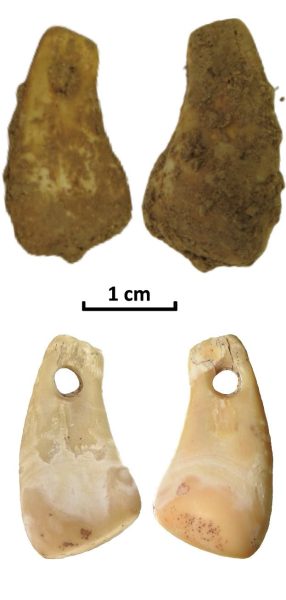
Elk-tooth pendant found at Denisova cave, before cleaning and DNA extraction (top) and after the ‘washing’ procedure (bottom). Credit: Essel et al., Fig 1.
Russian archaeologists who continue to work at Denisova cave found a pierced pendant made from the tooth of a Siberian elk or wapiti during the 2019 field season. It was sent to Leipzig, where the palaeogenetics team had been trying to extract the DNA of whoever had worn personal artefacts found in French and Bulgarian caves. Their efforts had been unsuccessful, but such an object from Denisova clearly spurred them on. When someone wears next to the skin objects made of porous materials their sweat and the DNA that it carries seeps into the pores. If the materials decay very slowly, as do bone and especially teeth, genetic material can, in principle be extracted. But crushing up important ancient objects is not an option: for such rarities the extraction has to be non-destructive. It can only be done by ‘washing’ it in reagents that do not themselves break down DNA. Elena Essel and her many colleagues experimented with many ‘brews’ of reagents and repeated immersion at steadily rising temperature (up to 90°C). This releases genetic material in a stepwise fashion, allowing separation of contaminants in the host sediment from that which had penetrated into the tooth’s pores from whoever made the pendant and the wearer, and the animal from which it came
Analysis of the recovered material yielded elk mtDNA, which was compared with that from four other ancient elks of known ages. This suggested that the elk had lived between 19 and 25 ka ago, thereby indirectly dating the time when the pendant was made and worn. A surprisingly large amount human DNA showed that the wearer was a female who was genetically allied with ancient anatomically modern humans who lived further east in Siberia at about that time.
Obviously this astonishing result opens up a wide vista for archaeology, though not from Palaeolithic burials, which are extremely rare. But artefacts of various kinds are much more common that actual human remains. Because the technique is non-destructive museums may be more willing to make objects in their collections available for analysis. Maybe the approach will be restricted to porous bone or tooth ornaments worn for long periods by individuals. Yet stone tools that were handled continually could be a more important target, depending on the rock from which they were made and its porosity.



 Earth-logs