Human impact on surface geological processes

I last wrote about sedimentation during the ‘Anthropocene’ a year ago (See: Sedimentary deposits of the ‘Anthropocene’, November 2019). Human impact in that context is staggeringly huge: annually we shift 57 billion tonnes of rock and soil, equivalent to six times the mass of the UKs largest mountain, Ben Nevis. All the world’s rivers combined move about 35 billion tonnes less. I don’t particularly care for erecting a new Epoch in the Stratigraphic Column, and even less about when the ‘Anthropocene’ is supposed to have started. The proposal continues to be debated 12 years after it was first suggested to the IUGS International Commission on Stratigraphy. I suppose I am a bit ‘old fashioned’, but the proposals is for a stratigraphic entity that is vastly shorter than the smallest globally significant subdivision of geological time (an Age) and the duration of most of the recorded mass extinctions, which are signified by horizontal lines in the Column. By way of illustration, the thick, extensive bed of Carboniferous sandstone on which I live is one of many deposited in the early part of the Namurian Age (between 328 and 318 Ma). Nonetheless, anthropogenic sediments of, say, the last 200 years are definitely substantial. A measure of just how substantial is provided by a paper published online this week (Kemp, S.B. et al. 2020. The human impact on North American erosion, sediment transfer, and storage in a geologic context. Nature Communications, v. 11, article 6012; DOI: 10.1038/s41467-020-19744-3).

‘Badlands’ formed by accelerated soil erosion.

Anthropogenic erosion, sediment transfer and deposition in North America kicked off with its colonisation by European immigrants since the early 16th century. First Americans were hunter-gatherers and subsistence farmers and left virtually no traces in the landscape, other than their artefacts and, in the case of farmers, their dwellings. Kemp and colleagues have focussed on late-Pleistocene alluvial sediment, accumulation of which seems to have been pretty stable for 40 ka. Since colonisation began the rate has increased to, at present, ten times that previously stable rate, mainly during the last 200 years of accelerated spread of farmland. This is dominated by outcomes of two agricultural practices – ploughing and deforestation. Breaking of the complex and ancient prairie soils, formerly held together by deep, dense mats of grass root systems, made even flat surfaces highly prone to soil erosion, demonstrated by the ‘dust bowl’ conditions of the Great Depression during the 1930s. In more rugged relief, deforestation made slopes more likely to fail through landslides and other mass movements. Damming of streams and rivers for irrigation or, its opposite, to drain wetlands resulted in alterations to the channels themselves and their flow regimes. Consequently, older alluvium succumbed to bank erosion. Increased deposition behind an explosion of mill dams and changed flow regimes in the reaches of streams below them had effects disproportionate to the size of the dams (see: Watermills and meanders, March 2008). Stream flow beforehand was slower and flooding more balanced than it has been over the last few hundred years. Increased flooding, the building of ever larger flood defences and an increase in flood magnitude, duration and extent when defences were breached form a vicious circle that quickly transformed the lower reaches of the largest American river basins.

North American rates of alluvium deposition since 40 Ka ago – the time axis is logarithmic. (Credit: Kemp et al., 2020; Fig. 2)

All this deserves documentation and quantification, which Kemp et al. have attempted at 400 alluvial study sites across the continent, measuring >4700 rates of sediment accumulation at various times during the past 40 thousand years. Such deposition serves roughly as a proxy for erosion rate, but that is a function of multiple factors, such as run-off of rain- and snow-melt water, anthropogenic changes to drainage courses and to slope stability. The scale of post-settlement sedimentation is not the same across the whole continent. In some areas, such as southern California, the rate over the last 200 years is lower than the estimated natural, pre-settlement rate: this example may be due to increased capture of surface water for irrigation of a semi-arid area so that erosion and transport were retarded. In others it seems to be unchanged, probably for a whole variety of reason. The highest rates are in the main areas of rain-fed agriculture of the mid-west of the US and western Canada.

In a nutshell, during the last century the North American capitalism shifted as much sediment as would be moved naturally in between 700 to 3000 years. No such investigation has been attempted in other parts of the world that have histories of intense agriculture going back several thousand years, such as the plains of China, northern India and Mesopotamia, the lower Nile valley, the great plateau of the Ethiopian Highlands, and Europe. This is a global problem and despite its continent-wide scope the study by Kemp et al. barely scratches the surface. Despite earnest endeavours to reduce soil erosion in the US and a few other areas, it does seem as if the damage has been done and is irreversible.

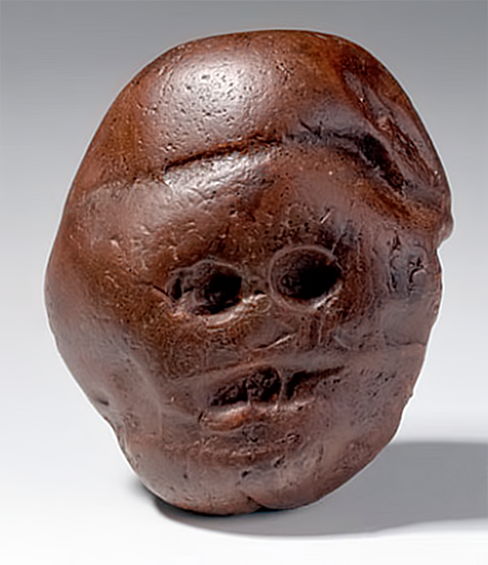
Earliest sign of a sense of aesthetics

Maybe because of the Covid-19 pandemic, there has been a dearth of interesting new developments in the geosciences over that last few months: the ‘bread and butter’ of Earth-logs. So instead of allowing a gap in articles to develop, and as a sign that I haven’t succumbed, this piece concerns one of the most intriguing discoveries in palaeoanthropology. In 1925 Wilfred Eitzman, a school teacher, investigated a cave in the Makapansgat Valley in Limpopo Province, South Africa that had been exposed by quarry workers.  His most striking discovery was a polished pebble made of very fine-grained, iron-rich silica, probably from a Precambrian banded iron formation. Being round and deeply pitted, it had clearly been subject to prolonged rolling and sand blasting in running water and wind. Eerily, whichever way it was viewed it bore a striking resemblance to a primate face: eyes, mouth, nose and, viewed from the rear, a disturbing, toothless grin. We have all picked up odd-looking pebbles on beaches or a river bank: I recently found a sandstone demon-cat (it even has pointy ears) when digging a new vegetable patch.

The Makapansgat Pebble. Inverted it still resembles a face and its obverse side does too.

What is different about the Makapansgat Pebble is that Eitzman found it in a cave-floor layer full of bones, including those of australopithecines. The cave is located in dolomitic limestone outcrops high in the local drainage system, so it’s unlikely that the pebble was washed into it. The nearest occurrence of banded iron formation is about 20 kilometres away, so something must have carried the pebble for a day or more to the cave. The local area has since yielded a superb palaeontological record of early hominin evolution, stimulated by  Eitzman’s finds. He gave the fossils and the pebble to Raymond Dart, the pioneer of South African palaeoanthropology. Dart named the hominin fossils Australopithecus prometheus because associated bones of other animals were covered in black stains that Dart eagerly regarded as signs of burning and thus cooking. When it became clear that the stains were of manganese oxide the name was changed to Au. africanus, the fossils eventually being dated to around 3 million years ago.

Dart was notorious for his showmanship, and the fossils and the Makapansgat Pebble ‘did the rounds’ and continue to do so. In 2016 the pebble was displayed with a golden rhino, a collection of apartheid-era badges and much more in the British Museum’s South Africa: the art of a nation exhibition. Well, is the pebble art? As it shows no evidence of deliberate working it can not be considered art, but could be termed an objet trouvé. That is, an ‘object found by chance and held to have aesthetic value to an artist’. The pebble’s original finder 3 million years ago must have found the 0.25 kg pebble sufficiently interesting to have carried it back to the cave, presumably because of its clear resemblance to a hominin head: in fact a multiple-faced head. Was it carried by a cave-dwelling australopithecine or an early member of genus Homo who left no other trace at Makapansgat? At an even earlier time a so-far undiscovered hominin did indeed make simple stone tools to dismember joints of meat on the shores of Lake Turkana in Kenya. It is impossible to know who for sure carried the pebble, nor to know why. Yet all living primates are curious creatures, so it is far from impossible that any member of the hominins in our line of descent would have collected portable curiosities.

Kerguelen Plateau: a long-lived large igneous province

It’s easy to think of the Earth’s largest outpourings of lava as being restricted to the continents; continental flood basalts with their spectacular stepped topography made up of hundreds of individual massive flows and intervening soil horizons. The Deccan Traps of western India are the epitome, having been so named by natural scientists of the late 18th century from the Swedish word for ‘stairs’ (trappa). Examples go back to the Proterozoic Era, younger ones still retaining much of their original form as huge plateaus. All began life within individual tectonic plates, although some presaged continental break-up and the formation of new oceanic spreading centres. They must have been spectacular events, up to millions of cubic kilometres of magma belched out in a few million years. They have been explained as manifestations of plumes of hot mantle rock rising from as deep as the core-mantle boundary. Unsurprisingly, the biggest continental flood-basalt outpourings coincided with mass extinction events. Otherwise known as large igneous provinces (LIPs), they are not the only signs of truly huge production of magma by partial melting in the mantle. The biggest LIP, with an estimated volume of 80 million km3, lies deep beneath the Western Pacific Ocean. To the northeast of New Guinea, the Ontong Java Plateau formed over a period of about 3 Ma in the mid-Cretaceous (~120 Ma) and blanketed one percent of the Earth’s solid surface with lavas erupted at a rate of 22 km3 per year. Possibly because this happened on the Pacific’s abyssal plains beneath around 4 km of sea water, there is little sign of any major perturbation of mid-Cretaceous life, but it is associated with evidence for global oceanic anoxia. Ontong Java isn’t the only oceanic LIP. Bearing in mind that oceanic lithosphere only goes back to the start of the Jurassic Period (200 Ma) – earlier material has largely been subducted – they are not as abundant as continental flood-basalt provinces. One of them is the Kerguelen Plateau 3000 km to the SE of Australia, which is about three times the area of Japan and the second largest LIP of the Phanerozoic Eon. The Plateau was split into two large fragments while sea-floor spreading progressed along the Southeast Indian Ridge.

Bathymetry of the Indian Ocean south-west of Australia, showing the Kerguelen Plateau and South-east Indian Ridge. The red arrows show the amount of sea-floor spreading on either side of the Ridge since it began to open. The pale blue area at the NE end of the arrow was formerly part of the Plateau (credit: Google Earth)

Long regarded as a microcontinental  fragment left when India parted company with Antarctica – based on isolated occurrences of gneisses – there is evidence that during the formation of the Kerguelen LIP the basalts rose above sea level. Because earlier radiometric dating of basalts from ocean-floor drill cores were of low quality, an Australian-Swedish group of geoscientists have re-evaluated those data and supplemented them with 25 new Ar-Ar dates from 12 sites (Jiang, Q. et al. 2020. Longest continuously erupting large igneous province driven by plume-ridge interaction. Geology, v. 48, online; DOI: 10.1130/G47850.1). Rather than a cluster of ages around a short time range as expected from the short life of most other LIPs, those from Kerguelen span 32 Ma during the Cretaceous (from 122 to 90 Ma). The magmatic pulse began at roughly the same time as that of Ontong Java, but continued for much longer. Smaller oceanic LIPs do seem to have lingered for unusually lengthy periods, but all seem to have constructed in several separate pulses. Large-volume eruption at Kerguelen was continuous for at least 32 Ma; the drilling did not penetrate the oldest of the plateau basalts. It seems that the Kerguelen LIP is unique in that respect and requires an explanation other than simply a mantle plume, however large.

Jiang et al. suggest a model of continuous interaction between a long-lived plume and the development of the Southeast Indian Ridge oceanic spreading centre. Their model involves the line of continental splitting between India and Antarctic taking place close to a major deep-mantle plume at around 128 Ma. There is nothing unique about that; incipient ocean rifting in the Horn of Africa and formation of the Red Sea and Gulf of Aden ridges is currently associated with the active Afar plume. This was followed by a kind of tectonic shuffling of the Ridge back and forth across the head of the Kerguelen plume: not far different from the Palaeogene North Atlantic LIP, where the mid-Atlantic Ridge and the still-active Iceland plume, except the ridge and plume seem more intimately involved there. However, there are probably many subtle relationships between plumes and various kind of oceanic plate margins that are still worth exploring. Since the first discovery of mantle plumes as an explanation for volcanic island chains (e.g. the Hawaiian chain) where volcanism becomes progressively older in the direction of plate movement, there is still much to discover.

See also: Magma .conveyor belt’ fuelled world’s longest erupting supervolcanoes (Science Daily, 4 November 2020)

More Denisovan connections

In 2006 mining operations in NE Mongolia uncovered a human skull cap with prominent brow ridges. After having been dubbed Mongolanthropus because of its primitive appearance and then suggested to be either a Neanderthal of Homo erectus. Radiocarbon dating in 2019 then showed the woman to be around 34,500 years old and the accompanying sequencing of its mtDNA assigned her to a widespread Eurasian haplotype of modern humans. Powdered bone samples ended up in Svante Paabo’s renowned ancient-DNA lab at the Max Planck Institute for Evolutionary Anthropology in Leipzig and yielded a full genome (Massilani, D. and 14 others 2020. Denisovan ancestry and population history of early East Asians. Science, v. 370, p. 579-583; DOI: 10.1126/science.abc1166). From this flowed some interesting genetic history.

Skull cap of a female modern human from Salkhit in Outer Mongolia, which superficially resembles those of Homo erectus from Java (Credit: Massilani et al. Fig 1a; © Institute of Archaeology, Mongolian Academy of Sciences)

First was a close overall resemblance to living East Asians and Native Americans, similar to that of an older individual from near Beijing, China. This confirmed the antiquity of the East Eurasian population’s split from that of the west, yet contained evidence of some interbreeding with West Eurasians to the extent of sharing 25% of DNA and with Neanderthals. The two specimens also contained evidence of Denisovan ancestry in their genomes, but fragments that are more akin to those in living people in East Asia than to those of Papuans and Aboriginal Australians: these were definitely cosmopolitan people! The simplest explanation is two distinct minglings with Denisovans: that involving ancestors of Papuans and Australian being the perhaps earlier, en route to their arrival at least 60 thousand years on what became an island continent in the run-up to the last glacial maximum. Be that as it may, two separate Denisovan populations interbred with modern human bands. Further genetic connections with ancient Northern Siberian humans suggests complex movement across the continent, probably inevitable because these hunter-gatherers would have followed prey animals on their seasonal migrations, which would have been longer than today because of climatic cooling. The same can be surmised for Denisovans which would have increased the chances of contact

See also: Denisovan DNA in the genome of early East Asians (Science Daily, 29 October 2020)

In May 2019 (Denisovan on top of the world) I wrote about a human lower jaw that a Buddhist monk had found in a cave at a height of 3.3 km on the Tibetan plateau. Analysis of protein traces in the teeth it retained suggested that it was Denisovan. Like the earlier small remnants from Siberia, dating this putative Denisovan precisely proved to be impossible. The jawbone was at least 160 ka old from the age of speleothem carbonate encrusting it. Excavation of the sediment layers from Baishiya Cave has enabled a large team of Chinese, Australian, US and Swedish scientists to try out the ‘environmental DNA’ approach pioneered by the Max Planck Institute for Evolutionary Anthropology (see: Detecting the presence of hominins in ancient soil samples, April 2017). The cave confirmed occupation by Denisovans from mtDNA found in layers dated using radiocarbon and optically stimulated luminescence methods. Denisovan mtDNA turned up in four layers dated at ~100, ~60 and possibly as young as 45 ka, as well at that from a variety of other mammals (Zhang, D. and 26 others. Denisovan DNA in Late Pleistocene sediments from Baishiya Karst Cave on the Tibetan Plateau. Science, v. 370, p. 584-587; DOI: 10.1126/science.abb6320).  Denisovans were clearly able to live at high elevations for at least 100 thousand years: long enough to evolve the metabolic processes essential to sustain living in low-oxygen conditions, which it has been suggested was passed on to ancestral modern Tibetans.