Pterosaurs had feathers and fur

Pterosaurs, which include the pterodactyls and pteranodons, were the first vertebrates to achieve proper, flapping flight. In the popular imagination they are regarded as ‘flying dinosaurs’, whereas the anatomy of the two groups is significantly different. The first of them appeared in the Upper Triassic around 235 Ma ago, at roughly the same time as the earliest known dinosaurs. The anatomical differences make it difficult to decide on a common ancestry for the two. But detailed analysis of pterosaur anatomy suggests that they share enough features with dinosaurs, crocodiles and birds for all four groups to have descended from ancestral archosaurs that were living in the early Triassic, and they survived the mass extinction at the end of that Period. Birds, on the other hand, first appear in the fossil record during the Upper Jurassic 70 Ma later than pterosaurs. They are now widely regarded as descendants of early theropod dinosaurs, which are known commonly to have had fur and feathers.

Pterosaurs leapt into the public imagination in the final chapter of Sir Arthur Conan Doyle’s Lost World with a clatter of ‘dry, leathery wings’ as Professor George Challenger’s captive pterodactyl from northern Brazil’s isolated Roraima tepui plateau made its successful bid for escape from a Zoological Institute meeting in Queens Hall. Yet, far from being leathery, pterosaurs turned out, in the late 1990’s, to have carried filamentous pycnofibres akin to mammalian hair. Widespread reports in the world press during the week before Christmas in 2018 hailed a further development that may have rescued pterosaurs from Conan Doyle’s 1912 description before it sprang from its perch:

It was malicious, horrible, with two small red eyes as bright as points of burning coal. Its long, savage mouth, which it held half-open, was full of a double row of sharp-like teeth. Its shoulders were humped, and round them was draped what appeared to be a faded grey shawl. It was the devil of our childhood in person.

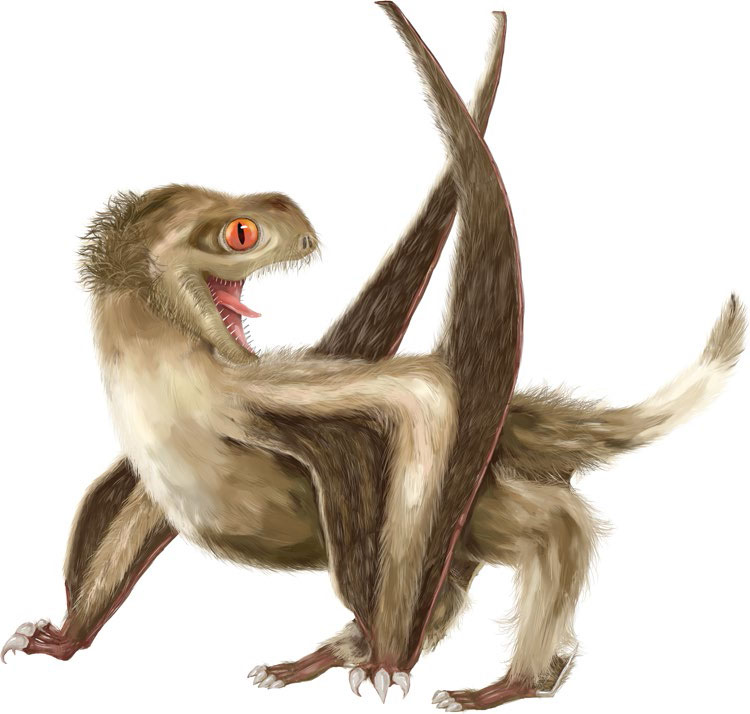
Two specimens from the Middle to Upper Jurassic Yanliiao lagerstätte in China show far more (Yang, Z. and 8 others 2018. Pterosaur integumentary structures with complex feather-like branching. Nature Ecology & Evolution, v. 3, p. 24-30; DOI: 10.1038/s41559-018-0728-7). Their pycnofibres show branching tufts, similar to those found in some theropods dinosaurs, including tyrannosaurs. They also resemble mammalian underfur fibres, whose air-trapping properties provide efficient thermal insulation. Both body and wings of these pterosaurs are furry, which the authors suggest may also have helped reduce drag during flight, while those around the mouth may have had a sensory function similar to those carried by some living birds. Moreover, some of the filaments contain black and red pigments.
407458aa.2
Artist’s impression of a Jurassic anurognathid pterosaur from China (Credit: Yang et al 2018; Fig. 4)

Pterosaurs may have independently developed fur and feathers; a case of parallel evolution in response to similar evolutionary pressures facing dinosaurs, birds and mammals. Alternatively, they may have had a deep evolutionary origin in the common ancestors of all these animal groups as far back as the Upper Carboniferous and Lower Permian.

Related articles: Nature Editorial 2018. Fur and fossils. Nature, v. 564, p. 301-302; DOI: 10.1038/d41586-018-07800-4; King, A. 2018. Pterosaurs sported feathers, claim scientists (The Scientist); Conniff, R. 2018. Pterosaurs just keep getting weirder (Scientific American); New discovery pushes origin of feathers back by 70 million years (Science Daily)

Read more on Palaeobiology

Calibrating 14C dating

Radiocarbon dating is the most popular tool for assessing the ages of archaeological remains and producing climatic time series, as in lake- and sea-floor cores, provided that organic material can be recovered. Its precision has steadily improved, especially with the development of accelerator mass spectrometry, although it is still limited to the last 50 thousand years or so because of the short half-life of 14C (about 5,730 years,). The problem with dating based on radioactive 14C is its accuracy; i.e. does it always give a true date. This stems from the way in which 14C is produced – by cosmic rays interacting with nitrogen in the atmosphere. Cosmic irradiation varies with time and, consequently, so does the proportion of 14C in the atmosphere. It is the isotope’s proportion in atmospheric CO2 gas at any one time in the past, which is converted by photosynthesis to dateable organic materials, that determines the proportion remaining in a sample after decay through the time since the organism died and became fossilised. Various approaches have been used to allow for variations in 14C production, such as calibration to the time preserved in ancient timber by tree rings which can be independently radiocarbon dated. But that depends on timber from many different species of tree from different climatic zones, and that is affected by fractionation between the various isotopes of carbon in CO2, which varies between species of plant. But there is a better means of calibration.

The carbonate speleothem that forms stalactites and stalagmites by steady precipitation from rainwater, sometimes to produce visible layering, not only locks in 14C dissolved from the atmosphere by rainwater but also environmental radioactive isotopes of uranium and thorium. So, layers in speleothem may be dated by both methods for the period of time over which a stalagmite, for instance, has grown. This seems an ideal means of calibration, although there are snags; one being that the proportion of carbon in carbonates is dominated by that from ancient limestone that has been dissolved by slightly acid rainwater, which dilutes the amount of 14C in samples with so called ‘dead carbon’. Stalagmites in the Hulu Cave near Nanjing in China have particularly low dead-carbon fractions and have been used for the best calibrations so far, going back the current limit for radiocarbon dating of 54 ka (Cheng, H. and 14 others 2018. Atmospheric 14C/12C during the last glacial period from Hulku Cave. Science, v. 362, p. 1293-1297; DOI: 10.1126/science.aau0747). Precision steadily falls off with age because of the progressive reduction to very low amounts of 14C in the samples. Nevertheless, this study resolves fine detail not only of cosmic ray variation, but also of pulses of carbon dioxide release from the oceans which would also affect the availability of 14C for incorporation in organic materials because deep ocean water contains ‘old’ CO2.

Read more on Stratigraphy

The earliest humans in Tibet

Modern Tibetans thrive in the rarefied air at altitudes above 4 km partly because they benefit from a genetic mutation of the gene EPAS1, which regulates haemoglobin production. Surprisingly, the segment of Tibetan’s DNA that contains the mutation matches that present in the genome of an undated Denisovan girl’s finger bone found in the eponymous Siberian cave. The geneticists who made this discovery were able to estimate that Tibetans inherited the entire segment sometime in the last 40 thousand years through interbreeding with Denisovans, who probably were able to live at high altitude too. Wherever and whenever this took place the inheritance was retained because it clearly helped those who carried it to thrive in Tibet. The same segment is present in a few percent of living Han Chinese people, which suggests their ancestors and those of the Tibetans were members of the same group some 40 ka ago, most of the Han having lost the mutation subsequently.

That inheritance would have remained somewhat mysterious while the existing evidence for the colonisation of the Tibetan Plateau suggested sometime in the Holocene, possibly by migrating early farmers. A single archaeological site at 4600 m on the Plateau has changed all that (Zhang, X.L. and 15 others 2018. The earliest human occupation of the high-altitude Tibetan Plateau 40 thousand to 30 thousand years ago. Science, v.  362, p. 1049-1051; DOI: 10.1126/science.aat8824). The dig at Nwya Devu, which lies 250 km NW of Lhasa, has yielded a sequence of sediments (dated by optically stimulated luminescence at between 45 to 18 thousand years) that contains abundant stone tools made from locally occurring slate. The oldest coincides roughly with the age of the earliest anatomically modern human migrants into northern China, so the earliest Tibetans may well have been a branch of that same group of people, as suggested by the DNA of modern Tibetan and Han people. However, skeletal remains of both humans and their prey animals are yet to emerge from Nwya Devu, which leaves open the question of who they were. Anatomically modern humans or archaic humans, such as Denisovans?

The tools do not help to identify their likely makers. Slate is easy to work and typically yields flat blades with sharp, albeit not especially durable, edges; they are disposable perhaps explaining why so many were found at Nwya Devu. None show signs of pressure flaking that typify tools made from harder, more isotropic rock, such as flint. Yet they include a variety of use-types: scrapers; awls; burins and choppers as well as blades. The lack of associated remains of prey or hearths is suggested by the authors to signify that the site was a workshop; perhaps that will change with further excavation in the area. The age range suggests regular, if not permanent, occupancy for more than 20 ka

Related articles: Gibbons, A. 2014. Tibetans inherited high-altitude gene from ancient human. Science News,2 July 2014, Zhang J-F. & Dennell, R. 2018. The last of Asia conquered by Homo sapiens. Science, v. 362, p. 992-993; DOI: 10.1126/science.aav6863.

Read more on Human evolution and Migrations

Volcanism and the Justinian Plague

Between 541 and 543 CE, during the reign of the Roman Emperor Justinian, bubonic plague spread through countries bordering the Mediterranean Sea. This was a decade after Justinian’s forces had had begun to restore the Roman Empire’s lost territory in North Africa, Spain, Italy and the present-day Balkans by expeditions out of Byzantium (the Eastern Empire). At its height, the Plague of Justinian, was killing 5000 people each day in Constantinople, eventually to consume 20 to 40% of its population and between 25 to 50 million people across the empire. Like the European Black Death of the middle 14th century. The bacterium Yersinia pestis originated in Central Asia and is carried in the gut of fleas that live on rats. The ‘traditional’ explanation of both plagues was that plague spread westwards along the Silk Road and then with black rats that infested ship-borne grain cargoes. Plausible as that might seem, Yersinia pestis, fleas and rats have always existed and remain present to this day. Trade along the same routes continued unbroken for more than two millennia. Although plagues with the same agents recurred regularly, only the Plague of Justinian and the Black Death resulted in tens of million deaths over short periods. Some other factor seems likely to have boosted fatalities to such levels.

407458aa.2
Monk administering the last rites to victims of the Plague of Justinian

Five years before plague struck the Byzantine historian Procopius recorded a long period of fog and haze that continually reduced sunlight; typical features of volcanic aerosol veils. Following this was the coldest decade in the past 2300 years, as recorded by tree-ring studies. It coincides with documentary evidence of famine in China, Ireland, the Middle East and Scandinavia.. A 72 m long ice core extracted from the Colle Gnifetti glacier in the Swiss Alps in 2013 records the last two millennia of local climatic change and global atmospheric dust levels. Sampled by laser slicing, the core has yielded a time series of data at a resolution of months or better. In 536 an Icelandic volcano emitted ash and probably sulfur dioxide over 18 months during which summer temperature fell by about 2°C. A second eruption followed in 540 to 541. ‘Volcanic winter’ conditions lasted from 536 to 545, amplifying the evidence from tree-ring data from the 1990’s.

The Plague of Justinian coincided with the second ‘volcanic winter’ after several years of regional famine. This scenario is paralleled by the better documented Great Famine of 1315-17 that ended the two centuries of economic prosperity during the 11th to 13th centuries. The period was marked by extreme levels of crime, disease, mass death, and even cannibalism and infanticide. In a population weakened through malnutrition to an extent that we can barely imagine in modern Europe, any pandemic disease would have resulted in the most affected dying in millions. Another parallel with the Plague of Justinian is that it followed the ending of four centuries of the Medieval Warm Period, during which vast quantities of land were successfully brought under the plough and the European population had tripled. That ended with a succession of major, sulfur-rich volcanic eruption in Indonesia at the end of the 13th century that heralded the Little Ice Age. Although geologists generally concern themselves with the social and economic consequences of a volcano’s lava and ash in its immediate vicinity– the ‘Pompeii view’ – its potential for global catastrophe is far greater in the case of really large (and often remote) events.

Chemical data from the same ice core reveals the broad economic consequences of the mid-sixth century plague. Lead concentrations in the ice, deposited as airborne pollution from smelting of lead sulfide ore to obtain silver bullion, fell and remained at low levels for a century. The recovery of silver production for coinage is marked by a spike in glacial lead concentration in 640; another parallel with the Black Death, which was followed by a collapse in silver production, albeit only for 4 to 5 years.

Related article: Gibbons, A. 2018. Why 536 was ‘the worst year to be alive’. Science, v. 362,p. 733-734; DOI:10.1126/science.aaw0632

Read more on Geohazards, Magmatism and Palaeoclimatology