The ‘boring billion’ years of the Mesoproterozoic: plate tectonics and the eukaryotes

The emergence of the eukaryotes – of which we are a late-entry member – has been debated for quite a while. In 2023 Earth-logs reportedthat a study of ‘biomarker’ organic chemicals in Proterozoic sediments suggests that eukaryotes cannot be traced back further than about 900 Ma ago using such an approach. At about the same time another biomarker study showed signs of a eukaryote presence at around 1050 Ma. Both outcomes seriously contradicted a ‘molecular-clock’ approach based on the DNA of modern members of the Eukarya and estimates of the rate of genetic mutation. That method sought to deduce the time in the past when the last eukaryotic common ancestor (LECA) appeared. It pointed to about 2 Ga ago, i.e. a few hundred million years after the Great Oxygenation Event got underway. Since eukaryote metabolism depends on oxygen, the molecular-clock result seems reasonable. The biomarker evidence does not. But were the Palaeo- and Mesoproterozoic Eras truly ‘boring’? A recent paper by Dietmar Müller and colleagues from the Universities of Sydney and Adelaide, Australia definitely shows that geologically they were far from that (Müller, R.D. et al. 2025. Mid-Proterozoic expansion of passive margins and reduction in volcanic outgassing supported marine oxygenation and eukaryogenesis. Earth and Planetary Science Letters, v. 672; DOI: 10.1016/j.epsl.2025.119683).
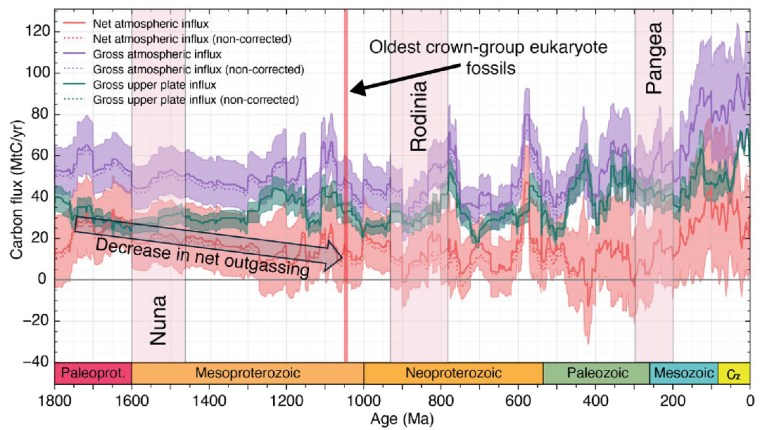
Carbon influx (million tons per year) into tectonic plates and into the ocean-atmosphere system from 1800 Ma to present. The colour bands represent: total carbon influx into the atmosphere (mauve); sequestered in tectonic plates (green); net atmospheric influx i.e. total minus carbon sequestered into plates (orange). The widths of the bands show the uncertainties of the calculated masses shown as darker coloured lines.

From 1800 to 800 Ma two supercontinents– Nuna-Columbia and Rodinia – aggregated nearly all existing continental masses, and then broke apart. Continents had collided and then split asunder to drift. So plate tectonics was very active and encompassed the entire planet, as Müller et al’s palaeogeographic animation reveals dramatically. Tectonics behaved in much the same fashion through the succeeding Neoproterozoic and Phanerozoic to build-up then fragment the more familiar supercontinent of Pangaea. Such dynamic events emit magma to form new oceanic lithosphere at oceanic rift systems and arc volcanoes above subduction zones, interspersed with plume-related large igneous provinces and they wax and wane. Inevitably, such partial melting delivered carbon dioxide to the atmosphere. Reaction on land and in the rubbly flanks of spreading ridges between new lithosphere and dissolved CO2 drew down and sequestered some of that gas in the form of solid carbonate minerals. Continental collisions raised the land surface and the pace of weathering, which also acted as a carbon sink. But they also involved metamorphism that released carbon dioxide from limestones involved in the crustal transformation. This protracted and changing tectonic evolution is completely bound up through the rock cycle with geochemical change in the carbon cycle.

From the latest knowledge of the tectonic and other factors behind the accretion and break-up of Nuna and Rodinia, Müller et al. were able to model the changes in the carbon cycle during the ‘boring billion’ and their effects on climate and the chemistry of the oceans. For instance, about 1.46 Ga ago, the total length of continental margins doubled while Nuna broke apart. That would have hugely increased the area of shallow shelf seas where living processes would have been concentrated, including the photosynthetic emission of oxygen. In an evolutionary sense this increased, diversified and separated the ecological niches in which evolution could prosper. It also increased the sequestration of greenhouse gas through reactions on the flanks of a multiplicity of oceanic rift systems, thereby cooling the planet. Translating this into a geochemical model of the changing carbon cycle (see figure) suggests that the rate of carbon addition to the atmosphere (outgassing) halved during the Mesoproterozoic. The carbon cycle and probable global cooling bound up with Nuna’s breakup ended with the start of Rodinia’s aggregation about 1000 Ma ago and the time that biomarkers first indicate the presence of eukaryotes.
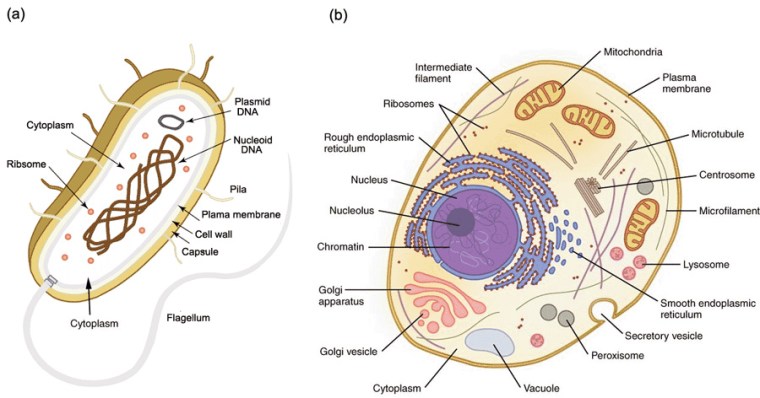
Simplified structures of (a) a prokaryote cell; (b) a simple eukaryote animal cell. Plants also contain organelles called chloroplasts

So, did tectonics play a major role in the rise of the Eukarya? Well, of course it did, as much as it was subsequently the changing background to the appearance of the Ediacaran animals and the evolutionary carnival of the Phanerozoic. But did it affect the billion-year delay of ‘eukaryogenesis’ during prolonged availability of the oxygen that such a biological revolution demanded? Possibly not. Lyn Margulis’s hypothesis of the origin of the basic eukaryote cell by a process of ‘endosymbiosis’ is still the best candidate 50 years on. She suggested that such cells were built from various forms of bacteria and archaea successively being engulfed within a cell wall to function together through symbiosis. Compared with prokaryote cells those of the eukaryotes are enormously complex. At each stage the symbionts had to be or become compatible to survive. It is highly unlikely that all components entered the relationship together. Each possible kind of cell assembly was also subject to evolutionary pressures. This clearly was a slow evolutionary process, probably only surviving from stage to stage because of the global presence of a little oxygen. But the eukaryote cell may also have been forced to restart again and again until a stable form emerged.

See also: New Clues Show Earth’s “Boring Billion” Sparked the Rise of Life. SciTechDaily, 3  November 2025

When did supercontinents start forming?

Plate tectonics is easily thought of as being dominated by continental drift, the phenomenon that Alfred Wegener recognised just over a century ago. So it is at present, the major continents being separated by spreading oceans. Yet, being placed on a near-spherical planet, continents also move closer to others; eventually to collide and weld together. Part of Wegener’s concept was that modern continents formed from the breakup of a single large one that he called Pangaea; a supercontinent. The current drifting apart began in earnest around the end of the Triassic Period (~200 Ma), after 200 Ma  of Pangaea’s dominance of the planet along with a single large ocean (Panthalassa) covering 70% of the Earth’s surface. Wegener was able to fit Pangaea together partly on the basis of evidence from the continents’ earlier geological history. In particular the refit joined up zones of intense deformation from continent to continent. Although he did not dwell on their origin, subsequent research has shown these zones were the lines of earlier collisions between older continental blocks, once subduction had removed the intervening oceanic lithosphere; Pangaea had formed from an earlier round of continental drift. Even older collision zones within the pre-Pangaea continental blocks suggested the former existence of previous supercontinents.

Aided by the development of means to divine the position of the magnetic poles relative to differently aged blocks on the continents, Wegener’s basic methods of refitting have resulted in the concept of supercontinent cycles of formation and break-up. It turns out that supercontinents did not form by all earlier continental clanging together at one time. The most likely scenario is that large precursors or ‘megacontinents’ (Eurasia is the current example) formed first, to which lesser entities eventually accreted  A summary of the latest ideas on such global tectonic cycles appeared in the November 2020 issue of Geology (Wang, c. et al. 2020. The role of megacontinents in the supercontinent cycle. Geology, v. 49  p. 402-406; DOI: 10.1130/G47988.1). Chong Wang of the Chinese Academy of Sciences and colleagues from Finland and Canada identify three such cycles of megacontinent formation and the accretion around them of the all-inclusive supercontinents of Columbia, Rodinia and Pangaea since about 1750 Ma (Mesoproterozoic). They also suggestion that a future supercontinent (Amasia) is destined to agglomerate around Eurasia.

Known megacontinents in relation to suggested supercontinents since the Mesoproterozoic (credit: Wang et al.; Fig 2)

The further back in time, the more cryptic are ancient continent-continent collision zone or sutures largely because they have been re-deformed long after they formed. In some cases younger events that involved heating have reset their radiometric ages. The oldest evidence of crustal deformation lies in cratons, where the most productive source of evidence for clumping of older continental masses is the use of palaeomagnetic pole positions. This is not feasible for the dominant metamorphic rocks of old suture zones, but palaeomagnetic measurements from old rocks that have been neither deformed nor metamorphosed offer the possibility of teasing out ancient supercontinents. Commonly cratons show signs of having been affected by brittle extensional deformation, most obviously as swarms of vertical sheets or dykes of often basaltic igneous rocks. Dykes can be dated readily and do yield reliable palaeomagnetic pole positions. Some cratons have multiple dyke swarms. For example the Archaean Yilgarn  Craton of Western Australia, founded on metamorphic and plutonic igneous crust that formed by tectonic accretion between 3.8 to 2.7 Ga, has five of them spanning 1.4 billion years from late-Archaean (2.6 Ga) to Mesoproterozoic (1.2 Ga). Throughout that immense span of time the Yilgarn remained as a single continental block. Also, structural trends end abrubtly at the craton margins, suggesting that it was once part of a larger ‘supercraton’ subsequently pulled apart by extensional tectonics.  The eleven known cratons show roughly the same features.

On the strength of new, high quality pole positions from dykes of about the same ages (2.62 and 2.41 Ga) cutting the Yilgarn and Zimbabwe cratons, geoscientists from Australia, China, Germany, Russia and Finland, based at Curtin University in Western Australia, have attempted to analyse all existing Archaean and Palaeoproterozoic pole positions (Liu, Y. et al. 2021. Archean geodynamics: Ephemeral supercontinents or long-lived supercratons. Geology, v. 49  ; DOI: 10.1130/G48575.1). The Zimbabwe and Yilgarn cratons, though now very far apart, were part of the same supercraton from at least 2.6 Ga ago. Good cases can be made for several other such large entities, but attempting fit them all together as supercontinents by modelling is unconvincing. The modelled fit for the 2.6 Ga datum is very unlike that for 2.4 Ga; in the intervening 200 Ma all the component cratons ould have had to shuffle around dramatically, without the whole supercontinent edifice breaking apart. However, using the data to fit cratons together at two supercratons does seem to work, for the two assemblies remain in the same configurations for both the 2.6 and 2.4 Ga data.

Interestingly, all cratonic components of one of the supercratons show geological evidence of the major 2.4 Ga glaciation, whereas those of the other show no such climatic indicator. Yet the entity with glacial evidence was positioned at low latitudes around 2.4 Ga, the ice-free one spanning mid latitudes. This may imply that the Earth’s axial tilt was far higher than at present. The persistence of two similar sized continental masses for at least 200 Ma around the end of the Archaean Eon also hints at a different style of tectonics from that with which geologists are familiar. Only palaeomagnetic data from the pre 2.6 Ga Archaean can throw light on that possibility. That requires older, very lightly or unmetamorphosed rocks to provide palaeopole positions. Only two cratons, the Pilbara of Western Australia and the Kaapvaal of South Africa, are suitable. The first yielded the oldest-known pole dated at 3.2 Ga, the oldest from the second is 2.7 Ga. A range of evidence suggests that Pilbara and Kaapvaal cratons were united during at least the late Archaean.

The only answer to the question posed by this item’s title is ‘There probably wasn’t a single supercontinent at the end of the Archaean, but maybe two megacontinents or supercratons’. Lumps of continental lithosphere would move and – given time – collide once more than one lump existed, however the Earth’s tectonics operated …