
The DNA of anatomically modern humans (AMH) differs from that of chimpanzees by a mere 1.2%; they are our closest relatives. This similarity has allowed geneticists to estimate roughly when the two groups diverged from their last common ancestor. A 2016 study suggested 9.3 to 6.5 Ma ago, whereas a 2025 estimate using a different approach suggested 6.3 to 5.5 Ma. Broadly speaking, the divergence took place sometime during the Late Miocene. But that does not mean that the chimp-human last common ancestor resembled either as they are today. The later hominins are different from each other, and fossil chimps of any age are extremely rare.
All living organisms carry the distant past in this manner, ultimately linking them to the Last Universal Common Ancestor (LUCA) of Hadean times. The last two decades have witnessed demonstration of such ancestral genetic connections between the three most recent hominin groups found outside of Africa: AMH, Neanderthals and Denisovans. Most living non-Africans possess 1 to 2 % Neanderthal ancestry and the genomes of Asians and people from Oceania have 0.5 to 5% Denisovan ancestry.
Intriguingly, the DNA of some individuals living in sub-Saharan Africa contains evidence of their ancestors’ introgression with archaic humans, which were neither Neanderthal nor Denisovan. Because DNA is prone to decay in hot climates, none has been extracted from African fossils of earlier Homo, despite their abundance and diversity. Such genetic ancestors have appropriately been termed ‘ghosts’. A group of geneticists from the University of California Berkeley and Johns Hopkins University, Maryland USA have deployed a DNA analytical technique aimed at identifying traces of this archaic ‘ghost lineage’ (Yulin Zhang et al. 2026. Recovering signatures of archaic hominin introgression using ancestral recombination graphs. Science, v. 393, article eaef8874; DOI: 10.1126/science.aef8874)
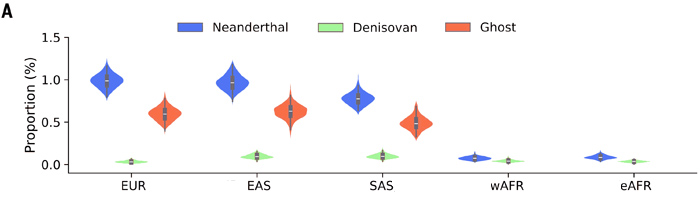
Yulin Zhang and colleagues have devised a novel means of exploring ‘ancestral recombination graphs’ (ARG), called TRACE, which enables them to attempt reconstructions of this hidden history. Ideally, this should be based on archaic reference genomes, such as those of Neanderthals and/or Denisovans, so they devised a ‘work around’ in the absence of any such reference data. They tested their methodology by attempting to filter out the Neanderthal and Denisovan DNA contributed to all genomes of non-African individuals. The results tallied closely with those using earlier methods. The methodology also picked up contributions from both in small amounts (~0.1 %) within the sub-Saharan African data, presumably from individual AMH that migrated back into Africa in the last 65 ka, which had been identified using earlier methodologies. But as well as identifying the previously discovered DNA from an unknown (ghost) lineage in modern Africans’ genomes, their method also found it in those from Europe, East Asia and South Asia. The fact that the ghost DNA segments are shorter than those of Neanderthal and Denisovan origin suggests that the introgression events responsible for them are older. Logically, it can be inferred that they predated modern humans’ leaving Africa, and that is backed-up by similar proportions in non-African genomes.
Applying the last common ancestor approach to the data, Yulin Zhang et al. estimated that the ghost archaic introgression into African human ancestry occurred about 800 ka ago, perhaps involving African Homo heidelbergensis. That date is also roughly when Neanderthals and Denisovans split from a common ancestor. Intriguingly the analysis hinted at an earlier introgression, around 1.8 Ma, that involved interaction of Denisovans with an even more archaic – indeed ‘super-archaic’ – hominin group, perhaps Homo erectus. The most certain conclusion to be drawn from the study is that late-hominin evolution was far more complex than previously imagined. If any remotely related groups met in the course of their migrations, then it seems that interbreeding was almost inevitable.
Palaeoanthropology may be at the beginning of a leap forward based on the DNA of living people and AI-type investigation. It will be spurred on if DNA from more fossils emerges, especially any of late Homo erectus. Even without such a breakthrough, genetic data from the living clearly have plenty more to tell us.
See also : Timmer, J. 2026. Not just Neanderthals: Ghost lineage in Africa left its mark on our DNA. Ars Technica 31 July 2026; Scientists found two mysterious ‘ghost’ ancestors hiding in our DNA. Science Daily 31 July 2026.


