
About 45 thousand years ago Homo sapiens became the only hominin roaming our home world. By 25 ka every continent bar Antarctica was populated that species. Its peregrinations stemmed from their being hunter-gathers: continually moving in search of food and water resources that often shifted as climate changed towards the last glacial maximum. Such episodic migration seems to have been the primary characteristic of all earlier hominins throughout the Pleistocene, almost certainly enabled by their invention of tool-using cultures since about the late-Pliocene ~3.4 Ma ago (See: Stone tools go even further back; May 2015). About ten thousand years ago, after the termination of the last glacial episode, hunting and gathering began to be supplanted by a completely new lifestyle: herding and agriculture. Today, almost all the world’s population relies entirely on agriculture. To farm demands continuous settlement: over a mere ten millennia migration dwindled for all except the persecuted and dispossessed. Modern humans became a sedentary species in the Holocene, culminating in city life and accelerated population growth. Why was this delayed for so long? Until recently little research has been applied to such a fundamental change?
A new interdisciplinary approach to shifts in evolution considers how organisms allocate energy toward different functions, such as growth, reproduction, maintenance, and defence. It is termed life-history theory: a framework that explains how natural selection shapes an organism’s schedule of growth, reproduction, and survival under environmental and resource constraints. Because all organisms have finite energy and time, investing in one trait often requires sacrificing another. It can be applied to both physiological and behavioural change, and requires reliable data. European archaeology has yielded abundant information about the transition from the Mesolithic to the Neolithic, particularly from human skeletal remains, carbon and nitrogen stable isotopes and high quality radiocarbon dating. Eóin W. Parkinson of University College Cork, Ireland has analysed anatomical features of over 3000 well-preserved skeletons from the last 15 ka to estimate the body size and robustness of individuals, δ13C and δ19N isotopes in bones and teeth that indicate their diet (> 30 thousand samples) from dated archaeological sites. Sixty-thousand dated sites allowed him to estimate relative shifts in population density (Parkinson, E.W. 2026. Fifteen thousand years of bioarchaeological data reveal life history trade-offs among Europe’s first farmers. Proceedings of the National Academy of Sciences, v. 123, article e2505519123, DOI:10.1073/pnas.2505519123 ).
The data reveal that beginning at ~8.5 ka ago, around the start of the Neolithic transition to agricultural lifestyles, European population reached a peak well above the small and dispersed populations of hunter-gatherer Mesolithic people. However, human stature and body mass declined significantly, confirming earlier findings that Neolithic Europeans were on average 3.5 cm shorter than their Mesolithic counterparts. This ‘boom’ therefore coincided with a shift in life history that prioritised reproduction over skeletal growth. Northern and southern European populations differed significantly, the south showing a somewhat larger growth–reproduction trade-off. After about 5.6 ka a significant period of population declines set in during the later Neolithic, suggesting a ‘boom and bust’ scenario. Eóin Parkinson suggests that may have resulted from reduced dietary diversity among farmers and greater child mortality.
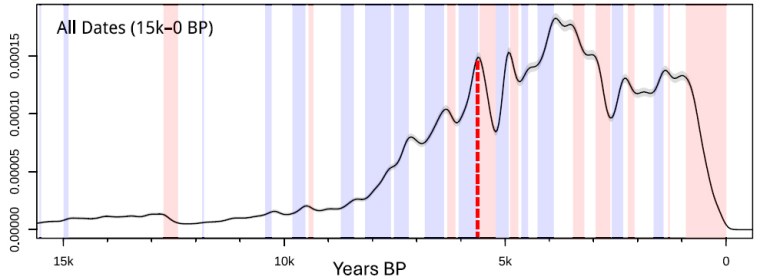
The different trajectory of southern European farmers differs from that in the north. That may have stemmed from migration to the west of early farmers from the ‘Fertile Crescent’ of eastern Türkiye and the steppes further north along two routes: along the Mediterranean coast, the other following the Danube through Central Europe to the Baltic. The stable isotope data suggest another possibility: the southern population may have adopted seafood and wheat and barley, whereas people in the north relied more on meat and dairy products and hardier grains. Parkinson briefly discusses how the influx of people with agricultural skills genetically erased earlier, hunter-gatherer Europeans, probably by assimilation.
Several other issues are not discussed at any length in the paper. For instance, fluctuating grain and livestock yields could decimate and weaken populations or allow them to bounce back. Moreover, migration could have continued in waves. A variety of developments, such as crop failure through pest infestations, droughts or cooling may repeatedly have set people migrating westwards. The most notable of these was around 5 ka ago, when Yamnaya steppe people with a horse-oriented culture and early metal industries began to move westwards. Genetic studies suggest that Neolithic European DNA was also largely assimilated during the Bronze Age.
Much of Parkinson’s hypothesis depends on skeletal evidence of diet, body size and limb robustness. Europeans became smaller and less robust during the Neolithic. One possible cause could have been endemic rickets that weakens bones and stunts growth. It is brought on by insufficient Vitamin D, either from lack of exposure to sunlight or a diet low in meat or fish protein, or both. A diet dominated by cereal grain is not healthy in this regard, nor is dark skin pigmentation outside the tropics. Interestingly, the evolution of pale skin pigmentation in Europeans may stem from their farmer ancestors’ dependence on cereals. The DNA of Mesolithic Europeans suggests that they retained their dark, African pigmentation for tens of thousand years, which may be due to sufficient Vitamin D from a meat-rich diet, and nuts and fungi foraged from woodland, which farmers cleared. What if the Neolithic migrant farmers retained dark skin pigmentation? The genetics of a significant proportion of them reveals that they did, and that lingered through the Bronze and Iron Ages. Perhaps that helps explains the ‘boom and bust’ in population through increased infant mortality from rickets and the overall skeletal stunting of adults. Incidentally, rickets persisted into adulthood among deprived European city dwellers until the 20th century, when the connection with Vitamin D deficiency was discovered and their diet became more balanced.
Parkinson does mention other diseases that may have contributed to European population fluctuation during the Holocene. Living in permanent settlements encourages all kinds of disease to spread, especially if people are in close contact with livestock. Plasmids of Yersinia pestis – the plague pathogen – have been found in teeth of Bronze Age people from 5 ka ago. There are many other pathogens that can jump from species to species – zoonotic diseases: anthrax and tuberculosis to name but two. Prehistoric people would have had no idea of what made them fatally ill or deformed.
Climate change may also have played an important role in the fluctuations of Holocene European numbers and physique. The early Holocene experienced a climatic optimum from 9.5 to 5.5 ka ago, that would have sustained agriculture in Europe, but not constantly. Ice-core and tree-ring data show a relapse in European air temperature at around 8.2 ka. The Bronze Age had a cold epoch from 3.8 to 3.5 ka, followed by an optimum between 3.5 to 2.9 ka.The 3.2 ka collapse of Eastern Mediterranean civilizations has been linked to severe drought resulting from major volcanic eruptions, which must have affected agriculture throughout the Northern Hemisphere. There are few if any comments on climate in relation to the time-series data in Parkinson’s paper. That is perhaps to be expected from their poor time-resolution relative to ice-core and tree-ring analyses.
See also: Tribedi, S. 2026. The paradox of plenty: How Europe’s first farmers grew more people, not taller ones. Sciencex 1 May 2026


