Advances in hominin evolution

For decades, most of the news concerning our deep ancestry emerged from discoveries in sub-Saharan Africa at sites in Zambia, Tanzania, Kenya, South Africa, Ethiopia. The first week of 2026 decisively shifted that focus northwards to Chad and Morocco in two separate publications.

In 2002 ago the world of palaeoanthropology was in turmoil following the first discovery of fragments of what was then thought to be a hominid, or great-ape, cranium in Chad dated at around 7 Ma ago (Brunet, M. and 37 others 2002. A new hominid from the Upper Miocene of Chad, central Africa. Nature, v. 4418, p. 145-151;DOI:10.1038/nature00879). When pieced together the cranium looked like a cross between that of a chimpanzee and an australopithecine. Some suggested that the creature may have been a ‘missing link’ between the hominids and hominins; perhaps the ultimate ancestor of humans. Sahelanthropus tchadensis (nicknamedToumaï­ or ‘hope of life’ in the local Goran language) was undoubtedly enigmatic. The ‘molecular-clock’ age estimate for the branching of hominins from a common ancestor with chimpanzees was, in 2002, judged to be two million years later the dating of Sahelanthropus, so controversy was inevitable. Another point of contention was the size of Sahelanthropus’s canine teeth: too large for australopithecines and humans, but more appropriate for a gorilla or chimp. Moreover, Toumaï­ showed no indisputable evidence for having been bipedal. The Chadian site subsequently yielded three lower jaw bones and a collection of teeth, a partial femur (leg bone) and three fragmentary ulnae (forearm bones). The finds suggested that as many as five individuals had been fossilised. The femur gave an unresolved hint of an upright gait, yet the ulnas suggested Toumaï­ might equally have been arboreal; as could also be said for the australopithecines.

Reconstructed skull of Sahelanthropus tchadensis. (Credit: Didier Descouens, University of Toulouse)

All the limb bones of Toumaï­have now been anatomically compared with those of hominins and apes (Williams S.A. et al. 2026. Earliest evidence of hominin bipedalism in Sahelanthropus tchadensis. Science Advances, v. 12, article eadv0130; DOI: 10.1126/sciadv.adv0130). Scott Williams of New York University and co-workers from other US institutions show that although the leg bones are much the same size as those of chimpanzees, their proportions were more like those of hominins. They also showed features around the knees and hips needed for bipedalism and an insertion point for a tendon for the gluteus maximus muscle (buttock) vital for sustained upright locomotion, similar to the femurs of Orrorin tugenensis (see: Orrorin walked the walk; May 2008) and Ardipithecus ramidus. Unfortunately, an intact Sahelanthropus cranium showing a foramen magnum – where the skull attaches to the spine – continues to elude field workers. Its position distinguishes upright gait definitively.

See also: This ancient fossil could rewrite the story of human originsScience Daily, January 3, 2026)

The second new advance concerns the joint ancestry of Neanderthals, Denisovans and anatomically modern humans (AMH), whose ancient genetics crudely suggest a last common ancestor living between 765 to 550 ka. This had previously been attributed to Homo antecessor found in the Gran Dolina cave at Atapuerca in northern Spain, roughly dated between 950 ka and 770 ka. (Incidentally, Gran Dolina has yielded plausible evidence of cannibalism). A novel possibility stems from hominin fossils excavated from a cave in raised-beach sediments near Casablanca in Morocco (Hublin, JJ. and 28 others, 2026  Early hominins from Morocco basal to the Homo sapiens lineageNature, v. 649 ; DOI: 10.1038/s41586-025-09914-y). The fossil-bearing sediments contain evidence for a shift in the Earth’s magnetic field (the Brunhes–Matuyama reversal) dated at 773 ka, much more precisely than the Atapuerca age span for H. antecessor. Jean-Jacques Hublin of CNRS in Paris and his multinational colleagues report that the fossils are similar in age to H. antecessor, yet are morphologically distinct, displaying a combination of primitive traits and of ‘derived features reminiscent of’ later Neanderthal, Denisovan and AMH fossils. The differences and shared features suggest that there may have been genetic exchanges between the Moroccan and Iberian population over a considerable period. The most obvious route would have been across the Straits of Gibraltar, but would have required some kind of water craft.  An important question is ‘which population gave rise to the other?’
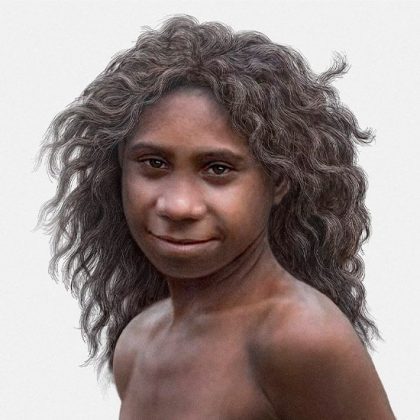
Artistic reconstruction of a juvenile Homo antecessor, Based on skeletal remains from Gran Dolina Cave

Larger and more robust hominin remains in Algeria dated at 1,000 ka – H. heidelbergensis? – resemble those found near Casablanca. They may have evolved to the latter. Similar possible progenitors to Iberian Homo antecessor have yet to be found in Western Europe. Homo erectus appeared in Georgia and Romania between 2.0 and 1.9 Ma, but the intervening million years or more have yielded no credible European forebears of H. antecessor. For the moment, incursion of a North African population into Europe followed by sustained contact is Hublin et al’s favoured hypothesis, rather than a European origin for Homo antecessor. For Neanderthals and Denisovans to have originated from such an African group, as has been suggested, requires finds of African fossils with plausible resemblance to what are predominantly Eurasian groups. The Iberian population migrated far and wide in Western Europe, as witnessed by stone tools and footprints dating to between 950 to 850 ka in eastern England. So it is equally possible that the Iberian group were progenitors of Neanderthals and Denisovans in Eurasia itself. At least for the moment, ancient genomes of the two H. antecessor groups are unlikely to be found in either Iberian or African fossils of the same antiquity. But, as usual, that will not stifle debate: a resort to the adage ‘absence of evidence is not evidence of absence’ seems appropriate to several research teams!

The oldest anatomically modern human fossils dated at ~300 ka, were also discovered in Morocco (see: Origin of anatomically modern humans, June 2017). Their isolation in the NW corner of the African continent poses a similar conundrum, as since then such beings went on to occupy wide areas of sub-Saharan Africa and then the world.

The earliest upright ape

Two decades ago the world of palaeoanthropologists was in turmoil with the publication of an account of a new find in Chad (see: Bonanza time for Bonzo; July 2002). A fossil cranium, dubbed Sahelanthropus tchadensis (nicknamed Toumaï­ or ‘hope of life’ in the Goran language), appeared like a cross between a chimpanzee and an australopithecine. The turmoil erupted partly because of its age: Upper Miocene, around 7 Ma old. Such an antiquity was difficult to reconcile with the then accepted ~5 Ma estimate for the evolutionary split between humans and chimpanzees, based on applying a ‘molecular clock’ approach to the difference between their mtDNA. The other point of contention was the size of Sahelanthropus’s canine teeth: far too large for australopithecines and humans, but more appropriate for a gorilla or chimp.

Cast of the reconstructed skull of Sahelanthropus tchadensis. (Credit: Didier Descouens, University of Toulouse)

In the absence of pelvic- and foot bones, or signs of the foramen magnum where the spinal cord enters the skull – crucial in distinguishing habitual bipedalism or being an obligate quadruped – encouraged the finders of a 6.1 to 5.7 Ma-old Kenyan hominin Orrorin tugenensis to insist that its skeletal remains – several teeth, fragments of a lower jaw, a thigh bone, an upper arm and of a finger and thumb but no cranial bones – were of ‘the earliest human ancestor’. In Orrorin’s favour were smaller canine teeth than those of later australopithecines. At the time of the dispute, centred mainly on absence of crucial evidence, doyen of hominin fossils Bernard Wood of George Washington University and an advocate of ‘untidy’ evolution, suggested that both early species may well have been evolutionary ‘dead ends’ (see: A considered view; October 2002). And there the ‘muddle’ has rested for 20 years.

In 2002 not only a cranium of Sahelanthropus had been unearthed. Three lower jaw bones and a collection of teeth suggested that as many as 5 individuals had been fossilised. A partial leg bone (femur) and three from forearms (ulna) cannot definitely be ascribed to Sahelanthropus but, in the absence of evidence of any other putative hominin species, they may well be. It has taken two decades for these remains to be analysed to a standard acceptable to peer review (Daver, G. et al. 2022. Postcranial evidence of late Miocene hominin bipedalism in Chad. Nature v. 608, published online; DOI: 10.1038/s41586-022-04901-z). The authors present convoluted anatomical evidence that Toumaï­’s femur, which had been gnawed by a porcupine and lacks joints at both ends, suggesting that it was indeed suited to upright walking. Yet the arm bones hint that it may have been equally comfortable in tree canopies. Yet it does look very like an ape rather than a hominin.

Much the same conclusion has been applied to Australopithecus afarensis, indeed its celebrated representative ‘Lucy’ met her end through falling out of a large tree ~3.2 Ma ago (see: Lucy: the australopithecine who fell to Earth?; September 2016). So, dual habitats may have been adopted by hominins long after they emerged. Yet Au afarensis was capable of trudging through mud as witnessed by the famous footprints at Laetoli in Tanzania. Only around 3 Ma has reasonably convincing evidence for upright walking similar to ours been discovered in Au africanus. The full package of signs from pelvis and foot for habitual bipedalism dates to 2 Ma ago in Au sediba. Even this latest known australopithecine seems to have had a gait oddly different from that of members of the genus Homo.

So, in many respects the benefits of full freeing of the hands to develop manipulation of objects, as first suggested by Freidrich Engels, may have had to await the appearance of early humans. Earlier hominins almost certainly did make tools of a kind, but the revolutionary breakthrough associated with humanity was more than 5 million years in the making.

See also: Callaway, E. 2022. Seven-million-year-old femur suggests ancient human relative walked upright. Nature (News)24 August 2022;

Handwerk, B. 2022. Seven Million Years Ago, the Oldest Known Early Human Was Already Walking. Smithsonion Magazine, 24 August 2022 (click the link ‘published today in Nature’ in 2nd paragraph to access complimentary PDF of Daver et al)

Hominin evolution becoming a thicket

Scientific American is renowned for its eminently readable reviews of both emerging and perennial topics. Its February 2013 issue takes on one that is guaranteed to run and run; the evolutionary course that produced us (Harman, K. 2013. Shattered ancestry. Scientific American, v. 308 (February 2013), p. 36-43). Since its launch Earth Pages has covered much of the new science in the field but did not anticipate the depth of the stir towards which it has led.

Australopithecus afarensis reconstruction
Australopithecus afarensis reconstruction (credit: Wikipedia)

For a decade it has become increasingly clear that anatomically modern humans are unique in one respect: they are the first species in perhaps 4 million years to be the sole extant member of the cladistic tribe Hominini. As recently as 30 ka Homo sapiens shared the planet with Neanderthals, Denisovans, H. erectus and H. floresiensis. At the time the genus Homo emerged around 2.0-2.5 Ma ago there were at least four other fossil groups that shared the major characteristic of upright gait, all australopithecines in ‘robust’ and ‘gracile’ guises.

As time goes by there will likely be more fossil discoveries that show important anatomical signs of other novel evolutionary divergence, which therefore warrant new species. Pliocene-Pleistocene time is becoming crowded, and the more diversity in its fossil record the less likely it is that some clear evolutionary pathways can be devised to explain just what was going on. Katherine Harmon of Scientific American’s editorial team touches on the thorny issues of upright walking and gait, tree climbing, precise use of the fingers and thumb, and brain size that are raised by 22 species; 2 living and 20 extinct.

Genetics clearly indicates that our nearest living relatives belong to two species in the genus Pan(chimpanzees and bonobos). It has been generally assumed that the common ancestor of this extant kinship some 8 Ma back was chimp-like, and that evolutionary divergence from its habits and anatomy produced the growing ‘bramble patch’ of hominin evolution. That assumption is based on the principle of parsimony, i.e. the simplest view of the evidence – what there is now and fragments from the past eight million years. The trouble is there is a dearth of fossils that can be said to be en route to chimps in some way.

In fact today’s chimps and bonobos are more or less restricted to clambering in tropical forest habitats, for which they are well-adapted. Maybe they are the survivors of evolutionary vagaries just as complex as those leading to us. For one thing, almost embarrassingly, their brain size is substantially larger than those of quite a few fossil hominins; and why not? How they behave socially may possibly have arisen as part of their specialisation too, of which more shortly. Our big difference from them is being supreme generalists, as well as consciousness.

All the fossils classed as hominins show some signs of being able to walk upright, classically the forward position of the foramen magnum at the base of the skull where it joins to the backbone, but in some cases merely the geometry of the hip joint to the pelvis for that is all that has been found. Yet that anatomical likelihood glosses over the vital detail of the actual gait – heel-to-toe like us (Australopithecus afarensis),  on the outside edge of the foot akin to chimps (Ardepithecus ramidus) or differently again but possible as efficient as us (Au. sediba). Then there is the matter of arboreal abilities: chimps are masters despite their bulk, but every hominin whose foot bones have been found shows some evidence of grasping with the big toe. Indeed humans are pretty nimble climbers but do not brachiate from branch to branch.

As regards the hands, an interesting point is that while chimpish knuckle walking is not seen in fossils, Ardipithecus probably could walk on all fours with hands flat on the ground but had fingers quite capable of precise manipulation, an ability shown spectacularly well by 2 Ma old Au. sediba. Upright walking may have evolved more than once, and it is even possible that chimps evolved specifically for climbing in forestlands, their highly adapted grasping hands only capable of knuckle walking on the ground.

English: Fossil of Oreopithecus bambolii, an e...
Oreopithecus bambolii from the Upper Miocene of northern Italy(credit: Wikipedia)

The late-Miocene of Africa – the likely time range for the Pan-Homo common ancestor – is a fossil desert as regards primates. Yet its Italian equivalent has yielded a fascinating and well-preserved creature; Oreopithecus bambolii has skeletal features compatible with an upright posture and bipedal locomotion. Until the African Miocene yields something more appropriate, Oreopithecus is a candidate for a common ancestor, and interesting in another respect. Its dentition does not include prominent canine teeth that in the predominantly vegetarian, though occasionally carnivorous, Pan species serve well in their aggression-based, hierarchical social systems, as they do in the even more spectacular baboons.

Christopher Boehm, primate behaviouralist cum anthropologist, in his recent book Moral Origins (2012 Basic Books, ISBN-13: 978-0465020485) uses the principle of parsimony to reconstruct the social system of the Miocene Pan-Homo common ancestor from those of chimps and surviving human hunter-gatherers. His thesis is that it was centred on the hierarchical dominance of ‘alpha’ males, as is that of chimps. Prolonged social selection in hominin evolution largely tempered such a ‘Big Man’ tendency through a variety of strategies directed by majorities. Social punishments, including capital punishment, evolved to combat free-loading, theft and individual dominance in favour of cooperative egalitarianism. Such measures developed increasingly conscious self-suppression of such traits that eventually manifested themselves as what we now regard as human morals. Boehm considers that this psychological trend in evolution accelerated once Homo sapiens began hunting of large prey animals that added substantially to diet.

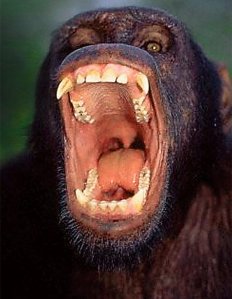
Aggressive male chimpanzee (Credit: Daily Mail)

There is a major problem for this view: like Oreopithecus every well-preserved hominin species, even the earliest Sahelanthropus tchadensis, do not have prominent canines irrespective of whether they show evidence of at least partial meat-eating or pure vegetarianism. For some species with many fossil members, such as Au. afarensis, there are signs of sexual dimorphism – larger males than females – but that does not necessarily signify hierarchical social behaviour. With the appearance of H. erectus that difference wanes to the present slight differences between modern male and female humans.

Scrum
Agressive male humans, note gumshields (credit: John_Scone via Flickr)

If it is valid – and who knows? – for morphology to give clues to social behaviour, then it is equally likely that the beginnings of the hominin evolutionary thicket may well have involved a trend in social behaviour towards cooperative action; 8 million years ago. For generally small, gracile creatures with habits no more threatening to the big predators of the African savannahs that that of the porcupine, there would have been a powerful selection pressure towards a united front. Of course, in the last ten thousand years since the shift to economic strategies based on storable surpluses and their expropriation, hierarchical social systems with violence at their heart emerged among modern humans. Judging by the body shapes and dentition of extant ‘alphas’, as in capital’s boardrooms and among the frontbenchers at Westminster, anthropology clearly is in need of some refinement…