Evolution of pigmentation in anatomically modern humans of Europe: a new paradigm?

The colours of human skin, eyes and hair in living people across the world are determined by variants of genes (alleles) found at the same place on a chromosome. Since chromosomes are inherited from both mother and father, an individual may have the same two alleles (homozygous), or one of each (heterozygous). A dominant allele is always expressed, even if a single copy is present. A recessive allele is only expressed if the individual inherits two copies of it. Most characteristics of individuals result from the interaction of multiple genes, rather than a single gene. A commonly cited example is the coloration of eyes. If we had a single gene for eye colour – that of the iris – that had alleles just for blue (recessive or ‘b’) and one for brown (dominant or ‘B) pigmentation, brown-eyed individuals would have one or two ‘B’ alleles (bB or BB), whereas those with blue eyes would have to have two ‘blue’ alleles (bb). But inheritance is more complicated than that: there are people with green, hazel or grey eyes and even left- and right eyes of different colour. Such examples suggest that there are more than two genes affecting human eye colour, and each must have evolved as a result of mutations. Much the same goes for hair and skin coloration.

A group of scientists from the University of Ferrara in Italy have analysed highly detailed ancient DNA in anatomically modern human remains from Russia (Palaeolithic), Sweden (Mesolithic) and Croatia (Neolithic) to tease out the complexities of pigmentation inheritance. Then they applied a statistical approach learned from that study to predict the likely skin-, eye- and hair pigmentation in 348 less detailed genomes of ancient individuals whose remains date back to 45 Ma ( Silvia Perretti et al, 2025. Inference of human pigmentation from ancient DNA by genotype likelihood. Proceedings of the National Academy of Science, v. 122, article e2502158122; DOI: 10.1073/pnas.2502158122).

An artist’s impression of a Mesolithic woman from southern Denmark (credit: Tom Bjorklund)

All the hunter-gatherer Palaeolithic individuals (12 samples between 45 and 13 ka old) bar one, showed clear signs of dark pigmentation in skin, eyes and hair – the outlier from Russia was probably lighter. Those from the Mesolithic (14 to 4 ka) showed that 11 out of 35 had a light eye colour (Northern Europe, France, and Serbia), but most retained the dark skin and hair expected in descendants of migrants from Africa. Only one 12 ka hunter-gatherer from Sweden had inferred blue eyes, blonde hair, and light skin.  The retention of dark pigmentation by European hunter-gatherers who migrated there from Africa has been noted before, using DNA from Mesolithic human remains and in one case from birch resin chewed by a Mesolithic woman. This called into question the hypothesis that high levels of melatonin in skin, which protects indigenous people in Africa from cancers, would result in their producing insufficient vitamin D for good health. That notion supposed that out-of-Africa migrants would quickly evolve paler skin coloration at higher latitudes. It is now known that diets rich in meat, nuts and fungi – staple for hunter-gatherers – provide sufficient vitamin-D for health at high latitudes. A more recent hypothesis is that pale skins may have evolved only after the widespread Neolithic adoption of farming when people came to rely on a diet dominated by cereals that are a poor source of vitamin-D.

However, 132 Neolithic farmers (10 to 4 ka ago) individuals studied by Perretti et al. showed increased diversity in pigmentation, with more frequent light skin tones, yet dark individuals persisted, particularly in southern and eastern Europe. Hair and eye colour showed considerable variability, the earliest sign of red hair showing up in Turkey. Even Copper- and Bronze Age samples ( 113 from 7 to 3 ka) and those from Iron Age Europeans (25 from 3 to 1.7 ka ago) still indicate common retention of dark skin, eyes and hair, although the proportion of lighter pigmentation increased in some regions of Europe. Other analyses of ancient DNA have shown that the Palaeo- and Mesolithic populations of Europe were quickly outnumbered by influx of early farmers, probably from the Anatolian region of modern Turkey, during the Neolithic. The farming lifestyle seems likely to have allowed the numbers of those who practised it to rise beyond the natural environment’s ‘carrying capacity’ for hunter-gatherers. The former inhabitants of Europe may simply have been genetically absorbed within the growing population of farmers. Much the same absorption of earlier groups seems to have happened with the westward migration from the Ukrainian and Russia steppes of the Yamnaya people and culture, culminating in the start of the European Bronze Age that reached western Europe around 2.1 ka, The Yamnaya introduced metal culture, horse-drawn wheeled vehicles and possibly Indo-European language.

So the novel probabilistic approach to ancient DNA by Perretti et al. also casts doubt on the diet-based evolution of light pigmentation at high latitudes. Instead, pulses of large population movements and thus changes in European population genetics probably account for the persistence of abundant evidence for dark pigmentation throughout Europe until historic times. The ‘lightening’ of Europeans’ physiognomy seems to have been vastly more complex than previously believed. Early Europe seems to have been almost bewilderingly diverse, which make a complete mockery of modern chauvinism and racism. The present European genetic ‘melting pot’ is surprisingly similar to that of Europe’s ancient past.

Extraction of ancient human DNA from artefacts

The Denisova cave in southern Siberia is now famous for the evidence that it has provided for Neanderthals and Denisovans and their interbreeding based on DNA recovered from their bones, even a tiny finger bone of the latter. Indeed we would not know of the former existence of Denisovans without such a clue. Scientists at the Max Planck Institute for Evolutionary Anthropology in Leipzig, responsible for both breakthroughs, also pioneered the extraction of hominin DNA from soil in the cave. Now they have refined the intricate extraction of genetic material to such an extent that detailed hominin DNA sequences can be analysed from ornaments worn by ancient people, in much the same manner as applied in forensic studies of crime scenes (Essel, E. and 22 others 2023. Ancient human DNA recovered from a Palaeolithic pendant. Nature, early release 3 May 2023; DOI: 10.1038/s41586-023-06035-2).

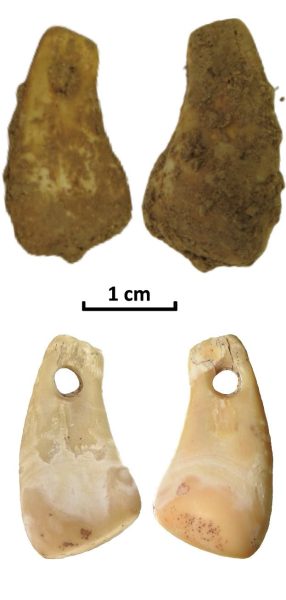
Elk-tooth pendant found at Denisova cave, before cleaning and DNA extraction (top) and after the ‘washing’ procedure (bottom). Credit: Essel et al., Fig 1.

Russian archaeologists who continue to work at Denisova cave found a pierced pendant made from the tooth of a Siberian elk or wapiti during the 2019 field season. It was sent to Leipzig, where the palaeogenetics team had been trying to extract the DNA of whoever had worn personal artefacts found in French and Bulgarian caves. Their efforts had been unsuccessful, but such an object from Denisova clearly spurred them on. When someone wears next to the skin objects made of porous materials their sweat and the DNA that it carries seeps into the pores. If the materials decay very slowly, as do bone and especially teeth, genetic material can, in principle be extracted. But crushing up important ancient objects is not an option: for such rarities the extraction has to be non-destructive. It can only be done by ‘washing’ it in reagents that do not themselves break down DNA. Elena Essel and her many colleagues experimented with many ‘brews’ of reagents and repeated immersion at steadily rising temperature (up to 90°C). This releases genetic material in a stepwise fashion, allowing separation of contaminants in the host sediment from that which had penetrated into the tooth’s pores from whoever made the pendant and the wearer, and the animal from which it came

 Analysis of the recovered material yielded elk mtDNA, which was compared with that from four other ancient elks of known ages. This suggested that the elk had lived between 19 and 25 ka ago, thereby indirectly dating the time when the pendant was made and worn. A surprisingly large amount human DNA showed that the wearer was a female who was genetically allied with ancient anatomically modern humans who lived further east in Siberia at about that time.

Obviously this astonishing result opens up a wide vista for archaeology, though not from Palaeolithic burials, which are extremely rare. But artefacts of various kinds are much more common that actual human remains. Because the technique is non-destructive museums may be more willing to make objects in their collections available for analysis. Maybe the approach will be restricted to porous bone or tooth ornaments worn for long periods by individuals. Yet stone tools that were handled continually could be a more important target, depending on the rock from which they were made and its porosity.

See also: Lesté-Lasserre, C.. DNA from 25,000-year-old tooth pendant reveals woman who wore it. New Scientist, 3 May 2023.

More early art from South Africa?

407458aa.2
Silcrete flake from Blombos with crosshatching drawn in red ochre. (Credit: C. Foster)

The Blombos Cave 300 km east of Cape Town is where the earliest signs of art produced by anatomically modern humans were found (see Snippets on human evolution October 2011). The most publicized was a shaped piece of ochre etched with a hashed pattern of lines (Henshilwood, C.S. et al. 2018. An abstract drawing from the 73,000-year-old levels at Blombos Cave, South Africa. Nature v. 561, online; DOI: 10.1038/s41586-018-0514-3). This and the ochre-processing workshop where it was found gave a date of about 100 ka, Now another item has hit the newsrooms; a  ground piece of flinty silcrete that shows signs of being the product of knapping, on which has been drawn a similar pattern, which resembles the now ubiquitous ‘hashtag’ associated with Twitter. The level in the excavation from which it was removed gives an age of about 75 ka. Like the earlier artifact, it involved the use of ochre but in a way that has been said to be an example of drawing or painting, rather than etching. It is likely to have been produced by a sharpened piece of solid ochre, perhaps a kind of crayon

For some reason the object has been hyped as the earliest example of art and of advanced cognitive abilities. But the pattern is not as complex as that on the original etched ochre block from Blombos, or even those on a freshwater mussel from Trinil in Java that could have =been made by associated Homo erectus between 430 and 500 ka ago. This does not take the context at Blombos into account. There is ample evidence that ochre, along with charcoal and burnt seal bone, was being ground there and made into paint found in an abalone shell. It can be surmised that such paint was used for some kind of decoration that has not yet been discovered. That is quite possibly because it was used for body paint as similar materials are still widely used.  Now anyone – male or female – who uses cosmetics today, be it foundation, lipstick, eye-liner and -shadow or the truly fabulous make-up used by the Kathakali performers of Kerala, takes an age to try and to decide on which of an almost imperceptible range of shades to apply. Ochres are like that, as any native Australian artist will tell you.

407458aa.2
Lord Rama face paint in Kathakali

To me, the most likely origins of both kinds of Palaeolithic hashtag are: in the case of the ‘drawing’, checking the colour and ‘grindability’ of a sharpened piece of red ochre before use; and for the etched block, using a sharp tool to grind off small amounts from what may have been a well-used block of an especially valued hue.

A revised and updated edition of Steve Drury’s book Stepping Stones: The Making of Our Home World can now be downloaded as a free eBook