
During the last 2 months I have not encountered any new papers that piqued my interest, hence the long hiatus in Earth-logs. So rather than waiting until something that suits turns up, I am trying another approach: a post that summarises a paper that might seem outlandish to most Earth scientists. The paper appeared in a journal that I do not usually consult – National Science Review – and describes experiments that hint at a non-biological driver for the Great Oxygenation Event (Yongjiang Xu et al. 2026. Magma as a carrier of non-stoichiometric oxygen linking Earth’s interior and atmosphere. National Science Review, v. 13, article nwag539; DOI: 10.1093/nsr/nwag539)
Yongjiang Xu of the Center for High Pressure Science and Technology Advanced Research, Beijing, China with colleagues from China, the US and the Netherlands claim to have discovered that igneous magma can contain oxygen that is not combined chemically in silicate melts in much larger amounts than geochemists previously thought. This implies that magma rising from oxygen-bearing parts of the deep mantle could act as a previously unsuspected system for oxygen transport within the Earth towards its surface and atmosphere.
They made powders of pure metal oxides and carbonates mixed to mimic the chemical composition of ocean floor basalt. They heated them to temperatures up to 2000°C at pressures as high as 7GPa, equivalent to a depth of 240 km within the Earth. To create oxygen-rich conditions platinum oxide was added to the powder – it breaks down to the metal and oxygen when heated. At the end of each run the molten ‘basalt’ was quenched to form glass and analysed using several techniques. Rather than existing as bubbles of gas in the quenched samples oxygen became incorporated in the structure of the silicate glass itself. These experiments showed that the amount of this ‘excess oxygen’ added to artificial basaltic magma increases substantially with pressure, to about 3% at 240 km. The oxygen probably bonds to silicon atoms in the silicate melt structure.
Any magmatic oxygen transport in the real mantle would depend, of course, on uncombined oxygen being present in actual mantle rock. The geochemistry of naturally occurring basalts formed by mantle melting does show that oxygen is available in the mantle at different concentrations. But whether or not the magma from which they formed actually carried oxygen is impossible to tell: it had crystallised at shallow depth and would have expelled any ‘excess oxygen’.
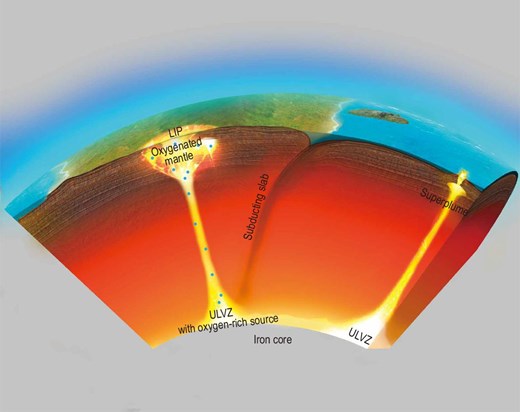
Despite the care that the authors took, their results merely suggest a hypothesis, albeit a very interesting one. They speculate that the Great Oxygenation Event (2.5 to 2.0 Ga ago) may have stemmed from a massive upsurge in magma from the deep mantle; over 7 million km3 of magma erupted during that period. Moreover, other recent research suggests that Earth’s core may contain vast amounts of oxygen in the form of iron-oxygen alloys: perhaps 8–13% oxygen by weight in the outer core. That would account for its calculated density being about 10% lower than would be the case if it was pure iron or iron-nickel alloy. So, there is a possibility that abundant oxygen in the mantle may have resulted from leakage across the core-mantle boundary: where some mantle plumes are thought to originate …
See also: Scientists discover a hidden oxygen source deep inside Earth that could rewrite our planet’s history. Sci Tech Daily,23 October 2026.


