Gravity survey reveals signs of Archaean tectonics in Canadian Shield

Much of the Archaean Eon is represented by cratons, which occur at the core of continental parts of tectonic plates. Having low geothermal heat flow they are the most rigid parts of the continental crust.  The Superior Craton is an area that makes up much of the eastern part of the Canadian Shield, and formed during the Late Archaean from ~4.3 to 2.6 billion years (Ga) ago. Covering an area in excess of 1.5 million km2, it is the world’s largest craton. One of its most intensely studied components is the Abitibi Terrane, which hosts many mines. A granite-greenstone terrain, it consists of volcano-sedimentary supracrustal rocks in several typically linear greenstone belts separated by areas of mainly intrusive granitic bodies. Many Archaean terrains show much the same ‘stripey’ aspect on the grand scale. Greenstone belts are dominated by metamorphosed basaltic volcanic rock, together with lesser proportions of ultramafic lavas and intrusions, and overlying metasedimentary rocks, also of Archaean age. Various hypotheses have been suggested for the formation of granite-greenstone terrains, the latest turning to a process of ‘sagduction’. However the relative flat nature of cratonic areas tells geologists little about their deeper parts. They tend to have resisted large-scale later deformation by their very nature, so none have been tilted or wholly obducted onto other such stable crustal masses during later collisional tectonic processes. Geophysics does offer insights however, using seismic profiling, geomagnetic and gravity surveys.

The Geological Survey of Canada has produced masses of geophysical data as a means of coping with the vast size and logistical challenges of the Canadian Shield. Recently five Canadian geoscientists have used gravity data from the Canadian Geodetic Survey to model the deep crust beneath the huge Abitibi granite-greenstone terrain, specifically addressing variations in its density in three dimensions. They also used cross sections produced by seismic reflection and refraction data along 2-D survey lines (Galley, C. et al. 2025. Archean rifts and triple-junctions revealed by gravity modeling of the southern Superior Craton. Nature Communications, v. 16, article 8872; DOI: 10.1038/s41467-025-63931-z). The group found that entirely new insights emerge from the variation in crustal density down to its base at the Moho (Mohorovičić discontinuity). These data show large linear bulges in the Moho separated by broad zones of thicker crust.

Geology of the Abitibi Terrane (upper),; Depth to the Moho beneath the Abitibi Terrane with rifts and VMS deposits superimposed (lower). Credit: After Galley et al. Figs 1 and 5.

Galley et al. suggest that the zones are former sites of lithospheric extensional tectonics and crustal thinning: rifts from which ultramafic to mafic magmas emerged. They consider them to be akin to modern mid-ocean and continental rifts. Most of the rifts roughly parallel the trend of the greenstone belts and the large, long-lived faults that run west to east across the Abitibi Terrain. This suggests that rifts formed under the more ductile lithospheric condition of the Neoarchaean set the gross fabric of the granites and greenstones. Moreover, there are signs of two triple junctions where three rifts converge: fundamental features of modern plate tectonics. However, both rifts and junctions are on a smaller scale than those active at present. The rift patterns suggest plate tectonics in miniature, perhaps indicative of more vigorous mantle convection during the Archaean Eon.

There is an interesting spin-off. The Abitibi Terrane is rich in a variety of mineral resources, especially volcanic massive-sulfide deposits (VMS). Most of them are associated with the suggested rift zones. Such deposits form through sea-floor hydrothermal processes, which Archaean rifting and triple junctions would have focused to generate clusters of ‘black smokers’ precipitating large amounts of metal sulfides. Galley et al’s work is set to be applied to other large cratons, including those that formed earlier in the Archaean: the Pilbara and Kaapvaal cratons of Australia and South Africa. That could yield better insights into earlier tectonic processes and test some of the hypotheses proposed for them

See also: Archaean Rifts, Triple Junctions Mapped via Gravity Modeling. Scienmag, 6 October 2025

New drill core penetrates the Mohorovičić Discontinuity (the ‘Moho’)

In 1909 Croatian geophysicist Andrija Mohorovičić examined seismograms of a shallow earthquake that shook the area around Zagreb. To his surprise the by-then familiar time sequence of P-waves followed by the slower S-waves appeared twice on seismic records up to 800 km away. The only explanation that he could come up with was that the first arrivals had travelled directly through the crust to the detector whereas the second set must have followed a longer path: it had travelled downwards to be refracted to reach the surface when it met rocks denser than those at the surface. His analysis revealed a sharp boundary between the Earth’s crust and its mantle at a depth of about 54 km below what was then Yugoslavia. Later workers confirmed this discovery and honoured its discoverer by naming it the Mohorovičić Discontinuity. Difficulty with pronouncing his name resulted in a geological nickname: ‘the Moho’. It can be detected everywhere: at 20 to 90 km beneath the continental surface and 5 to 10 km beneath the ocean floor, thus distinguishing between continental and oceanic crust.

In the late 1950s accelerating geological and oceanographic research that would culminate in the theory of plate tectonics turned its focus on drilling down to the Moho in much the same way as a lust for space travel spawned getting to the Moon. The difference was that the proposers of what became known as the Mohole Project were members of what amounted to a geoscientific glee club (The American Miscellaneous Society), which included a member of the well-financed US National Science Foundation’s Earth Science Panel. The idea emerged shortly after the Soviet Union had launched the Sputnik satellite and rumours emerged that it was proposing deep drilling into the continental crust beneath the Kola Peninsula.  The Mohole’s initial target was the 3.9 km deep floor of the Caribbean off Guadalupe in Mexico and required advanced methods of stabilisation for a new oceanographic ship that was to host the drilling rig.

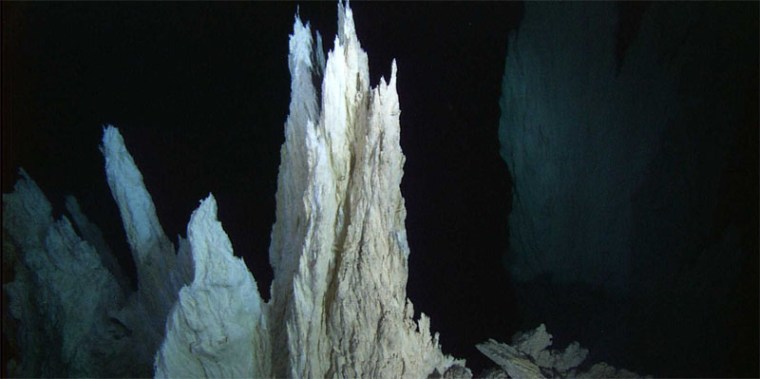
Huge (tens of metres high) pillars or ‘chimneys’ of carbonates formed by the Lost City hydrothermal vent near the mid-Atlantic ridge (Credit: ETH Zurich)

The Mohole was spudded in 1961, but the deepest of five holes reached only 200 m beneath the sea floor. It recovered Miocene sediments and a few metres of basalt. Deep water drilling was somewhat more complicated than expected and about US$ 57 million was spent fruitlessly. The project was disbanded in 1966 with considerable acrimony and schadenfreude. Nonetheless, the Mohole fiasco made technical advances and did demonstrate the feasibility of offshore drilling. The petroleum industry benefitted and so did oceanography with the globe-spanning deep-sea drilling of ocean floor sediments. The sediment cores produced the 200 million-year exquisitely detailed record of climate change and vast amounts of geochemical data from the basaltic oceanic crust. In 2005 JOIDES (the Joint Oceanographic Institutions for Deep Earth Sampling) had another crack at the Moho. That venture centred on the intersection of the Mid-Atlantic Ridge and the Atlantis Fracture Zone close to the ‘Lost City’ hydrothermal vent. The area around the vent is the site of a huge low-angled extensional fault that has partly dragged the basaltic ocean crust off the mantle beneath causing it to bulge. This provided an excellent opportunity to drill through the Moho. All went well, but 54 days of drilling yielded 1.4 km of basalt but nothing resembling mantle rock. So, again, the Moho had thwarted Science (and research economics). But finally it is beginning to reveal it secrets (see: Voosen, P. 2023. Ocean drillers exhume a bounty of mantle rocks. Science, v. 380 (News) p. 876-877; DOI: 10.1126/science.adi9899

The area around the ‘Lost City’ vent was originally chosen for drilling to examine the chemical processes going on there. Hydrogen emitted by serpentinisation of mantle rocks can combine with carbon monoxide in hydrothermal fluids to create a wide variety of organic compounds, which could be the initial building blocks for the origin of life. As part of the International Ocean Drilling Programme JOIDES decided to launch IODP Expedition 399 to re-examine the area around ‘Lost City’ in more detail. The expedition first tried to continue drilling the 2005 hole, but failed yet again. Finally a new drill site aimed at penetrating the extensional detachment. Within a few days the drill bit punched into mantle rocks and over a 6-week period the expedition had recovered a kilometre of core. The technical accounts for each week of drilling give a flavour of what it must be like to be a part of such a ship-borne expedition as well as describing what emerged in the drill core. It seems like a bit of a jumble, dominated by the mineral olivine– the principal characteristic of the ultramafic mantle – almost pure in the rock dunite and mixed with pyroxenes in various kinds of peridotite. There are also coarse-grained rocks that contain plagioclase feldspar, which cut through the ultramafic materials – gabbros, troctolites and norites.  They are relics of intrusive basaltic magmas that did not make it to the seabed. The samples are variably altered by interaction with watery hydrothermal fluids, with lots of serpentine, talc and even asbestos: the drilling presented a health hazard for a few days. The rocks have been metamorphosed under pressure-temperature conditions of greenschist to amphibolite facies and subject to ductile deformation, probably because of the effect of extensional deformation. Whatever, there is plenty of material to be analysed, including for signs of microbial activity. So, the dreams of a 1950s academic drinking fraternity (they were all men!) have finally been realised. But since those pre-plate-tectonic times many geologists have seen and collected much the same, even putting their index fingers on the Moho itself in the time-honoured fashion. Intricate 3-D geology in ophiolite complexes such as that in Oman, provide such opportunities at the much lower cost of air travel, Land Cruiser hire and camping. Indeed what we know of the structure of the oceanic lithosphere – pillow lavas, sheeted dyke complexes, gabbro cumulates and serpentinised ultramafic mantle – has come from such bodies thrust onto continental crust at ancient plate margins. So, why the celebration in this case? They are the first samples of mantle from young oceanic lithosphere; the rocks of ophiolites may not have formed at mid-ocean ridges. These should give clues to the long-term magmatism that has created the vast abyssal basins that the mantle eventually reabsorbs by subduction. Then, of course, there is the link to biogenic processes at constructive margins that underpinned the return to the active hydrothermal venting at ‘Lost City’.