Evidence for Earth’s magnetic field 3.7 billion years ago

If ever there was one geological locality that  ‘kept giving’ it would have to be the Isua supracrustal belt in West Greenland. Since 1971 it has been known to be the repository of the oldest known metasedimentary rocks, dated at around 3.7 Ga. Repeatedly, geochemists have sought evidence for life of that antiquity, but the Isua metasediments have yielded only ambiguous chemical signs. A more convincing hint emerged from iron-rich silica layers (jasper) in similarly aged metabasalts on Nuvvuagittuk Island in Quebec on the east side of Hudson Bay, Canada, which may be products of Eoarchaean sea-floor hydrothermal vents. X-ray micro-tomography and electron microscopy of the jaspers revealed twisted filaments, tubes, knob-like and branching structures up to a centimetre long that contain minute grains of carbon, phosphates and metal sufides, but the structures are made from hematite (Fe2O3­) so an inorganic formation is just as likely as the earliest biology. Isua’s most intriguing contribution to the search for the earliest life has been what look like stromatolites in a marble layer (see: Signs of life in some of the oldest rocks; September 2016). Such structures formed in later times on shallow sea floors through the secretion of biofilms by photosynthesising blue-green bacteria.
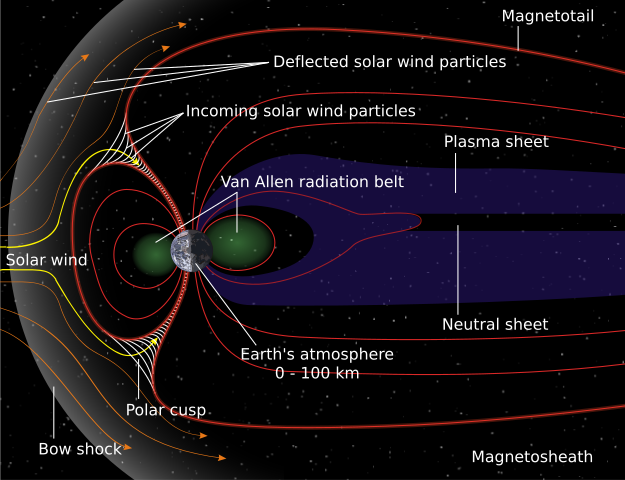
Structure of the Earth’s magnetosphere that deflects charged particles which form the solar wind. (Credit: Wikipedia Commons)

For life to form and survive depends on its complex molecules being protected from high-energy charged particles in the solar wind. In turn that depends on a strong geomagnetic field deflecting the solar wind as it does today, except for a small proportion that descend towards the poles and form aurora during solar mass ejections. In  visits to Isua in 2018 and 2019, geophysicists from the Massachusetts Institute of Technology, USA and Oxford University, UK drilled over 300 rock cores from metasedimentary ironstones (Nichols, C.I.O. and 9 others 2024. Possible Eoarchean records of the geomagnetic field preserved in the Isua Supracrustal Belt, southern West Greenland. Journal of Geophysics Research (Solid Earth), v. 129, article e2023JB027706; DOI: 10.1029/2023JB027706 Magnetisation preserved in the samples (remanent magnetism) suggest that it was formed by a geomagnetic field strength of at least 15 microtesla, similar to that which prevails today. The minerals magnetite (Fe3O4) and apatite (a complex phosphate) in the ironstones have been dated using U-Pb geochronometry and record a metamorphic event only slightly younger that the age of the Isua belt (3.69 and 3.63 Ga respectively). There is no sign of any younger heating above the temperatures that would reset the ironstones’ magnetisation. The Isua remanent magnetisation is at least 200 Ma older than that found in igneous rocks from north-eastern South Africa dated at between 3.2 to 3.45 Ga. So even in the Eoarchaean it seems likely that life, had it formed, would have avoided the hazard of exposure to the high energy solar wind. In all likelihood, however, in a shallow marine environment it would have had to protect itself somehow from intense ultraviolet radiation. That is now vastly reduced by stratospheric ozone (O3) which could only form once the atmosphere had appreciable oxygen (O2) content, i.e. after the Great Oxygenation Event beginning about 2.4 Ga ago. Undoubted stromatolites as old as 3.5 Ga suggest that early photosynthesising bacteria clearly had cracked the problem of UV protection somehow.

Pushing back the origin of photosynthesis

English: Rock sample from a banded iron format...
Sample from a banded iron formation (BIF) from the Barberton Greenstone Belt, South Africa. (credit:K. Lehmann and J.D. Kramers via Wikipedia)

More than a decade ago the oldest sedimentary rocks in the world at Isua in West Greenland hit the headlines, and not for the first time. Inclusions of graphite in crystals of the mineral apatite from the Isua supracrustals  had yielded carbon isotopes unusually deficient in 13C relative to 12C, which is often regarded as a sign that life was involved in the carbon cycle at the time. The Isua rocks have been reliably dated at around 3.8 billion years (Ga) so that added over 400 Ma to the time at which life was present on Earth. Sedimentary rocks formed at 3.4 Ga contain the first tangible signs in the form of stromatolites thought to have been secreted by biofilms of blue-green bacteria which are oxygen-generating photosynthesisers. Sadly, limestones at Isua, indeed all the putative sedimentary rocks there were metamorphosed and deformed plastically so that such features, if they were ever present, had been obliterated. Apatite was thought to be so strong and resistant to heating that carbon within its crystals would have preserved original isotopic ‘signatures’. Detailed studies to test this hypothesis refuted the early age for life, which reverted back to around 3.4 Ga. But Isua presents too good an opportunity for its geochemical secrets to be left uninvestigated.

The latest targets are its iron isotopes. Isua includes metamorphosed banded ironstones composed largely of magnetite and quartz. Magnetite is iron oxide (Fe3O4) and begs the question of how such an oxygen-rich mineral formed in such volumes in sediment if photosynthesizing life had not made elemental oxygen available. That would oxidize soluble ferrous ions (Fe2+) to the insoluble ferric form (Fe3+) in order for iron oxide to precipitate from sea water in large amounts. There is no other means known for oxygen to be produced in a planet’s surface environment. A team at the University of Wisconsin’s NASA Astrobiology Institute, led by Andrew Czaja and joined by Stephen Moorbath of the University of Oxford, who set the entire West Greenland story rolling by leading its geochronological investigation since the early 1970s, have made a breakthrough (Czaja, A.D. et al. 2013. Biological Fe oxidation controlled deposition of banded iron formation in the ca. 3770 Ma Isua Supracrustal Belt (West Greenland). Earth and Planetary Science Letters, v. 363, p. 192-203).

Any element that has more than one naturally occurring isotope offers the possibility of studying various kinds of chemical process by looking for changes to the relative proportions of the different isotopes. Having different relative atomic masses isotopes of an element have slightly different chemical properties so that one is likely to be more favoured in a reaction than another. In the case of iron, the most important reactions in surface processes are those that depend on reducing and oxidising conditions, i.e. producing soluble Fe2+ and insoluble Fe3+ respectively. Oxidation and precipitation of iron oxides and hydroxides tend to favour the heavier isotope 56Fe over the more common 54Fe resulting in an increase in the 56Fe/54Fe ratio (δ56Fe). This is found throughout the Isua ironstones, but may again reflect metamorphism. However, such was the detail of this study that δ56Fe values were measured for many individual bands. Instead of showing roughly the same values throughout the rock, each band had a different value. That strongly suggests that values produced during sedimentation had been preserved. It seems that a bacterial mechanism of oxidation was involved. Moreover, by comparing the 3.8 Ga Isua ironstones with examples dated at 2.5 Ga from Australia the team found different isotopic values that implicates different kinds of bacteria involved in producing apparently similar rock types. The twist is that the most likely bacterial type involved at Isua may have been a photosynthesiser, but not of the kind that releases elemental oxygen instead transferring it from water to combine directly with the ions of iron that its photosynthesis  had oxidised. The younger ironstones seem more likely to have involved cyanobacteria that do excrete oxygen; shortly after their formation the Earth’s surface increasingly became oxygen-bearing.

Throughout the Precambrian, BIFs appear and then vanish from the record only to reappear when geologist least expect them, for instance around the time of the Snowball Earth events in the Neoproterozoic Era. Iron isotopes could well become handy tools to probe the processes that formed them.