Earliest hominin occupation of Sulawesi and crossing of an ocean barrier

Regular readers of Earth-logs will recall that the islands of Indonesia were reached by the archaic humans Homo erectus and H. floresiensis at least a million years ago. Anatomical comparison of their remains suggest that the diminutive H. floresiensis probably evolved from H. erectus under the stress of being stranded on the small, resource-poor island of Flores: a human example of island dwarfism. In fact there are anatomically modern humans (AMH) living on Flores that seem to have evolved dwarfism in the same way since AMH first arrived there between 50 and 5 ka. Incidentally, H. erectus fossils and artefacts were found by Eugene Dubois in the late 19th century at a famous site near Trinil in Java. In 2014, turned out that H. erectus had produced the earliest known art – zig-zag patterns on freshwater clam shells – between 540 and 430 ka ago. The episodic falls in global sea level due to massive accumulations of ice on land during successive Pleistocene glacial episodes aided migration by producing connections between the islands of SE Asia. They created a huge area of low-lying dryland known as ‘Sundaland’. The islands’ colonisation by H. erectus was made easy, perhaps inevitable.

The interconnection of SE Asian islands to form Sundaland (yellow) when sea level was 120 m lower than today. Even at that extreme the island of Sulawesi remained isolated by deep ocean water. Credit: based on Hakim et al Fig 1.

However, Flores and islands further east are separated from those to the west by a narrow but very deep strait. It channels powerful currents that are hazardous to small-boat crossings even today. Most palaeoanthropologists consider the colonisation of Flores by H. erectus most likely to have resulted by accident, reckoning that they were incapable of planning a crossing and building suitable craft. For AMH to have reached New Guinea and Australia around 60 ka ago, they must have developed sturdy craft and sea-faring skills. This paradigm suggests that the evolution of AMH, and thus their eventual occupation of all continents except Antarctica, must have involved a revolutionary ‘leap’ in their cognitive ability just before they left Africa. That view has been popularised by the presenter (Ella Al-Shamahi) of the 2025 BBC Television series Human – now on BBC iPlayer (requires viewers to create a free account) – in its second episode Into the Unknown. [The idea of a cognitive leap that ushered in the almost worldwide migration of anatomically modern humans was launched in 1995 by controversial anthropologist Chris Knight of University College London].
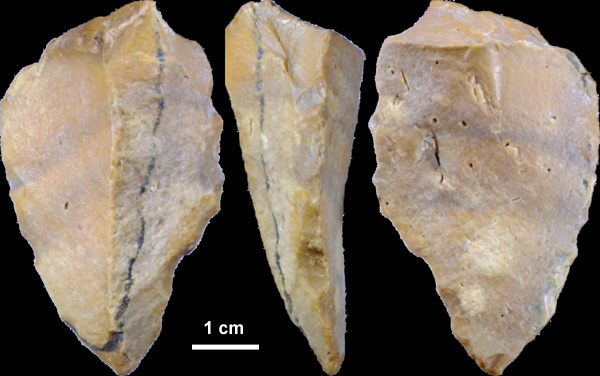
Flaked artefact, about the length of a human thumb, made of chert from excavations at Calio on Sulawesi, dated at 1.02 Ma. Credit: based on Hakim et al Fig 2

The large and peculiarly-shaped island of Sulawesi, also part of Indonesia, is notable for being the location of the earliest known figurative art; a cave painting of a Sulawesi warty pig, dated to at least 45.5 ka ago. Indonesian and Australian archaeologists working at a site near Calio in northern Sulawesi unearthed stone artefacts deep in river-terrace gravels that contain fossils of extinct pigs and dwarf elephants (Hakim, B. and 26 others 2025. Hominins on Sulawesi during the Early Pleistocene. Nature, v. 644;DOI: 10.1038/s41586-025-09348-6). The tools were struck from pebbles of hard fine-grained rocks by flaking to produce sharp edges. A combination of dating techniques – palaeomagnetism, uranium-series and electron-spin resonance – on the terrace sediments and fossils in them yielded ages ranging from 1.04 to 1.48 Ma; far older than the earliest known presence of AMH on the island (73–63 ka). The dates for an early human presence on Sulawesi tally with those from Flores. The tool makers were probably H. erectus. To reach the island from Sundaland at a time when global sea level was 120 m lower than at present would have required crossing more than 50 km of open water. It seems unlikely that such a journey could have been accidental. The migrants would have needed seaworthy craft; possibly rafts. Clearly the AMH crossings to New Guinea around 60 thousand years ago would have been far more daunting. Both land masses would have been below the horizon of any point of departure from the Indonesian archipelago, even with island ‘hopping’. Yet the Sulawesi discovery, combined with the plethora of islands both large and small, suggests that the earlier non-AMH inhabitants of Indonesia potentially could have spread further at times of very low sea level.

See also: Brumm, A. t al. 2025. This stone tool is over 1 million years old. How did its maker get to Sulawesi without a boat? The Conversation, 6 August 2025

News about ‘hobbits’ (Homo floresiensis)

The roof lifted for palaeoanthropologists in October 2004 when news emerged of a fossil from Liang Bua cave on Flores in the Indonesian archipelago. It was an adult female human skull about a third the size of those of anatomically modern humans (see: The little people of Flores, Indonesia; October 2004). Immediately it was dubbed ‘Hobbit’, and from the start controversy raged around this diminutive human. The cave layer contained evidence of fire and sophisticated tools as well as bones of giant rats and minute elephants, presumed to be staple prey for these little people. Despite having brains about the size of a grapefruit – as did australopithecines – the little people challenged our assumptions about intelligence. Preliminary dating from 95 to 17 ka suggested they may have cohabited Indonesia with both H. erectus and AMH. Indeed, modern people of Flores tell legends of the little people they call Ebo Go Go. Like both their ancestors must have crossed treacherous straits between the Indonesian islands, which existed even when global sea level was drawn down by polar icecaps. Once an early suggestion that the original find was the skull of a deformed, microcephalic individual had been refuted by further finds in Flores, scientists turned to natural selection of small stature through living on a small island with limited resources – similar to the tiny elephant Stegodon and other island faunas elsewhere. By 2007, it had become clear from other, similar fossils that they were definitely a distinct species Homo floresiensis (see: Now we can celebrate the ‘Hobbits’! November 2007) with several anatomical similarities to H. erectus. Then more sophisticated dating revealed that the Flores cave sediments containing their fossils and tools spanned 100 to 60 ka, well before AMH reached Indonesia. By 2018 their arrival on Flores, marked by a mandible fragment and 6 teeth in sediments from sediment excavation at Mata Menge 70 km east of Luing Bua, had been pushed back to 773 ka.  At the new site stone tools were found in even earlier sediments (1.02 Ma). In 2019 evidence emerged that isolated island evolution in the Philippines had produced similar small descendants (H. luzonensis) by around 67 ka.

Artist’s impression of Homo floresiensis with giant rat. (Credit: Box of Oddities podcast)

The latest development is the finding of a fragment of an adult humerus (an arm bone) in the Mata Menge excavations that had yielded the oldest dates for Homo floresiensis fossils (Kaifu, Y. and 12 others 2024. Early evolution of small body size in Homo floresiensis. Nature Communications, v. 15, article number 6381; DOI: 10.1038/s41467-024-50649-7). Comparing the teeth and arm-bone fragment with an intact adult from Liang Bua suggests that the earliest known ancestors of Homo floresiensis were even smaller. The teeth, albeit much smaller, resemble those of Indonesian specimens of H. erectus. That observation helps to rule out earlier speculation that the tiny people of Flores descended from the earliest humans from Africa (H. habilis) that were about the same size, but more than twice as old (2.3 to 1.7 Ma). The evidence points more plausibly towards their evolution from Asian H. erectus, who arrived in Java around 1.1 million years ago. Having solved the issue of ‘island hopping’ to reach Java a group of Asian H. erectus could have found their way to Flores. That island’s biological resources may not have met the survival requirements of a much larger human ancestor but evolution in isolation kept the arrivals alive. Within 300 ka, and perhaps much less for a small population, survival of smaller offspring allowed them a very long and apparently quite comfortable stay on the island. Though diminished in stature, they demonstrated the survival strategies conferred by being smart.

The last known Homo erectus

There are a lot of assumptions made about Homo erectus and, indeed, there is much confusion surrounding the species (see: various items in Human evolution and migrations logs for 2001, 2002, 2003 and several other years). For a start, the name derives from Eugene Dubois’s 1891 discovery of several hominin cranial fragments in sediments deposited by the Solo River in Java. Dubois was the first to recognise in ‘Java Man’ the human-ape ‘missing link’ about which Charles Darwin speculated in his The Descent of Man, and Selection in Relation to Sex (1871). Dubois named the beings Pithecanthropus (now Homo) erectus. Once the “multiregional” versus “out-of-Africa” debate about the origin of anatomically modern humans (AMH) emerged after a variety of H. erectus-like fossils had also turned up in Africa and Europe, as well as in East and SE Asia, ‘Java Man’ was adopted by the multiregionalists as ‘evidence’ for separate evolution of AMH in Asia. Such a view remains adhered to by a tenacious number of Chinese palaeoanthropologists, but by virtually no-one else.

Reconstruction of the Nariokotome Boy from the skeleton found in the Turkana Basin of Kenya (credit: Atelier Daynes/Science Photo Library)

The earliest of the African ‘erects’ were distinguished as H. ergaster, represented by the 1.6 Ma old, almost intact skeleton of Nariokotome Boy from the Turkana area of Kenya. In Africa the specific names ergaster and erectus often seem to be used as synonyms, whereas similar-looking fossils from Asia are almost always referred to as ‘Asian ­H. erectus’. Matters became even more confusing when the earliest human migrants from Africa to Eurasia were discovered at Dmanisi in Georgia (see; Human evolution and migrations logs for 2002, 2003, 2007, 2013). Anatomically they deviate substantially from both H. ergaster and Asian erectus – and from each other! – and at 1.8 Ma they are very old indeed. Perhaps as a palliative in the academic rows that broke out following their discovery, for the moment they are called Homo erectus georgicus; a sub-species. But, then, how can Asian H. erectus be regarded as their descendants. Yet anatomically erectus-like fossils are known in East and SE Asia from 1.5 Ma onwards.

There is another mystery. Homo ergaster/erectus in Africa made distinctive tools, typified by the bifacial Acheulian hand axe. Their tool kit remained substantially the same for more than a million years, and was inherited by all the descendants of H. erectus in Africa and Europe: by H. antecessor, heidelbergensis, Neanderthals and early AMH. Yet in Asia, such a technology has not been discovered at sites older than around 250 thousand years. Either no earlier human migrants into Asia made and carried such artefacts or stone tools were largely abandoned by early Asian humans in favour of those more easily made from woods, for instance bamboo.

In 1996 the youngest Solo River sediments that had yielded H. erectus remains in the 1930s were dated using electron-spin resonance and uranium-series methods. The results suggested occupation by ‘erects’ between 53 and 27 ka, triggering yet more astonishment, because fully modern humans had by then also arrived in Indonesia. Could anatomically modern humans have co-existed with a species whose origin went back to almost two million years beforehand? It has taken another two decades for this perplexing issue to be clarified – to some extent. The previous dates were checked using more precise versions of the original geochronological methods covering a wider range of sediment strata (Rizal, Y. et al. 2019. Last appearance of Homo erectus at Ngandong, Java, 117,000–108,000 years ago. Nature, published online; DOI:10.1038/s41586-019-1863-2). No AMH presence in Asia is known before about 80 ka, so can the astonishment be set aside? Possibly, but what is known for sure from modern and ancient DNA comparisons is that early modern human migrants interbred with a more ancient Asian group, the Denisovans. At present that group is only known from a site in Siberia and another in Tibet through a finger bone and a few molar teeth that yielded DNA significantly different from both living humans and ancient Neanderthals. So we have no tangible evidence of what the Denisovans looked like, unlike Asian H. erectus of whom there are many substantial fossils. Yet DNA has not been extracted from any of them. That is hardly surprising for the Indonesian specimens because hot and humid conditions cause DNA to break down quickly and completely. There is a much better chance of extracting genomes from the youngest H. erectus fossils from higher latitudes in China. Once that is achieved, we will know whether they are indeed erects or can be matched genetically with Denisovans.

See also:  Price, M. 2019. Ancient human species made ‘last stand’ 100,000 years ago on Indonesian island (Science)

Hobbit time

A few months after the diminutive hominin fossil Homo floresiensis, which because of its relatively large feet was quickly dubbed the ‘Hobbit’, turned out to be considerably older than previously thought it hit has the headlines again because its ancestors may have colonized the Indonesian island of Flores far earlier still. A pair of articles in the 9 June 2016 issue of Nature consider evidence from another site on the island where fluvial sediments offer more easily interpreted stratigraphy than the complex Liang Bua cave assemblage where the original skeletal remains were unearthed. The site in the So’a Basin became an important target for excavation following the discovery there in the 1950’s of stone artefacts, east of Wallace’s Line – a fundamental faunal and floral divide once thought to be due to the difficulty of crossing a deep, current-plagued channel in the Indonesian archipelago. The unexpected presence of artefacts drew palaeoanthropologists from far afield, but it was almost 50 years later before their exploration yielded hominin remains.

English: homo from flores
Homo floresiensis (credit: Wikipedia)

One of the papers reports sparse new finds of hominin material from the So’a Basin, a fragment of mandible and 6 isolated teeth thought to be from at least three individuals (van den Bergh, G.D. et al., 2016. Homo floresiensis-like fossils from the early Middle Pleistocene of Flores. Nature, v.  534, p. 245-248). The other covers newly discovered artefacts, the stratigraphic and palaeoecological setting, and radiometric dates of the finds (Brumm, A. and 22 others, 2016. Age and context of the oldest known hominin fossils from Flores. Nature, v.  534, p. 249-253). The jaw fragment shows signs of having once held a wisdom tooth, showing that it belonged to an adult. Yet although it resembles the dentition of the younger Liang Bua specimens, it seems more primitive and is even smaller. The other dental finds are most likely to be deciduous teeth of juveniles. Fission-track, uranium-series and 40Ar/39Ar dating indicates that the fossils entered the sediments about 700 ka ago. But tools and remains of prey animals in deeper sedimentary layers here and at other Flores sites indicate the presence of hominins back as far as about 1 Ma, before which there are no such signs.

So, at least a million years ago Flores was colonised by hominins. Either the original immigrants were uniquely small compared with other hominins of that vintage in Asia and Africa, or within 300 ka they had decreased in size through the evolutionary influence of limited resources on Flores and the process of island dwarfism. The second may also have been influenced by an initially small population of migrants or a later population ‘bottleneck’ that added a loss of genetic variability – a founder effect.   These two alternatives may point respectively to either the even earlier migration out of Africa and across most of Asia of perhaps H. habilis, or the dwarfing of a limited population of H. erectus who made their way there from their known occupation of Java. The authors painstaking analysis of the meagre remains suggest a closer dental resemblance to Asian Homo erectus than to earlier African hominins, so the second alternative seems more likely. However, even that scenario poses palaeoanthropology with a major problem; yet another evolutionary process that helps cryptify the links among our earlier relatives. (See also: Gomez-Robles, A., 2016. The dawn of Homo floresiensis. Nature, v.  534, p. 188-189.)