Darwin’s ‘warm little pond’: a new discovery

There may still be a few people around today who, like Aristotle did, reckon that frogs form from May dew and that maggots and rats spring into life spontaneously from refuse. But the idea that life emerged somehow from the non-living is, to most of us, the only viable theory. Yet the question, ‘How?’, is still being pondered on. Readers may find Chapter 13 of Stepping Stones useful. There I tried to summarise in some detail most of the modern lines of research. But the issue boils down to means of inorganically creating the basic chemical building blocks from which life’s vast and complex array of molecules might have been assembled. Living materials are dominated by five cosmically common elements: carbon, hydrogen, oxygen, nitrogen and phosphorus – CHONP for short. Organic chemists can readily synthesise countless organic compounds from CHONP. And astronomers have discovered that life is not needed to assemble the basic ingredients: amino acids, carbon-ring compounds and all kinds of simpler CHONP molecules occur in meteorites, comets and even interstellar molecular clouds. So an easy way out is to assume that such ingredients ended up on the early Earth simply because it grew through accretion of older materials from the surrounding galaxy. Somehow, perhaps, their mixing in air, water and sediments together with a kind of chaotic shuffling did the job, in the way that an infinity of caged monkeys with access to typewriters might eventually create the entire works of William Shakespeare.  But, aside from the statistical and behavioural idiocy of that notion, there is a real snag: the vaporisation of the proto-Earth’s outer parts by a Moon-forming planetary collision shortly after initial accretion.

In 1871 Charles Darwin suggested to his friend Joseph Hooker that:

          ‘… if (and Oh, what a big if) we could conceive in some warm little pond, with all sorts of ammonia and phosphoric salts, light, heat, electricity, etc., present that a protein compound was chemically formed, ready to undergo still more complex changes, at the present day such matter would be instantly devoured or absorbed, which would never have been the case before living creatures were formed’.

Followed up in the 1920s by theorists Alexander Oparin and J.B.S. Haldane, a similar hypothesis was tested practically by Harold Urey and Stanley Miller at the University of Chicago. They devised a Heath-Robinson simulation of an early atmosphere and ocean seeded with simple CHONP (plus a little sulfur) chemicals, simmered it and passed electrical discharges through it for a week. The resulting dark red ‘soup’ contained 10 of the 20 amino acids from which a vast array of proteins can be built. A repeat in 1995 also yielded two of the four nucleobases at the heart of DNA – adenine and guanine.  But simply having such chemicals around is unlikely to result in life, unless they are continually in close contact: a vessel or bag in which such chemicals can interact. The best candidates for such a containing membrane are fatty acids of a form known as amphiphiles. One end of an amphiphile chain has an affinity for water molecules, whereas the other repels them. This duality enables layers of them, when assembled in water, spontaneously to curl up to make three dimensional membranes looking like bubbles. In the last year they too have been created in vitro (Purvis, G. et al. 2024. Generation of long-chain fatty acids by hydrogen-driven bicarbonate reduction in ancient alkaline hydrothermal vents. Nature Communications (Earth & Environment), v. 5, article 30; DOI: 10.1038/s43247-023-01196-4).

Cell-like membranes formed by fatty acid amphiphiles

Graham Purvis and colleagues from Newcastle University, UK allowed three very simple ingredients – hydrogen and bicarbonate ions dissolved in water and the iron oxide magnetite (Fe3O4) – to interact. Such a simple, inorganic mixture commonly occurs in hydrothermal vents and hot springs. Bicarbonate ions (HCO3) form when CO2 dissolves in water, the hydrogen and magnetite being generated during the breakdown of iron silicates (olivines) when  ultramafic igneous rocks react with water:

3Fe2SiO4 + 2H2O → 2 Fe3O4 + 3SiO­2 +3H2

Various simulations of hydrothermal fluids had previously been tried without yielding amphiphile molecules. Purvis et al. simplified their setup to a bicarbonate solution in water that contained dissolved hydrogen – a simplification of the fluids emitted by hydrothermal vents – at 16 times atmospheric pressure and a temperature of 90°C. This was passed over magnetite. Under alkaline conditions their reaction cell yielded a range of chain-like hydrocarbon molecules. Among them was a mixture of fatty acids up to 18 carbon atoms in length. The experiment did not incorporate P, but its generation of amphiphiles that can create cell-like structures are but a step away from forming the main structural components of cell membranes, phospholipids.

When emergence of bag-forming membranes took place is, of course, hard to tell. But in the oldest geological formations ultramafic lava flows are far more common than they are today. In the Hadean and Eoarchaean, even if actual mantle rocks had not been obducted as at modern plate boundaries, at the surface there would have been abundant source materials for the vital amphiphiles to be generated through interaction with water and gases: perhaps in ‘hot little ponds’. To form living, self-replicating cells requires such frothy membranes to have captured and held amino acids and nucleobases. Such proto-cells could become organic reaction chambers where chemical building blocks continually interacted, eventually to evolve the complex forms upon which living cells depend.

Direct signs of what caused the Palaeocene-Eocene thermal maximum

Until about 56 Ma ago North America and Europe were connected: one of the last relics of the Pangaea supercontinent. Oxygen isotopes and magnesium/calcium ratios in the tests of both surface- and bottom-dwelling foraminifera suggest that around that time global mean surface temperature increased by about 5 to 6°C within 10 to 20 thousand years. The rate of global warming was comparable to that currently being induced by human activities. The Palaeocene-Eocene thermal maximum (PETM) is seen by climatologists as a dreadful warning of times to come in the not so distant future. The PETM event marks the most dramatic biological changes since the mass extinction at the Cretaceous-Palaeogene boundary 10 million years earlier. They included the rapid expansions of mammals and land plants and major extinction of deep-water foraminifera. The PETM also coincided with an equally profound excursion in the δ13C of carbon-rich strata of that age, whose extreme negative value marks the release of a huge mass of previously buried organic carbon into the atmosphere. It was probably methane, much more potent at delaying heat loss to space than carbon dioxide – methane has more than 80 times the warming effect of carbon dioxide. Since CH4 is soon oxidised to CO2 and H2O estimates of atmospheric greenhouse gas levels are generally expressed in terms of CO2. The PETM release was equivalent to about 4.4 x 10¹³metrictons over 50 ka; on average 0.24 gigatons per year compared with 0.51 Gt from energy-related sources in 2022.

During the Palaeocene, areas around the present North Atlantic were subject to basaltic continental volcanism before the rifting that opened the North Atlantic from 62 to 58 Ma. Magmatism, dominated by intrusions, began again at the Palaeocene-Eocene boundary from 56 to 54 Ma, linked to the start of continental rifting. Both episodes suggest a rising mantle plume. Once the rift had truly opened volcanism became restricted to the mid Atlantic ridge and a mantle plume remains active beneath Iceland. After geoscientists became aware of the PETM and its coincidence with North Atlantic igneous activity many palaeoclimatologists suggested methane release from organic-rich sediments heated by intrusion of basaltic sills below the opening seaway (but see 2022 post on alternative hypotheses). As with so many extreme geological events, choosing a most-likely scenario depends ultimately on tangible evidence. A convincing sign has been demonstrated dramatically in a recent study by a multinational team of geophysicists, oceanographers, geochemists, palaeontologists and sedimentologists (Berndt, C. and 35 others 2023. Shallow-water hydrothermal venting linked to the Palaeocene–Eocene Thermal Maximum. Nature Geoscience, v. 16, p. 803–809; DOI: 10.1038/s41561-023-01246-8).

Three-dimensional view of seismic reflection data off western Norway. The greytone lower part is a vertical ‘slice’. The coloured part shows the depth variation of sediments that fill hydrothermal vent systems beneath a horizontal unconformity. (Credit: Berndt et al, Fig 1b)

The breakthrough by Berndt et al. stemmed from a detailed 3-D seismic survey off the coast of Norway. It revealed an unconformity at the P-E boundary beneath which were clear signs of hundreds of large pockmarks, up to 80 m deep. Seismic reflection from older sediments beneath the unconformity showed the distinctive presence of intrusive sills of igneous rocks. The consortium drilled 20 boreholes into the seabed beneath the survey area. Five of them penetrated crater-like features to yield cores through the sediments that had filled them. The fills were muds, which were interleaved beds of volcanic ash in the sequences marking the P-E boundary suggesting an igneous influence. Organic remains in the muds established the depositional timing of several distinct layers and also gave clues to their depositional conditions. Those spanning the 50 ka of the PETM were dominated by plant debris, pollen and spores, together with abundant marine diatoms that live in very shallow water. Laminations in the muds dip radially inwards towards the deeper parts of some craters to define funnel-like structures. In others the sediments have been domed upwards. The sediments and their structures closely resemble those in blow-out craters formed during petroleum drilling accidents and in onshore maar volcanoes produced by sudden explosive eruptions on land. The pockmarks formed suddenly, to be filled by mobilised mud and volcanic ash.

The evidence points to explosive vents formed by massive degassing of deeper sediments induced by igneous intrusions. Such systems are common around active ocean-floor rifts: ‘black-‘ and ‘white smokers’, but those off Norway formed in shallow water. That has an important bearing on their potency during the PETM. Deep hydrothermal systems may emit methane, but it is oxidised to CO2 in seawater. Those very close to the surface vent their gas almost directly into the atmosphere before such oxidation can consume methane. Intrusive sills also underlie the eastern continental margin of Greenland, so such explosive hydrothermal vents may have been widespread during the initial rifting of the North Atlantic’.

Soluble iron, black smokers and climate


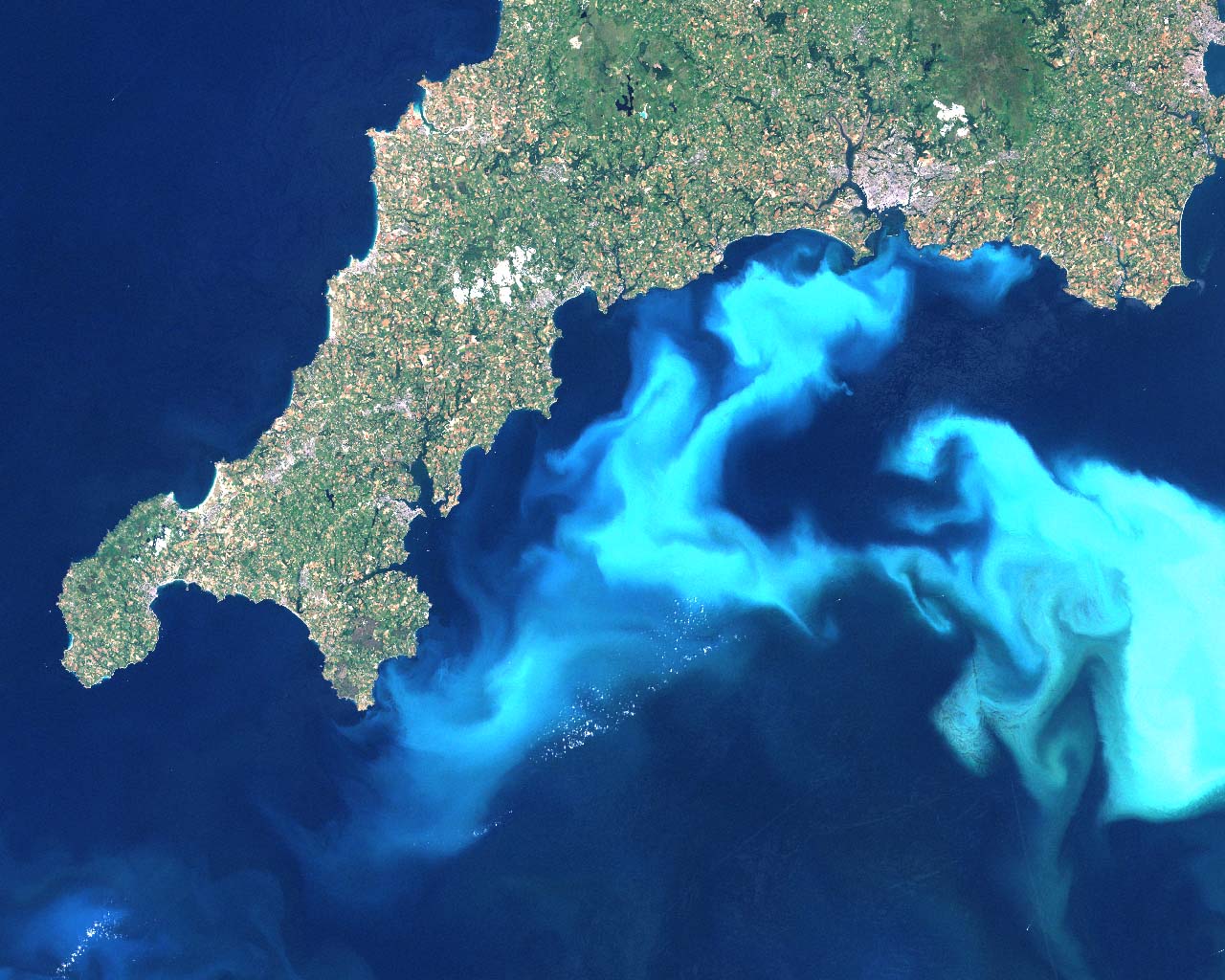
Phytoplankton bloom in the Channel off SW England (Landsat image)

At present the central areas of the oceans are wet deserts; too depleted in nutrients to support the photosynthesising base of a significant food chain. The key factor that is missing is dissolved divalent iron that acts as a minor, but vital, nutrient for phytoplankton. Much of the soluble iron that does help stimulate plankton ‘blooms’ emanates from the land surface in wind blown dust (Palaeoclimatology September 2011) or dissolved in river water. A large potential source is from hydrothermal vents on the ocean floor, which emit seawater that has circulated through the basalts of the oceanic crust. Such fluids hydrate the iron-rich mafic minerals olivine and pyroxene, which makes iron available for transport. The fluids originate from water held in the muddy, organic-rich sediments that coat the ocean floor, and have lost any oxygen present in ocean-bottom water. Their chemistry is highly reducing and thereby retains soluble iron liberated by crustal alteration to emanate from hydrothermal vents. Because cold ocean-bottom waters are oxygenated by virtue of having sunk from the surface as part of thermohaline circulation, it does seem that ferrous iron should quickly be oxidised and precipitated as trivalent ferric compounds soon after hydrothermal fluids emerge. However, if some was able to rise to the surface it could fertilise shallow ocean water and participate in phytoplankton blooms, the sinking of dead organic matter then effectively burying carbon beneath the ocean floor; a ‘biological pump’ in the carbon cycle with a direct influence on climate. Until recently this hypothesis had little observational support. Continue reading “Soluble iron, black smokers and climate”

A role for iron in the origin of life

Experiments aimed at suggesting how RNA and DNA – prerequisites for life, reproduction and evolution – might have formed from a ‘primordial soup’ have made slow progress. Another approach to the origin of life is investigation of the most basic chemical reactions that it engages in. Whatever the life form, prokaryote or eukaryote, its core processes involve reducing carbon dioxide, or other simple carbon-bearing compounds, and water to synthesise organic molecules that make up cell matter. Organisms also engage in metabolising biological compounds to generate energy. At their root, these two processes mirror each other; a creative network of reactions and another that breaks compounds down, known as the Krebs- and the reverse-Krebs cycles. In living organisms both are facilitated by other organic compounds that, of course, are themselves produced by cells. How such networks arose under inorganic conditions remains unknown, but three biochemists at the University of Strasbourg in France (Muchowska, K.B. et al. 2019. Synthesis and breakdown of universal metabolic precursors promoted by iron. Nature, v. 569, p. 104-107;  DOI: 10.1038/s41586-019-1151-1) have designed an inorganic experiment. They aimed to investigate how two simple organic compounds, which conceivably could have formed in a lifeless early environment, might have been encouraged to kick-start basic living processes. These are glyoxylate (HCOCO2) and pyruvate (CH3COCO2).

The most difficult chemical step in building complex organic compounds is inducing carbon atoms to bond together through C-C bonds; a process that thermodynamics tends to thwart but is accomplished in living cells by adenosine tri-phosphate (ATP). Previous workers focussed on interactions between reactive compounds, such as cyanide and formaldehyde, as candidates for the precursors of life, but such chemistry is totally different from what actually goes on in organisms. Joseph Moran, one of the co-authors of the paper, and his research group recently settled on five fundamental linkages of C, H and O as ‘universal hubs’ at the core of the Krebs cycle and its reverse. Kamila Muchowska and co-workers found that glyoxylate and pyruvate introduced into a simulated hydrothermal fluid that contains ions of ferrous iron (reduced Fe2+) were able to combine in producing all five ‘universal hubs. Ferrous iron clearly acted as a catalyst, through being a powerful reducing agent or electron donor, to get around the stringencies of classic thermodynamics. Moran’s team had previously shown that pyruvate itself can form inorganically from CO2 in water laced with iron, cobalt and nickel ions. Formation of glyoxylate in such a manner has yet to be demonstrated. Nevertheless, the two together in a watery soup of transition metal ions seem destined to produce an abundance of exactly the compounds at the root of living processes. In fact the experiment showed that all but two of the eleven components of the Krebs cycle can be synthesised inorganically.

407458aa.2
Metal-rich ‘black smoker’ at a hydrothermal vent on the mid-Atlantic ridge(credit: MARUM, Germany)

Until the rise of free oxygen in the Earth system some 2400 Ma ago, the oceans would have been awash with soluble ferrous iron. This would have been especially the case around hydrothermal vents that result from the interaction between water and hot mafic lavas of the oceanic crust, together with less abundant transition-metal ions, such as those of nickel and cobalt. The ocean-vent hypothesis for the origin of life seems set for a surge forward.

See also: Katsnelson, A. 2019. Iron can catalyse metabolic reactions without enzymes.

Read more on Palaeobiology

Oceanic hydrothermal vents and the origin of life

A range of indirect evidence has been used to suggest that life originated deep in the oceans around hydrothermal vents, such as signs of early organic matter in association with Archaean pillow lavas. One particularly persuasive observation is that a number of proteins and other cell chemicals are constructed around metal sulfide groups. Such sulfides are common around hydrothermal ‘smokers’ associated with oceanic rift systems. Moreover, Fischer-Tropsch reactions between carbon monoxide and hydrogen produce quite complex hydrocarbon molecules under laboratory conditions. Such hydrogenation of a carbon-bearing gas requires a catalyst, a commonly used one being chromium oxide (see Abiotic formation of hydrocarbons by oceanic hydrothermal circulation May 2004). It also turns out that fluids emitted by sea-floor hydrothermal systems are sometimes rich in free hydrogen, formed by the breakdown of olivine in ultramafic rocks to form hydroxylated minerals such as serpentine and talc. The fact that chromium is abundant in ultramafic rocks, in the form of its oxide chromite, elevates the possibility that Fischer-Tropsch reactions may have been a crucial part of the life-forming process on the early Earth. What is needed is evidence that such reactions do occur in natural settings.

407458aa.2
A white carbonate mound forming at the Lost City hydrothermal vent field on the Mid-Atlantic Ridge (Credit: Baross 2018)

One site on the mid-Atlantic ridge spreading centre, the Lost City vent field, operates because of serpentinisation of peridotites exposed on the ocean floor, to form carbonate-rich plumes and rocky towers; ‘white smokers’. So that is an obvious place to test the abiotic theory for the origin of life. Past analyses of the vents have yielded a whole range of organic molecules, including alkanes, formates, acetates and pyruvates, that are possible precursors for such a natural process. Revisiting Lost City with advanced analytical techniques has taken the quest a major step forward (Ménez, B. et al. 2018. Abiotic synthesis of amino acids in the recesses of the oceanic lithosphere. Nature, advance online publication; DOI: 10.1038/s41586-018-0684-z). The researchers from France and Kazakhstan focused on rock drilled from 170 m below the vent system, probably beyond the influence of surface contamination from living organisms. Using several methods they detected the nitrogen-containing amino acid tryptophan, and that alone. Had they detected other amino acids their exciting result would have been severely tempered by the possibility of surface organic contamination. The formation of tryptophan implies that its abiotic formation had to involve the reduction of elemental nitrogen (N2) to ammonia (NH3). Bénédicte Ménez and colleagues suggest that the iron-rich clay saponite, which is a common product of serpentine alteration at low temperatures, may have catalysed such reduction and amino-acid synthesis through Friedel–Crafts reactions. Fascinating as this discovery may be, it is just a step towards confirming life’s abiogenesis. It also permits speculation that similar evidence may be found elsewhere in the Solar System on rocky bodies, such as the moons Enceladus and Europa that orbit Saturn and Jupiter respectively. That is, if the rock base of hydrothermal systems thought to occur there can be reached.

Related article: Baross, J.A. 2018. The rocky road to biomolecules. Nature, v. 564, p. 42-43; DOI: 10.1038/d41586-018-07262-8.

Earliest hydrothermal vents and evidence for life


That seawater circulates through the axial regions of rifts associated with sea-floor spreading has been known since well before the acceptance of plate tectonics. The idea stems from the discovery in 1949 of brines with a temperature of 60°C on the central floor of the Red Sea, which in the early 60s turned out to be anomalously metal-rich as well. Advanced submersibles that can withstand the high pressures at great depth a decade later produced images of swirling clouds of sediment from large sea-floor springs, first on the Galapagos rift and subsequently on many others. The first shots were of dark, turbulent clouds, prompting the term ‘black smoker’ for such hydrothermal vents and it turns out that others produce light-coloured clouds – ‘white smokers’. Sampling revealed that the sediments in black smokers were in fact fine-grained precipitates of metallic sulfides, whereas those forming white smokers were sulfates, carbonates and oxides of barium calcium and silicon also precipitated from solute-rich brines produced by partial dissolution of ocean floor through which they had passes.

A black smoker known as "the brothers".
A black smoker with associated organism. (credit: Wikipedia)

Excitement grew when hydrothermal vents were shown to have complex animal ecosystems completely new to science. A variety of chemical evidence, most importantly the common presence of proteins and other cell chemicals built around metal sulfide groups in most living organisms, prompted the idea that hydrothermal vents may have hosted the origins of life on Earth. Many fossil vent systems also contain fossils; macrofossils in the Phanerozoic and microbial ones from the Precambrian. But tangible signs of life, in the form of mats ascribed to bacteria or archaea holding together fine-grained sediments, go back no further than 3830 Ma in the Isua area of SW Greenland. Purely geochemical evidence that carbonaceous compounds may have formed in living systems  are ambiguous since quite complex hydrocarbons can be synthesised abiogenically by Fischer-Tropsch reactions between carbon monoxide and hydrogen. Signs of deep sea hydrothermal activity are common in any geological terrain containing basalt lavas with the characteristic pillows indicating extrusion beneath water. So to trace life’s origins all that is needed to trigger the interest of palaeobiologists are the oldest known pillow lavas. Until quite recently, that meant the Isua volcano-sedimentary association, but heating, high pressures and  very strong deformation affected those rocks when they were metamorphosed half a billion years after they were formed; a cause for skepticism by some geoscientists.

The primacy of Isua metavolcanic rocks has been challenged by more extensive metamorphosed basalts in the Nuvvuagittuk area in Quebec on the east side of Hudson Bay, Canada. They contain hydrothermal ironstones associated with pillowed basalts that are cut by more silica-rich intrusive igneous rocks dated between 3750 and 3775 Ma. That might place the age of basalt volcanism and the hydrothermal systems in the same ball park as those of Isua, but intriguingly the basalts’ 146Sm-142Nd systematics suggest a possible age of magma separation from the mantle of 4280 Ma (this age is currently disputed as it clashes with  U-Pb dates for zircon grains extracted from the metabasalts around the same as the age at Isua). Nonetheless, some parts of the Nuvvuagittuk sequence are barely deformed and show only low-grade metamorphism, and they contain iron- and silicon-rich hot spring deposits (Dodd, M.S. et al. 2017. Evidence for early life in Earth’s oldest hydrothermal vent precipitates. Nature, v. 543, p. 60-64; doi:10.1038/nature21377). As at Isua, the ironstones contain graphite whose carbon isotope proportions have an ambiguous sign of having formed by living or abiotic processes. It is the light deformation and low metamorphism of the rocks that gives them an edge as regards being hosts to tangible signs of life. Extremely delicate rosettes and blades of calcium carbonate and phosphate, likely formed during deposition, remain intact. These signs of stasis are in direct contact with features that are almost identical to minute tubes and filaments formed in modern vents by iron-oxidising bacteria. All that is missing are clear signs of bacterial cells. Ambiguities in the dating of the basalt host rocks do not allow the authors claims that their signs of life are significantly older than those at Isua, but their biotic origins are less open to question. Neither offer definitive proof of life, despite widespread claims by media science correspondents, some of whom tend  metaphorically to ‘run amok ‘ when the phrase ‘ancient life’ appears; in this case attempting to link the paper with life on Mars …

You can find more on early life here