Chinese skull confirmed as Denisovan

For over a century Chinese scientists have been puzzling over ancient human skulls that show pronounced brow ridges. Some assigned them to Homo, others to species that they believe were unique to China. A widely held view in China was that people now living there evolved directly from them, adhering to the ‘Multiregional Evolution’ hypothesis as opposed to that of ‘Out of Africa’. However, the issue might now have been resolved. In the last few years palaeoanthropologists have begun to suspect that these fossilised crania may have been Denisovans, but none had been subject to genetic and proteomic analysis. The few from Siberia and Tibet that initially proved the existence of Denisovans were very small: just a finger bone and teeth.  Out of the blue, teeth in a robust hominin mandible dredged from the Penghu Channel between Taiwan and China yielded protein sequences that matched proteomic data from Denisovan fossils in Denisova Cave and Baishiya Cave in Tibet, suggesting that Denisovans were big and roamed  widely in East Asia. In 2021 a near-complete robust cranium came to light that had been found in the 1930s near Harbin in China and hidden – at the time the area was under Japanese military occupation. It emerged only when its finder revealed its location in 2018, shortly before his death. It was provisionally called Homo longi or ‘Dragon Man’. Qiaomei Fu of the Institute of Vertebrate Paleontology and Paleoanthropology in Beijing and her colleagues have made a comprehensive study of the fossil.

The cranium found near Harbin, China belonged to a Denisovan. Credit: Hebei Geo University

It is at least 146 ka old, probably too young to have been H. erectus, but predates the earliest anatomically modern humans to have reached East Asia from Africa (~60 ka ago). The Chinese scientists have developed protein- and DNA extraction techniques akin to those pioneered at the Max Planck Institute for Evolutionary Anthropology in Leipzig. It proved impossible to extract sufficient ancient nuclear DNA from the cranium bone for definitive genomic data to be extracted, but dental plaque (calculus) adhering around the only surviving molar in the upper jaw did yield mitochondrial DNA. The mtDNA matched that found in Siberian Denisovan remains (Qiaomei Fu et al. 2025. Denisovan mitochondrial DNA from dental calculus of the >146,000-year-old Harbin cranium. Cell, v. 188, p. 1–8; DOI: 10.1016/j.cell.2025.05.040). The bone did yield 92 proteins and 122 single amino acid polymorphisms, as well as more than 20 thousand peptides (Qiaomei Fu and 8 others 2025. The proteome of the late Middle Pleistocene Harbin individual. Science, v. 388: DOI: 10.1126/science.adu9677). Again, these established a molecular link with the already known Denisovans, specifically with one of the Denisova Cave specimens. Without the painstaking research of the Chinese team, Denisovans would have been merely a genome and a proteome without much sign of a body! From the massive skull it is clear that they were indeed big people with brains much the same size as those of living people. Estimates based on the Harbin cranium suggest an individual weighing around 100 kg (220 lb or ~15 stone): a real heavyweight or rugby prop!

The work of Qiaomei Fu and her colleagues, plus the earlier, more limited studies by Tsutaya et al., opens a new phase in palaeoanthropology. Denisovans now have a genome and well-preserved parts of an entire head, which may allow the plethora of ancient skulls from China to be anatomically assigned to the species. Moreover, by extracting DNA from dental plaque for the first time they have opened a new route to obtaining genomic material: dental calculus is very much tougher and less porous than bone.

See also: Curry, A. ‘Dragon Man’ skull belongs to mysterious human relative. 2025. Science, v. 388; DOI: 10.1126/science.z8sb68w. Smith K. 2025. We’ve had a Denisovan skull since the 1930s – only nobody knew. Ars Technica, 18 June 2025. Marshall, M. 2025. We finally know what the face of a Denisovan looked like. New Scientist 18 June 2025.

Massive hominin skull from China: is it a Denisovan?

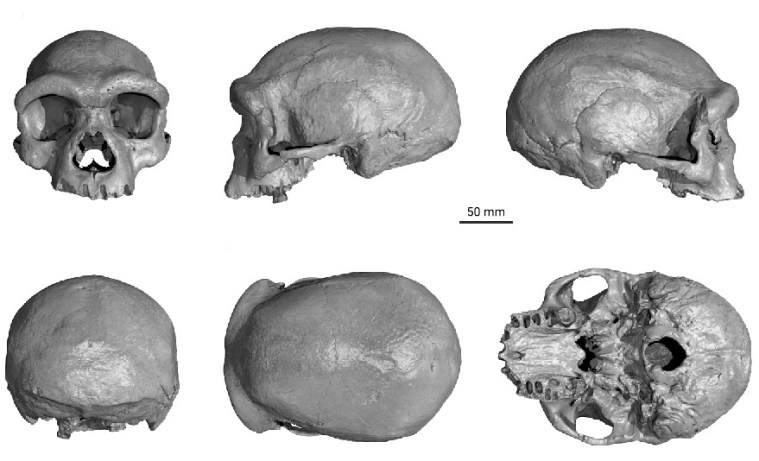
In 1933 labourers unearthed a very large skull during the construction of a bridge near Harbin, Northern China. At that time, the area was under occupation by Imperial Japanese forces. To keep it out of the invaders’ hands the skull was quickly wrapped in a cloth and hidden in an old well. It was only in 2018 that the original finder’s grandson recovered it to pass on to archaeologists at  Hebei Geo University. It lacks a lower jawbone, so technically it is a cranium, but is very well preserved. The face has very large brow ridges – generally taken as a primitive feature – but also some more modern features. With a 1,420 ml brain case, it is significantly larger than most modern human crania. Apparently, it is of an adult male. As well as a big head, he had a large nose, as do Neanderthals: a possible adaptation to very cold conditions. Without waiting to see if the bones might yield DNA, five of the team who examined the cranium claimed it as a new species, Homo longi or ‘Dragon Man’; i.e. distinct from modern humans and Neanderthals and all known older hominins (Ni, X. et al. 2021. Massive cranium from Harbin establishes a new Middle Pleistocene human lineage in China. The Innovation, v. 2, article 100130; DOI: 10.1016/j.xinn.2021.100130. Ji, Q. et al. 2021. Late Middle Pleistocene Harbin cranium represents a new Homo species. The Innovation, v. 2, article 100132; DOI: 10.1016/j.xinn.2021.100132). They based this phylogenetic interpretation on morphology alone. At least one of the team, Chris Stringer a leading hominin palaeoanthropologist at The Natural History Museum in London, demurred. The cranium is not unique and bears close similarity to another from the central Chinese province of Shaanxi, which was found in the late 1970s. In fact there are three other Chinese crania that resemble that from Harbin, although they are less well preserved.

All-sided views of the Harbin cranium. (Credit: Ni et al., Fig 2)

Dating the fossil was not easy, as the site where labourers discovered him was destroyed during construction of the bridge. Researchers used a variety of geochemical analyses, including from sediment stuck in his nasal cavity, to derive a likely stratigraphic profile from which the cranium may have been excavated. The best fit is with Middle Pleistocene sediments in the Harbin area. Uranium-series dating of the bone suggests that it is older than 146 ka (Shao, Q.  et al. 2021. Geochemical locating and direct dating of the Harbin archaic human craniumThe Innovation, v. 2, article 100131; DOI: 10.1016/j.xinn.2021.100131). So it is likely that this man and his companions did not cohabit China with anatomically modern humans, who arrived no more than about 50 ka ago. The highly robust nature of all the similar crania suggests that the individuals must have been large and physically active. Like the Neanderthals, they had adapted to harsh conditions over several hundred thousand years of repeated climate change. Even today, winters in northern China average around -16°C, and far inland conditions are semi-arid to arid. For them to migrate would have involved traversing some of highest, bleakest passes in the world. These people evolved to survive extreme climatic and environmental change, much as did the Neanderthals in West Asia and Europe. By comparison anatomically modern humans evolved in the more stable environments of Africa and the Middle East, surviving only the last ice age once they had migrated northwards. Those who made it to northern Siberia and crossed the Bering Strait via Beringia around the last glacial maximum did evolve physical traits that helped them survive, but minor ones compared with the earlier humans.

So what do these Chinese fossils represent? Using cranial features alone to propose distinct species smacks of the techniques of 19th and early 20th century anatomical anthropologists, albeit with powerful statistical analysis. We know that anatomically modern humans carry genetic signatures of interbreeding with at least two known ‘species’ with whom they cohabited Eurasia – Neanderthals and Denisovans. Indeed, traces in  the DNA of living African and Eurasian humans hint at other unknown and probably very ancient ‘ghost’ populations. Genetic, physical and probably cultural differences did not deter repeated interbreeding with these ‘others’. To be frank, erecting new human ‘species’ these days seems to serve little purpose. ‘Dragon Man’ is just as likely to represent the Denisovans as the fully sequenced DNA from a couple of bones from caves in Siberia and Tibet. The latter matched stretches of the DNA from living people of East Asia and parts of the Pacific. There are no other such live genetic tracers awaiting a different candidate to fill the role that we know Neanderthals and Denisovans to have filled. That may yet change, but the first job for the mainly Chinese consortium of scientists is to get genetic material from these crania and sequence it, or invite other highly successful palaeogeneticists who would leap at the opportunity.

See also: Jones, N. 2021. Mysterious skull fossils expand human family tree — but questions remain. Nature, v. 595, p. 50; DOI: 10.1038/d41586-021-01738-w

Sample I. 2021. Massive human head in Chinese well forces scientists to rethink evolution. The Guardian, 25 June 2021.