More dinosaur trackways from the Jurassic of the Isle of Skye, Scotland

The Isle of Skye off the northwestern coast of Scotland is one of several areas in Britain that are world-class geological gems. Except for the Cuillin Hills that require advanced mountaineering skills it is easy to explore and has become a major destination for both beginners and expert geoscientists of all kinds. Together with the adjacent Isle of Raasay the area is covered by a superb, free geological guidebook (Bell, B. 2024. The Geology of the Isles of Skye and Raasay. Geological Society of Glasgow) together with 60 standalone excursion guides, and even an introduction to Gaelic place names and pronunciation. It is freely available from https://www.skyegeology.com/
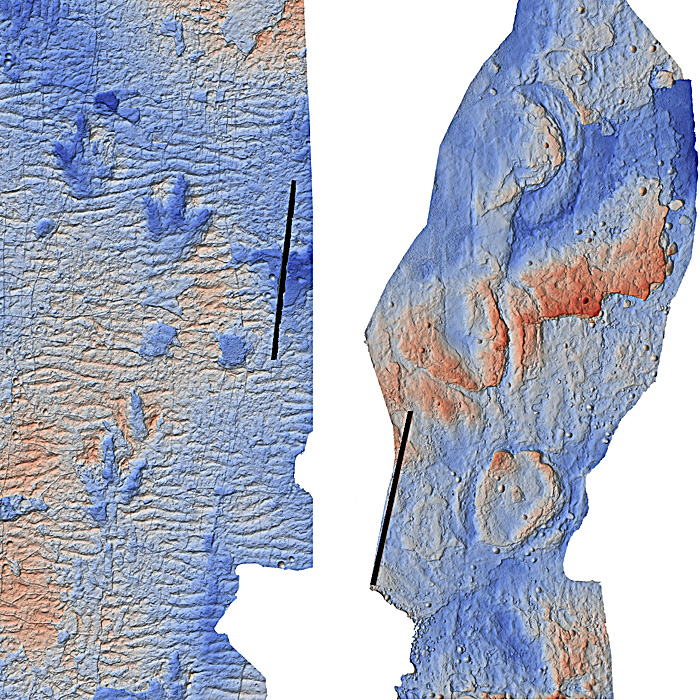
Fig Dinosaur trackways at Prince Charles’s Point on the Isle of Skye: Left carnivorous theropods; Right herbivorous sauropods. The black scales are 1 m long. The images are enhanced fine-scale elevation models of the exposed surfaces that were derived from vertical photographs. Credit: Blakesley et al., Figs 9 and 27.

Since 2018 Skye has also become a must-visit area for vertebrate palaeontologists. Beneath Palaeocene flood basalts is a sequence of Jurassic strata, both shallow marine and terrestrial. One formation, the Great Estuarine Group of Middle Jurassic (Bathonian, 174–164 Ma) age covers the time when meat-eating theropod- and herbivorous sauropod dinosaurs began to grow to colossal sizes from diminutive forebears. While other Jurassic sequences on Skye have notable marine faunas, its Bathonian strata have yielded a major surprise: some exposed bedding surfaces are liberally  dotted with trackways of the two best known groups of dinosaur. The first to be discovered were at Rubha Nam Brathairean (Brothers’ Point) suggesting a rich diversity of species that had wandered across a wide coastal plain, also including the somewhat bizarre Stegosaurus. The latest finds are from a rocky beach at Prince Charles’s Point where the Young Pretender to the British throne, Charles Edward Stuart, landed and hid during his flight from the disastrous Battle of Culloden (16 April 1746). It was only in the last year or so that palaeontologists from the universities of Edinburgh and Liverpool, and the Staffin Museum came across yet more footprints (131 tracks) left there by numerous dinosaurs in the rippled sands of a Bathonian lagoon (Blakesley, T. et al. 2025. A new Middle Jurassic lagoon margin assemblage of theropod and sauropod dinosaur trackways from the Isle of Skye, Scotland. PLOS One, v. 20, article e0319862; DOI: 10.1371/journal.pone.0319862.

The Prince Charles’s Point site is partly covered by large basalt boulders, which perhaps account for the excellent preservation of the bedding surfaces from wave action. Two kinds of footprint are preserved (see image): those made by three-toed feet and by elephant-like feet that ‘squidged-up’ sediment surrounding than. Respectively these are suggested to represent the hind limbs of bipedal carnivorous theropods and quadrupedal herbivorous sauropods. They show that individual dinosaurs moved in multiple directions, but there is no evidence for gregarious behaviour, such as parallel trackways of several animals. They occur on two adjacent bedding surfaces so represent a very short period of time, perhaps a few days. The authors suggest that several individual animals were milling around, with more sauropods than theropods. What such behaviour represents is unclear. The water in an estuarine lagoon would likely have been fresh or brackish. They may have been drinking or perhaps there was some plants or carcases worth eating ? That might explain both kinds of dinosaurs’ milling around. The sizes of both sauropod and theropod prints average about 0.5 m. The stride lengths of the theropods suggest that they were between 5 to 7 metres long with a hip height of around 1.85 m. Their footprints resemble those reconstructed from skeletal remains of Middle Jurassic Megalosaurus, the first dinosaur to be named (by William Buckland in 1827). The sauropods had estimated hip heights of around 2 m so they may have been similar in size (around 16 m) to the Middle Jurassic Cetiosaurus, the first sauropod to be named (by Richard Owen in 1842).

A fully revised edition of Steve Drury’s book Stepping Stones: The Making of Our Home World can now be downloaded as a free eBook

Hominin footprints in Kenya confirm two species occupied the same ecosystem the same time

For the last forty thousand years anatomically modern humans have been the only primates living on Planet Earth with a sophisticated culture; i.e. using tools, fire, language, art etcetera. Since Homo sapiens emerged some 300 ka ago, they joined at least two other groups of humans – Neanderthals and Denisovans – and not only shared Eurasia with them, but interbred as well. In fact no hominin group has been truly alone since Pliocene times, which began 5.3 Ma ago. Sometimes up to half a dozen species occupied the habitable areas of Africa. Yet we can never be sure whether or not they bumped into one another. Dates for fossils are generally imprecise; give or take a few thousand years. The evidence is merely that sedimentary strata of roughly the same age in various places have yielded fossils of several hominins, but that co-occupation has never been proved in a single stratum in the same place: until now.

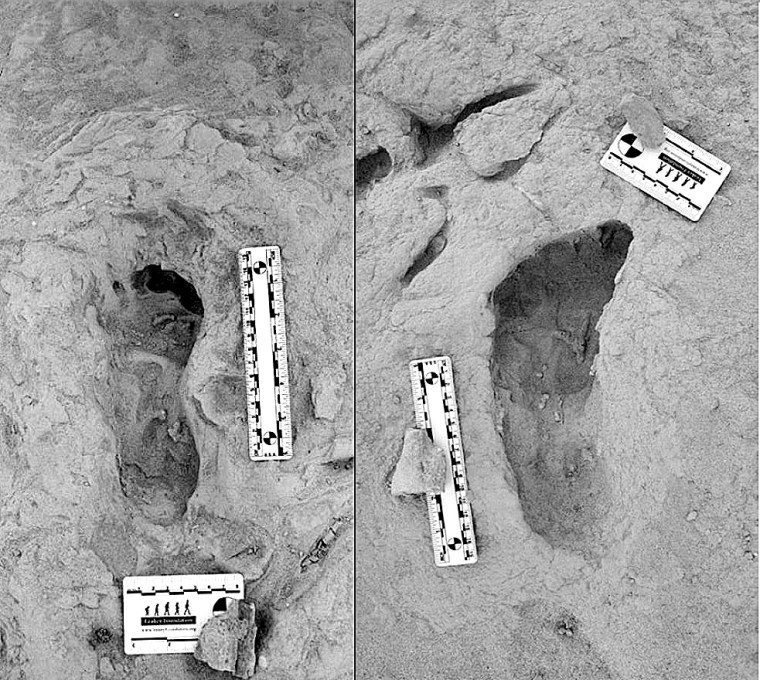
Footprints from Koobi Fora: left – right foot of H. erectus; right – left foot of Paranthropus boisei. Credit: Kevin Hatala. Chatham University

The Koobi Fora area near modern Lake Turkana has been an important, go-to site, courtesy of the Leakey palaeoanthropology dynasty (Louis and Mary, their son and daughter-in-law Richard and Meave, and granddaughter Louise). They discovered five hominin species there dating from 4.2 to 1.4 Ma. So there was a chance that this rich area might prove that two of the species were close neighbours in both space and time. In 2021 Kenyan members of the Turkana Basin Institute based in Nairobi spotted a trackway of human footprints on a bedding surface of sediments that had been deposited about 1.5 Ma ago. Reminiscent of the famous, 2 million years older Laetoli trackway of Australopithecus afarensis in Tanzania, that at Koobi Fora is scientifically just as exciting  for it shows footprints of two hominin species Homo erectus and Paranthropus boisei who had walked through wet mud a few centimetres below the surface of Lake Turkana’s ancient predecessor (Hatala, K.G. and 13 others, 2024. Footprint evidence for locomotive diversity and shared habitats among early Pleistocene hominins. Science, v. 386, p. 1004-1010; DOI: 10.1126/science.ado5275). The trackway is littered with the footprints of large birds and contains evidence of zebra.

One set of prints attributed to H. erectus suggest the heels struck the surface first, then the feet rolled forwards before pushing off with the soles: little different from our own, unshod footprints in mud. They are attributed to H. erectus. The others also show a bipedal gait, but different locomotion. The feet that made them were significantly flatter than ours and had a big toe angled away from the smaller toes. They are so different that no close human relative could have made them. The local fossil record includes paranthropoids (Paranthropus boisei), whose fossil foot bones suggest an individual of that speciesmade those prints. It also turns out that a similar, dual walkers’ pattern was found 40 km away in lake sediments of roughly the same age. The two species cohabited the same terrain for a substantial period of time. As regards the Koobi Fora trackway, it seems the two hominins plodded through the mud only a few hours apart at most: they were neighbours.

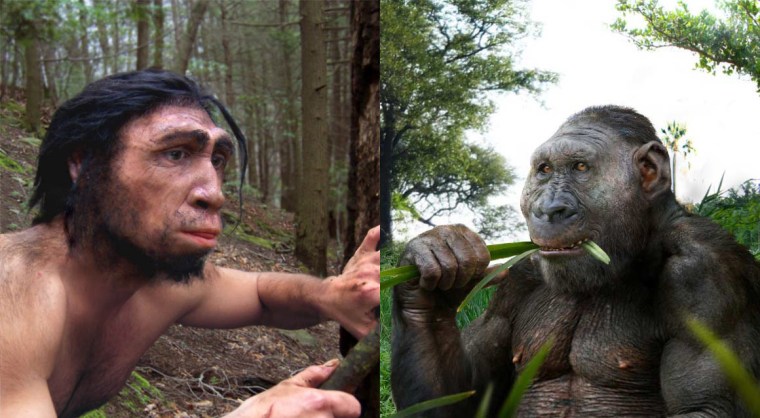
Artists’ reconstructions of: left – H. erectus; right – Paranthropus boisei. Credits: Yale University, Roman Yevseyev respectively

From their respective anatomies they were very different. Homo erectus was, apart from having massive brow ridges, similar to us. Paranthropus boisei had huge jaws and facial muscles attached to a bony skull crest. So how did they get along? The first was probably omnivorous and actively hunted or scavenged meaty prey: a bifacial axe-wielding hunter-gatherer. Paranthropoids seem to have sought and eaten only vegetable victuals, and some sites preserve bone digging sticks. They were not in competition for foodstuffs and there was no reason for mutual intolerance. Yet they were physically so different that intimate social relations were pretty unlikely. Also their brain sizes were very different, that of P. Boisei’s being far smaller than that of H. erectus , which may not have encouraged intellectual discourse. Both persist in the fossil record for a million years or more. Modern humans, Neanderthals and Denisovans, as we know, sometimes got along swimmingly, possibly because they were cognitively very similar and not so different physically.

Since many hominin fossils are associated with riverine and lake-side environments, it is surprising that more trackways than those of Laetoli and Koobi Fora have been found. Perhaps that is because palaeoanthropologists are generally bent on finding bones and tools! Yet trackways show in a very graphic way how animals behave and interrelate with their environment, for example dinosaurs. Now anthropologists have learned how to spot footprint trace fossils that will change, and enrich the human story.

See also: Ashworth, J. Fossil footprints of different ancient humans found together for the first time. Natural History Museum News 28 November 2024; Marshall, M. Ancient footprints show how early human species lived side by side. New Scientist, 28 November 2024

Earliest Americans and Denisovan art

It was Mary Leakey’s jaw-dropping discovery in the 1970s of the footprints of two adult Australopithecus afarensis and an accompanying juvenile in 3.6 Ma-old volcanic ash at Laetoli, Tanzania that provided the oldest palpable evidence of a bipedal hominin species. Just seeing a high-resolution image of this now legendary trackway made me determined to call my book on Earth and human evolution Stepping Stones: the Making of our Homeworld. Human footprints have figured several times in Earth-logs articles. A jumble of footprints in 1.0 to 0.78 Ma old Pleistocene interglacial sediments at Happisbugh on England’s Norfolk coast marks the presence there of Homo antecessor: the earliest known, northern Europeans. In The first volcanologists (March 2003) I noted the discovery of evidence that Neanderthal children played in 350 ka volcanic ash on the Roccamonfina volcano in Italy. The emotion generated by seeing such relics has never left me. Two similarly important proofs of human presence emerged in September 2021.

Footprints thought to have been made by children and teenagers between 23 and 21 thousand years ago in lake shore muds at White Sands, New Mexico. (Credit Bennett et al. 2021)

Since 2011 a variety of evidence has accumulated that the Americas began to be populated by anatomically modern humans before what had long been assumed to be the ‘first arrivals’: the Clovis people who made finely-worked stone spear points first found in 13 ka-old sediments in New Mexico. To the pre-Clovis artefacts that suggested earlier immigrations have been added indisputable signs of human presence even earlier than anticipated. They were uncovered in lake sediments beneath the gypsum sand dunes of White Sands National Park in New Mexico. The site is not far from where Robert Oppenheimer exclaimed to himself ‘Now I am become Death, the destroyer of worlds’ after he witnessed his creation, the first detonation of a nuclear weapon on 9 July 1945. These lake sediments have yielded thousands of human and animal footprints over the years, but the latest have been dated at between 23 to 21 ka (Bennett, M.R. and 13 others 2021. Evidence of humans in North America during the Last Glacial Maximum. Science, v. 373, p. 1528-1531; DOI: 10.1126/science.abg7586). As with the Happisburgh and Roccamonfina human trackways, size analysis suggests that they were made mainly by children and teenagers! Other animal trackways show that the lake edge was teeming with game at the height of the last Ice Age: abundant food for hunter-gatherers generally results in lots of free time. So maybe these early American people were having fun too. When ice sheets were at their maximum extent sea level had fallen, leaving the Bering Strait dry. The broad Beringia land-bridge made the Americas accessible from Eurasia. Whatever objections have previously been raised as regards human penetration south from Alaska during the Last Glacial Maximum, the White Sands find sweeps them away; people overcame whatever obstacles there were.

Travertine outcrop covered with hand- and footprints at Quesang on the Tibetan Plateau (Credit: Zhang et al., Fig. 1c)

Much older footprints and handprints, preserved in a biogenic carbonate (travertine) deposit from the Tibetan Plateau – more than 4,000 metres above sea level – are reported in an article soon to be published by Elsevier (Zhang, D.D. and 17 others 2021. Earliest parietal art: hominin hand and foot traces from the middle Pleistocene of Tibet, Science Bulletin v 66 online; DOI: 10.1016/j.scib.2021.09.001). Travertine forms when calcium carbonate is precipitated from lime-rich spring water onto films of algae or bacteria. At first it is soft and spongy, hardening as more carbonate is precipitated and solidifying when dried out to form a porous rock. People made a jumble of prints when they pressed their hands and feet into the originally spongy biofilm. Three-dimensional images of the slab provide the basis for interpreting how the prints were made. There are 5 handprints and 5 footprints. From comparing their sizes with modern humans’ feet and hands, it seems that the handprints were made by a single 12-year-old, and the footprints by a child of about 7. Although the travertine layer would have been steep and slippery none of the prints show signs of falling or sliding. They seem to have been deliberately placed close to one another, with suggestions that at least one thumb was wiggled. The authors argue that the prints are a form of art similar to the hand stencils commonly seen on Palaeolithic cave walls. It could be that a couple of kids took delight in leaving signs that they had been there, ‘messing around’: but still an art form. What is especially exciting is their age, between 169 and 226 ka. The children are unlikely to have been anatomically modern humans, who first reached Tibet only a little before 21 ka. One alternative is that they were Denisovans (see: Denisovan on top of the world, May 2019.

See also: Bennett, M.R. 2021.  Fossil footprints prove humans populated the Americas thousands of years earlier than we thought. The Conversation, 23 September 2021. 2021Metcalf, T. 2021. Art or not? Ancient handprints spark debate. NBC News, 16 September 2021.

Dinosaur corner

Many adjectives have been applied to dinosaurs: terrifying; lumbering; long-dead; fierce; huge; nimble, carnivorous; herbivorous and so on. But exquisite and tiny do not immediately spring to mind. The mineral amber – strictly speaking a mineraloid because it isn’t crystalline – having formed from resins exuded by trees, preserves materials, including animals, that became trapped in the resin. The shores of the Baltic Sea used to be the main source of this semi-precious gemstone, but it has been overtaken by high-quality supplies from Kachin State in Myanmar. Most specimens contain small invertebrates, including spiders and insects, in varying states of preservation. Once in a while truly spectacular amber pebbles turn up. In early March 2020 the world’s media splashed a unique find: a miniature dinosaur (Xing, L. et al. 2020. Hummingbird-sized dinosaur from the Cretaceous period of Myanmar. Nature v. 579, p. 245–249; DOI: 10.1038/s41586-020-2068-4).

Amber pebble from Myanmar containing a tiny vertebrate’s skull (credit: Lida Xing, China University of Geosciences)

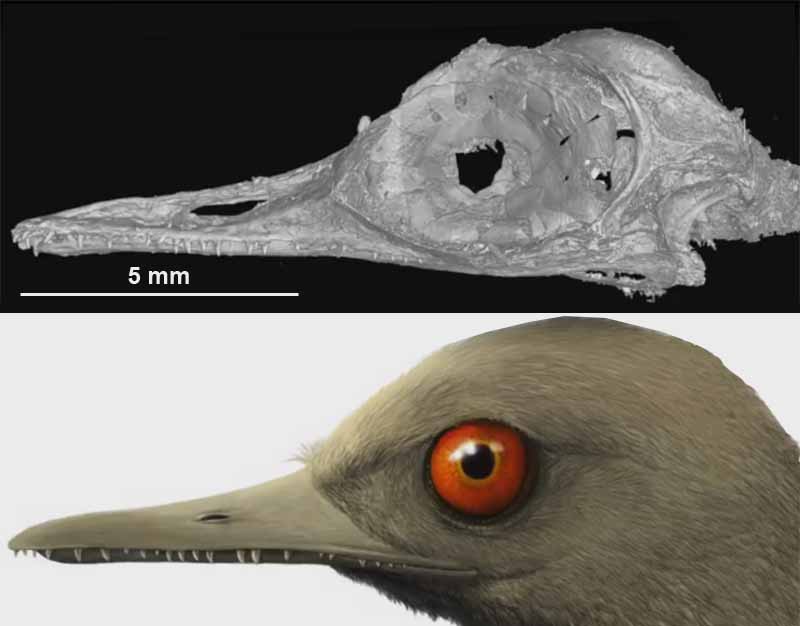
The amber specimen, from Middle Cretaceous (99 Ma) sediments, contains a perfectly preserved skull less than 2 cm long. At first glance it appears to be that of a tiny bird. The authors used micro-CT scanning to reconstruct the entire skull in 3-D. Although superficially resembling that of a bird, with eye sockets ringed by scleral ossicles that modern birds also have. These suggest that the animal was active during the daytime. Its beak-like jaws have many small teeth, as do many ancient fossil birds but not modern ones. These features led to its name: Oculudentavis khaungraaeI, translated as ‘eye-tooth bird’. So, is it a bird? A number of features shown by the skull suggest that, strictly speaking, it is not. Anatomically, it is a dinosaur, possibly descended from earlier types, such as the Jurassic winged and feathered dinosaur Archaeopterix, which evolved to early, true birds with which Oculudentavis coexisted during the Cretaceous Period. Having teeth, it was probably carnivorous and preyed on invertebrates: it may have been fatally attracted to tree resin in which insects had been trapped.

Micro-CT image of Oculudentavis khaungraaeI skull (top); artist’s impression of it in life (bottom) (credits: Xing, L. et al. 2020; Jingmai O’Connor, China University of Geosciences)

Even if it was a bird , it is smaller than the smallest living example, the bee hummingbird (Mellisuga helenae) and, weighing an estimated 2 grams,  Oculudentavis is about one-sixth the size of the smallest known fossil bird. As a dinosaur, it is two orders of magnitude smaller than the most diminutive example of those found as fossils, the chicken-sized Compsognathus. Rather than being just an oddity, Oculudentavis demonstrates that extreme miniaturisation among avian dinosaurs held out evolutionary advantages.

Watch a video about the discovery and analysis of the tiny dinosaur

See also: Benson, R.B.J. 2020. Tiny bird fossil might be the world’s smallest dinosaur. Nature, v. 579, p. 199-200; DOI: 10.1038/d41586-020-00576-6.

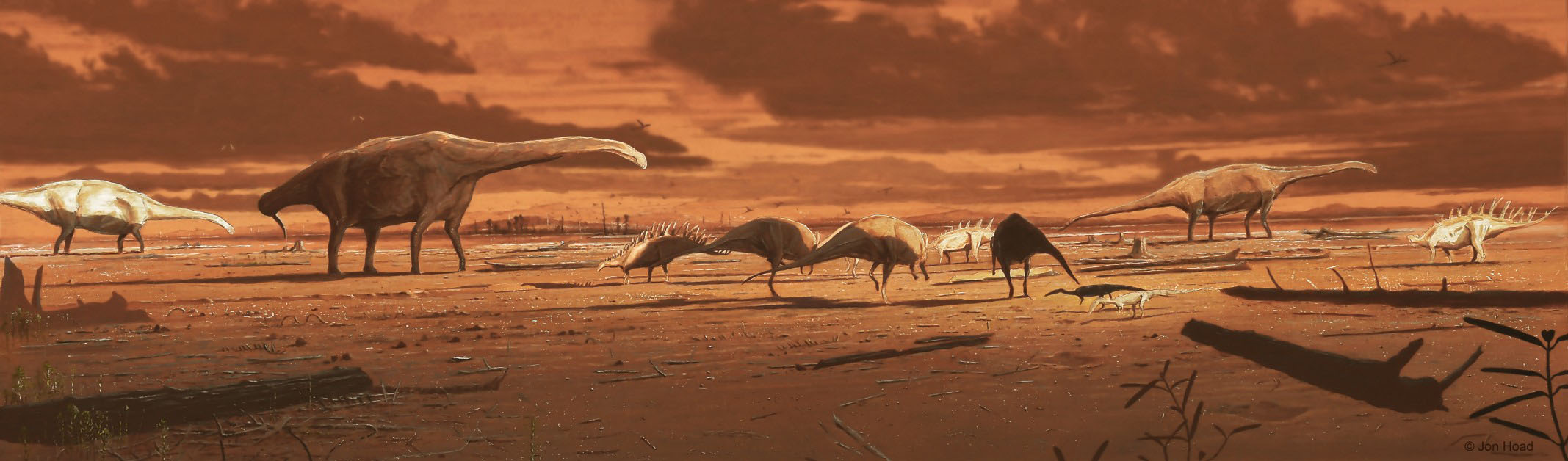
Artist’s rendering of a Middle Jurassic coastal plain in what is now the Isle of Skye across which a mixed dinosaur megafauna is migrating (credit: De Polo et al. 2020; Fig. 24; artist Jon Hoad)

And now for the lumbering and sometimes scary kinds of dinosaur. Since discovery of Middle Jurassic sauropod and theropod trackways with up to 0.5 m wide footprints at Brothers’ Point on the Trotternish Peninsula of Skye, the Inner Hebridean island has become a magnet for those wishing to commune with big beasts. Now the same team from the University of Edinburgh report more from the same locality (De Polo, P.E. and 9 others 2020. Novel track morphotypes from new tracksites indicate increased Middle Jurassic dinosaur diversity on the Isle of Skye, Scotland. PLoS ONE, v. 15, article e0229640; DOI: 10.1371/journal.pone.0229640). One set, referred to as Deltapodus was probably made by a species of stegosaur: the one with vertical plates on its back and a tail armed with large spikes, animated caricatures of which figure in inane YouTube clips, especially beating off Tyrannosaurs. The new locality preserves 50 dinosaur tracks that suggest a rich community of species. The most prominent suggest bipedal ornithopod herbivores and small, possible carnivorous theropods, both with three-toed feet, large quadripedal sauropods whose prints resemble those of elephants, as well as those with larger back feet than front attributed to stegosaurs. The sediment sequence displaying the tracks contains structures typical of deposition on a wide coastal plain.

Life with the Neanderthals

From Robinson Crusoe’s discovery of Friday’s footprint on his desert island to Mary Leakey’s unearthing of a 3.6 Ma old trackway left by two adults and a juvenile of the hominin species Australopithecus afarensis at Laetoli in Tanzania, such tangible signs of another related creature have fostered an eerie thrill in whoever witnesses them. Other ancient examples have turned up, such as the signs of mud trampled by 800 ka humans (H. antecessor?) at Happisburgh, Norfolk, UK (see Traces of the most ancient Britons, February 2014). From a purely scientific standpoint, footprints provide key evidence of foot anatomy, gait, travel speed, height, weight, and the number of individuals who contributed to a trackway. At Le Rozel on the Cherbourg Peninsula in Normandy, France – about 30 km west of the D-Day landing site at Utah beach – Yves Roupin, an amateur archaeologist, discovered a footprint on the foreshore in the 1960s close to the base of a thick sequence of late-Pleistocene dune sediments exposed below a rocky cliff. Fifty years later, rapid onset of wind and tidal erosion threatened to destroy the site, so excavations and scientific analysis began. This involved excavation of thick overburden on an annual basis to expose as much of five footprint-bearing horizons as possible (about 90 m2).

Le Rozel
The Le Rozel excavation, with weighted plastic sheets to protect the site from erosion between visits (credit: Dominique Cliquet)

More and more prints emerged, each photographed and modelled in 3-D, with the best being preserved as casts using a flexible material, similar to that used by dentists (Duveau, J. eyt al. 2019. The composition of a Neandertal social group revealed by the hominin footprints at Le Rozel (Normandy, France). Proceedings of the National Academy of Sciences. 9 September 2019; DOI: 10.1073/pnas.1901789116). At the end of the excavation hundreds of prints had been found and recorded. They had been preserved in wet sand, probably deposited in an interdune pond. Luminescence dating of sand grains revealed that the footprints were produced around 80 ka ago, 35 ka before Europe was occupied by anatomically modern humans. Scattered around the site are numerous fossils of butchered prey animals, together with stone tools typical of Neanderthal technology.

Such a large number of footprints presented a unique opportunity to analyse the social structure of the Neanderthal group that produced them, for they came in many different sizes. During the very short period in which they were produced and buried by wind-blown sand, an estimated 10 to 13 individuals had crossed and re-crossed the site – there may have been more individuals who didn’t happen to cross the wet patch But the evidence suggests that children and adolescents, one of whom may have been as young as 2 years, predominated. Two or three with the biggest feet were probably adults as tall as 1.9 metres – about 20 cm taller that the average for modern human males. That is surprising for Neanderthals who are widely believed to have been more stocky. The fact that footprints occur in 5 horizons suggests that the band, or perhaps family, found the site to be good for occupation. Wider hypotheses are a little shaky. Did Neanderthals have large families? Does the predominance of children and adolescents indicate that they died young? But perhaps children stayed close to habitations with just a few ‘minders’, while other adults went off hunting and foraging. Were the kids playing?