Early hominin dispersal in Eurasia

Evidence from Dmanisi in Georgia that Homo erectus may have been the first advanced hominin to leave Africa about 1.8 Ma ago was a big surprise (see: First out of Africa? November 2003). Remains of five individuals included one skull of an aged person who face was so deformed that he or she must have been cared for by others for many years. So, a second surprise from Dmanisi was that human empathy arose far earlier than most people believed. Since 2002 there has been only a single further find of hominin bones of such antiquity, at Longgudong in central China. For the period between 1.0 and 2.0 Ma eight other sites in Eurasia have yielded hominin remains. If finds of stone tools and evidence of deliberate butchery – cut marks on prey animals’ bones – are accepted as tell-tale signs, the Eurasian hominin record is considerably larger, and longer,. There are 11 Eurasian sites that have yielded such evidence – but no hominin remains – that are older than Longgudong: in Russia, China, the Middle East, North Africa and northern India. The oldest, at Masol in northern India is 2.6 Ma old. In January 2025 the earliest European evidence for hominin activity was reported from Grăunceanu in Romania (Curran, S.C. and 15 others 2025. Hominin presence in Eurasia by at least 1.95 million years ago. Nature Communications, v. 16, article 836; DOI: 10.1038/s41467-025-56154-9) in the form of animal bones showing clear signs of butchery, as well as stone tools, but no hominin fossils.
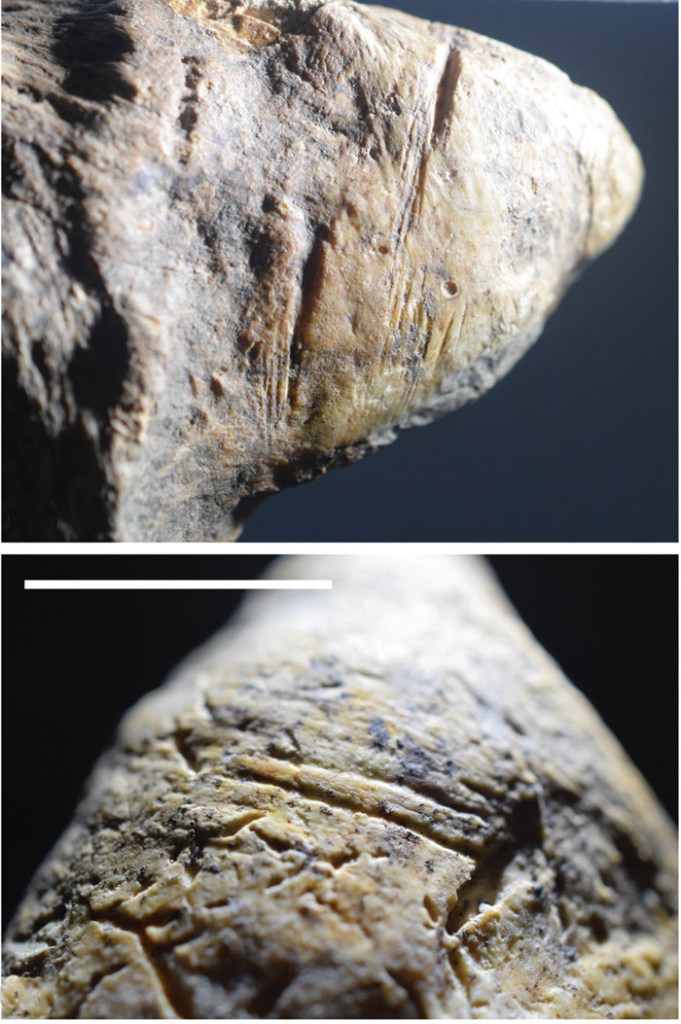
Animal bones showing cut marks from the 1.95 Ma old Grăunceanu site in Romania. (Credit: Curran et al. 2025, Figs 2A and C)

There were stone-tool makers who butchered prey in Africa as early as 3.4 Ma ago (see: Stone tools go even further back; May 2015), but without direct evidence of which hominin was involved. Several possible candidates have been suggested: Australopithecus; Kenyanthropus; Paranthropus. The earliest known African remains of H. erectus have been dated at around 2.0 Ma. So, all that can be said with some certainty about the pre-2 Ma migrants to Eurasia, until fossils of that antiquity are found, is that they were hominins of some kind: maybe advanced australopithecines, paranthropoids or early humans. Those from Longgudong and Dmanisi probably are early Homo erectus, and 2 others (1.7 and 1.6 Ma) from China have been designated similarly. Younger, pre-1.0 Ma Eurasian hominins from Israel, Indonesia, Spain and Turkey are currently un-named at the species level, but are allegedly members of the genus Homo.

So, what can be teased from the early Eurasian hominin finds? Some certainly travelled thousands of kilometres from their assumed origins in Africa, but none penetrated further north than about 50°N. Perhaps they could not cope with winters at higher latitudes, especially during ice ages. To reach as far as eastern and western Eurasia suggests that dispersal following exit from Africa would have taken many generations. There is no reason to suppose continual travel; rather the reverse, staying put in areas with abundant resources while they remained available, and then moving on when they became scarce. Climate cycles, first paced at around 40 ka (early Pleistocene) then at around 100 ka (mid Pleistocene and later), would have been the main drivers for hominin population movements, as it would have been for game and vegetation.

After about 3 Ma the 40 ka climate cyclicity evolved to greater differences in global temperature between glacial and interglacial episodes, and even more so after the mid Pleistocene transition to 100 ka cycles (see Wikipedia entry for the mid-Pleistocene Transition). Thus, it seems likely that chances of survival of dispersed bands of hominins decreased over hundreds of millennia. Could populations have survived in particularly favourable areas; i.e. those at low latitudes? If so did both culture and the hominins themselves evolve? Alternatively, was migration in a series of pulses out of Africa and then dispersal in all directions, most ending in regional extinction? Almost certainly, pressures to leave Africa would have been driven by climate, for instance by increased aridity as global temperatures waned and sea-level falls made travel to Eurasia easier. There may also have been secondary, shorter migrations within Eurasia, again driven by environmental changes. Without more data from newly discovered sites we can go little further. Within the 35 known, pre-1 Ma hominin sites there are two clusters: southern and central China, and the Levant, Turkey and Georgia. Could they yield more developments? A 2016 article in Scientific American about Chinese H. erectus finds makes particularly interesting reading in this regard.

Neanderthals and the elusive Denisovans began to establish permanent Eurasian ranges, after roughly 600 ka ago. Both groups survived until after first contact with waves of anatomically modern humans in the last 100 ka, with whom some interbred before vanishing from the record. However, evidence from the DNA of both groups suggests an interesting possibility. Before the two groups split genetically, their common ancestors (H. heidelbergensis or H. antecessor?) apparently interbred with genetically more ancient Eurasian hominins (see Wikipedia entry for Neanderthal evolution). This intriguing hint suggests that more may be discovered when substantial remains of Denisovans – i.e. more than a few teeth and small bones – are discovered and yield more DNA. My guess is such a future development will stem from analysis of early hominin remains in China, currently regarded as H. erectus. See China discovers landmark human evolution fossils. Xinhua News Agency 9 December 2024)

A fully revised edition of Steve Drury’s book Stepping Stones: The Making of Our Home World can now be downloaded as a free eBook

How changes in the Earth System have affected human evolution, migration and culture

Refugees from the Middle East migrating through Slovenia in 2015. Credit: Britannica

During the Pliocene (5.3 to 2.7 Ma) there evolved a network of various hominins, with their remains scattered across both the northern and southern parts of that continent. The earliest, though somewhat disputed hominin fossil Sahelanthropus tchadensis hails from northern Chad and lived  around 7 Ma ago, during the late Miocene, as did a similarly disputed creature from Kenya Orrorin tugenensis (~5.8 Ma). The two were geographically separated by 1500 km, what is now the Sahara desert and the East African Rift System.  The suggestion from mtDNA evidence that humans and chimpanzees had a common ancestor, the uncertainty about when it lived (between 13 to 5 Ma) and what it may have looked like, let alone where it lived, makes the notion debateable. There is even a possibility that the common ancestor of humans and the other anthropoid apes may have been European. Its descendants could well have crossed to North Africa when the Mediterranean Sea had been evaporated away to form the thick salt deposits that now lie beneath it: what could be termed the ‘Into Africa’ hypothesis. The better known Pliocene hominins were also widely distributed in the east and south of the African continent. Wandering around was clearly a hominin predilection from their outset. The same can be said about humans in the general sense (genus Homo) during the Early Pleistocene when some of them left Africa for Eurasia. Artifacts dated at 2.1 Ma have been found on the Loess Plateau of western China, and Georgia hosts the earliest human remains known from Eurasia. Since them H. antecessor, heidelbergensis, Neanderthals and Denisovans roamed Eurasia. Then, after about 130 ka, anatomically modern humans progressively populated all continents, except Antarctica, to their geographic extremities and from sea level to 4 km above it.

There is a popular view that curiosity and exploration are endemic and perhaps unique to the human line: ‘It’s in our genes’. But even plants migrate, as do all animal species. So it is best to be wary of a kind of hominin exceptionalism or superior motive force. Before settled agriculture, simply diffusion of populations in search of sustenance could have achieved the enormous migrations undertaken by all hominins: biological resources move and hunter gatherers follow them. The first migration of Homo erectus from Africa to northern China by way of Georgia seems to taken 200 ka at most and covered about ten thousand kilometres: on average a speed of only 50 m per year! That achievement and many others before and later were interwoven with the evolution of brain size, cognitive ability, means of communication and culture. But what were the ultimate drivers? Two recent papers in the journal Nature Communications make empirically-based cases for natural forces driving the movement of people and changes in demography.

The first considers hominin dispersal in the Palaearctic biogeographic realm: the largest of eight originally proposed by Alfred Russel Wallace in the late 19th century that encompasses the whole of Eurasia and North Africa (Zan, J. et al. 2024. Mid-Pleistocene aridity and landscape shifts promoted Palearctic hominin dispersals. Nature Communications, v. 15, article 10279; DOI: 10.1038/s41467-024-54767-0). The Palearctic comprises a wide range of ecosystems: arid to wet, tropical to arctic. After 2 Ma ago, hominins moved to all its parts several times. The approach followed by Zan et al. is to assess the 3.6 Ma record of the thick deposits of dust carried by the perpetual westerly winds that cross Central Asia. This gave rise to the huge (635,000 km2) Loess Plateau. At least 17 separate soil layers in the loess have yielded artefacts during the last 2.1 Ma. The authors radiocarbon dated the successive layers of loess in Tajikistan (286 samples) and the Tarim Basin (244 samples) as precisely as possible, achieving time resolutions of 5 to 10 ka and 10 to 20 ka respectively. To judge variations in climate in these area they also measured the carbon isotopic proportions in organic materials preserved within the layers. Another climate-linked metric that Zan et al. is a time series showing the development of river terraces across Eurasia derived from the earlier work of many geomorphologists. The results from those studies are linked to variations through time in the numbers of archaeological sites across Eurasia that have yielded hominin fossils, stone tools and signs of tool manufacture, many of which have been dated accurately.

The authors use sophisticated statistics to find correlations between times of climatic change and the signs of hominin occupation. Episodes of desertification in Palaearctic Eurasia clearly hindered hominins’ spreading across the continent either from west to east of vice versa. But there were distinct, periodic windows of climatic opportunity for that to happen that coincide with interglacial episodes, whose frequency changed at the Mid Pleistocene Transition (MPT) from about 41 ka to roughly every 100 ka. That was suggested in 2021 to have arisen from an increased roughness of the rock surface over which the great ice sheets of the Northern Hemisphere moved. This suppressed the pace of ice movement so that the 41 ka changes in the tilt of the Earth’s rotational axis could no longer drive climate change during the later Pleistocene, despite the fact that the same astronomical influence continued. The succeeding ~100 ka pulsation may or may not have been paced by the very much weaker influence of Earth changing orbital eccentricity. Whichever, after the MPT climate changes became much more extreme, making human dispersal in the Palearctic realm more problematic. Rather than hominin’s evolution driving them to a ‘Manifest Destiny’ of dominating the world vastly larger and wider inorganic forces corralled and released them so that, eventually, they did.

Much the same conclusion, it seems to me, emerges from a second study that covers the period since ~ 9 ka ago when anatomically modern humans transitioned from a globally dominant hunter-gatherer culture to one of ‘managing’ and dominating ecosystems, physical resources and ultimately the planet itself. (Wirtz, K.W et al. 2024. Multicentennial cycles in continental demography synchronous with solar activity and climate stability. Nature Communications, v. 15, article 10248; DOI: 10.1038/s41467-024-54474-w). Like Zan et al., Kai Wirtz and colleagues from Germany, Ukraine and Ireland base their findings on a vast accumulated number (~180,000) of radiocarbon dates from Holocene archaeological sites from all inhabited continents. The greatest number (>90,000) are from Europe. The authors applied statistical methods to judge human population variations since 11.7 ka in each continental area. Known sites are probably significantly outweighed by signs of human presence that remain hidden, and the diligence of surveys varies from country to country and continent to continent: Britain, the Netherlands and Southern Scandinavia are by far the best surveyed. Given those caveats, clearly this approach gives only a blurred estimate of population dynamics during the Holocene. Nonetheless the data are very interesting.

The changes in population growth rates show distinct cyclicity during the Holocene, which Wirtz et al. suggest are signs of booms and busts in population on all six continents. Matching these records against a large number of climatic time series reveals a correlation. Their chosen metric is variation in solar irradiance: the power per unit area received from the Sun. That has been directly monitored only over a couple of centuries. But ice cores and tree rings contain proxies for solar irradiance in the proportions of the radioactive isotopes 10Be and 14C contained in them respectively. Both are produced by the solar wind of high-energy charged particles (electrons, protons and helium nuclei or alpha particles) penetrating the upper atmosphere. The two isotopes have half-lives long enough for them to remain undecayed and thus detectable for tens of thousand years. Both ice cores and tree rings have decadal to annual time resolutions. Wirtz et al. find that their crude estimates of booms and busts in human populations during the Holocene seem closely to match variations in solar activity measured in this way. Climate stability favours successful subsistence and thus growth in populations. Variable climatic conditions seem to induce subsistence failures and increase mortality, probably through malnutrition.

A nice dialectic clearly emerges from these studies. ‘Boom and bust’ as regards populations in millennial and centennial to decadal terms stem from climate variations. Such cyclical change thus repeatedly hones natural selection among the survivors, both genetically and culturally, increasing their general fitness to their surroundings. Karl Marx and Friedrich Engels would have devoured these data avidly had they emerged in the 19th century. I’m sure they would have suggested from the evidence that something could go badly wrong – negation of negation, if readers care to explore that dialectical law further . . . And indeed that is happening. Humans made ecologically very fit indeed in surviving natural pressures are now stoking up a major climatic hiccup, or rather the culture and institutions that humans have evolved are doing that.

A new timeline for modern humans’ colonisation of Europe

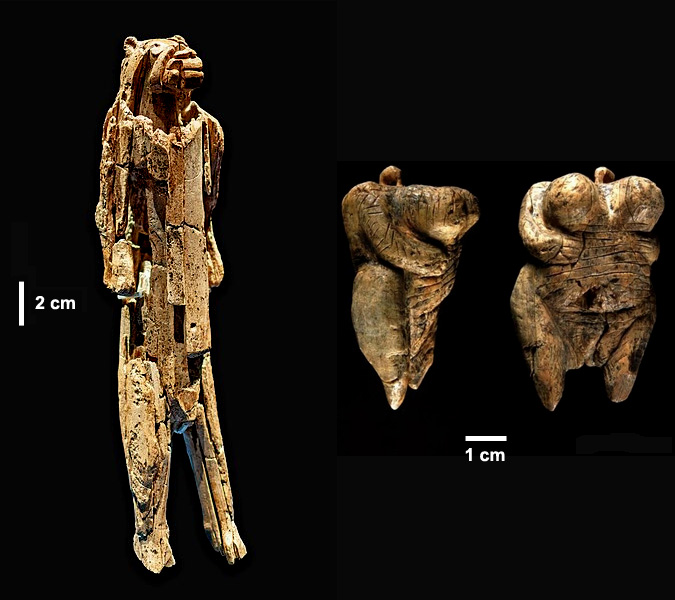
Aurignacian sculptures: ‘Lion-Man’ and ‘Venus’ from the Hohlenstein-Stadel and Hohle Fels caves in Germany.

The earliest culture (or techno-complex) that can be related to anatomically modern humans (AMH) in Europe is called the Aurignacian. It includes works of art as well as tools made from stone, bone and antler. Perhaps the most famous are the ivory sculptures of ‘Lion-Man’ and Venus of the Hohlenstein-Stadel  and Hohle Fels caves in Germany,  and also the stunning cave art, of Chauvet Cave in France. Aurignacian artefacts that are dated at 43 to 26 ka occur at sites throughout Europe south of about 52°N. It was this group of people who interacted with the original Neanderthal population of Europe and finally replaced them completely. There is a long standing discussion over who ‘invented’ the stone tools, both human groups apparently having used similar styles of manufacture (Châtelperronian). Likewise, as regards the subsistence methods deployed by each; in one approach Neanderthals may have largely restricted their activities to roughly fixed ranges, whereas the incomers were generally seasonal nomads. As yet it has not been possible to show if the interbreeding between the two, which ancient and modern genetic data show, preceded the Aurignacian influx or continued when the met in Europe. Whatever, Neanderthals as a distinct human group had disappeared from the geological record by 40 ka. (Note that the three thousand years of coexistence is as long as the time between now and the end of the Bronze Age, about 150 generations at least.) But that aspect of European human development is not the only bone of contention about the spread into Europe. How did the Aurignacian people fare during and after their entry into Europe?

Despite continuing discovery of AMH sites in Europe, and reappraisal of long-known ones, there are limits to how much locations, dates, bones and artifacts can tell us. The actual Aurignacian dispersal of people across Europe is confounded by the limited number of proven occupation sites. These were people who, like most hunter gatherers, must have moved continually in response to variations in the supply of resources that depend on changing climatic conditions. They probably travelled ‘light’, occupied many temporary camp sites but few places to which they returned generation after generation. Temporary ‘stopping places’ are difficult to find, showing little more than evidence of fire and a ‘litter’ of shards from retouched stone tools (debitage), together with discarded bones that show marks left by butchery. A group of archaeologists and climate specialists from the University of Cologne, Germany have tried to shed some light on the completely ‘invisible’ aspects of Aurignacian dispersal and subsistence using what they have called – perhaps a tribute to Frank Sinatra! – the ‘Our Way Model’ (Shao, Y. et al. 2024. Reconstruction of human dispersal during Aurignacian on pan-European scale. Nature Communications, v. 15, Article 7406; DOI: 10.1038/s41467-024-51349-y. Click link to download a PDF).

The reality of hunter-gatherer life during a period of repeated rapid change in climate would clearly have been complex and sometimes precarious. To grasp it also needs to take account of human population dynamics as well as climatic and ecological drivers. The team’s basic strategy was to combine climate and archaeological data to model the degree to which human numbers may have fluctuated and the extent and direction of their migration. Three broad factors would have driven both: environmental change; culture – social change, curiosity, technology; and human biology. Really, environmental change is the only one that can be addressed with any degree of precision through records of climate change, such as Greenland ice cores. Archaeological data from known sites should provide some evidence for technological change, but only for two definite phases in Aurignacian culture (43-38 ka and 38-32 ka). Dating of   Aurignacian sites establishes some time calibration for episodes of occupation, abandonment and resettlement. Issues of human biology can be addressed to some extent from ancient genetics, where suitable bones are available. However, the ‘Our Way Model’ is driven by climate modelling and archaeology. It outputs an historical estimate of ‘human existence potential’ (HEP) that includes predictions of carbon storage in plants and animals – i.e.  potential food resources – expressed as regional population density in Europe. The technical details are complex, but Shao et al.’s conclusions are quite striking.

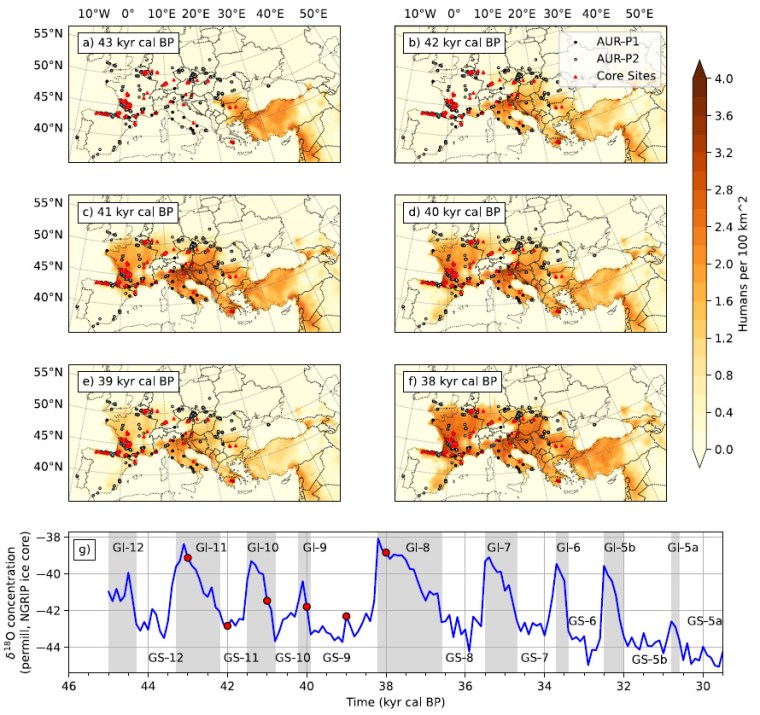
Maps of estimated anatomically modern human population density during the first six thousand years of Aurignacian migration and palaeoclimate record from the Greenland NGRIP ice core, with shaded warm episodes – red spots indicate the time of the population estimates above. (Credit: Shao et al. Fig. 1)

Climate change in the later stages of cooling towards the last glacial maximum at ~20 ka was cyclical, with ten Dansgaard-Oeschger cold stadial events capable of ‘knocking back’ both population density and the extent of settlement. In the first two millennia expansion from the Levant into the Balkans was slow. From 43 to 41 ka the pace quickened, taking the Aurignacian culture into Western Europe, with an estimate total European AMH population of perhaps 60 thousand. A third phase (41 to 39 ka) shrank the areas and densities of population during a prolonged cold period. The authors suggest that survival was in Alpine refuge areas that AMH people had occupied previously. Starting at around 38 ka, a lengthy climatic warm period allowed the culture to spread to its maximum extent reaching southern Britain and the north and east of the Iberian Peninsula. Perhaps by then the AMH population had evolved better strategies to adapt to increasing frigid conditions. But by that time the Neanderthals had disappeared from Europe freeing up territory and food resources. That too may have contributed to the expansion and the sustenance of an AMH total population of between 80 and 100 thousand during the second phase of the Aurignacian.

It’s as well to remember that this work is based on a model, albeit sophisticated, based on currently known data. Palaeoanthropology is extremely prone to surprises as field- and lab work progresses …

See also: New population model identifies phases of human dispersal across Europe. EurekaAlert, 4 September 2024; Kambani, K. 2024. The Dynamics of Early Human Dispersal Across Europe: A New Population Model. Anthropology.net, 4 September 2024.