The final closure of the Iapetus Ocean

A symposium hosted by the Royal Society in 1965 aimed at resurrecting Alfred Wegener’s hypothesis of continental drift. During the half century since Wegener made his proposal in 1915, it had been studiously ignored by most geologists. The majority had bumbled along with the fixist ideology of their Victorian predecessors. The symposium launched what can only be regarded as a revolution in the Earth Sciences. In the three years following the symposium, the basic elements of plate tectonics had emerged from a flurry of papers, mainly centred on geophysical evidence. Geology itself became part of this cause célèbre through young scientists eager to make a name for themselves. The geological history of Britain, together with that of the eastern North America, became beneficiaries only four years after the Royal Society meeting (Dewey, J. 1969. Evolution of the Appalachian/Caledonian Orogen. Nature 222, 124–129; DOI: 10.1038/222124a0).

In Britain John Dewey, like a few other geologists, saw plate theory as key to understanding the many peculiarities revealed by geological structure, igneous activity and stratigraphy of the early Palaeozoic. These included very different Cambrian and Ordovician fossil assemblages in Scotland and Wales, now only a few hundred kilometres apart. The Cambro-Ordovician of NW Scotland was bounded to the SE by a belt of highly deformed and metamorphosed Proterozoic to Ordovician sediments and volcanics forming the Scottish Highlands. That was terminated to the SE by a gigantic fault zone containing slivers of possible oceanic lithosphere. The contorted and ‘shuffled’ Ordovician and Silurian sediments of the Southern Uplands of Scotland. The oldest strata seemed to have ocean-floor affinities, being deposited on another sliver of ophiolites.  A few tens of km south of that there was a very different Lower Palaeozoic stratigraphy in the Lake District of northern England. It included volcanic rocks with affinities to those of modern island arcs. A gap covered by only mildly deformed later Palaeozoic shelf and terrestrial sediments, dotted by inliers of Proterozoic sediments and volcanics separated the Lake District from yet another Lower Palaeozoic assembly of arc volcanics and marine sediments in Wales. Intervening in Anglesey was another Proterozoic block of deformed sediments that also included ophiolites.

Dewey’s tectonic assessment from this geological hodge-podge, which had made Britain irresistible to geologists through the 19th and early 20th centuries, was that it had resulted from blocks of crust (terranes), once separated by thousands of kilometres, being driven into each other. Britain was thus formed by the evolution and eventual destruction of an early Palaeozoic ocean, Iapetus: a product of plate tectonics. Scotland had a fundamentally different history from England and Wales; the unification of several terranes having taken over 150 Ma of diverse tectonic processes. Dewey concluded that the line of final convergence lay at a now dead, major subduction zone – the Iapetus Suture – roughly beneath the Solway Firth. During the 56 years since Dewey’s seminal paper on the Caledonian-Appalachian Orogeny details and modifications have been added at a rate of around one to two publications per year. The latest seeks to date when and where the accretion of 6 or 7 terranes was finally completed (Waldron, J.W.F. et al. 2025. Is Britain divided by an Acadian suture?  Geology, v. 53, p. 847–852; DOI: 10.1130/G53431.1).
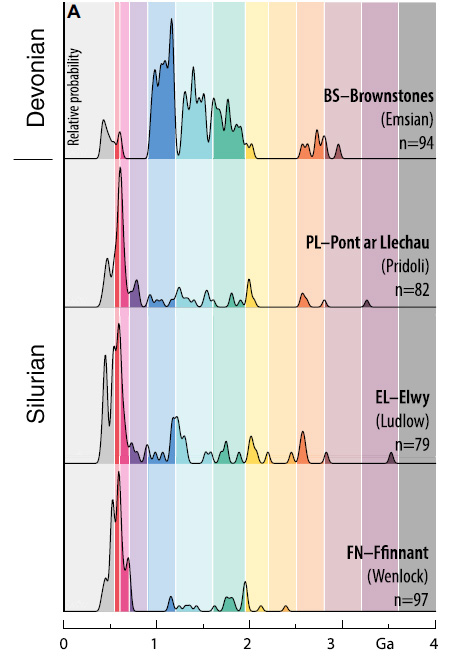
Kernel density plots – smoothed versions of histograms – of detrital zircon ages in Silurian and Devonian sandstones from Wales. The bracketed words are stratigraphic epochs. Credit: Waldron et al. 2025, Fig 3A

John Waldron and colleagues from the University of Alberta and Acadia University in Canada and the British Geological Survey addressed this issue by extracting zircons from four late Silurian and early Devonian sandstones in North and South Wales. These sediments had been deposited between 433 and 393 Ma ago at the southernmost edge of the British Caledonide terrane assemblage towards the end of terrane assembly. The team dated roughly 250 zircons from each sandstone using the 207Pb/206Pb and 206Pb/238U methods. Each produced a range of ages, presumed to be those of igneous rocks from whose magma the zircon grains had crystallised. These data are expressed as plots of probable frequency against age.  Each pattern of ages is assumed to be a ‘fingerprint’ for the continental crust from which the zircons were eroded and transported to their resting place in their host sediment. In this case, the researchers were hoping to see signs of continental crust from the other side of the Caledonian orogen; i.e. from the Precambrian basement of the Laurentia continent.

The three late-Silurian sediments showed distinct zircon-age peaks around 600 Ma and a spread of smaller peaks extending to 2.2 Ga. This tallied with a sediment source in Africa, from which the southernmost Caledonian terrane was said to have split and moved northwards.  The Devonian sediment lacked signs of such an African ‘heritage’ but had a prominent age peak at about 1.0 Ga, absent from the Welsh Silurian sediments.  Not only is this a sign of different sediment provenance but closely follows the known age of a widespread magmatic pulse in the Laurentian continent. So, sediment transport from the opposite side of the Iapetus Ocean across the entire Caledonian orogenic belt was only possible after the end of the Silurian Period at around 410 Ma. There must have been an intervening barrier to sediment movement from Laurentia before that, such as deep ocean water further north. Previous studies from more northern Caledonian terranes show that Laurentian zircons arrived in the Southern Uplands of Scotland and the English Lake District around 432 Ma in the mid-Silurian. Waldron et al. suggest, on these grounds that the suture marking the final closure of the Iapetus Ocean lies between the English Lake District and Anglesey, rather than beneath the Solway. They hint that the late-Silurian to early Devonian granite magmatism that permeated the northern parts of the Caledonian-Appalachian orogen formed above northward subduction of the last relics of Iapetus, which presaged widespread crustal thickening known as the Acadian orogeny in North America.

Readers interested in this episode of Earth history should download Waldron et al.’s paper for its excellent graphics, which cannot be reproduced adequately here.

News about ‘hobbits’ (Homo floresiensis)

The roof lifted for palaeoanthropologists in October 2004 when news emerged of a fossil from Liang Bua cave on Flores in the Indonesian archipelago. It was an adult female human skull about a third the size of those of anatomically modern humans (see: The little people of Flores, Indonesia; October 2004). Immediately it was dubbed ‘Hobbit’, and from the start controversy raged around this diminutive human. The cave layer contained evidence of fire and sophisticated tools as well as bones of giant rats and minute elephants, presumed to be staple prey for these little people. Despite having brains about the size of a grapefruit – as did australopithecines – the little people challenged our assumptions about intelligence. Preliminary dating from 95 to 17 ka suggested they may have cohabited Indonesia with both H. erectus and AMH. Indeed, modern people of Flores tell legends of the little people they call Ebo Go Go. Like both their ancestors must have crossed treacherous straits between the Indonesian islands, which existed even when global sea level was drawn down by polar icecaps. Once an early suggestion that the original find was the skull of a deformed, microcephalic individual had been refuted by further finds in Flores, scientists turned to natural selection of small stature through living on a small island with limited resources – similar to the tiny elephant Stegodon and other island faunas elsewhere. By 2007, it had become clear from other, similar fossils that they were definitely a distinct species Homo floresiensis (see: Now we can celebrate the ‘Hobbits’! November 2007) with several anatomical similarities to H. erectus. Then more sophisticated dating revealed that the Flores cave sediments containing their fossils and tools spanned 100 to 60 ka, well before AMH reached Indonesia. By 2018 their arrival on Flores, marked by a mandible fragment and 6 teeth in sediments from sediment excavation at Mata Menge 70 km east of Luing Bua, had been pushed back to 773 ka.  At the new site stone tools were found in even earlier sediments (1.02 Ma). In 2019 evidence emerged that isolated island evolution in the Philippines had produced similar small descendants (H. luzonensis) by around 67 ka.

Artist’s impression of Homo floresiensis with giant rat. (Credit: Box of Oddities podcast)

The latest development is the finding of a fragment of an adult humerus (an arm bone) in the Mata Menge excavations that had yielded the oldest dates for Homo floresiensis fossils (Kaifu, Y. and 12 others 2024. Early evolution of small body size in Homo floresiensis. Nature Communications, v. 15, article number 6381; DOI: 10.1038/s41467-024-50649-7). Comparing the teeth and arm-bone fragment with an intact adult from Liang Bua suggests that the earliest known ancestors of Homo floresiensis were even smaller. The teeth, albeit much smaller, resemble those of Indonesian specimens of H. erectus. That observation helps to rule out earlier speculation that the tiny people of Flores descended from the earliest humans from Africa (H. habilis) that were about the same size, but more than twice as old (2.3 to 1.7 Ma). The evidence points more plausibly towards their evolution from Asian H. erectus, who arrived in Java around 1.1 million years ago. Having solved the issue of ‘island hopping’ to reach Java a group of Asian H. erectus could have found their way to Flores. That island’s biological resources may not have met the survival requirements of a much larger human ancestor but evolution in isolation kept the arrivals alive. Within 300 ka, and perhaps much less for a small population, survival of smaller offspring allowed them a very long and apparently quite comfortable stay on the island. Though diminished in stature, they demonstrated the survival strategies conferred by being smart.

Rare meteorite gives clues to the early history of Mars

Apart from the ages and geochemistry of a few hundred zircon grains we have no direct evidence of what the earliest crust of the Earth was like. The vast bulk of the present crust is younger than about 4 billion years. The oldest tangible crustal rocks occur in the 4.2 billion year (Ga) old Nuvvuagittuq greenstone belt on Hudson Bay. The oldest zircon grains have compositions that suggest that they formed during the crystallisation of andesitic magmas about 4.4 Ga ago about 140 Ma after the Earth accreted. But, according to an idea that emerged decades ago, that does not necessarily represent the earliest geology. Geochemists have shown that the bulk compositions of the Earth and Moon are so similar that they almost certainly share an early history. Rocks from the lunar highlands – the light areas that surround the dark basaltic maria – collected during the Apollo missions are significantly older (up to 4.51 Ga). They are made mainly of calcium-rich feldspars. These anorthosites have a lower density that basaltic magma. So it is likely that the feldspars crystallised from an all-enveloping ‘magma ocean’ and floated to form an upper crust on the moon. Such a liquid outer layer could only have formed by a staggering input of energy. It is believed that what became the Moon was flung from the Earth following collision with another planetary body as vapour, which then collapsed under gravity and condensed to a molten state (see: Moon formed from vapour cloud; January 2008). Crystallisation of the bulk of anorthosites has been dated to between 4.42 to 4.35 Ga (see: Moon-forming impact dated; March 2009). The Earth would likely have had a similar magma ocean produced by the impact (a much fuller discussion can be found here), but no tangible trace has been discovered, though there is subtle geochemical evidence.

The surface geology of Mars has been mapped in great detail from orbiting satellites and various surface Rovers have examined sedimentary rocks – one of them is currently collecting samples for eventual return to Earth. Currently, the only materials with a probable Martian origin are rare meteorites; there are 224 of them out of 61 thousand meteorites in collections. They are deemed to have been flung from its surface by powerful impacts to land fortuitously on Earth. It is possible to estimate when they were ejected from the effects of cosmic-ray bombardment to which they were exposed after ejection, which produces radioactive isotopes of a variety of elements that can be used in dating. So far, those analysed were flung into space no more than 20 Ma ago. Meteorites with isotopic ‘signatures’ and mineral contents so different from others and from terrestrial igneous rocks are deemed to have a Martian origin by a process of elimination. They also contain proportions of noble gases (H, Ne, Ar, Kr and Xe) that resemble that of the present atmosphere of Mars. Almost all of them are mafic to ultramafic igneous rocks in two groups: about 25 % that have been dated at between 1.4 to 1.3 Ga; the rest are much younger at about 180 Ma. But one that was recovered from the desert surface in West Sahara, NW Africa (NWA 7034, nicknamed ‘Black Beauty’) is unique. It is a breccia mainly made of materials derived from a sodium-rich basaltic andesite source, and contains much more water than all other Martian meteorites.

The ‘Black Beauty’ meteorite from Mars (NWA 7035) with a polished surface and a 2 mm wide microscope view of a thin section: the pale clasts are fragments of pyroxenes and plagioclase feldspars; the rounded dark grey clast is a fine-grained basaltic andesite. (Credits: NASA; Andrew Tindall)

If you would like to study the make-up of NWA 7035 in detail you can explore it and other Martian meteorites by visiting the Virtual Microsope devised by Dr Andrew Tindall and Kevin Quick of the British Open University.

The initial dating of NWA 7034 by a variety of methods yielded ages between 1.5 to 1.0 Ga, but these turned out to represent radiometric ‘resetting’ by a high-energy impact event around 1.5 Ga ago. Its present texture of broken clasts set in a fine-grained matrix suggests that the breccia formed from older crustal rock smashed and ejected during that impact to form a debris ‘blanket’ around the crater. Cosmogenic dating of the meteorite indicates that the debris was again flung from the surface of Mars at some time in the last 10 Ma to launch NWA 7034 beyond Mars’s gravitational field eventually to land in northwest Africa. But that is not the end of the story, because increasingly intricate radiometric dating has been conducted more recently.

‘Black Beauty’ contains rock and mineral fragments that have yielded dates as old as 4.48 Ga. So the breccia seems to have formed from fragments of the early crust of Mars. Indeed it represents the oldest planetary rock that has ever come to light. Some meteorites (carbonaceous chondrites) date back to the origin of the Solar System at around 4.56 Ga ago, and were a major contributor to the bulk composition of the rocky planets. However, the material in NWA 7034 could only have evolved from such primordial materials through processes taking place within the mantle of Mars. That was very early in the planet’s history: less than 80 Ma after it first began to accrete. It could therefore be a key to the early history of all the rocky planets, including the Earth.

There are several scenarios that might account for the composition of NWA 7034. The magma from which its components originated may have been produced by direct partial melting of the planet’s mantle shortly after accretion. However, experimental partial melting of ultramafic mantle suggests that andesitic magmas would be unlikely to form by such a primary process. But other kinds of compositional differentiation, perhaps in an original magma ocean, remain to be explored. Unlike the Earth-Moon system, there is no evidence for anorthosites exposed at the Martian surface that would have floated to become crust once such a vast amount of melt began to cool. Some scientists, however, have suggested that to be a possibility for early Mars. Another hypothesis, by analogy with what is known about the earliest Archaean processes on Earth, is secondary melting of a primordial basaltic crust, akin to the formation of Earth’s early continental crust.

Only a new robotic or crewed mission to the area from which NWA 7034  was ‘launched’ can take ideas much further. But where on Mars did ‘Black Beauty’ originate? A team from Australia, France, Cote d’ Ivoire, and the US have used a range of Martian data sets to narrow down the geographic possibilities (Lagain, A., and 13 others 2022. Early crustal processes revealed by the ejection site of the oldest martian meteorite. Nature Communications, v. 13, article 3782; DOI 10.1038/s41467-022-31444-8). The meteorite contains a substantially higher content of the elements thorium and potassium than do other Martian meteorites. Long-lived radioactive isotopes of K, Th and U generate gamma-ray emissions with distinctly different wavelengths and energy levels. Those for each element have been mapped from orbit. NWA 7034 also has very distinct magnetic properties, and detailed data on variations on the magnetic field intensity of Mars have also been acquired by remote sensing. Images from orbit allow relative ages of the surface to be roughly mapped from the varying density of impact craters: the older the surface, the more times it has been struck by projectiles of all sizes. These data also detect of craters large enough to have massively disrupted Martian crustal materials to form large blankets of impact breccias like NWA 7034. That is, ‘targets’ for the much later impact that sent the meteorite Earthwards. Using a supercomputer, Lagain et al. have cut the possibilities down to 19 likely locations. Their favoured source is the relatively young Karratha crater in the Southern Hemisphere to the west of the Tharsis Bulge. It formed on a large ejecta blanket associated with the ancient (~1.5 Ga) 40 km wide Khujirt crater.

Interesting, but sufficiently so to warrant an awesome bet in the form of a mission budget?

Impacts increased at the end of the Palaeozoic

Because it is so geologically active the Earth progressively erases signs of asteroid and comet impacts, by erosion, burial or even subduction in the case of the oceanic record. As a result, the number of known craters decreases with age. To judge the influence of violent extraterrestrial events in the past geologists therefore rely on secondary outcomes of such collisions, such as the occasional presence in the sedimentary record of shocked quartz grains, glassy spherules and geochemical anomalies of rare elements. The Moon, on the other hand, is so geologically sluggish that its surface preserves many of the large magnitude impacts during its history, except for those wiped out by later such events. For instance, a sizeable proportion of the lunar surface comprises its dark maria, which are flood basalts generated by gigantic impacts around 4 billion years ago. Older impacts can only be detected in its rugged, pale highland terrains, and they have been partially wiped out by later impact craters. The Moon’s surface therefore preserves the most complete record of the flux and sizes of objects that have crossed its orbit shared with the Earth.

The Earth presents a target thirteen times bigger than the cross sectional area of the Moon so it must have received 13 times more impacts in their joint history.  Being about 81 times as massive as the Moon its stronger gravitational pull will have attracted yet more and all of them would have taken place at higher speeds. The lunar samples returned by the Apollo Missions have yielded varying ages for impact-glass spherules so that crater counts combined with evidence for their relative ages have been calibrated to some extent to give an idea of the bombardment history for the Earth Moon System. Until recently this was supposed to have tailed off exponentially since the Late Heavy Bombardment between 4.0 to 3.8 billion years ago. But the dating of the lunar record using radiometric ages of the small number of returned samples is inevitably extremely fuzzy. A team of planetary scientists from Canada, the US and Britain has developed a new approach to dating individual crater using image data from NASA’s Lunar Reconnaissance Orbiter (LRO) launched in 2009 (Mazrouei, S. et al. 2019. Earth and Moon impact flux increased at the end of the Paleozoic. Science, v. 363, p. 253-257; DOI: 10.1126/science.aar4058).

The method that they devised is, curiously, based on thermal imagery from the LRO’s Diviner instrument which records the Moon’s surface temperature. Comparison of day- and night-time temperatures produces a measure of surface materials’ ability to retain heat known as thermal inertia. A material with high thermal inertia stays warmer for longer at night. When a crater forms it partly fills with rock fragments excavated by the impact. When fresh these are full of large blocks of rock that were too massive to be blasted away. But these blocks are exposed to bombardment by lesser projectiles for the lifetime of the crater, which steadily reduces them to smaller fragments and eventually dust. Blocks of solid rock retain significantly more solar heat than do gravelly to dust-sized materials:  thermal inertia of the crater floor therefore decreases steadily with age.

407458aa.2
Blocky surface of a relatively young lunar crater (Credit: NASA)

As well as day- and night thermal data provided by the Diviner instrument, from which thermal inertia values are calculated, the LRO deploys two cameras that capture black and white images of the surface in the visible range, with a resolution of about a metre. They enable the blockiness of crater floors to be estimated. Sara Mazrouei and colleagues measured blockiness and thermal inertia of the floors of 111 craters more than 10 km across, ages of nine of which had been modelled independently using counts of smaller craters that subsequently accumulated on their floors shown by even finer resolution images from the Japanese Kaguya orbiter. Their results are surprising. About 290 Ma ago the rate of large impacts on the Moon increased by a factor of 2.6. This might explain why the Neoproterozoic and Palaeozoic Eras are deficient in terrestrial craters. Another inference from the results is that the number of objects in Earth-crossing orbits suddenly increased at the end of the Carboniferous. Maybe that resulted from an episode of collisions and break-up of large bodies in the Asteroid Belt or, perhaps, some kind of gravitational perturbation by Jupiter. The age-distribution of large craters on Earth is no help because of their ephemeral nature. Moreover, apart from Chicxulub that is bang on the K-Pg boundary, there is little evidence of an increase in impact-driven mass extinctions in the Mesozoic and Cenozoic. Nor for that matter did igneous activity or sediment deposition undergo any sudden changes. There are sediments that seem to have formed as a result of tsunami devastation, but none greater in magnitude than could have been caused by major earthquakes. Or … maybe geologists should have another look at the stratigraphic record.

Read more on Planetary science

Age calibration of Mesozoic sedimentary sequences: can it be improved?

Relative age sequences in sequences of fossiliferous sediments are frequently intricate, thanks to animal groups that evolved quickly to leave easily identifiable fossil species. Yet converting that one-after-the-other dating to absolute values of past time has been difficult and generally debateable. Up to now it has relied on fossil-based correlation with localities where parts of the sequence of interest interleave with volcanic ashes or lavas that can be dated radiometrically. Igneous rocks can provide reference points in time, so that age estimates of intervening sedimentary layers emerge by assuming constant rates of sedimentation and of faunal speciation. However, neither rate can safely be assumed constant, and those of evolutionary processes are of great biological interest.

Setting Sun at Whitby Abbey
Sunset at St Hilda’s Abbey, Whitby NE England; fabled haunt of Count Dracula (credit: epicnom)

If only we could date the fossils a wealth of information would be accessible. In the case of organisms that apparently evolved quickly, such as the ammonites of the Mesozoic, time resolution might be extremely fine. Isotopic analysis methods have become sufficiently precise to exploit the radioactive decay of uranium isotopes, for instance, at the very low concentrations found in sedimentary minerals such as calcium carbonate. So this prospect of direct calibration might seem imminent. Geochemists and palaeontologists at Royal Holloway University of London, Leicester University and the British Geological Survey have used the U-Pb method to date Jurassic ammonites (Li, Q. et al. 2014. U–Pb dating of cements in Mesozoic ammonites. Chemical Geology, v. 376, p. 76-83). The species they chose are members of the genus Hildoceras, familiar to junior collectors on the foreshore below the ruined Abbey of St Hilda at the small port of Whitby, in NE England. The abundance and coiled shape of Hildoceras was once cited as evidence for the eponymous founder of the Abbey ridding this choice locality of a plague of venomous serpents using the simple expedient of divine lithification.

English: Hildoceras bifrons (Bruguière 1789) L...
Hildoceras from the Toarcian shales of Whitby (credit: Wikipedia)

The target uranium-containing mineral is the calcite formed on the walls of the ammonites’ flotation chambers either while they were alive or shortly after death. This early cement is found in all well-preserved ammonites. The Hildoceras genus is found in one of the many faunal Zones of the Toarcian Age of the Lower Jurassic; the bifrons Zone (after Hildoceras bifrons). After careful selection of bifrons Zone specimens, the earliest calcite cement to have formed in the chambers was found to yield dates of around 165 Ma with precisions as low as ±3.3 Ma. Another species from the Middle Jurassic Bajocian Age came out at 158.8±4.3 Ma. Unfortunately, these precise ages were between 10-20 Ma younger than the accepted ranges of 174-183 and 168-170 Ma for the Toarcian and Bajocian. The authors ascribe this disappointing discrepancy to the breakdown of the calcium carbonate (aragonite) forming the animals’ shells from which uranium migrated to contaminate the after-death calcite cement.

Enhanced by Zemanta