A companion crater for Chicxulub on the continental shelf of West Africa

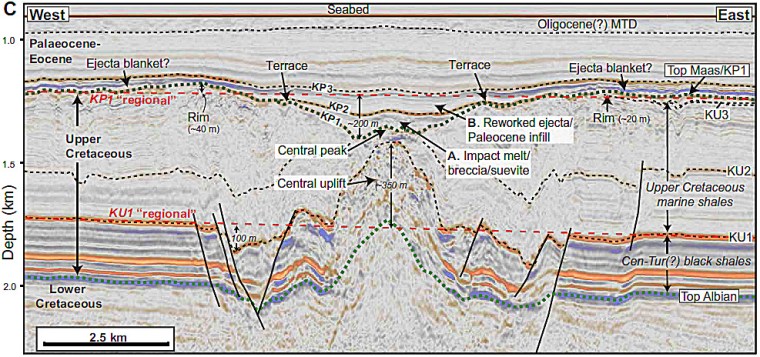
Fig Interpreted 2D seismic section across the Nadir crater and central uplift beneath the Guinea Terrace. (Credit: Nicholson, et al. 2022. Fig 2c)

In 2022 four geoscientists from Heriot-Watt University in Edinburgh, Scotland and the Universities of Arizona and Texas (Austin), USA were geologically interpreting seismic-reflection data beneath the seafloor off Guinea and Guinea-Bissau, West Africa. Individual sedimentary strata that cover the upper continental crust show up as many reflectors. They are calibrated to rock cores from exploratory well that had revealed up to 8 km of sedimentary cover deposited continuously since the Upper Jurassic. The team’s objective was to collect information on tectonic structures that had formed when South America separated from Africa during the Cretaceous. The geophysical data were from commercial reconnaissance surveys aimed at locating petroleum fields beneath part of the West African continental shelf known as the Guinea Terrace. One of the seismic sections revealed a ~9 km wide basin-like depression at the level of the Cretaceous-Palaeogene boundary, which is underlain by a prominent upward bulge in reflectors corresponding to the mid-Cretaceous, plus a large number of nearby faults (Nicholson, U., and 3 others 2022. The Nadir Crater offshore West Africa: a candidate Cretaceous-Paleogene impact structure. Science Advances, v. 8, article eabn3096; DOI: 10.1126/sciadv.abn3096). Elsewhere on the Guinea Terrace the strata were featureless by comparison.

The Nadir crater showed many of the signs to be expected from an asteroid impact. That it drew attention stemmed partly from being of roughly the same age as the much larger 66 Ma Chicxulub impact off the Yucatan Peninsula of Mexico: the likely culprit for the K-Pg mass-extinction event. Perhaps both impactors stemmed from the break-up of a large, near-Earth asteroid because of gravitational forces resulting from a previous close encounter with either the Earth or another planet. The crater lies at the centre of a 23 km wide zone of faults that only affect Cretaceous and older strata; i.e. they formed just before the K-Pg event. The seismic data also show signs of widespread liquefaction of nearby Cretaceous sedimentary strata and that the crater had been filled by sediments shortly after it formed. Yet the data were too fuzzy for an astronomical catastrophe to be absolutely certain: similar structures can form from the rise of bodies of rock salt, which is less dense than sediments and will dissolve on reaching the seabed.  The owners of the seismic data donated a much larger collection from a grid of survey lines. Processing of such seismic grids turns the collection of individual two-dimensional sections into a 3D regional data set showing the complete shape of subsurface structures. Seismic data of this kind enables more detailed structural and lithological interpretation of both cross section and plan views. They enable sedimentary layers to be ‘peeled’ back to examine the crater at all depths, in much the same manner as CT  and MRI scans reveal the inner anatomy of the human body.
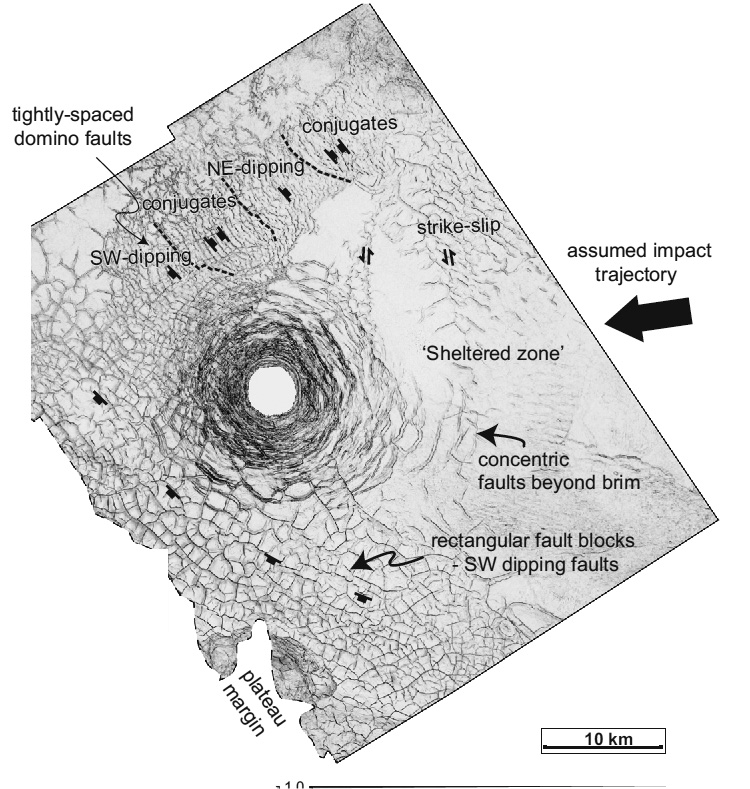
Map of faults around the Nadir crater at a level in the 3D seismic data that was about 200 m below the sea bed at the time of the impact. (Credit: Nicholson, et al. 2024, Fig 6)

Uisdean Nicholson and a larger team have now published their findings from the 3D seismic data that show the structure in unique detail (Nicholson, U., and 6 others 2024. 3D anatomy of the Cretaceous–Paleogene age Nadir Crater. Communications Earth & Environment v. 5, article number 547; DOI: 10.1038/s43247-024-01700-4). Nadir crater was affected by spiral-shaped thrust faults that suggest it was formed by an oblique impact from the northeast by an object around 450 m across, probably travelling at 20 km s-1 at 20 to 40° to the surface. Seconds after excavation uplift of deeper sediments was a response to removal of the load on the crust. The energy was sufficient to vaporise both sediment and impactor within a few seconds, the to drive drive seawater outwards in a tsunami about half a kilometre high, which in about 30 seconds exposed the incandescent crater floor. In the succeeding minutes hours and days liquefied sea water sloshed in and out of the crater, repeated tsunami resurgence forming gullies on its flanks and transporting sediment mixed with glass (suevite) flowed to refill the crater.

Time line for the Nadir impact, derived from detail shown by 3D seismic data. (Credit: Nicholson, et al. 2024, Fig 7)

There is no means of assigning any of the K-Pg extinctions to the Nadir crater, just that it happened at roughly the same time as Chicxulub. But it is the first impact crater to reveal the processes involved through complete coverage by high-resolution 3D seismic data. The majority of the roughly 200 craters are on the continental surface, and were thus ravaged to some extent by later erosion. Yet of the influx of hypervelocity objects through time at least 70% must have struck the oceans, but only 15 to 20 are known. That may reflect the fact that much deeper water could have buffered even giant impacts from affecting the oceanic crust beneath the abyssal plains, whose average depth is about 4 km. Only a small proportion of the continental shelves deemed to contain petroleum reserves have been explored seismically.  Chicxulub itself has been drilled, but only two seismic reflection sections have crossed its centre since its discovery, although earlier 3D data from petroleum exploration cover its outermost northern parts. More detail is available for Nadir and its lower energy did not smash its structural results, unlike Chicxulub. So, despite Nadir’s smaller size, fortuitously it gives more clues to how such marine craters formed. It looks to be an irresistible target for drilling.

News from the Chicxulub drilling project

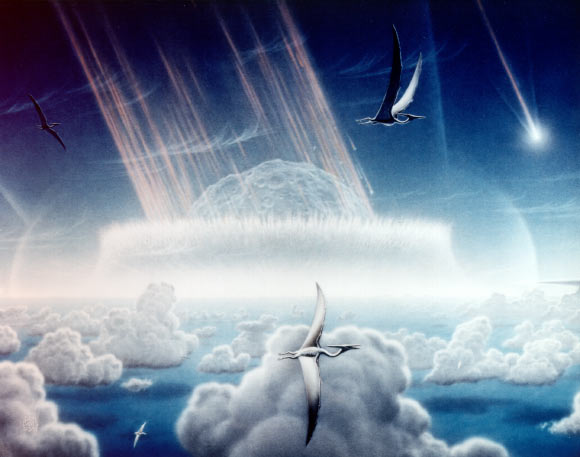
Artist’s impression of an asteroid slamming into the shallow sea off the present Yucatán Peninsula about 65 Ma ago (Credit: Donald E. Davis of NASA)

Aimed at resolving the impact versus volcanism debate about the causes of the K-Pg mass extinction, the International Ocean Discovery Program (IODP) and International Continental Scientific Drilling Program (ICDP) began drilling into the focus of the Chicxulub impact structure off the Yucatán Peninsula, Mexico in 2016. The project recovered 830 m of rock core, of which  about 140 cm contained the boundary between tsunami deposits and the post-impact marine limestones of Danian Age (basal Palaeogene); as close as one can get to the moment when the asteroid hit the sea floor. That an impact close to the start of the Danian had taken place was first discovered from abnormally high concentrations of the platinum-group metal iridium (Ir), shocked mineral grains and glass spherules, among other anomalous materials, in 350 marine and terrestrial sections across the globe. If the Chicxulub crater contained similar features to these ‘smoking guns’ then the link might seem to be done and dusted. A report on the crucial few centimetres from the Chicxulub drill core shows this to be the case (Goderis, S. and 32 others 2021. Globally distributed iridium layer preserved within the Chicxulub impact structure. Science Advances, v. 9, article eabe3647; DOI: 10.1126/sciadv.abe3647).

Yet the boundary layer at Chicxulub could not have been emplaced at the instant of impact. The gigantic power involved would have flung debris outwards, including seawater as well as the rocks that were once at considerable depth below the seabed. Much in the manner of a stone falling into a pond molten crust would have rebounded from the initial strike to form an axial peak and a ringed basin. Likewise huge tsunamis would have rolled away from the impact, then to return and fill the new basin, perhaps several times. Some of the ejected debris would have reached low orbit in the form of pulverised rock and asteroid to remain there for a while before completely falling back to Earth. The core includes about 130 m of once partly molten debris (suevite) above more-or-less intact granitic basement. Only the top 3.5 m show signs of having been deposited in water; fine-grained, well-sorted and laminated suevite containing clasts of once molten material and even late-Cretaceous foraminifera tests, formed probably by the refilling of the impact basin during the backflow of tusunamis. A mere 3 cm of silt and clay just below marine limestones has yielded the characteristic high Ir and nickel concentrations. This Ir-rich layer also contains the earliest Palaeocene foraminifera.

Grains in the Ir-rich layer were the last to settle, the main question being ‘How long after the impact took place did that happen?’ Being very fine they are estimated to have fallen-out from suspension and circulation in the atmosphere over a period of up to a few decades. Coarser material below them would have taken no longer than a few weeks to years. Yet these estimates are based mainly on Stokes’ law governing particles of different sizes falling through a viscous fluid. Taking an empirical view based on actual rates of clay sedimentation in the ocean (~5 mm per thousand years) the Ir-rich layer may have been deposited over 6000 years. That is hardly the ‘instant of the impact’. But the timing does say something interesting about the return of life to the seas; in geological terms it was swift, if the forams are anything to go by. Since the tsunamis swept onto and drained the surrounding land masses a great deal of nutrient would have ended up in the sea awaiting organisms at the bottom of the food chain. Biomarker chemicals and trace fossils in the Ir-rich layer suggest  thriving bacterial communities, with forams, crustacea and larval fish.

The authors conclude ‘The clear association of the Ir anomaly within the Chicxulub impact structure and the recorded biotic response confirms the direct relationship between the impact event and the K-Pg mass extinction’. Whether that is accepted by those geoscientists with their eyes on the Deccan Trap hypothesis is not so certain …

Closure for the K-Pg extinction event?

Anyone who has followed the saga concerning the mass extinction at the end of the Cretaceous Period (~66 Ma ago) , which famously wiped out all dinosaurs except for the birds, will know that its cause has been debated fiercely over four decades. On the one hand is the Chicxulub asteroid impact event, on the other the few million years when the Deccan flood basalts of western India belched out gases that would have induced major environmental change across the planet. Support has swung one way or the other, some authorities reckon the extinction was set in motion by volcanism and then ‘polished-off’ by the impact, and a very few have appealed to entirely different mechanism lumped under ‘multiple causes’. One factor behind the continuing disputes is that at the time of the Chicxulub impact the Deccan Traps were merrily pouring out Disentanglement hangs on issues such as what actual processes directly caused the mass killing. Could it have been starvation as dust or fumes shut down photosynthesis at the base of the food chain? What about toxic gases and acidification of ocean water, or being seared by an expanding impact fireball and re-entering incandescent ejecta? Since various lines of evidence show that the late-Cretaceous atmosphere had more oxygen that today’s the last two may even have set the continents’ vegetation ablaze: there is evidence for soots in the thin sediments that mark the K-Pg boundary. The other unresolved issue is timing: of volcanogenic outgassing; of the impact, and of the extinction itself. A new multi-author, paper may settle the whole issue (Hull, P.M and 35 others 2020. On impact and volcanism across the Cretaceous-Paleogene boundary. Science, v. 367, p. 266-272; DOI: 10.1126/science.aay5055).

K-Pg oxygen
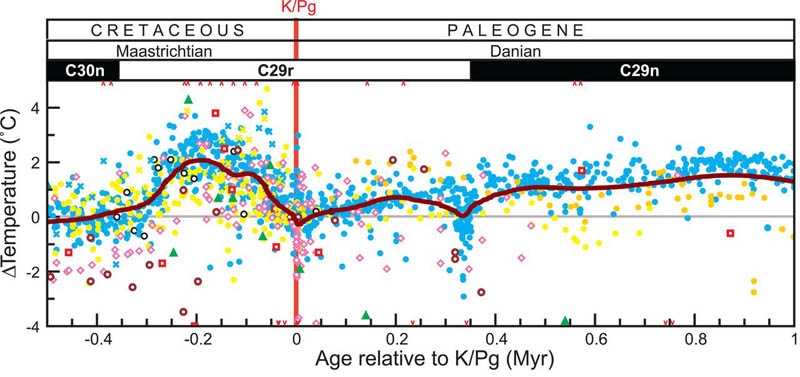
Marine temperature record derived from δ18O and Mg/Ca ratios spanning 1.5 Ma that includes the K-Pg boundary: the bold brown line shows the general trend derived from the data points (Credit: Hull et al. 2020; Fig 1)

The multinational team approached the issue first by using oxygen isotopes and the proportion of magnesium relative to calcium (Mg/Ca ratio) in fossil marine shells (foraminifera and molluscs) in several ocean-floor sediment cores, through a short interval spanning the last 500 thousand years of the Cretaceous and the first  million years of the Palaeocene. The first measures are proxies for seawater temperature. The results show that close to the end of the Cretaceous temperature rose to about 2°C above the average for the youngest Cretaceous (the Maastrichtian Age; 72 to 66 Ma) and then declined. By the time of the mass extinction (66 Ma) sea temperature was back at the average and then rose slightly in the first 200 ka of Palaeocene to fall back to the average at 350 ka and then rose slowly again.

Changes in carbon isotopes (δ13C) of bulk carbonate samples from the sediment cores (points) and in deep-water foraminifera (shaded areas) across the K-Pg boundary. (Credit: Hull et al. 2020; Fig 2A)

The second approach was to look in detail at carbon isotopes (δ13C) – a measure of changes in the marine carbon cycle –  and oxygen isotopes (δ18O) in deep water foraminifera and bulk carbonate from the sediment cores, in comparison to the duration of Deccan volcanism (66.3 to 65.4 Ma). The δ13C measure from bulk carbonate stays roughly constant in the Maastrichtian, then falls sharply at 66 Ma.  The δ13C of the deep water forams rises to a peak at 66 Ma. The δ18O measure of temperature peaks and declines at the same times as it does for the mixed fossils. Also examined was the percentage of coarse sediment grains in the muds from the cores. That measure is low during the Maastrichtian and then rises sharply at the K-Pg boundary.

Since warming seems almost certainly to be a reflection of CO2 from the Deccan (50 % of total Deccan outgassing), the data suggest not only a break in emissions at the time of the mass extinction but also that by then the marine carbon system was drawing-down its level in air. The δ13C data clearly indicate that the ocean was able to absorb massive amounts of CO2 at the very time of the Chicxulub impact and the K-Pg boundary. Flood-basalt eruption may have contributed to the biotic aftermath of the extinction for as much as half a million years. The collapse in the marine fossil record seems most likely to have been due to the effects of the Chicxulub impact. A third study – of the marine fossil record in the cores – undertaken by, presumably, part of the research team found no sign of increased extinction rates in the latest Cretaceous, but considerable changes to the marine ecosystem after the impact. It therefore seems that the K-Pg boundary impact ‘had an outsized effect on the marine carbon cycle’. End of story? As with earlier ‘breaks through’; we shall see.

See also: Morris, A. 2020 Earth was stressed before dinosaur extinction (Northwestern University)