The earliest known impact structure

Earth has been through a great many catastrophes, but the vast majority of those of which we know were slow-burning in a geological sense. They resulted in unusually high numbers of extinctions at the species- to family levels over a few million years and the true mass extinctions seem to have been dominated by build ups of greenhouse gases emitted by large igneous provinces. Even the most famous at the end of the Cretaceous Period, which did for the dinosaurs and considerably more organisms that the media hasn’t puffed, was partly connected to the eruption of the Deccan flood basalts of western India. Yet the event that did the real damage was a catastrophe that appeared in a matter of seconds: the time taken for the asteroid that gouged the Chicxulub crater to pass through the atmosphere. Its energy was huge and because it was delivered in such a short time its sheer power was unimaginable. Gradually geologists have recognised signs of an increasing number of tangible structures produced by Earth’s colliding with extraterrestrial objects, which now stands at 190 that have been confirmed.
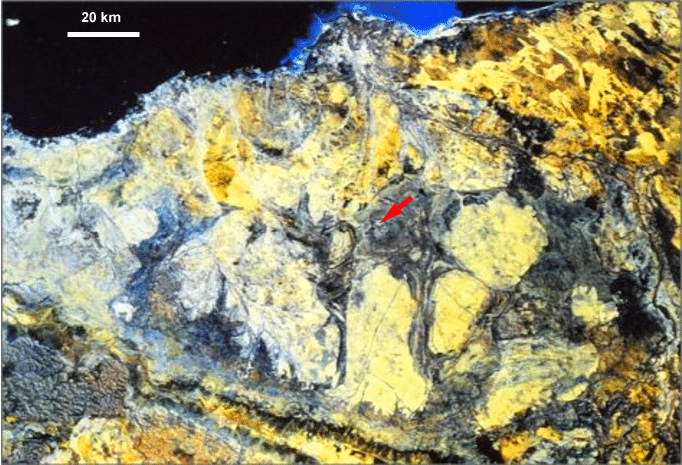
Landsat image mosaic of the Palaeoarchaean granite-greenstone terrain of the Pilbara Craton, Western Australia. Granite bodies show as pale blobs, the volcanic and sedimentary greenstone belts in shades of grey. The site of Kirkland et al.’s study site is at the tip of the red arrow

The frequency of impact craters falls off with age, most having formed in the last ~550 million years (Ma) during the Phanerozoic Eon, only 25 being known from the Precambrian, which spanned around 88 percent of geological time. That is largely a consequence of the dynamic processes of tectonics, erosion and sedimentation that may have obliterated or hidden a larger number. Earth is unique in that respect, the surfaces of other rocky bodies in the Solar System showing vastly more. The Moon is a fine example, especially as it has been Earth’s companion since it formed 4.5 billion years ago (Ga) after the proto-Earth collided with a now vanished planet about the size of Mars. The relative ages of lunar impact structures combined with radiometric ages of the surfaces that they hit has allowed the frequency of collisions to be assessed through time. Applied to the sizes of the craters such data can show how the amount of kinetic energy inflicted on the lunar surface has changed with time. During what geologists refer to as the Hadean Eon (before 4 Ga), the moon underwent continuous bombardment that reached a crescendo between 4.1 and about 3.8 Ga. Thereafter impacts tailed off. Always having been close to the Moon, the Earth cannot have escaped the flux of objects experienced by the lunar surface. Because of Earth’s much greater gravitation pull it was probably hit by more objects per unit area. Apart from some geochemical evidence from Archaean rocks (see: Tungsten and Archaean heavy bombardment; July 2002) and several beds of 3.3 Ga old sediment in South Africa that contain what may have been glassy spherules there are no signs of actual impact structures earlier than a small crater dated at around 2.4 Ga in NE Russia.

Shatter cones in siltstone near Marble Bar in the Pilbara Province: finger for scale. Credit: Kirkland et al.; Fig 2a

Now a group of geologists from Curtin University, Perth Western Australia, and the Geological Survey of Western Australia have published their findings of indisputable signs of an impact site in the northern part of Western Australia (Kirkland, C.L. et al. 2025. A Paleoarchaean impact crater in the Pilbara Craton, Western Australia. Nature Communications, v. 16, article 2224; DOI: 10.1038/s41467-025-57558-3). In fact there is no discernible crater at the locality, but sedimentary strata show abundant evidence of a powerful impact in the form of impact-melt droplets in the form of spherules together with shatter cones. These structures form as a result of sudden increase in pressure to 2 to 30 GPa: an extreme that can only be generated in underground nuclear explosions, and thus likely to bear witness to large asteroid impacts. The shocked rocks are immediately overlain by pillow lavas dated at 3.47 Ga, making the impact the earliest known. It has been speculated that impacts during the Archaean and Hadean Eons helped create conditions for the complex organic chemistry that eventually to the first living cells. Considering that entry of hypervelocity asteroids into the early Earth’s atmosphere probably caused such compression that temperatures were raised by adiabatic heating to about ten times that of the Sun’s surface, their ‘entry flashes’ would have sterilised the surface below; the opposite of such notions. Impacts may, however, have delivered both water and simple, inorganic hydrocarbons. Together with pulverisation of rock to make ‘fertiliser’ elements (e.g. K and P) more easily dissolved, they may have had some influence. Their input of thermal energy seems to me to be of little consequence, for decay of unstable isotopes of U, Th and K in the mantle would have heated the planet quite nicely and continuously from Year Zero onwards.

A fully revised edition of Steve Drury’s book Stepping Stones: The Making of Our Home World can now be downloaded as a free eBook

The chaotic early Solar System: when giant planets went berserk

Readers of Earth-logs will be familiar with the way gravitational interactions between the planets that orbit the Sun control cyclical shifts in each other’s rotational and orbital behaviours. The best known are the three Milankovich cycles. The eccentricity of Earth’s orbit (deviation from a circular path) changes according to the varying gravitational pulls exerted by Jupiter and Saturn as they orbit the Sun, and is dominated by 100 ka cyclicity. The tilt (obliquity) of Earth’s rotational axis changes in 41 ka cycles.  The direction in which the axis points relative to the Sun varies with its precession which has a period of about 25.7 ka. Together they control the amount of solar heating that our planet receives, best shown by the current variation in glacial-interglacial cycles. But the phenomena predicted by Milutin Milankovich show up in palaeoclimatic changes back to at least the late Precambrian. Climate changes resulting from the gravitational effect of Mars have recently been detected with a 2.4 Ma period. But that steady carousel of planetary motions hasn’t always characterised the Solar System.

Cartoon showing planet formation in the early, unstable Solar System (Credit: Mark Garlick, Science Source)

Observations of other stars that reveal the presence of their own planetary systems show that some have giant planets in much closer orbits than those that circuit the Sun. Others occur at distances that extend as far as the orbital diameters as those in the Solar System: so perhaps giant planets can migrate. A possibility began to be discussed in the late 1990s that Jupiter, Saturn, Uranus and Neptune – and a fifth now-vanished giant planet – were at the outset in neat, evenly-spaced and much closer orbits. But they were forced outwards later into more eccentric and generally askew orbits. In 2005, planetary astronomers gathered in Nice, France to ponder the possibilities. The outcome was the ‘Nice’ Model that suggested that a gravitational instability had once emerged, which set the Solar System in chaotic motion. It may even have flung gigantic masses, such as postulated fifth giant planets, into interstellar space. This upheaval may have been due to a rapid change in the overall distribution of mass in the Solar System, possibly involving gas and dust that had not yet accreted into other planets or their planetesimal precursors. Chaotic antics of monstrous bodies and shifts in their combined gravitational fields can barely be imagined: it was nothing like the staid and ever present Milankovich Effect. Geologists have reconstructed one gargantuan event that reset the chemistry of the early Earth when it collided with another body about the size of Mars. That  also flung off matter that became the Moon. Evidence from lunar and terrestrial zircon grains (see: Moon-forming impact dated; March 2009) suggests the collision occurred before 4.46 billion years ago (when parts of both eventually crystallised from magma oceans), Solar System having begun to form at around 4.57 Ga. Could formation of the Moon record the early planetary chaos? Others have suggested instead that the great upheaval was the Late Heavy Bombardment, between 4.1 and 3.8 Ga, which heavily cratered much of the lunar surface and those of moons orbiting the giant planets.

Another approach has been followed by Chrysa Avdellidou of the University of Leicester, UK and colleagues from France and the US (Avdellidoli, C. et al. 2024. Dating the Solar System’s giant planet orbital instability using enstatite meteorites. Science, v. 384, p. 348-352; DOI: 10.1126/science.adg8092) after discovery of a new family of asteroids: named after its largest member Athor. The composition of their surfaces, from telescopic spectra, closely matches that of EL enstatite chondrite meteorites. Dating these meteorites should show when their parent asteroids – presumably the Athors – formed.  Using argon and xenon isotopes Mario Trieloff  and colleagues from the University of Heidelberg, Germany in showed that the materials in EL enstatite chondrite meteorites were assembled a mere 2 Ma after the Solar System formed (Trieloff, M. et al. 2022. Evolution of the parent body of enstatite (EL) chondrites. Icarus, v. 373, article 114762; DOI: 10.1016/j.icarus.2021.114762). Be that as it may, that the evidence came from small meteorites shows that the parent body, estimated as having had a 240 to 420 km diameter, was shattered at some later time. Moreover, at that very early date such bodies would have contained a ready heat source in the form of a short-lived isotope of aluminium (26Al) which decays to stable 26Mg, with a half-life of 0.717 Ma. 26Al is thought to have been produced by a supernova that has been suggested to have triggered the formation of the Solar System. Excessive 26Mg is found in many meteorites, evidence for metamorphism formed by such radiogenic heat. They also record the history of their cooling.

Avdellidoli et al. estimate that the 240 to 420 km Athor parental planetesimal had slowly cooled for at least 60 Ma after it formed. When it was shattered, the small fragments would have cooled instantaneously to the temperature of interplanetary space – a few degrees above absolute zero (-273.2 °C). From this they deduce the age of the chaotic restructuring of the early Solar System to be at least 60 Ma after its formation. Other authors use similar reasoning from other chondritic meteorite classes to suggest it may have happened even earlier at 11 Ma. But there are other views for a considerably later migration of the giant planets and the havoc that they wrought. The only widely agreed date, in what seems to be an outbreak of wrangling among astronomers, is for the Moon-forming collision: 110 Ma after formation of the Solar System. For me, at least, that’s good-enough evidence for when system-wide chaos prevailed. The Late Heavy Bombardment between 4.1 and 3.8 Ga seems to require a different mechanism as it affected large bodies that still exist. It may have resulted from whatever formed the asteroid belt, for it was bodies within the range of sizes of the asteroids that did the damage, in both the Inner and Outer Solar System.

See also: The instability at the beginning of the solar system. MSUToday, 27 April 2022: Voosen, P. 2024. Giant planets ran amok soon after the Solar System’s birth. Science, v. 384 news article eadp8889; DOI: 10.1126/science.adp8889

Asteroid dust said to resolve a conundrum

In September 2005 a Japanese space probe, Hayabusa, twice landed lightly on the small (700 m long) asteroid Itokawa that habitually crosses the orbit of Mars. The plan was to scoop up a substantial amount of its rubbly surface and return it for lab analysis. In the event the main sampling device malfunctioned. The dismayed Hayabusa team were mollified to some extent by the second landing impact fortuitously directing dust particles up to 0.2 mm across into the sampler. After Hayabusa landed safely in Australia on 13 June 2010, the team thankfully recovered 1574 tiny grains. Most were made of single minerals: olivine, pyroxene, feldspar (including 14 alkali feldspar grains), sulfides, chromite, Ca phosphate and iron-nickel alloy. About 450 were silicate mixtures some containing K-bearing halite (NaCl) (Nakamura, T. and 21 others. Itokawa dust particles: a direct link between S-type asteroids and ordinary chondrites. Science, v. 333, p. 1113-1116  – followed by 5 other papers from the Hayabusa team in the same issue). The sample analyses clearly show that Itokawa chemically and mineralogically resembles ordinary LL chondrites that make up most meteorites found on Earth.

Hardly a surprise, then… Yet it was, for Itokawa is an S-type asteroid – the most common – whose spectra do not match those of ordinary chondrite meteorites despite the logic that commonly found meteorites ought to come from the break-up of commonly seen asteroids. S-type asteroids have annoyed astronomers for decades because of their cryptic appearance, and now they are broadly relieved. Any object floating around the inner Solar System for billions of years inevitably undergoes a process for which terrestrial weathering is a metaphor; it is affected by the stream of charged particles that constitutes the solar wind, by bumping other bodies and attracting debris from such collisions. The Itokawa dust particles turn out to have extremely thin veneers of sulfide and metallic blobs on the scale of a few nanometres that are thought to result from condensation of matter vaporised either by tiny impacts or the solar wind. This veneer gives Itokawa and probably other S-type meteorites their irritatingly uniform reddish colour. It strikes me that there is a problem here: all asteroids, no matter what their mineralogy and chemistry, would be subject to the same kind of process and end up with a similar veneer. Itakawa may well be an ordinary chondrite, but what about all the other S-type asteroids?

See also: Kerr, R.A. 2011. Hayabusa gets to the bottom of deceptive asteroid cloaking. Science, v. 333, p. 1081.