An early magma ocean on Mars?

The division of the lunar surface into two petrological domains – ancient anorthositic highlands and younger basaltic maria – spurred the idea, as long ago as the early 1970s, that the early Moon had a deep ocean of magma at the surface, whose cooling caused fractional crystallization. Low density plagioclase feldspar, dominated by high-calcium anorthite and bytownite, floated to the surface to form the lunar anorthosites leaving a more mafic mantle from which the mare basalts formed by partial melting. The key evidence in support of this hypothesis lies in the rare-earth elements of the two terrains. Because plagioclase feldspar has a much stronger affinity to incorporate the element europium (Eu) than the other REEs, the lunar anorthosites are enriched in Eu compared with its related elements. If the highland anorthosites did form by fractional crystallisation the remaining magma that formed the lunar mantle would be depleted in Eu yet enriched in the remaining REE. Although there are no samples of the Moon’s mantle there are plenty of the mare basalts that formed when it partially melted, probably as a result of huge impacts around 3.8 billion years ago. They should have inherited dominant features of mantle geochemistry, and indeed they do show characteristic depletion of Eu.

Lunar Highlands, near Descartes Crater. Collec...
Lunar Highland anorthosite, collected by the crew of Apollo 16. (credit: Wikipedia)

The giant-impact hypothesis for the Earth-Moon system presupposes that such a cataclysm would have left much of the outer Earth in much the same molten condition and destined to fractionate in the same manner. There are geochemical hints from terrestrial rocks that do support such an idea. An important target for exploration of Mars has been to check if a magma ocean also existed early in its history. Of the various missions in recent years only two have the capacity to shed useful light on the issue: the US Mars Reconnaissance Orbiter and Mars Odyssey. Both orbiters carry more sophisticated remote sensing instruments than any circling the Earth. The first has the hyperspectral Compact Reconnaissance Imaging Spectrometer for Mars (CRISM) that senses visible to short-wave infrared (VNIR) radiation, the other deploys  the Thermal Emission Imaging System (THEMIS) that captures different parts of the longer wavelength thermal infrared (TIR) spectrum emitted by surface materials. Both allow spectra of surface materials to be reconstructed and compared with the features of known minerals from the Earth and Moon.

Feldspars are highly reflective for the most part of  the VNIR range but show a shallow, broad absorption feature centred on a wavelength of 1.26 micrometres. Such spectra have been detected using CRISM from parts of the Martian surface in the highlands of its southern hemisphere (Carter, J. & Poulet, F. 2013. Ancient plutonic processes on Mars inferred from the detection of possible anorthositic terrains. Nature Geoscience, v. 6, p. 1008-1012). The authors, from Chile and France, acknowledge that the plagioclase-rich rocks occur only in small patches, unlike the vast tracts on the Moon, and also that on Earth anorthosites are known to have formed by a variety of processes from far smaller magma systems than a veritable ocean of molten rock. Feldspars also show spectral features in the TIR, though not so distinctive, both plagioclase and alkali feldspars being very similar. Moreover, THEMIS deploys sensor for only 10 thermal wavebands, compared with 544 on CRISM.  A team of US remote sensers (Wray, J.J. and 8 others 2013. Prolonged magmatic activity on Mars inferred from the detection of felsic rocks. Nature Geoscience, v. 6, p. 1013-1017) used both CRISM and THEMIS data. While noting resemblances to lunar anorthosites, they adopt a more cautious approach to the spectra and prefer the broad, ‘sack’ term ‘felsic rocks’. It seemed possible from their work that feldspar-rich magmas may have formed by partial melting of common andesitic crust noted from the Martian surface: high spatial resolution images of the occurrences bear some resemblance to outcrops of granitic rocks in arid environments on Earth. That is, there may be highly evolved rocks akin to terrestrial continental crust.

The interesting spectral observations on Mars can only be validated by actual rock samples. While rovers still operating on the Martian surface are well able to produce geochemical data that would petrologically characterise most rocks that they encounter, none of them is in a terrain suitable for resolving this particular issue. Yet, coincidentally, a meteorite found in West Africa shows hallmarks of having been blasted from the surface of Mars and sheds useful light on various hypotheses about the Martian crust http://earth-pages.co.uk/2013/11/21/a-glimpse-of-early-martian-crust/. It is a breccia that may represent the soil or regolith that accumulated from early impacts that shattered and melted surface materials, and it is extremely old: zircons yielded an age of 4428 Ma. The clasts set in a fine matrix consist of a variety of igneous rocks, none of which are anorthosites. Some are coarse grained, plutonic rocks containing both alkali feldspars and plagioclase, which match terrestrial monzonites; broadly speaking members of the granite family. Having formed from the ejecta of large impacts, such regolith materials represent the breadth of compositions across the planet and extending deep into its crust. This one suggests that anorthosites may have been rare on early Mars.

A glimpse of early Martian crust

That planetary scientists are eager for chemical information about the rocks of planet Mars is probably unnecessary information, a vast amount of money having been spend to get three spindly vehicles equipped with miniaturized petrographic instruments onto the Martian surface. Meteoriticists might say, ‘Well, we already have some Mars rock in our lab, and we can collect some more from deserts or ablated blue ice in Antarctica’. Four classes of meteorites are alleged to have been flung from Mars by impacts: the allegation is supported by the materials having oxygen isotope proportions that are different from those in rocks from the Earth or Moon.

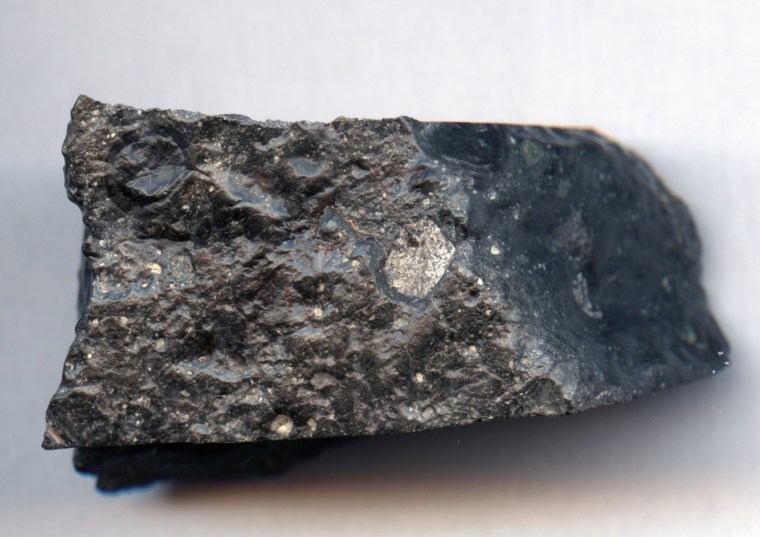
Another class of meteorite has joined the Martian family, and it it’s a doozy. Found in the northwestern Sahara Desert the rock is a breccia containing a variety of rocks in the form of clasts (Humayun, M. and 10 others 2013. Origin and age of the earliest Martian crust from meteorite NWA7533. Nature  online doi:10.1038/nature12764). In fact four other meteorites looking much the same were found near NWA7533. The bulk of the material is impact melt rock, now devitrified. Some of the clasts are also melt fragments and spherules, while others are fine-grained basalts, broken crystals and, most exciting, coarser igneous rocks rich in alkali and plagioclase feldspar. Their rare-earth element contents, like those of the Earth’s average continental crust, show evidence of fractional crystallization, particularly the removal of plagioclase to produce a marked depletion in the element europium. Slowly cooled and evolved monzonites of this kind are candidates for Martian crustal material. Overall, the texture of the breccia meteorites closely resembles the material that coats the lunar surface – regolith – but it has been lithified rather than remaining a dust.

Meteorite NWA7533 showing a variety of clasts, including light-coloured monzonite (credit: Humayun et al. 2013; doi:10.1038/nature12764)

Highly evolved igneous rocks, broadly speaking those of granitic composition, are the most likely to contain the mineral zircon, and the monzonite clasts yielded five that the US-Australian-French team subjected to U-Pb dating. The results are astonishing. These zircons formed around 4425 Ma ago, in the first hundred million years of the planet’s evolution, at the same time – within statistical error – as did the earliest materials from Earth and the Moon. Other putative Martian meteorites have yielded evidence from their neodymium isotopes that the earliest event there was the formation of a magma ocean, much as postulated for the Earth-Moon system. The latter is widely regarded as having resulted from a mega impact of the proto-Earth with an object roughly the size of Mars. The Martian monzonites may well be products of fractionation from that magma, subsequently excavated and shattered by a series of later, lesser impacts. If it did come from Mars, NWA7533 probably represents part of the early, heavily cratered highlands of the southern hemisphere of that planet.

The four hemispheric views shown above have be...
Full-color global map showing the regions of Mars imaged by the Hubble telescope (credit: Wikipedia)

It will be a long time before rocks can be lifted from the actual surface of Mars and transported back to Earth, and meteorites with a Martian provenance are so rare, that one can foresee a lot of very frustrated planetary petrogeneticists in the near term and a great deal of field work on desert and ice-cap surfaces looking for similar lumps of far-flung regolith.

Evidence for comet impact in the Sahara Desert

The desert surface of the remote Sahara of SW Egypt and adjacent Libya is strewn with silica-rich glass over an area of up to 6500 km2.  Pale yellow in colour and translucent, the glass clearly attracted Pleistocene hunter gatherers who manufactured edged tools  from it. Pieces cut en cabouchon are also found in pharaonic jewellery, including an item found in the tomb of Tutankhamun. Evidence for its formation at very high temperature is the melting temperature of pure silica around 2000°C and the presence of baddeleyite, a breakdown product of zircon. The glass fragments are undoubtedly the product of shock heating of desert sand or the local Nubian Sandstone of Cretaceous age by some kind of extraterrestrial impact. Fission-track dating suggests the glass formed around 29 Ma ago. A possible source is a 30 km wide crater on the Gilf Kebir Plateau made famous by Michael Ondaatje’s novel The English Patient that was centered on Pleistocene rock art discovered at the Cave of Swimmers in the Nubian Sandstone.

Tutanhkamun pendant with Wadjet
Scarab cut from Libyan Desert Glass in a pendant from the tomb of Tutanhkamun (credit: Wikipedia)

Neither the crater nor the glass strewn field yields meteoritic material despite several expeditions but the platinum-group metal content of the glass indicates an impact origin. Some specimens include enigmatic, graphite-rich banding. However, recently a South African-French team studied a strange, irregular 30 g fragment picked up in 1996 by an Egyptian postgraduate student collecting samples from the strewn field. He discovered that the dark fragment contained diamond by using X-ray diffraction. The dominant element in the fragment is carbon with less than 5% silicates and the new study used a battery of geochemical tests that confirmed the presence of abundant tiny diamonds (Kramers, J.D. and 13 others 2013. Unique chemistry of a diamond bearing pebble from the Libyan Desert Glass strewn field, SW Egypt: Evidence for a shocked comet fragment. Earth and Planetary Science Letters, v. 382, p. 21-31).

Conceivably, the diamonds could have formed by shock metamorphism of a coal seam or other carbonaceous sediments at the site of an impact – the K-T boundary layer formed by the huge Chicxulub impact contains nano-diamonds. However none of the chemical characteristics, including noble gas isotopic proportions and those of carbon, match terrestrial organic matter. Nor do they match carbonaceous chondrite meteorites that could have been another potential source, in its case an impactor of that composition. Instead, much evidence suggests the fragment is chemically akin to interplanetary dust and dust from the coma of comet 81P/Wild2 captured by NASDA’s Stardust mission in 2004. A plausible explanation, therefore, for the glass strewn field is an airburst explosion of a comet nucleus above the Sahara, the particle being a shocked fragment of the comet itself.

Bling from space

People have a keen eye for unusual objects and an even keener one for the aesthetic. Fossil echinoderms with their five-fold starry shape have been enduringly popular as trinkets since the Palaeolithic. Astonishingly, the gravel terrace at Swanscombe that yielded skull fragments of 400 ka Homo erectus plus many Acheulean tools also contained a flint bi-face ‘hand axe’ with a near perfect echinoid in its blunt grip. It cannot be proven, but the object seems to refute the idea that an artistic sense only arose with anatomically modern humans in the last 100 ka. Our immediate ancestors of the Neolithic sometimes took collecting to extremes in graves half full of fossil sea urchins (McNamara, K.J. 2007. Shepherds’ crowns, fairy loaves and thunderstones: the mythology of fossil echinoids in England. In: Piccardi, L. & Masse, W.B. Myth and Geology. Geological Society, London, Special Publication 273, 279–294).

Before the invention of metal smelting native gold, iron and copper appear in the archaeological record, undoubtedly because they look and indeed feel so different from the usual pebbles on the beach or just lying around. It is just that element of the odd that continues to draw people, including scientists, into a perpetually stooped posture when the walk across surfaces scattered with pebbles and boulders. The habit is especially hard to shake off for the meteoriticist whose hunting grounds are desert plains and ice caps where oddities are easy to spot, even when rare. So it is interesting when such dogged searchers encounter evidence of long-dead people having done much the same.

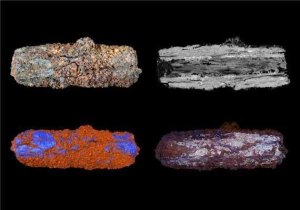
By 5300 years ago people had settled in small farming communities in the Nile Valley eventually to develop on the shores of lake – now represented by several smaller water bodies – what is regarded as the world’s first city near modern Faiyum. These Predynastic people buried their dead nearer to the Nile at Gerzeh, often sending them off with grave goods. The site has been continually excavated by professional archaeologists for more than a century, beginning with Sir Flinders Petrie. Two of the graves contained metallic iron beads, which presented a puzzle as iron smelting is only known from the 6th century BCE onwards. Unsurprisingly, the beads came to be regarded as artefacts wrought from an iron meteorite, though their highly altered nature and intrinsic value thwarted attempts at full analysis. Geochemists from the Open and Manchester Universities, and the Natural History Museum have now resolved the issue (Johnson, D. et al. 2013. Analysis of a prehistoric Egyptian iron bead with implications for the use and perception of meteorite iron in ancient Egypt. Meteoritics and Planetary Science, on-line, DOI: 10.1111/maps.12120). Non-destructive electron microscopy and X-ray tomography reveal, respectively, clear signs of the banded Widmanstätten structures and traces of nickel-rich iron alloy (taenite) that typify iron meteorites but are absent from smelted iron. The beads were clearly beaten and rolled into shape, but this working did not destroy the tell-tale evidence of their origin.

Optical, microprobe and CT-scan images of Predynastic iron bead from the Nile Valley (credit: Open University)

This provenance tallies with the appearance in early New Kingdom hieroglyphs of the term biA-n-pt – literally iron-from-the-sky – which was adopted for smelted iron when first made in the 26 to 27th Dynasties. But pharaonic iron was not a poor relation of gold, regarded as flesh of the gods and hence featuring in the masks of Pharaohs such as Tutankhamen, but supposedly what their bones were made from.

Mercury: sometimes a moist, organic-rich world

Full-color image of from first MESSENGER flyby
Full-colour image of Mercury from MESSENGER  (credit: NASA via Wikipedia)

Astronomers welcomed in 2013 by suggesting from Kepler spacecraft data that the Milky Way galaxy alone probably hosts at least a hundred billion extrasolar planets and that a potentially habitable world the size of Earth probably lies within 20 light years of ours (go.nature.com/pxgbbt). OK, so there are at least 10-15 planets out there for every person likely to be alive by the mid-21 century when the technology becomes available to judge whether or not any of them hold a shred of interest for a population facing worsening living conditions right here.

Mercury is closer and currently being peered at in considerable detail by NASA’s MESSENGER mission to the Sun’s closest planet. The venture seems to have justified itself – and probably JAXA/ESA’s forthcoming BepiColumbo to be launched in 2015, arriving in 2022 – by showing that the long suspected ‘cold traps’ at Mercury’s poles have indeed trapped something: ice and abundant organic debris (Neuman, G.A . and 10 others 2013. Bright and dark polar deposits on Mercury: evidence for surface volatiles. Science, v. 339, p. 296-300).

The planet is exceeding rough, having been hit by objects of all sizes yet possessing insufficient internal energy to repave itself. Its axis of rotation is at a right angles to Mercury’s orbital plane, much like that of the Moon, so its polar regions are perpetually short of solar radiation. Deeply shadows places have been measured by infrared radiometry to be as cold as 25 degrees above absolute zero. Any volatile materials that might have landed in them or condensed there from earlier atmospheres might seem likely to stay there indefinitely. Not quite so, for the most likely compound, water ice, can sublimate away (shift directly from the solid to vapour state). Nevertheless, remote sensing shows the north pole region to be somewhat mottled dark and light on shadowed poleward-facing surfaces. The properties of backscattered radar beams and detection of emitted neutrons are consistent with the bright areas being water ice (Lawrence, D.J. and 12 others 2013. Evidence for water ice near Mercury’s north pole from MESSENGER neutron spectrometer measurements. Science, v. 339, p. 292-296). First estimates give a total ice volume of around 10 to 1000 km3 compared with almost 3 million km3 in the Greenland ice cap.

It’s the dark stuff that sets Mercury apart from, say, the Martian or lunar poles, the idea being that comets or icy asteroids impacting Mercury would have delivered complex organic compounds as well as water ice. This would temporarily give otherwise airless Mercury an atmosphere of volatiles parts of which might condense in the perpetually shaded parts of the polar region. Sublimation of exposed ice would have left a residue rich in those organic compounds that eventually protected deeper ice from fading away with time.

Now, imagine how supremely excited exo-planet hunters would be if they picked up such signals from a truly far-off world.

On-line global geological maps

This item about the OneGeology map portal can now be read at Earth-logs in the Remote Sensing archive for 2013

OneGeology1
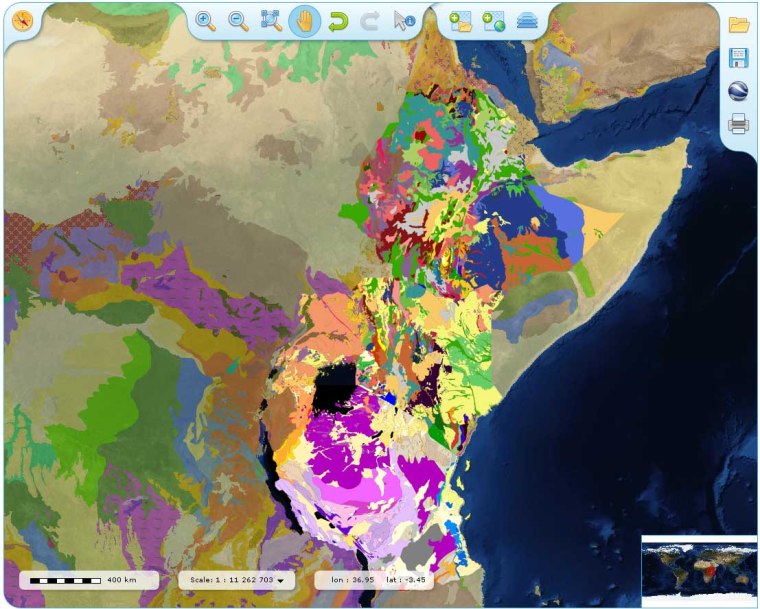
Small-scale extract from the OneGeology portal with 1:2 million maps for Ethiopia, Kenya, Tanzania and Uganda, and at 1:10 million covering surrounding areas (credit:OneGeology portal)


A glimpse of the deep Moon

Charting the variation in gravitational potential across a planet provides a measure of the distribution of mass beneath its surface. That depends on both the planet’s actual shape and on internal variations in rock density. The Earth’s gravity has been mapped with varying degrees of precision, depending on sample spacing, by surface measurements using gravimeters. Doing gravity surveys from space cannot be so direct, however. One ingenious approach for the gravitational field over the oceans is to measure the mean height of the ocean surface using radar beams from a satellite. Since this is affected by variations in the gravitational field, partly due to bathymetry and partly because of varying density beneath the ocean floor, removing the calculable bathymetric effect leaves a gravitational signal from the underling lithosphere and deeper mantle. The first satellite to illuminate the Earth with radar microwaves, Seasat, gradually built up such a gravitational map of the deep Earth over a period of 105 days in 1978, which was followed up by other satellites such as the ERS series and Topex-Poseidon.

GRAIL lunar probes
The GRAIL satellites in lunar orbit (credit: Wikipedia)

It is not so easy to map gravity precisely above a solid planetary surface, but through the GRACE experiment this can be done by measuring very precisely the distance between a pair of satellites that follow the same orbit. As the gravitational field changes so too does the separation between the tandem of satellites; an increase in gravity pulls the satellites closer together and vive versa. GRACE has provided some fascinating data, such as estimates of the withdrawal of groundwater from large sedimentary basins and shrinkage of ice caps. However, GRACE is limited in its resolution of gravitational anomalies by the fact that Earth has an atmosphere above which such tandems must be parked in orbit to avoid burning up. The higher the orbit, the more degraded is the resolution. This effect is much less for Mars and non-existent for the Moon.

Gravity field of the moon as measured by NASA's GRAIL mission. The far side of the moon is at the centre, whereas the nearside (as viewed from Earth) is at either side. (credit: NASA/ARC/MIT)
Gravity field of the moon as measured by NASA’s GRAIL mission. The far side of the moon is at the centre, whereas the nearside (as viewed from Earth) is at either side. (credit: NASA/ARC/MIT)

A sister experiment to GRACE has been orbiting the Moon since September 2011: the Gravity Recovery and Interior Laboratory (GRAIL). First the tandem orbited at 55 km, then 22 and for a brief period 11 km, before running out of thruster fuel on 17 December 2012 and crashing into the lunar surface. Results from the highest orbit resolve lunar gravity to 13 km cells, recently reported on-line in three papers (Zuber, M.T. and 16 others 2012. Gravity field of the Moon from the Gravity Recovery and Interior Laboratory (GRAIL) Mission. Science, doi 10.1126/science.1231507; Wieczorek, M.A. and 15 others 2012. The crust of the Moon as seen by GRAIL. Science, doi 10.1126/science.1231530; Andrews-Hanna, J.C. and 18 others 2012. Ancient igneous intrusions and early expansion of the Moon revealed by GRAIL gravity gradiometry. Science, doi 10.1126/science.1231753). From crater gravitational signatures due to variations in surface topography it seems that the early bombardment of the lunar surface far exceeded previous assumptions. Impact effects dominate the GRAIL data at this resolution, but 2% of the information relates to structures hidden at depth.

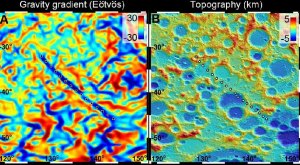
500 km linear anomaly in the Moon's far-side  gravitational field. (credit: NASA/JPL-Caltech/CSM)
500 km linear anomaly in the Moon’s far-side gravitational field. (credit: NASA/JPL-Caltech/CSM)

There are linear gravity anomalies extending over hundreds of kilometres, which may be huge igneous intrusions in the form of dykes; perhaps reflections of early influences of early extensional tectonics in the Moons lithosphere. Estimates point to this having been due to an up to 5 km increase in the lunar radius, probably as a result of thermal changes. The dominant feature of the lunar surface is not the near-side flat basaltic maria, visually prominent as they are, but the far more rugged lunar highlands which stand far higher because of the lower density of their constituent feldspar-rich anorthosites. GRAIL permitted a bulk estimate of the density of highland crust that turned out to be substantially lower, at 2550 kg m-3 – compared with 2600-2700 for granite and 2800-3000 for basalt – than originally estimated from samples returned by the Apollo mission. This forces a reassessment of the thickness of highland crust from 50-60 km to between 34 and 43 km, with a near-surface layer that has a porosity of around 12%, probably resulting from its awful battering. A thinner highland crust than previously assumed presents a bulk geochemical picture that need not be more enriched in ‘refractory’  elements, such as aluminium and calcium, than is the Earth.

Such unanticipated results from the low-resolution mode of the GRAIL experiment have its science team almost salivating at prospects from the sharper ‘pictures’ that will arise from the lower altitude orbits.

New twist on lunar origin

English: Giant impact - artist impression. Čes...
Artistic impression of the moon-forming giant impact. (credit: Wikipedia)

Although a few would-be space faring countries have ambitions, a post-Apollo crewed mission to the Moon is unlikely for quite a while. Yet moon-struck curiosity goes on: currently there is a surge in re-examining the lunar samples brought back more than 40 years ago. The Lunar Sample Laboratory Facility in Houston holds about a third of a ton of rock and regolith. I suppose part of the reason why lunar rocks are being re-analysed – in fact some for the first time – is because new or improved methods are available, but frustration among  a growing community of planetary geochemists having little more than meteorites to peer at probably plays a role as well. Since Hartman and Davis first suggested it, the giant impact theory for the Moon’s origin has dominated geochemical ideas. Most tangible is that of a magma ocean, floated plagioclase crystals from its fractional crystallisation probably having formed the glaring white lunar highlands composed of anorthosite. More subtle are ideas about what happened to the Mars-sized planet that did the damage to Earth and flung vaporised rock into orbit to accrete into the new Moon, and the effects of the stupendous energy on the geochemistry of all three bodies. Directed at all that is new research on isotopes of zinc (Paniello, R.C. et al. 2012. Zinc isotope evidence for the origin of the Moon. Nature, v. 490, p. 376-379).

The focus on zinc is because it is easily vaporised compared with more refractory materials, such as calcium an titanium, and as well as being ‘volatile’ it has five naturally occurring isotopes with relative atomic masses of 64 (the most abundant), 66, 67, 68 and 70. In general, isotopes of an element behave in slightly different ways during geological and cosmological processes, which changes their proportions in the products; a process known as ‘mass-fractionation’. Paniello and colleagues from Washington University, Missouri and the Scripps Institution of Oceanography, California USA found that Moon rocks are enriched in the heavier isotopes of zinc yet depleted in total zinc compared with terrestrial rocks and meteorites supposed to have come from Mars. Unlike those two planets the Moon’s zinc deviates from its abundance relative to other elements recorded by chondritic meteorites. This zinc depletion tallies with volatile loss from incandescent vapour blurted from the colliding planets. But it doesn’t help with the detailed predictions from the giant-impact model. A variety of scenarios suggest that the Moon should be made from remnants of the inbound impactor’s mantle, yet studies of other elements’ isotopes indicate that the Moon is rather Earth-like. But not those of zinc, so it looks like they have to be explained by a complete rethink of the whole hypothesis (Elliott, T. 2012. Galvanized lunacy. Nature, v. 490, p. 346-7).

Are Martian clays magmatic in origin?

593496main pia14840 full Curiosity Touching Do...
Artist’s Concept of Curiosity’s touchdown(credit: Wikipedia)

The remote detection of spectral features in the infrared that suggest abundant clay minerals on the surface of Mars is the basis for a widely-held view that Mars may once have had moist climatic conditions that encouraged life to form (see The Martian ‘sexy beast’ in September 2012  EPN). The presence of clays, along with suggestive landforms, has also been used to speculate that Mars once harboured long-lived lakes and perhaps even a huge ocean on its northern hemisphere, between 3.7 to 4.1 Ga. It was the clays that pitched the recently arrived Curiosity (aka Mars Exploration)Rover at the Gale crater and its central Aeolis Mons. The latter, also known as Mount Sharp, preserves about 5 km of layered rocks, the lowest of which are clay-rich and hypothesised to be sediments laid down in a lake that filled the crater. Provided Curiosity operates according to plan, we will know soon enough whether or not the layered rocks of Mount Sharp are indeed sediments, but a soon-to-be-published article suggests another explanation than weathering for the production of abundant clay minerals on Mars (Meunier, A. et al. 2012. Magmatic precipitation as a possible origin of Noachian clays on Mars. Nature Geoscience, published online 9 September 2012; DOI: 10.1038/NGEO1572).

Focusing the 100-millimeter Mastcam [detail]
Layered rocks on the flanks of Mount Sharp in Gale crater from Curiosity’s Mastcam (NASA Goddard via Flickr)
The French-US team provides evidence from terrestrial lavas that abundant iron- and magnesium-rich clays, known as smectites, may form at a late stage during crystallization of magma. If magma contains water – and most magmas do – as more and more anhydrous silicates crystallise during cooling water builds up in the remaining liquid. Once silicate crystallisation is complete there remains a watery fluid capable of reacting with some of the silicates to form clay minerals; a process often referred to as pneumatolysis. How much clay is formed depends on the initial water content of the magma. Pneumatolysisoperates on hot lava, whereas weathering occurs at ambient temperature provided the climate is able to support liquid water at the surface. Mars is currently far too cold for that, and ideas of a wet surface environment earlier in the planet’s history demand an explanation for a much warmer climate. Clay minerals do not appear to be present in Mars’s younger rocks, so Meunier and colleagues suggest that as the planet’s mantle evolved early water-rich magmas were gradually replaced by ones with less water: interior Mars was gradually de-gassed and its magmas lost the ability to alter minerals that crystallised from them.

Now, clay minerals are extremely resistant to change except through high-temperature metamorphism. Once formed they can be blown around – Mars has probably always been a very windy place – to end up in aeolian sediments that are plentiful on Mars.  Also, if occasionally water flowed on the surface perhaps by subsurface water venting suddenly, fine-grained pneumatolytic clays would easily be picked up, concentrated as flow speed lessened and deposited in waterlain sedimentary layers.  A dilemma that faces the Curiosity science team is what significance to assign to clays in sediment layers, when they no longer provide unequivocal evidence of weathering.  But will the resistant layers on Mount Sharp turn out to be pneumatolytically altered lava flows?
Note added 28 September 2012: The first scientific triumph of the Curiosity Rover is imagery of sediments in what had been suggested to be an alluvial fan washed into Gale crater. They show gravels with rounded pebbles.

Whence Earth’s water?

English: Carbonaceous chondrite Meteorite. The...
Carbonaceous chondrite meteorite. (credit: Mila Zinkova via Wikipedia)
English: Image of comet C/1996 B2 (Hyakutake),...
Comet Hyakutake. (credit: E. Kolmhofer & H. Raab via Wikipedia)

Because they can be so big, consist mainly of water ice and there are probably a great many lurking in the outer reaches of the solar system impacting comets have long been thought to have delivered the water that makes the Earth so dynamic and, so far as we know, the only place in near-space that hosts complex life. Remote sensing studies of the isotopic composition of water in one comet (Hartley 2) caused great excitement in 2011 by showing that its ratio of deuterium to hydrogen was very similar to that of Earthly ocean water. Other D:H ratios have recently been published from a suite of meteorites gleaned from the surface of Antarctic ice (Alexander, C.M.O’D. et al. 2012. The provenances of asteroids, and their contributions to the volatile inventories of the terrestrial planets. Science, v. 337, p. 721-723). These meteorites are carbonaceous chondrites thought to be the source of much of the solid material in planets of the Inner Solar System. To cut short a long and closely argued argument, it seems that the CI-type chondrites’ water is isotopically quite different from that in analysed comets, knocking another popular hypothesis on the head; that comets and carbonaceous chondrites formed in the same part of the Solar System.

Since hydrocarbons in comets – known from interplanetary dust particles – contain hydrogen with a far richer complement of its heavy isotope deuterium than does cometary water ice, the crashing of entire comets onto planets such as the Earth would not produce the observed terrestrial D:H ratio even though their water ice alone does match it. The US, British and Canadian meteoriticists conclude what seems to be a unifying explanation whereby CI chondritic solids and volatiles alone would have been able to form the Inner Planets and their various complements of water by initial accretion. Comets as a second-stage source, in this account, are relegated to mere curiosities of the Solar System with little role to play other than occasional big impacts that may, or may not, have influenced evolution by the power that they delivered not through their chemistry.