Apart from ancient detrital zircons no dated materials from the Earth’s crust come anywhere near the age when our home world formed, which incidentally was derived by indirect means. Hutton’s famous saying towards the close of the 18th century, ‘The result, therefore, of our present enquiry is, that we find no vestige of a beginning, – no prospect of an end’ seems irrefutable. Hardly surprising, you might think, considering the frantic pace of events that have reworked the geological record for four billion years and convincing evidence that not long after accretion the Moon-forming collision may have melted most of the early mantle. But there is a way of peering beyond even that definitive catastrophe. The metal tungsten, as anyone from the steel town of Rotherham will tell you, alloys very nicely with iron and makes it harder, stronger and more temperature resistant. Most of the Earth’s original complement of tungsten probably ended up in the core; it is a siderophile element. But traces can be detected in virtually any rock and, of course, in W-rich ore bodies. Its interest to modern-day geochemists lies in its naturally occurring isotopes, particularly 182W, a proportion of which forms by decay of a radioactive isotope of hafnium (182Hf). Or rather it did, for 182Hf has a half-life of about 9 million years. Only a vanishingly small amount from a nearby supernova that may have triggered formation of the solar system remains undecayed.
Artistic impression of the early Earth before Moon formation. (Source: Creative Commons)
A sign of the former presence of 182Hf in the early Earth comes from higher amounts of its daughter isotope 182W in some Archaean rocks (3.96 Ga) than in younger rocks. That excess is probably from undecayed 182Hf in asteroidal masses that bombarded the Earth between 4.1 and 3.8 Ga. Now it turns out that some much younger flood basalts from the Ontong Java Plateau on the floor of the West Pacific Ocean (~120 Ma) and Baffin Island in northern Canada (~60 Ma) also contain anomalously high 182W/184W ratios (Rizo, H. et al. 2016. Preservation of Earth-forming events in the tungsten isotopic composition of modern flood basalts. Science, v. 352, p. 809-812; see also: Dahl, T.W. 2016. Identifying remnants of early Earth. Science, v. 352, p. 768-769). A different explanation is required for these occurrences. The flood basalts must have melted from chemically anomalous mantle, which originally contained undecayed 182Hf. The researchers have worked out that this heterogeneity stems from a silicate-rich planetesimal that had formed in the first 50 Ma of the solar system’s history, and was accreted to the Earth before the Moon-forming event – lunar rocks formed after 182Hf became extinct. That catastrophe and the succeeding 4.51 Ga of mantle convection failed to mix the ancient anomaly with the rest of the Earth.
The Kepler Space Telescope launched in 2009 was designed to detect and measure planetary bodies orbiting other stars. It was hoped that it would help slake the growing thirst for signs of alien but Earth-like worlds, extraterrestrial life and communications from other sentient beings. Results from the Kepler mission have, however, fostered a growing awareness that all is not well with the simple, Laplacian formation of planetary systems. For a start not one of the thousands of exoplanets revealed by Kepler is in a planetary system resembling the Solar System, let along sharing crucial attributes with the Earth. Giant planets occur around only a tenth of the stars observed, and even fewer in stable, near-circular orbits. Although it is early days in the quest for Earth- and Solar System look-alikes, some unexpected contrasts with the Solar System are emerging. For instance, many of the systems have far more mass in close orbit around their star, including gas giants with orbital periods of only a few days and giant rocky planets. Such configurations defy the accepted model for the Solar System where an outward increase in the proportion of volatiles and ices was thought to be the universal rule. Could these ‘hot Jupiters’ have formed further out and then somehow been dragged into scorching proximity to their star? Answers to this and other questions have been sought from computer simulations of the evolution of nebulas. Inevitably, the software has been applied to that of the Solar System, and the results are, quite literally, turning ideas about its early development inside out (Batygin, K., Laughlin, G. & Morbidelli, A., 2016. Born of chaos. Scientific American, v. 314(May 2016), p. 20-29).
An artist’s impression of a protoplanetary disk (credit: Wikipedia)
It seems that at some stage in its growth from the protoplanetary disk the gravitational influence of a planet creates mass perturbations in the remainder of the disk. These feed back to the planet itself, to others and different parts of the disk to create complex and continuously evolving motions; individual planets may migrate inwards, outwards or escape their star’s influence altogether in a chaotic, unpredictable dance. Ultimately, some balance emerges, although that may involve the star engulfing entire worlds and other bodies ending up in interstellar space. It may also end up with worlds dominated by ‘refractory’ materials – i.e. rocky planets like Earth – orbiting further from their star than those composed of ‘volatiles’. In the case of the early Solar System the modelling revealed Jupiter and Saturn drifting inwards and dragging planetesimals, dust, ice and gas with them to create a gap in the protoplanetary disk. Within about half a million years the two giant planets became locked in their present orbital resonance, which changed the distribution of angular momentum between them and reversed their motion to outward. The clearing of mass neatly explains the asteroid belt and Mars’s otherwise inexplicably small size.
One of the characteristics emerging from Kepler’s discoveries is that ‘super Earths’ orbit close to their star in other systems. Had they existed in the early Solar System the inward drive of Jupiter and Saturn and their ‘bow wave’ of smaller bodies would have had consequences. Swarms of matter from the ‘bow wave’ captured and dissipated angular momentum from the super Earths and dissipated it within a few hundred thousand years, thereby pushing them into death spirals to be consumed by the Sun. This explains what by comparison with Kepler data is a mass deficit in the inner Solar System. The rocky planets – Mercury, Venus, Earth and Mars – accreted from the leftovers, perhaps over far longer periods than previously thought.
Intense bombardment of the Moon and the Earth took place during the first half billion years after they had formed, rising to a crescendo in its later stages. Formation of the mare basins brought it to a sudden close at 3.8 Ga, which coincides with the earliest evidence for life on Earth. Lunar evidence indicates that this Late Heavy Bombardment spanned 4.1 to 3.8 Ga. Previously explained by a variety of unsatisfying hypotheses it forms part of the new grand modelling of jostling among the giant planets. Once Jupiter and Saturn together with Uranus and Neptune had stabilised, temporarily, they accumulated lesser orbital perturbations from an outlying disk of evolving dust and planetesimals throughout the Hadean Eon. Ultimately, around 4.1 Ga, the giant planets shifted out of resonance, pushing Jupiter slightly inwards to its current orbit and thrusting the other 3 further outwards. Incidentally, this may have flung another giant planet out of solar orbit to the void. Over about 300 million years they restabilised their orbits through gravitational interaction with the Kuiper belt but at the expense of destabilising the icy bodies within it. Some fled inwards as a barrage of impactors, possibly to deliver much of the water in Earth’s oceans. By 3.8 Ga the giants had settled into their modern orbital set-up; hopefully for the last time.
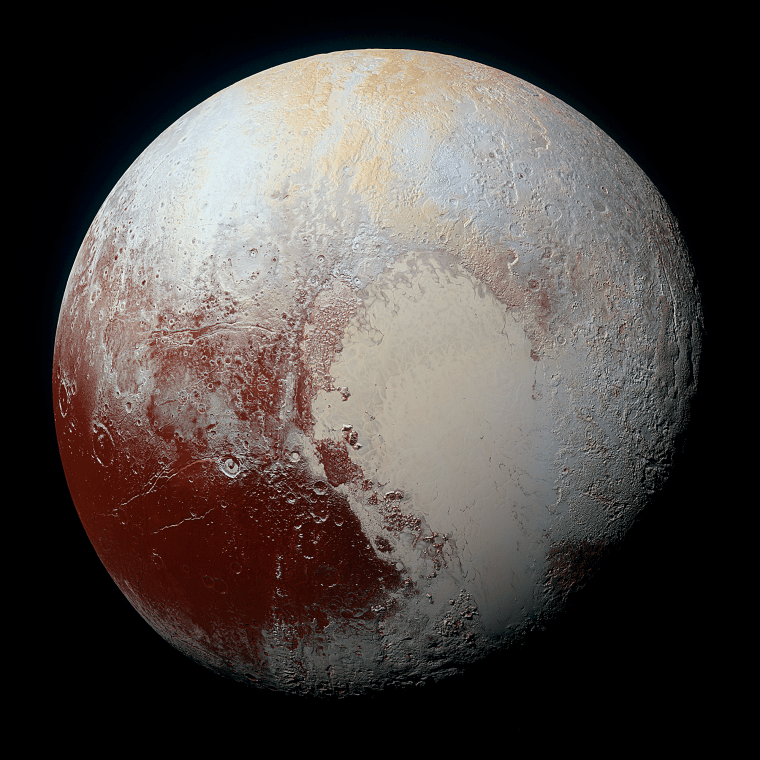
About 9 months ago NASA’s New Horizons spacecraft flew past the binary dwarf planets Pluto and Charon more than 9 years after launch. Everyone knew they would be frigid little worlds but the great risk was that they might turn out to be geologically boring. The relief when the first images finally arrived – New Horizons’ telecoms are pretty slow – was obvious on the faces at mission control. Even non-Trekkies, such as me, will be thrilled by the first in-depth, illustrated account (Moore, J.M. and 41 others 2016. The geology of Pluto and Charon through the eyes of New Horizons. Science, v. 351, p. 1284-1293), part of a five-article summary of early findings; the other 4 are on-line and scheduled for full publication later (summaries in Science, 18 March 2016, v. 351, p. 1280-1284). A gallery of images can be seen here and an abbreviated summary of the series here.
Pluto imaged in approximately natural colour by New Horizons. (credit: NASA)
They are astonishing places, even at a resolution of only about 1 km (270 m for some parts), and only one fully illuminated hemisphere was imaged for each because of the short duration of the fly-by. Pluto is by no means locked in stasis, for one of its largest features, Sputnik Planum, is so lightly cratered that is must be barely 10 Ma old at most. It is a pale, heart-shaped terrane dominated by smooth plains, which have a tiled or cellular appearance, with flanking mountains up to 9 km high that appear to be a broken-up chaos. Much of it is made of frozen nitrogen, carbon monoxide and methane. The dominant nitrogen ice has low strength which accounts for the large area of very low relief. The highly angular mountains are water ice that is buoyant and stronger relative to the others making up Sputnik Planum. Across the plain are areas of pitting and blades that seem to have formed by ice sublimation (solid to gas phase transitions) much like terrestrial snow or ice fields that have begun to degrade, and there are even signs of glacier-like flow.
4 Ga old cratered, upland terranes surrounding Sputnik Planum display grooved, ‘washboard’ and a variety of other surface textures reminiscent of dissection. The may have formed by long-term lateral flow (advection) of nitrogen ice and perhaps some melting. It is in this rugged part of Pluto that colour variation is spectacular, with yellows, blues and reds, probably due to deposition of hydrocarbon ‘frosts’ condensed from the atmosphere. That Pluto is still thermally active is shown by a few broad domes with central depressions that suggest volcanism, albeit with a magma made of ices. Areas of aligned ridges and troughs provide signs of tectonics, possibly extensional in nature.
Charon imaged in approximately natural colour by New Horizons. (credit: NASA)
Charon shows little sign of remaining active and capable of remoulding its surface. The hemisphere that has been imaged is spectacularly bisected by a 200 km wide belt of roughly parallel escarpments, ridges and troughs with a relief of about 10 km. Superimposed by large craters the extensional system probably dates back to the early history of the outer Solar System. Dominated by water ice it seems that Charon’s surface may have lost any more volatile ices by sublimation and loss to space. This suggests that superficial differences between two small worlds of similar density may be explained by Charon’s lower mass and gravitational field, resulting in the loss of its most volatile components that partly veneer the surface of Pluto.
Being hugely distant from any other sizeable body it is likely that the energy used to form cryovolcanic eruptions and deform the surface of both dwarf planets is due to internal radioactivity. Their similar mean density around 1.9 implies rocky cores that could host the required unstable isotopes. Being the only Kuiper Belt objects that have been closely examined naturally suggests that the rest of the myriad bodies that clutter it are similar. There are currently as many as 9 other sizable bodies suspected of eccentrically orbiting the Sun in the Kuiper Belt, including one that may be ten times more massive than Earth – a candidate for a ninth planet to replace Pluto, which was removed from that status following redefinition in 2006 of what constitutes a bona fide planet.
Many of the vast wastes of northern Canada and Scandinavia that were ground to a paste by ice sheets during the last glacial cycle show peculiar features that buck the general glacial striation of the Shield rocks. They are round-topped ridges that wind apparently aimlessly across the tundra. In what is now a gigantic morass, the ridges form well-drained migration routes for caribou and became favourite hunting spots for the native hunter gatherers: in Canada they are dotted with crude simulations of the human form, or inugoks, that the Innuit erected to corral game to killing grounds. Where eroded they prove to be made of sand and gravel, which has proved an economic resource in some areas lacking in building aggregate, good but small examples being found in the Scottish Midland Valley that have served development of Glasgow and Edinburgh. They were given the Gaelic name eiscir meaning ‘ridge of gravel’ (now esker) from a few examples in Ireland.
Eskers form from glacial meltwater that makes its way from surface chasms known as moulins to the very bottom of an ice sheet where water flows much in the manner of a river, except in tubes rather than channels. Where the ice base is more or less flat the tubes meander as do normal sluggish rivers, and like them the tubes deposit a proportion of the abundant sediment derived by melting glacial ice. Once the ice sheet melts and ablates away, the sediments lose the support of the tube walls and flop down to form the eponymous low ridges: the reverse of the sediment filled channels of streams that have either dried up or migrated. Eskers are one of the features that shout ‘glacial action’ with little room for prevarication.
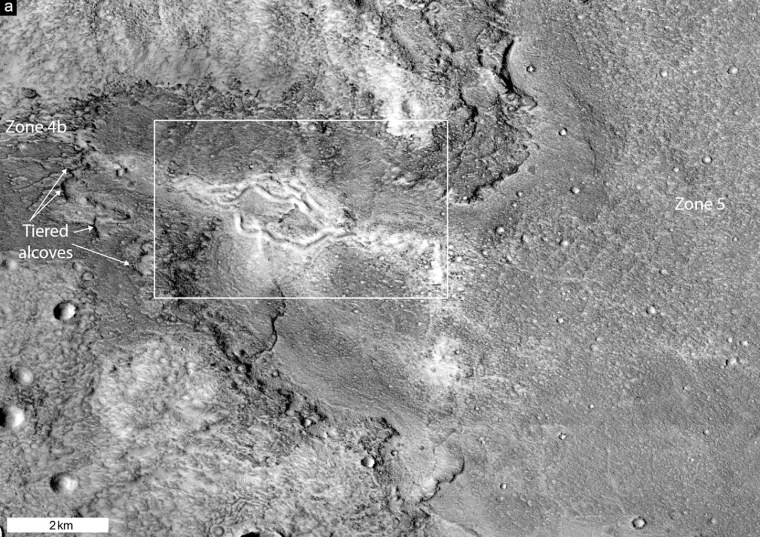
The classic form of eskers in the Phlegra Montes of Mars. (credit: Figure 6 in Gallagher and Balme, 2015)
Glacial terrains on Mars have been proposed for some odd looking surfaces, but other processes such as debris flows are equally attractive. To the astonishment of many, Martian eskers have now been spotted during systematic interpretation of the monumental archives of high-resolution orbital images of the planetary surface (Gallagher, C. & Balme, M. 2015. Eskers in a complete, wet-based glacial system in the Phlegra Montes region, Mars. Earth and Planetary Science Letters, v. 431, p. 96-109). The discovery is in a suspected glacial terrain that exhibits signs of something viscous having flowed on low ground around higher topographic features, bombardment stratigraphy suggests a remarkable young age for the terrain or about 150 Ma ago: the Amazonian. Ice and its effects are not too strange to suggest for Mars which today is pretty much frigid, except for a few suggestions of active flow of small watery streams. Eskers demand meltwater in abundance, and Gallagher and Balme attribute some of the other features in the Phlegra Montes to wet conditions. However, the eskers are a one-off, so far as they know. Consequently, rather than appealing to some climatic warm up to explain the evidence for wetness, they suggest that the flowing water tubes resulted from melting deep in the ice as a result of locally high heat flow through the Martian crust, which is a lot more plausible.
Luis and Walter Alvarez at the end-Mesozoic Boundary (credit: Wikipedia)
It was 35 years back that father and son team Luis and Walter Alvarez upset a great many geoscientists by suggesting that a very thin layer of iridium-rich mud that contained glass spherules and shocked mineral grains was evidence for a large meteorite having struck Earth. They especially annoyed palaeontologists because of their claim that it occurred at the very top of the youngest Cretaceous and that the mud was spread far and wide in deep- and shallow-marine stratigraphic sequences and also in those of continental rocks. It marked the boundary between the Mesozoic and Cenozoic Eras and, of course, the demise of the dinosaurs and a great many more, less ‘sexy’ beasts. Luis was a physicist, his son a proper geologist and their co-researchers were chemists. It can hardly be said that they stole anyone’s thunder since the issue of mass extinctions was quiescent, yet their discovery ranks with that of Alfred Wegener; another interloper into the closed-shop geoscientific community. They got the same cold-shoulder treatment, but massive popular acclaim as well, even from a minority of geologists who welcomed their having shaken up their colleagues, 15 years after the last ‘big thing’: plate tectonics. And then the actual site of the impact was found by geophysicists in a sedimentary basin in the Gulf of Mexico off the small town of Chicxulub on the Yucatan peninsula.
Chicxulub impact – artist impression (credit: Wikipedia)
As they say, ‘the rest is history’ and a great many geoscientists didn’t just jump but pounced on this potential bandwagon. Central to this activity was the fact that, within error, the ages of the impact, the mass extinction and a vast pile of continental lavas in western India, the Deccan Traps, were more or less the same (around 66 Ma). Flood basalt events are just about as dramatic as mega-impacts because of their sheer scale, of the order of a million cubic kilometres; that they were exuded in a mere million years or so, but in only a few tens of stupendous lava flows; and they are far beyond the direct experience of humans, blurting out only every 30 Ma or so. This periodicity roughly tallies with mass extinctions, great and small, through the Mesozoic. There have been two large bands of enthusiasts engaged in the causality of the end-Mesozoic die-off – the extraterrestrials and the parochialists who favoured a more mundane, albeit cataclysmic snuffing-out. Mass extinctions in general have been repeatedly examined, and in recent years it has become clear that most of those since 250 Ma ago seem to be associated with basalt-flood events and are purely terrestrial in origin. As regards the event that ended the Mesozoic, it has proved difficult to resolve whether to point the finger at the Deccan Traps or the Chicxulub impact. Both might have severely damaged the biosphere in perhaps different ways, so a ‘double whammy’ has become a compromise solution.
Deccan flood basalts forming the Western Ghats in Maharashtra, India (credit: Wikipedia)
Unsurprisingly, a lot of effort from different quarters has gone into charting the progress of the Deccan volcanism. Some dating seemed at one stage to place the bulk of the volcanism significantly before the mass extinction and impact, others had them spot on and there were even signs of an hiatus in eruptions at the critical juncture. The problem was geochronological precision of the argon-argon method of radiometric dating that is most used for rocks of basaltic composition: many labs cannot do better than an uncertainty of 1%, which is ±0.7 Ma for ages around the end of the Mesozoic, not far short of the entire duration of these huge events. Some Deccan samples have now been dated to a standard of ±0.1 Ma by the Ar-Ar lab at the Department of Earth and Planetary Sciences, University of California-Berkeley (Renne, P.R. et al. 2010. State shift in Deccan volcanism at the Cretaceous-Paleogene boundary, possibly induced by impact. Science, v. 350, p. 76-78). The results, between 65.5 to 66.5 Ma, nicely bracket the K/T (now K/Pg) boundary age of 66.04±0.04 Ma. It looks like the double whammy compromise is the hypothesis of choice. But there is more to mere dating.
Renne and colleagues plot the ages against their position in the volcanic stratigraphy of the Deccan Traps in two ways: against the estimated height from base in the pile and against the estimated volume of the erupted materials as it built up – the extent and thickness of successive flows varies quite a lot. The second plot provided a surprise. After the K/Pg event the mean rate of effusion – the limited number of individual flows capped by well-developed soils shows that the build-up was episodic – doubled from 0.4±0.2 to 0.9±0.3 km3 yr-1. Despite the much larger uncertainty in the extent and volume of individual lava Formations than that of their ages, this is clearly significant. Does it imply that the Chicxulub impact somehow affected the magma production from, the mantle plume beneath the Deccan? It had been suggested early in the debate that the antipodean position of the lava field relative to that of Chicxulub may indicate that the huge seismicity from the impact triggered the Deccan magma production. Few accepted that possibility when it first appeared. However, Renne and co. do think it deserves another look, at least at the possibility of some linked effect on the magmatism. Perhaps the magma chamber was somehow enlarged by increased global seismicity; other chambers could have been added; magma might have been ‘pumped’ out more efficiently, or a combination of such effects. The ‘plumbing’ of flood basalt piles is generally hidden, but huge dyke swarms in Precambrian times have been suggested as feeders to long-eroded flood basalts. Seismicity of the scale produced by asteroid impacts can do a lot of damage. The Chicxulub impactor at around 10 km diameter would have carried energy a million times greater than that of the largest thermonuclear bomb, equivalent to an earthquake of Magnitude 12.4 that would have been a thousand times more powerful than the largest recorded earthquake with tectonic causes. Extensional faulting sourced in this fashion in the Deccan area may have increased the pathways along which magma might blurt out.
Related articles
Duncan, R. 2015. Deadly combination. Nature, v. 527, p. 172-173.
The dominance of the Lunar Highlands by feldspar-rich anorthosites, which form when feldspars that crystallise from magmas float because of their lower density, gave rise to the idea that the Moon initially formed as a totally molten mass. That this probably resulted because the early Earth collided with a Mars-sized protoplanet stems from the almost identical chemical composition of the lunar and terrestrial mantles, as worked out from the composition of younger basalts derived from both, together with the vast energy needed to support a large molten planetary body condensing from a plasma cloud orbiting the Earth. Such a giant impact is also implicated in the final stages of core formation within the Earth.
Artist’s depiction (after William K. Hartmann) of the giant impact that is hypothesized to have formed the Moon. (credit: Wikipedia)
A core formed from molten iron alloyed with nickel would have acted as a chemical attractor for all other elements that have an affinity for metallic iron: the siderophile elements, such as gold and platinum. Yet the chemistry of post-moon formation basaltic melts derived from the Earth’s mantle contain considerably more of these elements than expected, a feature that has led geochemists to wonder whether a large proportion of the mantle arrived – or was accreted – after the giant impact.
A tool that has proved useful in geochemistry on the scale of entire planets – well, just the Earth and Moon so far – is measuring the isotopic composition of tungsten, a lithophile metal that has great affinity for silicates. One isotope is 182W that forms when a radioactive isotope of hafnium (182Hf) decays. The proportion of 182W relative to other tungsten isotopes has been shown to be about the same in Lunar Highland anorthosites as it is in the Earth’s mantle. This feature is believed to reflect Moon formation and its solidification after the parent 182Hf had all decayed away: the decay has a half-life of about 9 Ma and after 60 Ma since the formation of the Solar System (and a nearby supernova that both triggered it and flung unstable isotopes such as 182Hf into what became the Solar nebula) vanishingly small amounts would remain.
Oddly, two papers on tungsten and Earth-Moon evolution, having much the same aims, using similar, newly refined methods and with similar results appeared in the same recent issue of Nature (Touboul, M. et al. 2015. Tungsten isotopic evidence for disproportional late accretion to the Earth and Moon. Nature, v. 520, p. 530-533. Kruijer, T.S. et al. 2015. Lunar tungsten isotopic evidence for the late veneer. Nature, v. 520, p. 534-537). The two of them present analyses of glasses produced by large impacts into the lunar surface and probably the mantle, which flung them all over the place, maintaining the commonality of the ventures that might be explained by there being a limited number of suitable Apollo samples. Both report an excess of 182W in the lunar materials: indeed, almost the same excess given the methodological precisions. And, both conclude that Moon and Earth were identical just after formation, with a disproportional degree of later accretion of Solar nebula material to the Earth and Moon.
So, there we have it: it does look as if Earth continued to grow after it was whacked, and there is confirmation. Both papers conclude, perhaps predictably, that the early Solar System was a violent place about which there is much yet to be learned…
Dateline: Chelyabinsk, Russia 09.20 15 February 2013. As in many parts of Russia drivers in this Oblast in the Urals Economic District use an in-car camera during rush hour, hopefully to have proof of innocence in the event of a traffic accident. On this day, such cameras recorded a massive fireball streaking low across a clear, frosty sky. Some people on foot were temporarily blinded by its light, about 4 times that sunlight, and others were thrown off their feet by a large shock wave. Travelling at about 20 km s-1 the fireball exploded, the blast shattering windows where people were gazing at the remarkable sight, about 1500 needing medical treatment. This event is the first in modern times to record the atmospheric entry of a superbolide and air blast, probably similar to what happened in the deserted area of Tunguska in Siberia on 30 June 1908.
Meteor trail and fireball seen over industrial estate in Chelyabinsk, Russia (credit: Russia Today)
Cut to the Levant in the 1st century of the Common Era: on the road to Damascus a Jewish fundamentalist with Roman citizenship, sworn to destroy the early Christian movement, is on a mission to arrest Christians and take them in chains to Jerusalem. Saul witnesses a great light in the sky and a deafening sound that he believes is the voice of Jesus, saying ‘Saul, Saul, why persecutest thou me?’(Acts 9:4). He is flung off his feet, struck blind and convinced of the error of his calling. Three days later, in Damascus ‘…there fell from his eyes as it had been scales: and he received sight forthwith, and arose, and was baptized’ (Acts 9:18), taking the name Paul.
The conversion of Saul by Michaelangelo
William Hartmann of the Planetary Science Institute at the University of Arizona, among the first planetary scientists to propose the giant impact origin for the Moon (see next item) and in his case to visualise it in a famous painting, has drawn a somewhat obvious hypothesis linking the two events (Hartmann, W.K. 2015. Chelyabinsk, Zond IV, and a possible first-century fireball of historical importance. Meteoritics and Planetary Science, v. 50, p. 368-381: doi: 10.1111/maps.12428). These days such a scary observation is easily rationalised as a natural phenomenon, but in earlier times Hartmann believes such a shock would have convinced witness of the almighty power of the supernatural ‘in terms of current cultural conceptions’. He suggests that Saul of Tarsus may, at the time, have been struggling with his conscience about his attacks on his countrymen: hence his conversion. The phrase ‘ scales fell from his eyes’ has entered common parlance for sudden changes in mental state and attitude: in fact it matches an outcome of severe photokeratitis of the eye’s epithelial coating, the dead tissue eventually becoming detached, when clear sight is restored to some sufferers.
While claiming to have no intention of undermining anyone’s spiritual beliefs, Hartmann suggests that such rare and spectacular events are capable of having emotionally changed influential figures of the past and thereby re-routing the course of history. Hartmann cites modern cases of lesser bolide-entry phenomena, such as destruction of satellites over the US and Russia, which some witnesses misreported as rockets with lighted windows; i.e. UFOs. There are plenty of medieval cases where spiritual connotations were widely attached to strange natural phenomena. I have heard accounts from people living in Asmara, capital of Eritrea, who ascribed saintly intervention to a full solar halo with sun dogs connected by cruciform arcs on a misty morning in 1991. This occurred a few days before the occupying Ethiopian forces surrendered to Eritrean nationalist forces whose struggle for self determination had lasted for the previous three decades.
When I learned about the unveiling of Lunar Mission One (LM1) , a few days after the global excitement about ESA’a Rosetta mission following Philae’s 12 November 2014 landing on a far-distant comet and success with its core experiments, it did cross my mind that here was a bit of a let-down in PR terms. There’s an old saying – ‘What can follow the Lord Mayor’s Show?’ – and the thrill of Philae’s landing rivalled any of the events at the 2012 London Olympics, plus the science it and Rosetta promise is likely to be about as leading-edge as it will get for quite some time. So what does LM1 offer that might achieve a similar scoop, and indeed your prospect of virtual immortality?
Unlike NASA or ESA missions, LM1 is to be a crowd-funded private enterprise by Lunar Missions Ltd, and for that the subscribers will want something in exchange. Through Kickstarter anyone can have a punt to help raise the initial £600 thousand goal by midnight on 17 December. Apparently that sum is to fund 3 years full-time work by a professional management team to raise further mission funds from commercial partners to take the project further: it will cost at least £0.5 billion. At this stage you can pledge any sum you wish, but what you get in return depends on your generosity. Highlights are: for £3 to 15 the reward is ‘Our eternal thanks and a place in space history’; >£15 gets you a certificate and a place in an online ‘wall of thanks’; >£30 escalates to your name being included in a digital ‘time capsule’ taken to the Moon and buried, plus membership of the Lunar Missions Club; >£60 entitles you to a voucher to invest in your own digital ‘memory box’ to go in the capsule – one of ‘millions and millions’ – and a vote on key decisions; for >£300 you can ‘Meet the Team’; >£600 gets you annual meetings and a chance to ballot for the landing module’s name; for higher contributions there are invitations to the launch (>£1200), sealing of the digital archive capsule and your name engraved on the lander (>£3000); and – wait for it – you get a place in the viewing gallery at Mission Control if you can stump up more than £5000.
For those contributing £60 or more, what goes in the much vaunted digital ‘Memory Box’ is on a sliding scale, from the equivalent of a text message to a strand of your hair and the DNA in it. One catch, if you are thinking of resurrection, is that it will be at the bottom of a 5 cm diameter hole at least 20 m deep. The buried digital archive will also contain a record of all living species on Earth and the entire history of humankind to date, but a continually updated copy will also be freely available online. Wikipedia seems not to be associated for some reason, but every item in this public archive will be peer-reviewed through an editorial board to whose deliberations schools, colleges and universities can contribute. The buried, multi-Terabyte, digital capsule is said to have a life of perhaps a billion years. Currently the longest lived data storage (~1500 years) is still ink on vellum, whereas the most advanced static and optical digital media are estimated to have a maximum 100 year lifetime, subject to technical obsolescence. On the plus side, privacy is guaranteed, partly by the nature of the storage. So, for £10000 Joe and Josie Soap will figure on a kind of cenotaph but who- or whatever digs up the module will learn absolutely nothing about them and but conceivably could clone them from their anonymous strands of hair.
What are the science goals for an LM1 landing scheduled for 2024 that cannot be achieved by lunar-lander and sample-return missions currently under state-funded development by China, Russia, NASA, Japan and India before LM1 reaches the ‘Go/No Go’ stage? The landing is planned for the Moon’s South Pole, on the rim of a major crater. There, LM1 will drill a hole to between 20-100 m deep, using a maximum of 1 kW of solar power – this ‘will also be a major leap forward for safer and more efficient remote drilling on Earth’: make of that claim what you will. Such a hole is said to enable sampling of pristine lunar rock in 15 cm lengths of 2.5 cm diameter core through the debris of the impact that caused the crater. The core samples are to be chemically analysed in the lander to test the hypothesis that Earth and Moon shared their origins. Future missions may pick up the cores and return them for more detailed analysis on Earth. But consider this: the oldest rocks known from the Apollo programme are approximately 4.4 billion year-old, feldspar-rich anorthosites that are thought to have formed the lunar highlands through fractional crystallisation of an early magma ocean that immediately followed Moon formation. Any unfractionated lunar material is only likely, if at all, at far greater depths than 20 m, and none was found or even suggested among the 0.4 tonnes of samples returned by the Apollo missions, which have been repeatedly analysed using advanced instruments. Indeed, near-surface debris from a crater rim is unlikely to be any more diverse lithologically than the various kinds of lunar surface from which the Apollo samples were collected, and may be contaminated by whatever caused the cratering and by the immense, long-lived heating at the impact site itself.
Lunar Ferroan Anorthosite #60025 (Plagioclase Feldspar). Collected by Apollo 16 from the Lunar Highlands near Descartes Crater. (credit: National Museum of Natural History in Washington, D.C.)
Compared with the prospect of advancing understanding of the origins of life and the Earth’s oceans, and the early stages of Solar System evolution from data provided by Rosetta and Philae, LM1 might seem less exciting, though the buzz being hyped is that it would be a People’s Mission. Yet those who place their punt on it and the commercial concerns that ultimately earn from it are two different sets of people. The ambitious global education wing will, of course, face competition from the growth of MOOCs in the science, technology, engineering and maths area that have a considerable head start, but it does have a noble ring to it. Whatever, if you make a pledge before midnight on 17 December this year and the ‘pump-priming’ target is not met by then, you pay nothing. If £600 thousand is raised there is no going back and only 10 years to wait. But what a challenge, you may well think… LM1 definitely has the edge over Virgin Galactica, but here on Earth there are probably a great many more vital challenges than either.
Large features on the near side of the Moon give us the illusion of the Man-in-the-Moon gazing down benevolently once a month. The lightest parts are the ancient lunar highlands made from feldspar-rich anorthosite, hence their high albedo. The dark components, originally thought to be seas or maria, are now known to be large areas of flood basalt formed about half a billion years after the Moon’s origin. Some show signs of a circular structure and have been assigned to the magmatic aftermath of truly gigantic impacts during the 4.1-3.8 Ga Late Heavy Bombardment. The largest mare feature, with a diameter of 3200 km, is Oceanus Procellarum, which has a more irregular shape, though it envelopes some smaller maria with partially circular outlines.
Full Moon viewed from Earth. Oceanus Procellarum is the large, irregular dark feature at left. (credit: Wikipedia)
A key line of investigation to improve knowledge of the lunar maria is the structure of the Moon’s gravitational field above them. Obviously, this can only be achieved by an orbiting experiment, and in early 2012 NASA launched one to provide detailed gravitational information: the Gravity Recovery and Interior Laboratory (GRAIL) whose early results were summarised by EPN in December 2012. GRAIL used two satellites orbiting in a tandem configuration similar to the US-German Gravity Recovery and Climate Experiment (GRACE) launched in 2002 to measure variations over time in the Earth’s gravity field. The Grail orbiters flew in a low orbit and eventually crashed into the Moon in December 2012, after producing lots of data whose processing continues.
The latest finding from GRAIL concerns the gravity structure of the Procellarum region (Andrews-Hanna, J.C. and 13 others 2014. Structure and evolution of the lunar Procellarum region as revealed by GRAIL gravity data. Nature, v. 514, p. 68-71) have yielded a major surprise. Instead of a system of anomalies combining circular arcs, as might be expected from a product of major impacts, the basaltic basin has a border made up of many linear segments that define an unusually angular structure.
The topography and gravity structure of the Moon. Oceanus Procellarum is roughly at the centre. Note: the images cover both near- and far side of the Moon. (credit: Andrews-Hanna et al 2014)
The features only become apparent from the gravity data after they have been converted to the first derivative of the Bouguer anomaly (its gradient). Interpreting the features has to explain the angularity, which looks far more like an outcome of tectonics than bombardments. The features have been explained as rift structures through which basaltic magma oozed to the surface, perhaps feeding the vast outpourings of mare basalts, unusually rich in potassium (K), rare-earth elements (REE) and phosphorus (P) know as KREEP basalts. The Procellarum polygonal structure encompasses those parts of the lunar surface that are richest in the radioactive isotopes of potassium, thorium and uranium (measured from orbit by a gamma-ray spectrometer) – thorium concentration is shown in the figure.
Tectonics there may be on the Moon, but the authors are not suggesting plate tectonics but rather structures formed as a huge mass of radioactively heated lunar lithosphere cooled down at a faster rate than the rest of the outer Moon. Nor are they casting doubt on the Late Heavy Bombardment, for there is no escaping the presence of both topographic and gravity-defined circular features, just that the biggest expanse of basaltic surface on the Moon may have erupted for other reasons than a huge impact.
It is barely credible that only two decades ago geoscientists who argued that extraterrestrial impacts had once had an important role in Earth history met with scorn from many of their peers; slightly mad, even bad and perhaps dangerous to know. Yet clear evidence for impacts has grown steadily, especially in the time before 2.5 billion years ago known as the Archaean (see EPN for March 2003 , April 2005, July 2012 , May 2014). Even in the 1990s, when it should have been clear from the golden years of lunar exploration that our neighbour had been battered at the outset of the Archaean, claims for terrestrial evidence of the tail-end of that cataclysmic event were eyed askance. Now, one of the pioneer researchers into the oldest terrestrial impacts, Don Lowe of Stanford University, California has, with two colleagues, reported finds of yet more impact-related spherule beds from the famous Archaean repository of the Barberton Mountains in South Africa (Lowe, D.R. et al. 2014. Recently discovered 3.42-3.23 Ga impact layers, Barberton Belt, South Africa: 3.8 Ga detrital zircons, Archaean impact history and tectonic implications. Geology, v. 42, p. 747-750).
Barberton greenstone belt, South Africa (credit: Barberton World Heritage Site)
Like four other such layers at Barberton, those newly described contain several types of spherules, degraded to microcrystalline alteration products of the original glasses. Some of them contain clear evidence of originally molten droplets having welded together on deposition. Their contrasted geochemistry reveals target rocks ranging in composition from well-sorted quartz sands to intermediate, mafic and ultramafic igneous rocks. Some beds are overlain by chaotic deposits familiar from more recent times as products of tsunamis, with signs that the spherules themselves had been picked up and transported.
Dated by their stratigraphic relations to local felsic igneous rocks, the spherule beds arrived in pulses over a period of about 240 Ma between 3.42 to 3.23 Ga. Even more interesting, the overlying tsunami beds have yielded transported zircons that extend back to 3.8 Ga spanning the Archaean history of the Kaapvaal craton of which the Barberton greenstone belt rests and indeed that of many Eoarchaean cratons; the Earth’s oldest tangible continental crust. The zircons may reflect the depth to which the impacts penetrated, possibly the base of the continental crust. It isn’t easy to judge the size of the responsible impactors from the available evidence, but Lowe and colleagues suggest that they were much larger than that which closed the Mesozoic at the Cretaceous-Palaeogene boundary; perhaps of the order of 20-70 km across. So, although the late, heavy bombardment of the Moon seems to have closed at around 3.8 Ga, from evidence yielded by the Apollo programme, until at least half a billion years later large objects continued to hit the Earth more often than expected from the lunar record. Lowe has suggested that this tail-end of major bombardment on Earth may eventually have triggered the onset of plate tectonics as we know it now.






 Earth-logs