Disputes in the cavern

If Ignatius Loyola been a child of the late 20th century, it is quite likely that he would have chosen palaeoanthropology as a career rather than theology, seeing as he was so predisposed to casuistry. When I innocently asked a vertebrate palaeontologist who specialized in the Pliocene and Pleistocene Epochs why it was that students of hominins were so prone to controversy, his answer was revealing: ‘They don’t have many fossils’. One place where there are lots of hominin fossils, in fact the largest known sample of them, is the Atapuerca cavern in northern Spain. At the deepest level of the cave system there is a veritable charnel house containing the remains of at least 28 individuals. Because there are bones from all parts of the human anatomy, some have suggested that the cache is one of deliberate burial, but there is a disturbing dearth of the smaller bones of feet and hands. Consequently, other voices claim that the bodies were washed in by floods, losing extremities en route – though that view would be easily tested using other signs of trauma on large bones. Yet that is a minor quibble compared with one that is developing around the age of the boneyard and the taxonomy of the cadavers in it (http://www.guardian.co.uk/science/2012/jun/10/fossil-dating-row-sima-huesos-spain).

Head of Homo heidelbergensis (Replika), Sencke...
Head of Homo heidelbergensis , Senckenberg Museum, Frankfurt am Main, Germany (Photo credit: Wikipedia)

The Spanish team responsible for the evolutionary wealth in the entire Atapuerca cave complex, which ranges from almost a million years ago to recent times, assigned the Sima de los Huesos (Pit of Bones) fossils to Homo heidelbergensis. In fact about 90% of all H. heidelbergensis remains are from Atapuerca, so any anatomical dispute over these specimens is a threat to the status of the species itself. One leading authority who does dispute this assignment is Chris Stringer of the UK Natural History Museum, who claims that many of the heads have teeth and jaws with shapes that fall within the range of Neanderthals – supposedly descended from H. heidelbergensis. The age of the deposit is the focus of debate. Were it to be around 400 ka or younger, as early attempts at dating suggested, then the fossils might well be those of Neanderthals for that is early in the range of that species as determined by ‘molecular-clock’ studies of Neanderthal DNA. However, the material most likely to yield a good radiometric age is carbonate speleothem, the stuff of stalactites and stalagmites though more commonly a matrix that binds together old cave detritus. The fossils are undoubtedly far older than the maximum age that can be achieved using the well known radiocarbon method (<60 ka), but speleothem lends itself to a precise dating technique based on the decay series of uranium isotopes. In the case of Sima de los Huesos, the fossils lie in a clay breccia overlain by a layer of speleothem, which has yielded a U-series age of around 600 Ma (Bischoff, J.L. et al. 2007. High-resolution U-series dates from the Sima de los Huesos hominids yields 600 kyrs: implications for the evolution of the early Neanderthal lineage. Journal of Archaeological Science, v. 34, p. 763-770).
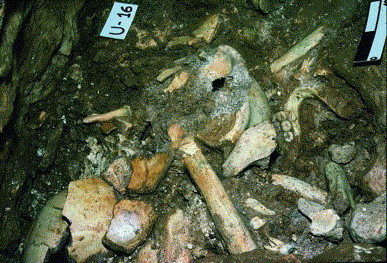
The ‘bone breccia’ in Sima de los Huesos, Atapuerca caverns Spain (from Bischoff, J.L. et al. 2007)
English: Skhul V
Neanderthal head from Israel (Wikipedia)

Stringer argues that the hominins’ anatomy is so like that of Neanderthals that, somehow, the radiometric age must be wrong – i.e. “too old” – perhaps because the speleothem is in fact from a 600 ka block that fell onto the fossils after they had accumulated. His view is that they are Neanderthals descended from H. heidelbergensis living in the earlier Pleistocene and which was the common ancestor of both Neanderthals and anatomically modern humans. Bischoff et al. consider the Sima de los Huesos hominids to be ‘at the very beginnings of the Neanderthal evolutionary lineage’, which seems to me to be a reasonable deduction from both stratigraphic and anatomical data. To demand that they must be at least 200 ka younger, apparently on the basis of an estimate of Neanderthal origination from DNA data seems less reasonable. The appearance of Stringer’s detailed arguments  in Evolutionary Anthropology (v. 21(3)) is eagerly awaited, following the Observer’s take on his position.

Another area in which controversy is brewing – and has been for decades – is that of the origin of human artistic culture. One of the gem-boxes of early art is the Geissenclösterle (monastery of the goats) cavern in southern Germany, in which have been found various figurines made of bird bone and ivory, including a celebrated lion-man theriomorph, highly exaggerated female figures, flutes and beads. They belong to the Aurignacian culture brought by the earliest anatomically modern Europeans who diffused westwards along the Danube from the near-East as early as 45 ka ago. The layer containing the artifacts was originally dated at about 35 ka, but new radiocarbon techniques have been tried on bone with cut marks, among other materials (Higham, T. et al. 2012. Testing models for the beginnings of the Aurignacian and the advent of art and music: the radiocarbon chronology of Geissenclösterle. Journal of Human Evolution, v. 62, p. 664-676 doi:10.1016/j.jhevol.2012.03.003) and found to yield a much older age of 42.5 ka, close to the oldest European date for modern human occupation 43-45 ka for the stratigraphically older Uluzzian tool industry.

Lion_man_photo
Lion-man sculpture from Geissenclösterle ( J. Duckek Wikipedia)

The date is also considerably earlier than the demise of the Neanderthals and raises the issue of modern-Neanderthal contacts. Indeed the layer below that assigned to Aurignacian contains tools made by Neanderthals, whose age is statistically indistinguishable from the later occupation level. The Chatelperronian tool industry, which closely resembles the Aurignacian but is ascribed to Neanderthals, is supposed to be around 40 ka old, but the advanced radiocarbon technique that yielded much older ages for Geissenclösterle apparently has not yet been deployed on this culture. On the basis of limited age data, it does seem likely that Neanderthals adopted the new technology after they encountered it. The Aurignacian artistic products are vastly more advanced than any found at older sites in Africa.

Original Venus from Hohle Fels, mammoth ivory,...
Aurignacian female figurine from near Geissenclösterle..(Silosarg: Wikipedia)

In the context of the debate about modern human and Neanderthal cognitive abilities, which suggests the former were altogether smarter and more creative, there is an unvoiced or at least unheeded argument. Whether or not Neanderthals originated artifacts that were ‘modern’ for their time or copied them is not as important as the fact that this group, previously isolated for up to 400 millennia, were able to appreciate and learn these novelties. That is much the same as people living today, in Australia for instance, a couple of generations from hunter-gatherer origins, working on production lines, piloting aircraft, social networking and creating world-class abstract art. What did they, and the Aurignacians, produce from other materials that have not survived decay; ditto for any pre-45 ka humans? Another point rarely raised, but surely valid, is that previous people may not have felt any need to produce art in forms that survive for tens or hundreds of millennia. Forty-odd thousand years ago, climate was undergoing rapid ups and downs of temperature and humidity in the run-up to the last glacial maximum. Conditions at mid-latitudes would have been much more changeable than those of the tropics. Both anatomically modern humans and Neanderthals faced the same attendant ecological changes, and as co-occupants of southern Europe they faced each other as rivals for available resources. Finally, Aurignacians hailed from the east, also Neanderthal territory and severely affected by rapid climate change from around 80 ka; so did they bring with them a culture formed elsewhere? Europe concentrates palaeoanthropologists and their endeavours, while much of the planet to which humans diffused from Africa – and Africa itself – are grossly under-investigated by comparison: ideas will undoubtedly change drastically as these areas get the attention they deserve.

Controversy is not a problem. Indeed, with imperfect, inadequate or ambiguous data it is unavoidable, and heated disputes spur the search for more information that can help resolve ideas or change them. What cannot be sidestepped is the potential for havoc that may arise with new and improved methods. In both cases outlined here radiometric dates have thrown the proverbial spanner into the works. The method used in the Geissenclösterle cavern was designed to remove younger contaminating material from samples for radiocarbon dating and inevitably tends to push 14C dates further back in time. By removing a source of inaccuracy it highlights the inadequacies of dates obtained by earlier approaches on which a great deal of current archaeological thinking relies. Just how much younger contamination is present in a sample only emerges after the improved dating: it may be absent but an be substantial. So, until materials dated by earlier radiocarbon methods are re-run using the new approach neither their absolute ages nor their relative sequence in time can be considered reliable.

Español: Réplica del techo de la cueva de Alta...
Art on the walls of Altamira Cave, northern Spoain, including both older abstract works and younger figurative depictions of prey animals (Photo credit: Wikipedia)

Results from just such an advance in radiometric dating of cave deposits in northern Spain will really cause a stir, when they sink in (Pike, A.W.G. and 10 others 2012. U-series dating of Paleolithic art in 11 caves in Spain. Science, v. 336, p. 1409-1413). The U-series method used at the University of Bristol by the joint British-Spanish collaborators dates calcite deposits on painted cave walls, including those at the famous Altamira site. This  ‘flowstone’ may underlie artwork or may have grown over it after its completion, giving maximum or minimum ages for the painting, respectively. If a work has flowstone underneath and as a coating, dating potentially ‘brackets’ a possible age range. The superb figurative depictions of various prey animals, such as bison in Altamira cave, turn out to have been painted at around 18 ka, during the last glacial maximum. However a lot of the art there is abstract, such as hands picked out by red pigment presumably sprayed onto the wall from the artist’s mouth, various stippled discs and dots. Many of the abstracts are beneath flowstone that is around twice as old as the more familiar objects and range in age from 34 to 41 ka, thereby being close in time with the Geissenclösterle materials. Like them, their ages may coincide with the arrival of the earliest anatomically modern Europeans, but they are also towards the end of the period when Neanderthals were still present in much of Europe, including northern Spain. It cannot be ruled out therefore that the earliest paintings were Neanderthal symbolic art.

Early origins of meat and two veg

Barbecue chef at festival
(Photo credit: Wikipedia)

When and how humans acquired fire on demand and began to cook has long engaged story tellers and historians. Entertaining tales are those of the titan Prometheus, who stole fire from  Zeus and then had his liver eaten by  an eagle (http://en.wikipedia.org/wiki/Prometheus ), and of Bo-bo, who accidentally discovered the barbecue approach to the meat of pigs (http://www.amazingribs.com/BBQ_articles/dissertation_on_roast_pork.html). Despite the secretive pleasures of some French and Ethiopian gourmets, raw flesh is not widely appreciated, although a rare steak comes pretty close. There is nothing wrong with it apart from its usually being tough and prone to deliver spectacular evacuations. Cooking  unfolds the proteins in meat making them easier to digest and therefore portions of cooked meat deliver higher nutrition than they would direct from the carcase. Likewise, cooking some vegetables, especially various tubers, breaks down their chemistry to more easily digested and more palatable materials: think ‘potato’ in this context. In fact many potentially nutritious tubers are positively toxic if not processed and cooked, classic examples being cassava and wild yams.

While some anthropologists consider a change in hominin habits to eating meat per se, probably originally as carrion, as the necessary step to a leap in nutrition from which an enlarged brain developed, others favour the harnessing of fire and the invention of cooking that released greater proportions of proteins and carbohydrates from available foodstuffs. Since hominins evolved in distinctly seasonal savannas and open woodland, the shortage of game and directly edible above-ground plant parts in the dry season suggests indirectly that our early ancestors had two possible survival paths open to them: powerful jaws and complex digestive tracts to survive on woody stems or digging up tubers. Respectively, the anatomy and tooth-wear patterns of paranthropoids and early Homo to some extent support such a dichotomy that arose from the australopithecines after about 2 Ma ago. Both succeeded and cohabited roughly the same ranges in eastern Africa for as long as a million years.

So pinning down the origin of controlled use of fire is a major goal of Pleistocene archaeology to settle the issue of nutrition and brain growth. Also, it would help explain how hominins were able to diffuse far beyond their home ranges to northern latitudes sufficiently high to place fire as an essential source of warmth at night and in winters. Yet, evidence for habitual use of fire is younger than 400 thousand years among H. heidelbergensis, H. neanderthalensis and H. sapiens, literally leaving the wide roaming H. erectus to shiver as far as scientific proof of hearth and home is concerned. There have been claims of early charring, burnt bones and ashes but until recently such evidence has been ambiguous, largely because fire can start easily and naturally in tinder-rich conditions. There are now, however, advanced microscopic, chemical and physical techniques for estimating temperatures to which bones have been subjected and detecting changes in materials caused by fire, which can be applied to minute samples from sites once occupied by earlier people. One test site for the methods has been the Wonderwerk Cave in South Africa  that is known from Acheulean tools and cut bone to have been occupied as long ago as 1.1 Ma. They gave a positive result for the use of fire by the earliest cave occupants (Berna, F, et al. 2012. Microstratigraphic evidence of in situ fire in the Acheulean strata of Wonderwerk Cave, Northern Cape province, South Africa.  Proceedings of the National Academy of Science USA, www.pnas.org/cgi/doi/10.1073/pnas.1117620109 – open access). The same methods had previously been used to establish controlled human use of fire around 400 ka in once occupied caves in Israel, but at Wonderwerk almost triple the age of earliest known use. But they have refuted similar claims from the famous Zhoukoudian site of ‘Peking Man’ (Asian H. erectus) (http://www.unesco.org/ext/field/beijing/whc/pkm-site.htm).

A useful adage is that ‘the absence of evidence is not evidence of absence’, and it is early days for the routine archaological use of micromorphology, Fourier transform infrared (FTIR) spectroscopy in the search for human embers. In drylands naturally started fires, either as a result of lightning or spontaneous combustion, are so common that hominins would have been well aware of them, their dangers and perhaps their advantages as regards a free barbecue. Possibly Bo-bo’s salivating at the aroma of roast pig from the wreckage of his father house that he had razed to the ground though sheer stupidity would have struck some early hominins as a useful connection between a lucky feast and the still glowing embers of a bush fire. With care, embers can survive for long enough to be carried and used to start controlled fire; a fact not lost on many surviving fully human foragers, and also kids on a South Yorkshire council estate eager for the delights of roasting some ‘borrowed’ potatoes.

Large-animal extinction in Australia linked to human hunters

Diprotodon optatum, Pleistocene of Australia. ...
Artist's impression of a giant Australian wombat (Diprotodon) (credit: Wikipedia)

In North America, between 13 and 11.5 ka, around 30 species of large herbivorous mammals became extinct. Much the same occurred in Australia around 45 ka. Both cases roughly coincided with the entry of anatomically modern humans, where neither they nor earlier hominids had lived earlier. Such extinctions are not apparent in the Pleistocene records of Africa or Eurasia. An obvious implication is that initial human colonisation and a collapse of local megafaunas are somehow connected, perhaps even that highly efficient early hunting bands slaughtered and ate their way through both continents. But other possibilities can not be ruled out, including coincidences between colonisation and climate or ecosystem change. As many as thirteen different hypotheses await resolution, one that inevitably makes headline news repeatedly: that both the early Clovis culture and North American megafaunas met their end around the same time as the start of the Younger Dryas millennial cold snap because a meteorite exploded above North America (http://earth-pages.co.uk/2009/03/01/comet-slew-large-mammals-of-the-americas/). One problem in assessing the various ideas is accurately dating the actual extinctions, partly because terrestrial environments rarely undergo the continual sedimentation that builds up easily interpreted stratigraphic sequences. Another is that it is not easy to prove, say, that all giant kangaroos died in a short period of time because of the poor record of preservation of skeletons on land. A cautionary take concerns the demise of the woolly mammoth that roamed the frigid deserts of northern Eurasia and definitely was hunted by both modern humans and Neanderthals. It was eventually discovered that herds still survived on Wrangell Island until the second millennium BC. There is a need for a proxy that charts indirectly the fate of megafaunas plus accurate estimates of the timing of human colonisation. In North America there is a candidate for the first criterion: traces of a fungus (Sporormiella – see Fungal clue to fate of North American megafauna in EPN of January 2010) that exclusively lives in the dung of large herbivores. Fungal spores get everywhere, being wind-dispersed, and in NE US lake cores they fell abruptly at about 13.7 ka. Sporormiella needs to pass through the gut of herbivores to complete its life cycle.

Aboriginal Rock Art, Anbangbang Rock Shelter, ...
Aboriginal Rock Art, Kakadu National Park, Australia (Photo credit: Wikipedia)

The same genus of fungus breaks down dung in Australia. Measuring spore content in sediment on the floor of a Queensland lake shows the same abrupt decline in abundance at between 43 to 39 ka before present (Rule, S. et al. 2012. The aftermath of a megafaunal extinction: ecosystem transformation in Pleistocene Australia. Science, v. 335, p. 1483-1486). Moreover, the fungal collapse is accompanied by a marked increase in fine-grained charcoal – a sign of widespread fires – and is followed by a steady increase in pollen of scrub vegetation at the expense of that of tropical rain forest trees. The shifts do not correlate with any Southern Hemisphere climatic proxy for cooling and drying that might have caused ecosystem collapse. That still does not mark out newly arrived humans as the culprits, as the early archaeological record of Australia, as in North America, is sparse and only estimated to have started at around 45 ka. Yet this is quite strong circumstantial evidence. The 20 or more animals – marsupials, birds and reptiles – with a mass more than 40 kg that formerly inhabited the continent would probably have been ‘naive’ as regards newly arrived, organised, well-armed and clever new predators, as would those of North America and much later in New Zealand, and would have been ‘easy prey’. Incidentally, faunas of both Africa and Eurasia are extremely wary of humans, possibly as a result of a far longer period of encounters with human hunter-gatherers.  In Australia’s case, the use of deliberate fire clearing to improve visibility of game may have had a major role, although it is equally likely that the demise of large herbivores would have left large amounts of leaf litter and dry grasses to combust naturally. Yet the Earth as a whole around 40 ka was slowly cooling and drying towards the last glacial maximum around 20 ka, so human influence may merely have pushed the megafauna towards extinction, such is the fragility of Australia’s ecosystems.

Feet of the ancients

Cast of Footprints, Laetoli Museum
Cast of footprints, probably of Au. afrensis, from the famous trackway of Laetoli in Tanzania (Photo credit: GIRLintheCAFE)

Much of what palaeoanthropologists have surmised about the evolution of humans and their hominin forebears has come from fossils of their heads. Crania, jaws and teeth can reveal a lot about human ancestors and related species, and inevitably smart modern humans would dearly like to know how brainy and clever they were and when possible intellectual changes, such as the acquisition of language, might have taken place. But only the rest of the body gives us clues about what they did and potentially might have done. If, like Darwin, and following his lead Frederick Engels (http://www.marxists.org/archive/marx/works/1876/part-played-labour/index.htm), we believe that the single most important development was adopting an upright gait and thereby freeing the hands to manipulate the world, then fossil hands and feet are of very high importance. Yet they are among the most fragile appendages consisting of a great many separate bones, each being small enough to be transported by flowing water once soft tissues decay and a corpse falls apart. And they are easily bitten off by scavengers.  Heads are a lot bigger, heavier and robust, and being round and smooth, quite difficult for, say, a hyena or porcupine to gnaw. Moreover, disaggregated hominin foot and hand bones are not easy to recognise in fossiliferous sediments, especially if they have been scattered far and wide: the big prize being heads jaws and teeth, professional hominin hunters become expert at spotting them, but not necessarily the other 80% of skeletons.

Ardi (Ardipithecus ramidus)
Artists reconstruction of female Ardipithecus ramidus (Photo credit: Mike Licht, NotionsCapital.com)

So, the discovery of hominin hands or feet is a rare cause for celebration. A new partial foot has turned up in the hominin ‘bran-tub’ that is the Afar depression of NE Ethiopia (Haile-Selassie, Y. et al. 2012. A new hominin foot from Ethiopia shows multiple Pliocene bipedal adaptations. Nature, v. 483, p. 565-569) and has caused quite a stir. It is significantly different from the few other feet known from the hominin record. Moreover, it adds a sixth design to those already know, leaving out those of chimps, taken as likely to be similar to those of our shared common ancestor, Homo sapien, Neanderthals and H. erectus whose feet are much the same. While being easily distinguished from the feet of Homo species, those of australopithecines are sufficiently like them in basic morphology to suggest that Au. africanus and sediba both walked the savannas as upright as we do. But one of the earlier hominins, Ardipithecus ramidus, also from Afar but dated at more than 4 Ma, has provided an almost complete foot whose geometry , including a spayed-out, short big toe capable of grasping, almost certainly indicates that the creature was equally at home in trees as it was on the ground. Ardipithecus walked upright, but probably could not run as its gait placed the side of the foot on the ground, much like a chimpanzee, instead of proceeding heel-to-toe as we do (Lieberman, D.E. 2012. Those feet in ancient times. Nature, v. 483, p. 550-551). The new find seems similar, although better adapted for upright walking. Yet no other body parts have been found so it has not been assigned to a species, though it almost certainly represents a new one. The excitement concerns its age, which at 3.4 Ma is within the time range of Australopithecus afarensis, a family of which left the famous trackway at Laetoli in Tanzania whose foot prints strongly suggest full adaptation to human-like gait: walking, running and abandonment of partially habitual life in the trees.

It seems therefore that the multiplicity of co-existing hominins from 2 million years ago to very recently existed much further back in their evolutionary history. That raises several possibilities, among which is the possibility of repeated evolution of bipedality, hinted at by some similarities to the feet of modern gorillas in that of the newly found foot. Another implication is that simply being able to walk upright did not lead quickly to a tool-making ability because the earliest stone tools capable of cutting through meat, skin and sinew did not arise until 2.6 Ma. Like fossils of feet, those of hominin hands are extremely rare. The first crucial evidence of a hand with potential to manipulate objects delicately and with purpose is around 2 Ma, with the astonishingly well preserved hand of a young Au. sediba unearthed in South Africa (http://earth-pages.co.uk/2011/10/12/another-candidate-for-earliest-direct-human-ancestor/). Frustratingly, the 2.6 Ma tools are not associated with fossil hominins, and the Au. sediba skeletons had no tools.

Denisovans scooped?

In late 2010 it emerged from genomic studies of a finger bone from Denisova Cave in eastern Siberia that a probably archaic human group had shared genes with ancestors of some modern humans who colonised West Pacific islands around 45 Ka ago, well before the last glacial maximum. Melanesians, including tpeople living in Papua-New Guinea have DNA that contains on average around 6% contributed from fertile interbreeding with Denisovans. This ancient groups are suggested by comparative studies of their and Neanderthal mitochondrial DNA to have split from them as lond as a million years ago. Now it seems possible that much more complete fossils of Denisovans may have been discovered in China (Curnoe, D. And 16 others 2012. Human Remains from the Pleistocene-Holocene Transition of Southwest China Suggest a Complex Evolutionary History for East Asians. PLoS ONE, http://www.plosone.org/article/info:doi/10.1371/journal.pone.0031918).

Skull from Red Deer Cave in Guanxi Province, southern China. Darren Curnoe

A block of sediment from Longlin Cave in Guanxi Province in southern China that was collected more than 30 years ago, has yielded skull fragments whose reconstruction reveals a most unusual individual, very different from anatomically modern humans, Neanderthals and from H. erectus. It had a wide flat face with highly prominent cheek bones, strong brow ridges and a diminutive chin.  Remains of three other individuals found by recent excavations in Maludong (Red Deer) Cave 300 km to the south of Longlin share similar characteristics. Yet there are similarities to moderns, for instance CT-scans show that the brain likely had a height and frontal lobes similar to ours, but different from Neanderthals.

These are not truly ancient fossils; radiocarbon and uranium-series dating give an age range from 14.3 to 11.5 ka, around the time of the Younger Dryas cold episode that preceded the Holocene. These two individuals lived when East Asia had long been home to fully modern humans.

The finds perhaps open a major new focus for human evolution, directed towards less-well studied older fossils from elsewhere in the East including those referred to by Jonathan Kingdon as ‘Mapas’ from both southern and northern China. Certainly it will boost palaeoanthropological research within China

Hominin updates

A new approach to 14C dating at the Oxford Radiocarbon Accelerator Unit at the University of Oxford UK, combined with detailed analysis of human teeth to distinguish fully modern human remains from those of Neanderthals has pushed back the date and pace of migration into Europe by people whose tools define the Aurignacian and Italian Uluzzian technologies. These are the earliest modern-human cultures found in Europe, but some of the tools are similar to those produced by Neanderthals (Châtelperronian culture), raising the possibility of transfer of technologies between the two groups. So, without confirmation from human remains of the anatomical affinities the would be doubts about using tools of these kinds to signify the presence at a site of full modern humans. Teeth found decades ago at caves in SW England and southern Italy prove, on detailed comparative study, to be from ‘moderns’ (Higham, T. And 12 others 2011. The earliest evidence for anatomically modern humans in northwestern Europe. Nature, v. 479, p. 521-524; Benazzi, S. And 13others 2011. Early dispersal of modern humans in Europe and implications for Neanderthal behaviour. Nature, v. 479, p. 525-528).The new carbon-isotope method  efficiently eliminates chemical contamination of material by post-fossilisation processes and so tend to increase the measured age of samples. The two studies produced exciting results: dates of occupation between 42-43 and 43-45 ka from SW England and southern Italy respectively. Together with results from other sites throughout central and southern Europe, the discovery shows that widespread colonisation was accomplished in three to five thousand years by migrants probably from the Levant, who may have travelled along three routes fanning out from the Bosporus in modern Turkey: along the Danube; along the Adriatic coast; from southern Greece to the ‘heel’ of Italy.

In early 2011 a group of archaeologists led by Simon Armitage of the University of Birmingham, UK reported stone tools from a cave in the United Arab Emirates for which they derived possible ages of 125, 95 and 40 ka (see Human migration in EPN for January 2011). The older dates were coeval with anatomically modern humans in the Levant, but the tools themselves showed features that could not be matched decisively with those from any other sites, including those in the Leant, though they most resembled collections from East and NE Africa. Armitage and colleagues suggested that the people who occupied the UAE cave had crossed the Red Sea at the time of the glacial maximum around 130 ka, at a time of unprecedented low sea level. A recent paper adds considerable weight to this idea (Rose, J.I. and 9 others 2011. The Nubian Complex of Dhofar, Oman: An African Middle Stone Age Industry in Southern Arabia at http://www.plosone.org/article/info%3Adoi%2F10.1371%2Fjournal.pone.0028239). Jeffrey Rose, also of the University of Birmingham, and colleagues from Ukraine, US, UK, Germany, the Czech Republic and Australia excavated site in Dhofar southern Oman, much closer to the Straits of Bab el Mandab than the UAE. Chert tools found in the area are of the Levallois type, specifically resembling closely those found widely in the Nile Valley of southern Egypt and northern Sudan, and in the Afar Depression of Ethiopia, in deposits dated between 128 to 74 ka. The Omani tools yielded an optically stimulated luminescence age of about 106 ka. This nicely confirms that Africans had moved far beyond the confines of their home continent by the last interglacial episode, with the route to South Asia open to them along the shores of the Persian Gulf and Indian Ocean. However, the route that they had taken could equally have been around the head of the Red Sea as across the Bab el Mandab.

Desert varnish: an outdoor canvas

Petroglyphs carved in desert varnish at the Va...
Petroglyphs in desert varnish near Las Vegas, Nevada, USA. Image via Wikipedia

Early occupants of semi-arid areas found a cultural use for what is one of geology’s greatest annoyances: desert varnish. Annoying because once developed it leaves an extremely durable brownish to black, shiny coating over rock surfaces: be they dunite, marble or quartzite, sandstone or granite, desert outcrops all look very much the same. You have to bash them unmercifully to see the true texture and mineralogy, and, except on images of thermally emitted infrared, remote sensing doesn’t help as the varnish has the same reflectance whatever the wavelength of radiation. Yet to the former inhabitants of dry lands – and latter day ‘taggers’ – desert varnish has been irresistible for millennia. Lightly peck away with a sharp pebble – and some ability to depict your thoughts – and you can leave an almost indelible sign that you and your ideas were at that very rock face: a petroglyph, picked out for all time in the manner of chalk on a blackboard. Even more spectacular, given an oversight of a varnished cobbly plain and it is possible to magnify your tag, or whatever petroglyphs once signified, a hundredfold or more. That happened on the famous Nazca Plain of Peru  and continues to do so in especially dry places in the south-western US, as around Lake Havasu City in Arizona. Varnish forms only on the exposed face of cobbles, the downward side remaining more or less the original rock’s colour; generally lighter. Turn over the cobbles in an organised way, with a degree of persistence as well as talent and you too can make your mark on Google Earth! (Do not pass this on to Banksy – it doesn’t hurt the ecosystem, but will annoy the authorities immensely).

Français : Lignes de Nazca au Pérou. Le contra...
Ancient art depicting a hummingbird on the Nazca Plain, Peru. Image via Wikipedia

For all this period of artistic endeavour, stretching back in some places to the Palaeolithic, it now seems that desert varnish also records how environments have changed as well as the religiosity, humour or downright egotism of its inhabitants (Dickerson, R. 2011. Desert varnish – nature’s smallest sedimentary formation. Geology Today, v. 27 (November-December issue), p. 216-219). As well as reviewing how the varnish forms (see also Desert varnish in EPN May 2008, in Subjects: GIS and Remote Sensing)., Dickerson flags-up the little-known fact that the minute layers produced as varnish imperceptibly develops record changes in environmental conditions – wet, dry and middling – and, moreover they can be dated precisely despite being extremely thin (e.g. Liu, T. & Broeker, W.S. 2008. Rock varnish microlamination dating of late Quaternary geomorphic features in the dry lands of wester USA. Geomorphology, v. 93, p. 501-523). Liu and Broeker were able to match variations in the colour of varnish layers with important climatic episodes of the Northern Hemisphere, such as the Younger Dryas and other warming-cooling, dry-wet shifts as far back as the Last Glacial Maximum. Their approach offers a chance of dating petroglyphs and thereby cultural changes during critical stages in the history of modern human migrations, occupations and abandonments, even when no artefacts or bones remain. That is because once made, petroglyphs gradually become varnished themselves.

Water sources and early migration from Africa

SeaWiFS collected this view of the Arabian Pen...
The Arabian Peninsula today. Image via Wikipedia

In March 2011 EPN reported in Human migration a puzzle relating to evidence for modern human occupation of Arabia on the southern shore of the Persian Gulf during the last Eemian interglacial at 125 and 95 ka. At that time sea level would have been as it is now, discouraging any attempt to cross the Red Sea via the Straits of Bab el Mandab; a widely suggested short-cut from East Africa to the rest of the world. Around 125 ka modern humans were making a living from coastal resources in Eritrea, leaving abundant stone tools in shoreline deposits at the head of the Gulf of Zula, and in the Sodmein Cave on Egypt’s Red Sea coast. They had also reached the famous Qafzeh and Skhul caves of Mount Carmel in today’s Israel around 100 thousand years ago. A route out of Africa through the Levant has not been widely favoured and the humans of Qafzeh and Skhul have been suggested to have reached a geographic cul-de-sac with no eastward exit because of the aridity of the Arabian Peninsula. Yet once in the Levant they could have skirted the desert interior by following the east coast of the Red Sea, and ‘strandloped’, as Jonathan Kingdon has dubbed following the coastline. But continuous access to fresh water would still have been essential.

The shores of the Red Sea preserve many examples of uplifted coral reefs, indeed signs of human presence in Eritrea occur in such a terrace. Being extremely porous, reef terraces are potential aquifers and a sign that they may have sourced freshwater springs is the conversion of the intricate coral skeletons from one form of calcium carbonate to another; original aragonite changes to calcite in the presence of fresh water, a complete replacement being estimated to take a thousand years of continual contact with fresh water. This change allowed Boaz Lazar and Mordechai Stein of the Hebrew University of Jerusalem and the Geological Survey of Israel to check for the presence of freshwater coastal springs in the past (Lazar, B. & Stein, M. 2011. Freshwater on the route of hominins out of Africa revealed by U-Th in Red Sea corals. Geology, v. 39, p. 1067-1070). Their test site was a series of uplifted reefs near Aqaba on the Red Sea coast of Jordan. The authors determined variations in the 230Th/238U ratio in the reefs relative to that of 234U/238U and showed open-system addition of 230Th and 234U during the aragonite to calcite recrystallization, that results in an isotopic compositional trend charting the timing of any alteration. Thus, the original age of reef terraces can be backtracked, revealing at Aqaba successively higher terraces formed recently and at 120, 142 and  190 ka. The oldest of the terraces seems to have been flooded with fresh water at the start of the Eemian interglacial (~140 ka), and may have been a source of springs that would have served the earliest human travellers well. It remains to use Lazar and Stein’s approach at other reef terraces along the postulated northern exit route for the earliest modern human emigrants from Africa and, more important, to find traces of their passage.

Added 21 December 2011. The likely route for leaving Africa got a push towards the Bab el Mandab with publication of evidence for a greener south Arabia at several times in the late Pleistocene (Rosenberg, T.M. and 8 others 2011. Humid periods in southern Arabia: Windows of opportunity for modern human dispersal. Geology, v. 39, p. 1115-1118). On the eastern edge of the now hyper-arid Rub al Khali are a series of former lakes with thin sediments. When first discovered they yielded radiocarbon ages of fossil molluscs of around 40 to 20 and 10.5 to 6 ka. However recent dating using optically stimulated luminescence (OSL) of the dune sands between which occur lacustrine muds and silts suggest that the lakes were water-filled  for lengthy periods  before those ages – radiocarbon dating can be reset to younger ages by precipitation of carbonates on older  fossils.  The OSL results show wet periods around 80, 100 and 125 ka, suggesting that around these times the Intertropical Convergence Zone was pulled northwards so taking seasonal monsoon rains well into the Arabian Peninsula. They tie in nicely with a variety of other parameters, including the timing of lowstands of the Red Sea. This created episodes a few thousand years long that would have been conducive to humans living there and passing through en route to Asia around eastern Arabia and perhaps to the Levant up the west side of the sub-continent. Potential occupancy was shut off by long arid periods, which might have allowed only pulses of migration. Had such episodic diffusion occurred it might have left a record in human DNA that ongoing and planned population genetic research may reveal.

Snippets on human evolution

Image copyright held by author, Chris Henshilw...
Artifacts from the Blombos Cave, South Africa, including deliberately etched block of hematite Image by Chris Henshilwood via Wikipedia

The news that most humans outside of Africa carry fragments of DNA that match with those of Neanderthals and the mysterious Denisovan archaic humans ( see Yes, it seems that they did… and Other rich hominin pickings in the May 2010 issue of EPN) has entered into popular culture; or soon will have! Similar dalliances with the ‘older folk’ seem also to have occurred among those humans who remained in Africa (Hammer, M.F. et al. 2011. Genetic evidence for archaic admixture in Africa. Proceedings of the National Academy of Sciences, v. 108, p. 15123-15128). The DNA of three groups in West Africa who maintain a hunter-gatherer lifestyles show regions that are not involved in coding for proteins that differ from the African norm. This suggests mating with an entirely separate and unknown group of hominins – probably archaic forms of humans – that produced fertile offspring, probably around 35 thousand years ago. The find spurred re-evaluation of bones with a mix of archaic and modern features that were discovered in a Nigerian cave in the 1960s (Harvati, K. et al. 2011. The Later Stone Age Calvaria from Iwo Eleru, Nigeria: Morphology and Chronology. PLoS ONE, v.  6: e24024. doi:10.1371/journal.pone.0024024). The study confirms that the skulls are outside the fully modern human range, but display a close similarity with Neanderthal and H. erectus. The big surprise is that U-Th dating suggests they are quite recent, around 16 ka. The stage seems set for nor only a burst of exploration for human remains of less antiquity than early hominins but a ‘paradigm shift’ in our view of what constitutes a human species.

See also: Gibbons, A. 2011, African data bolster new view of modern human origins. Science, v. 334, p. 167.

Another interesting link with archaic humans who had the closest of relationships with some of our ancestors is that their union may have bolstered the resistance of migrants from Africa to Eurasian pathogens (Abi-Rached, L. and 22 others 2011. The shaping of modern human immune systems by multiregional admixture with archaic humans. Science, v. 334, p. 89-94). The focus was on the human leucocyte antigen (HLA) group that is a vital part of our immune system in the form of ‘killer cells’. Part of modern Eurasian DNA that codes for the group (HLA-B*73 allele) appears in the Neanderthal and Denisovan genomes; indeed more than half the HLA alleles of modern Eurasians may have originated in this way, and have also been introduced into Africans subsequently.

Also at the front line of genomic research into human origins, DNA sequenced from a lock of hair given to an Edwardian anthropologist by a native Australian turns out to have an extreme antiquity compared with that of other Eurasian people descended from African migrants (Rasmussen, M. and 57 others. An aboriginal Australian genome reveals separate human dispersals into Asia. Science, v. 334, p. 94-98). The unique aspects of the Australian genome signify separation of a group of individuals from the main African population around 62-75 thousand years ago; significantly earlier than and different from ‘run of the mill’ migrants from whom modern Asians arose at between 25 to 38 ka. There is little doubt that native Australians are descended from the pioneers who first diffused from Africa either by crossing the Straits of Bab el Mandab or taking another route and they moved more speedily across southern Asia than other waves made possible by climate change and sea-level falls following the Eemian interglacial of 133-115 ka.

Despite the lingering Eurocentrist view that somehow fully modern human consciousness sprang into being at the time the famous French and Spanish cave art was painted, around 30 ka, increasing evidence points to an African origin for a sense of aesthetics and the ability to express it. The latest is the discovery of a 100 ka ‘paint box’ in a South African coastal cave (Henshilwood, C.S. et al. 2011. A 100,000-year-old ochre-processing workshop at Blombos Cave, South Africa. Science, v. 334, p. 219-223). The material consists of two large abalone shells containing traces of red and orange ochre, together with a hammer stone and grinder with adhering ochre, and fat-rich bones which ground-up would have produced a binder for the ochre. No art occurs in the cave and it might be supposed that the pigments were intended for face- or body adornment.

Another candidate for earliest, direct human ancestor

The cranium of Malapa Hominid 1, Holotype of A...
The head of Australopithecus sediba. Image via Wikipedia

In May 2010 EPN commented on a new find from the famous fossil-rich caves of north-eastern South Africa; a new hominin species called Australopithecus sediba. At least one of them fell into a deathtrap shaft, died and remained unchewed without bones being spread far and wide. Inevitably, near-complete skeletons of individual hominins are soon pored over by dozens of specialists in human evolution, as they were for the much older Ardepithecus ramidus found in sediments of Ethiopia’s Afar Depression (see Early hominin takes over Science magazine in the November 2009 issue of EPN). Now there are two near-complete, well-preserved skeletons of Au. sediba and the palaeoanthropological world is agog. Dating to about 1.98 Ma the specimens represent the same time as do far less impressive remains of H habilis from Tanzania that were found with associated rudimentary stone tools. The first hint (just a fragment of upper jaw) of any remains that might be tagged ‘Homo’ dates to 2.3 Ma and is from Ethiopia, as are the first undoubted stone tools going back as far as 2.5 Ma, though lacking association with a maker.

Five consecutive papers on Au. Sediba occupy 22 pages in the 9 September 2011 issue of Science and make for startling reading. The first concerns the shape of its brain case, and therefore crudely its brain, discerned by tomographic X-ray scanning (Carlson, K.J. et al. 2011. The endocast of MH1, Australopithecus sediba. Science, v. 333, p. 1402-1407). It isn’t any bigger than that of other members of the genus but shows ‘some foreshadowing of the human frontal lobes’ and other shifts from the basic ape model that the authors imply are en route to human features. The next considers the two pelvis regions (Kibii, J.M. et al. 2011. A partial pelvis of Australopithecus sediba. Science, v. 333, p. 1407-1411); again australopithecine-like in the small size of the birth canal but with a hint of the S-shape of humans. Most astonishingly well-preserved are the fragile bones of a complete hand (Kivell, T.L.  et al. 2011. Australopithecus sediba hand demonstrates mosaic evolution of locomotor and manipulative abilities. Science, v. 333, p. 1411-1417), which convincingly shows the long thumb and short fingers (for a primate) that characterise Homo and are essential for a precision grip and making things. Actually, the thumb is longer relative to fingers (60%) than in humans (54%), but Lucy’s (Au. afarensis) was a closer match. No tools that such a hand might have created and wielded were found with the fossils. Then there is the foot (Zipfel, B. et al. 2011. The foot and ankle of Australopithecus sediba. Science, v. 333, p. 1417-1420), which, again, mixes human and australopithecine features, giving ‘a unique form of bipedality and some degree of arboreality’. The fifth paper (Pickering, R. et al. 2011. Australopithecus sediba at 1.977 Ma and implications for the origins of the genus Homo. Science, v. 333, p. 1417-1420) is as remarkable for the precision of U-Pb dating of speleothem (cave carbonates), which at 1.977+0.002 Ma far exceeds the workhorse Ar-Ar method used for most other hominins, as it is for the absolute age that precedes that of undisputed remains of humans.

In short, for Australopithecus sediba there is an embarrassment of riches unmatched until those of the 1.5 Ma old H. erectus (‘Turkana Boy’) found at Nariokotome in NW Kenya. To some extent this throws a flock of peregrines in among the palaeoanthropology pigeons, as an account of a meeting earlier in 2011, at which the bones were grandstanded, shows (Gibbons, A. 2011. Skeletons present an exquisite paleo-puzzle. Science, v. 333, p. 1370). Naturally, the authors are making the most of their material especially, it seems, its finder Lee Berger of the University of Witwatersrand, South Africa, the last author in all the papers. Comparisons with more australopithecine remains were said to be needed. The soon-to-be-famous hand has been said to be essentially like others from the same genus. While the remains of the creature’s pelvis could imply that its evolution was more driven by a need for efficient upright walking than to birth big-headed babies, the ankle shows a primitive trait that would have forced Australopithecus sediba to walk strangely as the heel bone is small and angled unlike that in human feet, which is broad and flat. But all the species’s features are combined in two near-complete individuals, whereas for the rest of its contemporaries, predecessors and near successors in time speculation is based on fragments of several individuals, none more so than in the case of the earliest agreed human, near contemporaneous H. habilis, which barely stands up to taxonomic scrutiny (Gibbons, A. 2011. Who was Homo habilis – and was it really Homo?  Science, v. 332, p. 1370-1371). Some would say that it was only the associated stone tools that assigned ‘Handy Man’ to more elevated status than slightly large-headed australopithecine. The fact is; stone tools were around since 2.5 Ma, at least in Ethiopia, and this newly found being could have handled them and even made them with its palpable dexterity. Finding tools and skeletons together is almost as rare as hens with teeth…