The first generally recognised piece of artwork is abstract in the extreme: a worked piece of hematite with a complex linear pattern etched into it. It comes from Blombos Cave in South Africa, together with similarly engraved bone, shell ornaments and advances in stone tool kits.
Artifacts from Blombos Cave, South Africa (credit: Wikipedia; copyright held by Chris Henshilwood)
Dated at 100 ka, the Blombos culture is regarded by many palaeoanthropologists as the start of the ‘First Human Revolution’. Yet most believe that such a massive cultural shift only properly manifested itself around 40 ka in Europe shortly after its colonisation by anatomically modern humans. It was then that lifelike pictures of animals began to appear on the walls of caves, such as those discovered in Chauvet Cave in France and radiocarbon dated to between 35.5 to 38.8 ka.
Drawing of horses in the Chauvet cave. (credit: Wikipedia)
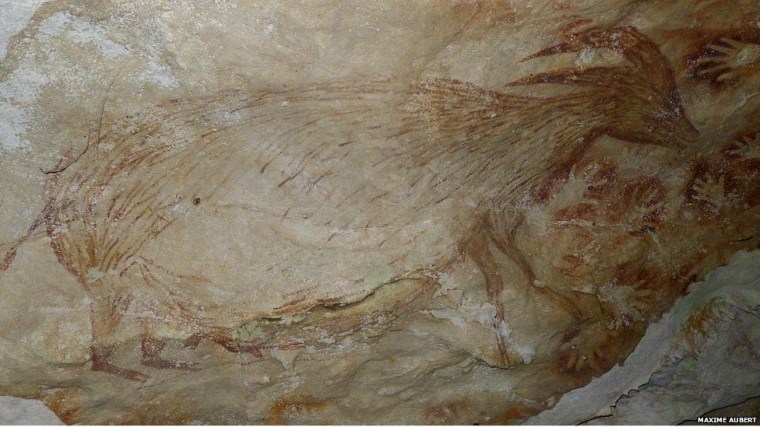
Such a Eurocentric view is based on the lack of evidence for precedent art of this kind from elsewhere. The adage that 'absence of evidence is not evidence of absence' - attributed to Carl Sagan - recently popped up with sophisticated dating of cave art in the Indonesian island of Sulawesi. The cave-riddled limestones of southern Sulawesi have long been known for artwork on the roofs of caves and in some of their darker recesses, including sketches of local animals, humans and a great many stencils made by blowing a spray of pigment over a hand placed on a rock face. The pictures were thought to be relatively recent. Painting of a dwarf water buffalo and stencils of human hands from a cave in SW Sulawesi (credit: Maxim Aubert, Griffith University, Australia)
A joint Australian-Indonesian group of Archaeologists used a specialist technique to date them (Aubert, M. and 9 others 2014. Pleistocene cave art from Sulawesi, Indonesia. Nature, v. 514, p. 223-227. See also Roebroeks, W. 2014. Art on the move. Nature (News & Views), v. 514, p. 170-171). Like many paintings in limestone caves, with time they become coated with calcite film deposited from water flowing over the rock surface, known as flowstone or speleothem. It is possible to date the film layers using the uranium-series method to derive a maximum age for the encased pigment from speleothem beneath it and a minimum age from the layer immediately overlaying it. One of the hand stencils proved to be the oldest found anywhere, with a minimum age of 39.9 ka, while sketches of animals ranged from 35.4 to 35.7 ka. To see more images and view an interactive video about the Sulawesi finds click here.
The discovery by Maxime Auberts and his colleagues has set the cat among the pigeons as regards the origin of visual art. The paintings’ roughly coincident age with the earliest in Europe raises three possibilities: the artistic muse struck simultaneously with people widely separated since their ancestors’ emergence from Africa; somehow the skills were quickly carried a third of the way around the world from one place to the other; the original migrants from Africa took artistic ability of this kind with them to Eurasia, perhaps as early as 125 ka ago.
Three points need to be considered: whether in Europe or eastern Indonesia, cave art is preserved either on the roofs or in the deep recesses of caves, where it is more likely to survive then in more exposed sites; preservation by speleothem enhances longevity and the oldest works are in limestone caves; many more archaeologists have researched caves in Europe than in the far larger areas of Asia and Africa. A view worth considering is that art may have begun outdoors, in a well-lit site on whatever ‘canvas’ presented itself. The artists’ choice of cave walls in Europe and Indonesia may have resulted from the need for shelter from rain and/or cold, whereas much of Africa and Australia poses little need for ‘interior design’. Besides, what if art began on the most easily available canvas of all – human skin! My guess is that the record will widen in space and deepen in time.
The Arabian Peninsula from the SeaWIFS satellite (credit: Wikipedia)
From time to time between 130 and 75 ka fully modern humans entered the Levant from Africa, which is backed up by actual fossils. But up to about 2010 most palaeoanthropologists believed that they moved no further, because of the growth of surrounding deserts, and probably did not return to the Middle East until around 45 ka. The consensus for the decisive move out of Africa to Eurasia centred on crossings of the Straits of Bab el Mandab at the entrance to the Red Sea, when sea level fell to a level that would have allowed a crossing by rafting over narrow seaways. The most likely time for such n excursion was during a brief cool/dry episode around 67 ka that coincided with an 80 m fall in global sea level: the largest since the previous glacial maximum (see Evidence for early journeys from Africa to Asia).
In 2011 finds reported from the United Arab Emirates of ‘East African-looking’ Middle Palaeolithic tools in sediment layers dated at 125, 95 and 40 ka led some to speculate that there must have been an eastward move from the Levant by anatomically modern humans (see Human migration – latest news). That view stemmed from the fact that the earliest date was during the last interglacial when sea level would have been as high as it is today, and around 95 ka it would have been little different. That report coincided with others about freshwater springs having emanated from uplifted reefs around the edges of the Arabian Peninsula during the last interglacial, and the existence of substantial lakes deep within the subcontinent around that time (see Water sources and early migration from Africa). Substantial funding followed such exciting news and results of new research are just beginning to emerge (Lawler, A. 2014. In search of Green Arabia. Science, v. 345, p. 994-999).
Al Ain, a rare spring-fed oasis in the eastern Rub al Khali near the UAE-Oman border (credit: Wikipedia)
A team led by Michael Petraglia of the University of Oxford has used field surveys and remote sensing to reveal a great many, now-vanished lakes across the Arabian Peninsula, including many in the fearsome Rub al Khali or Empty Quarter. They are linked by an extensive, partly sand-hidden network of palaeochannels, which include several of the major wadis; a system that once drained towards the Persian Gulf. As well as abundant freshwater molluscs and other invertebrates, former lakeshore sediments are littered with huge numbers of stone tools, also with East African affinities (Scerri, E.M.L. et al. 2014. Unexpected technological heterogeneity in northern Arabia indicates complex Late Pleistocene demography at the gateway to Asia. Journal of Human Evolution, In Press http://dx.doi.org/10.1016/j.jhevol.2014.07.002). Using optically stimulated luminescence dating, which shows how long stone objects have been buried, the British team has found tools dating back as long as 211 ka, with a cluster of dates between 90 to 74 ka. Modern humans, Neanderthals and even Denisovans may have made these tools; only associated fossil remains will tell. Yet it is already clear that for lengthy periods – perhaps of a few hundred or thousand years – the hyper-arid interior of Arabia was decidedly habitable. It may have been a thriving outpost of emigrants from Africa, whose abandonment as climate shifted to extreme dryness as the last interglacial gave way to Ice Age conditions, could well have been the source of the great migration that colonised the rest of the habitable world. Petraglia’s team has already courted controversy with their claim for anatomically modern humans’ tools in South Indian volcanic ash beds that date to the Toba eruption around 74 ka: considerably earlier than the more widely accepted post-65 ka dates of human eastward migration.
As Earth Pages reported in December 2011 a refined method of radiocarbon dating that removes contamination by younger carbon has pushed back the oldest accessible 14C dates. Indeed, materials previously dated using less sophisticated methods are found to be significantly older. This has led archaeologists to rethink several hypotheses , none more so than those concerned with the relationship in Europe between anatomically modern humans (AMH) and Neanderthals, especially the extinction of the latter.
The team of geochronologists at Oxford University who pioneered accelerator mass spectrometry (AMS) of carbon isotopes, together with the many European archaeologists whose research has benefitted from it, have now published results from 40 sites across Europe that have yielded either Neanderthal remains or the tools they are thought to have fashioned (Higham, T. and 47 others. The timing and spatiotemporal patterning of Neanderthal disappearance. Nature, v. 512, p. 306-309) . One such site is Gorham’s Cave in the Rock of Gibraltar where earlier dating suggested that Neanderthals clung on in southern Iberia until about 25 ka. Another hypothesis concerns the so called Châtelperronian tool industry which previous dating at the upper age limit of earlier radiocarbon methodology could not resolve whether or not it preceded AMH colonisation of Europe; i.e. it could either have been a Neanderthal invention or copied from the new entrants. Most important is establishing when AMH first did set foot in previously Neanderthal’s exclusive territory and for how long the two kinds of human cohabited Europe before the elder group met its end.
Reconstruction of Neanderthal life from the Neandertahl Museum(credit: Wikipedia)
The new data do not quash the idea of Neanderthals eking out survival almost until the last glacial maximum in the southernmost Iberian Peninsula, since material from Gorham’s Cave could not be dated. However, occupation levels at another site in southern Spain in which Neanderthal fossils occur and that had been dated at 33 ka turned out to be much older (46 ka). So it is now less likely that Neanderthals survived here any longer than they did elsewhere.
Neanderthal remains are generally associated with a tool kit known as the Mousterian that is not as sophisticated as that carried by AMH at the same time. Of the Mousterian sites that yielded AMS ages, the oldest (the Hyaena Cave in Devon, Britain) dates to almost 50 ka. The youngest has a 95% probability of being about 41 ka old. Of course, Neanderthals may have survived until later, but there is no age data to support that conjecture. The earliest known AMH remains in Europe are those associated with the so-called Uluzzian tool industry of the Italian peninsula. In southern Italy Mousterian tools are replaced by Uluzzian between about 44.8 and 44.0 ka, while Mousterian culture was sustained in northern Italy until between 41.7 to 40.5 ka.
Châtelperronian stone tools (credit: Wikipedia)Mousterian blade tool from France (credit: Wikipedia)
Châtelperronian tools associated with Neanderthal remains occur in south-western France and the Pyrenees. The new AMS dating shows that the culture arose at about the same time (~45 ka) as the Uluzzian tool industry began in Italy and ended in those areas where it was used at about the same time (~41 ka) as did the more widespread Mousterian culture. So the question of whether Neanderthals copied stone shaping techniques from the earliest Uluzzian-making AMH more than 500 km to the east, or invented the methods themselves remains an open question. But does it matter as regards the cognitive abilities of Neanderthals? Copying methodology is part and parcel of the success and survival of succeeding AMH, but o too is the capacity to invent useful novelties from scratch. So, yes it does matter, for Neanderthals had sustained the Mousterian culture for tens to hundreds of thousand years with little change.
The upshot of these better data on timing is that AMH and Neanderthals co-existed in Europe for between 2.6 to 5.4 ka; as long as the time back from now to the Neolithic and early Bronze Age. Even allowing for low population density to make contacts only occasional, this is surely too long for systematic slaughter of Neanderthals by AMH. Yet it gives plenty of time for two-way transmission of cultural and symbolic activities, and even for genetic exchanges: assimilation as well as out-competition.
Incidentally, Scientific American’s September 2014 issue is partly devoted to broader issues of human evolution (Wong, K. (editor) The Human Saga. Scientific American, v. 311(No 3), p. 20-75) with a focus on new developments. These cover: a revised time line; the emerging complexity of hominin evolution by veteran palaeoanthropologist Bernard Wood.; the influence of climate change; by Peter de Menocal; cultural evolution in the broad hominin context by Ian Tattersall; a discussion of hominin mating arrangements by Blake Edgar; two contributions on cooperation versus competition among hominins by Frans de Wall and GGry Stix; two articles on recent biological and future cultural evolution by John Hawks and Sherry Turkle (interview).
It is widely thought that anatomically modern humans (AMH) began to diffuse out of Africa during the climatic cooling that followed the last interglacial episode. Periods of build-up of ice sheets, or stadials, also saw falls in sea level, which would have left shallow seas dry and easily crossed. The weight of evidence seems to point towards the narrowing of the Red Sea at the Straits of Bab el Mandab between modern Eritrea and the Yemen. Because the Red Sea spreading axis goes onshore through the Afar region of Ethiopia further north, the Straits today are shallow. Between about 70 and 60 ka, during a major stadial, much of the Bab el Mandab would have been dry. Dating of the earliest AMH remains in Asia and Australasia seems to suggest that the move out of Africa probably began around that time. But, of course, that presupposes the AMH fossils being the oldest in existence, although some would claim that genetic evidence also supports a 70-60 ka migration. Yet, AMH human remains dated at around 100 ka have been found in the Middle East on a route that would also lead out of Africa, but for the major problem of crossing deserts of modern Syria and Iraq. The supposed desert barrier has led many to suggest that the earlier venture into the Levant met a dead end. Should AMH fossils older than 70 ka turn up in Eurasia or Australasia then a single migration becomes open to doubt.
Chart of large human migrations based on variations in mitochondrial DNA in living humans(Numbers are millennia before present.) (credit: Wikipedia)
It appears that challenge to what has become palaeoanthropological orthodoxy has emerged (Bae, C.J. et al. 2014. Modern human teeth from Late Pleistocene Luna Cave (Guangxi, China). Quaternary International, In Press). Scientists from the US, China and Australia found two molar teeth within calcite flowstone in Lunadong (‘dong’ means ‘cave’). That speleothem is amenable to uranium-series dating, and has yielded ages between 70 and 127 ka. That antiquity does open up the possibility of earlier migration, perhaps during the interglacial that ended at about 115 ka when sea levels would have stood about as high as it does nowadays (in fact it was only after about 80 ka that it stood low enough to make a move across the Bab el Mandab plausible). If that were the case, the migration route would have more likely been through the Middle East, perhaps along the Jordan valley and thence to the east. Had there been greater rainfall over what is now desert then there would have been no insurmountable barrier to colonisation of Asia.
These teeth are not the only evidence for earlier entry of AMH into east Asia; a date of 66 ka for a modern human toe bone was recently reported from the Philippines. Yet many experts remain unconvinced by teeth alone, especially from east Asia where earlier humans had evolved since first colonisation as early as 1.8 Ma ago. There are other pre-70 ka east Asian bones with more convincing AMH provenance, however.
There is another approach to the issue of earlier Out of Africa migration; one resting on theoretical modelling of the observed genetic and morphological variation among living Eurasians, especially the decreasing diversity proceeding eastwards (Reyes-Centeno, H. et al. 2014. Genomic and cranial phenotype data support multiple modern human dispersals from Africa and a southern route into Asia. Proceedings of the National Academy of Sciences, v. 111, p. 7248-7253. doi: 10.1073/pnas.1323666111). The authors, from Germany, Italy and France, challenge the single-exit hypothesis based on genetic data, suggesting that those data are also commensurate with several Out of Africa dispersals beginning as early as 130 ka. They favour the Bab el Mandab exit point and migration around Eurasia at that time when sea-level was extremely low during a glacial maximum. They hint at the ancestors of living native Australians and Melanesians being among those first to leave Africa, other Asian and European populations having dispersed from a later wave.
Perhaps the most evocative traces of our ancestors are their footprints preserved in once soft muds or silts, none more so than the 3.6 Ma old hominin trackway at Laetoli in Tanzania, discovered by Mary Leakey and colleagues in 1978. Such records of living beings’ activities are by no means vanishingly rare. In 2003 footprints of Neanderthal children emerged in volcanic ash that had formed on the slopes of an Italian volcano. The fact that the tracks zig-zagged and included handprints seemed to suggest that the children were playing on a tempting slope of soft sediment, much as they do today (see The first volcanologists? and Walking with the ancestors). The muddy sediments of the Severn and Mersey estuaries in England yield younger footprints of anatomically modern humans of all sizes every time tidal flows rip up the sedimentary layers. Now similar examples have been unearthed from 1.0 to 0.78 Ma old Pleistocene interglacial sediments at a coastal site in Norfolk, England, in which stone tools had been found in 2010 .
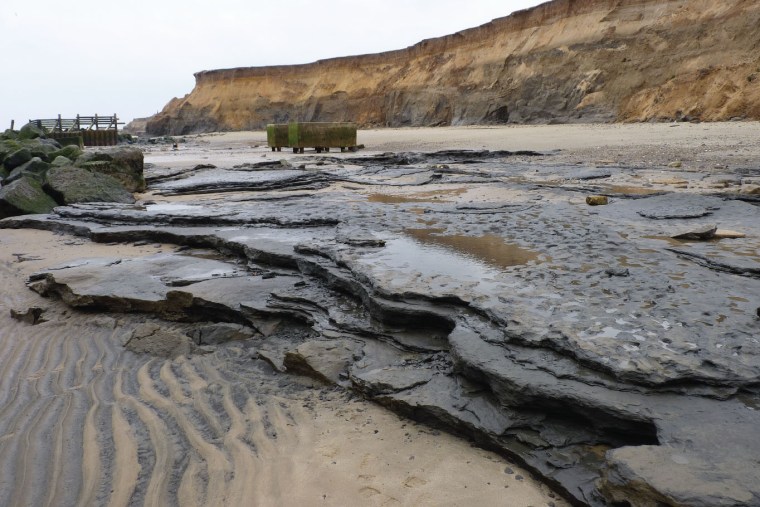
Coastal exposure of Pleistocene laminated sediments at Happisburgh; the top surface exposes the hominin trackway (credit: Ashton et al. 2014 PLOS1)
A team funded by the Pathways to Ancient Britain Project, involving scientists from a consortium of British museums and universities, rapidly conserved a 12 m2 surface of laminated sediments fortuitously exposed on the foreshore at Happisburgh (pronounced ‘Haze-burra’) by winter storms. It was covered in footprints (Ashton, N. and 11 others 2014. Hominin Footprints from Early Pleistocene Deposits at Happisburgh, UK. PLoS ONE v. 9: e88329. doi:10.1371/journal.pone.0088329). Analysis of the prints suggested a band of individuals who had tramped southwards across mudflats at the edge of an estuary. They were possibly members of an early human species, known as Homo antecessor, skeletal remains of whom are known from northern Spain. The Happisburgh individuals were of mixed size, probably including adults and juveniles: three footprint sets suggested 1.6 to 1.73 m stature; nine less than 1.4 m.
View from above of the well-trodden trackway at Happisburgh, with an enlarged example of one of the foot prints (credit: Ashton et al. 2014 PLoS1)
From pollen samples, East Anglia during the interglacial had a cool climate with pine, spruce, birch and alder tree cover with patches of heath and grassland. That it had attracted early humans to travel so far north from the Mediterranean climate where skeletal remains are found, suggests that food resources were at least adequate. It is hard to imagine the band having been seasonal visitors from warmer climes further south. They must have been hardy, and from the stone tools we know they were well equipped and capable of killing sizeable prey animals, bones of which marked by clear cut marks being good evidence for their hunting skills.
Analysis of DNA from ancient humans has revealed its power decisively in the last few years, and especially at the beginning of 2014 with publication of the sixth full genome of an individual who was not an anatomically modern human (Prüfer, K. and 44 others 2014. The complete genome sequence of a Neanderthal from the Altai Mountains. Nature, v. 505, p. 43-49). The newly sequenced material came from a toe bone found in the Denisova Cave in the Altai Mountains of southern Siberia; the same location made famous in 2010 by genetic evidence for unknown late hominins, the Denisovans . The bone occurred in the same layer of cave sediment, dated at 50.3 ka, which yielded the Denisovan finger bone, but from a lower sublayer. So there is no firm evidence that both groups cohabited the cave.
The genome reveals that the individual was female and related to the three Neanderthals from Croatia and another infant Neanderthal from the Caucasus, also analysed previously by Svante Pääbo’s team at the Max Planck Institute for Evolutionary Anthropology in Leipzig, Germany (Note that the toe-bone team also includes co-workers from US, Chinese, Austrian, French and Russian institutions). The closest statistical link is to the Caucasian infant Neanderthal’s DNA. Interestingly, it proved possible to demonstrate that the Siberian Neanderthal woman was from a population that was clearly inbred, her parents having been related at the level of half siblings. Her mtDNA shows that she shared a common ancestor with all 6 Neanderthals from whom mtDNA has been analysed.
Comparing genomes from the single Denisovan, the 5 Neanderthals and living humans from sub-Saharan Africans gives an estimated 550 to 765 ka time of divergence of a population leading to anatomically modern humans from the progenitors of Neanderthals and the Denisovan. The Neanderthal-Denisovan split was roughly 380 ka ago. It was already known that non-African living humans contain genetic evidence for past interbreeding with Neanderthals and that some people in Asia, Australia, Melanesia and the Philippines had acquired genes from Denisovans. More refined comparisons now show Oceanians to have 3 to 6% Denisovan make-up with Asians in general sharing 0.2%. Neanderthal to modern non-African gene flow is now estimated at between 1.5 and 2.1%, with Asians and Native Americans being at the high end. Neanderthals and Denisovans also interbred, but only at the level of about 0.5% inheritance. However, that genetic sharing involved DNA regions known to confer aspects of immunity and sperm function, that also made their way into living non-African humans.
Since the common ancestor of Neanderthals and Denisovans left Africa long before modern humans appeared on the scene it would be expected that living Africans’ genomes would show the same level of similarity with both the now extinct groups, if all three originally shared a common ancestor. A surprising outcome from comparison of Neanderthal and Denisovan genomes with those of living sub-Saharan Africans is that there is a significant bias towards Neanderthal rather than Denisovan comparability. There are three possibilities for this bias. After the Neanderthal-Denisovan split the former group may have continued to interbreed with the group leading to modern Africans (and indeed to modern non-Africans): that would require Neanderthal genetics to have originated in Africa before they migrated to Eurasia. Secondly, the gene flow could have been from the ancestors of modern humans to Neanderthal progenitors, making descendant Neanderthals more like modern humans. Prüfer et al. suggest that the evidence is less supportive of both and weighs towards a third possibility; that the Denisovans interbred with an unknown contemporary hominin, whose genetic make-up was yet more different from that of all three known groups of the late Pleistocene and therefore their common ancestor . This may have been Homo antecessor or possibly H. erectus who survived until as late as 20 ka in SE Asia.
Family tree of the four groups of early humans living in Eurasia 50,000 years ago and the gene flow between the groups due to interbreeding. Image credit: Kay Prüfer et al.
As other commentators on the paper (Birney, E. & Pritchard J.K. 20113. Four makes a party. Nature, v. 505, p. 32-34) have observed, ‘…Eurasia during the late Pleistocene was an interesting place to be a hominin, with individuals of at least four quite diverged groups living, meeting and occasionally having sex.’ All this arises quite convincingly from the genetics of only 7 ancient individuals, to show that it may no longer be appropriate to consider human evolution as a tree or a bush linking permanently separated species. Either it is the history of a single, polymorphic species – remains of 1.7 Ma old Homo georgicus show clear evidence of such polymorphism – or a better metaphor for human development is an interwoven basket or twine. Rumour has it that attempts are being made to sequence an H. antecessor dated at 900 ka from Gran Dolina Cave in the Atapuerca Mountains in Northern Spain: as they say, ‘Watch this space’!
The Sima de los Huesos (‘pit of bones’) site in the cave complex of Atapuerca in northern Spain has yielded one of the greatest assemblages of hominin bones. Well-preserved remains of at least 28 individuals date to the Middle Pleistocene (>300 ka). Anatomically the individuals have many Neanderthal-like features but also show affinities with earlier Homo heidelbergensis, who is widely considered to be the common ancestor for anatomically modern humans and Neanderthals, and perhaps also for the mysterious Denisovans. Most palaeoanthropologists have previously considered this Atapuerca group to be early Neanderthals, divergent from African lineages because they migrated to and became isolated in Europe.
Human cranium from the Sima de los Huesos, Atapuerca mountains (Spain). (credit: Wikipedia)
The riches of the Sima de los Huesos ossuary made it inevitable that attempts would be made to extract DNA that survived in the bones, especially as bear bones from the area had shown that mtDNA can survive more than 4300 ka. There has been an air of expectancy in hominin-evolution circles, and indeed among the wider public, since rumours emerged that the famous Max Planck Institute for Evolutionary Anthropology in Leipzig, Germany had initiated genetic sequencing under the direction of Svante Pääbo: perhaps another ‘scoop’ to add to their reconstructing the first Neanderthal and Denisovan genomes. The news came out in the 5 December 2013 issue of Nature, albeit published on-line (Meyer, M. and 10 others 2013. A mitochondrial genome sequence of a hominin from Sima de los Huesos, Nature, v. 504; doi:10.1038/nature12788) with a discussion by Ewan Callaway (Callaway, E. 2013. Hominin DNA baffles experts Nature, v. 504, p. 16-17).
The bafflement is because the mtDNA from a femur of a 400 ka individual does not match existing Neanderthal data as well as it does that of the Denisovan from Siberia by such a degree that the individual is an early Denisovan not a Neanderthal. Northern Spain being thousands of kilometres further west than the Denisova cave heightens the surprise. Indeed, it may be on a lineage from an earlier hominin that did not give rise to Neanderthals. The full Neanderthal and Denisovan genomes suggest that they shared a common ancestor up to 700 ka ago. So the Sima de los Huesos individual presents several possibilities. It could be a member of an original population of migrants from Africa that occupied wide tracts of Eurasia, eventually to give rise to both Neanderthals and Denisovans. That genetic split may have arisen by the female line carrying it not surviving into populations that became Neanderthals – mtDNA is only present in the eggs of mothers. Mind you, that begs the question of who the Neanderthal females were. Another view is that the Sima de los Huesos individual may be descended from even earlier H. antecessor, whose 800 ka remains occur in a nearby cave. Pääbo’s team have even suggested that Denisovans interbred with a mysterious group: perhaps relics of the earlier H. antecessor colonists.
Established ideas of how humans emerged, based on bones alone and very few individuals to boot, are set to totter and collapse like a house of cards. Interbreeding has been cited three times from DNA data: modern human-Neanderthal; modern human-Denisovan and Denisovan with an unknown population. Will opinion converge on what seems to be obvious, that one repeatedly errant species, albeit with distinct variants, has been involved from far back in the human evolutionary journey? There seems only one avenue to follow for an answer, which is to look for well preserved H. heidelbergensis. H. antecessor and H. erectus remains and apply ever improving techniques of genetic retrieval. Yet there is a chance that stretches of ancient DNA can be teased out of younger fossils.
Whatever controversies still linger about when they arrived in the Americas, there can be little doubt that humans crossed what are now the Bering Straits from NE Asia using the landmass of Beringia exposed by sea-level fall during the last ice age. Of course, there have been controversies too about who they were; probably of East Asian origin but the waters muddied by the celebrated case of 9300 year-old Kennewick Man whose skull bears close resemblance to those of modern Europeans but also to those of the Ainu of northern Japan. Genetic studies of Y-chromosome DNA suggested that all early Americans stemmed from 4 separate colonising populations who may have entered via Beringia by different routes (coastal and across the interior of North America) and at different times. Now, perhaps unsurprisingly, a new kind of data seems set to stir things up immeasurably.
Famous Lacotans of the Dakotas (credit: Wikipedia)
After the triumphs of reconstruction of the Neanderthal and Denisovan genomes and the corollary that both interbred with anatomically modern humans, it was only a matter of time before the palaeogenetics of humans would be pushed back in time. The oldest remains to yield DNA are those of a boy from near Lake Baikal in Siberia excavated by Soviet archaeologists along with a rich trove of cultural remains, including female effigies. Such figurines are rare in Siberia, most being known from western Eurasia. Radiocarbon dating of the bones gave an age of around 24 ka, just before the last glacial maximum. The genetic information, specifically mtDNA and Y-chromosome DNA are potentially revolutionary (Raghavaan and 30 others 2013. Upper Palaeolithic Siberian genome reveals dual ancestry of Native Americans. Nature online doi:10.1038/nature12736).
The mtDNA (passed down the female line) places the individual in haplogroup U, but with little relation to living members with that ‘signature’. Modern haplogroup U is mainly confined to people now living in North Africa, the Middle East, south and central Asia, Europe and western Siberia up to the area where the skeleton was found but rare further to the northeast. The male-specific Y-chromosome DNA is related to haplogroup R widely spread today among men living in western Eurasia, south Asian and in the vicinity of the find. When the data were subject to statistical tests routinely used in distinguishing existing p[populations and lineages within them (principal component analysis) a surprise emerged. The boy plots separately from all living populations but halfway between modern Europeans and the genetic trend of native Americans: i.e. descendants from the population to which he belonged could have evolved towards both extant groups but certainly not to East Asians. Plotted on a map, the degree of shared genetic history of the ice-age south Siberian boy to modern humans shows links westward to Europeans and eastwards to northeastern Siberians and hence to native Americans. Up to 38% of native American ancestry may have originated by gene flow from the population to which the boy belonged, similarly for Europeans as a whole.
The research helps explain traces of European genetic ‘signatures’ in native Americans rather than the commonly held view that this resulted from post-Columbian admixture with European invaders. It also links with the European-looking skulls of a number of early Americans which do not resemble those of East Asians once thought to be their forebears.
The earliest known human fossils outside of Africa were found at a site near Dmanisi in Georgia, between 1991 and 2005, following the discovery there in 1984 of primitive stone tools together with early Pleistocene animal bones. The Dmanisi finds occur with those of sabre-toothed cats and giant cheetahs, and so are probably not interments or in some kind of dwelling but were probably dragged into an underground carnivore den.
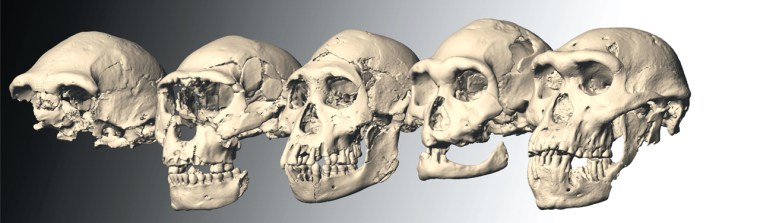
The five Dmanisi skulls of Homo erectus georgicus (credits; M.S. Ponce de Leon & P.E. Zollkofer, University of Zurich)
Initially the remains were assigned to a new species – Homogeorgicus – but are now believed to be a subspecies of H. erectus. The finds are anatomically rich, with fossils of at least 5 individuals, both male and female, including 5 well-preserved skulls. Analysing them has been a long process. Details of the best preserved, indeed the most complete early Homo skull ever found, have taken 8 years since its discovery in 2005 to reach publication (Lordkipanidze, D. et al. 2013. A complete skull from Dmanisi, Georgia, and the evolutionary biology of early Homo. Science, v. 342, p. 326-331, DOI: 10.1126/science.1238484).
To the surprise of palaeoanthropologists, this specimen of Homoerectus georgicus has some ape-like features, including a protruding upper jaw in a relatively large face that most resembles the oldest African H. habilis, from Ethiopia, dated at 2.3 Ma. With a braincase of 546 cm3, the skull is on the small side of H. habilis and in the range of late australopithecines. Yet, like the much younger Homo floresiensis – dubbed ‘the Hobbit’ – the association with tools, of the most basic Oldowan type, places it a cut above non-human hominins. The rest of the skeletal fossils show individuals with modern human proportions, albeit somewhat diminutive.
Surprises multiplied when comparative studies of all 5 skulls were complete. They are so different that, if found in widely separated specimens, would be placed in different species by most anatomists. Ruling out the chance association of several human species far from their Africa origins – few would suggest that up to 5 species left Africa at the same time and stuck together – a suggested explanation is that they represent a population of a human lineage in the process of evolving to a new species. The strength of this hypothesis contradicts the other recent view that several human species may have cohabited environments at different times. It also seems to throw into question the adoption of the name H. erectus for later human populations in both Africa and Eurasia: unless, as the authors tentatively suggest, there was genetic continuity and connectivity over large distances between both evolving populations
One of the oddities of using human genetic material passed down the male (from Y chromosomes) and female lines (from mitochondria) to assess when fully modern humans originated is that they have hitherto given widely different dates: 50 to 115 ka and 150 to 240 ka respectively. Twice to three-times the age for a putative ancestral ‘mother’ compared with such a ‘father’ for humanity raised all kinds of problematic issues for palaeoanthropology, such as a possibly greater ‘turnover’ of lines of descent among males perhaps due to riskier lifestyles. Y-chromosome data limited speculation on the timing of human colonisation outside of Africa to a maximum of 60 ka, even though there is fossil and archaeological evidence for a much earlier presence in the Levant and India. The difference also questions the validity of molecular-clock approaches to evolutionary matters. Two new studies have lessened the phylogenetic strains.
One examines Y chromosomes in 69 males from nine diverse populations from Africa, Eurasia and Central America (Poznik, G.D. and 10 others 2013. Sequencing Y chromosomes resolves discrepancy in time to common ancestors of males versus females. Science, v. 341, p. 562-565). The US-French team applied sophisticated statistics as well as the elements of a molecular clock approach to both Y-chromosome and mitochondrial DNA, discovering in the process a hitherto unresolved feature in the African part of the male ‘tree’. The outcome is a significant revision of both male and female paths of descent: 120 to 156 ka and 99 to 148 ka to the last common ancestor in both lines. The upper limit is somewhat lower than the age of fossil evidence for the earliest anatomically modern humans.
The second study zeros-in on the European story, by examining the Y-chromosome data of 1200 men from Sardinia (Francalacci, P. and 38 others. Low-pass DNA sequencing of 1200 Sardinians reconstructs European Y-chromosome phylogeny. Science, v. 341, p. 565-569) calibrated to some extent by the date when Sardinia was first colonised (7.7 ka). It too revealed new detail that enabled the Italian-US-Spanish team to refine the time when features of Sardinian Y-chromosome DNA would coalesce with those from the rest of the world. In this case the date for a last common paternal ancestor goes back to between 180 to 200 ka, more similar to the old dates for ‘African Eve’ and the earliest modern human fossils than to either that for male or female lines arrived at by Posnik et al. (2013), which are significantly younger.
Map of early migrations of modern humans based on Y chromsome data (credit: Wikipedia)
Equally interesting are the comments on both papers in the Perspectives section of the issue of science in which they appear (Cann, R.L. 2013. Y weigh in again on modern humans. Science, v. 341, p. 465-7).Rebecca Cann of the University of Hawaii Manoa considers the two sets of results from Y-chromosomes potentially capable of refining models for the migration times of modern humans out of Africa and their interactions with the archaic populations that they eventually displaced from Europe and central and southern Asia (Neanderthals, Denisovans and Homo erectusrespectively). She believes that will include signs of earlier excursions that the generally accepted diaspora between roughly 60 and 50 ka seemingly constrained by the previous 50 to 115 ka estimate for the last common paternal ancestor. That would help explain the presence of modern humans in India at the time of the Toba eruption (71 ka).








 Earth-logs